Mail

South Korean mail carrier hailed after rescuing man

The main entrance of the Yeouido Post Office in Seoul on Wednesday. Photo by Hyojoon Jeon / UPI

April 8 (Asia Today) — South Korea’s postal service chief praised a mail carrier who helped save a man injured at the scene of a suspected gas explosion.

The Korea Post said Tuesday that Park In-hwan, head of the postal service, visited the Gunsan Daeya Post Office in North Jeolla Province a day earlier to commend mail carrier Han Sang-geun.

According to the agency, Han was delivering mail in Gunsan in February when he heard a loud explosion and ran toward the scene.

Han found a man in his 60s collapsed at the site and provided emergency assistance while helping with rescue efforts, the postal service said.

Park said he was proud of Han for acting courageously in a dangerous situation to help save a life.

He added that mail carriers serve as watchful figures in communities across the country and can have a positive impact beyond their daily duties.

— Reported by Asia Today; translated by UPI

© Asia Today. Unauthorized reproduction or redistribution prohibited.

Original Korean report: https://www.asiatoday.co.kr/kn/view.php?key=20260408010002584

Source link

California election experts sound alarm as rejected ballots quadruple

As Democratic leaders in California challenge President Trump’s latest effort to restrict the use of mail-in ballots, they also must grapple with a troubling development in the last election.

A significant number of mail-in ballots arrived too late to be counted in the Nov. 4 special election for Proposition 50, Gov. Gavin Newsom’s successful measure to reconfigure the state’s congressional districts, according to state data.

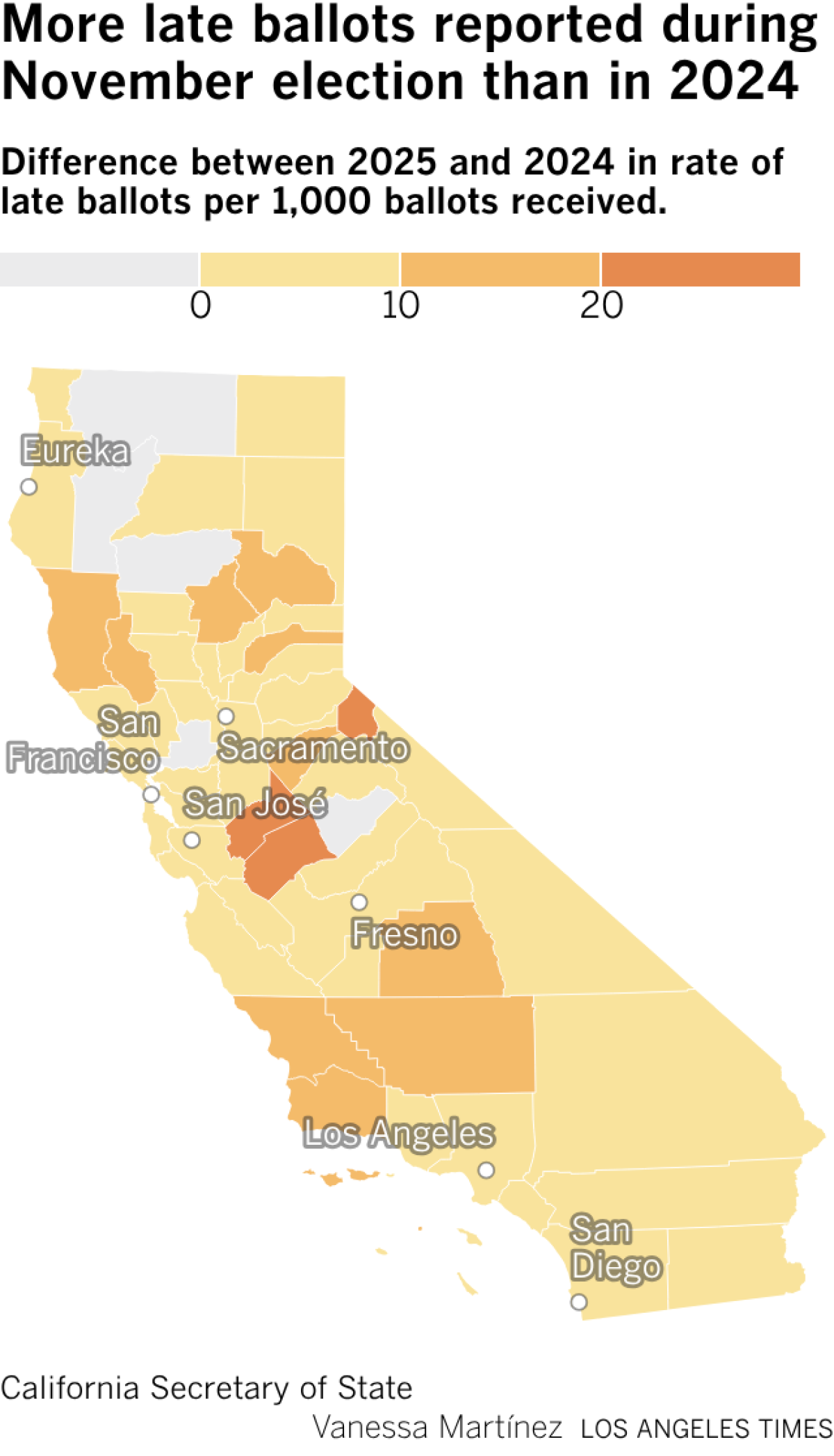
Ballots came in late at an average rate four times higher than that of the 2024 election, with rural counties seeing some of the biggest increases, according to a Times review.

“Something changed,” said Melvin E. Levey, who heads the Merced County Registrar of Voters. “We don’t like seeing late ballots and if someone has made the effort to vote, we want to count it.”

Merced saw almost a sevenfold increase in late-arriving mail ballots in the November election compared with the year before.

Vote-by-mail ballots are considered late if they are not postmarked on or ahead of election day or do not arrive within seven days of election day.

The issue appears to be linked to the U.S. Postal Service, which last year reduced the number of trips to pick up mail at post offices in mostly rural areas. Election officials warned before Nov. 4 that the Postal Service changes could delay the postmarking of ballots and lead to votes not being counted.

During the Nov. 4 election in California, an average of 8 out of every 1,000 vote-by-mail ballots were rejected by counties because they arrived too late, according to Secretary of State data. In the 2024 general election, which included the presidential race, an average of 2 of every 1,000 vote-by-mail ballots were rejected for being late.

In Kern County, for example, 3,303 mail-in ballots — or 1.95% of returned mail-in ballots — were not counted in the 2025 special election because they arrived too late. In 2024, that number was 332 — or 0.14%. And in Riverside County, 5,831 ballots — or 0.95% of those mailed in — were deemed too late to count, more than double the number of late ballots rejected in 2024.

Postal Service spokesperson Cathy Purcell recommended that voters mail their ballot a week in advance of when it must be received by election officials to ensure it arrives on time.

“You should never be mailing your ballot on election day,” Purcell told The Times.

Before last’s year’s special election, California Secretary of State Shirley Weber issued a similar warning about the delays. Anyone dropping off their ballot at a post office on election day should get it postmarked at the counter, she said.

“We don’t want anyone to just toss it into the mailbox as we have been able to do in the past and have it counted,” she said. “The Postal Service has said that they may not be counted in certain areas.”

California voter data expert Paul Mitchell expressed astonishment about the Postal Service’s guidance.

“We’ve had six, eight years of elections where people were feeling confident about mailing in their ballot,” said Mitchell, vice president of the voter data firm Political Data Inc. “Now the USPS is saying they have to mail it in a week early.”

“That is a dramatic change that can disenfranchise voters who are just following the same pattern that they’ve used in prior elections,” he added.

Democrats have been defending the vote-by-mail system in the face of Republican attacks. Trump recently signed an executive order to impose federal restrictions on mail-in ballots and, without evidence, has long criticized mail-in ballots as a source of fraud and a factor in his 2020 election loss to Joe Biden.

The Nov. 4 special election on Proposition 50 was the Democrats’ attempt to counter Trump’s push for Republican-led states, most notably Texas, to redraw their electoral maps to keep Democrats from gaining control of the U.S. House of Representatives in the 2026 midterms and upending his agenda. The ballot measure overwhelmingly passed.

Nearly 89% of votes in the Nov. 4 election were vote-by-mail ballots, according to Weber’s office. In addition to Proposition 50, tax measures were also on the ballots in some counties.

Postal Service changes

About a month before the Nov. 4 election, Weber and Atty. Gen. Rob Bonta held a news conference to encourage California voters to vote early because of service changes at the U.S. Postal Service.

Bonta told reporters that voters living 50 or more miles from six large mail processing centers in urban areas who mailed their ballots on election day would not have those ballots postmarked in time. The centers are in Los Angeles, Bell Gardens, San Diego, Santa Clarita, Richmond and West Sacramento, according to Bonta’s office.

The changes at the U.S. Postal Service are part of a 10-year plan that kicked off several years ago aimed at improving services and reducing costs at the independent federal agency.

In the 17 counties that are mostly or entirely within the 50-mile distance from the mail facilities, the average rate of late ballots doubled in the November 2025 election compared with the election the year before — from 2.5 per 1,000 ballots received in 2024 to 5.6 per 1,000 in 2025.

But in counties that are entirely or mostly outside of the 50-mile radius, the average rate of late ballots quadrupled — from 2 per 1,000 ballots received in 2024 to 9.3 per 1,000 in 2025, state election records show.

Similar complaints about late ballots because of the mail changes have been reported in other states, including in Snohomish County, Wash., according to the New York Times.

The U.S. Postal Services told the Times that there are “any number of factors” that may affect the timeliness of mail.

“The Postal Service has successfully delivered America’s election mail, and we are confident that we will do so again this year,” spokesperson Nikolaj Hagen said. “We rely on long-standing, robust and tested policies and procedures, which have proven successful in the secure and timely delivery of election mail.”

Hagen added that “adjustments to our transportation operations will result in some mailpieces not arriving at our originating processing facilities on the same day that they are mailed.”

Postmarks are generally applied at those processing facilities, Hagen said, so the postmark date may not reflect the date the mail was collected by a letter carrier, dropped off at a retail location, or placed in a collection box.

While the U.S. Postal Service uses postmarking as an internal tool to track the place and date the mail was accepted, outside entities also use the postmarks for their own purposes, including the Internal Revenue Service, which requires federal tax returns to be mailed by April 15.

Several U.S. senators, including Sen. Alex Padilla (D-Calif.), sent a letter in January to USPS Postmaster Gen. Dave Steiner warning that changes to postmarking will make it more difficult for people, particularly those in rural areas, to vote by mail and pay tax bills on time.

On Tuesday, Trump signed an executive order that seeks to put new federal controls on voting by mail in states, repeating his long-held but unsubstantiated claim that mail-in ballots are a source of widespread fraud in U.S. elections.

The order directs the U.S. Postal Service to take control of mail balloting by designing new envelopes with special bar codes that will allow the federal government to ensure that such ballots go out only to eligible voters.

States must follow the USPS process if they plan to use the federal mail system for sending or receiving ballots. They also must submit to the USPS lists of eligible voters in advance of such ballots passing through the mail system.

Separately, the Republican National Committee is challenging a Mississippi law that allows ballots that arrive up to five days after election day to be accepted and counted. The case was argued before the conservative-leaning U.S. Supreme Court in March.

Times staff reporter Kevin Rector contributed to this report.

Source link

Trump signs executive order limiting mail-in ballots; California leaders say they’ll fight

President Trump signed an executive order Tuesday purporting to place new federal controls on voting by mail in states such as California, repeating his long-held but unsubstantiated claim that mail-in ballots are a source of widespread fraud in U.S. elections.

California leaders immediately responded with promises to fight the order in court. They said mail ballots are a safe and secure method for voting relied on by millions of Californians, that Trump’s order infringes on the state’s constitutional right to administer elections as it sees fit, and that it amounts to an “illegal power grab” ahead of midterm elections in which his party is poised to suffer substantial losses.

The order directs the United States Postal Service to take control of mail balloting by designing new envelopes with special bar codes that will allow the federal government to ensure that such ballots go out only to eligible voters, and that only eligible voters return such ballots.

It requires states to submit to the USPS process if they plan to use the federal mail system for sending or receiving ballots, and to submit to the USPS lists of eligible voters in advance of such ballots passing through the mail system.

It also requires the Department of Homeland Security, U.S. Citizenship and Immigration Services, and the Social Security Administration to “compile and transmit to the chief election official of each State a list of individuals confirmed to be United States citizens who will be above the age of 18 at the time of an upcoming Federal election and who maintain a residence in the subject State.”

Those lists will be drawn from federal citizenship and naturalization records, Social Security records and “other relevant Federal databases,” and the USPS will be barred from transmitting ballots that do not match those lists, the order says.

“Secure ballot envelope identifiers provide a reliable, auditable mechanism to enforce Federal law without unduly burdening or infringing on the rights of eligible voters,” the order reads. “Unique ballot envelope identifiers, such as bar codes, enable confirmation that only citizens receive and cast ballots, reducing the risk of fraud and protecting the integrity of Federal elections.”

Trump — who recently voted by mail himself in Florida — framed the order as a solution to “massive cheating” in U.S. elections currently, which he did not back up with evidence.

“The cheating on mail-in voting is legendary. It’s horrible what’s going on,” Trump said.

“He’s going to make sure that mail-in ballots are safe secure and accurate,” said Commerce Secretary Howard Lutnick, who appeared alongside Trump and whose agency the order requires to be involved in the coordination of the new voting measures.

California officials blasted the president for attacking and undermining election integrity, rather than shoring it up, and said they would fight the order from taking effect.

“President Trump’s Executive Order marks a dangerous and unprecedented escalation in his ongoing attacks on our elections. The power to regulate elections belongs to the States and to Congress — he has no role to play. We blocked his previous Executive Order on elections in court, and we are prepared to stop him again,” said California Atty. Gen. Rob Bonta.

“The reality is that President Trump and Congressional Republicans see the writing on the wall — that they are likely to lose in the upcoming midterms — and they are pushing to make it harder for people to vote,” Bonta added. “We won’t stand idly by.”

Sen. Alex Padilla (D-Calif.), in a statement to The Times, said Trump’s actions were “a clear and present threat to our democracy,” that he will “use every tool I can to stop him,” and that he expects “immediate legal challenges in order to protect our free and fair elections.”

“Instead of focusing on lowering the cost of energy, groceries, and health care, Donald Trump is desperately attempting to take over and rig our elections and avoid accountability in November. This executive order is a blatant, unconstitutional abuse of power,” said Padilla, the ranking Democrat on the Senate Committee on Rules and Administration.

“The President and the Department of Homeland Security have no authority to commandeer federal elections or direct the independent Postal Service to undermine mail and absentee voting that nearly 50 million Americans relied on in 2024,” he said. “A decade of lies about election fraud does not change the Constitution.”

“In the middle of an unauthorized war abroad and an escalating authoritarian crackdown by ICE here at home, Trump is attempting another illegal power grab,” Padilla said.

A vast majority of Californians vote by mail. In the state’s 2025 special election on Proposition 50, the state’s mid-decade redistricting measure, nearly 89% of votes were cast by mail, according to California Secretary of State Shirley Weber’s office — or nearly 10.3 million out of about 11.6 million votes cast.

Trump has long criticized mail-in ballots — without evidence — as a source of fraud and a factor in his losing the 2020 election to President Biden, which he still contends was illegitimate.

Election experts, voting rights advocates, local elections officials and other California leaders have all dismissed those claims as unfounded and inaccurate. They have also been preparing for Trump to act to curtail such voting.

Padilla previously warned colleagues that he would force a vote on any effort by Trump to declare a national emergency in order to seize control of this year’s midterm elections from the states, forcing them to either co-sign on the power grab or resist it.

Critics of mail ballots have also been actively working to end or curtail the practice. Just last week, the U.S. Supreme Court heard arguments in a case in which the Republican Party challenged a Mississippi law that allows ballots to be accepted and counted if they arrive up to five days after election day.

During those arguments, the court’s six conservatives sounded ready to rule that federal law requires ballots to be received by election day in order to be counted as legal.

Weber, California’s top elections official, has warned that attacks on mail-in voting risked undermining a system the state has spent years building around universal mail voting.

Trump’s executive order is the latest front in a years-long campaign he has led attacking the integrity of U.S. elections — which has contributed to a steep decline in voter trust in U.S. elections.

On Tuesday, Trump said his order was drafted by “great legal minds,” and will survive any legal challenges unless “rogue” judges rule against it inappropriately.

“We want to have honest voting in our country,” he said.

Rick Hasen, an election law expert and director of the Safeguarding Democracy Project at UCLA Law, argued otherwise in a post Tuesday, noting that an earlier executive order purporting to place new federal controls on elections was blocked in court, and “this one is likely to fare no better.”

“To put this in plain terms: the order would use the USPS, which is not under the direct control of the President, to interfere with a state’s lawful transmission of ballots. If the state does not comply with these rules, federal law would purport to interfere with a state’s conduct of its own elections,” Hasen wrote. “The President does not have the authority to do this.”

Source link

Trump casts Florida mail ballot as he pushes Congress to severely limit that voting option

President Trump has cast another mail ballot in Florida as he continues to publicly bash the voting method as a source of fraud and push Congress to curtail the practice.

Palm Beach County voter records show the president voted by mail in a Tuesday special election for state legislative seats and that his ballot has been counted. Early in-person voting in the contest ran through Sunday, when Trump was still at his south Florida estate.

The White House said Tuesday that Trump’s ire is at states using universal mail-in voting, not individual instances of voters needing accommodations to vote by mail. A spokeswoman pushed back specifically at the idea that his voting practice contradicts his push for new federal voting rules.

“As President Trump has said, the SAVE America Act has commonsense exceptions for Americans to use mail-in ballots for illness, disability, military, or travel — but universal mail-in voting should not be allowed because it’s highly susceptible to fraud,” said White House spokeswoman Olivia Wales in a statement.

A report by the Brookings Institution published in 2025 found that cases of mail voting fraud occurred in only 0.000043% of total mail ballots cast, or about four cases out of every 10 million mail votes.

Wales added: “As everyone knows, the President is a resident of Palm Beach and participates in Florida elections, but he obviously primarily lives at the White House in Washington, D.C. This is a non-story.”

Nonetheless, Trump has in the last week called mail-in voting “cheating” and “corrupt as hell.” He is urging Congress to pass the SAVE Act. The sweeping bill would bar universal mail ballots and, as Wales noted, limit the options to a select few voters such as those with disabilities, military commitments or who are traveling on Election Day. The measure faces steep odds in the closely divided Senate even with the president’s pressure.

Trump has fixated on mail ballots since he began falsely claiming that his 2020 presidential election loss to Democrat Joe Biden was the result of fraud. Multiple U.S. courts and Trump’s own attorney general have found no evidence of fraud that affected the outcome, despite the COVID-19 pandemic increasing the share of the electorate that cast mail ballots that year.

“We’re the only country in the world that does it that way. Corrupt as hell,” Trump said last week at the White House when hosting Irish Prime Minister Micheál Martin.

Dozens of countries, including European democracies that are traditional U.S. allies, use some form of mail-in voting.

Trump said last week that the SAVE Act was the “biggest thing” pending in Washington, even as Congress and administration grapple with the Iran war and a partial shutdown of the Department of Homeland Security.

Last August, Trump used a White House meeting with Ukrainian President Volodymyr Zelensky to blast mail voting.

“We’re going to start with an executive order that’s being written right now by the best lawyers in the country to end mail-in ballots because they’re corrupt,” Trump said. “And it’s time that the Republicans get tough and stop it because the Democrats want it. It’s the only way they can get elected.”

The president, who changed his official personal residence and voter registration from New York to Florida during his first term, does not have a standing vote-by-mail request for all elections, according to the county records. That means he has to request a mail ballot for any individual election.

The ballot today includes Florida state House District 87 and Senate District 14.

Trump offered an endorsement late Monday in the House contest via his Truth Social platform.

“There is a very important Special Election tomorrow, Tuesday, March 24th, for Florida State House District 87 in beautiful Palm Beach County. … TO ALL GREAT PATRIOTS IN FLORIDA STATE HOUSE DISTRICT 87: GET OUT AND VOTE FOR JON MAPLES! Polls are open from 7:00 A.M. to 7:00 P.M.” Trump wrote, without mentioning that he had voted by mail or at all.

The Florida election comes one day after the Supreme Court heard oral arguments in a Mississippi case questioning whether states can count mail-in ballots that are postmarked by Election Day but not received until later. Trump has criticized those allowances in 14 states and the District of Columbia.

Barrow writes for the Associated Press.

Source link

Californians may need to mail ballots early as Supreme Court signals support for new election day deadline

Californians may be forced to put their ballots in the mail well before election day to be certain they will be counted.

That’s the likely outcome of a Republican challenge to mail ballots that came before the Supreme Court on Monday.

The court’s six conservatives sounded ready to rule that federal law requires that ballots must be received by election day if they are to be counted as legal.

In the 19th century, Congress set a national day for federal elections on a Tuesday in early November, but it did not say how or when states would count their ballots. The Constitution leaves it to states to decide the “times, places and manners for holding elections.”

California and 13 other states count mail ballots that were cast before or on election day but arrive a few days late. And most states accept late ballots from members of the military who are stationed overseas.

By law, California counts mail ballots that arrive within seven days of election day. In 2024, more than 406,000 of these late-arriving ballots were counted in California, about 2.5% of the total.

Other Western states — Washington, Oregon, Nevada and Alaska — also count late-arriving mail ballots.

But President Trump has repeatedly claimed that voting by mail leads to fraud, and the Republican National Committee has gone to court to challenge the state laws that allow for counting the legally cast ballots of citizens which are postmarked on time but arrive late.

GOP lawyers argued that the phrase “election day” has always meant ballots must be in the hands of election officials on that day. In their questions and comments, all six conservatives agreed.

Justice Samuel A. Alito Jr. saw a real prospect of fraud. There could be “a big stash of ballots” that arrive late and “flip the outcome,” he said.

Democrats and election law experts say that the proposed new rule conflicts with more than a century of practice, because most states allowed for some people to vote by mail if they were traveling on election day. They argued that election day is like the federal tax day of April 15. While tax returns must be postmarked then, the tax returns are legal even if they arrive at the Internal Revenue Service a few days later.

The GOP filed its challenge in Mississippi, which accepts ballots that arrive up to five days after election day. A district judge rejected the claim, but a 5th Circuit Court panel with three Trump appointees ruled that ballots are illegal if they are not received by election day.

The case before the court is Watson vs. Republican National Committee.

California has been criticized for taking weeks to count all the votes, but that issue was not raised in this case.

Source link

As Supreme Court hears mail ballot case, alarms are raised in far-flung Alaska

The tiny Alaska Native village of Beaver is about 40 minutes — by plane — from the nearest city. Its roughly 50 residents rely on weekday flights for mail and many of their basic supplies, including groceries and Amazon deliveries of everyday household items.

Air service plays an outsize role in the nation’s most expansive state, where most communities rely on flights for year-round access. Planes also play a crucial role in elections, getting voting materials and ballots to and from rural precincts such as Beaver and delivering ballots for thousands of Alaskans who vote by mail — some in places where in-person voting is not available.

The vast distances and relative isolation of so many communities make Alaska unique and are why its residents have a significant interest in arguments taking place Monday before the U.S. Supreme Court.

Many here worry that a case from Mississippi challenging whether ballots received after election day can be counted in federal elections could end Alaska’s practice of accepting late-arriving ballots. Alaska counts ballots if they are postmarked by election day and received within 10 days, or 15 days for overseas voters in general elections.

“These processes have been in place for a long time just to ensure that our ballots are counted,” said Rhonda Pitka, a poll worker and first chief in Beaver, which sits along the Yukon River 110 miles north of Fairbanks.

If the court decides ballots in all states must be received by election day, she said, “they’ll be disenfranchising thousands of people — thousands of people in these rural communities. It’s just basically saying that their votes don’t count, and that’s a real shame.”

The Supreme Court will hear arguments as the U.S. Senate is debating legislation being pushed by President Trump that would require people to show proof of citizenship to register to vote — an onerous burden for many — and a photo ID to cast a ballot.

Most Republicans argue that the bill is necessary to shore up voting integrity, but Democrats and voting rights advocates — and Alaska Republican U.S. Sen. Lisa Murkowski — contend that it amounts to voter suppression. Studies have consistently shown that voting fraud is exceedingly rare in the U.S., and courts have struck down similar measures after finding they prevented eligible voters from casting ballots.

Some ballots already arrive late

Alaska is one of 14 states that allow all mailed ballots postmarked by election day to arrive days or weeks later and be counted, according to the National Conference of State Legislatures and the Voting Rights Lab. An additional 15 provide grace periods for military and overseas ballots.

But Alaska’s geography, weather and great distances between communities — Alaska is more than twice the size of Texas, the nation’s second-largest state — raise the stakes for voters. The unusual way the state counts its votes also makes a grace period important, advocates say.

Under Alaska’s ranked-choice system for general elections, workers in small rural precincts call in voters’ first choices to a regional election office. All ballots, however, ultimately are flown to the state Division of Elections in the capital, Juneau. There, the races not won outright are tabulated to determine a winner.

Even with Alaska’s current 10-day grace period, ballots from some villages in 2022 were not fully counted because of mail delays. They arrived too late for tabulations in Juneau, 15 days after election day.

If the Supreme Court rules that ballots cannot be counted if they arrive at election offices after election day, many Alaska voters could be affected. About 50,000 Alaskans voted by mail in the 2024 presidential election.

“I think there’s probably no other state where this ruling could have a more detrimental impact than ours,” Murkowski, her state’s senior senator, said in an interview.

Murkowski sees the case — a challenge by the Republican National Committee and others to Mississippi’s allowance of late-arriving ballots — as an effort to end voting by mail nationwide.

‘Seeing a level of voter intimidation’

The RNC argues that such grace periods improperly extend elections for federal office, but Mississippi responded that no voting occurs after election day — only the delivery and counting of already completed ballots.

Taken together, Murkowski said, the Trump-backed voting bill and the Supreme Court case could discourage people from voting.

“I think we’re seeing a level of voter intimidation, I’ll just say it,” she said. “I feel very, very strongly that the effort that we should be making at the federal level is to do all that we can to make our elections accessible, fair and transparent for every lawful voter out there.”

Alaska’s other congressional members, Rep. Nick Begich and Sen. Dan Sullivan, both Republican allies of Trump who are seeking reelection this year, support the SAVE America Act now before the Senate. But they also said they want to ensure that ballots properly cast on or before election day get counted.

“We’ll see what the courts choose to do on that issue, but I do think that we need to allow for time for ballots to come in from the rural parts of our state,” Begich said during a recent visit to Juneau.

Alaska officials highlight challenges to the court

A court filing in the Mississippi case by Alaska Atty. Gen. Stephen Cox and Solicitor Gen. Jenna Lorence did not take sides but outlined geographic and logistical challenges to holding elections in Alaska.

In Atqasuk, on Alaska’s North Slope, poll workers counted votes on election night in 2024, tallies they would normally relay by phone to election division officials. But the filing said they could not get through and “chose what they saw as the next best solution — they placed the ballots and tally sheets into a secure package and mailed them to the Division, who did not receive them until nine days later.”

The filing seeks clarity from the Supreme Court, particularly around what it means for ballots to be received by election day.

While it is clear when a ballot is cast, “when certain ballots are actually ‘received’ is open to different interpretations, especially given the connectivity challenges for Alaska’s far-flung boroughs,” Cox and Lorence wrote.

Effect on Alaska Native voters

Lawyers with the Native American Rights Fund and Great Lakes Indigenous Law Center said in filings with the court that limited postal service in rural areas means that some ballots might not be postmarked until they reach Anchorage or Juneau, which can take days.

In the 2022 general election, between 55% and 78% of absentee ballots from the state House districts spanning from the Aleutian Islands up the western coast to the vast North Slope arrived at an election office after election day, they wrote. Statewide, about 20% of all absentee ballots in that election were received after election day.

Requiring ballots to be received by election day, they warned, would “disproportionately disenfranchise” Alaska Native voters. The lawyers represent the National Congress of American Indians, Native Vote Washington and the Alaska Federation of Natives.

Michelle Sparck, director of Get Out the Native Vote, a nonpartisan voting rights advocacy group affiliated with the Alaska Federation of Natives, worries about creating confusion and fear among voters.

She sees the case before the Supreme Court and the Republican SAVE Act as “a multipronged attempt to take control or wrest control of elections away from states.” Alaska, she said, already has enough inherent barriers for many voters.

“There is a minute record of election fraud — not at the rate that requires this heavy-handed response through the legislature and the Supreme Court,” she said.

Bohrer writes for the Associated Press.

Source link