MAGA

Union power vs. MAGA politics in California school superintendent race

The race for California’s next superintendent of public instruction is meant to be nonpartisan. Still, the two candidates — both school board presidents — are pushing decidedly political campaigns, one aligning with liberal Democrats and the other with pro-Trump Republicans as they present dueling visions for how the state’s children should be taught.

Democrat Richard Barrera, the favorite, beat out six other Democrats with his background in union organizing and liberal politics — and with more than $5 million from the California Teachers Assn. Republican Sonja Shaw rode a wave of support from a conservative education movement she helped build alongside MAGA organizations, Christian nationalists and anti-LGBTQ+ groups, while also consolidating mainstream Republicans behind her.

Although Democratic state lawmakers recently stripped many of the powers from the superintendent, the race remains a bellwether for how Californians feel about the public education of about 5.7 million children — as the Trump administration aggressively targets the state over its progressive policies.

Candidates’ disparate visions

Taking the California Democratic Party convention stage in February, Barrera, president of the San Diego Unified Board of Education, gave a quick shout-out to the California Teachers Assn. for backing his bid.

He then promoted his work in San Diego to improve student performance, raise teacher salaries and construct “environmentally sustainable schools built by union workers.” He blasted “downtown Republican business interests” for trying to privatize schools, and President Trump’s immigration policies, which he said terrify many California students who fear losing their undocumented parents.

“It’s time for us to organize, stand up to Trump, abolish ICE and create the schools our students are worthy of,” Barrera said.

Two months later, Shaw, president of the Chino Valley Unified School District Board of Education, introduced herself at an event as a mom and a “fighter” who isn’t afraid to “look the enemy in the eye” because God protects her.

She described her opponents as California liberals who pushed school closures and mask policies during the COVID-19 pandemic and now advocate for the rights of transgender students at the expense of other students.

Shaw said she entered politics inspired by the MAGA-aligned group Moms for Liberty, which campaigns against teaching about ongoing systemic racism, opposes diversity programs as discriminatory and has fought against classroom instruction on sexual orientation and gender identity.

Shaw also described being called a year prior and encouraged to run for superintendent by then-state Assemblymember Bill Essayli, who is now the lead federal prosecutor in Los Angeles and one of Trump’s strongest local allies.

“And I kind of laughed,” she said. “Ha ha. Me? The soccer mom? Really?” She said she told Essayli that she had to talk to God and her family. Essayli urged her to decide quickly.

Despite her humble, “who, me?” persona on the campaign trail, Shaw argues that her message resonates with parents in both parties. Shaw said she would use the superintendent position as a bully pulpit to expand that base beyond party lines and fight what she sees as the state’s failed liberal schooling policies from within. She also would challenge in court the new state law that transferred most of the post’s authority to an appointee of the governor.

Morgan Polikoff, a USC education professor, said that to win, Shaw would have to “dramatically broaden her base, inviting people who aren’t animated primarily by anti-LGBTQ animus to vote for her.”

Barrera, meanwhile, a senior aide to current state Supt. Tony Thurmond, represented the California Department of Education at a recent event held by the statewide LGBTQ+ group Equality California, where school districts were rated on their LGBTQ+ policies and resources. San Diego Unified received a high rating, while Chino Valley did not participate in the voluntary analysis.

Tony Hoang, executive director of Equality California, has described Shaw as a threat to LGBTQ+ students and endorsed Barrera as a candidate who has spent his career “advancing policies that make schools safer and more inclusive.”

Lance Christensen, of the conservative California Policy Center, disagreed. He said Barrera “will continue to be the servant and mouthpiece of the CTA,” while Shaw “represents a return to common sense, or better yet, good sense — because she’s speaking to basic issues of education policy that have been ignored for far too long.”

Barrera acknowledged his primary win over the other Democratic challengers was largely thanks to the CTA, which he said “made all the difference.” But he also credited a “long partnership” with San Diego educators and a record of believing in public education.

Shaw consolidated conservative Republican support in the primary, in which she finished first, with her campaign raising $399,000.

Barrera’s campaign collected $274,000 in primary contributions. Since the primary, Barrera’s campaign has raised at least $340,000, compared with $104,000 for Shaw.

However, it is in independent expenditures — spending by outside groups on behalf of political candidates — that Barrera has the financial leg up on Shaw. Already considered the likely fall winner because he no longer will be splitting the state’s sizable liberal vote with other Democratic candidates, Barrera also has benefited from the CTA’s massive spending covering the cost of mailers, text message campaigns and TV, radio, newspaper and digital ads, among other things.

Shaw: Soccer mom to MAGA warrior

Shaw, a 44-year-old Chino native and mother who has worked in fitness training and photography, said pandemic school closures and mask and vaccine mandates she opposed prompted her to show up to school board meetings, confront officials and challenge school policies in court. “I’m relentless. I don’t let go,” she said.

In November 2022, she was elected to the Chino Valley Unified school board, part of a small wave of evangelical Christians and far-right candidates to win seats across the state that cycle, and quickly became a go-to conservative voice on education issues.

Shaw has sidestepped concerns about immigration agents targeting schools as an issue outside of a school district’s jurisdiction. She also has derided the influence of unions in the education sector. And she lambasted efforts by California Democrats to oppose “school choice,” calling charter schools, homeschooling and other “alternative learning models” critical “lifelines” for families.

Shaw also became laser-focused on LGBTQ+ issues, challenging state laws that allow transgender students to participate in athletics and use school facilities in line with their gender identity. She also fought a state privacy policy that dissuaded school administrators from informing the parents of children who change their gender presentation or pronouns at school, and backed bans on library books with passages deemed sexually obscene. Critics have said the policy targets LGBTQ+ books, which Shaw denied.

Separately, Shaw has rallied her followers online to protest transgender teen athletes, including Jurupa Valley High School track star AB Hernandez. Shaw has showed up at track meets to protest Hernandez’s participation — which Hernandez’s mother has called threatening.

Shaw also has filed federal civil rights complaints on behalf of and helped draft complaints for cisgender high school athletes — including some of Hernandez’s teammates — who, she said, told her they were unhappy with sharing races, podiums and athletic facilities with transgender peers.

Shaw said she did not consult with Essayli on his recent unsuccessful lawsuit challenging the state’s transgender sports policies, which was based on the participation of some of the same high school athletes Shaw has protested. However, she said she would be in touch with federal authorities about such issues were she to win.

“You don’t think I’ll be calling, in my position, to the federal government?” she said. Essayli did not respond to a request for comment.

Barrera: Built by labor

Barrera, a 59-year-old father of grown children and member of the San Diego Unified school board since 2008, has been a union organizer for decades.

He never has been a teacher — nor has Shaw — but said his organizing experience makes him a natural fit as the chosen candidate of the teachers union and other labor groups, where he said he believes “the educator voice comes out most powerfully.”

“For me, the unions are a partner and will always be a core … voice in influencing the way that I make decisions,” he said.

In the 2000s, Barrera served as a regional organizer for the United Domestic Workers and United Healthcare Workers, then helped start the Chula Vista chapter of ACORN, a liberal pro-labor group.

Barrera rejects the assertion that California’s public schools are failing and wants to help “create a different narrative,” that students are “capable of anything” and educators are “capable of bringing out the best in our young people.”

Barrera helped turn the San Diego school board from a conservative-dominated body to a liberal, union-allied one. He once joined a five-day hunger strike in support of hotel workers.

Barrera has long subsidized his school board pay — a stipend of about $20,000 a year plus health benefits — with outside union work. In 2013, he was appointed secretary-treasurer of the San Diego and Imperial Counties Labor Council, earning about $110,000 per year. The council includes the San Diego Unified employee unions, which critics considered a clear conflict of interest because as a school board member, Barrera was on the opposite side of the negotiation table from unions that were helping pay his Labor Council salary.

In 2016, Barrera switched to a lower-profile role as secretary-treasurer of UFCW Local 135, holding the No. 2 position in the San Diego area’s largest private-sector union representing grocery, pharmacy, casino and factory workers but not school employees.

During that period, Barrera’s direct supervisor, Mickey Kasparian, was accused of sexual harassment, which Kasparian denied. Three accusers were paid settlements with no admission of wrongdoing. Barrera was not accused of sexual misconduct but was swept out of office alongside Kasparian in 2018.

The subsequent union leadership, which is still in place, opposes Barrera for superintendent, arguing that he should have taken a stand against Kasparian. Barrera dismissed these criticisms as part of a “decade-old internal union leadership fight.”

In 2021, as officials debated when and how to reopen campuses closed during the pandemic, Barrera was aligned with the local teachers union, and his school board approved a vaccine mandate for all district employees and conditioned the return to in-person instruction on educators having the opportunity to be fully vaccinated.

Today, Barrera is in near lock-step with the CTA when it comes to policy. His only critique is that CTA lobbying in Sacramento should be better connected to ground-level demands, a goal that CTA leadership has been working toward, he said.
Source link

He was called ‘MAGA’s Man’ in Latin America. Now he’s charged with murder

He’s been called the “MAGA man” of Latin America, a brash political provocateur whose social media assaults boosted right-wing campaigns from his native Argentina to Central America.

His career as political consultant and co-founder of an ultra-right online outlet made him a rich man and helped elect Trump-aligned politicians across the region. The Economist gave him the “MAGA Man” label, while political commentators gave him another nickname — the “Steve Bannon of Latin America” — a nod to the longtime Trump ally and advisor.

Now, however, Fernando Cerimedo, 45, sits in a maximum-security prison in Bolivia, accused of masterminding a murder-for-hire plot: The attempted femicide of his pregnant mistress, Nadia Beller, 33, a Bolivian lawyer and activist.

It’s a stunning collapse for a onetime ad man with a dodgy reputation who rose to become the go-to digital campaign guru for Latin America’s ascendant right wing. Cerimedo’s signature boasts, exaggerations and peddling of false election-fraud narratives reflected those of his political model, President Trump.

Cerimedo also is another example of how right-wing political operatives outside the United States — as recently in Colombia and Germany — have adopted Trumpian tactics and messaging.

The fall of the “King Midas of the Latin American right,” said Daniel Matamala, a prominent Chilean journalist, stunned “the ecosystem of fake news, bots, trolls and disinformation that has taken this region by storm in recent years.” Speaking on his podcast, Matamala added, “The name of Cerimedo looms like a ghost over the summit of the radical right.”

The Aug. 17 attack on Beller was a seemingly well-planned ambush that was captured by security cameras, the grainy images widely disseminated on social media.

One of two would-be assassins dressed as fast-food deliverymen pulled out a pistol and shot Beller point blank outside a hotel in the eastern Bolivian city of Santa Cruz. She fell to the ground and, according to her account, feigned death. The next day, at dawn, Cerimedo was arrested as he was about to board a plane to Buenos Aires.

Cerimedo set up the hit, prosecutors charge, in a nefarious attempt at damage control. Beller had threatened to expose his alleged criminal behavior and physically abusive behavior toward her while revealing Cerimedo, a married man with two children, as the father of her unborn child.

Cerimedo is also under investigation for alleged illegal enrichment and potential links to cocaine trafficking.

He has denied any wrongdoing.

Even before Cerimedo’s arrest, Latin American journalists had begun unmasking Cerimedo as a prodigious purveyor of fake news — about himself. New reports revealed that his frequent boasts about U.S. connections — that he attended Harvard, trained with U.S. Navy SEALs, worked in the Obama White House — were fanciful.

“He certainly exaggerated things,” said Damian Merlo, a Miami-based consultant who worked with Cerimedo on the 2023 campaign of Argentine President Javier Milei, a Trump favorite. “I never really got the impression that Cerimedo was ‘MAGA’s man in Latin America.’ The guy could hardly speak English! But that’s how he sold himself.”

Many times, the sales pitch worked. It was Cerimedo who helped broker then-candidate Milei’s celebrated 2023 interview with Tucker Carlson, at the time a Trump confidant, an appearance that thrust Milei into the international spotlight.

Like Milei, Cerimedo seemed to relish any proximity to Trump-land.

In February, at the inaugural “Hispanic Prosperity Gala” — a right-wing pep rally held at Trump’s Mar-a-Lago estate — Cerimedo was honored as “Hispanic Political Consultant of the Year.’” From the podium, he spoke of Latin America’s “culture war” and the need to ensure that “the left never again returns” to governments that have elected conservative leaders.

Switching to heavily accented English, Cerimedo gave a shout-out to Brad Parscale, Trump’s former campaign manager, whom Cerimedo thanked for “believing [in] me all the time and giving me your technology.”

Parscale declined to comment.

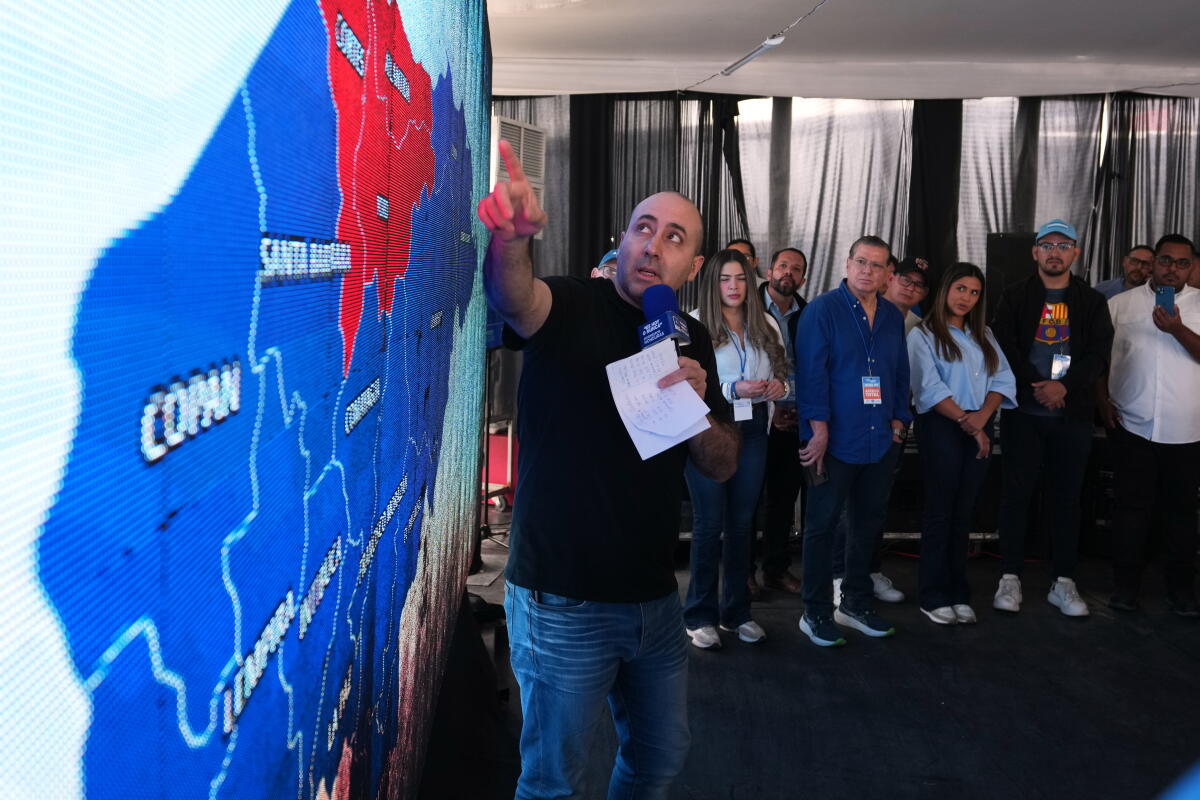
Fernando Cerimedo

Fernando Cerimedo, an advisor to the National Party, points at a map of Honduras on Dec. 1, 2025, one day after voters went to the polls to elect Nasry Asfura president.

(Moises Castillo / Associated Press)

Both Cerimedo and Parscale were involved in last year’s campaign that resulted in the election of Honduran President Nasry Asfura, whom Trump backed publicly.

Last year, Cerimedo was a key player in the election of Bolivian President Rodrigo Paz, the center-right, U.S.-educated son of a former president who transitioned from Marxist firebrand to moderate. The ascension of Paz broke almost two decades of leftist rule by the Movement for Socialism party of ex-President Evo Morales.

Cerimedo had no official capacity in Paz’s government, but he enjoyed insider status. He accompanied Paz in March to Trump’s anti-narco “Shield of the Americas” summit, a confab of mostly conservative leaders at Trump’s Doral resort in south Florida.

Among the items found in searches of Cerimedo-linked properties, authorities say, was a business card listing him as Paz’s “chief adviser” — a nonexistent post.

“Mr. Cerimedo never had the authorization to represent … the presidency, the government or my family,” a deeply discomfited Paz said in Facebook message last month.

How exactly Cerimedo got into politics — and how he became a right-wing rabble-rouser — remains somewhat opaque. According to media accounts, he worked a series of uninspiring jobs — including stints as a taxi driver, a schoolteacher and an employee of insurance and computer firms — before veering into advertising. In 2019, he assisted the campaigns of several leftist Peronist candidates in provincial races in Argentina, and later founded his own consultancy, Numen.

Cerimedo first gained prominence in neighboring Brazil. That’s where he championed false election-fraud narratives following the narrow reelection defeat in 2022 of President Jair Bolsonaro — a MAGA stalwart — in his reelection bid against Luiz Inácio Lula da Silva, a leftist. Cerimedo’s “Brazil Was Stolen” livestream exacerbated the sense of outrage among Bolsonaro loyalists, who took to the streets in mass protests.

The Brazil exposure helped catapult Cerimedo into successful presidential campaigns in Argentina (Milei), Honduras (Asfura) and Bolivia (Paz). His arrest prompted Chilean lawmakers to create a commission to investigate Cerimedo’s possible role in that nation’s recent electoral shift to the right.

With Cerimedo’s name now toxic, Paz, Milei and other former allies have distanced themselves.

Also ditching Cerimedo was his close partner, Javier Negre, a right-wing Spanish media entrepreneur who, in 2024, purchased 50% ownership of Cerimedo’s La Derecha Diario (The Daily Right), an online, Spanish-language MAGA megaphone. The site strongly backed Colombian President Abelardo de la Espriella — who had Trump’s support — during his tight campaign this summer.

Following Cerimedo’s arrest, Negre announced that he had bought out his former partner in La Derecha Diario.

In Bolivia, the Cerimedo scandal has taken on the character of a Latin American telenovela.

A recovering Beller, shot three times in her upper body, granted interviews from her hospital bed, dishing on her lover’s alleged brutality and criminality.

According to Beller’s testimony to authorities, Cerimedo tricked her into the near-fatal rendezvous outside the hotel. He told her that a source was waiting to share details about the purported rape of a 13-year-old, she said. The supposed rapist? Bolivian ex-President Morales — a despised figure on the Latin American right.

The case has seen the once high-flying Cerimedo reduced to a slumping presence in a hoodie as authorities have shuffled the baldish, heavyset figure to hearings and lockups. Last week, he was transferred while awaiting trial to Bolivia’s maximum-security Chonchocoro prison, infamous for its high-altitude, ill-heated confines.

“I want to see my children!” a sobbing Cerimedo declared at one point in earshot of the media.

His legal team has pushed back. A defense lawyer, Margarita Arce, questioned whether Cerimedo had impregnated Beller and asserted to reporters that Beller staged a “self-inflicted attack” to smear Cerimedo and undermine the Bolivian government.

But prosecutors have sided with Beller, who told the Argentine daily Clarín: “Fernando Cerimedo wanted to kill me because I can tell everything that I know.”

Times staff writer Ana Ceballos in Washington and special correspondents Andrés D’Alessandro in Buenos Aires and Cecilia Sánchez Vidal in Mexico City contributed to this report.

Source link

Convicted MAGA election denier declines job in California amid pressure from Newsom

Tina Peters, who served prison time for tampering with voting machines on behalf of the MAGA movement, has declined a job offer helping to oversee elections in a conservative Northern California county.

“She declined the offer because she’s running around the country right now trying to secure the elections,” Clint Curtis, the Shasta County registrar of voters, said in an interview Tuesday. “Shasta County lost out.”

Last month, Curtis set off alarm bells across California by telling reporters he planned to hire Peters, a former county clerk in Colorado who was released early from prison this summer amid a pressure campaign by President Trump.

Curtis, himself a longtime election denier, told The Times he had planned to hire Peters as a consultant “to assist with supervision of the November election.”

Peters’ attorney, Peter Ticktin, said in an interview Tuesday that she had given serious consideration to the job offer but that he had not discussed it with her in recent days. It would “not have been a full-time position,” because she is so busy, he said.

“There’s far more for her to do than get tied up in one county,” Ticktin said. “At this point, she is an American icon. I mean, think about it: How many people meet with the president of the United States in the Oval Office?”

In California, talk of hiring Peters drew swift condemnation from Gov. Gavin Newsom and other Democratic lawmakers who vowed to fight her employment.

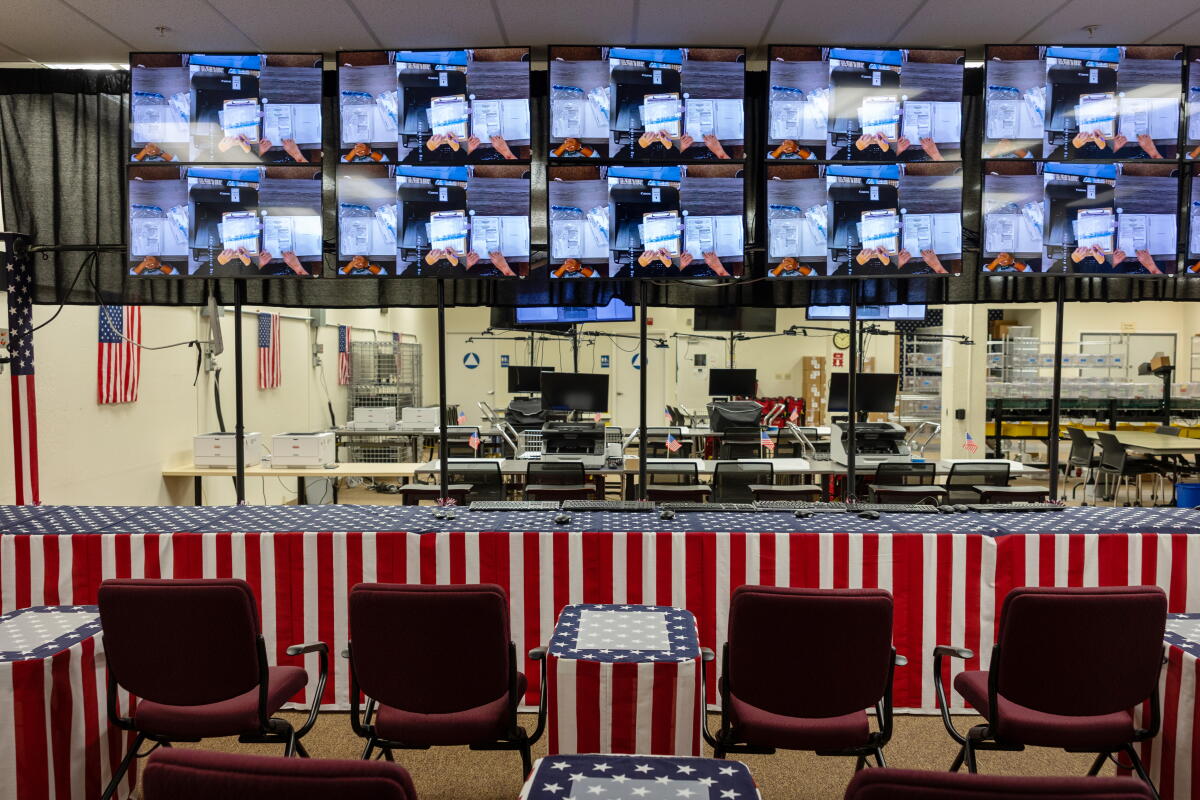
The public observation area at the Shasta County elections office in Redding.

The public observation area installed at the Shasta County elections office in Redding by Clint Curtis, the registrar of voters.

(Jason Armond / Los Angeles Times)

On Monday, Newsom wrote in a sarcastic post on X: “A convicted MAGA election tamperer working in an elections office. What could possibly go wrong?”

He added, in all caps: “TINA, NOT IN CALIFORNIA! ELECTION DENIER FELONS NOT WELCOME HERE!!!”

In a separate social media post, the governor’s press office called the job offer “a disgrace” and said Newsom had directed corrections officials to “make every effort” to reject transfer of her parole supervision into the state.

Peters is not supposed to leave Colorado without permission from her parole officer, although she did visit Trump at the White House.

Curtis called the governor “crazy” and said he was amused that Newsom — who has advocated for prison reform and rehabilitation for criminals — was focused on Peters’ felony conviction.

“California is kind of a second-chance state,” Curtis said. “Except for Tina Peters. No second chance for her in Shasta County.”

Peters, the former clerk in Mesa County, Colo., was convicted in 2024 and sentenced to nine years behind bars for breaching her county’s voting machines as part of a scheme to show that the 2020 election was rigged against Trump, a claim that has been repeatedly debunked in court.

She was found guilty of helping an associate of MAGA conspiracy theorist and MyPillow founder Mike Lindell gain unauthorized access to Mesa County’s Dominion election equipment in 2021 and make copies of its hard drive before and after a software upgrade.

After months of haranguing from Trump, Colorado Gov. Jared Polis, a Democrat, commuted Peters’ sentence. She was released in June after serving less than a quarter of the nine years.

In interviews with right-wing media, Curtis said Peters essentially would do the job of assistant registrar but would be brought on as a consultant to get around the county’s slow hiring process.

Brent Turner, the Shasta County assistant registrar, said his job was not open because he had not quit. He told The Times on Tuesday that he was happy Peters had declined his boss’ offer.

A man stands in an doorway near a sign: "Live election ballots present - please keep this door closed at all times."

Shasta County Registrar Clint Curtis stands in the election counting area on Feb. 25 in Redding.

(Jason Armond / Los Angeles Times)

“I’m glad that Gavin is paying attention,” said Turner, a Democrat from San Francisco and a longtime election reform activist who has pushed for non-proprietary open-source voting systems with software code that can be examined by anyone.

Curtis handpicked Turner as his assistant last year.

Last month, Curtis told the hosts of “Jefferson State of Mine,” a radio show by leaders of the State of Jefferson secession movement, that Turner “got sick on me” and that he was hoping his assistant would “just, like, retire on June 2 and go away and let me fill [the position], but he didn’t.”

Turner, who is on medical leave, said he had not given Curtis permission to speak publicly about his health and that he had not spoken to his boss since Curtis began talking about hiring Peters.

“It’s been aggravating and unfortunate,” Turner said. “But we’re undaunted, as election officials and workers. And the fact is, there’s work to be done now, so the sooner we put this behind us, the better.”

Curtis was appointed by the Shasta County Board of Supervisors last year after two previous registrars resigned. He will be out of office in January after losing the June primary to Joanna Francescut, a longtime assistant registrar whom he had fired.

Curtis has sequestered primary ballots in a room in the elections office in Redding, sealing the doors with locks and duct tape and telling reporters that the ballots did not look, feel or smell right.

Both Curtis and county officials — who have condemned his actions — have asked the FBI and other authorities to investigate.

Source link

Why Catholic voters must lead Americans in rebuking MAGA in the midterms

Though I don’t regularly attend Mass, I fondly remember the two years in high school when I prepared for the sacrament of Communion.

In the basement of St. Boniface Church in Anaheim on weekday afternoons and weekend mornings in the mid-1990s, my sister, about 20 other teenagers and I learned about the tenets of our faith.

We were inculcated with the importance of charity, love toward all, good works and humility, and urged to carry those virtues into adulthood. I didn’t agree with everything our lay teachers espoused — why abortion should be outlawed, why necking was bad, why only men could become priests — but I learned enough important moral lessons that I still proudly call myself Catholic.

Confirmation is meant to bring recipients closer to God and “imprints on the soul an indelible spiritual mark,” according to the Vatican’s official guide to its doctrine. What especially stayed with my classmates and me was, well, us.

We were white, Filipino, Vietnamese and Latino, children of working-class parents and equals in the eyes of God. Church fairs were as likely to serve pancit and spring rolls as hamburgers and tacos. When we finally received confirmation at a special Mass at St. Boniface attended by then-Bishop Norman McFarland, we exemplified not just the future of the church but also the promise of a better tomorrow for the United States.

Our parish lived and practiced American Catholicism’s long tradition of welcoming the stranger, the outcast, the refugee — following the example and words of the Gospel we read every Sunday. But even as we committed ourselves to the path of Christ, politicians in California waged a war against illegal immigrants and anything that suggested diversity — a xenophobia that would culminate decades later with President Trump’s election.

Trump is a walking manifestation of the seven deadly sins, to the point that he has depicted himself as Jesus and a pope on social media. Nevertheless, a majority of Catholics — thankfully no one in my immediate family — voted for him in each of his three presidential elections, with support topping out at 55% in 2024, per the Pew Research Center.

Catholics were a key constituency in every sector Trump needed for his historic victory against Kamala Harris. Swing states with old-line communities like Wisconsin and Pennsylvania. Boom states like Nevada and Florida. And especially Latinos, who voted for Trump in numbers never before seen for a Republican presidential candidate. Latino Catholics went even harder for Trump: The Public Religion Research Institute found their support for him increased by 17 percentage points from 2016 to 2024, even as his white Catholic support dropped from 64% to 59%.

Issues from abortion to the economy to transgender rights spurred Catholics to side with Trump, but his hard-line stance against immigration was especially popular. As immigrant Catholics were being demonized, echoing previous eras of American history, too many Catholics sided with the demonizers.

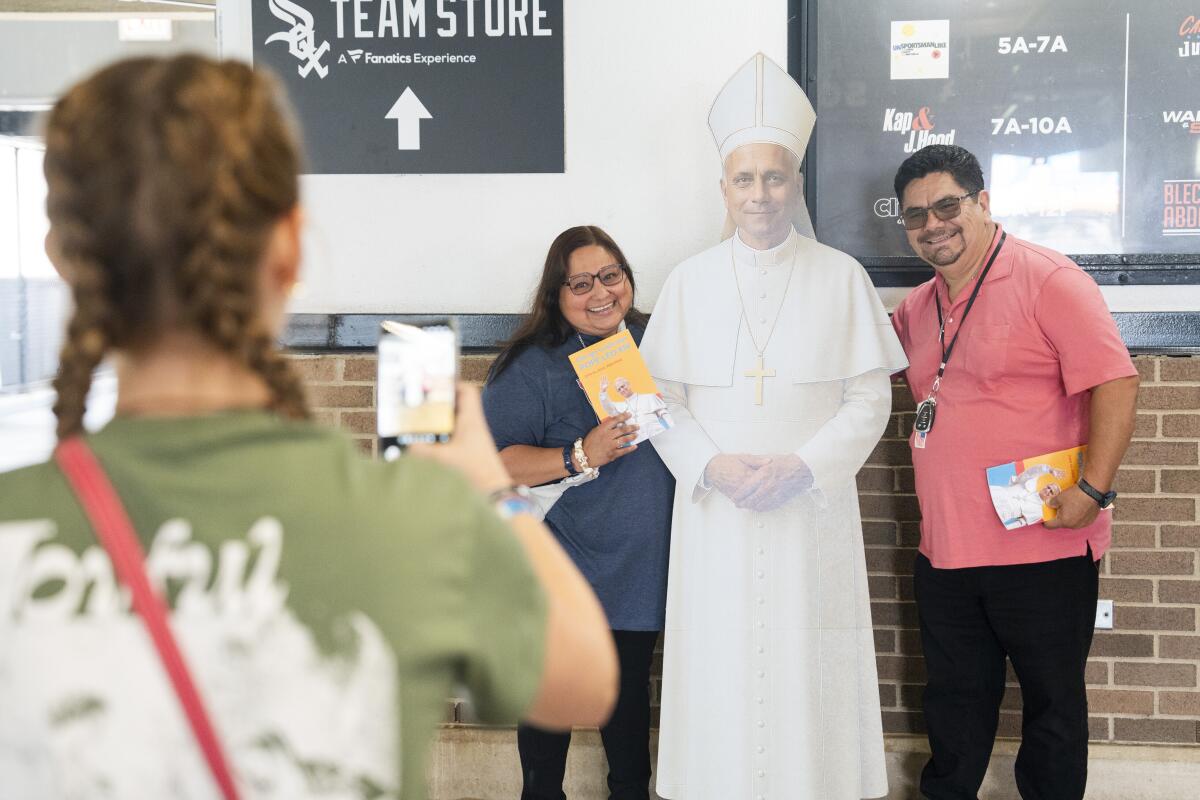
A person uses a phone to take a photo of a woman and a man flanking a cutout of a religious-garbed person.

Maria Marin and her husband, Martin Marin, pose with a cardboard cutout of Pope Leo XIV during the Archdiocese of Chicago’s celebration of Leo at Rate Field on June 14, 2025.

(Pat Nabong/Chicago Sun-Times via Associated Press)

A June 2024 survey by Georgetown’s Center for Applied Research in the Apostolate, which tracks American Catholic life, showed that 43% of respondents supported lower levels of immigration. A month into Trump’s second term, 41% of American Catholics thought that increased immigration in recent years had changed the U.S. “for the worse,” compared with 33% who felt it made life better, according to a Pew Research Center poll.

In the lead-up to the 2024 election, I argued about the dignity of Venezuelan and Salvadoran migrants with people from my parents’ native ranchos in Mexico, who came to this country without papers and are regular churchgoers. I sighed in disappointment as former confirmation classmates whose refugee parents fled tyrannical rulers, just like the Holy Family, posted approvingly on social media about Trump’s vow to build a bigger, nastier border wall.

Catholics have frequently exemplified the best and worst tendencies of American society. We’ve been brutal conquistadors and the huddled masses yearning to be free, trailblazing politicians and the millions who stood silently during our church’s sex abuse scandals. Trump’s support among Catholics represented a new low. But by some miracle of God, more and more of those supporters are finally seeing him for who he is.

On Aug. 12 — the feast day of Jane Frances de Chantal, the patron saint of forgotten people — the Public Religion Research Institute released a survey showing that 62% of Catholics think unfavorably of Trump, while 57% oppose his handling of immigration, both legal and illegal. If this repentance transforms into votes against MAGA in the midterms, the rest of Trump’s presidency is doomed.

The poll offers no insight into why Catholic support for Trump has cratered. The easy explanation would be the president’s enmity toward Pope Leo XIV, who has preached a gospel of kindness toward the undocumented and spoken out against the quagmire in Iran. When the Trump administration invited the native-born Chicagoan to visit the U.S. for America’s 250th anniversary, Leo instead decided to spend his Fourth of July on Lampedusa, the Ellis Island of the Mediterranean.

But the poll noted that Leo’s predecessor, Pope Francis, had higher favorability ratings among American Catholics during the same time in their respective reigns — 90% to Leo’s 75%.

Trump’s popularity is also collapsing among Americans as a whole. Only about a third support him, according to an a recent Reuters/Ipsos poll — the poorest showing of his second term, matching the lowest numbers of his first term. But for Catholics, it’s not just high prices, the Iran War and Trump’s drift toward despotism that makes him so onerous.

The Catholics in his government, from Supreme Court justices to Cabinet members to Vice President JD Vance, are acting as a rubber stamp for an imperious ruler, instead of imitations of Christ. Trump’s immigration sweeps are hitting American Catholicism so hard that bishops have allowed the faithful to stay home instead of attending Mass.

What reason is there left for good Catholics to support Trump? If ever a group needed to break away from him, it’s us.

What’s been especially galling about Trump’s second term, from a Catholic perspective, is his gleeful cruelty.

Proverbs 21:13 states, “Whoever closes his ear to the cry of the poor will himself call out and not be answered.” Conservatives who have criticized Pope Leo for taking on Trump over his nastiness toward the meek don’t get that his motive isn’t political — this has been standard Vatican doctrine going back to his namesake, Leo XIII. In an influential 1891 encyclical urging the world to stand by the working class, Leo XIII pointed out that sacrificing oneself “for the benefit of others, is man’s surest antidote against the insolence of the world and immoderate love of self.”

Is there any statement more contrary to MAGA than that?

Four men in black religious clothes.

Cardinals Robert McElroy, Christophe Pierre and Joseph Tobin and Archbishop Bernard Hebda speak to reporters after a Mass in solidarity with migrants at the Chapel of St. Thomas Aquinas on Feb. 27, 2026, in St. Paul, Minn.

(Mark Vancleave/Associated Press)

The Catholics who supported Trump may have forgotten Leo XIII’s words as they repeatedly voted for him. But that’s the beauty of our faith. We can admit our errors and seek to right them through another sacrament — confession.

“Through such an admission man looks squarely at the sins he is guilty of,” reads the catechism of the Catholic Church. That way, people can “take responsibility” for their faults and reconcile with God “in order to make a new future possible.” And the way to do that is by “doing something more to make amends for the sin.”

Catholics are supposed to confess our sins privately. But we must repent of Trump publicly and loudly at the ballot box this November and urge others to follow.

We helped usher in Trump. We must now lead in exorcising him from American society once and for all.

Source link