Why reported challenges with touchscreen voting machines don’t signal election rigging
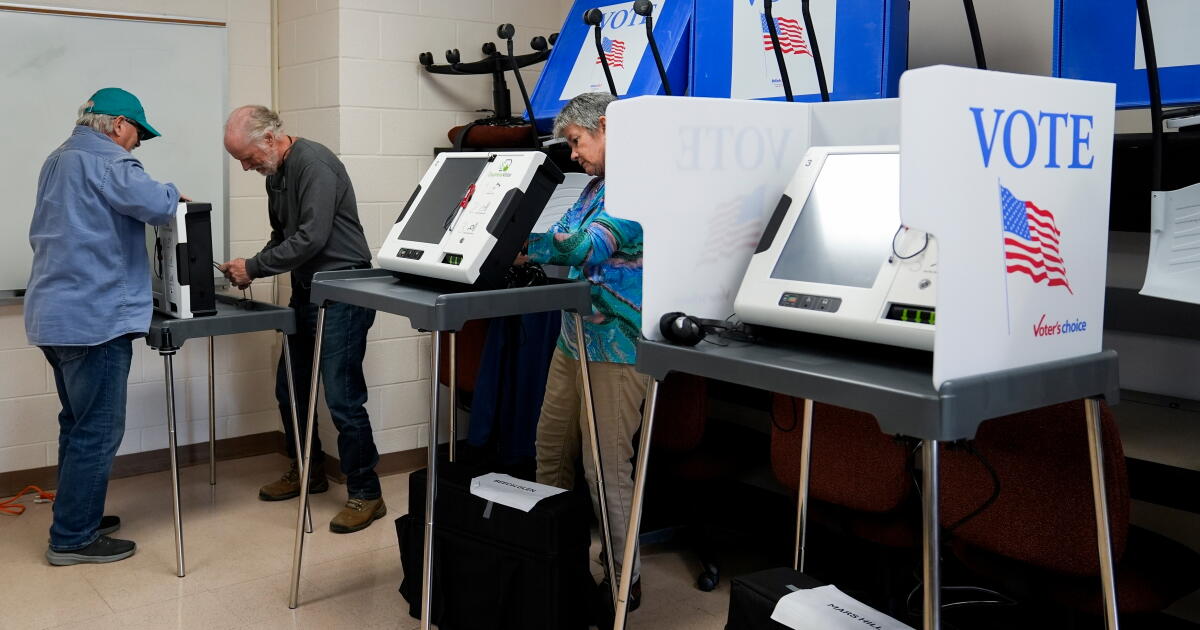
NEW YORK — The reports erupt on social media every election year: Voters say they tapped a candidate’s name on a touchscreen voting machine, only for the wrong person to light up as their selection.
With some trial and error, and occasionally help from poll workers, the voters are generally able to cast their intended ballots. Nevertheless, some come away from the experience assuming the worst — that the anecdotal issues are proof of a partisan election-rigging scheme.
As early voting in November’s midterm elections gets underway in most states, with soaring turnout in many of them, the claims have returned in force, with voters — especially Democratic ones — in Kansas, Ohio, South Carolina, Tennessee and Texas documenting difficulties with the ballot marking devices.
Many voters have described their experiences on social media, with some falsely interpreting the troubles as attempts at election tampering to favor Republicans. The claims come as an AP-NORC poll shows many Democrats have lost trust in election results over the last four years, with many seeing the president interfering with the vote as a major concern.
Election officials say the touchscreen challenges are almost always the result of user error or an easily fixed screen miscalibration, and say the number of complaints this year isn’t higher than it has been in years past, despite the outsized attention on social media. They emphasize that voters can select a candidate as many times as needed, consult a poll worker for help and review selections before submitting their ballot.
Elections in the U.S. are decentralized, with thousands of election jurisdictions controlling the vote, each with different rules set by state and sometimes local governments. That structure makes the nation’s voting process extraordinarily complicated. It also shields it from widespread fraud.
“Almost all of the claims of vote flipping are understandable human error,” said David Becker, executive director of the Center for Election Innovation and Research, who noted disinformation purveyors often seize on well-meaning concerns to sow doubt in the voting process. “Is there one of us who hasn’t had a butt dial or mistyped something on our phones? It is not nefarious.”
Many voters, including Dolly Parton’s sister, report issues
The complaints about touchscreen machines switching votes have gathered tens of thousands of likes, shares and views on social media in recent days, popping up in various high-population areas across the country, including Tennessee’s Williamson and Davidson counties, homes to Franklin and Nashville.
Stella Parton, the sister of the late country singer Dolly Parton, wrote in a Facebook post on Wednesday that at her polling place near Nashville she had to “go back three times and correct my vote” because it kept defaulting to Republican Sen. Marsha Blackburn.
She added: “I’m putting this out here because when we vote, we take it seriously but we try not to hold up the long lines. Do it anyway. Don’t let them rig this election.”
Chad Gray, election administrator in Williamson County, said officials there had found no discrepancies in the voting equipment. If problems or questions do arise, he said, people from each party will examine the devices and make sure they are working properly.
Tennessee Elections Coordinator Mark Goins told WSMV in Nashville that the issues reported in his area were “not a vote-flipping situation.” “It’s more like an unintended touch that they may not even realize,” Goins said.
Another Facebook user explained in a video that when his mother-in-law attempted to vote for Democratic candidates in Kendall County, Texas, the machine kept selecting Republicans. He said she was ultimately able to vote as desired and contended that it could have been user error, but still concluded people were “jacking with our elections.”
Staci Decker, elections administrator in Kendall County, said “100% of the time” the issue can be attributed to a voter tapping the wrong part of the box onscreen or from voters tapping the screen too hard, causing it to become miscalibrated. She said her policy is for staff to recalibrate the screens every few days to ensure the accuracy of the touchscreen.
“This is part of an attempt at every election (especially the bigger ones) to scare voters away,” Decker said in an email. “Every single piece of equipment used in our election is tested before it can be used in an election.”
Reports of voting machine errors common during high-turnout elections
In South Carolina, where an X user said a machine made it hard for her to vote for Democratic Senate nominee Annie Andrews, state election officials haven’t seen any unusual increase in reports of voters having trouble making selections, said Sydni Bain, a spokesperson with the state’s election commission.
“We commonly receive some of these reports during elections, particularly statewide elections with high turnout,” she said. “We encourage all voters to be careful in making their selections and to review their ballot before it is cast.”
In Bexar County, Texas, where an X user reported having to tap the screen forcefully to get the machine to register her choice of Democrat James Talarico instead of Republican Ken Paxton for Senate, election officials said they couldn’t confirm any equipment issues.
“This could possibly be user error,” said John Moreno, the county’s assistant public information officer. “If a voter has concerns about their ballot, they should bring it to the attention of the on-site judge.”
Kristin Miles, president of the Texas Assn. of County Election Officials and election administrator in Bastrop County, said “vote-switching” claims come up every election cycle.
“Nearly every case comes back to the screen calibration on older touchscreen machines, not a change to anyone’s vote,” she said.
Officials emphasized that machines are tested before each election and that in most jurisdictions, there is a postelection audit that consists of a manual hand count of a sample of paper ballots.
Voting machine company explains what to do if you encounter problems
Voters across the country cast ballots in various ways, including with ballot marking devices that print a paper record or with paper ballots they fill out by hand.
The counties where most of the recent vote-flipping social media reports are concentrated use ExpressVote ballot marking devices from a company called Election Systems & Software. The machines let voters make their selections on a touchscreen. Then, a paper record is typically printed for review before the votes are tabulated.
Katina Granger, senior manager of public relations for the Nebraska-based ES&S, said the company works closely with election officials and provides technical support when needed but has not been made aware of any widespread issue with voting machines this cycle.
She said when a voter is having difficulty, they should ask a poll worker for assistance. If they’ve already printed a ballot that doesn’t reflect their intended selections, “they should notify a poll worker rather than cast it so the jurisdiction can follow its procedures for replacing the ballot.”
Swenson and Goldin write for the Associated Press. AP writers Anna Wilder in Austin, Texas, and video journalist Kristin M. Hall in Nashville contributed to this report.