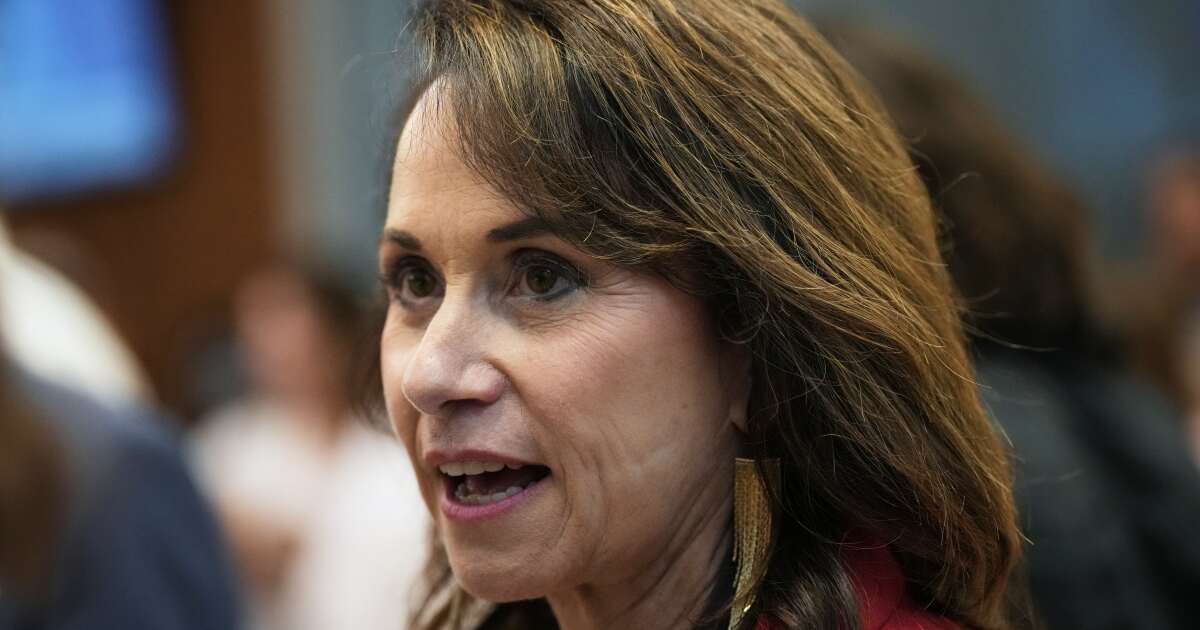
A grand jury indicts Louisiana’s attorney general in a fight over changes to New Orleans courts
NEW ORLEANS — Louisiana’s attorney general has been indicted over accusations she threatened the jobs of New Orleans leaders who fought a Republican-led overhaul of local courts in the heavily Democratic city.
The 16-count indictment against Republican Liz Murrill, handed up Thursday by a New Orleans grand jury, charges Louisiana’s first female attorney general with intimidation and malfeasance.
At the center of the case are deepening rifts between state leaders in Louisiana, which is heavily Republican, and Democrats who control the state’s most prominent city.
Republican Gov. Jeff Landry promised a swift pardon, saying Murrill would not have her reputation tarnished by an “Orleans kangaroo court.” Mayor Helena Moreno, a Democrat, was among those who had accused the state’s top law enforcement official in May of making threats against public officials.
Murrill called the case against her “retaliatory, meritless, and unconstitutional.” Late Thursday, Murrill said she had filed for an emergency stay with the Louisiana Supreme Court.
“I will not back down. I will continue enforcing the law, fighting corruption, and doing the job the people of Louisiana elected me to do,” she wrote on X.
For months, political tensions intensified between Louisiana Republicans and New Orleans officials over a new law that abolished a court clerk office won by an exoneree, Calvin Duncan, who spent nearly three decades in prison. The change consolidated that job with another clerk’s office, which Republican supporters said would make the local judicial system more efficient.
The change was staunchly opposed by New Orleans leaders, and in May, the City Council set a special election that would have given Duncan a chance to win the newly combined job. Murrill responded by warning local officials in letters that they could lose their offices for violating state “usurper” laws, which forbid support for an unauthorized officeholder.
“We’re very interested in elected officials in New Orleans not being intimidated or threatened by letter or any other way,” special prosecutor Laurie White told reporters.
Bond for Murrill was set at $400,000 on Thursday, according to court records.
Landry said he was ordering state police to investigate what he called “alleged improprieties” of the grand jury and those who ran it.
“The criminal justice system is a circus at its finest in Orleans and we will not have any of that!” he wrote on X.
The Republican Attorneys General Assn. said that making statements to local officials — in writing — was simply “issuing a legal opinion and warning public officials about the law” as part of her official duties. It called the indictment “as outrageous as it is dangerous.”
Moreno, who was elected in January and was defiant after Murrill sent the letters, on Thursday called it a “matter for the courts” and did not directly address the allegations.
“My focus, as always, remains on fulfilling the responsibilities the people of New Orleans elected me to carry out,” Moreno said.
Duncan has said he believes state officials were retaliating against him in eliminating the job he won with 68% of the vote. Murrill and Landry have long refused to acknowledge his innocence, though he’s listed on the National Registry of Exonerations.
Republicans have said the change was not personal and supporters have noted that the offices of criminal and civil clerks of courts are combined in other parishes.
Duncan was a jailhouse lawyer who later graduated from law school. He founded a nonprofit dedicated to expanding incarcerated people’s access to the court system and was the driving force behind a 2020 U.S. Supreme Court decision that ended nonunanimous jury convictions.
Duncan spent more than 28 years in prison over a fatal shooting during a robbery in 1981.
The night before a 2011 hearing to consider new evidence, prosecutors offered to reduce Duncan’s sentence to the time he’d already served in prison if he pleaded guilty to manslaughter and armed robbery. Duncan took the deal and was freed but didn’t give up on clearing his name.
In 2021, a judge agreed that Duncan had been unjustly convicted and vacated his sentence altogether. Landry and Murrill have pointed to the 2011 plea deal in objecting to Duncan calling himself exonerated.
Riddle and Hanna write for the Associated Press. Associated Press reporter Jack Brook in New Orleans contributed.