NBA star marks comeback after nine weeks as Houston Rockets beat Golden State Warriors 117-116 in San Francisco.
By Reuters and The Associated Press
Published On 6 Apr 20266 Apr 2026
Stephen Curry marked his return from a two-month absence with 29 points but ended up on the losing side as the Houston Rockets edged the Golden State Warriors 117-116 in San Francisco.
The Rockets’ Alperen Sengun capped a 24-point performance with a go-ahead interior hoop with 11.1 seconds remaining, sealing his team’s victory on Sunday night.
Recommended Stories
list of 4 itemsend of list
In his first return to San Francisco as a member of the Rockets, former Warriors star Kevin Durant poured in a game-high 31 points for Houston (49-29).
Durant also found time for a team-high eight assists and eight rebounds, one shy of Smith’s nine for team honours in both categories.
The Rockets have now moved within one game of the Los Angeles Lakers and Denver Nuggets in their three-team duel for third place in the Western Conference.
Brandin Podziemski backed Curry with 18 points for the Warriors (36-42), who have virtually assured themselves of the 10th seed in the Western play-in tournament.
Sengun’s four-footer from the middle of the key came after Golden State used a 17-6 burst to overtake the visitors on a Gary Payton II layup with 19.6 seconds remaining.
Golden State had a shot after Sengun’s hoop, but Curry misfired under heavy pressure from 30 feet, capping a 5-for-10 effort from three-point range.
Jabari Smith Jr had 23 points, Amen Thompson 18 and Reed Sheppard 11 for the Rockets, who won their sixth straight game.
Alperen Sengun led the Houston Rockets’ offence against the Golden State Warriors [Noah Graham/Getty Images via AFP]
Curry, who had missed 27 straight games since a January 30 injury against Detroit, played 26 minutes, during which he hit 11 of his 21 shots.
Coming off the bench in the regular season for the first time in 14 years, Curry was greeted by a warm standing ovation and greetings on the big screen when he entered with 4:54 left in the opening quarter.
“He’s one of the most beloved players in league history, Bay Area history in any sport, and I think a long absence like this reminds everybody how lucky we are to see him, to watch him, to coach him, to play with him,” Warriors coach Steve Kerr said. “So tonight’s a special night because we’re reminded of how lucky we’ve been and how lucky we still are.”
Kerr said before the game that it is still unclear how many of the remaining games Curry will play, given Golden State have five contests in eight days with a back-to-back the rest of the way – and the expectation is he would not play on consecutive nights.
“We’re going to manage it accordingly. The plan for tonight would be shorter bursts, and we’ll see on the minutes,” Kerr said. “But first game back, he’s not playing 48 minutes.”
Kim Paul, executive director of the Piikani Lodge Health Institute, a nonprofit on the Blackfeet Reservation that promotes health and well-being, saw the email notification flash across her computer screen as she was working late one day recently.
It was the U.S. Department of Agriculture saying a nearly $9-million grant contract with Piikani Lodge had been terminated.
“The U.S. Department of Agriculture has determined that awards under this program involved discriminatory preferences based on Diversity, Equity and Inclusion and wasteful spending that did little to further lawful agricultural land purchases,” the USDA wrote.
Paul was stunned. Piikani Lodge had planned to use the grant to improve operations for Native and non-Native farmers and ranchers in the Montana region. The nonprofit had already separately acquired 600 acres on the Blackfeet Reservation and planned to use the USDA funds to build a training hub for food producers and support about 300 farmers and ranchers in Glacier and Pondera counties.
Paul said she became short of breath when she saw the email. She dreaded sharing the news with her team.
“It was horror,” she said. “The horror of losing stability for our community.”
Funded through the Biden-era American Rescue Plan Act of 2021, the Increasing Land, Capital and Market Access Program was designed to support “underserved” farmers and ranchers. It awarded about $300 million to 50 grantees in 2023. Forty-nine of those grants were terminated last month.
At least two additional projects in Montana were affected by the cancellations: a Chippewa Cree Tribe project to purchase land and train young farmers and ranchers how to manage it; and one run by South Dakota-based Four Bands Community Fund that would have trained and financially supported at least 25 low-income agricultural producers in North Dakota, South Dakota, Wyoming and Montana.
Montana-based awardees called the terminations “devastating.” They also say the grant cancellations were based on a false presumption that tribal initiatives fall under the Diversity, Equity and Inclusion — DEI — rubric, and that USDA claims of wasteful spending are baseless.
Asked for comment, a USDA spokesperson said in a statement Thursday that the agency “has worked to clean up the mess left for us by the last Administration. To no surprise, a peek behind the curtain of this Biden-era program revealed the egregious misuse of taxpayer dollars.”
Piikani Lodge Health Institute leaders say they will have to restructure budgets and reconfigure staffing to keep some semblance of their project going. The Chippewa Cree Tribal project may be halted altogether. Four Bands Community Fund did not respond to an interview request by publication deadline. Awardees say the terminations hinder economic progress, not just in their communities but across the state.
Montana projects targeted
The Chippewa Cree Tribe in north central Montana was awarded a grant of nearly $6 million for a land acquisition project.
Chippewa Cree planning director Neal Rosette said the tribe planned to purchase agricultural land on and around the reservation and train prospective farmers and ranchers how to manage it.
Though reservation land can be used for farming and ranching, Rosette said, land prices can keep people from entering the industry. The Rocky Boy’s Reservation is home to almost 3,400 people, about 35% of whom live below the poverty line, according to U.S. census data. The median household income on the reservation is $49,550, almost $26,000 less than the state average.
“We are trying to give opportunities to our young folks to make a living,” Rosette said.
Rosette said people working on the project had been trying to close on a 320-acre reservation property for months. The land costs about $400,000, but, according to Rosette, the tribe has received only about $50,000 of the nearly $6-million grant since 2023. The tribe, he said, asked USDA repeatedly to release the funds, but received minimal communication from the agency.
“They drug their feet, drug their feet, and then finally they pulled the rug out from under us,” he said.
Rosette has written many grants for the tribe in the past. He said receiving the termination letter from USDA marked “the first time I’ve ever got to the point where I felt like crying.”
“It’s so, so, so cruel,” he said. “It’s the worst feeling in the world. It was devastating for everybody. We were so proud of this project. We were so happy that we were finally going to be able to recover some lands for the benefit of our young people. And now it’s gone.”
Micaela Young, development director at Piikani Lodge Health Institute, said the canceled grant will delay construction on the community training center on the Blackfeet Reservation.
The Piikani Lodge project included building an industrial community kitchen where agricultural producers could prepare and process products such as jam and jerky.
In its termination letter to Piikani Lodge, the USDA cited a “$20,000 allocation for a [barbecue] smoker” as an example of funding for items “outside the program’s mission of increasing land access.” The USDA has also mentioned a “$20,000 [barbecue] smoker” in statements to other media outlets as an example of “inappropriate spending.”
Paul said the characterization is hurtful.
“We did all this work, we spent so many years on this,” she said. “To say this was built on fraud? It’s a travesty. This was going to be five years of jobs for our people. Can you imagine the economic development that would come from that?”
‘’DEI’ is the new buzzword’
Paul and Rosette both took issue with the USDA’s assertion that programs benefiting tribes fall into the category of DEI. It’s well established in federal law that tribal citizenship is a political classification, not a racial one.
In a May 2025 memorandum, Secretary of Agriculture Brooke Rollins acknowledged the distinction, writing that “the Department’s unique government-to-government relationship” with tribes and their members “are legally distinct from policy-based Diversity, Equity and Inclusion programs.”
“We are a sovereign nation,” Rosette said of the Chippewa Cree Tribe. “We have a political relationship with this government.”
Democratic state Sen. Jonathan Windy Boy, a citizen of the Chippewa Cree Tribe who is running for Congress in Montana’s eastern district, called the agriculture department’s DEI reasoning “ludicrous.”
“‘DEI’ is the new buzzword in D.C.,” he said. “Why isn’t our delegation protecting the sovereign status of the tribes? The bottom line is we don’t have representation in D.C.”
Asked for comment on the grant terminations, a spokesperson for the incumbent in the eastern district, Rep. Troy Downing, said his “office is aware of the rescinded grants and welcomes input from community members regarding their impact.” A spokesperson for Sen. Steve Daines (R-Mont.) said the senator “is looking into the grant cancellations and will always work to support Montana’s tribal communities.”
Sen. Tim Sheehy and Rep. Ryan Zinke, both Republicans, did not respond to requests for comment.
Walter Schweitzer, president of the Montana Farmers Union, said that as land, livestock and equipment prices increase, and as more farms are purchased by corporate entities, it becomes increasingly hard for young people to enter the agriculture industry.
“The average age of a farmer or rancher is somewhere around 60,” he said. “We need to encourage and incentivize any way we can to get young people involved in agriculture. And having diversity in who gets into agriculture is a positive thing because they bring a diverse set of ideas.”
Young, of Piikani Lodge Health Institute, said agricultural producers living on tribal land also face unique challenges. A patchwork of historical and sometimes conflicting federal policies have congealed over the course of more than a century into an unwieldy system of property ownership on reservations. Banks have not learned to effectively navigate the legal, bureaucratic and financial peculiarities of that system, making it difficult for prospective producers to access the capital necessary to enter the agricultural industry. Tribes, Young said, are also often located far from markets where they could sell their products.
“These kinds of projects that bring capital into Native communities can really help revitalize their main streets, increase public safety, there’s the opioid crisis, the suicide crisis in tribal communities, and people are really looking for hope,” Young said. “People are looking for jobs. Families need that income. So this kind of work really does lift up our Native communities to strengthen the overall state.”
What’s next?
Piikani Lodge leaders said they plan to file an appeal through the National Appeals Division, which reports directly to the secretary of agriculture, before the 30-day deadline.
Andrew Berger, director of agriculture and climate adaptation at Piikani Lodge, said the organization is drafting a petition urging restoration of the funds.
“We’re still wrapping our heads around this,” he said. “[The grant] supported salaries and internships and all kinds of things. So we need to fill those gaps with other funding.”
Rosette isn’t sure whether the Chippewa Cree Tribe will file an appeal, which he noted requires time and resources. He said the tribe plans to ask the USDA to reconsider its decision.
“Whether they will listen?” he said. “Who knows?”
This story was originally published by Montana Free Press and distributed through a partnership with the Associated Press.
Three top-20 sides faced by Thomas Tuchel’s England – and still no wins.
The Three Lions breezed through qualification for the World Cup winning all of their eight games without conceding a goal.
But after losing 1-0 to Japan, the world’s 18th-ranked side, at Wembley in England’s last match before Tuchel names his World Cup squad, questions about whether the Three Lions struggle when they come up against elite nations are being asked.
After their loss at Wembley, which saw Japan become the first Asian side to beat England, the Three Lions end the March international break without a win.
There is an argument that Tuchel experiemented with his line-ups in last June’s 3-1 loss to 14th-ranked Senegal, the 1-1 draw with 17th-ranked Uruguay and in the Japan defeat, something he would not do at a major tournament.
But critics will suggest that the England manager should be using these games to find his best XI, and get them ready for the challenge that is coming at this summer’s World Cup, especially as the sides that England did not face the same tests in qualification.
Serbia, England’s toughest oppnent in qualification, are ranked 39th in the world, and were comfortably beaten 5-0 away by England and 2-0 at Wembley in November.
The biggest worry for England and for Tuchel is what they will do without captain and record goalscorer Harry Kane if he is not available.
Kane missed the game against Japan after picking up a knock in training and England, who lacked ideas in attack, do not have a candidate who is ready to be his back-up.
Manchester City midfielder Phil Foden was trialled as a false nine and did not have a good night but Tuchel has said this window has provided him “more clarity” than questions about his side.
“I am disappointed, everyone is.” Tuchel said. “I knew that we had a top exam in this window because our players are heavy in club football and in European football in the most physical toughest league that there is.
“We played against two top-20 teams, well drilled and very good opponents who arrived with their best line-up
“We had big changes in the middle of camp, suddenly after the [Uruguay] match we had seven or eight injuries who had to leave.
“It is not an excuse, it is just an explanation why things are not perfectly smooth and perfectly at the highest level we expect.”
A fastball up and off the plate to Guardians left-handed hitter Steven Kwan was an inauspicious beginning to Dodgers right-hander Roki Sasaki’s season debut.
The arm-side miss fell in line with a persistent spring-training pattern for Sasaki, who struggled with command from his first Cactus League start through his Freeway Series appearance last week.
Over the course of a seven-pitch strikeout, however, Sasaki adjusted — something he failed to do during game action this spring.
“I actually didn’t have confidence at all before this game started,” Sasaki said through an interpreter Monday. “But I was just focusing on doing what I can control.”
In the Dodgers’ 4-2 loss Monday, Sasaki’s first start of the season was something of a best-case scenario. He held the Guardians to one run and four hits in four-plus innings. And the biggest difference from his spring training struggles was he issued just two walks.
The Dodgers squandered the effort with a lack of offense, in their first loss of the season.
Sasaki will have more to prove against stronger offenses than Cleveland’s. But his performance at least suggested that the Dodgers’ faith in him wasn’t misplaced.
“We know he can do it here, and especially now that his velocity is back to closer to where it used to be,” Dodgers general manager Brandon Gomes said last week. “I feel like he puts us in a great position to win.”
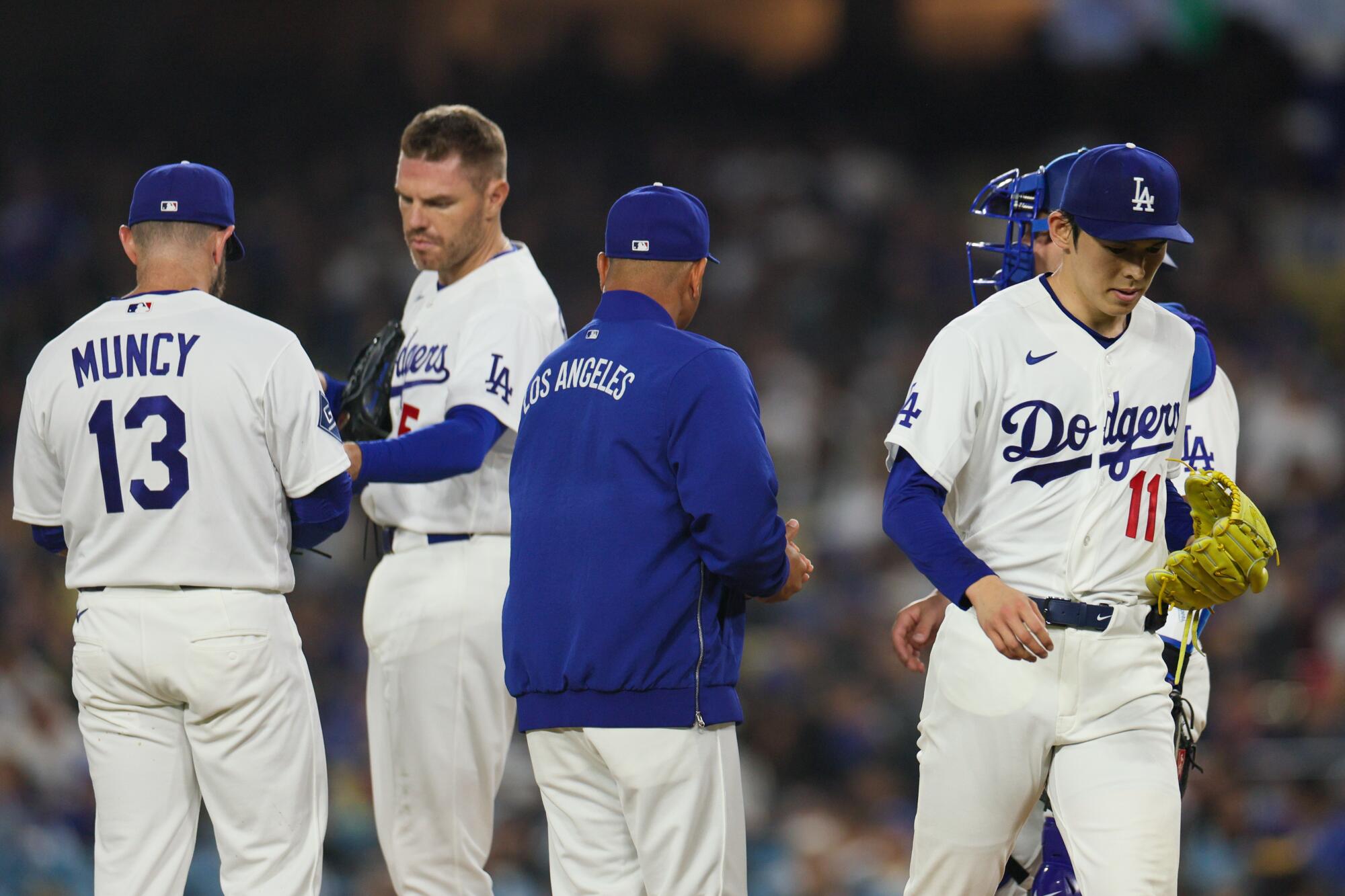
Dodgers manager Dave Roberts removes starting pitcher Roki Sasaki from the game in the fifth inning Monday against Cleveland.
(Ronaldo Bolanos / Los Angeles Times)
The Dodgers had seen Sasaki bounce back before. He had a middling start to last season and pitched through shoulder discomfort before landing on the injured list last May. His average fastball velocity plummeted from 98 mph in his MLB debut to 94.9 mph in his last start.
He returned from the IL in time for two relief appearances in September, his fastball sitting above 99 mph, and a dominant postseason run. He didn’t allow a run in eight of his nine playoff outings, and he posted a 0.84 ERA.
“He could have cashed in last year,” manager Dave Roberts said before the game. “Given his health early, the lack of performance towards the middle of the year, towards the end he could have just written it off and started fresh in the offseason.
“But he was willing to pitch out of the bullpen, ramp back up and give us whatever we needed. So for me, that was something where he put himself out there. That’s why I have a lot of confidence right now [that he can] turn the corner from spring training.”
Sasaki still threw some non-competitive pitches Monday. That inefficiency brought his pitch count up to 78 pitches twice through the Guardians’ batting order, and Roberts pulled him when the lineup turned over again.
Sasaki also reigned in his misses, used both sides of the plate, and effectively deployed his new cutter as a put-away pitch early.
“I couldn’t get through five innings, but the results overall felt pretty good,” Sasaki said. “I kind of have confidence about that.”
Through the first two innings, Sasaki held the Guardians scoreless, and to just one bloop single. But in the third, he threw a four-seam fastball down the middle to Austin Hedges and hung a cutter to Kwan for a pair of doubles and a run.
Dodgers outfielder Kyle Tucker rounds second base after a Mookie Betts double during the ninth inning against the Guardians at Dodger Stadium on Monday.
(Ronaldo Bolanos/Los Angeles Times)
Next, Sasaki walked Chase DeLauter, and the inning threatened to spiral. But Sasaki locked in to strike out José Ramírez and induce Kyle Manzardo to line out, escaping without further damage.
With no outs and one runner on in the fifth inning, Sasaki handed the ball over and left-hander Tanner Scott took over. Dodgers fans sent Sasaki, who’d been booed during his last spring start, off with a warm ovation.
“I think it should be a big boost to his confidence,” Roberts said after the game. “… When you don’t have success, it’s hard to have real confidence. That was certainly an honest admission. But when you perform, you start to have true confidence. So hopefully he can build on this one.”
After Scott, Dodgers left-hander Justin Wrobleski, who is in line to join the rotation when the schedule isn’t so packed with off days, provided four innings. He gave up three runs, all in the seventh.
The Dodgers didn’t score until the final inning, with the help of a little luck. Kyle Tucker reached base on a chopper that squeaked through the infield and then advanced all the way to third on a wild pitch. Mookie Betts then drove him in with a line-drive double. Two batters later, Betts scored as Freddie Freeman grounded out to first.
“The takeaway is, we’re 3-1 and the guys that we expect to swing the bats aren’t swinging the bats right now,” Roberts said. “So that’s a good thing; they’ll hit.”
It was a devastating experience for Abdul Rahman Azzam, 65, to recently cut down the olive trees he had planted decades ago on his land south of Jenin in the occupied West Bank, following an Israeli decision to confiscate it for the construction of a road for an illegal Israeli settlement.
The land slated for confiscation last December spans more than 513 dunams (51.3 hectares), 450 of which belong to the village of al-Fandaqumiya alone, with the remainder belonging to neighbouring towns such as Silat ad-Dhahr and al-Attarra.
Recommended Stories
list of 4 itemsend of list
As Palestinians commemorate the 50th anniversary of Land Day this year, the challenges of illegal Israeli settlement expansions, land confiscations, and restrictions on access to their land, particularly in Area C, persist.
Meanwhile, Israeli government leaders continue to declare that the annexation plan is a fait accompli.
Land Day commemorates the events of March 30, 1976, when Israeli authorities announced the confiscation of vast tracts of Palestinian land in the Galilee region.
In response, widespread strikes and demonstrations were organised in several towns and villages, which were met with force, resulting in the deaths of six Palestinians and the injury and arrest of hundreds.
Since then, this day has become a national symbol, embodying the connection of the Palestinians to their land and the rejection of its confiscation.
Twice taken
Since childhood, Azzam had worked alongside his father, grandfather, and uncles, planting and ploughing the land with olive trees.
He developed a deep connection to it, which he continued to work on until 2002, when the illegal Israeli settlement of Tarsala and the Sanur military base were established on it, and he and his family were barred from accessing it.
Following the 2005 disengagement plan, the Israeli army withdrew from the camp and the settlement of Tarsala. Azzam and other landowners returned to their land, and their joy was indescribable.
However, after the recent Israeli decision, the Palestinian landowners were denied access to their land, which is now entirely under Israeli military control.
Palestinian land being bulldozed in the occupied West Bank town of Ein Yabrud [Mohammed Turkman/Al Jazeera]
“Suddenly, we found the land number in the official newspaper along with a confiscation order for the construction of a road connecting the settlements of Homesh and Tarsala, to which the settlers had returned after the 2005 withdrawal. We saw the Israeli army had already begun bulldozing the land,” Azzam told Al Jazeera.
To prevent the Israeli army from cutting down his olive trees during the bulldozing, Azzam went to his land and cut them down himself. He wept as he did so. He then noticed that all the other landowners had done the same, fearing for their trees.
“It’s easier for us to cut them down ourselves than for the army or settlers to do it. This is our land, and our trees are like our children; we cherish them and treat them with kindness because we toiled to cultivate and care for them,” he added.
Confiscation in several ways
The Oslo Accords, signed between Israel and the Palestine Liberation Organization in 1993, divided the West Bank into three categories: Area A, under full Palestinian control, comprising approximately 18 percent of the West Bank; Area B, under joint Palestinian and Israeli control, comprising 22 percent; and Area C, under full Israeli control, comprising 60 percent.
Since October 2023, Israel has been issuing confiscation orders for Palestinian lands in Area C at an accelerated pace in the West Bank, in preparation for implementing its annexation plan, which Palestinians believe is already being carried out on the ground without a formal declaration.
According to data from the Palestinian Authority’s Commission Against the Wall and Settlements, Israel seized 5,572 dunams of Palestinian land in 2025 through 94 confiscation orders for military purposes, in addition to three expropriation orders and four declarations of state land.
These orders were not isolated or circumstantial, but rather geographically distributed to serve the expansion of settlements, secure their borders, and construct settlement roads that further fragment Palestinian land and sever its natural contiguity, as it said.
Concurrently, Israel allocated 16,733 dunams of previously confiscated land for settler grazing, a move that reveals a dangerous escalation in the tools of control, according to the commission’s annual report.
In another report, the commission stated that between October 2023 and October 2025, Israel confiscated 55,000 dunams of land, including 20,000 dunams under the pretext of modifying the boundaries of nature reserves, and 26,000 dunams through 14 declarations of “state land” in the cities of Jerusalem, Nablus, Ramallah, Bethlehem and Qalqilya.
A total of 1,756 dunams were confiscated through 108 orders for military purposes, aimed at establishing military towers, security roads, and buffer zones around settlements.
However, it has become increasingly apparent that many land seizures are carried out without official military orders. Soldiers or settlers prevent Palestinian landowners from accessing their land, leaving them surprised to find it seized without any prior notification.
Mohammed Fouad’s land was cleared without warning in the town of Ein Yabrud to make way for a road to an illegal Israeli settlement [Mohammed Turkman/Al Jazeera]
Mohammed Fouad, 56, was surprised on Wednesday to find an Israeli army bulldozer razing his land in the town of Ein Yabrud, east of Ramallah.
He went to the nearest point to the land and watched as the bulldozer removed trees, seemingly clearing a road for settlers.
“My land is 15 dunams … and is only 1km from the Beit El settlement, which is built on land north of Ramallah. I fear this bulldozing is a prelude to its annexation to the settlement, especially since it’s classified as Area C,” Fouad told Al Jazeera.
He was not notified of any decision regarding the confiscation of his land. A farmer who was nearby informed him of it. When he tried to inquire with the armed men accompanying the bulldozer, they told him they were from the Israeli army and intelligence services and expelled him from his land.
“I’ve always cared for this land, and now I’m watching it being bulldozed right before my eyes, unable to reach it. It’s as if they’re forcing me to leave. But I’ll try to reach it every day,” Fouad said bitterly.
Land confiscation procedures have been facilitated by several Israeli policies over the past two years to complete the annexation plan.
Raed Muqadi, a researcher at the Land Research Centre, told Al Jazeera that settlers have resorted to fencing off Palestinian lands to seize them, especially in the Jordan Valley.
This has affected thousands of dunams in the occupied West Bank that were used as pastures or agricultural land. Because of the fencing, Palestinians are prevented from entering or using it.
“The Israeli Knesset also recently approved what is called lifting the ban on data concerning landowners in the West Bank, which makes it easier for settlers to seize land and allows them to purchase it, even in Area A, with the help of settlement associations,” he explained.
Actual expulsion
The tragedy is not limited to land confiscation and seizure in the West Bank, but extends to the expulsion of entire Palestinian communities from their homes under the weight of attacks.
Qusay Abu Naim, 23, a resident of the Bedouin community of al-Khalail in the village of al-Mughayyir, east of Ramallah, told us that he and all other residents were forced to leave in February due to the intensity of settler attacks on the residents, some of whom were injured.
On February 21, Israeli settlers attacked the community intermittently, assaulting men, women, and children, resulting in injuries to an entire family of four, including two children. The Israeli army then joined the attack after the settlers filed a complaint that the Palestinians had resisted them. The soldiers opened fire, wounding the children, aged 12 and 13, further.
“This incident was the last straw. We decided to leave because the attacks were almost constant. When we returned from the hospital to dismantle our homes, we were shocked to find that the settlers had destroyed them and vandalised their contents,” Abu Naim explained.
The attacks against this community began in December 2024, intending to seize the lands of al-Mughayyir. The settlers deliberately targeted women, beating them and stealing sheep to force the residents to leave.
“Because of the numerous attacks, we sought help from international solidarity activists, but that didn’t stop the settlers. The activists were attacked several times in 2024 and 2025. Among the attacks, settlers broke my brother’s arm so severely that he needed a metal plate to repair the fracture. While he was receiving treatment, the Israeli army arrested him, even though he was the victim. He is currently being held in administrative detention without charge,” Abu Naim added.
In addition to the attacks, the homes of this community were repeatedly robbed by armed settlers. They would break into the houses and steal food from refrigerators, terrorising women and children.
The residents of the community were forced to leave for neighbouring villages, including Deir Jarir and areas within al-Mughayyir itself, but they still remember the years when they lived there in their communities, amid a beautiful Bedouin life, the images of which remain with them to this day, and they lament leaving it.
“Of course, it is now forbidden for any Palestinian to access the al-Khalail community area, which is under the control of settlers and the Israeli army. We left it, but the land will return to its original owners,” he concluded.
According to the Office for the Coordination of Humanitarian Affairs (OCHA), at least 4,765 Palestinians were displaced from 97 locations between January 2023 and mid-February 2026 due to settler violence.
Most of those displaced were from Bedouin and herding communities in Area C. At the beginning of this year alone, 600 people were forced to leave a single Bedouin village, Ras Ein al-Auja, in the Jordan Valley.
According to the United Nations Development Programme (UNDP), the number of Palestinian Bedouins in the West Bank is approximately 40,000. Most Bedouins are originally from the Naqab Desert, from which they were forcibly displaced or fled during the 1948 Arab-Israeli War, following further displacement after 1967, and then throughout the 1980s, they have continued to face waves of expulsion to this day.
Trevor Zegras and Matvei Michkov scored in a shootout to give the Philadelphia Flyers their fourth victory in five games, 4-3 over the Kings on Thursday night.
Noah Cates had a goal and an assist, Travis Konecny and Travis Sanheim also scored, and Samuel Ersson made 22 saves. The Flyers remained six points behind Boston and Detroit for the two Eastern Conference wild-card spots.
On Wednesday night against the Ducks, Cates scored in overtime in the Flyers’ 3-2 victory.
Adrian Kempe and Artemi Panarin failed on their shootout attempts for Los Angeles, though the Kings still moved into the second wild-card in the Western Conference.
Artemi Panarin had a goal and an assist for the Kings. Quinton Byfield and Anze Kopitar also scored, and Darcy Kuemper made 17 saves.
Panarin ensured the Kings picked up a point in the standings with a blistering wrist shot on a power play that tied it 3-3 with 9:32 remaining.
The Flyers were without forwards Sean Couturier (upper body), Luke Glendening (lower body) and Denver Barkey (upper body), leaving them to play with 11 forwards and seven defensemen.
Up next for the Kings: vs. Buffalo at Crypto.com Arena on Saturday.
NEW ORLEANS — Saddiq Bey scored 25 points, Trey Murphy added 23 and the New Orleans Pelicans overcame an early 18-point hole to beat the Clippers 124-109 on Wednesday night.
Dejounte Murray had 17 points and 11 assists, while Zion Williamson and rookie Derrick Queen each scored 14 for the Pelicans, who received a standing ovation as the final seconds wound down on their sixth straight victory at home and ninth win in their last 13 games overall
Kawhi Leonard scored 25 points and John Collins added 18 for the Clippers, who dropped a game below .500 (34-35), but maintained a tenuous hold on the No. 8 spot in the Western Conference standings, a half-game ahead of Portland.
Bey hit five of 10 three-point shots to help New Orleans go 16 of 37 (43.2%) from deep. The Pelicans also made 20 of 21 free throws, with Queen making all nine of his.
Pelicans rookie guard Jeremiah Fears chipped in 11 points off the bench.
Murphy made his 200th three of the season late in the third quarter to give New Orleans an 89-81 lead. His fourth make from deep made it 94-81 in the final minute of the period, which ended with New Orleans leading 96-85.
Murphy’s double-clutch dunk over Brook Lopez to close out a fast break spawned by Herb Jones’ steal gave New Orleans a 117-101 lead with 4:43 left, and the Pelicans led by as many as 20 in the final minutes.
New Orleans committed eight turnovers in the first nine minutes, and the Clippers converted those into nine points while building a 33-18 lead.
Leonard scored 12 of his points during that stint and the Clippers led by as many as 18 during the opening quarter before the Pelicans trimmed it to 40-26 on Murphy’s free throws.
New Orleans came all the way back to tie it at 58 on Murphy’s three late in the second quarter.
Leonard and Murphy traded baskets in the final 10 seconds before halftime, with Murphy tying it at 60 on a high, driving floater in traffic.
Callender was co-captain for last year’s two-Test series against Australia – leading the side to a historic first win Down Under – and the World Cup in England.
The 25-year-old overcame an ankle injury to feature in the tournament but then needed surgery after Wales’ early exit.
She returned for Harlequins at the end of January and it is believed to be a fresh injury and not a relapse.
Williams, who made her Test debut against Ireland in 2023, shared the captaincy duties and has been chosen as the leader for the Six Nations.
Lynn said: “Kate Williams has the respect of the whole squad, and her leadership skills means she will be Wales captain for this Six Nations campaign.”
Wales lost all five games of last year’s championship, condemning them to a second Wooden Spoon on the bounce.
TORONTO — William Nylander broke a tie on a power play 36 seconds into the third period and the Toronto Maple Leafs beat the Ducks6-4 on Thursday night to end an eight-game losing streak.
The victory was tempered by the loss of captain Auston Matthews on a knee-on-knee hit from Ducks defenseman Radko Gudas with four minutes left in the second period. Matthews stayed down favoring his left leg before being helped to the locker room. Gudas was assessed a major penalty and game misconduct.
Matthews scored earlier to end a 12-game goal drought.
Matias Maccell had a goal and two assists, and John Tavares and Benoit-Olivier Groulx also scored. Matthew Knies had three assists to go along with an empty-net goal, and Nylander added two assists. Joseph Woll made 36 saves.
Cutter Gauthier, Ian Moore, Pavel Mintyukov and Alex Killorn scored for the Pacific Division-leading Ducks. Lukas Dostal stopped 23 shots.
The Maple Leafs are 1-6-2 since the Olympic break to sink any realistic hope of a 10th straight playoff appearance. They won at home for the first time since Jan. 10.
BOSTON — Charlie McAvoy scored 39 seconds into overtime and Jeremy Swayman stopped 14 shots on Tuesday night to earn the Boston Bruins their 13th straight victory at home, 2-1 over the Kings.
Mason Lohrei scored midway through the third period to break a scoreless tie. But the Kings tied it five minutes later when Drew Doughty’s shot from the blue line deflected off the heel of Bruins forward Elias Lindholm and into the net.
It was the seventh straight time the teams had gone to overtime in Boston.
In the overtime, Mark Kastelic blocked a shot in the defensive zone and made a long pass to David Pastrnak, who waited for McAvoy to come into the zone. The Bruins’ defenseman and U.S. Olympian, who went to the locker room at the end of the second period after taking a puck off his mouth, skated in on Darcy Kuemper and went to his backhand for the winner.
Kuemper stopped 21 shots for the Kings, who entered the night one point out of the second wild-card spot in the Western Conference. The victory kept Boston in possession of the East’s second wild-card spot.
Swayman tied his career high with his 25th win of the season. The Bruins haven’t lost at the TD Garden since before Christmas.
After the game, Kings forward and future Hall of Famer Anze Kopitar stayed on the ice to shake hands with the Bruins after what is expected to be his last game in Boston.