Casey Wasserman, the embattled sports and entertainment mogul who is the face of the Los Angeles 2028 Olympics, is preparing to sell his talent agency.
In a memo to his staff Friday, Wasserman acknowledged his appearance in a recently released batch of documents related to the late sex trafficker Jeffrey Epstein and his companion, Ghislaine Maxwell, had “become a distraction.”
In his memo, which was reviewed by The Times, Wasserman said he was “heartbroken that my brief contact with them 23 years ago has caused you, this company, and its clients so much hardship over the past days and weeks.”
Representatives for Wasserman did not immediately return for requests for comment.
“I’m deeply sorry that my past personal mistakes have caused you so much discomfort,” Wasserman wrote to his staff. “It’s not fair to you, and it’s not fair to the clients and partners we represent so vigorously and care so deeply about.”
“I know what I know, and I am following my gut and my values,” Wambach wrote on Instagram. “I will not participate in any business arrangement under his leadership…He should leave, so more people like me don’t have to.”
Wasserman told his staff that Mike Watts, a longtime company executive, would assume day-to-day management of the firm while he begins the process of selling it.
The Wall Street Journal first reported Wasserman’s staff memo.
Wasserman’s grandfather, Lew Wasserman, was a Hollywood titan who built the studio MCA into a powerhouse that acquired Universal Pictures. Casey Wasserman’s sports and talent agency, also built through a series of savvy acquisitions, has about 4,000 employees.
Wasserman plans to stay in his position leading the LA28 Olympic Committee, which has stood by him. In a recent statement, LA28 noted that the racy emails with Maxwell were sent following a humanitarian mission to Africa two decades “before Mr. Wasserman or the public knew of Epstein and Maxwell’s deplorable crimes…This was his single interaction with Epstein.”
“The Executive Committee of the Board has determined that based on these facts, as well as the strong leadership he has exhibited over the past ten years, Mr. Wasserman should continue to lead LA28 and deliver a safe and successful Games,” LA28 concluded.
The messages to Maxwell were part of a massive trove of Epstein-related documents made public by the Department of Justice this month.
In them, Wasserman wrote to Maxwell, who is now serving a lengthy prison sentence for sex trafficking of minors, “I thought we would start at that place that you know of, and then continue the massage concept into your bed … and then again in the morning … not sure if or when we would stop.”
She responded: “Umm — all that rubbing — are you sure you can take it? The thought frankly is leaving me a little breathless. There are a few spots that apparently drive a man wild — I suppose I could practise them on you and you could let me know if they work or not?”
Wasserman released a statement saying: “I deeply regret my correspondence with Ghislaine Maxwell which took place over two decades ago, long before her horrific crimes came to light. I never had a personal or business relationship with Jeffrey Epstein. As is well documented, I went on a humanitarian trip as part of a delegation with the Clinton Foundation in 2002 on the Epstein plane. I am terribly sorry for having any association with either of them.”
When the Justice Department released an additional 3 million pages of documents related to convicted sex trafficker Jeffrey Epstein at the end of January, ARTnews unearthed and published excerpts from dozens of emails between Epstein and David A. Ross, a former director of the Whitney Museum of American Art who started his career in the 1970s as deputy director and curator of video art at the Long Beach Museum of Art.
Ross, who served as the chair of the MFA art practice program at New York’s School of Visual Arts since 2009, promptly resigned.
If the emails had been less damning, the revelation of Ross’ connection to Epstein might have played out differently, but that was not the case. In one letter, dated Oct. 1, 2009, Epstein wrote to Ross that Roman Polanski’s attorney was coming to see him and that he was considering funding an exhibit titled, “Statutory.”
“Girls and boys ages 14 – 25, where they look nothing like their true ages,” Epstein wrote. “Juvenile mug shots, photo shop, make up. Some people go to prison because they can’t tell true age. Controversial. Fun. Maybe it should be a web page with hits, tallied.”
“You are incredible,” Ross wrote back. “This would be a very [sic] owerful and freaky book. Do you know that total porno commercial kiddie picture of Brooke Sheilds that Richard Prince appropriated for an exhibition in the early 1980’s?”
Epstein replied in the affirmative to Ross’ reference to a Prince photo titled, “Spiritual America,” which appropriated a 1976 photo of a naked, 10-year-old Shields taken by commercial photographer Gary Gross.
“They closed it off in the London show,” Epstein noted.
Ross also expressed sympathy for Epstein’s legal travails in 2009 following a 13-month sentence he served in Florida after pleading guilty to reduced state charges of procuring a minor for prostitution.
“Glad the nightmare is over, Jeffrey,” Ross wrote. “It was an undeserved punishment foisted upon you by jealous creeps.”
In an email to ARTnews, Ross expressed remorse that he “fell for” Epstein’s lies.
“Like many he supported with arts and education patronage, I profoundly regret that I was taken in by his story,” Ross wrote. “I continue to be appalled by his crimes and remain deeply concerned for its many victims.”
Ross noted that he first met Epstein when he was director of the Whitney in the mid-1990s. Ross also served as director of the San Francisco Museum of Modern Art and the Institute of Contemporary Art in Boston.
“I knew him as a wealthy patron and a collector, and it was part of my job to befriend people who had the capacity and interest in supporting the museum,” Ross wrote, adding that when Epstein was jailed in 2008, he told Ross that it was a political “frame-up” resulting from his support for former President Bill Clinton. Ross said he believed him.
It seems lots of men believed Epstein. Meanwhile, behind all the power lunches, private plane rides and callous late-night emails, far too many women and girls suffered.
I’m Arts editor Jessica Gelt with your arts and culture news for the week.
You’re reading Essential Arts
On our radar
Michael Feinstein and the Carnegie Hall Ensemble will perform Valentine’s Day at Segerstrom Hall in Costa Mesa.
(Segerstrom Center for the Arts)
Michael Feinstein: A Broadway Valentine The singer, musician, conductor and stalwart proponent of the Great American Songbook celebrates the holiday of the heart with the Carnegie Hall Ensemble. Timeless love songs and lush orchestrations seem like a perfect way to spend the evening. 7:30 p.m. Saturday, Segerstrom Center for the Arts, Segerstrom Hall, 300 Town Center Drive, Costa Mesa. scfta.org
A detail of miniature “sportraits” from Lyndon J. Barrois, Sr.’s exhibit, “Fútbol Is Life,” at LACMA.
(Allen J. Schaben / Los Angeles Times)
Fútbol Is Life: Animated Sportraits GOOOOOOOOAAAAAAAL! Ahead of this summer’s World Cup, with L.A. as one of 16 host cities across the U.S., Canada and Mexico, arrives this unique exhibition celebrating the beautiful game. Portraying transcendent moments in men’s and women’s soccer, award‑winning animator and visual effects artist Lyndon J. Barrois, Sr. fashions engrossing scenes in miniature from gum wrappers, glue, paint and other materials. The handmade sculptures and stop-motion animations on display bring together the visual and emotional elements that make it the world’s most popular sport. Jasmine Mendez spoke to Barrois about his process and Times photographer Allen J. Schaben provides more marvelous images. Sunday through July 12. LACMA Resnick Pavilion, 5905 Wilshire Blvd. lacma.org
The Academy Museum’s exhibition “Studio Ghibli’s Ponyo” opens Saturday.
(Nibariki-GNDHDDT)
Studio Ghibli’s Ponyo A deep dive into Hayao Miyazaki’s 2008 animated film about a goldfish who longs to be human honors the traditional hand-drawn animation processes used by its creators. The exhibition includes more than a hundred items handpicked by Studio Ghibli: art boards, posters, a Studio Ghibli animation desk and original hand drawings by Miyazaki and others. “Because writer-director Miyazaki very much follows his own star when it comes to story, narratives like ‘Ponyo’ remind you of no one else’s tales,” wrote Times film critic Kenneth Turan upon the film’s U.S. release. “Not only do they offer up fantastical images, like Ponyo running on the crests of waves, they make deep connections to our emotions without following conventional paths, using the logic of dreams to excellent effect.” Screening 2:30 p.m. Saturday; exhibition, Saturday through Jan. 10. Academy Museum, 6067 Wilshire Blvd. academymuseum.org
The week ahead: A curated calendar
FRIDAY Nitrate Festival The American Cinematheque’s annual tribute to the beautiful, if highly volatile, film format that was used from the 1890s until the 1950s, offers audiences the rare opportunity to see this work on the big screen. The festival opens with the 1947 noir “Dead Reckoning,” starring Humphrey Bogart and directed by John Cromwell, and continues with William Wyler’s “The Good Fairy” (1935), Gregory La Cava’s “My Man Godfrey” (1936), William Wellman’s “Nothing Sacred” (1937), Mikio Naruse’s “Wife! Be Like A Rose!” (1935), David Lean’s “Blithe Spirit” (1945) and Cecil B. DeMille’s “Samson and Delilah” (1949). 7 p.m. Friday, through Feb. 22. Egyptian Theatre, 6712 Hollywood Blvd. americancinematheque.com
Foursome Matthew Scott Montgomery, Adrián Javier, Jimin Moon and Calvin Seabrooks star in Montgomery’s comedy about a quartet of queer friends who reunite for an emotionally fraught, desire-filled weekend at a cabin. Directed by Tom DeTrinis. Through March 23. Atwater Village Theatre, 3269 Casitas Ave. iamatheatre.com
Guards at the Taj Two sentries at the Taj Mahal have their friendship, faith and sense of duty challenged in Rajiv Joseph’s play set centuries in the past with contemporary resonance. Behzad Dabu and Kausar Mohammed star. Directed by Behzad Dabu. 8 p.m. Friday and Saturday; 2 and 7 p.m. Sundays, through Feb. 22 El Portal Theatre, 5269 Lankershim Blvd., North Hollywood elportaltheatre.com
Alfredo Rodriguez, left, and Pedrito Martinez will perform Friday at the Nimoy.
(Anna Webber)
Alfredo Rodriguez and Pedrito Martinez Pianist Rodriguez and percussionist-vocalist Martinez perform traditional Cuban songs, original compositions and some surprises. 8 p.m. UCLA Nimoy Theater, 1262 Westwood Blvd. cap.ucla.edu
Incitation To The Dance A young man upends an older gay couple’s relationship in the world premiere of writer-director Michael Van Duzer’s dark comedy. Through March 15. Theatre West, 3333 Cahuenga Blvd. https://theatrewest.org/on-stage/incitation-to-the-dance
Roksana Pirouzmand The Iranian-born, L.A.-based multidisciplinary artist’s solo exhibition “everything was once something else” explores the contrasting properties forged by earth and fire through clay and metal works. Through April 11. Oxy Arts, 4757 York Blvd. oxyarts.oxy.edu
SATURDAY Attune 1.0 A free public light- and sound-art experience happens simultaneously across L.A. County locations presented by NXT Art Foundations with community support. 4:30-7:30 p.m. Barnsdall Park, East Hollywood; Sycamore Grove Park, Northeast Los Angeles ; Jessie Brewer Jr. Park, Exposition Park; Jane and Bert Boeckmann Park, Porter Ranch; Hansen Dam, Lake View Terrace; Leimert Park, South Los Angeles; Wende Museum, Culver City; Promenade Square Park, Long Beach; Tongva Park, Santa Monica and Loma Alta Park, Altadena. nowartpublic.com
Desert Dreams and Coastal Currents The exhibition tracks the concurrent emergent of artistic hubs in Southern California and the Southwest, featuring work by artists in areas such as Laguna Beach, and Taos and Santa Fe, N.M. The Autry, 4700 Western Heritage Way, Griffith Park. theautry.org
Wally Hedrick “Sex Politics Religion” is a two-venue retrospective of the Pasadena-born artist, who established himself in the burgeoning post-war San Francisco art scene. Hedrick eschewed “style” in favor of pursuing a vision including welded assemblage junk sculptures, Bauhausian abstraction, black monochromes, gestural figuration, graphic signage, pictographic diagrams and near-photorealism. Through April 4. Parker Gallery, 6700 Melrose Ave.; The Box 805 Traction Ave., downtown L.A. parkergallery.com
Honour The Ruskin’s grand opening on the Kaplan Stage features Joanna Murray-Smith’s drama on the precariousness of marriage, directed by Max Mayer and starring Marcia Cross, Matt Letscher, Ariana Afradi and Jude Mayer. 8 p.m. Thursdays-Saturdays; 2 p.m. Sundays, through March 22. Ruskin Group Theatre, 2800 Airport Ave., Santa Monica.
Artist Takashi Murakami.
(Shin Suzuki)
Takashi Murakami The new solo exhibition “Hark Back to Ukiyo-e: Tracing Superflat to Japonisme’s Genesis” features 24 paintings by the Japanese artist. 4-7 p.m. opening, free and open to the public; exhibition continues through March 14. Perrotin, 5036. W Pico Blvd. perrotin.com
Mythical Creatures: The Stories We Carry Immigrant narratives and pan-Asian mythology infuse this immersive exhibition featuring contemporary artists including Dinh Q. Lê, Dominique Fung, Lily Honglei, Greg Ito, Wendy Park, Momoko Schafer, Kyungmi Shin, Sanjay Vora and Lauren YS. Conceived by L.A.-based Korean American artist and muralist Dave Young Kim. Through Sept. 6. USC Pacific Asia Museum, 46 N. Los Robles Ave. Pasadena. pacificasiamuseum.usc.edu
PASSION + MYSTERY Los Angeles Chamber Orchestra, led by conductor Jaime Martín, celebrate Valentine’s Day weekend with Fauré’s “Pelléas et Mélisande” and Gernot Wolfgang‘s “Desert Wind,” and are joined by pianist Fazıl Say for Beethoven’s “Piano Concerto No. 3.” 7:30 p.m. Saturday. Colburn School, Zipper Hall, 200 S. Grand Ave., downtown L.A.; 4 p.m. Sunday, The Wallis, 9390 N. Santa Monica Blvd., Beverly Hills. laco.org
Red Harlem Four Black actors in 1932 Harlem are recruited by the Communist Party to make a film in the Soviet Union in Kimba Henderson’s drama based on true events. Directed by Bernadette Speakes. Through March 15. Company of Angels, 1350 San Pablo St. companyofangels.org
Retro Romantics: An Academy Film Archive Trailer Show in 35mm Vintage cinematic love stories unspool in their original abridged glory, seductively beckoning you to the movies. 7:30 p.m. Academy Museum, 6067 Wilshire Blvd. academymuseum.org
SUNDAY Black History Month at The Ebell Soprano Gertrude Bradley performs a tribute to Joel Graham, accompanied by pianist Greg Schreiner in an African Americans for LA Opera recital; and Inner City Youth Orchestra of Los Angeles (ICYOLA) salutes the 250th anniversary of the Declaration of Independence in “I, Too, Sing America,” a nod to the Langston Hughes poem. AALAO Recital, 12:30 p.m. Sunday; LA Voices: ICYOLA, 4:30 p.m. Sunday. Ebell of Los Angeles, 743 S. Lucerne Blvd. https://www.ebellofla.org/
Isidore String Quartet The group performs “Brahms: the Admirer,” an exploration of the composer’s work alongside complementary pieces by Bach and Beethoven. 3:30 p.m. Caltech Beckman Auditorium, 332 S. Michigan Ave. Pasadena. colemanchambermusic.org
What Happened to Flamenco Clap your hands as dancer and choreographer Fanny Ara brings the folkloric tradition to life. 7 p.m. Fountain Theatre, 5060 Fountain Ave. fountaintheatre.com
TUESDAY Seth MacFarlane The erstwhile animator, writer, producer, director, actor and comedian picks up the mic, backed by an orchestra, for a program dedicated to the music of Frank Sinatra. 8 p.m. Walt Disney Concert Hall, 111 S. Grand Ave., downtown L.A. laphil.com/events
WEDNESDAY I Love You, You’re Perfect, Now Change Barry Pearl directs the long-running off-Broadway musical comedy revue on modern love, featuring book and lyrics by Joe DiPietro and music by Jimmy Roberts to open ICT’s 41st season. Through March 8. International City Theatre, 330 E. Seaside Way, Long Beach. ictlongbeach.org
Patti LuPone The Broadway star marks the 25th anniversary of her “Matters of the Heart,” which ran on Broadway and London’s West End and toured the globe. 8 p.m. Segerstrom Center for the Arts, Segerstrom Hall, 300 Town Center Drive, Costa Mesa. scfta.org
Preservation Hall Jazz Band Can’t get to New Orleans for Mardi Gras? The Soraya brings it to the Valley via the deep roots of this legendary French Quarter ensemble. 8 p.m. The Saroya, 18111 Nordhoff Street, Northridge. thesoraya.org
Emma Elizabeth Smith as Catherine of Aragon in The North American touring company of “Six.”
(Segerstrom Center for the Arts)
Six The national tour of the Broadway musical by Toby Marlow and Lucy Moss, a modern pop take on the sextet of women who were the wives of Henry VIII. Through March 9. Hollywood Pantages Theatre, 6233 Hollywood Blvd.; March 10-15. Segerstrom Center for the Arts, 300 Town Center Dr., Costa Mesa. sixonbroadway.com
THURSDAY Compagnie Hervé Koubi: Sol Invictus The French-Algerian choreographer’s dance troupe performs “Sol Invictus,” with a score featuring music by Swedish composer Mikael Karlsson, minimalist composer Steve Reich and digital composer Maxime Bodson. 7:30 p.m. Friday and Saturday; 2 p.m. Sunday. February 19 – 21, 2026 The Wallis, 9390 N. Santa Monica Blvd. Beverly Hills. thewallis.org
Culture news and the SoCal scene
The cast of “Brassroots District” performs on Sunday.
(Gabriella Angotti-Jones/For The Times)
Features columnist Todd Martens checked out “Brassroots District: LA ’74,” a piece of immersive theater he describes as “part concert, part participatory theater and part experiment, attempting to intermix an evening of dancing and jubilation with high-stakes drama. How it plays out is up to each audience member. Follow the cast, and uncover war tales and visions of how the underground music scene became a refuge for the LGBTQ+ community. Watch the band, and witness a concert almost torn apart as a group on the verge of releasing its debut album weighs community versus cold commerce. Or ignore it all to play dress-up and get a groove on to the music that never stops.”
Enjoying this newsletter? Consider subscribing to the Los Angeles Times
The UCLA Hammer Museum has announced the winner of the $100,000 Mohn Award.
(Eric Staudenmaier)
Artist Ali Eyal, who grew up in Baghdad in the late 1990s and early 2000s during U.S. military operations in Iraq, is the recipient of the $100,000 Mohn Award, which honors artistic excellence, in conjunction with the Hammer Museum’s Made in L.A. 2025. In addition to the award money, the Hammer will produce a publication for Eyal. The Hammer also announced that sculptor Carl Cheng has been given the $25,000 Career Achievement Award; and that painter Greg Breda won the $25,000 Public Recognition Award.
The news out of the Kennedy Center continues to be grim. This week, Trump-appointed center president Richard Grenell sent an email to staffers informing them that significant cuts would be implemented when the center closes for renovations, beginning July 4. “Over the next few months, department heads and I will be evaluating the needs and making the decisions as to what these skeletal teams left in place during the facility closure and construction phase will look like,” Grenell wrote in the email obtained by The Times.
I’m Glenn Whipp, columnist for the Los Angeles Times, host of The Envelope newsletter and the guy answering all of the above to this newsletter’s initial question.
Everyone loves a surprise or two on Oscar nominations morning, and this year gave us the gift of Delroy Lindo, 73, finally earning his first Oscar nomination for his standout performance as bluesman Delta Slim in “Sinners.”
Some people are still smiling about the news. Lindo certainly is.
Lindo and I talked about the lessons he has learned as an actor over the course of a career that has spanned a half-century. He recalled the self-doubts that plagued him when he first played the lead in “A Raisin in the Sun,” the story of a struggling Black family dealing with discrimination in 1950s South Chicago, and how he overcame those fears when he revisited the role three years later.
“This was an absolute period of growth for me as an actor all because I learned the most important thing: preparation, preparation, preparation,” he told me.
But even when you exercise that level of care, you still deal with doubt. Actors will be the first to tell you that they’re needy, neurotic.
To play Delta Slim, Lindo read books on the blues, listened to Son House, Muddy Waters and Howlin’ Wolf and immersed himself in the culture of the Mississippi Delta. Musicians helped him hone his harmonica and piano playing. He was ready.
But that doesn’t mean he couldn’t use a little affirmation for a final boost.
Lindo says there were two such “seminal moments” for him while making “Sinners.” The first came when they filmed the scene where Lindo stands as his car passes a chain gang. Delta Slim exhorts the prisoners to “hold your heads.”
“[Director] Ryan [Coogler] was very nervous,” Lindo says. “He didn’t want any accidents.”
Shortly after shooting the scene, the movie’s unit publicist, Anna Fuson, emailed Lindo’s agents, telling them how his work had moved her and the crew.
“That doesn’t happen,” Lindo says, his voice cracking with emotion.
Later they shot Delta Slim’s monologue, in which he recalls the lynching of a fellow musician, ending with Lindo breaking into a guttural humming and drumming, expressing pain that transcends words. That night Zinzi Coogler, Ryan’s wife and a producer on “Sinners,” wrote Lindo telling him how much that scene had meant to her.
“Those two moments gave me a grounding,” Lindo says quietly. “It let me know this work is impacting people. And you can’t put a value on that kind of thing.”
Conversations about Culver City — the vibrant enclave on Los Angeles’ Westside often called “the Heart of Screenland” — usually include phrases such as “walkable” and “green spaces” and “Erewhon.”
So when U.S. Atty. Gen. Pam Bondi insinuated the city of 39,000 residents is a crime haven during a heated exchange with Rep. Sydney Kamlager-Dove (D-Los Angeles) Wednesday, local officials and personalities responded with statistics, memes and wry mockery.
Bondi slipped in the jab near the end of an arduous House hearing largely focused on the Department of Justice’s handling of the Jeffrey Epstein investigation. Kamlager-Dove, whose district includes Culver City, hammered Bondi over deleted Department of Justice data linking far-right ideology with political killings, asserting that “there are violent, dangerous people out there with real threats.”
“There are — in your district,” Bondi responded. “Her district includes Culver City, and she’s not talking about any crime in her district. Nothing about helping crime in her district. She’s not even worth getting into the details.”
Hometown names stepped up to defend the burg by posting photos of clean streets, manicured parks and humming community events.
Political commentator and Angeleno Brian Taylor Cohen called the city “one of the most non-controversially safe” places in L.A., while Culver City-based comedian Heather Gardner said: “The worst crime of the century is that this woman had made a mockery of our justice system. Release the un-redacted files. Prosecute the REAL crimes.”
The Justice Department did not immediately respond to a request for Bondi to clarify her statements.
Crime in Culver City declined 9.7% in 2024 and was down an additional 6.1% in the third quarter of 2025 compared with the same period of 2024, according to the Culver City Police Department. Violent crime declined 3.9% in 2024 — the last full year of available data.
Over that period, murders dropped to zero while aggravated assault, kidnapping and robbery also fell. There were 26 cases of sexual assault in the city in 2024, compared with 25 in 2023. The only violent crime that saw a significant increase were simple assaults, which rose 8.1%.
The California Department of Justice and the FBI reported in 2024 that crime in the state had fallen to “among the lowest levels ever recorded.”
Mayor Freddy Puza, in an interview Thursday, described Culver City as a “strong and vibrant community” of people with no shortage of job opportunities at small businesses and corporations alike, including TikTok, Pinterest and entertainment giants Apple, Amazon and Sony.
He said the local government has been able to lower crime rates through community-based policing and by providing housing and social services to its unsheltered population. The mayor characterized Bondi’s retort as a “knee-jerk reaction” from an attorney general faced with damaging public trust concerns at her department.
“My read of it is that she’s trying to deflect,” he said. “I think she could really spend her time prosecuting the people in the Epstein files and making sure that information from the federal government is transparent.”
The city had seen no ideological violence, he said, adding, “but the potential for it is right around the corner. There’s no doubt that it is on the rise and the president is stoking it. People are becoming further and further polarized.”
At the hearing, Bondi faced sharp criticism over the Justice Department’s Epstein investigation — specifically over redaction errors in the release millions of case files last month. In one instance, the attorney general refused to apologize to Epstein victims in the room, saying she would not “get into the gutter” with partisan requests from Democrats.
Her performance has already prompted a volley of bipartisan demands for her resignation, including from conservative pundits including Megyn Kelly, Nick Fuentes and Kyle Rittenhouse.
Culver City was not Bondi’s only target Wednesday. She called Rep. Jamie Raskin (D-Md.) a “washed-up loser lawyer,” accused Kentucky Republican Rep. Thomas Massie of suffering from “Trump derangement syndrome,” and branded former CNN anchor Don Lemon a “blogger.”
Since the hearing, however, she has stayed silent as locals continue to question her intel and chuckle over images of the pylon-protected war zone of Culver City.
“The worst crime in Culver City,” Gardener joked again on TikTok, “is that they charge $24 for a smoothie at Erewhon.”
PALM BEACH, Fla. — As Major League Baseball closes in on an agreement for its players to participate in the 2028 Olympics, Commissioner Rob Manfred said the controversy surrounding LA28 chief Casey Wasserman would not impact the league’s final decision.
“Our dealings are not with Casey,” Manfred said Thursday at the MLB owners’ meetings. “Our dealings are with the institution of the Olympics.”
In recently released emails, Wasserman was linked to Jeffrey Epstein and his associate, Ghislaine Maxwell. The board retained a law firm to investigate, the statement said, and the review did not uncover any behavior beyond what was already known: a “single interaction with Epstein” on a plane flight for a humanitarian mission and raunchy emails with Maxwell, both two decades ago, before the “deplorable crimes” of both became public.
“Based on these facts, as well as the strong leadership he has exhibited over the past ten years, Mr. Wasserman should continue to lead LA28 and deliver a safe and successful Games,” the committee statement said.
Epstein died by suicide after his indictment on sex trafficking charges in 2019. Maxwell was convicted of sex trafficking in 2021.
Manfred declined to say whether he was concerned that an association with Wasserman could be detrimental for baseball.
“I’m going to pass on that one,” Manfred said. “People much closer to that situation are better to opine on that.”
Mark Attanasio, the Los Angeles-based owner of the Milwaukee Brewers, is a member of the LA28 executive committee. Attanasio said he would let the statement speak for itself.
While baseball is not new to the Olympics, the participation of major leaguers would be. In past Olympics, MLB declined to interrupt its season so its players could travel halfway around the world, and Team USA featured minor leaguers and college players.
MLB players already travel to Los Angeles every summer, and Wasserman has pitched Manfred and MLB owners in a variety of meetings on the benefit of using major leaguers at a time the league is focused on broadening its international appeal.
“What an incredible opportunity to elevate the sport in a city where you have one of the great cathedrals of the sport,” Wasserman told The Times last year. “There is no better chance to tell the global story of baseball than from the Olympics in Los Angeles.
“They understand that. We could have another Dream Team, or two, depending on the countries. That is a vehicle to tell the story of baseball around the world, and that is really powerful.”
MLB and LA28 officials have worked out a tentative timeline under which the All-Star Game would be played in its usual mid-July spot in 2028, most likely in San Francisco, followed by a six-day, six-team Olympic baseball tournament at Dodger Stadium.
“I think people have come to appreciate that the Olympics on U.S. soil is a unique marketing opportunity for the game,” Manfred said Thursday. “We’ve got a lot of players interested in doing it, and I feel pretty good about the idea we’ll get there.”
Are the Dodgers good for baseball?
Outfielder Kyle Tucker adjusts his Dodgers cap during his introductory news conference at Dodger Stadium on Jan. 21.
“I think great teams are always good for baseball,” Manfred said. “I think, with respect to this particular great team, it added to what we have been hearing from fans in a lot of markets for a long time about the competitiveness of the game. But great teams are always good for baseball.”
MLB officials have cited that fan concern repeatedly over the last year, prelude to an expected push for a salary cap. Manfred declined to discuss the owners’ labor strategy but said he expected negotiations on a new collective bargaining agreement to begin after Opening Day and said he would not talk about MLB proposals until they are presented to the players’ union.
The current agreement expires Dec. 1, and a lockout is widely expected.
Where can you watch the Angels?
Angels star Mike Trout celebrates after hitting a solo home run against the Houston Astros on Sept. 28 in Anaheim.
(Wally Skalij / Associated Press)
The Angels already are in spring training, and yet their fans have no idea where to watch their games on television this season.
The Angels have agreed that MLB will provide a streaming option, and a team official confirmed they are still deciding whether to let MLB sell their telecasts to cable and satellite distributors or reinvent what remains of the FanDuel Sports channel already part-owned by the team, with the Kings joining the Angels.
The Angels’ situation is not unique. Three years ago, MLB did not provide broadcast services to any team. Today, amid the collapse of the cable and satellite universe, MLB provides broadcast services to 14 of its 30 teams — 15, if the Angels go that way.
In 2028, Manfred would like to sell national streaming packages, in the hope that more bidders would mean more revenue, a particularly acute need for the teams losing revenue as guaranteed rights fees are cut or eliminated altogether. The challenge: how to convince the Dodgers and other big-market teams to sacrifice their still-lucrative local rights so MLB can sell a 30-team package.
“Ideally, I’d love to get there,” Manfred said. “I don’t need to get all the way there to accomplish most of what I am thinking about.”
On Thursday, Manfred cited one way he could get close enough: have rival owners vote to expand the number of games — for the Dodgers or anyone else — that would be classified as national rather than local.
“We can take as many games as we want from any club in a national package,” Manfred said, “with a majority vote of the clubs.”
After losing count of just how many bush poppy shrubs were blooming around me, I snapped a few photos of the delicate yellow flowers and texted them to my friend and colleague, Jeanette Marantos.
I didn’t expect to find so many blooming plants along the Mormon Rocks Interpretive Trail in San Bernardino National Forest. Jeanette, The Times’ plants writer, was often tasked each spring with answering whether Southern California would see a superbloom, and I had planned to tease her about whether this counted. I didn’t realize our short text exchange would be the last time we’d speak.
You are reading The Wild newsletter
Sign up to get expert tips on the best of Southern California’s beaches, trails, parks, deserts, forests and mountains in your inbox every Thursday
Jeanette, a beloved mother, grandmother, plant queen and journalist, died Saturday from a sudden heart emergency. We, the entire Times Features team, are devastated, along with the rest of our colleagues who knew her.
“She was the most loving person I ever met, probably to a fault in some cases. If she knew you and you were a part of her life, she was fiercely loyal always,” said her son, Sascha Smith.
Jeanette started writing for the Los Angeles Times in 1999, doing Money Makeovers until 2002. She returned to write for The Times’ Homicide Report in 2015 and she started writing gardening coverage in the Saturday section in 2016 before moving to the Features team in 2020 to cover all things flora full time.
Jeanette was maternal to me (and many others on our team). She often messaged me to see if I’d returned from a hike I’d taken for The Wild. Whenever I went skydiving (for work!), she wanted updates about when I’d landed. After I sent her the video, she wrote to me, “You are so much braver than I! I kept watching and thinking ‘when is he gonna pull that chute?! WHEN IS HE GOING TO PULL THAT CHUTE?!!!’” (I don’t think that I am braver than Jeanette was.)
Jeanette Marantos at the L.A. Times Plants booth at the Festival of Books on April 21, 2024.
(Maryanne Pittman)
Jeanette was also a strong LGBTQ+ ally. I am one of the few transgender people at The Times, and I knew Jeanette always had my back when work-related issues arose. I wrote about being trans and nonbinary for “Our Queerest Century,” The Times’ queer history project that published in 2024.
“I have been thinking about what to say after reading your beautiful piece about growing up queer in Oklahoma,” she wrote to me. “My first reaction was I wanted to hug you and tell you how sorry I was for the mean, ugly, stupid things you were told. And my second reaction was simply awe, that you worked through all of that and embraced yourself nonetheless, and found a way to forgive.”
I hope you enjoy the three trails below. I had one of the best days Friday that I’ve ever had hiking in Southern California. I was just so overwhelmed by the endless possibilities of discovery and adventure the desert provides. I was grateful for that joyful reserve when my heart broke open the following day over the news about Jeanette.
I hope your trip to the desert provides joy, healing or anything else your soul needs to bring home.
A view of the massive Mormon Rocks formation in San Bernardino National Forest.
(Jaclyn Cosgrove / Los Angeles Times)
1. Mormon Rocks Interpretive Trail
Distance: 1 mile Elevation gained: About 200 feet Difficulty: Easy Dogs allowed? Yes Accessible alternative:Mormon Rocks Viewpoint Area (see note below)
The Mormon Rocks Interpretive Trail is a one-mile loop east of Wrightwood in the San Bernardino National Forest that will take you through beautiful desert and past land and boulders with thousands of years of history to share.
If you’ve ever been driving on the 15 Freeway south of Barstow and wondered, “What are those massive rocks,” they were likely Mormon Rocks. I’ve passed the site several times on my way to Wrightwood to hike in the San Gabriel Mountains and always wondered about the name. “This area is called ‘Mormon Rocks,’ but perhaps a more fitting title would be ‘Serrano Rocks.’ The name refers to the jutting sandstone formations that provided brief shelter for Mormon colonists who crossed this area in 1851 and founded the city of San Bernardino,” according to a U.S. Forest Service brochure.
The brochure suggests “Serrano Rocks” because the area was home to the Serrano people, who lived in the area from about A.D. 1200 to the mid-1800s. “Before the Serrano, archaic hunters and gatherers lived in the area for thousands of years,” according to the forest service.
Massive rock formations in the Mormon Rocks area of San Bernardino National Forest.
(Jaclyn Cosgrove / Los Angeles Times)
To begin your hike, you will park near the Mormon Rocks fire station. You’ll need to arrive early in the day, as the gate to the trail closes at 4 p.m. Additionally, there are no public restrooms.
The trail will take you on an easy loop where you’ll gain enough elevation to get striking views of the massive white, pink and brown sandstone formations across State Highway 138. The trail would be fun for children 7 and older, as long as you’ve educated them on how to react if they see a rattlesnake. (Stay tuned — even an outdoors reporter must be reminded every now and then how to react!)
I usually use the citizen science app iNaturalist to identify plant and animal life on trails. The app uses your phone’s camera and artificial intelligence to identify in real time what’s before you. I had several years shaved off my life when I pointed my phone’s camera at a blooming narrowleaf goldenbush only to have iNaturalist suggest I was pointing at a “western rattlesnake.”
I leaped away, cursing loudly, but no one rattled their tail at me or made a sound. Was it an AI mistake or was I simply lucky enough to have encountered the most docile rattler in the Mojave Desert? Either way, I skedaddled on down the trail!
Bush poppies bloom along the Mormon Rocks Interpretive Trail in San Bernardino National Forest.
(Jaclyn Cosgrove / Los Angeles Times)
For those seeking an accessible alternative, the area around the massive boulders across the street from the Interpretive Trail might be an option. There are several unofficial dirt paths that are fairly flat, although they might be washed out in places. There is a gentle path, though, that will take you next to the ancient mountainous boulders.
For those who hike the Interpretive Trail, I’d recommend visiting the boulders across the way afterward too. There are several unofficial paths, so take good care in choosing the best route. Whenever I’m boulder hopping, I like to remind myself when considering my route: What goes up must come down, including you!
Also, there is unfortunately a lot of illegal dumping that takes place at Mormon Rocks. If you’d like to help organize a cleanup effort, please contact me. I’d love to help return this area to the pristine environment it deserves!
A faint rainbow forms over the Devil’s Punchbowl Natural Area near Pearblossom.
The 1.1-mile Loop Trail at Devil’s Punchbowl Natural Area takes visitors past massive sandstone formations from millions of years ago before they were warped and forced upward by tectonic pressure from multiple fault lines, including the Punchbowl and San Andreas faults.
You’ll begin your hike near the Devil’s Punchbowl Nature Center, which I’d recommend visiting if open. Poe and Blair, two female ravens who serve as animal ambassadors, live in an enclosure outside the center. They’re bonded to each other, sometimes holding each other’s beaks. (Yes, it is as precious as it sounds.)
The Devil’s Punchbowl Natural Area sits near the San Gabriel Mountains.
(Jaclyn Cosgrove / Los Angeles Times)
As you hike down, you can observe 300-foot sandstone walls, shaped over millions of years by water, weather and other natural factors. The path dips down to Punchbowl Creek, which was flowing as of early February, and features several small water cascades. I enjoyed rock hopping along the creek, exploring more of the canyon.
Punchbowl Creek flows through the park, continuing to shape the sandstone rocks formed over millions of years.
(Jaclyn Cosgrove / Los Angeles Times)
Keep a keen eye out near the creek, as bighorn sheep are sometimes in the area.
I would usually direct Wild readers to also check out the Devil’s Chair hike, a 7.4-mile out-and-back hike in Devil’s Punchbowl that leads to one of the most majestic overlooks in L.A. County. However, it’s closed right now. County workers told me it should reopen in a few weeks after they’re finished repairing it from damage caused by recent storms.
Instead, I’d recommend exploring the various boulder fields (with safety in mind!), a sort of choose-your-own adventure through the desert. Just make sure to respect any signage regarding private property or signs asking you to keep out of an area to protect sensitive habitat.
The Saddleback Butte Peak Trail leads hikers through the Western Mojave Desert to its Saddleback Butte, a 3,651-foot solitary mountain dating to the Cretaceous geologic period, roughly 70 million years ago.
(Jaclyn Cosgrove / Los Angeles Times)
3. Saddleback Butte Peak Trail
Distance: 3.8 miles out-and-back (see notes for loop option) Elevation gained: 1,030 feet Difficulty: Moderate Dogs allowed? No Accessible alternative:Prime Desert Woodland Preserve in Lancaster
The Saddleback Butte Peak Trail is a 3.8-mile out-and-back trail near Lancaster that will take you past Joshua trees of every shape and size, fragrant creosote bushes and, if lucky, fields of blooming wildflowers. The trail ends at Saddleback Butte, “a 3,651-foot solitary mountain dating to the Cretaceous geologic period, roughly 70 million years ago,” according to a California State Parks brochure.
To begin your hike, you will park at the day-use spot in the campground area. You will first need to pay the day-use fee ($6 per vehicle, $5 for seniors, $3 for disabled guests) for Saddleback Butte State Park.
From the trailhead, you will hike about 1.3 miles east until the trail jags southeast and then north, a V-shaped path that will lead you to the top of Saddleback Butte. You will have impressive views atop this ancient peak of the San Gabriel Mountains, the Antelope Valley and miles more of the Mojave Desert.
Joshua trees dot the landscape at Saddleback Butte State Park near Lancaster.
(Jaclyn Cosgrove / Los Angeles Times)
If you’d like, you can turn this into a loop trail by hiking 1.5 miles back along the Little Butte Trail before turning southward onto the unpaved park road, which is just under a mile and will lead you back to the campground. This lollipop-loop style route would be just over four miles through this 2,955-acre park.
I hope you’re luckier than I was, and you spot desert tortoise, yucca moths and any other animals that will send delight into your soul.
(Altrendo / Getty Images)
3 things to do
1. Put the ‘fun’ in fungi in Arcadia The Los Angeles Mycological Society will host its 42nd Annual Wild Mushroom Fair from 9 a.m. to 4 p.m. Sunday at the L.A. County Arboretum. The fair will feature a mushroom walk, cooking demonstrations and more. The event is included with paid admission and free for Arboretum members. Learn more at lamushrooms.org.
2. Love the land back in L.A. Coyotl + Macehualli needs volunteers from 3 to 5 p.m. Sunday to weed around budding wildflowers and emerging saplings. Participants are encouraged to bring offerings, like a song, tobacco or prayer, along with tools to help manage the land. Learn more at the group’s Instagram page.
3. Slam out the stumps in Chino Hills Volunteers are needed Sunday at Chino Hills State Park Discover Center for Stump Fest 2, a community workday at the park. Volunteers will remove stumps that are taking water from the native tree habitat. Tools and leadership provided. Call to RSVP. Learn more at the park’s Instagram page.
The must-read
Video still of a wolf entering L.A. County.
(California Department of Fish and Wildlife)
Just in time for Valentine’s Day, we have the makings of a howling good love story. On Saturday, a wolf entered Los Angeles County, marking the first time in at least 100 years that the elusive canines were documented in the area. Times staff writer Lila Seidman reported that the 3-year-old female wolf, BEY03F, is wearing a GPS collar she was outfitted with last May. BEY03F is seeking a partner “and the fact that she is still on the move is an indication that she has not found a mate and suitable habitat,” Axel Hunnicutt, gray wolf coordinator for the California Department of Fish and Wildlife, said. BEY03F was born in 2023 and has traveled more than 370 miles looking for a strapping lupine lover. Could this be the start of a local wolf pack? As of Tuesday, BEY03F was in southern Kern County.
Happy adventuring,
P.S.
Angeles National Forest announced this week that multiple trails in the Mt. Baldy area will be closed through Feb. 23 because of upcoming winter storms. Three hikers have died this winter while trying to traverse the Devil’s Backbone trail, a narrow trail that becomes perilous to cross once covered in ice and snow. The closed trails are: Mt. Baldy Trail; Mt. Baldy Bowl Trail; Devils Backbone Trail; Three T’s Trail (Timber Mountain, Telegraph Peak and Thunder Mountain); Icehouse Canyon Trail; Chapman Trail; and Ontario Peak Trail. The closure order comes with the potential of a hefty fine should hikers be caught violating the mandate.
For more insider tips on Southern California’s beaches, trails and parks, check out past editions of The Wild. And to view this newsletter in your browser, click here.
From Steve Galluzzo: As the NBA has evolved, so too has its midseason showcase.
The league’s 75th All-Star Game takes place Sunday at Intuit Dome and Kelly Flatow, executive vice president and head of the events group at the NBA noted how things have changed since the last time the event was in Los Angeles.
“This will be my 20th All-Star and I joined the events group in 2016, so I was responsible for All-Star when it was here at Staples Center in 2018,” she said. “So it’s great to be back in L.A.”
There is plenty in store for the public this year — both in Inglewood and the downtown area.
One key component of the All-Star spectacle is NBA Crossover — a chance for fans to experience the sport through pop culture, fashion, technology, music and entertainment.
“Every year All-Star grows in different shapes and forms,” Flatow said. “What we used to call a weekend is now an entire week. In fact, the Clippers have done an incredible job making All-Star an entire season long celebration of the game.”
Lauren Betts had 22 points, seven rebounds and five assists and No. 2 UCLA pushed its winning streak to 18 games by thumping No. 13 Michigan State 86-63 on Wednesday night.
Kiki Rice finished with 18 points and seven rebounds for the Bruins (24-1, 14-0 Big Ten). Gabriela Jaquez added 13 points, all in the first half, and Gianna Kneepkens chipped in 12.
UCLA now has nine wins over ranked opponents, six in conference play.
Rashunda Jones scored 15 points and Emma Shumate had 12 for the Spartans (20-5, 9-5), who have dropped three of their last four games. Grace VanSlooten and Kennedy Blair, the team’s top scorers entering the game, were held to a combined 18 points on six-for-25 shooting.
Bruce Thornton scored 21 points and hit two late throws to help Ohio State secure an 89-82 win over USC on Wednesday.
Ohio State (16-6, 8-6 Big Ten) trailed 43-40 at halftime after opening two of 13 at the free-throw line, but Thornton steadied the Buckeyes in the second half. He became the fifth player in program history to reach 1,935 career points and moved into fifth all-time in Ohio State scoring.
The Buckeyes grabbed their largest lead at 67-60 with eight minutes left after a Devin Royal layup and a John Mobley Jr. three-pointer. USC (18-7, 7-7) answered with a 7-0 run capped by a Jordan Marsh three to cut it to 70-69, but Christoph Tilly scored inside, and Royal added a jumper to push the margin back to five.
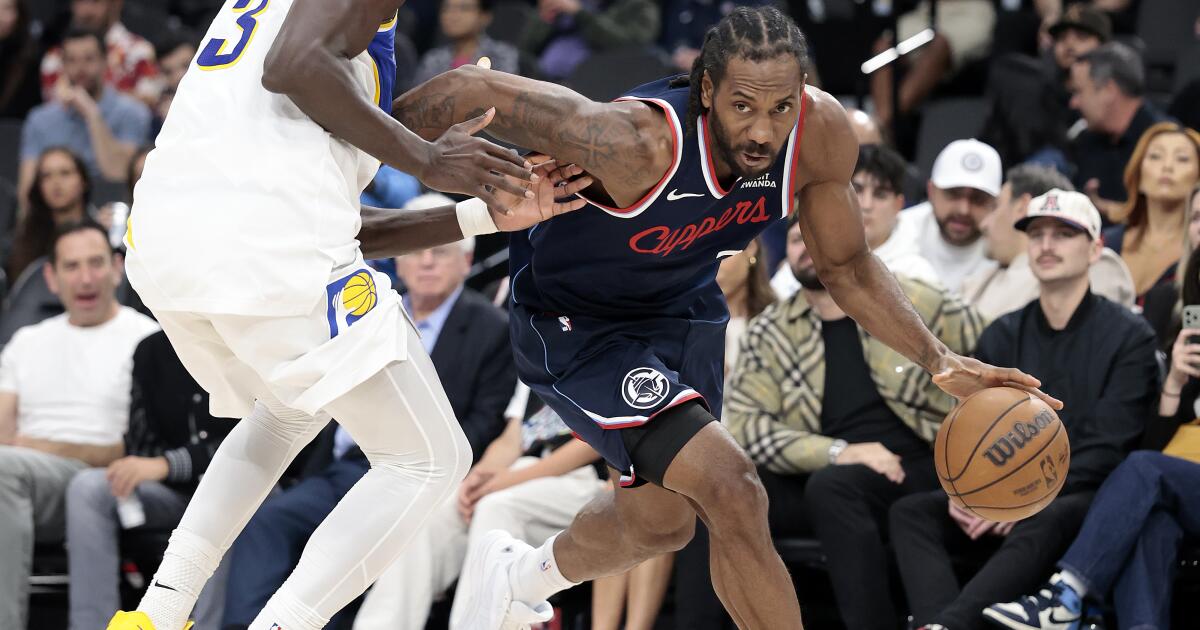
Kawhi Leonard scored 27 points and his three-point play with two seconds remaining lifted the Clippers to a 105-102 victory over the Houston Rockets on Wednesday night.
Leonard, who had 12 rebounds, scored 19 points in the fourth quarter to extend his career-best streak of 20-point games to 33.
The Clippers (26-28) led by four points when Kevin Durant made one of two free throws before a layup by Alperen Sengun cut the lead to 102-101 with 43 seconds left. Leonard missed a three-pointer and Jabari Smith Jr. grabbed a rebound to give Houston (33-20) the ball.
1937 — Cleveland is granted an NFL franchise. The Rams play in Cleveland for nine years before moving to Los Angeles. After the 1994 season, the Rams move to St. Louis.
1947 — Boston’s Bill Cowley becomes the NHL all-time scoring leader when he scores a goal and an assist for the Bruins in a 10-1 win over the New York Rangers. Cowley’s 529 points is one more than Syd Howe, who retired one year earlier.
1958 — Boston’s Bill Russell scores 18 points and grabs 41 rebounds to lead the Celtics to a 119-101 victory over the Syracuse Nationals.
1968 — Jean-Claude Killy of France wins the men’s giant slalom in the Winter Olympics at Grenoble, his second gold medal en route to the Alpine triple crown.
1972 — The Soviet Union ice hockey team wins the gold medal with a 5-2 victory over Czechoslovakia at the Winter Olympics. The United States is awarded the silver because it had beaten and tied Czechoslovakia.
1982 — Wayne Gretzky scores 153rd point of season, breaking NHL record.
1985 — Pittsburgh’s Mario Lemieux becomes the first rookie to be named most valuable player at the NHL All-Star game. The 19-year-old center scores two goals, including the game-winner, and has an assist to lead the Wales Conference to a 6-4 win over the Campbell Conference.
1989 — The largest crowd (44,735) in NBA All-Star Game history turns out at the Houston Astrodome to watch the West beat the East 143-134. Utah’s Karl Malone win MVP honors after scoring a team-high 28 points.
1993 — The San Jose Sharks tie an NHL record by losing 17 straight games, the latest a 6-0 defeat by the Edmonton Oilers.
1994 — Loy Allen Jr. becomes the first Winston Cup rookie to win a pole in the Daytona 500. Allen is .031 seconds quicker than six-time NASCAR Winston Cup champion Dale Earnhardt.
1995 — Sacramento’s Mitch Richmond scores a game-high 22 points and wins MVP honors in leading the West to a 139-112 triumph over the East in the NBA All-Star Game at America West Arena in Phoenix.
1997 — Morocco’s Hicham el Guerrouj breaks indoor track’s oldest record, winning the mile in 3 minutes, 48.45 at the Flanders meet held in Ghent, Belgium. Ireland’s Eamonn Coghlan ran 3:49.78 in 1983 in New York.
2005 — Allen Iverson scores 60 points, a career high, to lead the Philadelphia 76ers to a 112-99 victory over the Orlando Magic.
2007 — Duke, saddled by its first four-game losing skid in 11 years, falls out of The Associated Press men’s poll for the first time since the end of the 1995-96 season. The Blue Devils had been in the media poll for 200 straight weeks — the second longest streak behind UCLA’s record 221 weeks.
2014 — Tina Maze of Slovenia and Dominique Gisin of Switzerland tie for gold in the Olympic women’s downhill. Both speed down the Rosa Khutor course in 1:41.57 seconds for the first gold-medal tie in Olympic alpine skiing history.
2018 — Virginia is ranked No. 1 in the Associated Press men’s basketball poll for first time since 1982, when Terry Holland was the coach and Ralph Sampson was the Cavaliers’ star player.
2018 — Dutch speed skater Ireen Wüst becomes first Winter Olympian to win an individual gold medal in 4 straight Games with victory in the 1,500m at Pyeongchang; first speed skater to win 10 Olympic medals.
2023 — Super Bowl LVII, State Farm Stadium, Glendale, Arizona: Kansas City Chiefs beat Philadelphia Eagles, 38-35; MVP: Patrick Mahomes, KC, QB.
Compiled by the Associated Press
Until next time…
That concludes today’s newsletter. If you have any feedback, ideas for improvement or things you’d like to see, email me at houston.mitchell@latimes.com. To get this newsletter in your inbox, click here.
EAST LANSING, Mich. — Lauren Betts had 22 points, seven rebounds and five assists and No. 2 UCLA pushed its winning streak to 18 games by thumping No. 13 Michigan State 86-63 on Wednesday night.
Kiki Rice finished with 18 points and seven rebounds for the Bruins (24-1, 14-0 Big Ten). Gabriela Jaquez added 13 points, all in the first half, and Gianna Kneepkens chipped in 12.
UCLA now has nine wins over ranked opponents, six in conference play.
Rashunda Jones scored 15 points and Emma Shumate had 12 for the Spartans (20-5, 9-5), who have dropped three of their last four games. Grace VanSlooten and Kennedy Blair, the team’s top scorers entering the game, were held to a combined 18 points on six-for-25 shooting.
UCLA, which led by 31 points, outscored Michigan State 56-22 in the paint and had a 48-28 rebounding advantage.
Their matchup last season in Los Angeles wasn’t decided until late in the game, when the Bruins pulled out a 75-69 victory. Betts missed that game with a foot injury but the Spartans couldn’t avoid her imposing 6-foot-7 presence this time.
Coming off a hotly contested 69-66 victory over No. 8 Michigan on Sunday, the Bruins were in total control from the start.
UCLA scored on its six first possessions while powering to a 44-20 halftime lead, capped off by Jaquez’s three-pointer. Betts had 13 points by the break, while the Spartans were unable to get anything going in halfcourt sets or transition.
Michigan State hasn’t defeated a top-two team at home since 2005.
For nearly all of his 11 seasons, Rob Havenstein was a Rams mainstay at right tackle.
He started two Super Bowls, winning one, and provided sage wisdom and experience for younger players in what would be his final season in 2025.
On Tuesday, Havenstein, 33, announced he was retiring.
“What a ride it’s been!” Havenstein wrote in a post on Instagram. “I can look back on my career and smile knowing I have given everything I had and more to the game I love.
“In saying that, I am officially retiring from the NFL.”
Havenstein, the longest-tenured Rams player on the roster last season, thanked his teammates and coaches, the Rams organization and his parents and wife for their support.
The 6-foot-8 Havenstein, grew up in Maryland and was a second-round pick by the Rams out of Wisconsin in 2015.
He started 13 games as a rookie, and then moved with the team from St. Louis to Los Angeles.
Havenstein started 148 regular-season games and 13 playoff games, including the Rams’ victory over the Cincinnati Bengals in Super Bowl LVI at SoFi Stadium to cap the 2021 season.
Due to injuries, Havenstein was limited to 14 games in 2023, 11 in 2024 and seven this past season.
Yet the four-time captain was a constant presence, and helped Warren McClendon Jr. develop into a consistent starter.
After the season, coach Sean McVay described Havenstein and tight end Tyler Higbee, who also completed the final year of his contract, as “all-time Rams.” McVay said the team would give the players time to digest the season and decide what might be next.
For Havenstein, that is retirement.
“As this chapter ends,” he wrote, “I couldn’t be more grateful, hopeful, and excited to see what comes next!”
L.A. County voters will be asked this June to hike the sales tax rate by a half-cent to soften the blow of federal funding cuts on the region’s public health system.
The county Board of Supervisors voted 4 to 1 Tuesday to put the sales tax on the ballot. County officials estimate it would generate $1 billion per year to replenish the shrinking budgets of local hospitals and clinics. The tax, if approved by voters this summer, would last for five years.
The supervisors say the increased tax — a half-cent of every dollar spent — would offset major funding cuts in the One Big Beautiful Bill Act, which is expected to slash more than $2 billion from the county’s budget for health services over the next three years.
“Millions of people look to us to step up even when the federal government has walked away,” said Supervisor Holly Mitchell, who introduced the ballot proposal along with Supervisor Hilda Solis.
The tax was pushed by Restore Healthcare for Angelenos, a coalition of healthcare workers and advocates, who argue it is necessary to ward off mass layoffs of healthcare workers and keep emergency rooms open.
Mitchell said she was trying to make sure supervisors learned their lesson from the closure of Martin Luther King Jr./Drew Medical Center in 2007, which ripped a gaping hole in the health system for South L.A. residents who had to travel farther to more crowded emergency rooms.
“People died as a result of that,” she said. “I don’t want to go back there.”
Supervisor Kathryn Barger cast the lone no vote, saying she believed the county should look to the state for help rather than taxpayers. She also said she was concerned the tax money was not earmarked for healthcare costs but rather would go into the general fund, giving officials more discretion over how it gets spent.
“We are not, as a whole, credible when it comes to promises made, promises broken,” she said.
Members of the audience hold up signs inside the county Hall of Administration, where supervisors discussed how to replenish more than $2 billion in federal funding cuts to the county healthcare system.
(Myung J. Chun / Los Angeles Times)
As part of the tax hike, voters would be asked to also approve the creation of an oversight group to monitor how the money is spent. The supervisors also voted on a spending plan for the money, which would have the largest chunk of funds go to care for uninsured residents.
Los Angeles County currently has a sales tax of 9.75% with cities adding their own sales tax on top. If the healthcare hike passes this summer, the sales tax would be more than 11% in some cities. Palmdale and Lancaster, some of the poorest parts of the county, would potentially have the highest sales tax of 11.75%.
County public health officials painted a grim picture of what life looks like for the poorest and sickest residents if new money doesn’t flow into the system. Emergency rooms could be shuttered, they warned. Contact tracing and the daily testing of ocean water quality could slow down. Tens of thousands of health workers could lose their jobs, they said.
“The threat is real already,” said Barbara Ferrer, the head of the county Department of Public Health.
Some on Tuesday condemned the measure as well-intentioned but ill-formulated. The California Contract Cities Assn., a coalition of cities inside Los Angeles County, argued a larger sales tax would “disproportionately burden the very residents the County seeks to protect.”
“My phone has been blowing up,” said Janice Hahn, one of two supervisors who said the Citadel Outlets, a large shopping mall in City of Commerce, called to say they were worried shoppers were going to start crossing county lines.
With the effects of the federal cuts expected to be felt across the state, other California counties have already started to look to consumers to replenish government coffers. Last November, Santa Clara County voters approved a similar sales tax measure to raise money for the public health system.
Los Angeles police officers must turn on their body cameras at the scene of federal immigration enforcement operations and preserve the footage, according to an executive directive issued by Mayor Karen Bass on Tuesday.
Since June, federal immigration raids have disrupted neighborhoods and communities across Los Angeles and around the nation, including at work sites, along neighborhood streets and in commercial areas.
Often, police officers have responded to the scene to try to keep order amid tensions between immigration agents and community members.
“The point that we’re trying to make here is that ICE enforcement is not welcome here,” Bass said at a news conference Tuesday morning. “We have resisted against it since this terror started, and we will continue to do that.”
In addition to recording the federal immigration agents’ actions, LAPD officers must document the name and badge number of the agents’ on-scene supervisor, summon emergency personnel if someone at a scene is injured and take reports from the public about federal agents’ alleged misconduct, Bass’ five-page directive states.
The directive also prohibits federal immigration agents from using city property and imposes a fee on owners who allow federal agents to use private property.
The effort builds on a previous Bass directive that aimed to restrict the city from assisting federal immigration agents. The LAPD has a long-standing policy that its officers should not be involved in immigration enforcement.
The Department of Homeland Security did not immediately respond to a request for comment.
Bass noted that officers are supposed to turn on their body cameras anyway, including when they’re responding to a call from the public or when another law enforcement agency asks for assistance.
“We’re saying we really want you to do that, even if you are there and there’s not a disturbance that breaks out, if you’re there on the scene,” Bass said.
The LAPD did not immediately provide comment. The Los Angeles Police Protective League, which represents rank-and-file LAPD officers, did not respond to a request for comment.
In Chicago, the mayor issued a similar directive in January, instructing the Police Department to “investigate and document” alleged illegal activity by federal agents, said Tania Unzueta, political director of Mijente, a national group that organizes within Latino and Chicano communities.
“ICE’s power must be challenged at every level, and local governments have a critical role to play in holding the line against federal enforcement,” Unzueta said.
But in Los Angeles, immigrant rights advocates expressed concerns about requiring the LAPD to police another agency.
Maegan Ortiz, executive director of the Institute of Popular Education of Southern California, or IDEPSCA, cited the LAPD’s history of using excessive force against civilians and said that in the recent immigration raids, officers have sometimes inflamed instead of defused tensions.
“Are they really the best people to determine what is excessive use of force, given the literal millions of dollars that we’re seeing paid out in settlement because of use of force by LAPD?” Ortiz said. “Can we trust this police department to police others when they can’t police themselves?”
James “Jim” Willis, a former LAPD detective who later worked for the L.A. Police Commission’s inspector general’s office, said he agreed with the directive’s intent: to bring greater accountability to Immigration and Customs Enforcement operations. But he has questions about how it would work in practice.
For one thing, he said, it’s unclear whether LAPD officers are supposed to respond whenever an ICE operation is underway. Doing so would put further strain on a department that is down hundreds of officers from a few years ago, he said.
It’s also unclear what will happen with the recorded footage.
“Who’s going to audit this?” he asked. “Do you now create a new group, a new division and new section?”
Since rolling out the tiny recording devices in 2015, the city has spent millions of dollars, both on the body cameras themselves and data storage for the digital files. LAPD officials have conceded that the vast majority of the footage gathered by officers goes unwatched, since there isn’t enough manpower to review it.
At Tuesday’s news conference, Jocelyn Duarte, executive director of the Salvadoran American Leadership and Educational Fund, praised Bass’ directive and called on the Los Angeles Board of Commissioners, which provides civilian oversight of the LAPD, to ensure that officers “protect Angelenos from lawless federal conduct.”
“Local law enforcement must not be complicit through silence or inaction when federal agents overstep legal and ethical boundaries,” Duarte said. “Now it is imperative that our commission and LAPD fully implement this directive and make it clear that our city will not allow for fear-based enforcement to define life in our neighborhoods.”
Ortiz said she is excited that the directive imposes fees on private property owners who allow federal immigration agents to use their property. The Institute of Popular Education of Southern California has been a leader in calling for a boycott against Home Depot, which has not taken a public stance against repeated raids at the day labor centers that the organization runs at the stores.
“I do think that something does need to be done with these huge billion-dollar corporations who are allowing this and are choosing to stay silent while their customers are being dragged away and disappeared,” Ortiz said.