WASHINGTON — Members of Congress clashed Thursday over President Trump’s use of the National Guard in American cities, with Republicans saying the deployments were needed to fight lawlessness while Democrats called his move an extraordinary abuse of military power that violated states’ rights.
Top military officials faced questioning over the deployments for the first time at the hearing before the Senate Armed Services Committee. They were pressed by Democrats over the legality of sending in troops, which in some places were done over the objections of mayors and governors, while Trump’s Republican allies offered a robust defense of the policy.
It was the highest level of scrutiny, outside a courtroom, of Trump’s use of the National Guard in U.S. cities since the deployments began and came a day after the president faced another legal setback over efforts to send troops to support federal law enforcement, protect federal facilities and combat crime.
“In recent years, violent crime, rioting, drug trafficking and heinous gang activity have steadily escalated,” said Mississippi Sen. Roger Wicker, the committee chairman. The deployments, he said, are “not only appropriate, but essential.”
Democrats argued they are illegal and contrary to historic prohibitions about the use of military force on U.S. soil.
Sen. Tammy Duckworth, D-Ill., had pushed for the hearing, saying domestic deployments traditionally have involved responding to major floods and tornadoes, not assisting immigration agents who are detaining people in aggressive raids.
“Trump is forcing our military men and women to make a horrible choice: uphold their loyalty to the Constitution and protect peaceful protesters, or execute questionable orders from the president,” said Duckworth, a combat veteran who served in the Illinois National Guard.
Military leaders point to training
During questioning, military leaders highlighted the duties that National Guard units have carried out. Troops are trained in community policing, they said, and are prohibited from using force unless in self-defense.
Since the deployments began, only one civilian — in California — has been detained by National Guard personnel, according to Air Force Gen. Gregory M. Guillot, commander of U.S. troops in North America. Guillot said the troops are trained to de-escalate tense interactions with people, but do not receive any specific training on mental health episodes.
“They can very quickly be trained to conduct any mission that we task of them,” Guillot said.
Republicans and Democrats see the deployments much differently
In one exchange, Sen. Mazie Hirono, D-Hawaii, noted how former Defense Secretary Mark Esper alleged that Trump inquired about shooting protesters during the George Floyd demonstrations. She asked whether a presidential order to shoot protesters would be lawful.
Charles L. Young III, principal deputy general counsel at the Defense Department, said he was unaware of Trump’s previous comments and that “orders to that effect would depend on the circumstances.”
“We have a president who doesn’t think the rule of law applies to him,” Hirono said in response.
Republicans countered that Trump was within his rights — and his duty — to send in the troops.
Republican Sen. Tim Sheehy of Montana, a former Navy SEAL officer, argued during the hearing that transnational crimes present enough of a risk to national security to justify military action, including on U.S. soil.
Sheehy claimed there are foreign powers “actively attacking this country, using illegal immigration, using transnational crime, using drugs to do so.”
Senators also offered their sympathies after two West Virginia National Guard members deployed to Washington were shot just blocks from the White House in what the city’s mayor described as a targeted attack. Spc. Sarah Beckstrom died a day after the Nov. 26 shooting, and her funeral took place Tuesday. Staff Sgt. Andrew Wolfe is hospitalized in Washington.
Hearing follows court setback for Trump
A federal judge in California on Wednesday ruled that the administration must stop deploying the California National Guard in Los Angeles and return control of the troops to the state.
U.S. District Judge Charles Breyer granted a preliminary injunction sought by California officials, but also put the decision on hold until Monday. The White House said it plans to appeal.
Trump called up more than 4,000 California National Guard troops in June without Democratic Gov. Gavin Newsom’s approval to further the administration’s immigration enforcement efforts.
The move was the first time in decades that a state’s National Guard was activated without a request from its governor and marked a significant escalation in the administration’s efforts to carry out its mass deportation policy. The troops were stationed outside a federal detention center in downtown Los Angeles where protesters gathered and were later sent on the streets to protect immigration officers as they made arrests.
Trump also had announced National Guard members would be sent to Illinois, Oregon, Louisiana and Tennessee. Other judges have blocked or limited the deployment of troops to Portland, Oregon, and Chicago, while Guard members have not yet been sent to New Orleans.
Klepper, Finley and Groves write for the Associated Press. AP writer Konstantin Toropin contributed to this report.
A federal judge ruled Wednesday that the Trump administration must immediately end the deployment of the National Guard in Los Angeles, the latest legal blow to the president’s embattled efforts to police American streets with armed soldiers.
Senior U.S. District Judge Charles R. Breyer said in his ruling that command of the remaining 300 federalized National Guard troops must return to Gov. Gavin Newsom, who sued the administration in June after it commandeered thousands of troops to quell protests over immigration enforcement in Los Angeles.
On June 12, Breyer ruled that deployment illegal — a decision that was challenged and ultimately reversed by the 9th Circuit Court of Appeals. The court said the esoteric statute Trump invoked to wrest command of the Guard from the governor afforded him “a great level of deference” to determine whether a rebellion was underway in Los Angeles, as the Justice Department claimed at the time.
The same sequence repeated this autumn in Oregon, where 200 California Guard troops were sent to help quash demonstrations outside an ICE facility.
Unlike in California, the Oregon decision was vacated amid claims the Justice Department inflated the number of federal protective personnel it said were detailed to Portland and misrepresented other facts to the court.
The decision is now under review by a larger panel of the 9th Circuit, while the Supreme Court weighs an almost identical challenge to the deployment in Illinois.
In both cases, conservative judicial appointees have signaled skepticism about the president’s authority to order boots on the ground, and to keep troops federalized indefinitely.
“States are not only owed protection by the federal government, they are owed protection from it,” Judge Jay Bybee wrote in a lengthy filing Tuesday in support of the 9th Circuit review. “There is no greater threat to the sovereignty of the states than an assertion of federal control over their domestic affairs.”
The “domestic violence” clause of the Constitution was part of a careful compromise between its framers allowing the president to deploy armed soldiers against citizens “only as a last resort,” the judge argued. The president should be compelled to provide some proof of his claims and the states should be empowered to test it — “particularly in the face of contrary evidence.”
That position earned him a sharp rebuke from the court’s newest member, Trump appointee Judge Eric Tung, who echoed the administration’s claim that its deployments were “unreviewable” by the courts.
A demonstrator interacts with U.S. Marines and National Guard troops standing in line at the entrance of the Metropolitan Detention Center following federal immigration operations in July.
(Etienne Laurent / AFP via Getty Images)
Their exchange reflects a deepening rift on the 9th Circuit, once the most liberal appellate division in the United States.
Trump remade the 9th Circuit in his first term, naming 10 judges to the bench. Those picks were largely curated by Leonard Leo of the libertarian-leaning Federalist Society.
But Leo has since lost favor to Tung’s longtime friend Mike Davis of the Article III Project, whose recommendations tack well to the right of his predecessor, experts said.
Still, infighting on the appellate bench is far from the only hurdle facing Trump’s domestic deployments.
In October, the Supreme Court ordered both the administration and the state of Illinois to address a theory by Georgetown University law professor Martin S. Lederman, who argued the statute only allows presidents to federalize the National Guard after they send in the army.
“If the court wants to rule against Trump on this, that’s the least offensive way,” said Eric J. Segall, a professor at Georgia State College of Law. “It’s a way to avoid all factual determinations for the moment.”
But such a ruling could open the door to even more aggressive military action in the future, he and others warn.
“If the Supreme Court comes in and says, ‘you have to use the active duty military before you can use the National Guard,’ it has the effect of saying everything that happened until now [was illegal],” said David Janovsky from the Project on Government Oversight. “But then you have the prospect of more active duty troops getting deployed.”
Congress, too, is taking a fine-toothed comb to Trump’s troop cases. The Senate Armed Services Committee is set to hear testimony Thursday from military top brass about repeated domestic deployments.
“Across the United States, Donald Trump has illegally deployed our nation’s servicemembers into American cities under unclear and false pretexts and despite the costs to our military and civil rights,” Sen. Tammy Duckworth (D-Ill.) said in a statement announcing the hearing. “The American people and our troops deserve answers.”
Meanwhile, the Trump administration has continued to broaden its claims of executive power in court.
In recent weeks, Department of Justice lawyers have argued that, once federalized, state Guard troops would remain under the president’s command in perpetuity. Breyer called that position “contrary to law” in his ruling Wednesday.
“Defendants’ argument for a president to hold unchecked power to control state troops would wholly upend the federalism that is at the heart of our system of government,” Breyer wrote.
California leaders cheered Wednesday’s ruling as a turning point in what until now has been an uphill legal battle to constrain the president’s use of state troops. The order was set to take effect on Monday, though it was all but certain to be appealed to the 9th Circuit.
“The President deployed these brave men and women against their own communities, removing them from essential public safety operations,” Newsom said in a statement Wednesday morning. “We look forward to all National Guard servicemembers being returned to state service.”
Atty. Gen. Rob Bonta called it “a good day for our democracy and the strength of the rule of law.”
Still, some legal scholars and civil liberties experts warn repeated deployments — and the slogging court battles that attend them — could inure the public to further politicization of the military around the midterms.
“The sense of normalization is probably part of the plan here,” Janovsky said. “Having troops trained for war on the streets of American cities puts everyone at more risk. The more we normalize the blurring of those lines, the higher the risk that troops will be used for inappropriate purposes against the American people.”
Times staff writers Kevin Rector and Jenny Jarvie contributed to this report.
The NFL is advocating a more performance-driven model for its game officials, one linking bonuses and postseason assignments to regular-season grades as opposed to seniority.
The plan was outlined in a memo distributed to the league’s 32 teams Wednesday and obtained by the Los Angeles Times. It comes with the NFL’s collective bargaining agreement with game officials expiring at the end of May and negotiations slowed to a crawl.
The topic was part of a two-hour virtual owners meeting on Wednesday.
In the memo, sent by NFL Executive Vice President of Football Operations Troy Vincent and Management Council General Counsel Lawrence Ferazani Jr., the league said it is looking to implement changes that will “improve the performance of game officials, increase accountability, and ensure that the highest-performing officials are officiating our highest profile games.”
The NFL is pushing for mandatory training and development programs for low-performing and probationary officials, and contends the union is “resisting our efforts to give these officials access to more practice repetitions.”
The league is also seeking to extend the probationary period for assessing new game officials to have more flexibility to identify and remove those who are underperforming. According to the document, the union’s latest proposal seeks to eliminate the probationary period entirely.
“Our union’s negotiating committee is working diligently on behalf of members, and we will continue to respect that process,” said Scott Green, Executive Director of the NFL Referees’ Assn., in a statement. “We look forward to our continued conversations with the league as we make progress towards a new CBA.”
As it stands, the NFL has no communication with game officials following the Super Bowl through May 15. The league wants to shorten that so-called “dead period” and increase access to officials for rules discussions, video review and the like.
The league is also proposing a practice squad for game officials to deepen the bench of talent.
The next formal bargaining session between the NFL and officials union is scheduled for Dec. 30 in Atlanta.
Turned out, they were quietly plotting one of the most surprising — and influential — signings of the winter.
In a blockbuster move on Tuesday, the team agreed to a three-year, $69-million deal with top free-agent closer Edwin Díaz, according to multiple people with knowledge of the situation not authorized to speak publicly, snatching the three-time All-Star and three-time reliever of the year award winner in a move that will transform their previously shaky bullpen.
Díaz, 31, was the consensus best relief pitcher in this year’s free-agent class. Over his nine-year career, he has a 2.82 ERA and 253 saves. In that time, no other MLB reliever tops him in strikeouts (839), while only Kenley Jansen has recorded more saves (334). With the New York Mets this past season — his second since returning from a knee surgery that sidelined him for all of 2023 — Díaz also had one of his best career campaigns, posting a 1.63 ERA with 28 saves in 31 opportunities and 98 strikeouts in 66 ⅓ innings.
He was so good, he elected to opt out of the final two years of the record-setting five-year, $102-million deal he signed with the Mets in 2022.
Thanks to that track record, the hard-throwing right-hander was positioned to be the highest-paid reliever on this year’s market. Most projections pegged him for another four- or five-year deal, making upward of $20 million per season again.
From Ben Bolch: Nine months before his debut in his first big-time college football coaching job, Bob Chesney sounded as confident as a running back with four downs to gain one yard.
Nothing could stop him, no matter the weight of the unique challenges ahead.
For instance…
How did he feel about UCLA’s lack of recent football success?
“To me,” Chesney said, “there is zero doubt in my mind that we can win here.”
A perceived lack of institutional support?
“Alignment,” Chesney said, referencing his shared vision with university officials, “was a word that continued to show up over and over and over again.”
“We don’t need to be the other school in this town,” Chesney said, “we need to be the school in this town and I promise that will happen here in the very, very near future.”
From Ryan Kartje: When they first met more than four decades ago now, the four freshmen on the University of San Diego’s men’s basketball team in 1983 didn’t need long to figure out who would lead them. Eric Musselman had all but elected himself within moments of moving into their dorm room.
“Before I could even drop my bag on the bed, Eric goes, ‘OK, we’re going to the gym,’” recalled Scott Thompson, San Diego’s 7-foot center. “He’d barely said hello.”
It didn’t matter that, at 5-foot-7, Musselman — the future USC men’s basketball coach — was more than a foot shorter than his freshman counterparts, with the other two checking in at 6-foot-11 and 6-foot-9. Or that Musselman carried himself with a swagger and confidence more befitting, even then, of a coach than a college freshman. He was so sure of himself, he actually pitched himself for the head coaching job as a sophomore.
“Father [Pat] Cahill was our athletic director,” Musselman said. “So before they named our new coach [in 1984], I went in there and told him, ‘Hey I think I can coach these guys and be a student athlete and a coach, and it’d be great publicity, the first time ever and all that.”
From Sam Farmer: These are not your grandfather’s Indianapolis Colts.
Or perhaps they are.
The Colts are planning to sign Chargers legend Philip Rivers, who recently became a grandfather, bringing back the 44-year-old quarterback after five years of retirement.
From Eric Sondheimer: It was paparazzi time on Tuesday night at the old Morningside High gymnasium, where more than 20 photographers stationed themselves on the baseline trying to capture the moment Jason Crowe Jr. of Inglewood set the state record for career scoring by a high school basketball player.
Think Chino Hills days with the Ball brothers and Sierra Canyon days with Bronny James to bring out the cameras en masse.
The 6-foot-4 senior and son of Inglewood coach Jason Crowe Sr. needed 29 points to pass the 3,659 career points accumulated by Tounde Yessoufou of Santa Maria St. Joseph.
Beckett Sennecke scored a shorthanded goal with one second remaining to force overtime, Leo Carlsson scored in the shootout and the Ducks beat the Pittsburgh Penguins 4-3 on Tuesday night for their fifth win in seven games.
The 19-year-old Sennecke eluded three defenders and his shot deflected off the glove of Pittsburgh’s Erik Karlsson and into the net. A replay review confirmed the shot beat the buzzer.
Ville Husso made 45 saves, including seven in overtime, and stopped all three shots in the shootout.
1939 — The Green Bay Packers register the first shutout in an NFL championship game by beating the New York Giants 27-0.
1961 — Billy Cannon of the Houston Oilers rushes for 216 yards, catches five passes for 114 yards and scores five touchdowns in a 48-21 victory over the New York Titans. Cannon finishes with 373 combined yards.
1971 — Kareem Abdul-Jabbar scores a career-high 55 points in Milwaukee’s 120-104 victory over the Boston Celtics.
1982 — Michael Dokes knocks out Mike Weaver in the first round to capture the WBA heavyweight title in Las Vegas.
1985 — The Indiana Pacers hits only 19 field goals in an 82-64 loss to the New York Knicks, setting an NBA record for the fewest field goals made by one team since the inception of the shot clock.
1986 — Atlanta’s Dominique Wilkins scores 57 points to lead the Hawks to a 123-95 rout of the Chicago Bulls.
1992 — The NHL awards expansion franchises to Anaheim and Miami. The newcomers, scheduled to begin play in the 1993-94 season, bring the NHL to 26 teams.
1994 — Art Monk sets an NFL record for consecutive games with a reception on New York’s first play in the Jets’ 18-7 loss to the Detroit Lions. Monk’s 5-yard catch gives him 178 consecutive games with a reception, breaking Steve Largent’s NFL mark.
1999 — Laffit Pincay Jr. guides Irish Nip to a two-length victory in the sixth race at Hollywood Park for his 8,834th victory, breaking Bill Shoemaker’s 29-year-old record and making him the world’s winningest jockey.
2006 — LaDainian Tomlinson breaks Shaun Alexander’s NFL single-season touchdown record of 28 when he scores three times in the San Diego Chargers’ 48-20 victory over the Denver Broncos. Tomlinson has 26 TDs rushing and three receiving.
2006 — Marvin Harrison of Indianapolis is the fourth player in NFL history with 1,000 receptions, joining Jerry Rice, Tim Brown and Cris Carter.
2008 — Carmelo Anthony matches George Gervin’s NBA record for points in a quarter with 33 in the third and finishes with a season-high 45 points in Denver’s 116-105 victory over Minnesota.
2010 — George Karl earns his 1,000th coaching victory, the seventh coach in NBA history, as Al Harrington scores a season-high 31 points and Nene adds 26 to help the Denver Nuggets hold off the Toronto Raptors 123-116.
2016 — 82nd Heisman Trophy Award: Lamar Jackson, Louisville Cardinals (QB), youngest player to win at 19.
2016 — Army ends a 14-year run of frustration against Navy, using an overpowering running game and opportunistic defense to carve out a long overdue 21-17 victory.
2016 — Roman Torres scores in the sixth round of penalty kicks to give the Seattle Sounders their first MLS Cup title, 5-4 over Toronto FC after 120 scoreless minutes. It’s the first MLS Cup final to fail to produce a goal in regulation, setting the stage for a dramatic tiebreaker.
2017 — Ben Roethlisberger completes 44 of a franchise-record 66 passes for 506 yards and two touchdowns, becoming the first quarterback in NFL history to top 500 yards passing three times and leading Pittsburgh past Baltimore 39-38. Antonio Brown caught 11 passes for 213 yards for Pittsburgh.
Compiled by the Associated Press
Until next time…
That concludes today’s newsletter. If you have any feedback, ideas for improvement or things you’d like to see, email Houston Mitchell at houston.mitchell@latimes.com. To get this newsletter in your inbox, click here.
Los Angeles County’s inspector general is retiring as chief watchdog for the Sheriff’s Department, stepping down from the post he has held since it was first created a dozen years ago.
Max Huntsman, 60, announced his plans in a letter Tuesday.
“It has been my honor to work with a talented, brave, and tireless group of public servants to ensure that the public knows what its government is doing,” he wrote.
Huntsman, a former L.A. County prosecutor, also included comments that were critical of how the county has responded to efforts at civilian oversight of the Sheriff’s Department.
Time and again, he wrote, efforts by his office “were ignored” by county leaders.
“The county is putting all its efforts into convincing the public and the courts that it is following the law and has no room to honestly evaluate itself and make the changes it would need to really follow those laws,” Huntsman told The Times in a message early Tuesday. “That’s not compatible with my oath of office.”
In stacks of detailed reports, the inspector general’s office has described a wide range of abuses and failures by the Sheriff’s Department, the L.A. County Probation Department and county leaders. Huntsman’s office has documented poor conditions in L.A. County’s jails, called out the Sheriff’s Department’s for noncompliance with portions of of the Prison Rape Elimination Act, and criticized the inability or unwillingness of sheriff’s department officials to rein in so-called deputy gangs, whose tattooed members have repeatedly been accused of misconduct.
The Inspector General’s Office has independently probed hundreds of on-duty shootings by deputies, along with other use of force incidents. Under Huntsman’s direction, the office also scrutinized deficiencies in the county’s skilled nursing facilities during the early days of the COVID-19 epidemic.
In 1991, Huntsman graduated from Yale Law school and immediately joined the L.A. County District Attorney’s Office. A father of two, he served as a deputy district attorney for 22 years, prosecuting political corruption, police misconduct and fraud cases before leaving the courtroom for the helm of the new Office of Inspector General.
One of the main reasons the Sheriff’s Department is still plagued by many of the problems Huntsman confronted when he first became inspector general, he wrote in the Tuesday letter, has been the county’s reluctance to swiftly implement many of his office’s recommendations.
“In my twelve years at this work, I have longed for the day that the county would address the conditions in our reports without a court fight,” he wrote. “Some things never change.”
The Inspector General’s Office is now expected to undergo a sea change with the retirement of the only leader it has ever had.
Huntsman is the latest in a recent string of oversight officials to abruptly depart from their posts. In June, L.A. County Civilian Oversight Commission Chair Robert Bonner told the public that county officials were terminating him from the position. Earlier this year, Sean Kennedy, a member of the commission and its former chair, resigned over what he described as undue county interference in the commission’s activities.
The oversight bodies themselves also have faced cuts. In August, a county office proposed eliminating the Sybil Brand Commission, which conducts civilian oversight of the largest county jail system in the U.S. The county also announced that it would be reassigning or eliminating about a third of Huntsman’s staff.
Yet Huntsman and other county oversight officials continued to advocate for change. For instance, in October, state lawmakers approved Assembly Bill 847. The law will allow oversight commissions across the state, including L.A. County’s Civilian Oversight Commission, to view confidential documents in closed session.
“When government abuses occur, they are sometimes kept secret, but that is no longer the case for much of what is happening in Los Angeles County,” Huntsman wrote at the end of his Tuesday letter. “What you do about it is up to you.”
It was just last Friday that Netflix announced a blockbuster $72-billion deal to acquire Warner Bros. film and television studios, HBO and HBO Max — a tie-up that could fundamentally change Hollywood.
Yet on Monday, the stakes got even higher, as Paramount swooped in with a $78-billion hostile takeover bid it plans to take directly to Warner Bros. Discovery’s shareholders.
Paramount Chief Executive David Ellison called the Netflix deal an “inferior proposal,” saying in a statement that it “exposes shareholders to a mix of cash and stock, an uncertain future trading value of the Global Networks linear cable business and a challenging regulatory approval process.”
It all sets the stage for a long and potentially bruising fight. And the Netflix deal would have to overcome some significant regulatory hurdles, experts told me.
“This is a deal that never should have left the boardroom,” said David Balto, an antitrust attorney and a former policy director at the Federal Trade Commission during the Clinton administration. “The competitive concerns are profound. This is going to face a lot of opposition at the Justice Department.”
For one, antitrust regulators are expected to scrutinize the market share that would be controlled by a combined Netflix and HBO Max.
You’re reading the Wide Shot
Samantha Masunaga delivers the latest news, analysis and insights on everything from streaming wars to production — and what it all means for the future.
Netflix outlasted its rivals in the so-called streaming wars to become the dominant platform in a crowded space. That position has led to concern that gobbling up HBO Max would give Netflix outsized power in the streaming space — potentially more than 30% — which would cross a threshold under antitrust law, according to a recent letter from Rep. Darrell Issa (R-Vista) to Atty. Gen. Pam Bondi and Federal Trade Commission Chairman Andrew N. Ferguson.
Netflix executives have argued that analysis of its market share should include YouTube.
In a UBS investor conference Monday, Netflix Co-Chief Executive Greg Peters pointed to Nielsen data, which show Netflix’s shares of U.S. TV viewing is still behind YouTube‘s. Netflix represents just 8% of U.S. TV viewing in October, behind YouTube’s 12.9%.
If Netflix were to combine with Warner Bros. Discovery’s 1.3% share of U.S. TV viewing, its 9.2% would still be less than that of YouTube. (Other Nielsen data show that Warner Bros. Discovery channels have greater viewership, but Netflix is only interested in one channel, HBO).
“We think there’s a strong fundamental case here for why regulators should approve this deal,” Peters said. (The deal’s overall value is $82.7 billion due to the absorption of debt)
But who would regulators consider a competitor to Netflix? Is it YouTube, with its emphasis on shorter-form content? Or would the main competitors be other streaming services with films and series, like Disney+, Paramount+ and Peacock?
“The analytical issue there is, how do you define the market?” said George Hay, a professor of law at Cornell University and former director of economics in the Justice Department’s antitrust division. “What is their combined market share, what do they compete in and what are the alternatives available to consumers?”
The consumer angle would also invite involvement from the Federal Trade Commission. With a shrinking marketplace, the agency would likely investigate whether this could increase streaming prices for customers.
“What keeps Netflix honest is knowing there’s an HBO Max that’s right over its shoulder,” Balto said. “But once they get rid of that, they can lead the easy life, and the need to cut prices or provide better services or bid aggressively for film content — all of that will be diminished.”
Meanwhile, Hollywood unions and the Cinema United trade group have also raised concerns that a Netflix ownership of Warner Bros. would lead to fewer films being released in theaters, due to the company’s longstanding resistance to traditional movie releases. Netflix has said it would honor Warner Bros.’ theatrical release commitments and that future films without those existing deals will also go to theaters.
Beyond the U.S. concerns, Netflix would also need the blessing of regulators across the globe, and could be challenged by even state attorneys general who might have a significant number of entertainment workers in their areas who would question the effect on industry jobs.
Then, there’s the politics of it all.
President Trump himself has said he “would be involved” in his administration’s decision to bless any deal and that the combined market share of Netflix and Warner Bros. “could be a problem.”
As my colleagues Meg James and Stacy Perman have reported, Trump has openly favored Paramount’s bid for Warner Bros. Discovery, though word of Paramount backer Larry Ellison’s close ties with Trump dampened enthusiasm for the bid in Hollywood. Trump’s son-in-law, Jared Kushner, is now also one of the investors participating in the renewed Paramount bid.
Despite this involvement, the Trump administration may not have the final say on the deal, just as in the case of the AT&T deal for Time Warner.
For his part, Netflix Co-Chief Executive Ted Sarandos has also been trying to make his own case to Trump and ventured to the White House last month, Bloomberg reported.
“It’s a case in which the political issues are going to play a role,” Hay said. “They’re so front and center, and Trump has shown an inclination to get involved.”
About the only thing that’s clear is that it’s not going to be a quick process.
“This entire matter is not going to get resolved in a hurry,” said Corey Martin, managing partner at Granderson Des Rochers. “The resolution of this matter is very likely to take place over months and potentially years, and not days and weeks.”
Stuff We Wrote
Film shoots
Number of the week
Universal Pictures and Blumhouse-Atomic Monster’s horror sequel “Five Nights at Freddy’s 2” ruled the domestic box office this weekend with a $63 million haul in the U.S. and Canada. While it doesn’t surpass the first movie’s $80 million opening weekend in 2023, it’s a massive boost for theaters, which have seen a string of slower months.
Menacing animatronic figures weren’t the only thing that brought moviegoers to theaters this weekend. Disney’s animated “Zootopia 2” brought in about $43 million domestically in its second outing. Globally, the sequel has now brought in a total of $915 million.
The strong recent showings for films such as “Zootopia 2” and “Wicked: For Good” have helped push 2025’s year-to-date domestic box office total to a little over $8 billion, up just barely — 0.8%, in fact — compared with last year.
Welcome back to The Times’ Lakers newsletter, where everyone needs to catch up on sleep.
Despite arriving in Boston and Philadelphia at 2:30 a.m. on Friday and Saturday, respectively, and with some players not falling asleep until 4 a.m., the Lakers salvaged a 2-1 record during their difficult three-game, four-day Eastern Conference road trip. With wins over Toronto and the 76ers, the Lakers (17-6) maintained second place in the West entering the knockout stage of NBA Cup action.
When your job requires so much travel, everyone develops their own hacks. Travel-sized skin-care products hate to see me coming. For Jaxson Hayes, it’s a meticulously planned two-and-a-half-hour nap before every game.
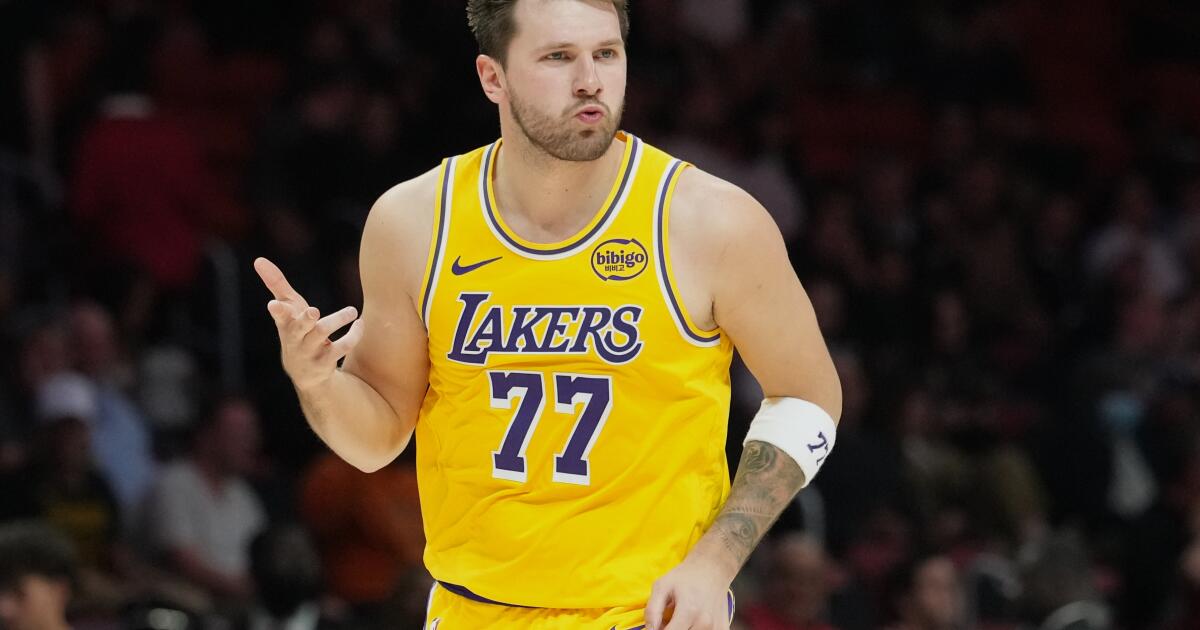
Luka Doncic, for one, could have used one of those this week.
All things Lakers, all the time.
He’s a girl(s) dad
Doncic rubbed his weary eyes, ran his hands through his hair and blinked hard as he tried to piece together the details of the last week. New parents know the feeling.
After missing two games while in his native Slovenia for the birth of his second daughter, Doncic rejoined the team Saturday afternoon in Philadelphia. Doncic posted a photo on social media of new baby Olivia wearing a pink sweater with a heart emoji covering her face.
In his typically reserved way, Doncic is private about his family life, but he carries constant reminders with him. He designed a pink colorway of his signature sneaker in honor of his first daughter, Gabriela. When he presented his autobiographical slideshow to the team earlier this year, he named Gabriela, born in 2023, as the person who changed his life. From writing “Gabriela” on his shoes for games, Doncic inscribed a small G and O with a heart on his shoes Sunday.
“Two girls, they’re going to make my life hell for sure, I know that,” Doncic half-joked. “I’m going to be their security after I retire. All jokes aside, it’s the best thing in the world. I’m just blessed.”
Doncic thanked the Lakers for allowing him to spend time with his family during a major life milestone during the season and his manager Lara Beth Seger for helping him set up the travel. He left L.A. on Monday after the Lakers finished back-to-back games against the Phoenix Suns, flying 12 hours to Slovenia, which is nine hours ahead of L.A.
It was a roller coaster, Doncic said. With a relieved smile, he added: “But it was worth it.”
As a father of two boys, coach JJ Redick understands. When his youngest son Kai was born, Redick handled night duty, feeding and changing the baby for almost two months before the season began. He called it “one of the coolest experiences of my life.”
“[I] somehow came to the gym every day with more energy than I thought was possible despite sleeping in two-hour segments for five or six hours,” Redick said before the game. “So hopefully it would be [the same] with Luka.”
Doncic didn’t miss a beat. He recorded his second triple-double of the season with 31 points, 11 assists and 15 rebounds.
Clutch gene
After LeBron James’ fourth-quarter heroics on Sunday, the Lakers are 8-0 in clutch games, which the NBA defines as within five points inside the final five minutes. They’re the only undefeated team in clutch games, besting even the juggernaut Oklahoma City Thunder.
The Lakers have also played the third fewest clutch minutes in the league and are tied for the second fewest clutch games. When they’re good, they’re really good, blowing out the struggling New Orleans Pelicans or the Dallas Mavericks. When they’re bad, they’re also really bad. Don’t forget the losses to Atlanta, Oklahoma City or Phoenix.
The Lakers have just a plus-2.2 point differential per game, the smallest margin of victory of any team in the top six of either conference. It’s a precarious way to live for a team that hopes to win a championship. The luck may run out soon. Or maybe the Lakers will show that it’s truly a sustainable skill they possess as a group.
But the ability to thrive among chaos is still valuable for the second-place team in the West.
“Most of those games, there have been moments where we could break,” Redick said. “We talk about bending but not breaking all the time.”
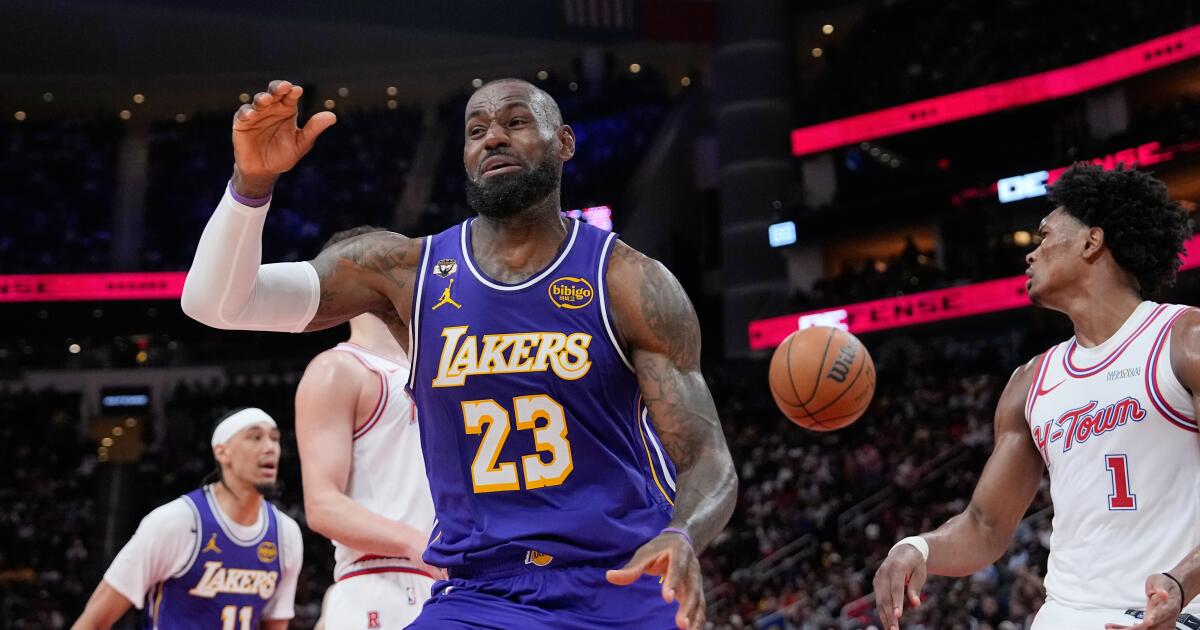
The Lakers won both of their games during this road trip in clutch fashion. James was at the center of both wins, firing the game-winning assist to Rui Hachimura against Toronto, then scoring 12 of his 29 points in the fourth quarter against Philadelphia. As James racked up 10 consecutive points in the fourth, center Deandre Ayton, sensing the superstar’s powers rising, stopped celebrating the big shots because he wanted to make sure he could enjoy the show.
“Clutch gene,” Ayton said. “Felt like a movie.”
Ayton could earn a nomination for best supporting actor for his work. Not only was he a perfect seven-for-seven from the field for 14 points, but he had 12 rebounds (10 defensive) with a steal and a block. Redick, who cited defense as the team’s biggest concern entering the three-game trip, praised Ayton for being disruptive in drop coverage, his hustle for loose balls and his willingness to switch onto 76ers star guard Tyrese Maxey.
“Whatever we needed him to do on that end of the floor in the second half, he was great,” Redick said.
The Lakers are first in defensive rating in clutch minutes. The team that Redick said was “basically average to slightly below average” on defense has an 85.7 defensive rating in clutch minutes compared with the overall 116.2 rating that ranks 20th in the league.
After giving up 60 points in the first half, the Lakers held Philadelphia to 48 in the second, and Maxey, who entered the game ranked third in the NBA in scoring, had just five points on two-for-six shooting in the fourth quarter.
On tap
Dec. 10 vs. Spurs (16-7), 7 p.m. PDT, NBA Cup quarterfinals
The Spurs won the most competitive Cup group with an impressive 139-136 win over the Denver Nuggets without Victor Wembanyama, who has been out for three weeks with a calf injury. The star Frenchman could return in time for the knockout round game.
If the Lakers win, they will play the winner of the quarterfinal matchup between Oklahoma City and Phoenix in the West semifinals in Las Vegas at 6 p.m. on Dec. 13. The final is at 5:30 p.m. on Dec. 16.
If the Lakers lose, they will play the loser of Oklahoma City-Phoenix in a regular season game on Dec. 11, 12, 14 or 15.
Status report
By popular demand, we’ll start including a brief update on the Lakers’ current injury status.
Marcus Smart: back
The guard’s back issue has lingered for two weeks, but he could return in time for Wednesday’s NBA Cup game, Redick said. The injury progressed from back spasms after the game against the Clippers to “lower back injury management” to “left lumbar muscle strain.”
LeBron James: “old”
James missed the game against Boston because of right sciatica and left foot joint arthritis. The soon-to-be 41-year-old has yet to play in back-to-back games this season, but Redick said the hope is that he will eventually. After missing the first 14 games because of right sciatica, the left foot injury designation cropped up after the Lakers’ NBA Cup win over the Dallas Mavericks. When asked about it, James didn’t seem particularly worried: “It’s called old,” he deadpanned.
Favorite thing I ate this week
The momo platter from Momo Ghar in Toronto. From left to right, the chili momo tossed in a spicy, savory sauce; the tandoori momo; the kurkure (breaded) momo; and the steamed momo.
(Thuc Nhi Nguyen / Los Angeles Times)
I understand the Toronto hype. The city that everyone told me was the best in the NBA delivered despite bitter cold and snow flurries. Walking 25 minutes in below-freezing temperatures to Momo Ghar in Cabbagetown was well worth it for the momo sampler. The platter featured these Tibetan dumplings tossed in a sweet and savory chili sauce, a tandoori sauce, breaded and deep fried and steamed.
And because I love a sweet treat, I ordered mango creme brulee for dessert. The cardamom spiced cream had me wanting to start an alternative life in Toronto.
Dicker kicked five field goals Monday night to lift the Chargers to a 22-19 overtime victory over the Philadelphia Eagles in a wild, turnover-filled game at SoFi Stadium.
On a night when the teams combined for eight turnovers — including a career-high four interceptions by Philadelphia’s Jalen Hurts — the game fittingly ended with an interception. Tony Jefferson latched onto a pass that was tipped by fellow Chargers defensive back Cam Hart, snuffing out the Eagles’ last chance.
So Dicker’s 54-yard field goal with 6:24 remaining in the extra period provided the margin of victory, just as it was Dicker who forced overtime with a 46-yarder in the waning moments of regulation.
“What a team we have,” Chargers coach Jim Harbaugh said, practically shouting at the postgame podium. “That’s my reaction — what a team we have. They refuse to lose.”
So much so that, on the first day of MLB’s annual winter meetings at the Signia by Hilton Orlando on Monday, the most intriguing rumor surrounding the team had to do with a potential subtraction from their big-league roster.
According to multiple reports, Teoscar Hernández has come up in the Dodgers’ trade talks with other teams this winter. USA Today went as far as saying the club was “shopping” the two-time All-Star, who is entering the second season of the three-year, $66-million deal he signed last offseason.
“Teo certainly fits [our roster still],” Roberts said. “He’s helped us win two championships. He’s one of my favorites.”
“That doesn’t feel likely,” Gomes added of the possibility of trading Hernández. “Obviously, you can never say never on those types of things. I know that’s come up [in reports]. But that’s not something we anticipate at all.”
The idea of the Dodgers trading Hernández has felt like a long shot from the start. Though the 33-year-old slugger suffered an inconsistent and injury-plagued regular season in 2025 — both at the plate, where he had 25 home runs but hit only .247, and especially defensively, where he had several notable lapses after moving to right field — the 10-year veteran has made crucial contributions in each of the Dodgers’ two World Series runs the last couple years, and has served in a mentor role to young players in the clubhouse; none more so than Andy Pages.
From Ben Bolch: The eight remaining candidates met with UCLA’s search committee on Zoom, each answering the same set of questions.
When those conversations ended, Martin Jarmond, the athletic director who was presiding over the Bruins’ quest to find their next great football coach, asked everyone on the committee to prioritize which candidates needed to be seen in person.
Everyone’s list included the same name: Bob Chesney.
The James Madison coach had already wowed the committee by then, according to multiple people with knowledge of the search who spoke with The Times on condition of anonymity because of the private nature of the process.
Chesney’s experience building programs into winners, established track record of success at multiple levels, ability to develop talent and appreciation for everything UCLA had to offer were all selling points that made him an attractive candidate early in a search lasting 2½ months.
From Ryan Kartje: USC will face Texas Christian in its first trip to the Alamo Bowl on Dec. 30, the night before the quarterfinals of the College Football Playoff kick off. Throw in the fact that the Horned Frogs finished in seventh place in the Big 12, and you don’t exactly have a marquee, made-for-TV matchup.
But for USC’s coach, the Alamo Bowl should carry a certain significance — if only for the fact that it’s where his reputation as a budding offensive mastermind was born.
Sixteen years ago this December, Lincoln Riley was on his way to a team meeting ahead of Texas Tech’s bowl game, when defensive coordinator Ruffin McNeill pulled him aside. Mike Leach, the Red Raiders’ head coach had been suspended for the bowl for allegations of player mistreatment — and would be fired days later. McNeill, the interim coach, wanted Riley to call plays for him.
Riley was 26, and reeling from the news about his mentor.
“An opportunity arose out of a not-very-positive situation,” Riley said Sunday.
In addition to reiterating his frustrations with the CFP ranking process, Bevacqua also turned his ire on the Atlantic Coast Conference during a Monday morning appearance on “The Dan Patrick Show.”
“We were mystified by the actions of the conference, to attack, you know, their biggest, really, business partner in football and a member of their conference in 24 of our other sports,” Bevaqua said. “And I wouldn’t be honest with you if I didn’t say that they have certainly done permanent damage to the relationship between the conference and Notre Dame.”
From Eric Sondheimer: Palisades, hoping to be a City Section basketball title contender, unveiled two 6-foot-5 twins from Detroit, EJ and OJ Popoola, on Monday night, but there was no stopping Windward shooting threes in its home gym.
The Wildcats made 14 threes and received a terrific performance from 6-6 junior Davey Harris in an 80-60 victory. Harris, who said he was “80%” several weeks ago in Windward’s season opener after recovering from a knee injury that sidelined him for two seasons, now says he’s “85 to 90%.” If that’s true, wait until he’s 100% because he finished with 31 points, nine rebounds and eight assists.
Palisades (0-3) is doing exactly what City Section football teams did during their nonleage seasons — play tough Southern Section opponents to prepare for league play. The Dolphins open Western League play on Wednesday against Venice and will be an Open Division title contender.
Clayton Keller had a goal and an assist, and Dylan Guenther also scored for the Mammoth in their sixth loss in eight games. Karel Vejmelka finished with 23 saves.
1934 — The New York Giants wins the NFL championship by beating the Chicago Bears 30-13 in the famous “Sneakers Game.” With the temperature at 9 degrees and the Polo Grounds field a sheet of ice, the Giants open the second half wearing basketball shoes and score 27 points in the final period to overcome a 13-3 Chicago lead.
1938 — The Chicago Cardinals select TCU center Ki Aldrich with the first pick of the NFL Draft.
1939 — The Chicago Cardinals select Tennessee half back George Cafego with the first pick of the NFL Draft.
1949 — The All-America Conference merges with the National Football League. Three teams from the AAFC — the Cleveland Browns, San Francisco 49ers and Baltimore Colts — join the 10-team NFL. The league is called the National-American Football League, but months later the National Football League name is restored.
1973 — Jim Bakken of the St. Louis Cardinals kicks six field goals in a 32-10 victory over the Atlanta Falcons.
1977 — Moses Malone scores 20 points and grabs nine rebounds in the second half to lead the Houston Rockets to a 116-105 win over the Los Angeles Lakers. The game s marred by a one-punch knockout of Rockets’ forward Rudy Tomjanovich by Los Angeles forward Kermit Washington.
1984 — Eric Dickerson of the Los Angeles Rams rushes for 215 yards and two touchdowns against the Houston Oilers, breaking O.J. Simpson’s NFL single-season rushing record of 2,003 yards. Dickerson ends the season with 2,105 yards.
1993 — Kevin Johnson of Phoenix becomes the 13th player to record 10 steals in an NBA game, during the Suns’ 114-95 win over Washington.
2000 — Dallas Cowboys running back Emmitt Smith rushes for a season-high 150 yards, putting him over 1,000 for a record-tying 10th straight season and joins Walter Payton and Barry Sanders as the only players in NFL history with 15,000 career yards.
2001 — Bode Miller becomes the first American since 1983 to win a World Cup giant slalom race. Miller, third after the opening leg, has an excellent second run to win in a combined time of 2 minutes, 36.02 seconds in Val D’Isere, France.
2007 — Peyton Manning of Indianapolis becomes the fifth quarterback in NFL history to throw 300 touchdown passes, getting four and going 13-for-17 for 249 yards in a 44-20 win over Baltimore.
2009 — Cassidy Schaub rolls consecutive 300 games and sets a Professional Bowlers Association 16-game scoring record, averaging 257.25 to retain the second-round lead in the Pepsi Red, White and Blue Open. Schaub had a 16-game total of 4,116 pins to erase the PBA record of 4,095 set by John Mazza in Las Vegas in 1996.
2016 — Russia’s sports reputation is ripped apart again when a new report into systematic doping details a vast “institutional conspiracy” that covers more than 1,000 athletes in over 30 sports and a corrupted drug-testing system at the 2012 and 2014 Olympics. This second and final report by World Anti-Doping Agency investigator Richard McLaren says the conspiracy involves the Russian Sports Ministry, national anti-doping agency and the FSB intelligence service, providing further details of state involvement in a massive program of cheating and cover-ups that operated on an “unprecedented scale” from 2011-15.
2017 — Jozy Altidore opens the scoring in the 67th minute and Toronto FC beats the Seattle Sounders 2-0 in the MLS Cup to become the first Canadian champion in league history.
2018 – New England Patriots quarterback Tom Brady breaks Peyton Manning’s record for most touchdown passes in NFL history.
2018 — Green Bay quarterback Aaron Rodgers breaks Tom Brady’s NFL record with his 359th straight pass without an interception during Packers 34-20 win over Atlanta Falcons; finishes game with streak intact at 368.
2021 – Chicago Black Hawks Marc-Andre Fleury becomes 3rd NHL goaltender to reach 500 career wins.
2023 — Japanese baseball two-way superstar Shohei Ohtani signs a North American pro-sports record 10-year $700m deal with the Los Angeles Dodgers.
Compiled by the Associated Press
Until next time…
That concludes today’s newsletter. If you have any feedback, ideas for improvement or things you’d like to see, email Houston Mitchell at houston.mitchell@latimes.com. To get this newsletter in your inbox, click here.
We were well into our journey from Los Angeles to Chicago, surrounded by cornfields and grain elevators, when the train halted and a voice rang out.
“All right, folks,” said a man on the PA system. “We’ve come to a stop in what appears to be the middle of nowhere.”
To a traveler in a hurry, this is the stuff of nightmares. To a seasoned passenger on the L.A.-Chicago train known as Amtrak’s Southwest Chief, it’s just another day.
Share via
When you board an American long-distance train in 2025, you are trading the airport routine for entry into a locomotive-driven realm where there is neither TSA nor WiFi. And AI might as well stand for aged infrastructure.
There will be delays, often because of passing freight trains. But in the bargain, you are freeing yourself from worry about aerodynamics or the chronic shortage of U.S. air traffic controllers and gaining access to ground-level scenery and idle hours.
You’re also joining a modest trend. Even before this fall’s bout of flight cancellations during the government shutdown, Amtrak had set records for passengers and revenue in fiscal 2024, then again in 2025. Ridership on the Southwest Chief rose 12.6% in the last year. Amtrak’s long-distance trains haven’t caught up with their pre-pandemic numbers yet, but we seem to like them a little more lately.
Passengers board the Southwest Chief at Los Angeles Union Station.
(Christopher Reynolds / Los Angeles Times)
To learn why, I boarded the Southwest Chief at Los Angeles Union Station on a recent Monday afternoon. I was ready to see a few desert sunsets from the Sightseer Lounge and hear what people say when they have the time to chat with a stranger IRL.
Before long, I had been party to conversations about fear of flying, doctors in Tijuana, how to make beef jerky and how to sleep in a moving metal box. I’d also heard these sentences:
“I like watching the country go by. I draw and I paint,” said passenger Nancy Roeder.
“I’m a fourth-generation model railroader,” said William Angus.
“I’m not going to lie to you. I took his life.”
This last comment came from a fellow traveler, ruefully disclosing an act of self-defense many years ago. No proof was offered, but I believed it. I also found the teller of the story (whom I won’t name) to be good company, thoughtful and generous.
In other words, on a two-day train, you meet people and hear things that you might not on a four-hour flight.
What Paul Theroux wrote 50 years ago in “The Great Railway Bazaar” is still true: “Anything is possible on a train: a great meal, a binge, a visit from card players, an intrigue, a good night’s sleep, and strangers’ monologues framed like Russian short stories.”
Flagstaff by dawn
Passengers relax in the Sightseer Lounge on Amtrak’s Southwest Chief.
(Christopher Reynolds / Los Angeles Times)
There’s one Southwest Chief departure from Los Angeles every day (and one from Chicago). If everything goes right, the 2,265-mile, 32-stop trip takes about 43 hours.
But only a rookie would count on that. About 60% of the time, the Southwest Chief arrives at least 15 minutes late.
For much of its route through Arizona, the route is flanked by old Route 66 and other lonely desert roads.
(Christopher Reynolds / Los Angeles Times)
Back in 1936, when the Atchison, Topeka & Santa Fe Railway introduced Southwest Super Chief service between Los Angeles and Chicago, this was a roughly 40-hour journey. The passenger list included plenty of show-biz people and the first stop was in Pasadena.
Nowadays, the Southwest Chief is run by Amtrak (which gets government funding but operates independently enough to be unaffected by recent government shutdowns). There are not so many show-biz people now, not as many frills. Instead of Pasadena, its first stop after Los Angeles is Fullerton, followed by a bend to the northeast. By the time I arrived in the dining car for my first dinner aboard, we were nearing Barstow.
“This way, young man,” lied the server winningly as he steered me to a table. (I am 65. In the dining car, every traveler, no matter how aged, gets greeted as a young man or young lady.)
Since booths hold four people, dining car stewards like Chuck Jones manage the delicate task of putting travelers together. Through PA announcements and whispers in the aisles, he encouraged us to introduce ourselves and keep phones off tables.
He also suggested we steer clear of politics — a tall order when traveling through a government shutdown from a city the president had just called “lawless” to one he had just called “the worst and most dangerous city in the world.”
Surprise: Almost everyone complied.
Over the course of six dining car meals as a solo traveler, I heard no political disagreements and met travelers from their 20s to their 80s.
Claudette Toth, a senior from Massachusetts, estimated that she’d only flown three or four times in her life. William Angus, a 24-year-old returning to Chicago from a pilgrimage to the San Diego Model Railroad Museum told of how much he loved running a 1/87 scale model of the Bakersfield-Mojave rail system, re-enacting operations from February 1953.
Ernie Haecker, of Sante Fe and New York, is a regular on Amtrak’s Southwest Chief train between Los Angeles and Chicago.
(Christopher Reynolds / Los Angeles Times)
As Angus spoke, Ernie Haecker, a longtime train lover, nodded in understanding, grinning beneath a handlebar mustache. Haecker, 77, an audiologist, told us he takes the train every six weeks, splitting time between Santa Fe and New York. After so many trips, he knows the crew, knows where the train will pause long enough for him to shave, knows he can count on chatting with “a whole panoply of folks every time.” He even knew the spot in Illinois where the train would switch from one old company’s tracks to another’s.
“We just left the old Santa Fe,” he would say when the moment came. “Now we’re on Burlington.”
My dinner on the first night was another happy surprise — a fairly tender and flavorful flat iron steak. There was a vase holding flowers at every table, along with white tablecloth.
A meal is served in the dining car.
(Christopher Reynolds / Los Angeles Times)
Still, nobody should expect a Michelin-star meal in an Amtrak dining car. It’s common for servers to bring out dessert before the main dish (to avoid running behind later) and at one meal, someone forgot my order and I had to start over half an hour later.
By the time we crossed into Arizona that first night, I was back in my roomette nodding off, lulled like a baby atop a washing machine.
We were near Flagstaff when I blinked awake, glad to catch sight of the sunrise and grateful to have a sleeping area of my own.
Arizona sprawl and the Amtrak class system
Roomettes measure about 23 square feet.
(Christopher Reynolds / Los Angeles Times)
Of the three ways you can travel long-distance on Amtrak, the fanciest option is a private room that’s about 50 square feet (including private bath). The cost — about $3,200 for a couple, one way, when I booked — includes meals in the dining cars. (Family rooms, which hold four people but share bathrooms, cost about the same. All rates fluctuate by season and demand.)
That was too pricey for me and my expense account, so I booked a roomette. The roomettes are about half the size of a private room, with dining-car access and upper and lower berths that allow two travelers to lie flat (or one to spread out). These share toilets and showers. This cost me $809. (For a couple, the tab would have been $1,112.)
The third option was coach class, which means sleeping in your seat. It’s a sensible choice if you’re traveling only a portion of the route, and it’s what I did when traveling this route as a college student 45 years ago.
I was intrigued to see that coach fares start at $198 — only a bit more than the starting price for a flight. But no, not intrigued enough.
As a coach passenger, you don’t get access to the dining car (unless there’s room and you’re willing to pay $20-$45 for a meal). Instead, you bring food, buy snacks in the cafe car below the Sightseer Lounge or, if truly desperate, try to arrange a restaurant delivery to an upcoming fresh-air stop.
Fortunately, all classes get access to the Sightseer Lounge, where armchairs and couches face big windows. I’ve heard of lounges getting pretty crowded and ripe on heavily booked trips, but our trained seemed less than half-full. A few coach passengers dozed in the lounge overnight (which is officially forbidden) and nobody seemed bothered.
That first morning, with coffee in hand, I tiptoed into the lounge, sank into an armchair and watched the desert sprawl while wispy clouds clung to the horizon under a brightening sky.
This postcard (or rather Instagram) moment came somewhere between Winslow and Holbrook. I’m told the scenery is more dramatic on the Coast Starlight (from Los Angeles to Seattle) and the California Zephyr (from Emeryville through the Rockies to Chicago). But this comes down to taste. If you like deserts, the Chief is hard to beat. (Though no matter the route, if you like photography, the train is a challenge: no open windows, so you’re always shooting exteriors through glass.)
As Arizona yielded to New Mexico, the dirt seemed to get redder and the ridges rose to form buttes. Along rivers and creeks, bright yellow cottonwood trees congregated in bursts of yellow. Occasionally we’d glimpse small towns and timeworn roadside attractions — a reminder that Old Route 66 basically follows Southwest Chief’s path between the West Coast and Albuquerque, N.M.
Amish in transit, elk at sunset
Travelers head toward seats at Chicago Union Station.
(Christopher Reynolds / Los Angeles Times)
“Living in L.A., you forget all this space,” said Kim Rinauro, a nurse from Los Feliz. “When you come out and see how vast this is, it really gives you a different perspective.”
“America is so ginormous,” said Jeanine Bass, a softball coach from Costa Mesa who was on her way to see family in upstate New York.
Meanwhile, one end of the observation car had been filled by several women in white bonnets, joined by men with straw hats, footlong beards and no mustaches. Occasionally I’d hear a sort of clapping sound. Amish families. Playing dominoes.
Amish travelers have been using this route for decades, one of the men told me, on their way to and from doctors in Tijuana. Seeking medical treatment that’s more affordable and easier to schedule than in the U.S., they take trains to Southern California, then continue overland across the border.
Just before we made a 45-minute stop at the station, which is surrounded by a grim neighborhood, an Amtrak staffer took the microphone to sternly address the coach-class travelers.
“Coaches: No alcohol,” she said. “If you bring alcohol, you can stay and spend all night here with the transients.” For those in rooms and roomettes, she continued, booze in private rooms is OK, but not in public spaces.
Farther into New Mexico, we passed the other Southwest Chief train, carrying passengers west.
Between Raton, N.M., and Trinidad, Colo., amid a gaudy sunset, we crept past a herd of elk, then plunged into a tunnel. Emerging, we caught a last bit of sunset, some of the most gorgeous miles of the trip.
Yet this, I learned later, is the part of the trip that Amtrak’s chief executive tried to replace with bus service in 2018. The effort failed and that executive is no longer in the job. But the battles in Washington over Amtrak funding and mission never end, which is why so many cars, like the Superliners on the Southwest Chief, were built between 1979 and 1996. Amtrak leaders have set a goal of replacing their older long-distance cars by 2032.
Speaking of hardware: Eventually I tried the shower. It didn’t go well. First, I saw that someone had stolen the shampoo dispenser. Then I couldn’t find a way to cool the scalding-hot water. I stood as far back as I could in the snug compartment and grimaced my way through it.
Missouri, Iowa and Illinois: The final miles
The concourse at Chicago Union Station is grand but quiet.
(Christopher Reynolds / Los Angeles Times)
On arrival day, I woke just as we reached the station in Kansas City, another gritty neighborhood along the tracks. Our news feeds were filled with fresh reports of nationwide flight delays because of the government shutdown.
Soon we were crossing the Missouri River, roaring through forest and skirting naked farmland where this year’s corn crop had just been cut. Then came Fort Madison, Iowa; the Mississippi River and the beginnings of Illinois. Water towers and grain elevators.
I zipped my bags shut, tipped the roomette attendant and dining car team. Soon I’d be stretching my legs at the Art Institute of Chicago, walking Millennium Park and along the Chicago River, checking out the skyline from Navy Pier.
We pulled into Union Station within an hour of our target time.
Was it a perfect trip? No. But it was full of humanity, scenery and comforting clangs and rumbles. I even liked the lurching way you had to walk down the corridors, adjusting balance as the train shifts. And then, to step off the train after two days into a brisk Chicago afternoon, 2,265 miles from home, having never left the ground? That’s almost magic.
Tracks dominate the view from the last car on the train.
The Lakers superstar scored 10 consecutive points late in the fourth quarter to seal a 112-108 win over the Philadelphia 76ers on Sunday, finishing with 29 points, seven rebounds and six assists to help the Lakers (17-6) nab two wins out of a difficult three-game trip.
Philadelphia (13-10) crawled back from a 10-point deficit in the third quarter and tied the score with 1:28 remaining on a shot by Joel Embiid. James answered with the fadeaway three-pointer over Quentin Grimes to put the Lakers up by three with 1:11 left. He all but iced the game with a 20-foot fadeaway shot over Grimes with 27.3 seconds remaining.
Running back up the court, James held both hands low to the ground in a “too small” signal. He placed an imaginary crown on his head. He soaked in the roars from the crowd and punctuated it with his signature silencer celebration.
“That was vintage Bron,” said Luka Doncic, who finished with 31 points, 15 rebounds and 11 assists after a two-game absence for the birth of his second child. “We’re happy he was there to save us.”
James played in his 1,015th win, passing Robert Parish for the second most in NBA history. Kareem Abdul-Jabbar holds the record with 1,074. The Lakers won for the first time in Philadelphia since Dec. 16, 2016.
A day after deciding not to travel with the team for fear of spreading stomach-flu symptoms, McVay arrived Sunday morning.
McVay fist-bumped players during warmups at State Farm Stadium, his trademark gelled hair spikes in full effect. And he looked none the worse for the wear while roaming the sideline sockless and calling plays against the Arizona Cardinals.
McVay and his players were feeling good after the Rams routed the Cardinals, 45-17.
Matthew Stafford passed for three touchdowns, Puka Nacua caught two touchdown passes in a game for the first time in his career, and Blake Corum rushed for a career-high 128 yards and two touchdowns as the Rams bounced back from a loss to the Carolina Panthers and improved to 10-3, reclaiming the top spot in the NFC.
Fourteen months removed from his death at the age of 63 in October 2024, and 27 years removed from the end of a pitching career measured by more than just wins, losses and ERA, Valenzuela failed to be elected for the 2026 Hall of Fame class by the Contemporary Baseball Era Committee — a 16-person group that once every three years considers players from the 1980s or later who had not been elected to the Hall through the traditional media vote.
Needing 12 votes from that committee to attain Hall of Fame status, Valenzuela instead came up short by receiving fewer than five.
Because Valenzuela didn’t receive five votes, he will be ineligible to be back on the Contemporary Era Committee’s ballot in 2028. The next time the committee could review his case won’t be until 2031.
Until then, his name will remain among the most notable snubs from Hall of Fame induction.
From Ryan Kartje: For the 11th straight season and fourth time under coach Lincoln Riley, USC finished its season on the outside looking in at the College Football Playoff field.
But it will get to finish this football season with a first.
USC will face Texas Christian in the Alamo Bowl on Dec. 30, a source not authorized to discuss the matchup publicly confirmed to The Times. The Trojans never have spent the bowl season in San Antonio, where the Alamo Bowl has been played since 1993.
Their opponent comes as somewhat of a surprise considering the Horned Frogs finished the regular season 8-4 in a tie for fifth in the Big 12. The Alamo Bowl gets first selection of Big 12 teams and could have chosen Brigham Young, which lost in the Big 12 title game and, like USC, finished within one win of the playoff field. But the bowl presumably passed on the Cougars because they took part in the game last season.
From Ryan Kartje: Jazzy Davidson glanced at the basket with less than two minutes left in USC’s Big Ten opener and in a split-second’s time considered her options. Nearly nothing had fallen from three-point range for the Trojans. It took 25 minutes Sunday just to see one three-pointer drop, and the Trojans had made only two.
But the mere threat of the freshman pulling up from range, even on a night defined by defensive struggle, was enough to give Davidson the sliver of space she needed. After pausing she raced past her defender and toward the basket, lifting for a finger roll that propelled USC past Washington in a 59-50 victory.
The win wasn’t just a significant statement for USC ahead of its heavyweight battle with No. 1 Connecticut next Saturday. It was also a major mile marker for Lindsay Gottlieb, who became the fastest coach in program history to reach 100 wins.
Notre Dame needs USC more than USC needs Notre Dame.
The Irish are reeling today after they were stunningly left out of the 12-team College Football Playoff, but they never would have been part of the playoff conversation without a win over Holiday Bowl-bound USC.
The 10-2 Irish lost their first two games of the season before embarking on their usual cupcake schedule.
Somewhere in the muck of forgettable games against the likes of Boise State and Boston College and Navy, they needed a marquee win.
USC showed up in October and gave them the opportunity for that marquee win. Every year USC shows up in the middle of the season and gives them a chance at collecting that marquee win.
From Antony Solorzano: Any time UCLA built a significant lead in the first half, Oregon tried to slow the the Bruins’ momentum with a timeout. The first call came after a UCLA built a 10-point advantage in the first quarter, with the second timeout after UCLA pulled ahead by 19 points.
It didn’t work — the Bruins remained in control of the game.
The No. 4 UCLA women’s basketball team (9-1) earned an 80-59 win over Oregon (10-1) during their Big Ten opener at Pauley Pavilion on Sunday.
Frederico Jucá Carsalade scored with one second remaining to cap a four-goal fourth quarter, and UCLA rallied to beat USC 11-10 to win the men’s water polo championship Sunday at the Avery Aquatic Center.
It was the 14th championship for the second-seeded and defending champion Bruins (27-2), winning back-to-back titles for the fifth time.
USC (23-4), the top seed, was aiming for its 11th title — all since 1998 — in a tournament that began in 1969. The Trojans won six in a row from 2008 to 2013.
Leo Carlsson scored two goals and rookie Beckett Sennecke had a goal and an assist in the Ducks’ 7-1 victory over the road-weary Chicago Blackhawks on Sunday night.
Jacob Trouba, Mason McTavish, Alex Killorn and Frank Vatrano also scored for the Pacific Division-leading Ducks, who have won three of four. The Ducks took charge with a four-goal second period that featured a franchise-record 27 shots on Chicago’s net, capped by Carlsson’s 15th goal on a fluttering deflection for a 5-0 lead.
Ville Husso made 19 saves for the Ducks, who beat Chicago for the first time in three tries this season. Ryan Strome, Cutter Gauthier and Chris Kreider had two assists apiece.
1940 — The Chicago Bears beat the Washington Redskins 73-0 for the most one-sided victory in NFL Championship play.
1942 — Georgia’s Frank Sinkwich wins the Heisman Trophy. Sinkwich ends his career holding the Southeastern Conference record for total offense with 2,399 yards.
1948 — Southern Methodist junior Doak Walker wins the Heisman Trophy. Walker over three years scores 303 points, including 40 touchdowns and 60 points after touchdowns.
1961 — Philadelphia’s Wilt Chamberlain scores 78 points and grabs 43 rebounds in a 151-147 triple overtime loss to the Lakers. Elgin Baylor leads the Lakers with 63 points.
1963 — Cookie Gilchrist of the Buffalo Bills sets an AFL record with 243 yards rushing and ties a league record with five touchdowns in a 45-14 rout of the New York Jets.
1977 — Texas running back Earl Campbell wins the Heisman Trophy.
1987 — Ron Hextall of the Philadelphia Flyers becomes the first NHL goaltender to shoot a puck into the opposing goal in a 5-2 victory over the Boston Bruins.
2000 — Shaquille O’Neal sets an NBA record by going 0-for-11 from the free-throw line as the SuperSonics beat the Lakers 103-95. He broke Wilt Chamberlain’s record, who went 0-for-10 for Philadelphia against Detroit on Nov. 4, 1960. O’Neal had 26 points and 16 rebounds.
2002 — Oakland quarterback Rich Gannon sets an NFL record with his 10th 300-yard game of the season, throwing for 328 yards in the Raider 27-7 win over San Diego and breaking a tie with Dan Marino, Warren Moon and Kurt Warner.
2007 — Florida quarterback Tim Tebow becomes the first sophomore to win the Heisman Trophy. He beats out Arkansas running back Darren McFadden, the first player since 1949 to finish second in consecutive seasons.
2011 — Three-time NL MVP Albert Pujols agrees to a $254-million, 10-year contract with the Angels on the final day of baseball’s winter meetings. Pujols’ contract is the second-highest in baseball history and only the third to break the $200 million barrier, following Alex Rodriguez’s $252 million, 10-year deal with Texas before the 2001 season and A-Rod’s $275 million, 10-year contract with the Yankees before the 2008 season.
2011 — The NBA and players union reach financial agreement to end a 161-day lockout, shortening the season by 16 games.
2012 — Texas A&M quarterback Johnny Manziel becomes the first freshman to win the Heisman Trophy, taking college football’s top individual prize after a record-breaking debut. Notre Dame linebacker Manti Te’o finishes a distant second and Kansas State quarterback Collin Klein is third in the voting.
2013 — Zach Johnson rallies from four shots behind with eight holes to play and beats Tiger Woods, the No. 1 player in golf, at the World Challenge. Johnson holes out from a drop area for par on the last hole to force a playoff and wins when Woods misses a 5-foot par putt on the first extra hole.
2013 — Lydia Ko, a 16-year-old from New Zealand, rallies to win her first title as a professional. Ko, making her second pro start, wins the Swinging Skirts World Ladies Masters, closing with a 4-under 68 for a three-stroke victory over South Korea’s So Yeon Ryu. She won four pro events as an amateur, taking the Canadian Women’s Open the last two years.
2022 — American basketball star Brittany Griner is released by Russian authorities in a prisoner exchange for Russian arms dealer Viktor Bout; Griner detained on drug smuggling charges since February 2022.
Compiled by the Associated Press
Until next time…
That concludes today’s newsletter. If you have any feedback, ideas for improvement or things you’d like to see, email me at houston.mitchell@latimes.com. To get this newsletter in your inbox, click here.
The eight remaining candidates met with UCLA’s search committee on Zoom, each answering the same set of questions.
When those conversations ended, Martin Jarmond, the athletic director who was presiding over the Bruins’ quest to find their next great football coach, asked everyone on the committee to prioritize which candidates needed to be seen in person.
Everyone’s list included the same name: Bob Chesney.
Sign up for UCLA Unlocked
A weekly newsletter offering big game takeaways, recruiting buzz and everything you need to know about UCLA sports.
The James Madison coach had already wowed the committee by then, according to multiple people with knowledge of the search who spoke with The Times on condition of anonymity because of the private nature of the process.
Chesney’s experience building programs into winners, established track record of success at multiple levels, ability to develop talent and appreciation for everything UCLA had to offer were all selling points that made him an attractive candidate early in a search lasting 2½ months.
Along the way, Chesney and the six-person committee nurtured a relationship based on shared values and mutual respect, according to those familiar with the process, making him feel prioritized when other potential suitors emerged as part of a coaching carousel that threatened to spin out of control as new openings materialized seemingly by the day.
After Jarmond and Erin Adkins, the executive senior associate athletic director who was also part of the search committee, flew to see Chesney last month in Virginia, the coach and his suitors came to the same conclusion — they were a perfect match. Chesney agreed to become the Bruins’ new coach on Dec. 1, accepting a five-year deal.
On Tuesday morning on campus inside the Luskin Center, UCLA will introduce a coach whose hiring might be the coup of the carousel.
“We owe UCLA students, alumni, supporters and fans a football program built to succeed in the modern age of college sports, and hiring coach Chesney will do just that,” search committee member Bob Myers said. “We not only believe in him as a head coach, but also as a person. His character and values were a huge factor in our decision. Coach Chesney exudes all the qualities you want in someone charged with leading our student-athletes at UCLA.”
The buzz around Chesney only intensified Sunday when James Madison was selected for the College Football Playoff, dramatically increasing his profile. UCLA has agreed to allow Chesney to coach the 12th-seeded Dukes (12-1) through a CFP run that starts Dec. 20 when they face fifth-seeded Oregon (11-1) at Autzen Stadium, the Bruins undoubtedly getting free air time during the TNT broadcast when their new coach is mentioned. The committee was firmly behind Chesney participating in the playoff, celebrating his team’s selection.
The process leading to Chesney’s hiring started as most coaching searches do, with a firing. The dismissal of coach DeShaun Foster on Sept. 14 after an 0-3 start — giving him a 5-10 record over a little more than one season — left the Bruins with a need to recalibrate their approach in picking a successor.
Martin Jarmond
(Wally Skalij/Los Angeles Times)
Jarmond identified three principal guidelines for the search while meeting with UCLA chancellor Julio Frenk. There needed to be alignment among everyone involved in the process about what they wanted in their new coach, ample investment to allow that coach to compete in the Big Ten and nationally, and ultimately the identification of a strong leader who embodied the school’s core values.
Jarmond was open to any candidate, including NFL coaches and college coordinators, but eventually came to prioritize sitting head coaches who had gone through the recent transformative changes in college sports involving the transfer portal, roster management and the name, image and likeness space. There was also a strong preference for someone who had experience turning around a program, building it into a sustained winner.
A search committee that included Jarmond, Adkins, Myers, sports executive Casey Wasserman, Washington Commanders general manager Adam Peters and former Bruins linebacker Eric Kendricks cast a wide net, starting with a list of 40 possible candidates. The committee gathered preliminary background information on those coaches and met regularly via phone calls and in person, with Peters often joining via Zoom because he was based on the East Coast.
Peters offered intelligence based on his extensive network of NFL personnel who regularly visited college campuses and observed coaches. Myers and Wasserman provided insights based on their vast experience as top-level sports executives. Kendricks, who has spent a decade playing in the NFL, queried candidates on playing style, practice habits, accountability measures and coaching philosophy.
As the committee continued to gather information and assess possible fit, it halved the list of candidates to 20, then narrowed it further to 12 and then eight, which included seven sitting college head coaches and one college coordinator. After the round of Zoom calls, the committee identified six candidates it wanted to remain in contention. Jarmond and Adkins flew to see four candidates in person, keeping two others in the running for possible future meetings.
After every interview and in-person meeting, the committee members always asked themselves the same things: Did this candidate possess the qualities they were seeking and could he fulfill their vision for winning?
Chesney, 48, kept checking every box from early in the process. On his Zoom with the committee, Chesney detailed his plan for winning with the Bruins and gave examples of experiences at other schools that revealed his appreciation for what it took to succeed at a highly rigorous academic institution. His resume was just as impressive as his answers.
Chesney’s 132-51 record included success at the Division III, Division II, Football Championship Subdivision and Football Bowl Subdivision levels. Part of that success included dramatic turnarounds. Assumption, which had gone 3-7 under previous coach Corey Bailey in 2012, enjoyed a steady rise under Chesney, going from 6-5 in Year 1 to 7-4 in Year 2 to 11-2 in Year 3.
It was a similar story at Holy Cross, which had gone 4-7 the year before Chesney’s arrival. By Chesney’s second season, the Crusaders started a four-year run of making the FCS playoffs, reaching a quarterfinal in 2022.
While coach Curt Cignetti already had James Madison rolling, the Dukes going 11-2 and reaching the Armed Forces Bowl in 2023, Chesney has now managed in only two years to take the program somewhere his predecessor couldn’t — the CFP.
It’s that sort of sustained success that left UCLA’s search committee with no qualms about Chesney not having won at the Power Four level. Given Chesney’s track record, the committee believed that all he needed to win big at college football’s highest level was an opportunity.
UCLA plans to support its new coach with enhanced resources, making a significant commitment to grow its assistant coach salary pool alongside additional investment in front-office, recruiting and strength and conditioning personnel as well as a restructured NIL operation.
Jarmond and Adkins flew to Virginia on Sunday so that they could accompany Chesney on his flight to Southern California on Monday ahead of his introduction a day later. Chesney will return to James Madison on Wednesday, continuing preparations to take his team somewhere the Bruins hope he can lead them.
Feeling like winners already, the Bruins are about to unveil the coach who seems to have all the answers..
A brand-new NIL
Chesney is going to have some new resources at his disposal.
As part of an aggressive restructuring, UCLA has transitioned its name, image and likeness efforts for football to the same third-party media and branding agency that handles the school’s other teams.
Champion of Westwood will assist Chesney in an effort to elevate his team’s NIL endeavors in the same way it has for men’s basketball — through its Men of Westwood arm — as well as women’s basketball, softball and other teams on campus.
Working with NIL agency Article 41, which has staff on campus to help athletes build their brands through content creation and social media strategies, Champion of Westwood is striving to create new opportunities for football players as part of an all-inclusive approach.
“Everyone is committed to being very symbiotic on this, which I think will lead to success,” said Ken Graiwer, the UCLA alumnus who runs Champion of Westwood. “Supporting NIL is supporting the program.”
As part of a new subscriber model in which payments can be made on a one-time or recurring basis, Champion of Westwood is offering benefits such as exclusive merchandise and player video updates directly from the locker room after a game.
Among its corporate sponsors, Champion of Westwood has partnered with Paige, the same apparel company that outfitted Dodgers stars Freddie Freeman and Mookie Betts.
“They were looking for the next generation of top athletes,” Graiwer said of Paige identifying UCLA as a client. “These are the great kinds of things that we’re doing.”
Champion of Westwood has also assembled a new advisory board that includes former UCLA quarterback Cory Paus, mega donor Michael Price and other heavyweights in the financial and entertainment sectors who can help facilitate introductions between players and individuals or companies interested in engaging them for NIL deals.
Olympic sport of the week: Men’s water polo
The UCLA men’s water polo team after winning the national championship.
(UCLA Athletics)
It was the sort of ending the cross-town rivalry deserved.
In another back-and-forth battle, Frederico Jucá Carsalade made sure the UCLA men’s water polo team came out on top with a goal as time expired Sunday at Stanford’s Avery Aquatic Center, lifting the Bruins to an 11-10 victory over USC in the national championship game.
USC’s Jack Martin had tied the score with 2:03 left before Carsalade’s goal gave UCLA its 125th NCAA title in school history and its second consecutive championship in men’s water polo. Carsalade finished with two goals and Ryder Dodd scored three, including back-to-back goals that pushed the Bruins into a 10-9 lead before the Trojans rallied.
It was payback after USC had won two of the three previous meetings between the teams this season. The victory gave UCLA coach Adam Wright his 10th NCAA title with the Bruins — six as head coach of the men’s water polo team, two as a player for the Bruins, one as head coach of the women’s water polo team and another as an assistant coach with the women’s team.
Opinion time
What is your level of happiness with the Bob Chesney hire?
We asked, “How optimistic are you for UCLA football in 2026?”
After 612 votes, the results:
They will qualify for a lower-tier bowl game, 47.1% They will show some fight, but struggle to a losing record, 23.5% It’s going to be another long season, 14.6% They will make a quality bowl game, 10.7% The Bruins will be in College Football Playoff contention, 4.1%
Do you have a comment or something you’d like to see in a future UCLA newsletter? Email me at ben.bolch@latimes.com, and follow me on X @latbbolch. To order an autographed copy of my book, “100 Things UCLA Fans Should Know & Do Before They Die,” send me an email. To get this newsletter in your inbox, click here.
Hi, and welcome to another edition of Prep Rally. My name is Eric Sondheimer. The state football championship games are this weekend, but there’s also another big moment happening Tuesday. The state basketball record for career scoring may be broken.
Get our high school sports newsletter
Prep Rally is devoted to the SoCal high school sports experience, bringing you scores, stories and a behind-the-scenes look at what makes prep sports so popular.
Jason Crowe Jr. (left) and his father coach, Jason Crowe Sr. of Lynwood after winning state Division V championship in 2023.
(Eric Sondheimer / Los Angeles Times)
This is the week the four-year basketball career of Jason Crowe Jr. from Inglewood gets the respect it deserves. He’s on the verge of becoming California’s all-time career scoring leader. He has a game scheduled Tuesday against Beverly Hills at the old Morningside gym, and if all goes as expected, he’ll pass Tounde Yessoufou of Santa Maria St. Joseph, who scored 3,659 points from 2022-2025, according to the CalHiSports.com record book. Crowe is 29 points away from the record.
Crowe has been on fire in the last week, scoring 51, 50 and 41 points.
With his father, Jason Sr., serving as head coach, Crowe started his career at Lynwood before moving over to Inglewood last season. He averaged 36.0 points as a freshman when Lynwood won a Division V state championship, 37.4 points as a sophomore, 35.3 points last season at Inglewood and is averaging 43 points for 7-1 Inglewood.
He has signed with Missouri, where he and his family plan to move to after this year. His ability to score comes from his relentless ability to attack, draw fouls, make free throws and make shots.
He deserves a standing ovation Tuesday night when the record is his.
It’s championship weekend in Orange County with Saddleback College, Buena Park High and Fullerton High hosting state championship games. Here’s the schedule.
There will be an intriguing tripleheader on Saturday at Saddleback College. One of the best small-school matchups in recent years kicks off the day at 11:30 a.m. in a battle of unbeatens — Rio Hondo Prep vs. Sonora. Then Oxnard Pacifica faces Fresno Central East in the 1-A final at 3:30 p.m. followed by Santa Margarita taking on De La Salle for the Open Division championship at 8 p.m.
Dash Fifita of Santa Margarita is a 5-9, 195-pound All-CIF linebacker.
(Craig Weston)
Santa Margarita has linebacker Dash Fifita, a 5-foot-9, 195-pound senior who has risen up despite lacking the usual size for playing football at that position. The younger brother of Arizona quarterback Noah Fifita explains how he can be successful.
Santa Margarita’s much respected defensive coordinator, Steve Fifita, said he plans to return in 2026. He would like to coach defensive line at the college level again, but he’s very happy at Santa Margarita. Barring a return to college, he’s staying an Eagle.
Los Alamitos High quarterback Colin Creason tries to evade the flying tackle attempt of San Diego Cathedral linebacker Cade Smith during the CIF Division 1-AA regional playoff game Friday night.
(Craig Weston)
Southern Section Division 2 champion Los Alamitos came up short in a 1-AA loss to Cathedral Catholic, but what a season it was for the Griffins. Here’s a report.
Signing day
Andrew Williams of Fremont is a 6-foot-5, 220-pound senior who committed to USC.
(Eric Sondheimer / Los Angeles Times)
Wednesday was early signing day for high school football players, and it was historic for Fremont defensive end Andrew Williams.
He was a member of USC’s No. 1-ranked recruiting class and the first inner city player to sign with USC since 2017. Here’s a report.
Boys’ basketball
Sierra Canyon and Santa Margarita, ranked No. 1 and No. 2, took a trip to the East Coast and each lost to the same team, Maryland’s Bishop McNamara. Here’s this week’s top 25 rankings by The Times.
San Gabriel Academy, led by freshman Zach Arnold, a had a break-through win over previously unbeaten Redondo Union. Harvard-Westlake’s Joe Sterling, a Texas commit, scored 36 points helped by seven threes in a win over Francis Parker.
Village Christian knocked off Crespi behind freshman Will Conroy, then traveled to Hawaii to finish runner-up to Crean Lutheran. Point guard Hunter Caplan was tournament MVP for Crean Lutheran.
Etiwanda (9-0), Corona del Mar (7-0), Chaminade (9-0) and Brentwood (10-0) are all moving up after impressive starts this season. St. John Bosco (4-0) hosts its tournament this week. A big league game is Wednesday when Arcadia hosts Pasadena in a Pacific League opener. Also Sherman Oaks Notre Dame plays Village Christian on Tuesday.
Jayshawn Kibble has provided a lift for Washington Prep in the City Section. Here’s a report.
Girls basketball
Kaleena Smith of Ontario Christian.
(Craig Weston)
What a start it’s been for defending Southern Section Open Division champion Ontario Christian, which is 9-0 and won the Troy tournament Saturday by routing JSerra. Here’s the report.
Junior guard Kaleena Smith scored 30 points to be tourney MVP and teamed with sophomore Tatianna Griffin to make the Knights pretty much unbeaten in the opening month of the season.
JSerra ruined a match-up of Ontario Christian vs. Sierra Canyon by upsetting the Trailblazers 67-63. Sierra Canyon is still waiting for standout Jerzy Robinson to return from an injury. Vivian Grenald had 19 points and Rosie Santos 18 in JSerra’s win.
Soccer
Peyton Trayer (left) and Cora Fry are Santa Margarita girls soccer players who will leave in January to train with their college programs.
(Eric Sondheimer / Los Angeles Times)
The opening weeks of the soccer season have been marked by players trying to finish up club seasons and join their high school teams.
Some won’t even play when January comes around because they’ve decided to get an early start in college.
It’s an intriguing story how coaches are trying to maneuver through uncertain times on who’s coming and who’s going.
Cathedral and Loyola renew their boys’ soccer rivalry with a nonleague game on Tuesday night at Loyola.
Palos Verdes looks strong in its early matches in boys soccer.
Southern Section history
A 45-minute documentary on the history of the CIF Southern Section will get its first public airing on Saturday after the Santa Margarita-De La Salle football game on Spectrum.
(Eric Sondheimer / Los Angeles Times)
The late Dr. John Dahlem, the volunteer historian for the CIF Southern Section, worked hard before his passing to put together information that would form a 45-minute documentary on the history of the Southern Section.
It will make its public television debut Saturday night on Spectrum at the conclusion of the Santa Margarita vs. De La Salle football game.
A preview was shown at a movie theater on Sunday in Santa Ana for friends and former workers in the Southern Section, and it looks thorough, interesting and well put together by executive producer Taylor Martinez.
Current statistics in 2025 about the Southern Section.
(Eric Sondheimer / Los Angeles Times)
One of the more humorous moments is Dahlem discussing the hand grenade throw, which used to be a Southern Section sport. Also a look at how girls were not real sport participants until 1974 when the Southern Section began sponsoring playoffs for girls.
Former commissioner Rob Wigod serves as the film narrator, and he might have a future in that endeavor.
Notes . . .
Erick Morales has resigned as football coach at La Puente. . . .
Standout Mater Dei girls basketball player Kaeli Wynn won’t play this season because of a knee injury that will require surgery. She has committed to South Carolina. . . .
Junior pitcher Charlie Fuller from Mater Dei has committed to Oklahoma State. . . .
Whittier is looking for a new football coach after Jimmy Welker was let go following two seasons as head coach. . . .
In January, Palisades students are expected to return to their campus with sports teams being allowed to use facilities after the Palisades fire damaged the campus. Students will be housed in portable bungalows and have use of 70% of the campus. Here’s the report.
From the archives: Michael Wilson
Michael Wilson with the catch for Chaminade in 2017.
(Jay L. Clendenin / Los Angeles Times)
Former Chaminade receiver Michael Wilson, in his NFL third season with Arizona, has been coming on strong this season. He had consecutive games of at least 10 receptions and more than 100 yards receiving.
The former Stanford receiver caught 70 passes his junior season at Chaminade. He also was an outstanding point guard until giving up basketball. He was a third-round draft pick.
From the Washington Post, a story on a high school football program that was best in Maryland, then the coach left, players transferred and now the team can’t win any games.
From the Los Angeles Times, a story on the life of former Morningside High and Lakers center Elden Campbell, who has died.
From the Wall Street Journal, a story on former Mission Viejo and Bishop Alemany receiver Phillip Bell, alleging possible CIF violations during his days in high school.
Tweets you might have missed
City Section attendance figures for football championship doubleheaders: 2,089 tickets sold Friday; 3,901 tickets sold Saturday. The commissioner is happy.
9 Divisions, 144 teams will battle in the Nations Top High School Basketball Tournament Where Champions Play🏆 December 26-30, 2025🏀 pic.twitter.com/zgH9b1HDqt
Former Grace Brethren football player Julien Stokes was named Ivy League special teams player of the year for Penn. Sierra Canyon grad Ezekiel Larry of Yale was All-Ivy League first team with Nico Brown (Edison).
Have a question, comment or something you’d like to see in a future Prep Rally newsletter? Email me at eric.sondheimer@latimes.com, and follow me on Twitter at @latsondheimer.
Did you get this newsletter forwarded to you? To sign up and get it in your inbox, click here.