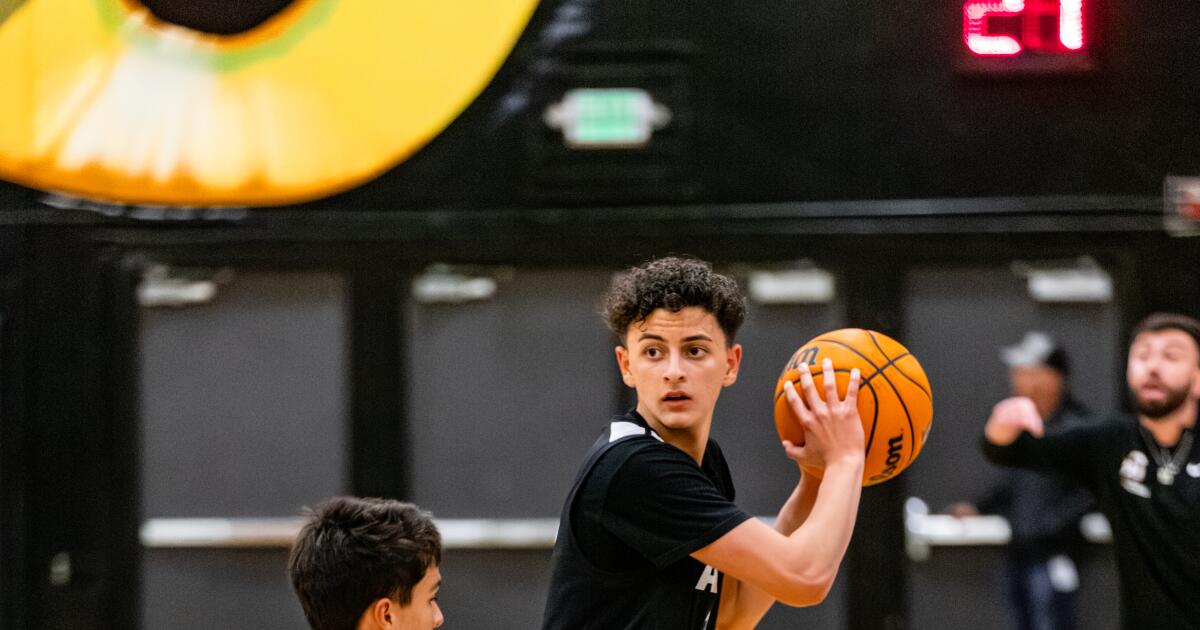
Young faces lit up with joy as award winners bounced to the podium. But it wasn’t only the elementary school recipients. The Westlake High students who created the ceremony were equally thrilled.
The teens are part of Make Great Plays, a grassroots organization that gives elementary school students a chance to dream, excel and believe they belong in educational echelons that once felt out of reach.
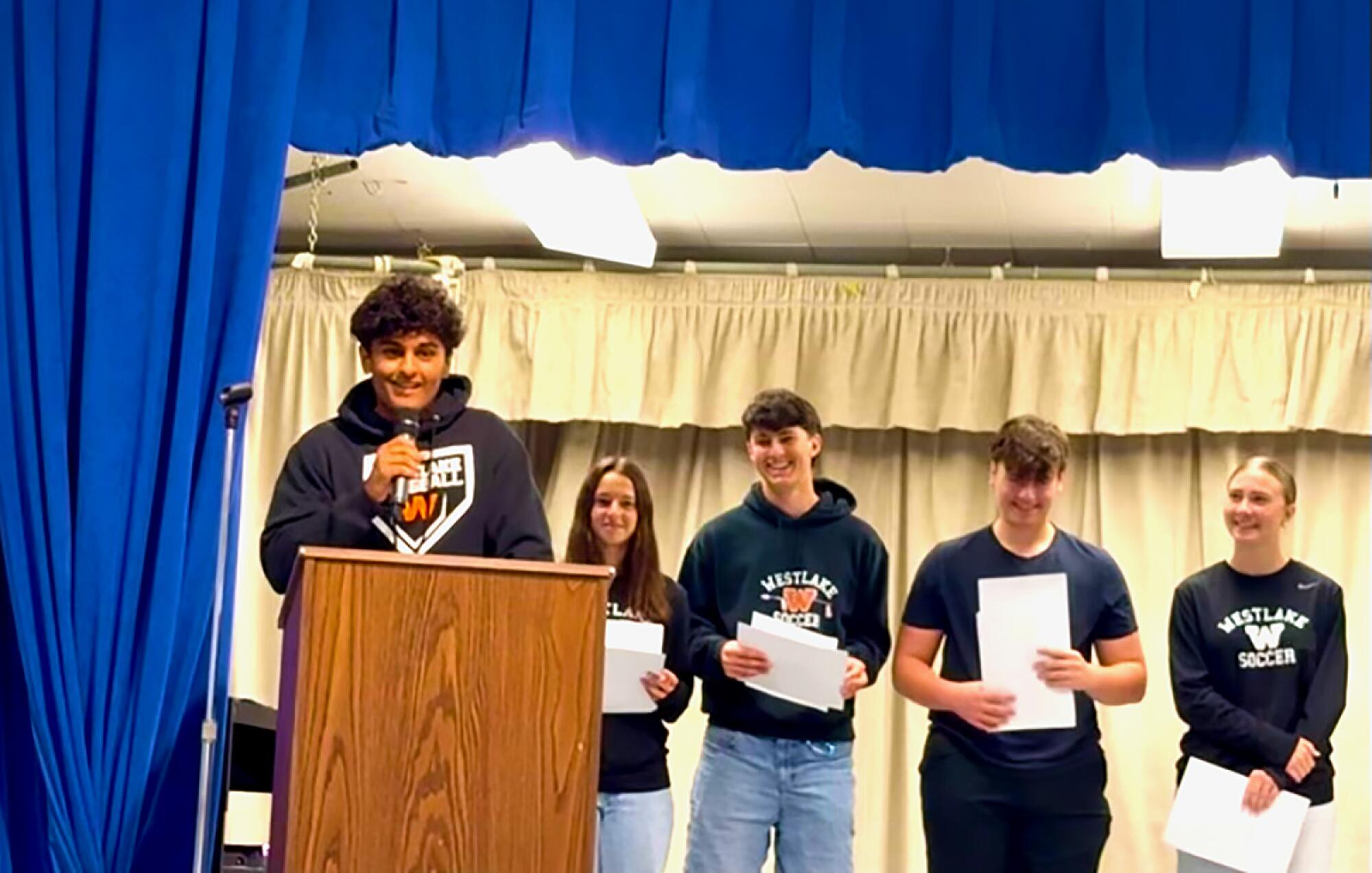
Dhuruv Sankararaman, a Westlake High junior and baseball player, launched Make Great Plays nearly four years ago, starting by collecting and donating sports equipment to the five Title 1 schools in the Conejo Valley Unified School District. (Title I public schools receive federal funding because they have a high percentage of students from low-income families.)
The mission quickly broadened. In the last year, Make Great Plays has conducted backpack and supply drives that outfitted more than 100 students and spent classroom time with students to increase computer literacy.
Maple Elementary in Newbury Park was one of the first schools that Sankararaman and his team helped.
“We picked up 100 backpacks full of supplies,” he said. “They made a huge difference to hand them out to everyone in need.”
‘Make Great Plays’ founder Dhuruv Sankararaman, left, and other Westlake High student-athletes give out awards at Maple Elementary in Newbury Park.
(Sai Krishna)
Next, they identified students who are especially helpful to the large autistic population at Maple and recognized them at an awards assembly. The Make Great Plays staff created five awards, one of each going to students in every grade: Inclusion Hero, Unity Champion, Global Ambassador, Hope Maker and Pathfinder.
“The kids are so excited to have high school students here to run the ceremony,” Maple principal Meghann O’Weger said. “Something feels different when the person giving the award is still a kid, but a bigger one. If adults came in and gave out the awards, it wouldn’t be the same as from peers.”
The 20 Make Great Plays members play soccer, baseball, lacrosse, tennis and volleyball at Westlake High. What began as a way to embellish college entrance applications has become a gratifying life experience for the teens as well as the elementary school students.
Sankararaman plans to expand Make Great Plays to schools in Los Angeles County and rural India, where his parents grew up.
“Some of the kids don’t have a stable home life and are behind in school,” Sankararaman said. “Spending time with them shifts their view a little bit. Many are incredibly smart. All the kids are very respectful. They listen to us as high schoolers and see us as role models.
“It’s cool to see faces light up when they realize how successful they can become, that they have the possibility of a great future.”
This is a daily look at the positive happenings in high school sports. To submit any news, please email eric.sondheimer@latimes.com.
Welcome back to this week’s Lakers newsletter, where the vibes are immaculate.
The Lakers have won 15 of their last 17 games. LeBron James continues to set NBA records, most recently tying the all-time mark for wins in the regular season and playoffs with Monday’s win over Washington. Jaxson Hayes hasn’t missed a three-point shot all year. The fans who chanted “We want Bronny!” have gotten their wish.
With seven games remaining in the regular season, we turn our focus to a different cheer.
MVP! MVP!
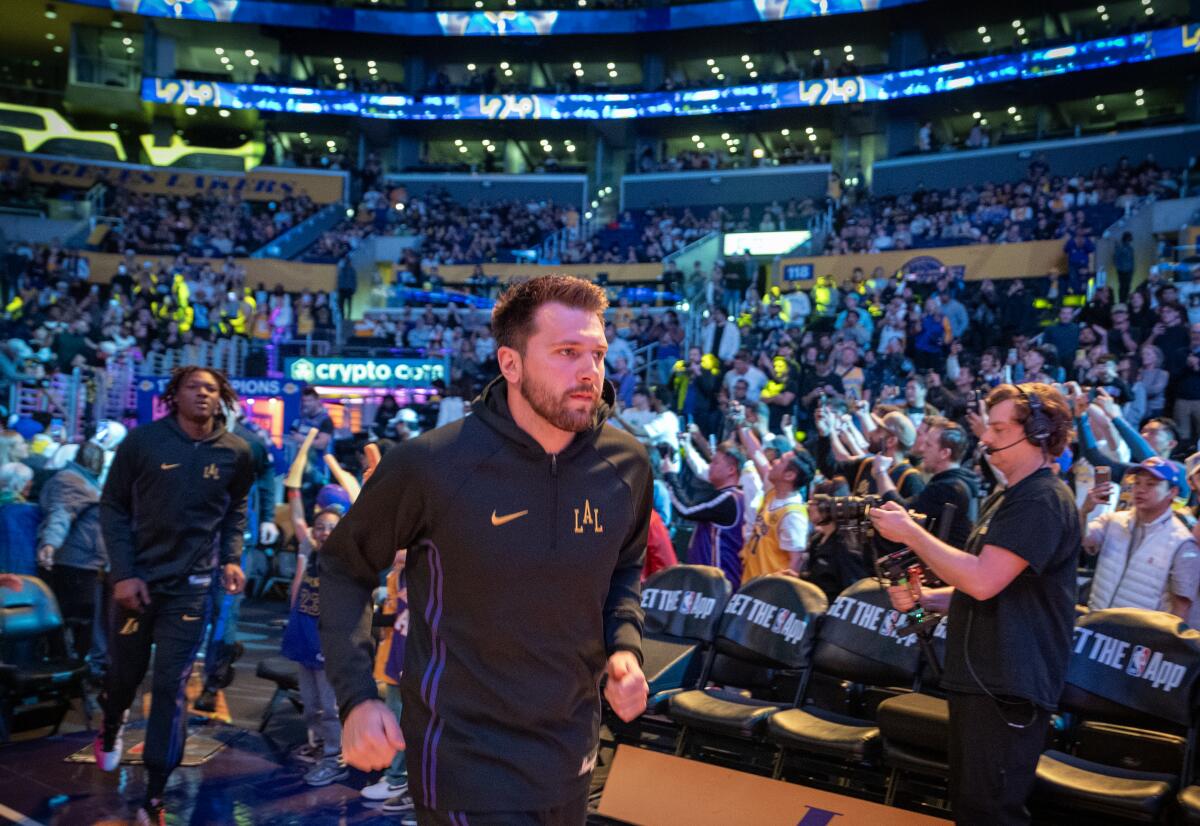
Lakers star Luka Doncic runs onto the court before a game against the Minnesota Timberwolves on March 10 at Crypto.com Arena.
(Allen J. Schaben / Los Angeles Times)
The familiar chant rang out in arenas from L.A. to Miami to Indianapolis. Luka Doncic’s campaign was powerful enough to sway even opposing crowds that showered him with shouts of “MVP.”
With Doncic on a historic season-ending heater, the most valuable player discussion suddenly got piping hot with two weeks left in the season. The NBA’s leading scorer surged back into the race with gaudy numbers over the month of March: 37.2 points, 8.2 rebounds and 7.1 assists per game; 12 straight 30-point games; a 24-hour stretch with 100 points; and the first 60-point performance by a Laker since Kobe Bryant in his final game.
The most important number from March: 14 wins. Approaching the playoffs, the Lakers (49-26) are one of the hottest teams in the league, powered by Doncic’s brilliance.
All things Lakers, all the time.
Get all the Lakers news you need in Thuc Nhi Nguyen’s weekly newsletter.
By continuing, you agree to our Terms of Service, which include arbitration and a class action waiver. You agree that we and our third-party vendors may collect and use your information, including through cookies, pixels and similar technologies, for the purposes set forth in our Privacy Policy such as personalizing your experience and ads.
“If we continue to finish the season the way we’re playing right now, and he continues to play that way, to me, he is the MVP,” Lakers coach JJ Redick said.
Doncic leads the league in scoring (33.7) and is just a hair off from the career-high 33.9 points per game he averaged when he finished third in MVP voting in 2024. Compared to the other top three MVP candidates — Shai Gilgeous-Alexander, Nikola Jokic and Victor Wembanyama — Doncic’s traditional stats paint a competitive picture. He has the second-most assists of the quartet behind Jokic and the third-most rebounds.
Among guards who have played more than 11 games, Doncic ranks third in rebounds per game at 7.8, and his 7.2 defensive rebounds per game is the most of anyone at his position. Doncic’s defense gets picked apart, but he also has a career-best 102 steals. He’s the only player averaging 30 or more points this season with 100 or more steals.
“He’s the engine that’s driving all of our winning,” Redick said.
Advanced statistics have Doncic a tier below his rivals. Doncic’s net rating of plus-4 is a distant fourth among the top contenders and pales in comparison to Wembanyama’s plus-17.3.
Breaking down the MVP race
Jokic appeared to be on his way to winning his fourth MVP before the Nuggets star missed a month with a knee injury. By leading the Oklahoma City Thunder to the best record in the league, Gilgeous-Alexander appeared to be in pole position to win his second consecutive MVP.
Doncic and Wembanyama are making a late charge. The Spurs see the Lakers’ 14-2 record in March and raise them a 25-2 mark since Feb. 1. They won their 10 consecutive game Monday. While Doncic was serving a suspension for technical foul accumulation, Wembanyama scored 41 points with 16 rebounds, four assists and three blocks against the Chicago Bulls.
The MVP chants in Frost Bank Arena are just as loud as anywhere in the league.
All fore one
Lakers guard Austin Reaves shoots a free throw during a win over the Washington Wizards on Monday at Crypto.com Arena.
(Robert Gauthier / Los Angeles Times)
Of all the NBA markets, L.A. presents unique challenges to team building. When Redick played for the Clippers, teammates scattered immediately after practice with hopes of beating traffic on the way home. Redick knew he wasn’t going to drive hours from his home in Manhattan Beach to visit Chris Paul in Calabasas.
But for the Lakers, a round of golf is worth a drive on the 405.
“Finding tee times, being with each other for four hours where you can shoot the proverbial S-H-I-whatever and not have to be in a high pressure moment or on a team bus and kind of be away from the facility,” Redick said, “I think it’s great.”
Golf is the Lakers’ latest bonding activity that’s helped keep the vibes high through the most successful stretch of the season. The Lakers have been intentional with team-building activities in Redick’s second year at the helm. All players and coaches made autobiographical powerpoint presentations to the team during the preseason. Jake LaRavia and assistant coach Beau Levesque won the team-wide pickleball tournament in November. Players and coaches arrange golf outings between games on long road trips. One day after hitting the winning shot in Orlando, newest teammate Luke Kennard got in on the golf action in a scramble match with players facing coaches.
“They had AR,” Redick said sheepishly, “so we can all guess the result of that one.”
Austin Reaves is the leader in the clubhouse. He remembered when teammates gave him grief about his love of golf, which he picked up at 17 and almost immediately excelled at. Seeing his teammates embrace the game “actually means a lot to me,” Reaves said.
“I’m glad that they are addicted,” he added with a satisfied smile.
After the COVID-19 bubble, Redick noticed an uptick in golf’s popularity around the league. Even the Lakers have a handful of players who suddenly decided to start during the last year. Doncic is the most recent convert. He bragged that he beat Reaves on one hole when they played in Indianapolis. Reaves, who got a double bogey compared to Doncic’s bogey, said he let his teammate win.
“It’s a confidence thing,” Reaves said. “We needed him to be at his best at 7 o’clock tonight.”
Doncic scored 43 points against Indianapolis the day after the golf outing.
On tap
Cleveland’s Jarrett Allen shoots between Detroit’s Cade Cunningham, left, and forward Tobias Harris on March 3.
(Sue Ogrocki / Associated Press)
Tuesday vs. Cleveland (47-28), 7:30 p.m. PDT
Center Jarrett Allen returned last week from a 10-game absence, but missed Cleveland’s game on Monday in Utah as he managed right knee tendinitis. Missing the first game of a back-to-back indicates that he’ll likely be available against the Lakers.
Thursday at Oklahoma City (60-16), 6:30 p.m. PDT
The Thunder have won 15 of their last 16 games with the only loss coming against Boston. This game and next week’s rematch at Crypto.com Arena could be critical in the MVP race between Gilgeous-Alexander and Doncic.
Sunday at Dallas (24-51), 4:30 p.m. PDT
Since the trade heard ‘round the league, Doncic has averaged 33 points, nine rebounds and 10 assists in four games against his former team. It’s his highest scoring average against any Western Conference opponent.
Status report
Marcus Smart (right ankle contusion)
Smart remains day-to-day with an ankle injury he sustained against Orlando. He has missed four games.
Adou Thiero (left knee soreness)
The rookie forward landed back on the injury report after playing two minutes in the Lakers’ loss to Detroit. Redick said Thiero was held out for precautionary reasons after his knee didn’t react well to playing in a G League game then playing in Detroit two days later. Thiero previously missed six weeks with a right medial collateral ligament sprain and underwent surgery on his left knee in college, which kept him sidelined at the beginning of the season.
Favorite thing I ate this week
(Thuc Nhi Nguyen / Los Angeles Times)
I have had Ramen Nagi on my list for literal years because former USC center Brett Neilon — who grew up in Tokyo — recommended it. I have changed beats three times since then but never forgot what he said was his favorite ramen place in L.A. The red king, which is a spicy version of their pork broth ramen, was worth the years of anticipation. Every bowl is customizable so I loved getting to add thick ramen noodles.
From Maddie Lee: A fastball up and off the plate to Guardians left-handed hitter Steven Kwan was an inauspicious beginning to Dodgers right-hander Roki Sasaki’s season debut.
The arm-side miss fell in line with a persistent spring-training pattern for Sasaki, who struggled with command from his first Cactus League start through his Freeway Series appearance last week.
Over the course of a seven-pitch strikeout, however, Sasaki adjusted — something he failed to do during game action this spring.
“I actually didn’t have confidence at all before this game started,” Sasaki said through an interpreter Monday. “But I was just focusing on doing what I can control.”
Go beyond the scoreboard
Get the latest on L.A.’s teams in the daily Sports Report newsletter.
By continuing, you agree to our Terms of Service, which include arbitration and a class action waiver. You agree that we and our third-party vendors may collect and use your information, including through cookies, pixels and similar technologies, for the purposes set forth in our Privacy Policy such as personalizing your experience and ads.
In the Dodgers’ 4-2 loss Monday, Sasaki’s first start of the season was something of a best-case scenario. He held the Guardians to one run and four hits in four-plus innings. And the biggest difference from his spring training struggles was he issued just two walks.
The Dodgers squandered the effort with a lack of offense, in their first loss of the season.
Sasaki will have more to prove against stronger offenses than Cleveland’s. But his performance at least suggested that the Dodgers’ faith in him wasn’t misplaced.
“We know he can do it here, and especially now that his velocity is back to closer to where it used to be,” Dodgers general manager Brandon Gomes said last week. “I feel like he puts us in a great position to win.”
Lakers star LeBron James, left, stands next to his son and Lakers guard Bronny James before a win over the Washington Wizards on Monday at Crypto.com Arena.
(Robert Gauthier / Los Angeles Times)
From Broderick Turner: The Lakers followed the lead of their oldest member, the triple-double producing LeBron James, in dispatching the Wizards 120-101 at Crypto.com Arena on Monday night.
Two days off between games left James looking spry, with lob dunks and dunks on the fast break contributing to his 21 points, 12 assists and 10 rebounds. James was eight for 16 from the field in notching his third triple-double of the season and the 125th of his 23-year NBA career, ranking him fifth all time.
At 41 years and 90 days old, James once again became the oldest player in league history to record a triple-double, passing his previous mark (41 years, 79 days).
“I mean, I’ve had moments more this year and last year that I’ve enjoyed more in the moment,” James said. “It’s pretty cool to know that I’m at this point in my career (and) I’m still able to do those things, man. It’s super dope. It’s super humbling. And I just try to put the work in and continue to put the work in and those are the results of it.”
UCLA guard Kiki Rice dribbles under pressure from Texas guard Rori Harmon on Nov. 26 in Las Vegas.
(Ian Maule / Getty Images)
From Marisa Ingemi:UCLA finally knows who it will face in the Final Four in Phoenix this week.
A day after taking down No. 3-seed Duke in the Elite Eight, the Bruins learned on Monday they will face fellow No. 1-seed Texas on Friday, the only team to beat them all season.
Since their Final Four debut ended with a 34-point loss to UConn last season, the Bruins have been on a mission to prove themselves. They faced their first adversity of the tournament during Sunday’s win over Duke when they trailed at the half, and now they’ll get a true test against the Longhorns.
“I trust this kid’s heart,” McVay said three times Monday at the NFL owners meetings.
But do the Rams trust Nacua, who has been at the center of several off-the-field situations, enough to break the bank with a massive extension?
Last week, a woman filed a civil lawsuit against Nacua, alleging that on New Year’s Eve he made an antisemitic statement during a group dinner and later bit her shoulder. Nacua’s attorney told The Times before the lawsuit was filed that Nacua “denies these allegations in the strongest possible terms,” and that Nacua would “pursue all available legal remedies in response to these false and damaging statements.”
Dr. Dre and Snoop Dogg perform at the Los Angeles 2028 Olympic Games handover celebration in Long Beach in August 2024.
(Emma McIntyre / Getty Images for LA28)
From Thuc Nhi Nguyen: There’s still more than two years remaining before the Olympics return to L.A., but fans can lock in their seats this week when tickets officially go on sale.
The virtual ticket box opens April 2 for locals in Southern California and Oklahoma. LA28 is planning to make 14 million tickets available for the Games, which would break the record for total tickets sold set by Paris 2024. The L.A. Games already attracted a record number of ticket registrations, topping 5 million fans from 197 countries and territories for the first drop.
Cabrera gave up one hit and walked one in his Chicago debut, delighting the crowd of 36,702 on a picturesque night at Wrigley Field. The 6-foot-5 right-hander was acquired in a January trade with Miami.
Carson Kelly and Moisés Ballesteros each drove in two runs for the Cubs (2-2) in the opener of a three-game series.
From the Associated Press: John Tavares redirected a shot from Morgan Rielly into the net with five seconds left in overtime to lift the Toronto Maple Leafs to a 5-4 come-from-behind victory over the Ducks in a fight-marred game Monday night.
The Leafs overcame a 3-1 deficit with three goals in the third period, including Rielly’s snap shot from the high slot that beat Ducks goalie Ville Husso stick-side to give Toronto a 4-3 lead with three minutes left in regulation.
But Leo Carlsson, who hobbled to the locker room after taking a hard hit and falling to the ice in the first minute of the third, gathered a loose puck near the left circle and flicked a shot past Toronto goalie Anthony Stolarz to make it 4-4 with 1:39 left.
Tavares added a first-period goal, and Stolarz stopped 28 of 32 shots for Toronto, which took the ice about 1½ hours after general manager Brad Treliving was fired near the end of his third season, with the Maple Leafs on the verge of being eliminated from the playoffs for the first time in a decade.
From the Associated Press: The Super Bowl will return to Las Vegas in 2029 for the second time after NFL owners voted Monday to award the nation’s gambling and entertainment capital the big game.
Las Vegas getting the Super Bowl back seemed only like a matter of time after Kansas City defeated San Francisco 25-22 in overtime at Allegiant Stadium in February 2024.
Commissioner Roger Goodell all but gave the return his blessing after the first Super Bowl in a city the league long shunned because of concerns about legalized sports betting.
“The Vikings are mourning the loss of Ring of Honor member Joey Browner,” the team said Sunday in a statement. “Browner will be deeply missed by former coaches and teammates, as well as many others he impacted throughout his life.”
The Vikings added in a separate post: “He helped define what it is to be an NFL safety.”
No cause of death was given. In August, former Minnesota quarterback Tommy Kramer organized a fundraiser for Browner, who Kramer said was “battling through some serious health issues.”
1923 — The Ottawa Senators of the NHL completes a two-game sweep of the WCHL’s Edmonton Eskimos with a 1-0 victory to win the Stanley Cup for the third time in four years. Harry “Punch” Broadbent scores the goal.
1931 — Notre Dame football coach Knute Rockne and seven others die in a plane crash in a wheat field near Bazaar, Kansas. During his 13 years at Notre Dame, the 43-year-old coach, led the “Fighting Irish” to 105 victories, 12 losses, five ties and three national championships.
1968 — The American League’s new franchise in Seattle chooses Pilots as its nickname.
1973 — The Philadelphia Flyers tie an NHL record for most goals in one period, scoring eight goals in the second period of a 10-2 win over the New York Islanders.
1973 — Ken Norton scores a stunning upset by winning a 12-round split decision over Muhammad Ali to win the NABF heavyweight title. Norton, a 5-1 underdog, breaks Ali’s jaw in the first round.
1975 — UCLA beats Kentucky 92-85 for its 10th NCAA basketball title under head coach John Wooden. Wooden finishes with a 620-147 career record after announcing his retirement two days earlier.
1976 — Cleveland Cavaliers beat Jazz to clinch club’s first ever NBA playoff berth.
1980 — Larry Holmes scores a TKO in the eighth round over Leroy Jones to retain his WBC heavyweight title in Las Vegas.
1980 — Mike Weaver knocks out John Tate in the 15th round to win the WBA heavyweight title in Knoxville, Tenn.
1982 — NBA and NBAPA reach 4-year agreement on return for minimum & maximum payrolls, the first of its kind in team sports.
1984 — Mike Bossy becomes first player in NHL history to record 7 straight 50 goal seasons.
1985 — Old Dominion beats Georgia in the 4th NCAAW National Championship.
1986 — Freshman center Pervis Ellison hits two free throws with 27 seconds left to seal Louisville’s 72-69 victory over Duke in the NCAA basketball championship.
1990 — 20-year old C Joe Sakic becomes the youngest player in NHL history to score 100 points in a season
1991 — Tennessee edges Virginia 70-67 in overtime for its third NCAA women’s basketball title. It’s the first overtime in the NCAA’s 10-year history.
1991 — Amy Alcott wins the Dinah Shore golf tournament with a record eight-shot victory over Dottie Mochrie.
1994 — Chicago White Sox assigns former NBA superstar Michael Jordan to the Birmingham Barons of Class AA Southern League.
1995 — Major league baseball players end their strike.
1997 — Martina Hingis becomes the youngest No. 1 player in tennis history. The 16-year-old Swiss sensation, who claimed her fifth title of 1997 at the Lipton Championships on March 29, supplants Steffi Graf in the WTA Tour rankings.
1998 — Expansion clubs, Tampa Bay Devil Rays and Arizona Diamondbacks both suffer losses in their MLB debuts.
2002 — UConn women’s basketball team beat Oklahoma, 82-70; Huskies conclude perfect season (39-0).
2002 — Andre Agassi wins his 700th career match and captures his second straight Key Biscayne Title.
2005 — Tarence Kinsey hits a 3-pointer with 1.3 seconds left to lift South Carolina to a 60-57 victory over Saint Joseph’s for the NIT championship.
2012 — Ray Whitney passes 1,000 career points with a goal and assist in Phoenix’s 4-0 victory over Anaheim.
2013 — In one of the biggest upsets in the history of the NCAA women’s tournament, sixth-seeded Louisville stuns defending national champion Baylor in the regional semifinals, 82-81. It’s the end of a remarkable college career for Baylor’s Brittney Griner, a record-setting 6-foot-8 post player who ended up as the second-highest scoring player in NCAA history.
2013 — Pete Weber ties Earl Anthony by winning his 10th major Professional Bowlers Association title with a 224-179 win over Australian Jason Belmonte in the Tournament of Champions.
2017 — UConn’s record 111-game winning streak comes to a startling end when Mississippi State pulls off perhaps the biggest upset in women’s basketball history, shocking the Huskies 66-64 on Morgan William’s overtime buzzer beater in the national semifinals.
2018 — Anthony Joshua beats Joseph Parker by unanimous decision to become a three-belt world heavyweight boxing champion. Joshua adds Parker’s WBO belt to his WBA and IBF titles, and moves within one belt of becoming the first undisputed champion since Lennox Lewis in 2000.
Compiled by the Associated Press
Until next time…
That concludes today’s newsletter. If you have any feedback, ideas for improvement or things you’d like to see, email me at houston.mitchell@latimes.com. To get this newsletter in your inbox, click here.
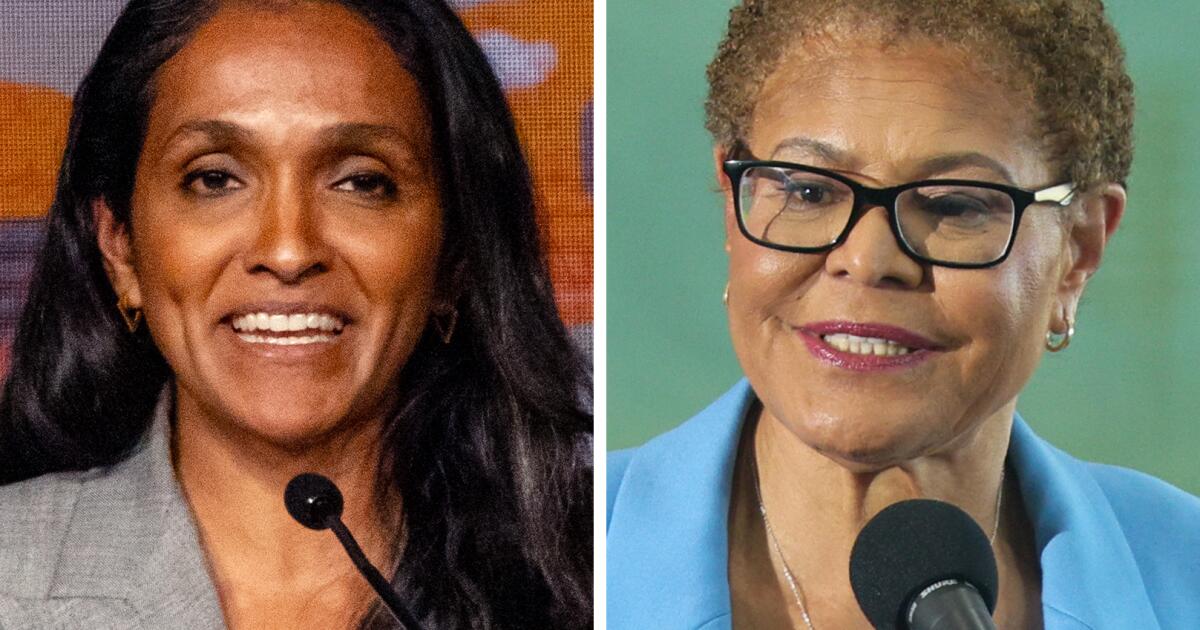
City Councilmember Nithya Raman came out ahead of incumbent Karen Bass in a new poll on the Los Angeles mayor’s race, though the poll’s director cautioned that it did not give the whole picture.
Raman had a commanding lead in a field of five major candidates, with 33% of voters supporting her, while Bass trailed at 17%, according to the poll by the Loyola Marymount University Center for the Study of Los Angeles.
Leftist Rae Huang came in just behind Bass at nearly 17%, while tech executive Adam Miller had 13% and conservative reality TV star Spencer Pratt had 12%.
In the Loyola Marymount poll, unlike the other polls, respondents were given brief descriptions of the candidates, including their occupations and political priorities.
Raman was labeled a “progressive LA City Councilmember focused on housing affordability, homelessness and systemic reform,” while Bass was “incumbent mayor of Los Angeles, veteran legislator, focused on homelessness.”
One of Raman’s challenges, as a councilmember representing Los Feliz and Silver Lake as well as parts of the San Fernando Valley, is to spread her name recognition citywide, with the June 2 primary election about two months away. She entered the race to challenge Bass, her one-time ally, at the last minute, hours before the early February filing deadline.
The Loyola Marymount poll of 370 registered Los Angeles voters was conducted from Feb. 11 to March 16. It did not include a choice for “undecided,” while the other two polls showed that significant percentages of voters hadn’t made up their minds.
“This poll shows if only positive descriptors are used and context is provided, Raman is ahead,” said Fernando Guerra, director of Loyola Marymount’s Center for the Study of Los Angeles, who directed the poll.
Guerra said he believes Bass is the front-runner, taking the previous polls into account.
Bass’ campaign took issue with the Loyola Marymount poll.
“In 2022, this same LMU poll had Karen Bass at 16% — she ended up winning the primary with 43%. The only thing more ridiculous than this poll is Spencer Pratt’s performance on The Hills,” said Alex Stack, a spokesperson for the Bass campaign, referencing Pratt’s reality show.
Raman’s campaign did not immediately respond to a request for comment. In a post on X citing the poll, Raman wrote, “OUR CAMPAIGN IS SURGING … Angelenos are ready for a city that actually works.”
Paul Mitchell, vice president of the bipartisan voter data firm Political Data Inc., said the poll’s sample size was too small to draw conclusions and that the poll was less reliable because it was conducted over the course of more than a month.
He also noted that with many of the candidates relatively unknown, including the descriptors could have a major effect.
“I’m sure Nithya Raman doesn’t have citywide name recognition, but that description is really great,” Mitchell said.
Guerra said he didn’t include an “undecided” option because he wanted to “force” respondents to give an answer, similar to when they actually vote.
In the Emerson poll, more than 50% of voters were undecided on who to support for mayor. The Berkeley IGS poll showed about a quarter of voters were undecided.
In LMU’s mayoral poll from 2022, released in early March of that year, 42% of respondents chose “undecided/someone else” for mayor.
After Bass, who had 16% support, then-City Councilmember Kevin de Léon was second at 12% in the 2022 poll. Rick Caruso, the billionaire developer, who ended up making the runoff election against Bass, received 6% support.
In that year’s June primary, Bass got 43% of the vote, Caruso nearly 36% and De Léon about 8%.
This year’s LMU poll also asked L.A. voters what kind of candidate they would prefer for mayor.
Nearly 50% said they prefer a Democratic Socialist, while 25% said they want a moderate Democrat, 19% said a conservative and just 8% said an establishment Democrat.
“Los Angeles is much more progressive than its elected leadership. This poll captures that,” Guerra said.
Some disagreed.
Mike Trujillo, a consultant for moderate Democrats who is not representing anyone in the mayoral race, said polling he has done across the city shows that the Democratic Socialists of America’s popularity is much lower.
Raman is a dues-paying member of the Los Angeles chapter of DSA, which endorsed her in her two successful City Council campaigns.
“If you believe this poll, I have bridges to sell you on 1st Street, 6th Street, and Alameda Street — and there’s no bridge on Alameda,” he said. “The poll was basically A to Z in Nithya Raman’s contact list.”
This year’s LMU poll also asked L.A. County voters about the governor’s race. Former U.S. Rep. Katie Porter led at about 16%, followed by Republican Steve Hilton at 13% and billionaire Tom Steyer at 12%.
The Berkeley IGS poll showed two Republicans — Riverside County Sheriff Chad Bianco and Hilton — leading the crowded field of gubernatorial candidates by slim margins among voters statewide, with Democratic support split among multiple candidates in a left-leaning state.
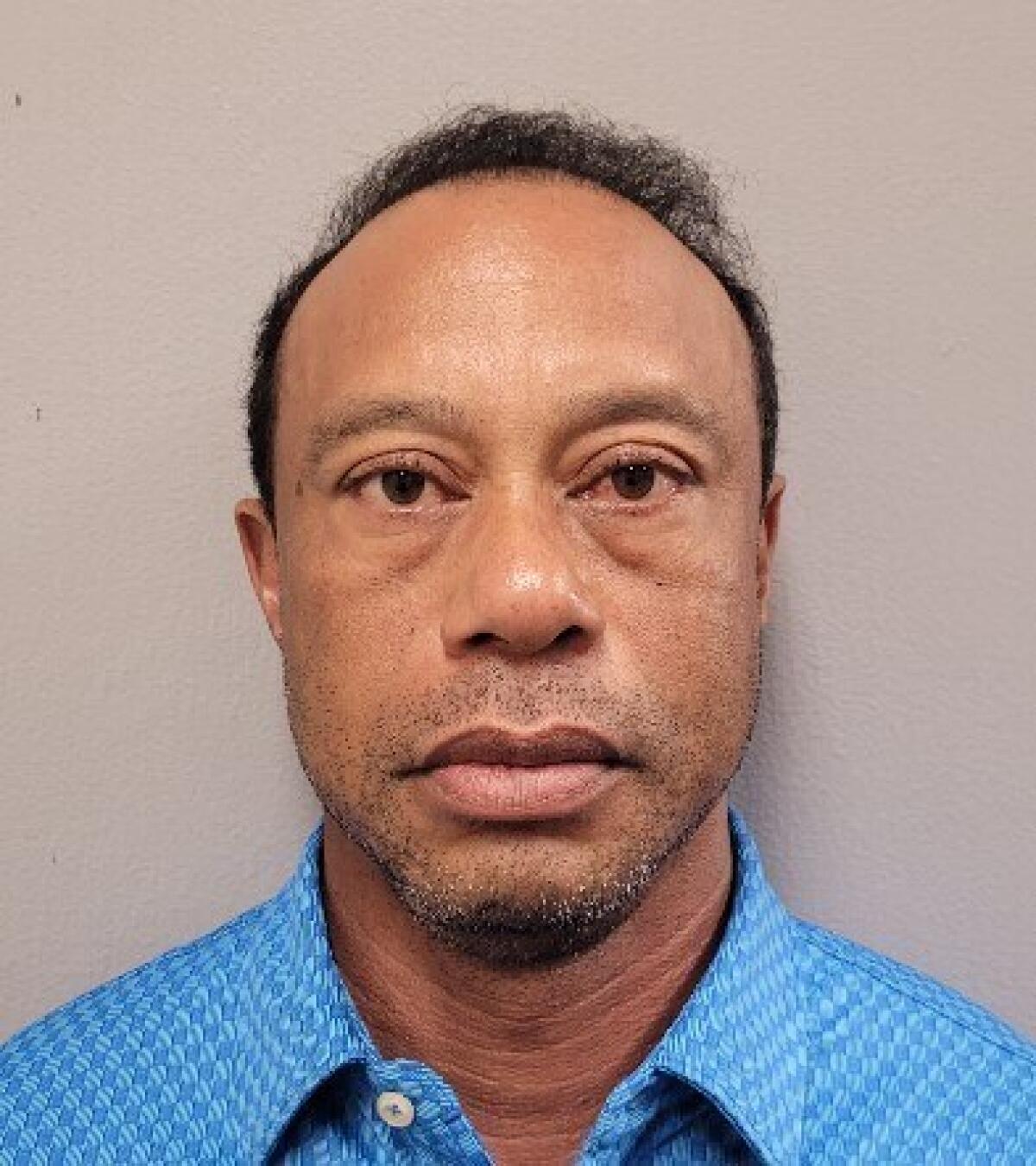
Tiger Woods was arrested on suspicion of driving under the influence and causing property damage following a rollover car crash Friday afternoon in Florida, authorities said.
The Martin County Sheriff’s Office said that Woods, 50, had tried to overtake another vehicle when his Land Rover clipped it. Woods climbed out of the passenger side of the car. He showed signs of impairment at the scene and was arrested, authorities said. Woods was driving alone, and neither he nor the driver of the other car were injured in the crash.
The Martin County Sheriff’s Office released Tiger Woods’ booking photo on Friday night following the golfer’s arrest.
(Martin County Sheriff’s Office via Associated Press)
Woods’ talent agency, Excel Sports Management, did not respond to a request for comment.
A breathalyzer test showed he had no alcohol in his system, but he refused to do a urine test, Martin County Sheriff John M. Budensiek said at a news conference around 5 p.m. local time.
The crash occurred around 1 p.m. local time, the department said in a Facebook post. The Jupiter Island Police Dept. was first to respond to the scene and found a pickup truck that had been pulling a pressure cleaner trailer and Woods’ Land Rover rolled over on the driver’s side door, Budensiek said. Officers talked to Woods and then asked the sheriff’s office for help.
The sheriff’s office determined that the pickup truck was slowing down to make a turn into a driveway off of a two-lane road with no shoulder when the driver looked in his mirror and saw the Land Rover approaching quickly from behind. The pickup driver tried to get out of the way of the approaching car. The Land Rover swerved at the last moment to avoid a crash, clipped the back end of the trailer, listed to the side and rolled onto the driver’s side door.
At the scene, Woods appeared lethargic, the sheriff’s office said, and was arrested following “in depth” roadside tests. The sheriff said he does not know exactly what Woods was intoxicated with, but concluded it was likely due to “some type of medication or drug.”
Because Woods refused to submit to a urinalysis, “we will never get definitive results as to what he was impaired on at the time of the crash,” the sheriff said. No drugs or medications were found in Woods’ car.
In addition to DUI and property damage, Woods also was charged with refusal to submit to a lawful test, Budensiek said. All three charges are misdemeanors.
Under Florida law, Woods had to remain in Martin County jail for at least eight hours following the arrest.
Asked if Woods would get preferential treatment, Budensiek said the celebrity would not be with other inmates who could take advantage of his position. Otherwise, it would be just another case.
“We know we arrested a high-profile figure,” Budensiek said. “I’m not trying to dramatize, but it doesn’t matter who you are. If you break the law, we’re going to follow the law. That’s a really easy path to take.”
Around Thanksgiving 2009, a report that Woods had been in a car accident near his home erupted into a major scandal involving allegations of affairs with multiple women. It resulted in Woods’ divorce from Elin Nordegren, the mother of his children.
Assistant Editor Christie D’Zurilla contributed to this story.
Good morning, and welcome to L.A. on the Record — our City Hall newsletter. It’s Noah Goldberg, with an assist from David Zahniser and Rebecca Ellis, giving you the latest on city and county government.
Adam Miller is running for mayor.
You might not know that, and you might not even know who he is — and his campaign team wouldn’t blame you.
In fact, the Miller team’s own internal poll of 800 likely voters shows the tech entrepreneur with just 6% support, behind incumbent Mayor Karen Bass, City Councilmember Nithya Raman, conservative reality TV star Spencer Pratt and leftist Rae Huang. Only 13% of Angelenos even have an opinion of Miller, with 7% coming down on the positive side and 6% negative.
Miller’s pollster, Jefrey Pollock, admits it’s not often that a campaign brags about a humble 6% backing their candidate.
But during a video conference with reporters, Pollock argued that Miller’s support rises along with his name recognition. When likely voters were given more information about the candidates, he shot up to 20%, according to the poll. When provided with additional positive information about the candidates, Miller finished first, with 27%.
“Adam is the one who jumps up,” said Pollock, who runs Global Strategy Group.
After voters got the first dose of information, 22% supported Bass, down from 26%; 21% went with Pratt, up from 14%; 14% backed Raman, up from 12%; and 8% chose Huang, down from 9%.
In a poll earlier this month by the UC Berkeley Institute of Governmental Studies, co-sponsored by The Times, Miller also came out with 6% support. Bass was supported by 25% of voters, while Raman drew 17% and conservative reality TV star Spencer Pratt came in third at 14%. About a quarter of voters were undecided.
Paul Mitchell, vice president of the bipartisan voter data firm Political Data Inc., said the Miller campaign poll was compelling.
“What I see is a good argument that he can make the runoff,” Mitchell said. “This is a real deal.”
The question for Miller and his team then becomes, how can he introduce himself to more voters before the June 2 primary?
Miller is the former CEO of Cornerstone OnDemand, a global training and development company he built over the course of more than 20 years. The publicly traded company was eventually sold to a private equity firm for $5.2 billion. He is also a co-founder of Better Angels, a nonprofit focused on preventing homelessness and building affordable housing.
Among everyday Angelenos, he’s a no-name.
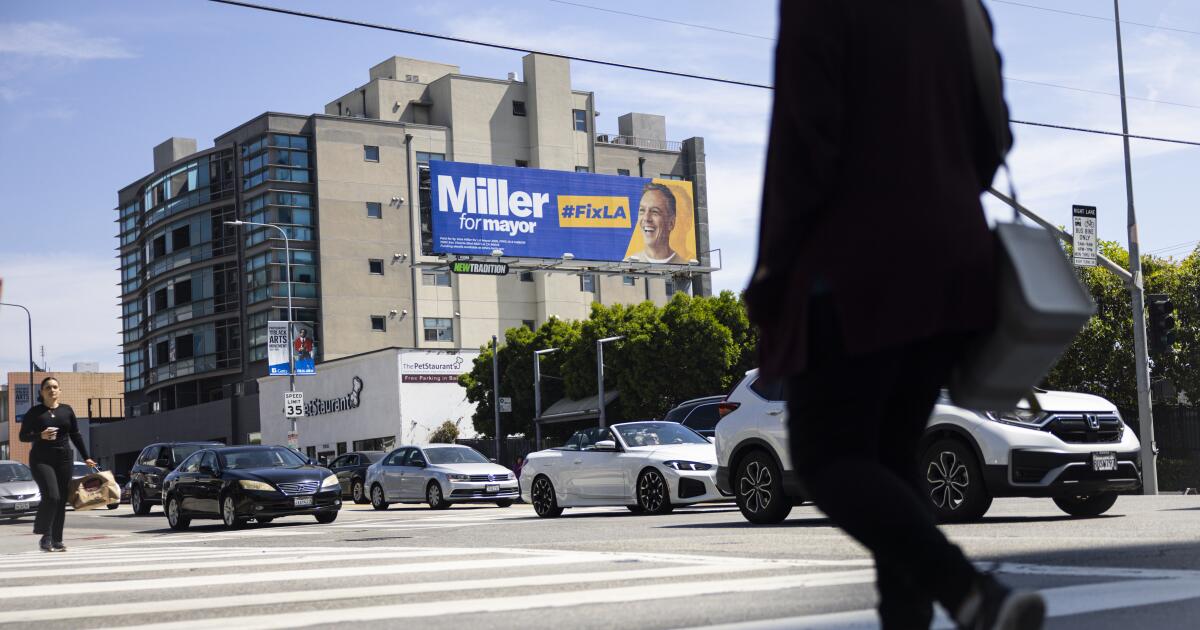
A television, social media and outdoor billboard advertising campaign launched this week should help change that, Miller’s team said. They said the “omnichannel” blitz cost seven figures but did not provide an exact amount.
The first billboard went up this week at Bundy Drive and Wilshire Boulevard, not far from Miller’s Brentwood home. More are expected next week in the San Fernando Valley.
Miller said he personally loaned his campaign a “majority” of the money for the ad blitz.
How much Miller is willing to spend on his mayoral ambitions?
In 2022, billionaire developer Rick Caruso threw more than $100 million of his own money into his campaign against Bass during the primary and runoff elections. He still lost by more than 10 percentage points.
“Obviously, we have the benefit of hindsight that that strategy did not work,” Miller said of the Caruso campaign. “There’s reasons my candidacy is different.”
For one thing, as opposed to Caruso, who was a Republican before registering as a Democrat to run for mayor, Miller is a lifelong Democrat. (That said, Miller voted for Caruso in 2022, said his spokesperson, Jaime Sarachit).
Miller is a moderate who sees himself as leader who gets things done. He believes the LAPD needs a minimum of 10,000 officers, up from about 8,700. He thinks the city should use anti-encampment laws to move homeless people away from sensitive areas like schools and day cares.
Miller would not directly answer a question about how much of his own money he will spend on his campaign. He has so far loaned it $2 million, “to get it up and running,” Sarachit said.
“That’s a significant sum, obviously,” said longtime L.A. political consultant Bill Carrick. “It’s a lot more efficient to write a check from your personal account than it is to go raise $2 million.”
But Miller said his campaign will largely be “traditionally financed,” meaning he plans to fundraise.
You’re reading the L.A. on the Record newsletter
Sign up to make sense of the often unexplained world of L.A. politics.
By continuing, you agree to our Terms of Service, which include arbitration and a class action waiver. You agree that we and our third-party vendors may collect and use your information, including through cookies, pixels and similar technologies, for the purposes set forth in our Privacy Policy such as personalizing your experience and ads.
State of play
— AO-K’ed: Metro’s board on Thursday unanimously approved a new route for a rail line that would extend from South L.A. into West Hollywood — a milestone deal struck after last-minute negotiations between Bass and local leaders. The K Line northern extension would link with four major rail lines and increase the number of riders to 100,000 a day.
— SOCIALIST SNUB: The Los Angeles chapter of the Democratic Socialists of America will not endorse a candidate for mayor. Last weekend, the group voted on whether to reopen its endorsement process and consider backing Huang or Raman but ultimately decided to stay out of the fray for the June primary.
— GUNNING FOR COUNCIL: Leftist City Council candidate Estuardo Mazariegos was convicted of misdemeanor gun possession in 2009. He thinks the conviction is a strength, not a weakness.
— SMALLER BIGGER: On Tuesday, the City Council adopted a strategy that would delay the effects of SB 79 citywide by upzoning 55 single-family and low-density areas, allowing for buildings of four to 16 units that are up to four stories tall. Under SB 79, buildings adjacent to certain transit stops can be up to nine stories.
— NOT UP FOR DEBATE: USC canceled its Tuesday gubernatorial debate, a stunning about-face after days of fiery criticism that every prominent candidate of color was excluded. Although the university defended the methodology used to determine who was invited, it ended up calling off the event with less than 24 hours’ notice.
— PHANTOM SUIT: A man said he has no idea how he became a plaintiff in the county’s $4-billion payout for sex abuse in juvenile halls and foster homes. His lawsuit, which he says was filed without his consent by Downtown LA Law Group, deepens questions around possible fraud in the nation’s largest sex abuse settlement.
— TAX TAKEAWAY: The proposal from a group of business leaders to repeal the city’s business tax has qualified for the November ballot. Organizers said their success — gathering twice as many signatures as needed — shows that voters “want affordability and fairness to be addressed immediately.” Labor unions have vowed to fight the proposal, which would rip an $800-million hole in the city budget.
— HOUSING HUDDLE: Three of the mayoral candidates — Miller, Huang and Raman — took the stage Monday for a downtown forum. The trio went back and forth on housing, transportation and other issues, particularly the future of Measure ULA, the so-called mansion tax. Bass did not attend, citing a previous engagement in New Orleans, where she held a campaign fundraiser with U.S. Rep. Troy Carter (D-La.) and the city’s mayor, Helena Moreno. Pratt also did not show.
QUICK HITS
Where is Inside Safe? The mayor’s signature program visited Skid Row in Councilmember Ysabel Jurado‘s district, moving 25 people indoors.
On the docket next week: The City Council is on recess next week.
Stay in touch
That’s it for this week! Send your questions, comments and gossip to LAontheRecord@latimes.com. Did a friend forward you this email? Sign up here to get it in your inbox every Saturday morning.
Congratulations to all the young athletes and their teams on The Times All-Area high school basketball teams. I do wonder about the choices the seniors are making in their commitments to colleges and I look to The Times to explain why UCLA is seemingly not on the radar for these young players.
It used to be known that the Bruins’ academic requirements were a significant barrier to many high school players. Is that still true? Are the local graduates not the cream of the crop that Southern California was known for in past years? Are NIL deals affecting the choices of these future freshmen? Is UCLA not making a strong outreach effort for the top local talent? Is L.A. so awful for these kids that it isn’t even on their radar to stay close to home?
I am sure I am not alone in seeking clarity around the issue of the exodus of local talent to Missouri, Oregon State, Texas, North Carolina, Nevada, and even more confounding, USC.
David Gerne Echt Torrance
The Los Angeles Times welcomes expressions of all views. Letters should be brief and become the property of The Times. They may be edited and republished in any format. Each must include a valid mailing address and telephone number. Pseudonyms will not be used.
Hello! I’m Mark Olsen. Welcome to another edition of your regular field guide to a world of Only Good Movies.
In another busy week for new releases, the horror-comedy “Forbidden Fruits” is among the standouts. Having just premiered at SXSW, it is the feature debut for director Meredith Alloway, who co-wrote the screenplay with Lily Houghton, adapting Houghton’s play. Diablo Cody is a producer on the film, and the movie shares a sensibility with her beloved “Jennifer’s Body.”
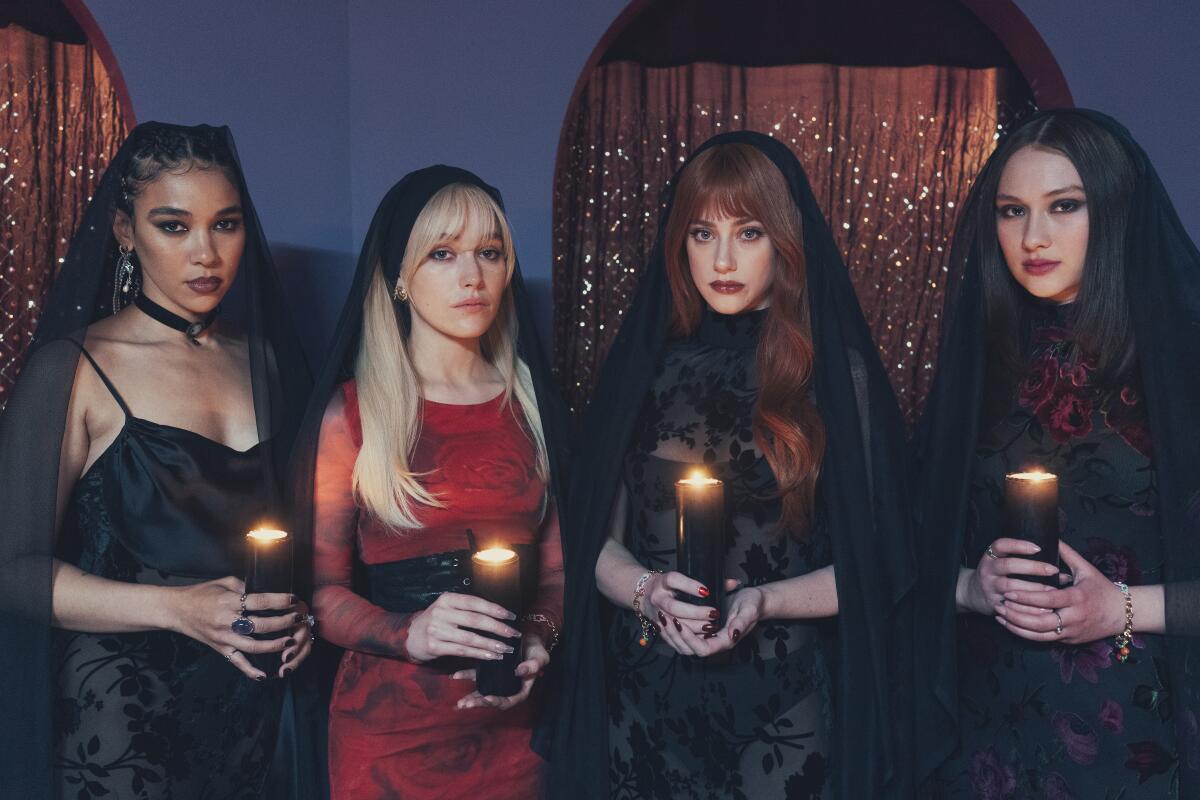
Set at a Texas shopping mall, the plot follows a group of female employees at a boutique who are secretly a coven of witches after hours. They bring a new employee into their fold. Lili Reinhart, Lola Tung, Victoria Pedretti and Alexandra Shipp star.
Alexandra Shipp, from left, Victoria Pedretti, Lili Reinhart and Lola Tung in the movie “Forbidden Fruits.”
(Sabrina Lantos / Independent Film Co. / Shudder)
Though Katie Walsh gave the film a mixed review, declaring it “essentially the fast fashion of girly pop horror,” the film casts a spell when it is working.
Pedretti in particular is a standout, and Malia Mendez spoke to her about the role. “It asks a lot of people to try to step into a world like this one,” Pedretti said of the film’s knowing, campy style. “And as nerve-racking as it may be to take that big swing, you gotta take the big swing.”
Also opening in L.A. this week is Sofia Coppola’s “Marc by Sofia.” The director’s first documentary, it’s more a snapshot than a definitive portrait of the life and career of her longtime friend, fashion designer Marc Jacobs, as he prepares for his spring 2024 collection. While not as in-depth or revealing as one would hope, the film has a warmth and charm all its own. And anyone feeling nostalgic for ’90s New York after watching the recent TV series “Love Story” will get a buzz from this too.
Larry Karaszewski on ‘Last Summer’
Richard Thomas, left, Barbara Hershey and Bruce Davison in the movie “Last Summer.”
(Warner Archive)
The American Cinematheque at the Aero Theatre on Sunday will host the world premiere of a new restoration of the theatrical version of 1969’s “Last Summer,” directed by Frank Perry from a screenplay by Eleanor Perry. Actors Barbara Hershey and Bruce Davison will be there for a Q&A moderated by screenwriter Larry Karaszewski.
“This is one of the holy grails for movie nerds,” says Karaszewski in a recent phone interview. The restoration happened in no small part thanks to his persistent and vocal fandom of the film. Best known for his work with writing partner Scott Alexander (including “Dolemite Is My Name” and “Ed Wood”) and currently a governor in the academy’s writer’s branch, Karaszewski is also a pillar of the repertory scene around Los Angeles, frequently moderating Q&As and an avid moviegoer.
Richard Thomas, left, Barbara Hershey and Bruce Davison in the movie “Last Summer.”
(Warner Archive)
“Last Summer” follows three teenagers (Hershey, Davison and Richard Thomas) whiling away the summer at the beach on New York’s Fire Island. As a certain psychosexual energy escalates among them, winding each other up, they turn their attention to a younger girl (Catherine Burns) and torment her in increasingly sadistic ways.
For her performance, Burns was nominated for an Oscar for supporting actress, while Hershey briefly changed her last name to Seagull after a bird was accidentally injured on set.
In his original July 1969 review, The Times’ Charles Champlin called “Last Summer” “a compelling and disturbing movie, with moments of quite extraordinary power and poignance.”
“This was a movie that people who saw it were just fascinated by,” says Karaszewski. “Even though it came out in ’69, it feels like an important ’70s-style movie, a really rough youth film that used the new freedom that cinema had at that time. But you couldn’t see it.”
Director Frank Perry and screenwriter Eleanor Perry during production of “Last Summer.”
(Warner Archive)
Over time, the rights to the movie changed hands, elements went missing and it became a rarity. Due to an intense rape scene, the movie was also briefly released to some theaters with an X-rating, though Karaszewski says the differences to the R-rated version are minimal — a matter of a few frames and a single word. Released on VHS, “Last Summer” has never been on DVD or Blu-ray. (The Warner Archive label will release a disc of the new restoration later this year.) An edited TV version of the film has circulated, and the last few times “Last Summer” has shown in Los Angeles, it has been from a print discovered at an archive in Australia.
Karaszewski has long had a fascination with the film, one that was only fueled by its inaccessibility.
“It became famous as just, ‘Oh, that’s the movie Larry champions, that’s the movie that Larry won’t stop talking about,’ ” he says. Karaszewski jokes that he won’t know what to do with himself now that his longtime obsession with seeing the film revived has been fulfilled.
“I’ve been championing it so long,” he says. “It could have been just like, ‘Oh, Larry’s a little crazy. He loves this movie.’ And that would’ve been fine too. I’m a person that feels like every movie should have its day in the spotlight.”
The complete Akira Kurosawa in 35mm
An image from Akira Kurosawa’s “Ran.”
(Rialto Pictures)
On Saturday, the Academy Museum launches “Darkness and Humanity: The Complete Akira Kurosawa,” a comprehensive retrospective of the Japanese filmmaker’s 30 existing features, all of which will screen in 35mm. The series opens with two of Kurosawa’s best-known films, “Seven Samurai” and “Rashomon.” Other highlights include “Throne of Blood,” “Ikiru,” “Hidden Fortress,” “Stray Dog,” “High and Low,” “Dreams” and “Ran.” This is a rare opportunity to take in the true breadth of Kurosawa’s work.
Writing about the filmmaker in 2009 to commemorate the centennial of his birth, Dennis Lim said, “The wonder of Akira Kurosawa’s 50-year career is that it was at once remarkably varied and satisfyingly coherent …. But the constant in his films was the principle of heroism, not as a vaporous ideal but a way of life, an awareness of individual agency and personal responsibility in a world that does not always reward or even allow heroic behavior.”
Toshiro Mifune in Akira Kurosawa’s “Yojimbo.”
(Janus Films)
Kurosawa’s influence on other filmmakers around the world has been widely acknowledged. Upon the news of Kurosawa’s death, Steven Spielberg proclaimed him “the visual Shakespeare of our time” and added, “I am deeply saddened by Kurosawa’s death. But what encourages me is that he … is the only director who right until the end of his life continued to make films that were recognized as, or will be recognized as, classics.”
In 1985, while in Los Angeles for a screening of his film “Ran,” Kurosawa described his own work by saying, “I just make up stories and film them. When I am lucky, the stories have a lifelike quality that makes them appealing to people and the film is successful.”
Points of interest
‘To Sleep With Anger’ in 35mm
Actor Danny Glover and director Charles Burnett during production of “To Sleep With Anger.”
(Samuel Goldwyn Company / Photofest)
To celebrate the release of Ashley Clark’s new book “The World of Black Film: A Journey Through Cinematic Blackness in 100 Films,” the UCLA Film and Television Archive will screen Charles Burnett’s 1990 drama “To Sleep With Anger” in 35mm at the Billy Wilder Theater on Sunday. Clark will be there for a book signing, and Burnett will join him for a Q&A.
Recently included as part of The Times’ ranked list of the 101 best Los Angeles movies, “Anger” stars Danny Glover in a galvanizing performance as Harry, an old friend from the South who arrives for an unexpected visit to a family in South Central L.A., upending their lives.
In his book, Clark describes the film as “a singular work with a distinct yet tantalizingly hard-to-pin-down performance from Danny Glover, who, as the inscrutable Harry, flickers between menace and charm, using all of his six-foot-four-inch stature to dominate the frame.”
In a 1990 Times story by David Wallace, Burnett spoke about how the film was meant to evoke a sense of Black cultural history, saying, “I didn’t appreciate the [storytelling] tradition until it disappeared. I had a sense of who I was because of that experience. … This film was an attempt to go back and deal with the past. To tell a story about a story.”
Added Glover: “I think there is a little of Harry in all of us. We’re constantly in conflict between the good side and the other. Harry’s involvement with the dark side is not that uncommon.”
Clark will also appear at the Academy Museum on Monday for the world premiere of Ngozi Onwurah’s restored 1995 film “Welcome II the Terrordome.”
‘Thank You for Smoking’
Aaron Eckhart in the movie “Thank You for Smoking.”
(Dale Robinette / Fox Searchlight Pictures)
On Saturday, Vidiots will host a 20th anniversary screening of Jason Reitman’s debut feature “Thank You for Smoking” in 35mm, with the filmmaker in attendance for a Q&A. Adapted by Reitman from a novel by Christopher Buckley, the film is media satire that follows the misadventures of a lobbyist (Aaron Eckhart) for Big Tobacco. The cast also includes Katie Holmes, Robert Duvall, William H. Macy and Sam Elliott.
In his original review, Kenneth Turan called the movie “that rare film that actually has a sense of humor,” before adding, “Reitman’s script and direction retain the novel’s rhythms and black comic sensibility while at the same time eliminating and/or rearranging large chunks of its plot. He’s also figured out a way to make the story more conventionally audience-friendly without losing the extraordinary bite that made the book so successful.”
I recall an afternoon spent on the Fox lot talking to Reitman and Buckley together for a piece I wrote in 2006. The political climate that the film examines, one of extreme partisanship, has only heightened in the years since.
“The compliment the book always got,” said Reitman at the time, “which I thought was wonderful, was Democrats always thought it was theirs and Republicans always thought it was theirs. Like all good satire, the book was a mirror. … It doesn’t feel like it’s coming from one way or the other. It’s ridiculing both, and hopefully the film does the same thing.”
More than a century after the Gilded Age, we have entered another: The gilded age of Trump.
A little over a year after President Trump was sworn into office for the second time, the country has borne witness to a striking aesthetic makeover of the White House and Washington, D.C. A week ago, when the Trump-packed Commission of Fine Arts approved a 24-karat commemorative coin stamped with Trump’s image, that makeover ascended to staggering new heights.
The coin, which breaks with the country’s longstanding tradition of not featuring a living person on its currency, joins a swiftly growing list of other Trumpian imprints on arts and culture, including architectural choices deemed gaudy and garish by experts and laypeople alike.
Plenty of people are on guard against these changes. This week a coalition of eight cultural heritage and architectural organizations, including the National Trust for Historic Preservation and the American Institute of Architects, filed a lawsuit to require the Trump administration to comply with historic preservation laws and get congressional authorization before making any changes to the Kennedy Center.
“The Kennedy Center is not a personal project of any president. It is a national cultural monument built to honor John F. Kennedy and to serve the American people. Federal law requires transparency, expert review, and public participation before it can be fundamentally altered,” Rebecca Miller, executive director of the DC Preservation League, said in a statement.
The same could be said of the White House, the Smithsonian, the NPS and the United States Mint. But Trump doesn’t care about due process, congressional approval or the courts. Time and again he has shown his willingness to go it alone when making big decisions that affect not only America but the world. This includes his actions in Venezuela and Iran. But if he decides he wants to take the Kennedy Center “down to the steel,” as he once threatened, there isn’t really anything that can stop him.
The gilded age of Trump proves that the look of things really does affect how the country sees itself — and how it acts as a result of its new self-image. Golden gaudiness conjures thoughts of empire and imperial rule, but it is also unserious and incidental, bombastic and self-centered. The Trump aesthetic screams, “Me, me, mine!” A willingness to tear down historic structures without care for their symbolic meaning reveals an inability to learn from the past, a tendency that has proved frighteningly perilous.
Will the leader who rises after Trump tear down all that Trump has built? And even if they do, can the damage really be undone?
I’m Arts editor Jessica Gelt, keeping it small and simple for posterity. Here’s your arts and culture news for the week.
You’re reading Essential Arts
Our critics and reporters guide you through events and happenings of L.A.
By continuing, you agree to our Terms of Service, which include arbitration and a class action waiver. You agree that we and our third-party vendors may collect and use your information, including through cookies, pixels and similar technologies, for the purposes set forth in our Privacy Policy such as personalizing your experience and ads.
FRIDAY
Laura Aguilar The late trailblazing photographer’s exploration of her queer Chicana identity against the natural backdrops of Southern California and the Southwest is on display in the exhibition “Body and Landscape.” More of the artist’s work will be on display starting Sept. 20 in “Laura Aguilar: Day of the Dead.” Through Sept. 7. The Huntington, 1151 Oxford Road, San Marino. huntington.org
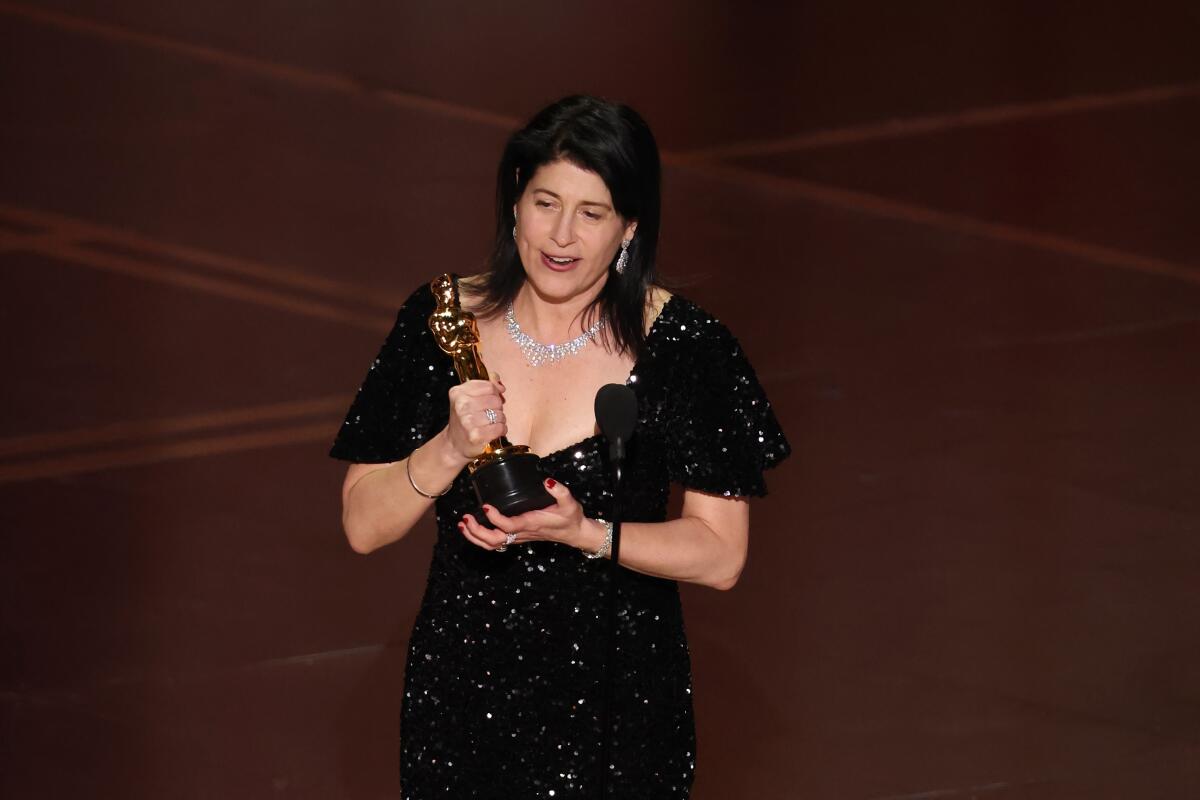
Cassandra Kulukundis holds the first-ever Oscar for casting for her work on “One Battle After Another” during the Academy Awards, March 15, 2026.
(Robert Gauthier/Los Angeles Times)
The Art of Casting With Cassandra Kulukundis recently winning the first Oscar in the category for her work on Paul Thomas Anderson’s “One Battle After Another,” what better time to learn more about the subject? The academy’s video presentation goes inside the casting process with casting directors discussing their craft and includes previously unseen auditions and screen tests. Through July 6. Academy Museum, 6067 Wilshire Blvd. academymuseum.org
Brahms & Beethoven Uzbek pianist Behzod Abduraimov performs Beethoven’s “Piano Concerto No. 3” as Paavo Järvi conducts the L.A. Phil in Brahms’ “Second Symphony” and Schumann’s “Overture, Scherzo and Finale.” 8 p.m. Friday and Saturday; 2 p.m. Sunday. Walt Disney Concert Hall, 111 S. Grand Ave., downtown L.A. laphil.com
A performance of “Escape.”
(Traj George Simian)
Escape Diavolo reprises this production featuring its trademark blend of dance, movement and storytelling as 22 artists challenge their abilities against a variety of architectural structures. 8 p.m. Fridays and Saturdays; 6 p.m. Sundays, through June 14. L’Espace Diavolo, 616 Moulton Ave. diavolo.org
Arshile Gorky: Horizon West In the summer of 1941, the Armenian immigrant artist, his soon-to-be wife Agnes “Mougouch” Magruder and the artist and furniture designer Isamu Noguchi drove from New York City to L.A. Gorky was emerging as one of the most important figures in the nascent Abstract Expressionism movement, and his cross-country adventures had an enormous impact on his art, which is explored in depth in this exhibit. A selection of landscapes include Gorky’s rich, surrealistic paintings and drawings from before, during and after the life-changing trip. (Jessica Gelt) Through April 25. Hauser & Wirth West Hollywood, 8980 Santa Monica Blvd. hauserwirth.com
A New Song: Langston Hughes in the West The exhibition reveals Hughes’ time spent in California, Nevada and Mexico during the Great Depression, World War II and into the 1950s, when he produced significant work, including lectures, film scripts, plays and his first book of short stories. Through Sept. 13. California African American Museum, 600 State Drive, Exposition Park. caamuseum.org
The White Album Arthur Jafa’s 2018 30-minute experimental film, a social critique of whiteness, uses found and produced footage to demonstrate how the creative work of Black Americans has been co-opted by white culture throughout history. Through Aug 30. UCLA Hammer Museum, 10899 Wilshire Blvd., Westwood. hammer.ucla.edu
SATURDAY
Akira Kurosawa’s “Seven Samurai,”starring Takashi Shimura, from left, Toshiro Mifune and Yoshio Inaba.
(Janus Films)
Darkness and Humanity: The Complete Akira Kurosawa The 1954 classic “Seven Samurai,” starring Toshiro Mifune, kicks off this comprehensive retrospective of the great Japanese filmmaker’s work. 6 p.m. Saturday; series continues through May 30. Academy Museum, 6067 Wilshire Blvd. academymuseum.org
from rock to rock… aka how magnolia was taken for granite Choreographer Jeremy Nedd’s exploration of the hidden poetry, virtuosic freedom and ownership features five performers examining “the Milly Rock,” a viral dance move. 8 p.m. UCLA Macgowan Hall, Freud Playhouse, 245 Charles E. Young Drive East. cap.ucla.edu
A Queer Arcana: Art, Magic, and Spirit On The exhibition collects an intergenerational group of Queer artists whose work examines hidden and mystical knowledge to find sources of connection and transformation. Through Oct. 18. Palm Springs Art Museum, 101 Museum Drivepsmuseum.org
Ralph Steadman More than 140 original artworks and ephemera, including sketchbooks, handwritten notes and personal photographs are included in “And Another Thing,” a traveling exhibition tracing six decades of the artist and illustrator’s career. Through May 9 Torrance Art Museum, 3320 Civic Center Drivetorranceartmuseum.com
Tonality The vocal ensemble performs “Refuge/Requiem,” a program that includes Caroline Shaw’s 17th-century-influenced contemporary work “To the Hands,” and “1605 Requiem,” composed for the funeral rites of Empress María by Tomás Luis de Victoria. Presented with the Wallis. 7:30 p.m. All Saints’ Beverly Hills, 504 N. Camden Drivethewallis.org
SUNDAY To Sleep With Anger Written and directed by the protean Charles Burnett, this film does more than vividly illuminate South-Central’s rarely portrayed Black middle class. A deft domestic horror story, it’s a contemporary tale with a folkloric twist that has old friend Harry (Danny Glover) visiting a married couple and gradually revealing himself to be a trickster with trouble on his mind. With a terrific ensemble headed by Mary Alice and Paul Butler as the couple in question. (Kenneth Turan) 7 p.m. The 35mm screening includes a Q&A with the filmmaker and Ashley Clark, author of “The World of Black Film: A Journey Through Cinematic Blackness in 100 Films.” Beginning at 6 p.m. Clark will sign copies of the book. Billy Wilder Theater, UCLA Hammer Museum, 10899 Wilshire Blvd., Westwood. cinema.ucla.edu
TUESDAY Philip Glass’ Cocteau Trilogy Pianists and siblings Katia and Marielle Labèque perform the composer’s triptych inspired by the films of Jean Cocteau. Part of the LA Phil’s “Body and Sound” festival. 8 p.m. Walt Disney Concert Hall, 111 S. Grand Ave., downtown L.A. laphil.com
Mary Halvorson The contemporary jazz musician, guitarist and composer and new quartet project Canis Major — featuring Dave Adewumi on trumpet, Henry Fraser on bass and Tomas Fujiwara on drums — perform an evening of music designed for deep listening and total immersion. 7 p.m. Getty Center, Harold M. Williams Auditorium, 1200 Getty Center Drive, L.A. getty.edu
Arts anywhere
New releases of arts-related media.
Album cover for “Evening Light: Raga Cycle I.”
(Cantaloupe Music)
Evening Light: Raga Cycle I The first release of an eight-album series in which American composer and pianist Michael Harrison collaborates with a global assortment of artists combining Eastern and Western musical traditions. Each chapter represents three hours of day or night following the Indian raga time cycle. For “Evening Light,” Quebec-based Brazilian vocalist Ina Filip co-composed the music with Harrison. Also appearing on the album are American composer Elliot Cole on synthesizer, French composer Benoit Rolland on electro-acoustics and Bangladeshi tabla virtuoso Mir Naqibul Islam. Cantaloupe Music: download ($10).
Book jacket for “Stephen Sondheim: Art Isn’t Easy” by Daniel Okrent.
(Yale University Press)
Stephen Sondheim: Art Isn’t Easy Part of Yale University Press’ Jewish Lives series, Daniel Okrent’s new biography of the award-winning composer-lyricist who took Broadway musicals to new heights “is a brisk, engaging read that avoids hagiography,” writes Julia M. Klein in a review for The Times. “Okrent highlights the emotional frailties that coexisted with the brilliance and generosity. He seeks to liberate Sondheim’s reputation from the encrustation of myth and to demystify his relationships, while offering a succinct analysis of his achievements. That’s a tall order for a compact book, especially given its subject’s long, complicated life. Okrent’s failings are, unsurprisingly, primarily those of omission.” Yale University Press: 320 pages, $35
Martha Graham Dance Company: We Are Our Times A two-part documentary goes behind the scenes with the troupe as it prepares for its 100th anniversary celebration. Producer-directors Peter Schnall and Cyndee Readdean followed the dancers from rehearsal to premiere on a global tour, capturing their artistic routines and everyday lives. Episode 1, “American Spirit,” 9 p.m. Friday; Episode 2, ““Athletes of God,” 9 p.m. April 3 on PBS. Streaming at pbs.org and on the PBS app.
Culture news and the SoCal scene
Pritzker Prize-winning architect Frank Gehry is photographed in May 2019 with a model of the Grand Avenue Project at his L.A. offices.
(Jay L. Clendenin / Los Angeles Times)
Can downtown L.A. still benefit from the vision of late-great architect Frank Gehry, who put so much time and energy into lifting the area up? Times classical music critic Mark Swed says yes in an optimistic column noting that, “So many plans Frank Gehry imagined for L.A. still remain. Gehry bequeathed blueprints and models, sketches and concepts, for his large and devoted team of younger architects and next-generation visionaries equipped to fabricate our way out of angst.” The time to build, Swed writes, is now.
Freelance writer Jane Horowitz got the skinny on the fifth edition of High Desert Art Fair, which arrives in Pioneertown this weekend, transforming “the rooms of the historic Pioneertown Motel into exhibition spaces for 20 galleries and publishers, while expanding into a broader mix of programming — something akin to a mini Coachella Valley Music & Arts Festival. This year’s edition includes an opening night party with a DJ set by street artist Shepard Fairey, panel discussions, guided meditation and even a sound bath.”
Monty Python” alum Eric Idle poses for a portrait at the Hollywood Pantages.
(Jason Armond / Los Angeles Times)
Malia Mendez sat down with British comedy legend Eric Idle to talk about his spoof musical “Spamalot,” which arrives at the Pantages more than a decade after its last stop at the stage. Over a margarita with a side of chef olives, Idle opened up to Mendez about “his earliest forays into comedy, his legendary run and subsequent break with his former ‘Monty Python’ castmates, and why ‘Spamalot’ arrives in L.A. at the perfect time.”
Times theater critic Charles McNulty headed to the Matrix Theatre to watch Rogue Machine’s production of Jackie Sibblies Drury’s Pulitzer Prize-winning 2018 drama “Fairview.” He writes that the play is “a shape-shifting work that eludes an audience’s assumptions at every turn,” and concludes that the new production “may struggle with the slipperiness of Drury’s writing.” The dramatic construction, however, is solid enough to withstand some of the overly broad strokes of the staging.”
Richard Neutra imagined his first Los Angeles project, the Jardinette Apartments, as a prototype for future garden apartment buildings.
(Myung J. Chun / Los Angeles Times)
Sam Lubell wrote a fascinating story about the painstaking rehabilitation of Modernist architect Richard Neutra’s first L.A. commission: the Jardinette Apartments in Hollywood. The building was hailed a structural and technical breakthrough when it opened in 1928, but it soon dropped from public view and sank into disrepair. The new owner spent more than $5 million on the historic preservation project and the complex may soon go on the market.
Enjoying this newsletter? Consider subscribing to the Los Angeles Times
The Hammer Museum Gala on Oct. 8, 2022, in Los Angeles.
(Michelle Groskopf / For The Times)
The Hammer Museum has announced the honorees for its annual gala. They are artist Betye Saar and television creator Darren Star. The highly anticipated event, set to take place in the Hammer’s garden courtyard on May 2, aims to honor impactful artists while raising funds to support the museum’s exhibitions and public programs.
The 80th Ojai Music Festival, set to take place June 11-14, recently announced this season’s programming and artistic collaborators. Much of this year’s event will be devoted to unpacking and performing works that have been central to the 2026 festival’s music director‘s artistic life. “Esa-Pekka Salonen is one of the most vibrant and adventurous creative forces in our musical world,” said Executive Director Ara Guzelimian in a statement. “It has been an absolute joy to dream up programs together that focus on numerous personal dimensions — his work as composer and conductor, his rich associations with and remarkable history in Los Angeles, the formative influence of his teachers and the giant musical figures of 20th century music, his deep friendships with many peer composers, and his championing of a new generation of composers.”
Washington National Opera Artistic Director Francesca Zambello, who was instrumental in the company’s decision to leave the Kennedy Center after Trump’s takeover, was inducted into the Opera Hall of Fame at the OPERA America Salutes Awards Dinner on March 20, at the Plaza Hotel in New York City.
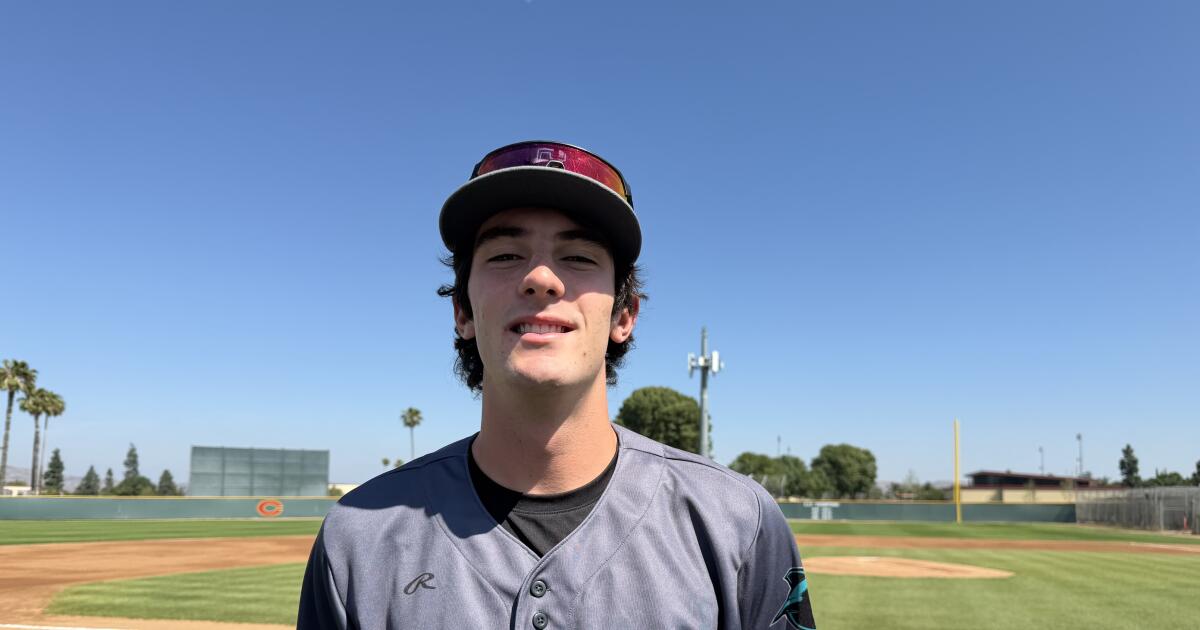
One month into the high school baseball season, it’s clear that junior third baseman and relief pitcher Troy Randall of Corona Santiago is headed to standout status.
So far, he’s batting .444 with 20 hits and only two strikeouts in 45 at-bats. As a pitcher, he’s given up no earned runs in eight innings with 13 strikeouts.
“He’s just been maturing,” coach Ty De Trinidad said.
Randall showed up as a 6-foot freshman and played junior varsity. Now he’s 6-2 and healthy after a broken foot last year interrupted his first season on varsity.
He made two terrific defensive plays on Wednesday in a loss to Corona and also had two hits.
His development has been important for Santiago, which is 10-3.
This is a daily look at the positive happenings in high school sports. To submit any news, please email eric.sondheimer@latimes.com.
He was on the bench for the Freeway Series finale at Dodger Stadium earlier this week, when manager Dave Roberts came over to check in and give Rojas the news.
“I didn’t know if ‘Thank you’ was the right thing to say because it’s something I earned,” Rojas recounted before the Dodgers’ 8-2 win Thursday against the Diamondbacks. “It’s not something that I asked for as a favor. So I was just kind of speechless.”
Rojas embraced Roberts.
“It was a gift to myself because of all the hard work and the preparation I put in throughout my whole career,” Rojas said. “This way is the best way possible because I got up to the big leagues as a utility defensive replacement who can play shortstop but couldn’t really hit much.”
Rojas, who intends to retire after this year, wrapped up his final opening day as a starter.
Opening day is a celebration across baseball. But the Dodgers made it a full production. The pregame program Thursday included roster-introduction pyrotechnics, along with a stage and blue carpet set up in center field.
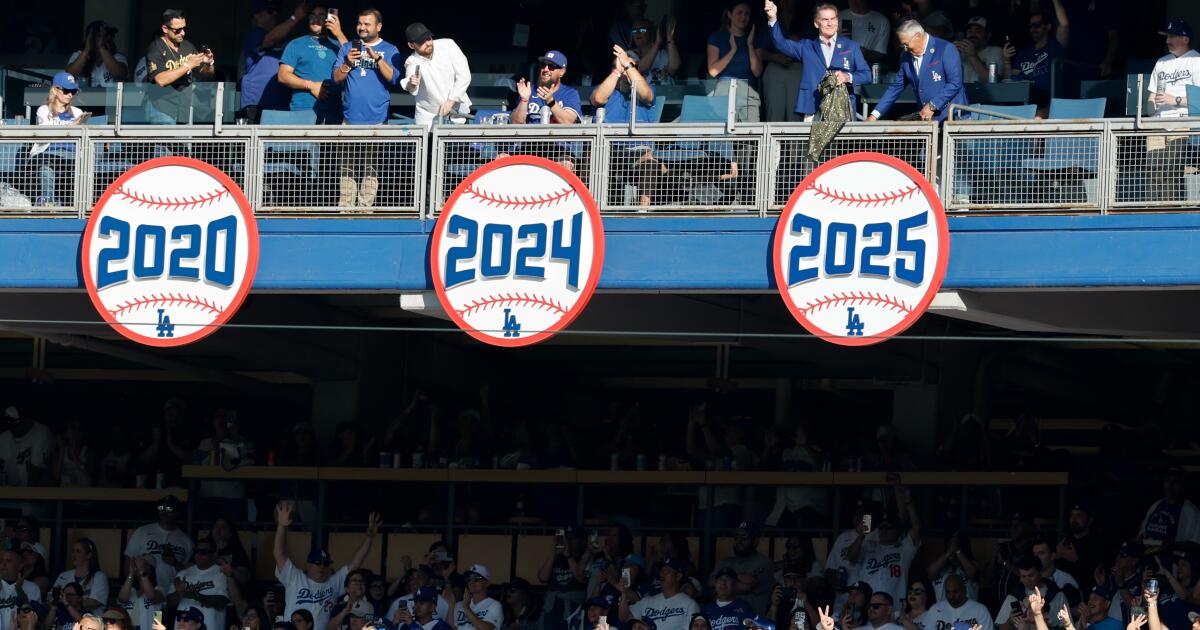
From Bill Plaschke: There were fireworks, there was a flyover, there was Will Ferrell screaming and Keith Williams Jr. crooning and four months of cheers unleashed by fans wearing championship belts and howling grins.
But the real stars of Thursday’s Dodger opening day show never made a sound.
They arrived silently at the end of the pregame ceremony, carefully held by two of the men who helped win them, lifted high for all those who so passionately longed for them.
They were the last two Commissioner’s Trophies, the back-to-back World Series championship trophies, the two symbols of the Dodgers domination held side by side in the afternoon sun.
Man, it was beautiful. Goodness, how they sparkled. Incredible, how they glowed.
It was almost as if they were powered by some electrical force, some sort of championship current running between them, lighting them up with a blinding power curated by the battered fingers of the two veterans who touched them.
Get the latest on L.A.’s teams in the daily Sports Report newsletter.
By continuing, you agree to our Terms of Service, which include arbitration and a class action waiver. You agree that we and our third-party vendors may collect and use your information, including through cookies, pixels and similar technologies, for the purposes set forth in our Privacy Policy such as personalizing your experience and ads.
Mike Trout homers as Angels win
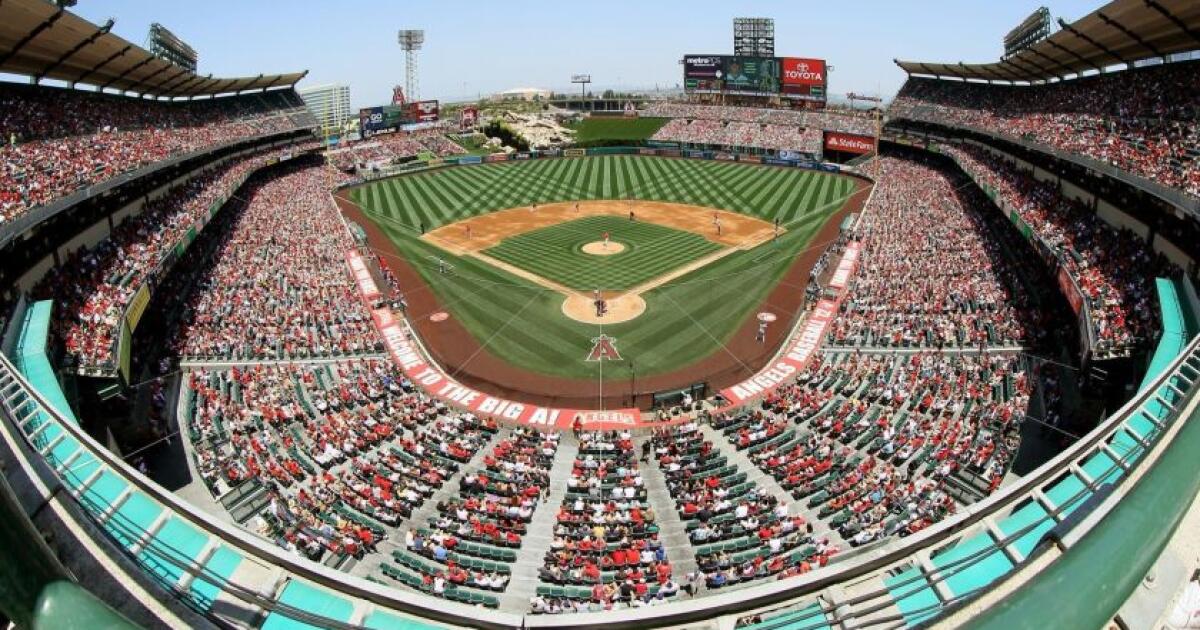
Mike Trout homered to launch what he hopes will be a bounce-back year, leading the Angels to a season-opening 3-0 win over the Houston Astros on Thursday.
Trout also walked three times and played center field for the first time since April 2024. The three-time MVP played 130 games last season, his most since 2019 because of various injuries.
Making his franchise-record 14th opening day start, the 34-year-old Trout broke a scoreless tie in the seventh inning when he sent a 96-mph fastball from reliever AJ Blubaugh (0-1) 403 feet onto the train tracks in left center. It was his fifth opening day homer, also a club record.
The Angels ended an eight-game road losing streak in season openers, starting 1-0 on the road for the first time since 2013.
From Marisa Ingemi: The UCLA women’s basketball team hasn’t lost a game in 120 days. In that time, the Bruins have outscored opponents by a total of 806 points and just one other school — Connecticut — has gone without a loss during the same stretch.
Yet somehow, the No. 1 seed in the Sacramento 2 region of the NCAA tournament hasn’t captured the same momentum and praise as the other three top seeds who have muscled their way into the Sweet 16.
UCLA (33-1) will play No. 4 Minnesota (24-8) at 4:30 p.m. Friday in Sacramento. The game will air on ESPN. Entering the matchup, is UCLA’s less dominant NCAA tournament run a cause for concern? Or is a win a win when it comes to March?
“Each game is going to present different adversity points,” UCLA coach Cori Close said. “And I think that we don’t look at it as getting back to something. We look at it as everything is a learning opportunity. ‘What does that teach us? How does that make us better? What kinds of things do we need to tighten up?’”
Darcy Kuemper made 19 saves for his third shutout of the season and 39th of his career to lead the Kings to a 4-0 victory over the Vancouver Canucks on Thursday night.
Mikael Granlund capped off his hat trick scoring on the power play with one second remaining in overtime on Thursday night to give the Ducks a 3-2 victory over the Calgary Flames.
Granlund has seven goals during a four-game goal streak that has him up to 19 on the season as the Ducks extended their winning streak to four games.
The Pacific Division-leading Ducks opened the night with a five-point cushion on the Edmonton Oilers and a six-point lead on the Vegas Golden Knights.
Eligibility for women’s competition will be determined by a one-time mandatory genetics test, according to the IOC. The test requires screening through saliva, a cheek swab or a blood sample.
No transgender woman competed at the 2024 Paris Summer Games, and it is unclear if any trans women currently compete at an Olympic level. Weightlifter Laurel Hubbard of New Zealand was the last to do so, competing in the 2021 Tokyo Olympics without winning a medal.
The new eligibility policy is not retroactive and does not apply to recreational sports programs. The IOC said in a statement that it “protects fairness, safety and integrity in the female category.”
“Eligibility for any female category event at the Olympic Games or any other IOC event, including individual and team sports, is now limited to biological females.”
1939 — Oregon beats Ohio State 46-33 in the NCAA’s first national basketball tournament.
1942 — Joe Louis knocks out Abe Simon in the sixth round at Madison Square Garden to retain his world heavyweight title.
1945 — Oklahoma A&M beats New York University 49-45 for the NCAA basketball championship.
1951 — Bill Spivey scores 22 points to lead Kentucky to a 68-58 win over Kansas State for the NCAA basketball title.
1960 — The Boston Celtics score a then NBA Finals record 76 points in the first half a 140-122 win over the St. Louis Hawks. Tom Heinsohn (24), Bill Sharman (23), Frank Ramsey (22) and Bob Cousy (20) each score 20-or-more points to win the series opener.
1971 — UCLA beats Villanova 68-62 for its fifth NCAA basketball title.
1978 — Jack Givens scores 41 points to lead Kentucky to a 94-88 victory over Duke for the NCAA basketball title.
1983 — Larry Holmes wins a unanimous 12-round decision over Lucien Rodriguez to retain his world heavyweight title in his hometown of Scranton, Pa.
2005 — Annika Sorenstam shoots a final-round 68 to finish at 15-under to win the Nabisco Championship by eight shots over Rosie Jones. It’s he 59th victory of the Swedish star’s LPGA Tour career — and her eighth major championship win.
2010 — Long shot Al Shemali wins the $5 million Dubai Duty Free, pulling away from a crowded field to pull off a surprisingly easy win in the Dubai World Cup. Al Shemali, at 40-1, starts slow then duels it out with Bankable before taking the lead for good.
2011 — Jamie Skeen scores 26 points as Virginia Commonwealth delivers the biggest upset of the NCAA tournament, a 71-61 win over No. 1 seed Kansas in the Southwest Regional final.
2014 — The Philadelphia 76ers tie the NBA record for futility with their 26th straight loss, falling 120-98 to the Houston Rockets. Philadelphia matches the 2010-11 Cleveland Cavaliers for the NBA’s worst skid.
2017 — UConn’s women’s basketball team advance to its 10th consecutive Final Four with a 90-52 victory against Oregon. The victory moves coach Geno Auriemma past Pat Summitt for the most NCAA tournament victories at 113.
Compiled by the Associated Press
Until next time…
That concludes today’s newsletter. If you have any feedback, ideas for improvement or things you’d like to see, email me at houston.mitchell@latimes.com. To get this newsletter in your inbox, click here.
How would you feel about getting a dream gig only to see it end in disgrace because of, well, you?
That’s what Gregory Bovino gets to think about for the rest of his life. Friday is the Border Patrol lifer’s last day on the job after 30 years — and he ain’t leaving because he wants to.
For the past year, the self-described “hillbilly” was the personification of the Trump administration’s xenophobic deportation deluge. Helicopter invasions of apartment complexes, tear gas canisters thrown into large crowds, defying court orders, glamorous photo shoots: There was no municipality too big, no tactic too crazy, no quote too incendiary for Bovino to take on while he treated immigrant neighborhoods like the shores of Normandy.
The North Carolina native’s caravan of cruelty quickly earned him a promotion from El Centro sector chief to Border Patrol commander at large, a new position crafted just for him. He embraced the role of migra bogeyman like a tween boy scarfing down a bowl of Warheads, always promising more deportations, more chaos, more more.
Not anymore.
In January, Border Patrol agents shot and killed ICU nurse Alex Pretti during a protest against them a few weeks after an Immigration and Customs Enforcement officer did the same to Renée Good, a mother of three. Bovino threw napalm on the matter by claiming Pretti wanted to “massacre law enforcement” without offering any evidence. The incidents so soured the public on immigration agents that a Public Religion Research Institute poll released this week showed only 35% of Americans surveyed approved of how Trump is handling immigration, compared to 48% a year ago.
Bovino was sent back down to El Centro and lost his social media privileges, where he had long posted cringe-inducing videos about what a swell guy he was. Even Trump turned on his migra man, telling Fox News that Bovino was “a pretty out-there kind of a guy … and in some cases that’s good. Maybe it wasn’t good [in Minneapolis].”
I should’ve warned Bovino the one time we met that failure was his fate.
Dressed in full Border Patrol uniform complete with a clipped-on walkie-talkie on his shoulder, the guy was billing himself as a modern-day Charles Martel defending the homeland from invading infidels. The nasal-voiced Bovino rambled to Michaelson about how “Ma and Pa America” deserved a country free from undocumented immigrants and vowed to remain in Los Angeles “until the operation is over.”
Then-U.S. Border Patrol commander at large Gregory Bovino, center, along with Border Patrol agents as they march to the Edward R. Roybal Federal Building after a show of force outside the Japanese American National Museum where Gov. Gavin Newsom was holding a redistricting press conference on Aug. 14, 2025, in Los Angeles.
(Carlin Stiehl / Los Angeles Times)
After his interview, Bovino and three Border Patrol agents strolled into the greenroom to grab some homemade cookies while I sat on a couch. He looked me in the eye while bending down to sign Michaelson’s guest book, as if he expected me to not only recognize him but say something.
It was like staring at someone doing an impersonation that was one part Lt. Col. Kilgore from “Apocalypse Now” and two parts Henery Hawk, the short, brash Looney Tunes character that was always trying to capture the much larger Foghorn Leghorn. He really thought that his scorched-earth assault on L.A. would defeat the city and convince other communities to offer no pushback once Bovino’s self-titled “Green Machine” trolled into town.
The opposite happened.
People who had never bothered with politics — even some who voted for Trump or at least agreed with deporting immigrants with criminal convictions — rose up to resist. Everywhere became a front — social media, the streets, courtrooms — and activists across Southern California began to share notes among themselves and with communities nationwide to prepare them for la migra. Bovino flailed back at every affront instead of focusing on his mission, not realizing his recklessness was eroding public support for his cause and threatening it altogether.
That’s when he convinced the Trump administration to send a skeptical National Guard alongside his men to surround the historic L.A. green space in the ludicrously named Operation Excalibur. Armed vehicles parked on Wilshire Boulevard. A grinning Bovino strutted around with media in tow. A wannabe cavalry unit, anchored in the center by an agent on a white horse, swept through a soccer field where children were attending day camp just minutes before.
No one was arrested or detained that day. Instead, Bovino left to a chorus of cuss words and boo birds. The exercise allowed Americans to see the folly of burning millions of taxpayer dollars just so someone could star in a TikTok reel. It also broke the spell Bovino had cast over many critics — myself included — who had feared he truly was an unstoppable Punisher.
Nah, he was just a spiky-haired pendejo.
If Bovino was as smart as he thinks he is, he would’ve followed the longtime strategy of another longtime immigration enforcer. Trump border czar Tom Homan executed a yearslong roundup under the Obama administration with numbers Trump has yet to reach and with nowhere near as much public rancor. Homan, who loves the camera almost as much as Bovino, knew then and now that an issue as explosive as deportations must be approached quietly if it’s to be done successfully.
Instead, not only does he have to clean up Bovino’s mess, there’s now a real chance that the Republicans will lose the midterms because of Latinos who voted for Trump in 2024 but are now furious at his administration. That’s why even Trump is now telling Republicans to tone down their anti-immigrant rhetoric, stat.
Gracias, Bovino!
You thought you would go down in U.S. history as a domestic Patton, a borderlands Sherman. Instead, your last week coincided with the publication of a New York Times profile of you railing at enemies while downing coffee at a burger bar in El Centro.
You called Customs and Border Protection commissioner Rodney Scott “weak-kneed,” mocked Homan and said you could’ve deported 100 million people — a radically racist number considering even the Center for Immigration Studies, which has long pushed for reduced immigration of all kinds, estimated a record 15.4 million illegal immigrants were in this country at the start of Trump’s second term.
Instead, you’re heading off to the Tar Heel State to spend your days hunting… coyotes.
“Maybe I get me some dogs and we go hard,” you told the New York Times. “I’ll take it in my own hands.”
Which reminds me of another hapless cartoon character who thought himself a genius but who kept screwing things up in ceaseless pursuit of his quarry: Wile E. Coyote.
“What happened to my dreams? Simply put: they changed,” reads Phil Augusta Jackson aloud to a crowd in a furniture store. Tonight’s theme is change. From a podium, the television writer reflects on the long, thorny odyssey of his career. A pinball machine blinks in the background. Behind him, dreamy abstract prints hang on the wall, their shapes seeming to melt in the unseasonable spring heat.
Alongside mid-century furnishings and art in Echo Park, siblings Madeline Walter and Evan Walter host their wildly popular reading series, Essays. It’s a warm spring night. In a tender essay, Evan considers what he’s inherited from his idiosyncratic father. “I scream-sneeze like him now,” he reads. “It feels like a mess figuring out what parts of your parents you’re going to keep.”
In March 2024, the Walter siblings began the reading series in a friend’s backyard. “It was cold and wet, and we were so nervous nobody would come,” says Madeline. Since then, the show has moved through a series of venues before settling into a home at The Hunt Vintage. In just two years, it has grown into a local phenomenon, regularly drawing crowds of more than 150 people into the singular space.
The idea for Essays took shape during a conversation about creative constraints. Both writers and comedians, the siblings wanted to host a show that pushed beyond snappy punchlines and polished half-truths. “The objective is different from just being funny,” Madeline says. “It’s to tell me about yourself. Tell me something you’re thinking about.”
Siblings Madeline and Evan Walter host a popular monthly reading series called Essays at Echo Park’s Hunt Vintage.
(Ryan Wall )
Like many readings across Los Angeles, Essays taps into a growing appetite for sincerity. “People are really craving a space where you can be funny, be vulnerable, laugh at yourself — and where there’s an earnestness,” Evan says. That sensibility feels familiar to them. They grew up in what Madeline describes as a “very NPR-coded household that loved David Sedaris-style stuff.” She adds: “Doing something in the essay space feels like a surprising return to form.”
“One of my roommates describes it as a church-like experience, because everything is just so emotionally0driven and connective,” says Kaitlyn Kilmer, a longtime attendee.
The legacy of the series has begun to ripple outward. Their reading series has created a complementary Substack. Kilmer is now hosting a reading in her living room among friends.“We decided that we wanted to do our own, so I gathered a few friends who had been fans of the Essays show,” she says.
Essays exists in a larger network of reading series that make up Los Angeles’ diverse and ever-evolving literary scene. “There are so many readings now,” explains non-fiction writer Diana Ruzova, who frequently attends readings. “I’m not mad at it, though, mostly grateful that L.A. has a thriving literary community.”
In Los Feliz, Skylight Books continues to host intimate book launches for some of the most anticipated literary releases, drawing local favorites and celebrities.
“Our vibe is cozy,” says Mary Williams, general manager of Skylight Books. “We set up chairs under the big tree that grows in the middle of the store, and we hope this is a go-to place for our community to see their favorite authors while mingling with other book lovers.”
Elsewhere, at Heavy Manners Library, the tone of literary events leans more toward the experimental. “Experimental, unpolished writing can be shared and reflected on in an accessible, communal setting,” says program assistant Jane Shin.
This spring, literary events across the city run the gamut — from independent book fairs to poetry workshops, from the bizarre to the deeply vulnerable — welcoming everyone from curious newcomers to die-hard bookworms.
You thought the Oscars brought awards season to an end? Think again. The iHeartRadio Music Awards took place Thursday night with performances and appearances by Taylor Swift, Miley Cyrus, Sombr, Weezer, Alex Warren, Shaboozey and John Mellencamp, among other stars. Here’s a glimpse at the best looks from the red carpet and the best moments of the show itself, which took place at the Dolby Theatre in Los Angeles.
The Show
Lainey Wilson performs onstage at the 2026 iHeartRadio Music Awards at Dolby Theatre in Hollywood.
Taylor Swift accepts the pop album of the year award onstage at the 2026 iHeartRadio Music Awards at Dolby Theatre in Hollywood.
Miley Cyrus accepts the Innovator Award onstage at the 2026 iHeartRadio Music Awards at Dolby Theatre in Hollywood.
John Mellencamp, right, performs onstage at the 2026 iHeartRadio Music Awards at Dolby Theatre in Hollywood.
Terry Ellis, from left, Cindy Herron and Maxine Jones of En Vogue perform at the 2026 iHeartRadio Music Awards.
Red Carpet
Miley Cyrus on the red carpet for the iHeartRadio Music Awards at the Dolby Theatre in Hollywood.
Ella Langley on the red carpet for the iHeartRadio Music Awards at the Dolby Theatre in Hollywood.
Shaboozey and Kehlani on the red carpet for the iHeartRadio Music Awards at the Dolby Theatre in Hollywood.
Cheryl Porter on the red carpet for the iHeartRadio Music Awards at the Dolby Theatre in Hollywood.
Cindy Herron, Maxine Jones and Terry Ellis of En Vogue on the red carpet for the iHeartRadio Music Awards at the Dolby Theatre in Hollywood.
Teddi Mellencamp on the red carpet for the iHeartRadio Music Awards at the Dolby Theatre in Hollywood.
Brianna Mazzola and Wennely Quezada of ‘3QUENCY’ on the red carpet for the iHeartRadio Music Awards at the Dolby Theatre in Hollywood.
Sublime on the red carpet for the iHeartRadio Music Awards at the Dolby Theatre in Hollywood.
Brent Smith and Zach Myers of Shinedown on the red carpet for the 2026 iHeartRadio Music Awards at the Dolby Theatre in Hollywood.
Graham Stanush, Sebastian Gonzalez, Matty Bielawski and London Hudson of Return to Dust on the red carpet for the iHeartRadio Music Awards at the Dolby Theatre in Hollywood.
WASHINGTON — When President Trump ordered immigration raids in Los Angeles last June, only a handful of those arrested were violent criminals. The sweeps split families, cost businesses millions of dollars and drove many undocumented residents into hiding.
Activists protested the Immigration and Customs Enforcement actions, prompting the president to deploy thousands of federal troops in what he called a security operation. A federal judge called it unlawful and said the deployment caused “greater harm” to the city.
Now, Trump wants a redo.
At a Cabinet meeting Thursday, he called on the mayors and governors of several blue cities and states to allow troops to “come in and stop the crime,” pointing to purported successes in Washington, Memphis and New Orleans.
“Crime is down 75% in a short period of time,” Trump told his top advisors. “We could do that for L.A. and we could do that for, frankly, San Francisco.”
The president framed the deployments as both a crime-fighting and immigration enforcement tool, saying that federal authorities can remove people from cities in ways local officials cannot.
“We can do it much more effectively, because [local leaders] can’t do what we do,” Trump said. “All the time, people come up to me … and they say ‘thank you so much.’ I know immediately what they’re talking about. They’re able to walk to work.”
Trump also said this week that he would consider deploying the National Guard at airports to assist with mounting security delays amid a 40-day partial government shutdown.
The renewed call comes after a series of controversial federal interventions in cities across the country. In Washington, Trump has repeatedly touted a visible security presence near federal buildings, crediting it with improving public safety, though local officials and analysts have debated how much of any decline in crime can be attributed to his order.
U.S. Marines stationed outside the federal detention center in downtown Los Angeles in June.
(Allen J. Schaben / Los Angeles Times)
In January, Trump threatened to invoke the Insurrection Act to deploy troops to Minneapolis during the civil unrest that followed the fatal shooting of Renee Good by a federal immigration agent. The Pentagon prepared active-duty troops for a possible deployment, but they were ordered to stand down following the shooting of a second Minneapolis civilian, Alex Pretti, the same month.
Immigration sweeps in Los Angeles targeted workplaces, neighborhoods and churches, stirring widespread panic and forcing many undocumented residents — including those with long-term residency and native-born children — into hiding. As a result, businesses reported sharp declines in revenue and customer traffic. A county analysis found that 82% of surveyed businesses experienced negative impacts, with some losing more than half their income amid workforce shortages and traffic reductions.
During the fallout, Mayor Karen Bass condemned Trump’s deployment of some 4,000 California National Guardsmen and 700 U.S. Marines.
“Deploying federalized troops on the heels of these raids is a chaotic escalation,” she said. “The fear people are feeling in our city right now is very real — it’s felt in our communities and within our families, and it puts our neighborhoods at risk. This is the last thing that our city needs.”
The president called the occupation off after U.S. District Judge Charles Breyer ruled that control of the California National Guard should be returned to the governor, rejecting the federal government’s authority to maintain control indefinitely. A similar Supreme Court ruling effectively ended federalized deployments throughout the country.
“The judges are really hurting this country,” Trump said Thursday. “Frankly, the justices — the Supreme Court — has really hurt our country, too.”
At the meeting, Trump also narrowed his comments on San Francisco and its mayor, Daniel Lurie.
“San Francisco was a great city, could quickly become a great city again,” Trump said. “But we can do it much more effectively.”
Last year, Trump considered carrying out similar federal law enforcement operations in the city. He backed off after a somewhat conciliatory phone call with Lurie, in which Trump said the mayor asked him “very nicely” to call off the deployment. Afterward, he agreed to give the newly elected mayor “a chance” to address crime in the city.
“In San Francisco, crime is down 30%, encampments are at record lows, and our city is on the rise,” Lurie said in a statement Thursday. “Public safety is my number one priority, and we are going to stay laser focused on keeping our streets safe and clean.”
A spokesperson for Lurie’s office said the two have not spoken since that October conversation, indicating Trump’s latest remarks do not reflect any new request or ongoing negotiations. Even so, the president struck a measured tone toward the San Francisco mayor on Thursday. He said Lurie is “trying very hard” but insisted federal intervention would get the job done faster.
Whether any Democrat-led city will take Trump up on that offer remains to be seen. City leaders have previously resisted federal deployments, arguing they undermine local control and risk inflaming already tense situations.
The White House did not respond to questions about whether any current plans exist to redeploy federalized troops to California cities.
Times staff writer Melissa Gomez in Los Angeles contributed to this report.
I heard the ribbit of a Pacific chorus frog and couldn’t stop my feet as they veered me off the official trail and onto a foot path leading down to Wiley Creek.
I grew up with a pond in the pasture behind my house where I could listen to the riotous sound of amphibians any evening I wanted. The soundscape of freshwater habitats is such a comfort to me.
I sat down on a boulder near the water, trying to remain still. The frog had quieted after spotting me, and I hoped it would restart its song, understanding I was not a threat but instead just a big fan.
This was the first of many beautiful moments I experienced on my recent hike through Ed Davis Park in Towsley Canyon in Newhall. It features shady canyons with blooming wildflowers and wildlife that appear to be thriving. I would later learn that a walk through Towsley Canyon is also a journey through the history of environmental activism in the Santa Clarita Valley. This area was once slated to become a landfill.
You are reading The Wild newsletter
Sign up to get expert tips on the best of Southern California’s beaches, trails, parks, deserts, forests and mountains in your inbox every Thursday
By continuing, you agree to our Terms of Service, which include arbitration and a class action waiver. You agree that we and our third-party vendors may collect and use your information, including through cookies, pixels and similar technologies, for the purposes set forth in our Privacy Policy such as personalizing your experience and ads.
And because I got confused by this, I will point out: The Rivendale Park and Open Space is also nearby, at the mouth of Towsley Canyon near the northeast corner of Ed Davis Park. So you could find yourself hiking along one of its trails as well.
Ed Davis Park offers access to multiple trails, including:
Clockwise, southern bush monkeyflower, blue dicks, phacelia, California poppy, a flower and purple nightshade that appears to be a collinsia heterophylla.
(Jaclyn Cosgrove / Los Angeles Times)
I arrived at Ed Davis Park just after 9 a.m. last week with a plan to take a short hike, given the high temperatures forecast that day. I parked near the entrance in the large dirt free lot. Note: There were no restrooms or portable toilets that this outdoors reporter could find anywhere nearby, so plan accordingly.
From the parking lot, I headed west, quickly turning south onto Wiley Canyon Trail. I was immediately greeted by a lesser goldfinch, perched on a strand of wild rye like a feathered park ranger.
The trail was initially a bit rutted but quickly smoothed out. As I headed into Wiley Canyon, I found myself in a crisp cool landscape shaded by large oak and California black walnut trees. I quickly heard running water. When I checked the thermometer hanging on my backpack, it read 69 degrees.
Clockwise, lesser goldfinch, western whiptail, convergent lady beetle and a lizard.
(Jaclyn Cosgrove / Los Angeles Times)
Although I could hear nearby traffic and a Southwest plane passing overhead, it didn’t block out the dynamic soundtrack of the canyon’s avian residents: the oak titmouse, northern mockingbird, blue-gray gnatcatcher and Hutton’s vireo, which, according to my birding app, were all above and around me.
As you travel along the canyon, you’ll find purple sage bursting out of the ground, and blue dicks starting to bloom. I passed by several ceanothus with white and blue-violet blooms. I really took my time taking in the native plant landscape and was lucky to spot a convergent lady beetle sipping on dew on a blade of grass.
After my short visit to the creek to find frogs, I was looking up to observe a turkey vulture and red-tail hawk circling overhead, seemingly competing for airspace, when I noticed the California dodder nourishing itself atop several plants on the hillside. Although it is a parasitic vine, this orange otherworldly being does indeed serve an important ecological purpose.
California dodder in the Towsley Canyon area around Newhall.
(Jaclyn Cosgrove / Los Angeles Times)
“Dodder will flower during the hot summer months, providing native insects with a valuable meal and drink during the months when many other California native plants are dormant,” Jorge Ochoa, an associate professor of horticulture at Long Beach City College, wrote for the Friends of Griffith Park regarding the plant’s purpose.
I continued south, passing a spotted towhee digging in the dirt for its breakfast. Then, just under half a mile in, I turned northwest onto the Don Mullally Trail. The trail is named after a naturalist who, according to park signage, “traversed every canyon, led countless hikes to unforgettable destinations, and shared the Woodlands’ unparalleled native tree associations and ecological majesty.” May we all be so lucky!
A shady portion of a trail in the Towsley Canyon area around Newhall.
(Jaclyn Cosgrove / Los Angeles Times)
This is where you’ll start to gain some elevation — and sun exposure. But it’s also where you will find the most blooming wildflowers! I quickly spotted phacelia with bright purple blooms, and as I headed west, an increasing number of California poppies and southern bush monkeyflower.
Towsley Peak near Towsley Canyon in Newhall.
(Jaclyn Cosgrove / Los Angeles Times)
Ed Davis Park is home to a robust butterfly population. I found a kaleidoscope of pollinators among the wildflowers and weeds, including a checkered white butterfly who was eagerly drinking from invasive mustard. I chuckled to myself. It didn’t seem to mind feasting on one of the most hated plants in Southern California.
The trail does turn into a narrow single track with thick vegetation, so please take good care as you’re hiking. I was very aware of the likelihood that I would encounter a rattlesnake, and I made sure to stomp my feet and pause from gaping at the flowers to make sure I wasn’t about to step on anyone. Additionally, watch out for poison oak, which I found growing among California black walnut.
Purple sage grows thick along the trails in Towsley and Wiley canyons. You might also spot an outdoors journalist who doesn’t realize their shadow is in the photograph until they get home.
(Jaclyn Cosgrove / Los Angeles Times)
Just over a mile in, I paused to take in the view. Several peaks in the Sierra Pelona Mountains, including Liebre Mountain, Burnt Peak and Jupiter Mountain, were easy to see from the trail, even though they’re about 20 to 25 miles away. I didn’t spend too long there, though, as my thermometer informed me it was 93 degrees in the direct sun. Where did spring go?
I took the Don Mullally Trail down and then the paved Towsley Canyon Road back to where I parked. You’ll notice as you head back that there are at least two paid lots should the free lot be full. You’ll need $7 in cash or a check, which you can deposit in the iron ranger.
The Sierra Pelona Mountains are visible from Towsley Canyon.
(Jaclyn Cosgrove / Los Angeles Times)
A turkey vulture flies low in Towsley Canyon.
(Jaclyn Cosgrove / Los Angeles Times)
Given its astounding beauty, it’s hard to comprehend how this parkland almost became a dump. But around 1989, an intense battle broke out between the Los Angeles County Sanitation Districts, which, at the time, managed wastewater and trash for 78 cities in L.A. County, and the Santa Monica Mountains Conservancy.
In early 1991, the Santa Monica Mountains Conservancy acquired 453 acres of Towsley Canyon, strategically buying a 180-acre parcel at the eastern entrance of the canyon and a 273-acre piece in the heart of it, according to The Times’ archive.
County officials mulled over whether they could still build a smaller dump in Towsley Canyon, but there was a major hiccup. The conservancy’s land was directly across the only two roads into the area, meaning the agency could hinder garbage trucks from using the roads.
“For all practical purposes, the coffin has been nailed on the proposal to turn Towsley Canyon into a landfill,” Joseph T. Edmiston, the conservancy’s executive director, said in a 1991 news article.
At the time, county officials were also considering building a dump at Elsmere Canyon — an effort also successfully fought off by local advocates.
Reflecting on my visit to Towsley and Wiley canyons, I thought about how our trash does indeed end up in someone’s neighborhood, whether that be a canyon wren, a jellyfish or your neighbor in another neighborhood (if we think about humanity and neighbors in a global sense). It’s a further incentive to practice the five Rs: refuse, reduce, reuse, recycle and rot.
I hope your journey through these canyons brings you a similar experience of joy, wonder and deep reflection!
3 things to do
An Egyptian goose in the Sepulveda Basin Wildlife Refuge.
(Amanda Thompson)
1. Better your birding in Pasadena The Sierra Club Angeles Chapter’s Pasadena group will host “Photographing the Sepulveda Basin Wildlife Reserve” from 7 to 9:30 p.m. Wednesday at Pacific Oaks College. Guests will hear from photographer and storyteller Amanda Thompson and visual communicator Joe Doherty about how to better navigate the Sepulveda Basin to observe the flora and fauna that lives there. RSVP at act.sierraclub.org.
2. Cycle on over to Cudahy Nature for All, an L.A. climate justice nonprofit, will host an 8-mile bike ride from 9:30 a.m. to 1 p.m. Saturday starting at Hollydale Regional Park in South Gate. Riders will peddle along the L.A. River before arriving at Cudahy River Park. Participants can reserve a bike by emailing Priscila Papias at priscila@lanatureforall.com. Register at cosechasoftware.com.
3. Frolic under a full moon in L.A. We Explore Earth will host a free full-moon gathering from 5:30 to 8:30 p.m. Wednesday at Elysian Park. Participants will come together for a guided group hike cleanup followed by a sound bath and live music, all under the rising full moon. Register at eventbrite.com.
The must-read
Manatees rest at Blue Spring State Park in Orange City, Fla.
(Explore.org)
As I glided my kayak along the aptly named Crystal River in late March 2019, I couldn’t believe just how close the 1,000-pound manatees came to me and my friends. Nearby, my best friend Jenny squealed as a massive sea cow poked its whiskered snout out of the water next to her kayak. Whenever I’m stuck working indoors, I often turn on the live feed of the manatees at Explore.org. Apparently I’m very much not alone! Times staff writer Lila Seidman wrote that the number of nature-themed 24/7 livestreams created per year swelled by about 3,000% between 2019 and 2025. This genre of entertainment has been dubbed “Slow TV,” as it’s unedited and can be quite calming (although there are grisly moments that remind us of nature’s brutality too).
Regardless, during this heat wave, I’d highly recommend checking out some Slow TV, including local livestreams such as Big Bear’s celebrity eagle couple Jackie and Shadow.
Happy adventuring,
P.S.
For Wild readers who’ve felt like there’s been a real lack of turtle news featured as of late, this one’s for you: During a recent trip, a visitor at Joshua Tree National Park reported to rangers about multiple Mojave Desert tortoises stuck inside a historic dig site in the northern part of the park. Rangers and the visitor ventured into the park and located three trapped male tortoises. “It’s unknown how long the tortoises were stuck in the hole, so biologists immediately began assessing and rehydrating them,” a staffer wrote on Joshua Tree National Park’s Instagram page. As a quick aside, is anyone else rethinking their life’s choices and wondering why they didn’t consider rehydrating tortoises as a profession? Does it include carrying a tiny water bottle? I digress. The park workers built a ramp out of natural materials to ensure any tortoise who scrambled by the dig site didn’t find themselves stuck inside. After the tortoises experienced the world’s cutest rehydration experience, the biologists discerned they were healthy and strong enough to keep trundling along. Shout out to this thoughtful visitor and our hardworking and earnest park workers for being great stewards to our natural world!
For more insider tips on Southern California’s beaches, trails and parks, check out past editions of The Wild. And to view this newsletter in your browser, click here.
Over the past few weeks, I’ve been driving all over Los Angeles doing something I haven’t done in a long time: playing pretend.
I pretended I was in a medieval castle at a French cafe in Miracle Mile and that I was looking for trolls on a fern-filled hike in Griffith Park. I imagined that Tolkien’s elves built the creekside restaurant where I met a friend for brunch in Topanga and that I was eating alongside real witches in a forest-themed dining room in North Hollywood.
In a Whittier tea room, I poured a glittering potion that said “Drink Me” into a glass of Champagne and in Beverly Hills, I stared awestruck at the platonic ideal of a witch’s house, half expecting a bent old lady with a wart on her nose to come out and turn me into a toad.
It’s been a rough start to 2026 and these brief moments of make-believe have served as a joyful balm in sad and scary times. I’m not looking to bypass reality, but taking a break from it every once in a while can be a welcome reprieve. Fortunately, Los Angeles is especially good at creating transporting experiences that drip with fairy-tale ambience. This is the home of Hollywood after all, the land of artifice, the spot where Walt Disney dreamed up the Happiest Place on Earth. Seeking and finding moments of happily ever after, even if they last just a few minutes, is part of the city’s collective DNA.
So grab your broom and make sure to leave a trail of bread crumbs behind you. L.A. has plenty of magic to share. All you need to do is open your mind and explore.
About This Guide
Our journalists independently visited every spot recommended in this guide. We do not accept free meals or experiences. What should we check out next? Send ideas to guides@latimes.com.
At the dawn of the 2025 season, we published a column with the headline, “What’s the future for aging Angel Stadium? It feels like an increasingly uncertain one.”
With opening day 2026 upon us, we’d like to update that: “What’s the future for the Angels? It feels like an increasingly uncertain one.”
I don’t mean to be an alarmist. Nothing is happening today, or tomorrow, or in the very near future.
However, the Angels’ stadium lease expires in six years, so what might happen beyond then is starting to come into focus. Angels owner Arte Moreno turns 80 this summer. Moreno — or a new owner, if Moreno eventually sells the team — could simply exercise options to extend the lease for another six years.
But that would not resolve the larger issue of replacing or renovating Angel Stadium. In the coming months, the city expects to release an assessment of what it would take to keep the stadium up and running for years to come, and that could trigger a debate between the city and the Angels about who should pay for what.
The Angels are frustrated by all of this, and in particular by what they consider the curiously timed skirmishes over their 21-year-old Los Angeles name. They are annoyed that, for the second consecutive season, city issues have detracted from the hope and faith and joy that surrounds opening day. It is the city, after all, that walked away from two deals that would have secured the Angels’ long-term future in Anaheim.
During negotiations for the last deal, city officials made clear that keeping the Angels was the top priority, even if Anaheim could make more money selling the stadium property to a developer that would not need to retain the stadium.
Now, with six years left on the lease and no commitment beyond then, the mayor of Anaheim says it is time to prepare for a future with or without the Angels.
“We need to plan for what we see as a vision for that property when the lease has expired,” Mayor Ashleigh Aitken told me. “That’s going to take time. No matter how that deal goes, we’re not breaking ground on any project next year.
“But what we need to do, whether it includes the Angels — which I hope it does — or not, is come up with a vision that includes everything residents want to see happen on that land. And only then can we truly advocate for a project that makes sense for us.”
On the day of the home opener last season, Aitken issued an open letter inviting Moreno to meet with her for “an open and honest conversation about the future of baseball in Anaheim” and listing eight starting points for negotiations on a new deal, including the Angels’ restoration of the Anaheim name.
“They have not reached out to us about reopening negotiations for potential development around the property,” Aitken said.
Moreno previously explored other potential ballpark sites, including Tustin in 2014 and Long Beach in 2019.
In Tustin, the targeted land is no longer available. In Long Beach, the proposed waterfront lot remains vacant, but the challenge remains too: Over 81 games each season, how would tens of thousands of fans drive into and out of a ballpark primarily accessible by a single freeway?
For the Los Angeles Angels, perhaps the solution could be found in Los Angeles County.
The Dodgers could bar every other major league team from moving into L.A., but not the Angels. Under MLB rules, neither team could stop the other team from moving anywhere within Los Angeles County or Orange County.
The logical landing spot would be Inglewood, where the Rams, Chargers and Clippers have moved since 2020. Inglewood Mayor James Butts said Sofi Stadium and Intuit Dome have helped to revitalize the city, with unemployment down, home prices up, and municipal revenue up.
“Before, we were known for gangs and crimes and poverty,” Butts told me.
“Now, we are known as the sports and entertainment capital of the western United States.”
How about a baseball stadium in place of the Forum?
“The Forum parcel is absolutely not large enough for a baseball stadium,” Butts said.
Butts said he believes a baseball stadium there would require about 170 acres for the stadium and surrounding parking. Angel Stadium and its surrounding parking lots cover about 150 acres.
On the other hand, the Athletics are building a ballpark on a nine-acre site in Las Vegas, where nearby parking, entertainment and dining options already exist, with more on the way, and with the A’s not responsible for any of that. The same could be true for the Angels in Inglewood, with Rams owner Stan Kroenke and Clippers owner Steve Ballmer developing the land around the sports facilities.
However, Butts said he did not envision baseball coming to Inglewood, at least so long as he remains the mayor. Not enough room in town, he said.
“We’re maxed out when it comes to sports,” Butts said. “We are not going to reduce the housing stock and move residents out to have a baseball team.”
Anaheim has one, plus a 150-acre site perfect for a new stadium surrounded by restaurants and shops and homes. There will be days to be anxious and worried about the Angels’ future in the city they have called home for 60 years. Today is not one of them.
Take it from the mayor of Anaheim, who told me that even after telling me why she wants the city attorney to look into whether the Angels are violating their stadium lease.
“Opening day, to me, is nothing about clauses in a contract,” Aitken said. “It’s about family traditions. It’s about kicking off summer. And it’s about getting so many factions and neighborhoods of Anaheim together for a singular purpose, which is cheering on our hometown boys. That’s the beauty of baseball.”
And, as a lifelong Angels fan, she had one more thing to say.
“Right now,” Aitken said, “we’re tied for first place.”
From Maddie Lee: Shohei Ohtani’s three straight strikeouts in the fourth inning of his final spring start Tuesday featured a different putaway pitch for each.
He got Angels slugger Jorge Soler to whiff on a sweeper. Jeimer Candelario went down on a curveball. And Jo Adell struck out on a fastball.
“Just shows the confidence he has and different ways he had to attack guys, to get ahead and also put guys away,” manager Dave Roberts said after the Dodgers’ 3-0 loss to the Angels in the Freeway Series finale. “And today the feel was really good, even better than the first outing.”
Pretty much everything was clicking for Ohtani heading into the regular season, even though it was only his second spring training start on the mound. Ohtani recorded 11 strikeouts in four-plus innings. He held the Angels to four hits, three of which were consecutive singles in the fifth, and was charged with three runs, all scored in the fifth.
For the first time in three years, Ohtani is set to begin the season as a fully healthy pitcher. And it will be the Dodgers’ first time managing his two-way schedule all year. Limited the last two seasons by his recovery and build-up from elbow surgery, Ohtani last made 20-plus starts in 2023 with the Angels.
“The desire is high,” Roberts said when asked about Ohtani’s aim to pitch wall to wall. “I think it’s realistic. Then the bigger question is, how are we going to manage that and navigate it?”
Get the latest on L.A.’s teams in the daily Sports Report newsletter.
By continuing, you agree to our Terms of Service, which include arbitration and a class action waiver. You agree that we and our third-party vendors may collect and use your information, including through cookies, pixels and similar technologies, for the purposes set forth in our Privacy Policy such as personalizing your experience and ads.
Can Kurt Suzuki lead Angels to success?
From Steve Galluzzo: Anxious may be the best word to describe the vibe in Anaheim before the Angels fly to Houston ahead of Thursday afternoon’s season opener versus the Astros.
New manager Kurt Suzuki has infused enthusiasm into a club that has not finished above .500 since 2015 and has missed the playoffs for an MLB-worst 11 straight seasons. The Angels went 72-90 and finished last in the American League West, though they were nine games better than 2024 — when they set a franchise record for losses with 99. Time will tell if the Halos have enough talent to contend in a division the Seattle Mariners are heavily favored to win.
A special assistant for the Angels the last three seasons, Suzuki signed a one-year contract last October and is the team’s fifth full-time manager since Mike Scioscia stepped down in 2018 after compiling a franchise-record 1,650 victories over 19 seasons. Suzuki spent 16 seasons as a major league catcher, retiring in 2022.
“It’s been fun,” Suzuki said prior to Sunday’s Freeway Series game, a 13-5 loss to the Dodgers at Angel Stadium. “Obviously I’ve never managed before but just being out of the game just as recently as a few years ago I understand the situations of the game, the speed of the game and those type of things. I’m not saying it’s going to be easy by any means. It’s a lot of work, but I’m having a great time, we’re surrounded by great people and the guys have been awesome so it’s been all good.”
As a former player, Suzuki will trust his instincts.
“For me, it’s attention to detail, it’s fundamentals, it’s just really being a baseball player,” he said. “Sometimes in this day and age of analytics and all that stuff you can kind of get lost in that sometimes. Not to say forget about it, but I think the more you can just play baseball how it’s supposed to be played, move guys over, situational hitting, things you grew up doing, if we can kind of keep that style and play hard and all that, I like our chances.”
From Bill Shaikin: Two decades after owner Arte Moreno decided the Angels should play under the Los Angeles name, elected officials representing Anaheim are pursuing two paths toward getting their hometown back into the team name.
Assemblyman Avelino Valencia, whose district includes Angel Stadium, has introduced state legislation that could require any sale or new lease of the stadium property be conditioned upon the team reverting to the Anaheim Angels name.
Meanwhile, Anaheim Mayor Ashleigh Aitken has asked the city attorney to explore whether the Angels have violated their current lease by dropping the Anaheim name from legal documents.
Not the best team in the country this year, but truly a testament to teamwork and hard work and talent retention.
Whether UCLA wins it all this season or not, the Bruins are the envy of teams everywhere, including Oklahoma State, whose season they ended with an 87-68 second-round victory Monday. Afterward, UCLA’s six seniors joined their teammates in one last victory lap around the court, waving to fans, soaking in the adoration, on their way to the Sweet 16 for the fourth consecutive season.
“Seeing a team who gets to host, a team who has stayed together, for the most part, they get to experience all the things that all of us want, and that is so incredibly rare and hard and special,” Oklahoma State coach Jacie Hoyt said.
But how much further those things will take these Bruins in the NCAA tournament after they fought off Oklahoma State?
Yegor Sharangovich scored in the fourth round of the shootout to lead the Calgary Flames to a 3-2 victory over the Kings on Tuesday night.
Olli Maatta and Zayne Parekh, each with their first goals of the season, scored in regulation time for the Flames, who have won four games in a row for the first time this season. Dustin Wolf stopped 23 shots.
Quinton Byfield scored both goals and Darcy Kuemper made 21 saves for the Kings, who have points in seven of their last nine but just three victories. They have dropped four straight.
Mikael Granlund scored twice, Alex Killorn had a goal and an assist, and the Ducks beat the Vancouver Canucks 5-3 on Tuesday night.
Mason McTavish and Troy Terry also scored for the Ducks, while John Carlson had three assists and Lukas Dostal stopped 27 shots.
The Ducks grabbed a 2-1 lead in the second period, only to see Vancouver rally and tie the score twice before McTavish scored the winner at the 5:45 mark of the third.
1934 — Horton Smith wins the first Masters golf tournament by one stroke over Craig Wood.
1947 — Holy Cross, led by George Kaftan, beats Oklahoma 58-47 in the NCAA basketball championship.
1958 — Sugar Ray Robinson regains the middleweight title for a record fifth time with a 15-round decision over Carmen Basilio.
1961 — Cincinnati ends Ohio State’s 32-game winning streak with a 70-65 win in the NCAA basketball championship. In the third-place game, St. Joseph’s beats Utah 127-120 in quadruple-overtime.
1967 — UCLA, led by sophomore Lew Alcindor’s 20 points, beats Dayton 79-64 for the NCAA basketball championship.
1972 — Bill Walton scores 24 points to lead UCLA to an 81-76 victory over Florida State and the NCAA basketball title.
1972 — Maryland beats Niagara 100-69 in the NIT championship, becoming the first team to score 100 points in the finals of the tournament.
1973 — The Philadelphia 76ers post the worst mark in NBA history at 9-73 under coaches Roy Rubin (4-47) and Kevin Loughery (5-26).
1982 — Wayne Gretzky becomes the first NHL player to score 200 points in a season.
1995 — Scotty Bowman gets his 900th regular-season coaching victory as the Detroit Red Wings beat the Canucks 2-1 in Vancouver.
2006 — Following the tradition of teenage American women pulling off big upsets, 16-year-old Kimmie Meissner uses the performance of her life to soar to the World Figure Skating Championships title.
2008 — Tennessee gives coach Pat Summitt her 100th NCAA tournament win, a 78-52 rout of host Purdue. The win sends the Lady Vols to the NCAA regional semifinals.
2011 — The Southwest regional is the first in NCAA men’s basketball history with three double-digit seeded teams in the semifinals. Virginia Commonwealth, an 11th seed beats 10th seed Florida State 72-71 in overtime and the top-seeded Kansas Jayhawks beat No. 12 seed Richmond 77-57 in the region’s other semifinal.
2012 — In the NBA’s first quadruple-overtime game since 1997, Joe Johnson scores 37 points and Josh Smith adds 22 as the Atlanta Hawks beat Utah 139-133. The four overtimes tie for the third-longest game in NBA history.
2016 — Klay Thompson scores 40 points and Stephen Curry adds 33 to help the Golden State Warriors become the second team to post back-to-back 65-win seasons with a 128-120 victory over the Dallas Mavericks. The Warriors improve their record to 65-7 following a 67-win season a year ago. The only other team to win at least 65 games in consecutive seasons was Chicago in 1995-96 and 1996-97.
2017 — Arrogate shows his class again in the $10 million Dubai World Cup as he comes from last place to win by an impressive 2 1/4 lengths.
Compiled by the Associated Press
Until next time…
That concludes today’s newsletter. If you have any feedback, ideas for improvement or things you’d like to see, email me at houston.mitchell@latimes.com. To get this newsletter in your inbox, click here.
For Nareg Kopooshian, the basketball coach at AGBU High in Canoga Park, there’s a big summer ahead. He’s going to be the head coach for the U16 Armenian national team in the FIBA U16 EuroBasket competition July 4-12 in Yerevan.
It’s the first time Armenia is hosting the event.
Los Angeles has the largest Armenian community in the United States with as many as 700,000 people.
Players selected for the training camp in Armenia include Anthony Sarkesian (Chaminade), Anthony Karayan (Village Christian), Ethan Kazanjian (AGBU), Edward Gemjian (La Canada) and Jivan Dorian (AGBU).
This is a daily look at the positive happenings in high school sports. To submit any news, please email eric.sondheimer@latimes.com.
HIGH SCHOOL BASEBALL, SOFTBALL SCORES Tuesday’s Results
BASEBALL
CITY SECTION El Camino Real 8, Birmingham 3
SOUTHERN SECTION AAE 19, Victor Valley Christian 5 Adelanto 11, Silverado 3 Alhambra 8, Bell Gardens 0 Aliso Niguel 7, Tesoro 4 Arcadia 10, Pasadena 0 Alta Loma 6, Colony 5 Beverly Hills 5, Lawndale 4 Buena 4, Ventura 0 Burbank Burroughs 6, Muir 0 Cajon 7, Riverside Prep 3 Calabasas 10, Thousand Oaks 9 Capistrano Valley 14, El Toro 8 Capistrano Valley Christian 6, Western Christian 4 Cathedral 1, Bishop Montgomery 0 Cerritos 7, Artesia 0 Charter Oak 13, Walnut 5 Chino 5, Montclair 4 Chino Hills 12, La Serna 3 CIMSA 12, Silver Valley 5 Claremont 12, Rowland 0 Colton 5, Fontana 2 Culver City 11, Inglewood 3 Damien 8, La Habra 3 Desert Christian 6, Vasquez 1 Desert Hot Springs 5, Banning 4 Diamond Bar 7, Knight 0 Don Lugo 11, Diamond Ranch 1 Downey Calvary Chapel 7, Fairmont Prep 6 El Modena 3, Villa Park 0 Elsinore 9, Temescal Canyon 1 Environmental Charter 17, Compton Early College 7 Fallbrook 8, Rancho Buena Vista 5 Firebaugh 6, Lynwood 5 Fountain Valley 1, Corona del Mar 0 Fullerton 7, Ocean View 5 Glenn 4, Whitney 3 Grace 14, Cate 2 Granite Hills 6, Victor Valley 1 Hawthorne 3, Compton Centennial 2 Irvine 3, Woodbridge 2 Laguna Beach 17, St. Margaret’s 2 Laguna Hills 3, Costa Mesa 1 La Mirada 5, Gahr 1 La Salle 15, Gardena Serra 0 La Sierra 11, West Valley 2 Los Alamitos 4, Marina 0 Los Altos 13, West Covina 2 Los Amigos 15, Santa Ana Valley 9 Magnolia 8, Graden Grove Santiago 4 Maranatha 14, Heritage Christian 2 Mary Star of the Sea 23, St. Genevieve 11 Montebello 13, Mark Keppel 0 Murrieta Valley 6, Murrieta Mesa 5 Newport Harbor 9, Edison 0 Norte Vista 22, Bethel Christian 1 Norwalk 7, Mayfair 4 Nuview Bridge 20, California Military Institute 0 Oaks Christian 5, Newbury Park 2 Oakwood 15, Milken 10 Ontario 5, Chaffey 0 Orange 7, Anaheim 5 Oxnard 3, Santa Barbara 1 Oxnard Pacifica 9, Rio Mesa 2 PACS 14, Faith Baptist 3 Paraclete 13, St. Anthony 1 Paramount 9, Dominguez 6 Riverside North 5, Vista del Lago 1 Rosamond 2, California City 1 Royal 8, Foothill Tech 1 Sage Hill 1, Irvine University 0 San Juan Hills 3, Mission Viejo 2 San Marino 4, Monrovia 1 Santa Monica 10, Leuzinger 1 Savanna 7, Loara 5 Schurr 10, San Gabriel 0 Segerstrom 8, Buena Park 6 Shalhevet 7, Animo leadership 0 Sherman Oaks Notre Dame 10, Crespi 0 Sierra Canyon 8, Chaminade 2 South Hills 4, San Dimas 0 St. Bernard 5, Bishop Amat 4 St. Bonaventure 8, Thacher 3 St. Francis 6, Alemany 4 St. Monica 21, Pasadena Marshall 3 St. Pius X-St. Matthias Academy 19, Verbum Dei 0 Tahquitz 3, San Jacinto 1 Temecula Prep 16, United Christian Academy 4 Temecula Valley 13, Chaparral 0 Trabuco Hills 8, San Clemente 1 Tustin 11, Santa Ana Calvary Chapel 6 Village Christian 13, Valley Christian 11 Vista Murrieta 4, Great Oak 2 Warren 2, Bellflower 0 Westlake 2, Agoura 1 Westminster La Quinta 7, Century 2 Whittier Christian 11, St. Paul 3 YULA 8, Santa Monica Pacifica Christian 7
INTERSECTIONAL Anza Hamilton 17, Bonsall 7 Bishop Union 11, Frazier Mountain 0 Boron 17, Desert 1 Carson 4, Ramona 3 Eastvale Roosevelt 3, Nevada McQueen 1 Esperanza 14, Arkansas Prairie Grove 4 Grand Terrace 6, Nevada McQueen 0 Immanuel Christian 21, Trona 9 Missouri Lincoln 13, Grand Terrace 1 Northview 10, Spanish Springs 4 Oregon Lakeridge 5, La Palma Kennedy 4 Oregon West Linn 3, Citrus Valley 2
Quartz Hill 15, Oregon Bend 2
SOFTBALL
CITY SECTION CALS Early College 0, East College Prep 0 Central City Value 40, Discovery 11
SOUTHERN SECTION Alemany 4, Vasquez 0 Aliso Niguel 11, Redondo Union 4 Anaheim Canyon 7, Segerstrom 1 Ayala 5, Bonita 0 Banning 8, Desert Hot Springs 3 Barstow 14, Ridgecrest Burroughs 7 Beaumont 6, Rancho Cucamonga 2 Bell Gardens 14, San Gabriel 3 Bethel Christian 26, Norte Vista 4 California City 15, Rosamond 3 California Military 21, Nuview Bridge 2 Cantwell-Sacred Heart 9, St. Monica 4 Cerritos 11, El Rancho 4 Channel Islands 15, Carpinteria 4 Chino 11, Montclair 0 Chino Hills 12, Temescal Canyon 5 CIMSA 19, Silver Valley 4 Claremont 6, Northview 4 Cornerstone Christian 14, Packinghouse Christian 8 Corona Santiago 8, Colony 5 Covina 4, Buena Park 3 Cypress 8, El Modena 2 Don Lugo 3, Diamond Ranch 2 Downey 10, Corona 2 Edison 9, Corona del Mar 0 El Dorado 3, Yorba Linda 0 El Toro 2, Tesoro 1 Esperanza 21, Troy 2 Fillmore 5, Santa Paula 4 Hart 11, Golden Valley 1 Hawthorne 15, Compton Centennial 0 Hueneme 11, Nordhoff 5 Huntington Beach 17, Fountain Valley 0 La Habra 9, Garden Grove Pacifica 4 Lakewood 15, Long Beach Cabrillo 1 La Palma Kennedy 2, Gahr 0 La Salle 11, Flintridge Sacred Heart 3 Lawndale 30, Beverly Hills 20 Lennox Academy 14, HMSA 3 Long Beach Poly 15, Long Beach Wilson 5 Los Alamitos 10, Newport Harbor 0 Los Altos 12, Alta Loma 0 Maranatha 15, Duarte 5 Mary Star of the Sea 21, St. Anthony 5 Mira Costa 7, South Torrance 2 Mission Viejo 5, Sunny Hills 3 Montebello 10, Mark Keppel 9 Monrovia 4, San Marino 3 Murrieta Mesa 7, Great Oak 0 Murrieta Valley 13, Temecula Valley 2 Oak Park 16, Royal 12 Oaks Christian 9, Newbury Park 3 Ontario 11, Chaffey 1 Placentia Valencia 8, Tustin 4 Ramona Convent 10, Bishop Conaty-Loreto 0 Rio Hondo Prep 12, Mayfield 8 Rio Mesa 14, Oxnard Pacifica 0 Rosary Academy 7, Irvine University 6 Sacred Heart of Jesus 12, St. Pius X-St. Matthias Academy 1 Santa Ana Foothill 6, Crean Lutheran 1 Santa Clara 4, Foothill Tech 2 Santa Monica 8, Leuzinger 4 Saugus 11, West Ranch 8 Schurr 11, Alhambra 1 Serrano 14, Riverside Notre Dame 4 Sierra Canyon 4, Chaminade 3 Silverado 22, Adelanto 3 Simi Valley 8, Camarillo 2 St. Genevieve 18, St. Bernard 3 St. Paul 14, Bishop Montgomery 2 Temecula Prep 16, Santa Rosa Academy 7 Thousand Oaks 30, Calabasas 0 Valencia 8, Castaic 6 Ventura 12, Buena 7 Victor Valley 8, Granite Hills 4 Westlake 1, Agoura 0 Westminster 15 Long Beach Jordan 5 Whittier Christian 16, Village Christian 5 Wiseburn-Da Vinci 22, Downey Calvary Chapel 1
INTERSECTIONAL Boron 16, Desert 1 Canyon Country Canyon 15, Arleta 5 Compton Early College 23, Environmental Charter 19 Immanuel Christian 12, Trona 10 Jesuit 5, Trabuco Hills 4 Santa Margarita 1, Jesuit 0