In Kangan, in central Kashmir, 53-year-old singer Yousuf Naseem has spent three decades preserving Shina through music.
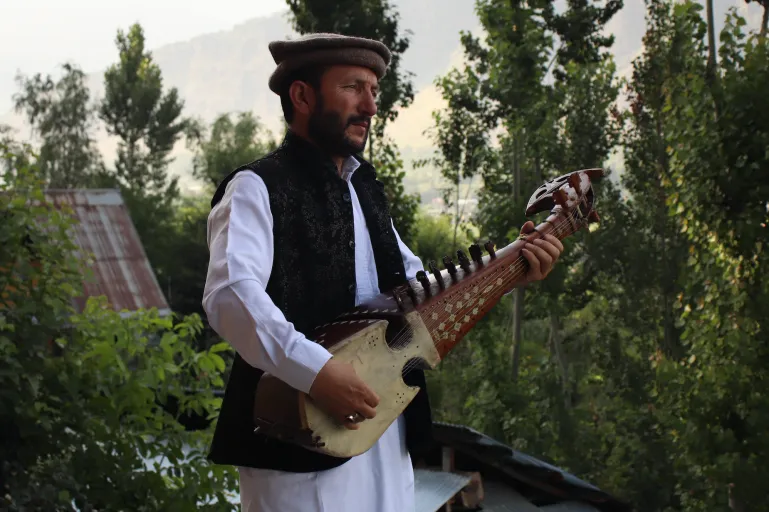
Sitting on his veranda, he plays a six-stringed rabab. His songs carry memories of migration, loss and the home he left behind.
Born in Dangithal, near the Line of Control in Gurez Valley, Naseem remembers long winters, family storytelling and songs passed along by older relatives.
“The elders in our house were our library,” he says. “Whatever they hummed, we sang.”
During the 1999 Kargil conflict, his family was among those forced to leave Gurez. They resettled in Kangan.
“We lost everything,” he says. “But the songs travelled with us.”
Naseem began taking Shina music to new listeners in Srinagar. In Bohri Kadal, a historic market in the old city where many Dard families work as wazas, or chefs, he gave a shopkeeper a copy of his first cassette, Dardistan, and asked him to play it every morning.
His voice began travelling through the market.
“People would ask what language it was,” Naseem says. “It was Shina. For many, it was the first time they had heard it.”
While Naseem carried Shina music beyond Gurez, Fareed Ahmed Kaloo worked to preserve it within the valley.
At the Shina Cultural Centre near Dawar, young musicians gather as Kaloo, 67, adjusts his harmonium and begins to sing. He wears a traditional shoka and white pakol cap.
Yousuf Naseem, 53, a Shina singer and rabab player, plays on the veranda of his home in Kangan, Indian-administered Kashmir [Ishtayaq Rasool/Al Jazeera]
“Gilgit, Kargil, Gurez, Drass – our pride, our own, This is our Golden Garden: Dardistan, our home.”
Kaloo leads the Habba Khatoon Dramatic Club, a cultural group founded in 1976 to preserve Shina folklore in Gurez.
“After Partition, our culture faded,” he says. “Kashmiri music dominated, and our Dardic roots went silent.”
For years, he travelled between villages on foot, carrying a harmonium and a tumbak naari, a clay percussion instrument. He performed at weddings, fairs and local gatherings, accepting food, a place to sleep or a small honorarium as payment.
“We didn’t do it for money,” he says. “We did it because someone had to, and no one else would.”
Some of the club’s earliest members have died. Others left amid cross-border shelling and never returned. Kaloo stayed, teaching folk songs to younger generations.
He now listens to new tracks on his phone and admires how musicians in Gilgit have developed their sound while retaining elements of traditional Shina music.
“They’ve gone far ahead of us,” he says with a smile. “As they should. Our songs must evolve, but never lose their roots.”
Along the shores of the Neiden Fjord, in Norway’s northernmost county Finnmark, Nils Boine* gazes out across the water. On the horizon, the Neiden River splits around the craggy island of Skogerøya, but lurking beneath its surface is a fisherman’s bounty: hundreds of king crabs.
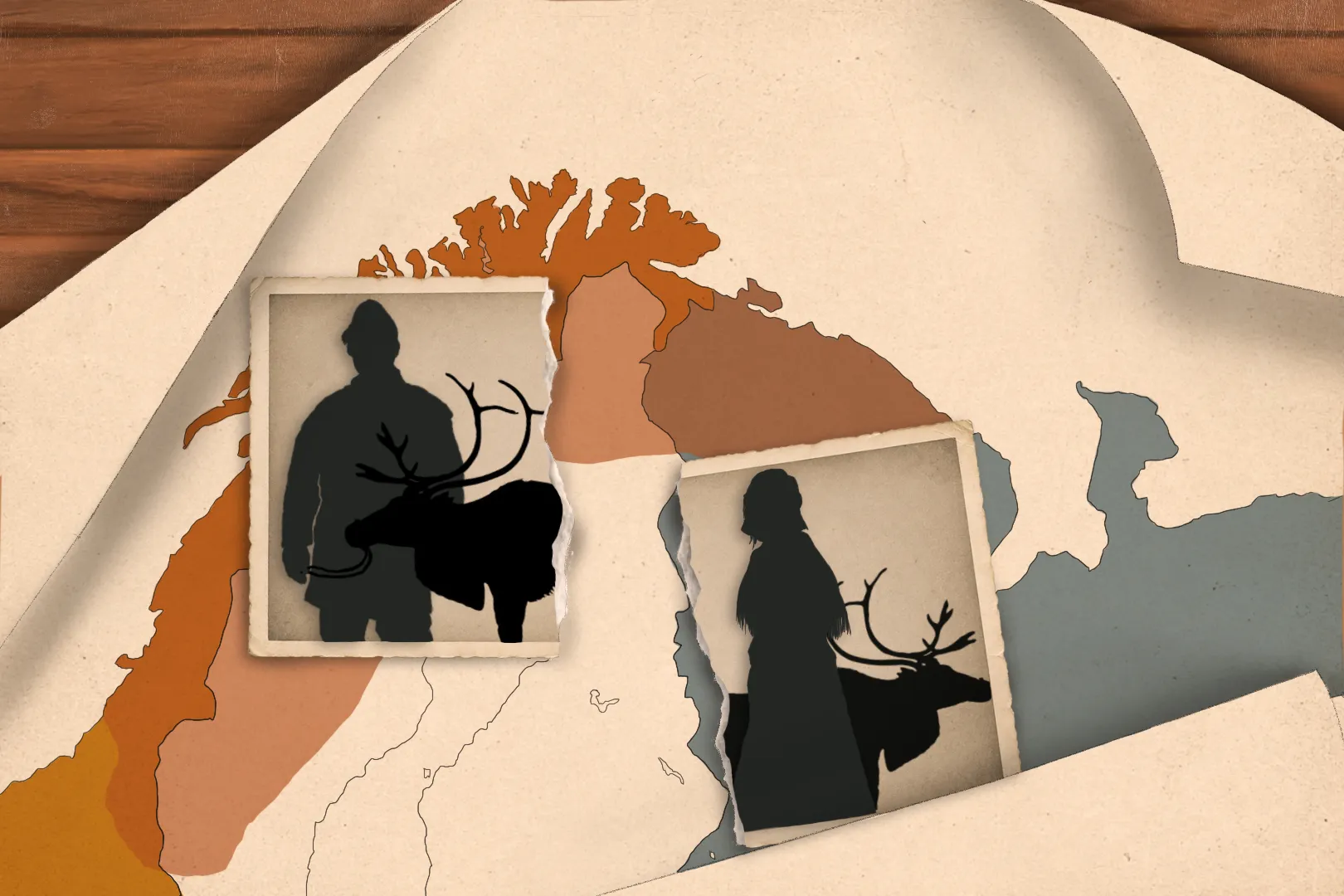
His grandmother was Sea Sámi, from an Indigenous coastal people whose homeland, Sápmi, stretches across northern Norway, Sweden, Finland and Russia’s heavily militarised Kola Peninsula. In Finnmark’s fjords, Sea Sámi families have fished for generations. But these waters are dissected by more than currents and shoals. Since Norway and Russia fixed their border in 1826, Sámi communities in the region have been divided by a national boundary.
Two hundred years later, this Arctic community is a combination of Sámi, Norwegians, Finns, Ukrainians, Russians, and international seasonal workers. Most of the Sámi population lives in Norway, with roughly 2 percent residing in Russia.
The Sámi have established a cross-border lifestyle, supported by flexible policies, including a Norwegian-Russian agreement allowing visa-free travel for those living within 30km (18.5 miles) of the border.
Security, however, has begun to tighten since the onset of Russia’s full-scale war on Ukraine. The West sees Finnmark as part of NATO’s exposed northern flank, as it is directly opposite Russia’s heavily armed Kola Peninsula. The Norwegian border town of Kirkenes has been caught in a spy war with Russia, with multiple Russian operatives having been caught posing as tourists and fishermen while trying to engage in espionage.
Now, border bureaucracy is a daily reality, and reindeer herding, language revitalisation and hunting traditions are increasingly being navigated through permits and regulations, making the wider Arctic infrastructure feel fractured.
“I have friends in Russia,” Boine says. “We used to go shopping in Russia, and go there for weekends.”
Since Russian President Vladimir Putin’s full-scale invasion of Ukraine in February 2022, those crossings have stopped — partly as a display of solidarity with Ukraine, and partly due to safety concerns.
“A local person was just arrested in Russia, so people are afraid to cross the border,” Boine explains. “The rumours say that he had some illegal things in his car, but he was arrested, and the [Ministry of] Foreign Affairs in Norway tried to do something, but it’s very difficult, of course, because we don’t have any diplomats in Russia.”
He is referring to the reported June arrest of a Kirkenes businessman. Lawyer John Christian Elden told the daily newspaper Verdens Gang (VG) that the man was in custody for two months under alleged “possession of weapons or ammunition”. Some Kirkenes residents were left shaken by the news, as recreational hunting is common in the region. They fear accidentally crossing the Russian border with forgotten hunting ammunition that might be left in their cars.
The number of Russian tourists visiting Norway has also declined, from 250,000 in 2019 to 52,000 last year.
“Before, we had Russian guests, but not now,” Boine says. Fortunately for his family, who run a tourism company, 80 percent of customers come from Asia or Finland. Their business has emerged relatively unscathed, but other companies have not been as lucky.
“Shops in the area have lost a lot of income without Russian [tourists],” says Boine. “Several shops have had to close.”
In a landscape traditionally connected for centuries, the fragmentation of communities is deeply concerning for both the regional economy and Sámi culture. Cross-border connections are deeply rooted in the regional psyche.
For Boine, the war in Ukraine has put his friendships with people in Russia on hold.
“They are afraid to do something wrong or write something wrong,” he says quietly. “You never know what might happen if they have too close contact,” he says.
Alora, Spain – The train chugs steadily out of Malaga station, its rhythmic clatter carrying it inland towards the mountains of the Guadalhorce Valley, where whitewashed villages cling to hillsides.
Beyond the window, pomegranate trees grow close to the tracks. Palms and cypress trees stand alongside young orange saplings planted in neat rows and, farther out, olive groves whose leaves shimmer between green and silver in the breeze. Above the rugged mountains, small white clouds float across an immense blue sky, like pieces of popcorn.
Over the train’s rattle, an announcement in Spanish comes through the speakers: “The next station is Aljaima.”
The name derives from the Arabic al-khaima, meaning “the tent”, a small echo of another language, another time.
And then Alora, where the town rises around a rocky hill crowned by the remains of an old fortress. Some etymologists suggest the town’s ancient name may derive from the Arabic al-lawra, loosely translated as “the light”.
The railway station is quiet in the midday heat.
A large black pick-up truck rumbles into the station car park and stops. Henrietta Szovati, a British-Hungarian Muslim, steps out, having driven down from the mountains to collect provisions.
Dressed in a loose blue shirt and cream trousers, she offers a warm embrace. Silver earrings dangle beside her face, and a sea-blue scarf is wrapped around her hair like a turban. A pair of red-framed spectacles rests on top.
She apologises for the truck’s state. Dust has settled on the dashboard, and bits of dried grass have found their way inside. “It is a working vehicle,” she says, more accustomed to hauling things across farmland than ferrying visitors from railway stations.
For the past two years, she and her husband, Ajmal Masroor, a therapist and imam, have been transforming an old farmhouse and its surrounding land into the House of Andalus. The project aims to bring people closer to southern Spain’s Islamic history and the natural world.
Nearly 400 olive trees dot the 14 hectares (35 acres). She wants to plant more and make it a thousand-tree olive grove, she says with a smile, glancing out of the truck’s open window.
The road winds higher into the mountains. Wildfires, Henrietta says, swept through parts of the surrounding region at the height of summer, and the landscape still bears the season’s harshness. Reddish-brown earth gives way to patches of parched scrub and exposed rock, while slabs of silvery-grey stone jut sharply from the slopes.
“That’s slate,” Henrietta explains, pointing through the windscreen. The Spanish word is pizarra, she adds, the same name as the neighbouring town.
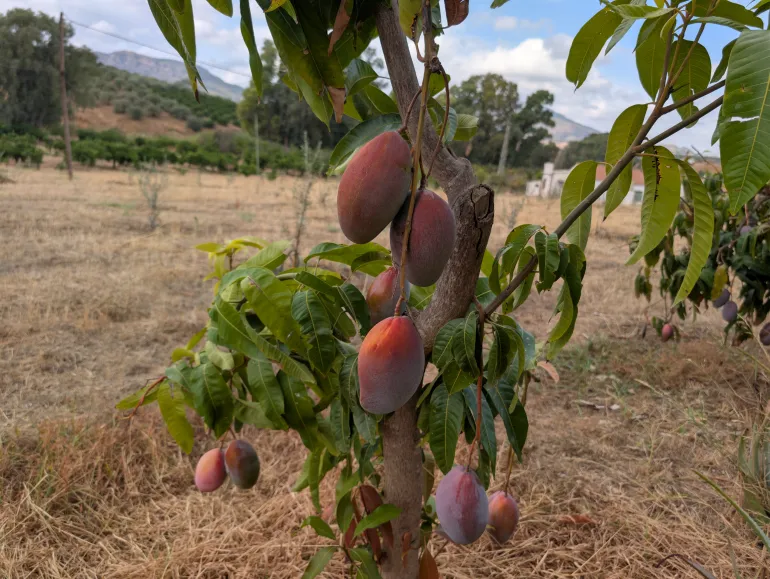
Oranges flourish here, as do figs and avocados. And mangoes that are better than those from South Asia, Henrietta emphatically declares.
Mangoes thrive in the warm climate of southern Spain’s Andalucia region [Indlieb Farazi Saber/Al Jazeera]
As we drive further into the mountains, Henrietta gestures towards a neighbouring property. “That’s my neighbour, Juan Garcia.”
Henrietta buys lemons, avocados and honey from him. Sometimes he comes over to help with the olives. It’s this sense of community and neighbourliness she found harder to come by in Britain, where she has lived since 2001, marrying Ajmal a year later.
“I feel like an outsider there. I’m still not ‘one of us’ after more than 20 years.”
As a Muslim and as a European, she says, Spain feels familiar in a way no other place does. Hungary was never an option, she adds, describing its government as “racist and right-wing”. And in Britain, she says, being Muslim can feel unavoidably political, her faith viewed through headlines and public arguments about Islam.
In the mountains above Alora, she feels her neighbours meet her first as Henrietta: the woman who lives up the track and joins in village life.
“Practising Islam here is just easier,” she adds.
Yet Spain is not immune to the political currents sweeping across Europe. The far-right Vox party has made opposition to immigration and what it calls the “Islamisation” of Spain central to its campaigning, raising questions about how secure that sense of belonging might be.
With a sigh, Henrietta acknowledges that being Muslim can be difficult anywhere in the world today. But she prefers to focus on what she can build, rather than on political circumstances beyond her control. “Circumstances change, but community, connections and faith don’t,” she says.
For her, that means building relationships with neighbours, even when they hold different beliefs. A sense of community, she argues, is forged through everyday encounters rather than political rhetoric.
On a visit to Juan Garcia’s home, his 79-year-old mother, Maria, is curious about the scarf wrapped around Henrietta’s hair.
The women are standing in Maria’s living room, its shutters drawn against the afternoon sun. A portrait of Jesus hangs on the wall.
Henrietta explains that she is Muslim and that covering her hair is part of her faith, a way to feel closer to God. Maria is Catholic. The conversation turns to the Virgin Mary, who also covered her hair.
But Maria insists all that matters is being a good person. If you cannot be good, none of the outward signs of faith means very much.
There is no awkwardness between them, no need to defend or explain their beliefs. The conversation moves on.
It is such ordinary encounters that have made Andalucia feel like home, Henrietta says. But her connection to this part of Spain runs deeper than the friendships she is making. It also stems from a deep respect for a history that stretches back more than 1,000 years.
Henrietta Szovati and her neighbour Juan Garcia overlook the countryside near Alora, southern Spain [Indlieb Farazi Saber/Al Jazeera]
For British Muslim travel writer and historian Tharik Hussain, author of Muslim Europe, the fascination is understandable. Al-Andalus was the medieval Muslim-ruled territory of modern-day Spain and Portugal. Its heartland lay in the south, in what is now Andalucia, home to cities such as Cordoba, Seville and Granada, where surviving monuments still evoke a period when Muslims helped shape European civilisation.
Its eventual loss, he says, has given it an almost “Atlantis-like aura” in the Muslim imagination, a longing reflected in Muslim literature over the centuries, from the 17th-century historian al-Maqqari to the 20th-century poet Allama Iqbal.
For nearly eight centuries, Muslim dynasties ruled parts of the Iberian Peninsula, leaving behind palaces and fortresses with horseshoe arches, intricate zellij tilework, carved yeseria plasterwork, and curling Arabic calligraphy. Their legacy endured in irrigation channels known as acequias (from the Arabic al-saqiya), scholarship, language and traditions that continued to shape Spain long after the fall of Granada in 1492.
Britons have long headed to Andalucia in search of a place in the sun. But among those putting down roots here are Muslims drawn by something more: The chance to reconnect with a history in which Islam was part of Europe, and to build lives where their faith feels less like a defining difference.
Yet the Andalucia they are entering is not a vanished kingdom waiting to be rediscovered; it is modern Spain, with its own economic pressures, social divisions, and complicated relationship with the past.
What happens when the dream of al-Andalus meets the realities of living here?