London Airports

Ryanair’s ticket rule people born in 2010, 2014 and 2024 have to comply with

Families need to be aware of how this could impact their flights home

Certain young people going on holiday with Ryanair this year could find themselves in trouble if they are booked to fly with the wrong ticket type. It can happen to anyone born in 2010, 2014, or 2024. Ryanair divides its passengers into four categories when assigning seats on planes: adults, teens, children, and infants.

The airline is clear online about who qualifies for specific ticket types when they are travelling abroad with the budget carrier. Outlining the policy online, Ryanair says: “For the purpose of defining our passenger types, adults are over 16 years of age, teens are between 12 and 15 years of age, children are between two and 11 years of age, and infants are those under two years of age.”

This applies from the “date of flight departure”. If families are heading abroad and celebrate a birthday, they need to be aware of how this could impact their flights home. Anyone born in 2010, 2014, or 2024 must comply with the rules.

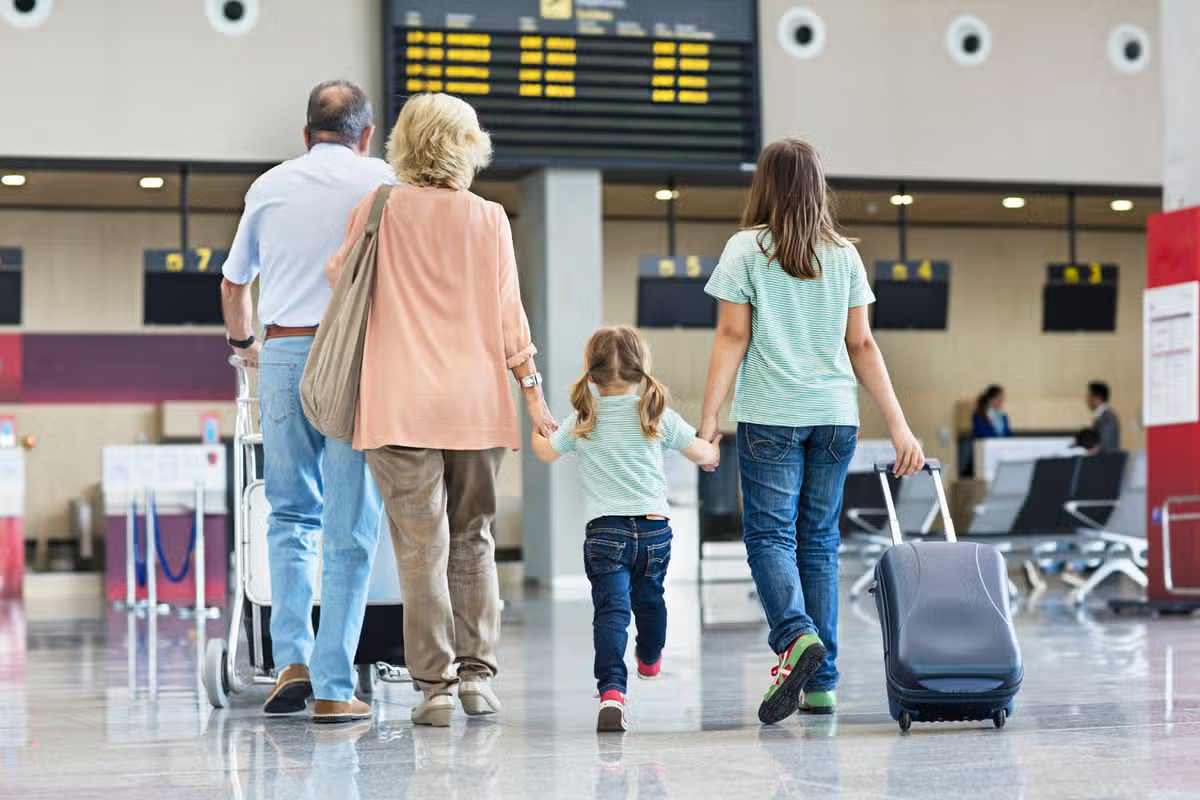
If a child turns two, 12 or 16 between leaving the UK and returning home, they cannot be booked onto Ryanair flights without potentially facing extra charges. It is important for parents to be aware of this before booking their next holiday – or act now if the plans are already in place.

Ryanair adds: “If an infant turns two years of age or a child turns 16 years of age during your trip, you should purchase two one-way flights rather than a return ticket. You may then connect the bookings by contacting us.”

In terms of pricing, teens (aged 12-15) are treated the same as adults for pricing. They may, however, lose any free seat selection that is offered to under-12s.

The airline has a section on its website for customers who have already made a booking and need to change their passenger type. Changing passenger types may incur fees, and it is generally better to update this to avoid issues at boarding.

Generally, swapping a child or teen ticket to an adult is free when done online, but child passengers will lose their free seat selection privileges and have to pay for a new seat when ageing out of the free under-12s seating offer. The cost of doing this varies, depending on the flight service and the newly selected seat.

In other Ryanair news, the budget airline is selling flights to Spain that are “cheaper than buying dinner”, which is great news if you’re looking for a budget holiday. The travel news was recently drawn to the attention of Spain Explore on Instagram, as they were keen to alert people to the deals.

The page claimed the airline has announced routes to Barcelona that are “cheaper than dinner”. After making a quick check, you’ll see that some flights from the UK are pretty reasonable.

Source link

Travel expert warns passengers to check ‘PIR number’ if their suitcase goes missing

Chris Harrington, managing director at travel transfer company hoppa, has outlined what to do to give yourself the best chance at recovering your valuables, or, at least, getting some compensation for the loss

One of the most common travel nightmare scenarios tourists face is having their luggage go missing after a flight.

Mishandling checked-in bags costs airlines around £4.2 billion a year, according to aviation technology company SITA. If you’re one of the unlucky ones who ends up not finding your suitcase on the conveyor belt, here are the seven steps to take immediately, according to an expert.

Chris Harrington, managing director at travel transfer company hoppa, has outlined what to do to give yourself the best chance at recovering your valuables, or, at least, getting some compensation for the loss.

The most important thing, he says, is to act fast. He says: “Ultimately, the faster and more informed your response is, the better your chances of recovering your bag or at least getting clear updates on where it is.”

Chris advises heading straight to the airline’s service desk near baggage reclaim if you notice a missing bag – stressing that delays can reduce the chances of locating your bag quickly.

READ MORE: Ryanair passengers warned over type of bag you can never check inREAD MORE: UK tourists face travel disruption on May 12 as new strike action confirmed

From then on, it’s important to have your baggage tag and flight details ready, as they will help staff begin tracking your suitcase straight away.

You should also be as specific as you can when describing the missing item. “Details matter. Think about the colour, size, brand, and any distinguishing features like stickers or tags. Even better, show photos if you have them,” Chris continued.

And once your case is all documented and reported, never forget to ask for a Property Irregularity Report, or PIR number, as it is “essential for tracking your luggage and for any future claims.”

In the meantime, most airlines try not to leave customers empty-handed. “Some carriers will provide an allowance for essentials like clothes and toiletries,” Chris notes. “If they don’t, keep every receipt, as you may be able to claim those costs back later.”

Another essential step is to contact insurance companies early on, since many policies include cover for delayed luggage after 12 to 24 hours, but the expert recommends being prepared and checking exactly what evidence they require. If, after several days, nothing is found, it’s crucial not to give up.

“You should be following up regularly,” Harrington advises, adding that “after 21 days, luggage is officially considered lost under international guidelines.”

Thats the stage in which travellers are encouraged to put forward a formal claim – according to the Montreal Convention, which sets out airline liability in such cases.

Chris highlights that passengers may then be entitled to compensation of up to around £1,300 if they provide the right documentation.

To claim that sum, “you’ll need proof of your luggage and what was inside it. The more evidence you have, the stronger your claim.”

Source link

UK has ‘worst airport in Europe’ for delays – and three others in the top 10

Four UK airports have found themselves in the top 10 of the ‘worst for delays’ across Europe, with one securing the top spot following average delays of almost two hours

A UK airport has been named the ‘worst in Europe’ for delays, while three other UK airports also found themselves in the top 10.

New research from AirAdvisor ranked Manchester Airport as the worst airport in Europe for hour-long flight delays. The airline comparison experts analyzed data from 9,594,711 flights across 46 European airports in 2025 to reveal results based on the percentage of flights delayed by 60 minutes or more (weighted at 70 percent) and the average length of those delays (weighted at 30 percent).

This saw Manchester take the top spot, with 6.16 percent of its flights delayed by 60 minutes or more in 2025 and an average delay of 116.7 minutes, which amounts to almost 2 hours. AirAdvisor AirData found that the routes from Manchester most prone to delays were to Amsterdam Schiphol, Paris Charles de Gaulle, and Dublin.

READ MORE: EasyJet’s new 7-hour route to white sand island is ‘longest ever’ with £120 flightsREAD MORE: Experts warning over common items packed in hand luggage that can cause travel disruptions

A Manchester Airport spokesperson told The Mirror: “This analysis of the Civil Aviation Authority’s data is misleading as it ignores important context – context which is directly referenced by the CAA in the notes accompanying the research and in the research itself. Punctuality is affected by factors that are outside of an airport’s control. The two most significant factors contributing to delays in the last year have been industrial action affecting air traffic control in Europe, and the weather. These were exacerbated by airspace restrictions above conflict zones meaning airports with significant long-haul networks, like Manchester, were more significantly affected than others.

“As an industry we are working collectively to achieve the best possible on-time departure rates, while protecting flight schedules and avoiding the need for cancellations.”

But it wasn’t just Manchester that found itself named among the worst. Birmingham, London Gatwick, and London Stansted joined the airport, making the UK the most represented country in the top 10.

London Gatwick was ranked the sixth worst in Europe, with a 5.24 percent rate of hour-long delays and an average delay of 111.88 minutes. According to the data, AirAdvisor found that the most impacted routes from Gatwick were to three major holiday hotspots: Barcelona, Malaga, and Lisbon.

In tenth place was Birmingham Airport, after the experts found that it scored a 5.26 percent rate of hour-long delays and an average duration of 108.01 minutes. The most disrupted routes from Birmingham were said to be flying to the popular destinations of Amsterdam, Dublin, and Paris Charles de Gaulle.

A Birmingham Airport spokesperson said: “Flight delays can happen for several reasons including industrial action and bad weather, some of which are out of an airport’s control. This month over half of all aircraft left on time and we continue to work hard to improve punctuality. Our colleagues work tirelessly to provide brilliant passenger service, with the vast majority of people rating their experience as excellent.”

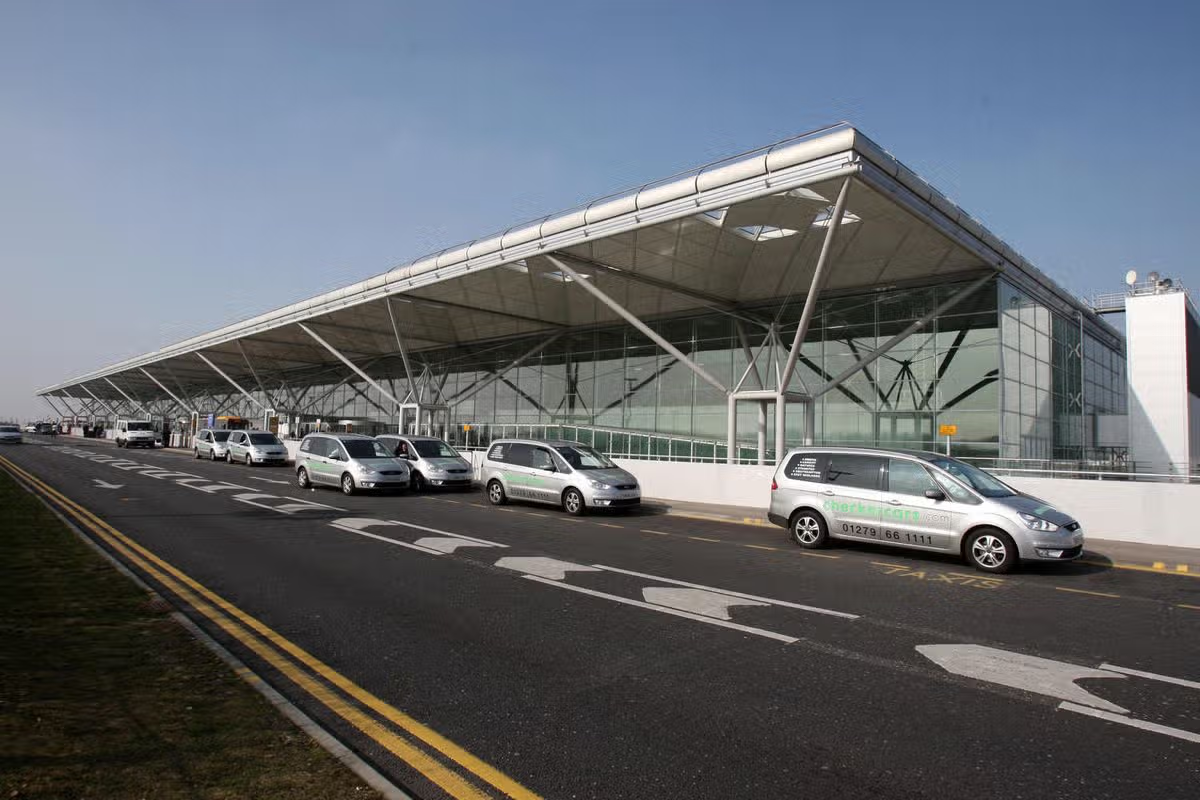
Meanwhile, London Stansted came in joint tenth with Birmingham, after data found that it had a 5.5 percent rate of hour-long delays and an average delay of 106.24 minutes. AirAdvisor said the most delayed routes from Stansted were to Dublin, Edinburgh, and Istanbul Sabiha Gokcen.

A London Stansted Airport spokesperson told the Mirror: “It’s very important to put this analysis into perspective. The data looks at 46 airports but there are more than 340 major airports across Europe, so this represents a small and self-selective sample. This type of analysis of the Civil Aviation Authority’s data is misleading as it ignores important context – context which is directly referenced by the CAA in the notes accompanying the research and in the research itself.

“It should also be noted this research has been produced by a flight compensation company and looks specifically at delays of more than 60 minutes, which are often driven by wider factors such as air traffic restrictions, industrial action, adverse weather impacts and airline operations, airline crew shortages or delays to inbound flights rather than airport performance.

“Like all major airports operating in busy European airspace, punctuality on certain routes can be affected by congestion elsewhere in the network. We continue to work closely with airlines, air traffic control and partners across the aviation system to reduce disruption and keep journeys running as smoothly as possible for passengers.”

London Gatwick has been contacted by The Mirror for a comment.

Top 10 worst airports in Europe for long delays

  1. Manchester, UK
  2. Palma de Mallorca, Spain
  3. Kraków Balice, Poland
  4. Nice Côte d’Azur, France
  5. Bucharest Henri Coandă, Romania
  6. London Gatwick, UK
  7. Porto, Portugal
  8. Marseille Provence, France
  9. Birmingham, UK
  10. London Stansted, UK

Birmingham, London Gatwick, and London Stansted were contacted for comment.

Do you have a travel story to share? Email webtravel@reachplc.com

Source link