LOCAL

Adam Thomas reveals he was ROBBED in local supermarket after his controversial I’m A Celeb stint

ADAM Thomas has revealed that he was ROBBED in a local corner shop by the owner.

The actor, who appeared on the latest I’m A Celebrity All Stars, explained that he was charged £100 for a couple of bags of sweets.

Adam Thomas revealed the shock moment he was ROBBED in local supermarket Credit: At Home With The Thomas Bros
The actor said the owner of the shop charged him £100 for a few bags of sweets Credit: Shutterstock Editorial

Adam was left stunned when he confronted the shopkeeper, who told him he didn’t think the soap star “needed the money” after his latest stint on the ITV jungle show, where he received a sizeable fee for his appearance.

The Emmerdale star said he spotted the error on the card reader after he had already paid for it.

Speaking on At Home with the Thomas Bros podcast, Adam said: “I got robbed the other day!’

“Listen right, so I went to my local off-licence, I was buying some sweets for the kids, and I went to pay for it, and I paid for it, and then I looked at the card machine, and it said £100, and I was like ”bro what are you doing?” 

relish the chance

How Adam Thomas plans to reinvent himself after I’m A Celeb fallout


MOVING ON

Adam Thomas says ‘weight has lifted’ after I’m A Celeb feud drama

Adam had a tough time in the jungle after he admitted he felt ‘bullied’ by some campmates Credit: Shutterstock Editorial
The Waterloo Road star said he had finally moved on from his I’m A Celeb feud drama Credit: ITV

He went: ”Come on you don’t need it!” and I was like ‘what do you mean I don’t need it?’”

Adam went on to say that the owner told him: ”You’ve just come off the jungle man, you don’t need it’.”

He continued: “I looked him dead in the eyes, and don’t get me wrong I had a banter with this guy, we have a little bit of a laugh back and forth and everything. I was just a bit caught off guard.

“That’s what I think, he’s getting his money back. But I was like ‘bro you can’t do that’.

‘He said ‘oh come on man, you don’t need, I need some money, I need some.’

“I said ‘I listen, I like you and everything, but don’t take the p**s out of me’.”

The Waterloo Road star revealed that the owner finally paid him back and apologised for it.

“Weeks passed and everything, and I sort of forgot about it, and I was walking through my village again, and I went in there, and he was like ‘bro where have you been? You’ve not been back, I’ve been wanting to give you the money, come in, come in, come in,’ and he was so apologetic. 

“Like counting the money out, and he was giving it to me, and he was like, ‘I’m so sorry, like I was just doing it as a joke. I didn’t really mean to offend you or anything like that.”

“And I felt really bad, and at one point I was gonna go ‘you know what, keep the money, it’s not about the money.”

“And anyway, he gave me my money back, and then I ended up giving him the bacon roll, and the croissant.”

The actor found himself at the centre of a catastrophic row during his time I’m A Celeb as he clashed with co-stars Jimmy Bullard and David Haye.

Last month, Adam said he had finally moved on from his I’m A Celeb feud drama, saying “a weight has been lifted” from his shoulders.

On a recent episode of their podcast, Adam’s brother Scott noted: “Ever since all this jungle stuff, you’ve become a proper man, mate, you’ve got a different presence. You’ve god a new strength, mate, about you.

“Even the way you talk, everything.”

Admitting he agreed, Adam responded: “I don’t know, I feel like, for months, I just feel like there was a big dark cloud over me.

“It was for a while until after the final. And then, literally, about a week and a half after the final, I was like, ‘Oh my god, it’s gone’.”

As Scott, Adam and brother Ryan continued to discuss the tough time, the jungle winner admitted he was finally feeling back to his best.

“I just feel like a big weight has been lifted.

“Even when I did the podcast when I first came out, it was straight after as well so I was resenting it a lot, I was angry a lot, I was sad.

“But now I can see the light between the trees a little bit. I just feel like, you know what? It was what it was, it was meant to be, that was my journey and I feel like a better man for it.”

Following the chaotic I’m A Celeb live final, which saw boxer David and former footballer Jimmy stand against Adam, the actor broke down on tears on his podcast with Ryan and Scott.

At the time, he said: “I’m just tired, I want it all to go away and just be forgotten about.

“The sad truth is that everyone will go on with their lives but for me, this will be in for me the rest of my life”.
Source link

As Rain Returns to Zamfara, So Do Terror Attacks on Local Farmers 

When dozens of farmers bade farewell to their family members on the morning of Friday, June 12, and headed out in different directions to work on their farms, 17 of them were not lucky enough to return home alive. The farmers were killed after terrorists invaded their fields in the Maradun Local Government Area (LGA) of Zamfara, North West Nigeria.

Locals say 13 other farmers were injured during the attack, with three of them referred to the Usmanu Danfodiyo University Teaching Hospital (UDUTH) in Sokoto. A survivor of the attack, who identified himself only as Bello, told HumAngle that he was on his farm in the outskirts of Gora in the Maradun LGA, at around 9 a.m., when he heard the first gunshot. He said he thought it was one of the Yan Sakai local security guards, but it became clear that it was a terrorist attack when the gunshot sounded a second time. Yan Sakai security volunteers are young people carrying weapons to protect residents from terrorist attacks. 

Bello recalled that he was lying face down while others fled. As the gunfire persisted, he managed to pull himself to the other side of the road before running home. “I was lucky, my farm is right on the side of the road; most of those killed had their farms a little bit away from the road,” he said.

For over ten years, rural terrorism has become widespread and persisted in Zamfara and other northwestern states. In many ungovernable areas, farmers are compelled to pay a farming tax before they are permitted to work on their fields as the wet season arrives. The armed groups also require farmers to make payments running into millions to cultivate their crops. Even after paying, not all communities are granted access to their farmlands. Many communities have been displaced, and food stores have been torched because residents failed to pay the required farming tax.

HumAngle recently reported that about 40 leaders of a farming community were abducted at a peace deal meeting with a terrorist leader in a village in the Maradun LGA. The community leaders were lured into a meeting to discuss how much they would pay to a terror group, only for them to be abducted by the leader of the criminal syndicate. In a separate report, we also documented how farmers were being displaced after paying millions of naira as farming tax to terrorists in Zamfara.

“There were a lot of motorcycles with bandits on top, shooting sporadically, but I managed to escape. The bandits [terrorists] must have divided into groups because there were gunshots from all corners,” Bello said.

The chairman of the Maradun LGA, Sanusi Dosara, stated that the recent devastating attack reflects the ongoing efforts of terrorists to disrupt farming activities in the state. Since early June, there has been an increase in attacks aimed at farmers in Zamfara. 

Prior to the latest incident, two farmers were killed while tending to their fields near the Kaya community, not far from Gora in Maradun. Earlier, eight farmers were killed in an attack in Gima village, located in Anka LGA. According to locals, the farmers who lost their lives in the Gima assault were: Sani Kanen Tidurogo, Salisu Kadda, Bello Kyabe, Ibrahim na Yakubu Ziti, Yusuf Malan Rabi, Masaudu Sani Adake, Abdulmajid Sani, and Adamu Dungo.

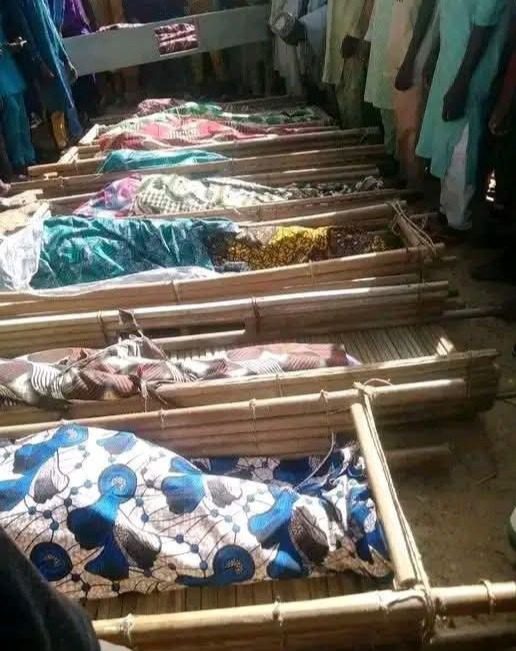
Several covered bamboo stretchers lay in a row, surrounded by onlookers in colorful clothing.
Funeral for the 17 farmers killed in Gora. Photo provided by Ibrahim Kaya.

“The terrorists are intentional about what they want,” Abdulmudallib Anka, a resident, told HumAngle. His house in Anka is filled with internally displaced persons from Gima and other villages. “The day of that attack, the terrorists circled a group of farmers working on their farms before they started shooting sporadically.”

Abdulmudallib noted that the recurring attacks have shown the terrorists are ready to continue their onslaught against the civilian population, so as to stop them from gaining access to their farms. There have also been reports of attacks in which farmers were killed in the communities of Kaura Namoda, Tsafe, Zurmi, and Birnin Magaji LGAs over the past few days.

Sulaiman Abdullahi, a youth leader in Birnin Magaji, said the situation has forced several farmers to stop going to the farm.

“Early June, farmers were attacked outside Tungar Danjuma and Gidan Kyafda, which led to the death of about six farmers with several others injured,” Sulaiman said. “That same day, farmlands on the Birnin Magaji – Kaura Namoda road were also attacked around 1 p.m.”

In Zurmi LGA, the terrorists struck on June 7 and invaded the outskirts of the town, along the road to Kaura Namoda, killing two farmers working on their farms. 

Seventeen farmers were killed, and thirteen injured in a terrorist attack in Maradun LGA, Zamfara, Nigeria. This is part of a broader issue where rural terrorism has thrived for over a decade, forcing farmers to pay exorbitant “farming taxes” to militant groups for access to their fields.

Despite payments, many communities are displaced, and attacks on farmers are increasing, disrupting agriculture activities.

Local security has been ineffective as indicated by repeated incidents, including the abduction of about 40 community leaders under false pretenses. Recent violence has persisted across various local government areas of Zamfara, further highlighted by incessant attacks which resulted in deaths and injuries of numerous farmers.

The ongoing threat deters farming activities and devastates local economies, leaving residents in fear and uncertainty.

Source link

In Orange County, progressive Latina pol beats back haters — again

On election night, Santa Ana City Council member Jessie Lopez found herself in third place, far behind fellow Democratic council colleague David Penaloza and Republican business owner Mayra Ruiz in the race to represent Orange County’s 68th Assembly District.

Tearful supporters at a California Working Families Party shindig at the Mission Control bar and arcade in downtown Santa Ana hugged Lopez, gifted her flowers and wished her well.

If the 37-year-old was sad, she didn’t show it. Lopez had seen this game play out before.

In 2023, the councilmember decisively beat back a recall attempt funded by Santa Ana’s police union and apartment owners who didn’t like her unabashedly progressive views in a city where centrist Democrats have dominated politics for decades and lefty ones were long ostracized.

I wrote a column shortly after, heralding Lopez’s overwhelming victory as a new era for Latino politics in Orange County, where Latinos make up a third of the population but still wield little power.

Lopez spent the next three years along with her fellow progressive Santa Ana council members shoring up the city’s rent control policies and its immigrant defense fund. Nevertheless, few gave Lopez a chance in her assembly race.

Penaloza — who declined to vote when the council deadlocked on whether to cancel Lopez’s recall election — had the backing of the Orange County and California Democratic Party establishment, from current 68th District Assemblymember Avelino Valencia (who’s running to represent the 34th Senate District) to Assembly Speaker Robert Rivas to Katie Porter, a former Orange County congresswoman who ran unsuccessfully for governor this year.

Penaloza’s campaign mailers and video ads were so ubiquitous these past few weeks that they filled up my mailbox and interrupted my binging of Hulu’s “Vanderpump Villa.”

So did anti-Lopez mailers and commercials, funded by nearly $2.7 million in independent expenditures. Yet Lopez once again beat back her well-funded opposition.

As of Wednesday evening, the latest Orange County Registrar of Voters election results had her in second place — less than 1,000 votes away from Penaloza.

“Voters proved that while money can influence politics, it can’t buy community support,” Lopez said this week as she unsuccessfully tried to enjoy tacos and guacamole at Lola Gaspar in downtown Santa Ana, where well-wishers kept calling her or congratulating the candidate in person. “This race is about the future of California — whether we answer to corporations and insiders or to the hard-working people we’re elected to serve.”

With Orange County Supervisor Vicente Sarmiento easily winning reelection and Unite Here Local 11 co-president Ada Briceño currently coming up short in her bid to represent the 67th Assembly District, which includes parts of Los Angeles County, Lopez may be the sole O.C. Latino progressive running in November for a seat beyond the local level.

Expect Lopez versus Penaloza to become a referendum on whether the leftward trend of Latino voters in Orange County continues — or whether its center holds.

“I’ve chosen my side,” Lopez told me. “I’m proud to stand with working people.”

Then she excused herself — someone else wanted to say what’s up.

Insights

L.A. Times Insights delivers AI-generated analysis on Voices content to offer all points of view. Insights does not appear on any news articles.

Viewpoint
This article generally aligns with a Center Left point of view. Learn more about this AI-generated analysis
Perspectives

The following AI-generated content is powered by Perplexity. The Los Angeles Times editorial staff does not create or edit the content.

Ideas expressed in the piece

  • The column portrays Jessie Lopez as a symbol of an emergent, unapologetically progressive Latino politics in Orange County, arguing that this movement is challenging decades of centrist Democratic dominance and Latino underrepresentation in positions of real power.

  • It emphasizes that Lopez’s political credibility comes from having already survived a 2023 recall effort backed by Santa Ana’s police union and apartment owners, which the piece describes as a decisive victory that marked a turning point for left-leaning Latinos in the region.[1]

  • The article frames Lopez’s record on the Santa Ana City Council—particularly work to strengthen rent control and expand an immigrant defense fund—as proof that progressive Latinos are now governing, not just organizing, and that these policies are resonating with working-class residents.[1]

  • It stresses the scale of opposition Lopez faces, noting that powerful interests and nearly $2.7 million in independent expenditures were deployed against her, and yet she still advanced to November, which the article casts as evidence that grassroots support can overcome big money in politics.

  • The column contrasts Lopez’s underdog status with the institutional backing behind rival Democrat David Penaloza, who is aligned with the county and state Democratic establishment, and interprets Lopez’s surge into second place as a rebuke to party insiders who had largely written off her chances.

  • It presents Lopez’s own framing of the race as a choice between “corporations and insiders” and “hard-working people,” highlighting endorsements from labor and progressive leaders as reinforcing her identity as a champion for working families rather than entrenched interests.[2]

  • The piece suggests that the Lopez–Penaloza matchup will function as a broader referendum on whether Latino voters in Orange County will continue a leftward drift or whether a more centrist orientation will reassert itself, positioning Lopez as the standard-bearer for the progressive side of that divide.

  • It further underscores Lopez’s uniqueness by noting that, with some other Latino progressives either safely re-elected at the local level or trailing in their own legislative bids, Lopez may be the only Orange County Latino progressive on the November ballot for higher office, heightening the stakes of her campaign.

Different views on the topic

  • Critics of Lopez in Santa Ana have argued that the councilmember’s agenda is too ideologically driven and insufficiently attentive to public safety and fiscal stability, a view that surfaced prominently during the 2023 recall, when backers contended that her policy positions undermined effective governance and community security.[1]

  • Recall supporters, including police union and property-owner interests, have maintained that Lopez’s role in strengthening rent control and supporting tenant protections represents an overreach that they believe discourages investment, burdens small landlords, and could ultimately reduce the supply and quality of housing in the city.[1]

  • Opponents have further asserted that her stances on issues such as policing and criminal justice skew too far left for parts of the electorate, arguing that more moderate Democrats or centrist candidates are better positioned to balance reform with public safety and to appeal to a broader cross-section of Orange County voters.[1]

  • From the perspective of some business-oriented and landlord groups, Lopez’s alignment with organized labor and progressive advocacy organizations, along with endorsements from high-profile national progressives, signals a policy direction they associate with higher regulatory costs, stricter labor standards, and a political climate they view as hostile to business growth.[2]

  • Within Democratic circles, the strong institutional support for David Penaloza and other establishment-aligned candidates reflects a competing view that stability, incremental change, and coalition-building with moderates are more effective strategies in competitive areas like Orange County than the confrontational style and ambitious reforms favored by progressive challengers.

  • Additionally, some analysts and political operatives point to mixed results for progressive Latino candidates elsewhere in the region as evidence that Lopez’s success is not guaranteed to translate into a broader realignment, and argue that many Latino voters in Orange County remain pragmatic swing voters rather than committed partisans of the left.

  • Skeptics of Lopez’s framing of “insiders versus working people” contend that such rhetoric oversimplifies complex policy debates, noting that unions, nonprofits, and progressive political organizations backing her are themselves powerful actors that shape legislation and budgets, and that community interests cannot be neatly divided into grassroots versus establishment.[2]

  • Finally, opponents warn that if Lopez’s approach becomes the dominant model for Latino politics in Orange County, it could sharpen ideological polarization inside local Democratic politics, potentially weakening the party’s ability to compete against Republicans in closely contested districts and to assemble broad coalitions needed to pass durable reforms.

Source link

LA28 releases details on second Olympics ticket sales drop

LA28 reserved the first Olympic tickets for locals. To kick off the second round of ticket sales, it’s a sponsorship connection that could help fans get to the front of the line.

Before the second Olympic ticket drop officially begins Aug. 10, LA28 announced Wednesday there will be a presale for Visa cardholders that will run from July 29-31.

Visa has sponsored the Olympics for 40 years and is the only credit card accepted for payment in Olympic zones. For a chance to be selected for the presale, fans need to first confirm their status as a Visa cardholder. Fans who have already registered can log into their existing LA28 ticket account, check the “Visa presale box” and save changes. New registrants must select the Visa cardholder option during the registration process. All ticket sales during the presale must be completed with a Visa credit card.

Fans can register for the second ticket drop at tickets.la28.org until July 22. Those who already registered for Drop 1 but weren’t selected or didn’t purchase their full 12-ticket allotment do not have to sign up again and are automatically entered into the lottery for Drop 2, which will run from Aug. 10-20.

Fans who are randomly selected for the Visa presale will be notified of their time slot on July 27. Those who aren’t selected for the presale remain eligible for a time slot in Drop 2. Email notifications for Drop 2 time slots will go out from Aug. 6-7.

The second ticket drop will offer tickets across all Olympic sports at a range of price points, LA28 said in a statement, subject to inventory availability. Prices start at $28 for individual tickets, but of the total 1 million $28 Olympic tickets, half were scooped up during the Drop 1 presale that was reserved for locals living near venue cities in Southern California and Oklahoma City.

April’s ticketing debut frustrated fans who were surprised by high prices, a 24% service fee on every ticket and limited inventory for key events. Still, LA28 sold 4 million tickets across 85 countries, a historic number that had International Olympic Committee officials giddy for the potential of the 2028 Games.

“What we thought we were going to sell, and what we thought we were going to get for people who registered for interest, we exceeded those by magnitudes,” LA28 Chief Executive Officer Reynold Hoover told The Times on June 4 after IOC members visited L.A. “We were able to set Olympic records in terms of sale, but I think the broader picture about all of that is people want to be a part of something really big and be part of something here in L.A., a part of history.”

LA28, the organizing committee behind L.A.’s first Olympics in 40 years, expects to generate $2.5 billion in ticketing and hospitality to support what has been advertised as a privately funded Games. The estimated $7.1-billion operations budget is also buoyed by $2.5 billion in expected sponsorship revenue. LA28 already has $2 billion in domestic partnership money.

Source link