
living

How Latino voters helped secure blue victories

Latino voters, whose swing to the right aided President Trump’s election in 2024, helped Democrats reclaim both chambers of Congress on Tuesday in a stunning reversal of support for Republicans.

The shift, which transpired nationwide but was especially pronounced in Texas, is seen as a rebuke of the president and his party by a group of Americans who have watched as their families and neighbors were detained by immigration agents while their cost of living shot up.

“President Trump asked voters to pretend like he was on the ballot, and our observation is that Latino voters did just by that, resoundingly rejecting his extreme policies and actions and anyone who rubber-stamped them,” said Janet Murguía, president of UnidosUS, a Washington-based Latino civil rights and advocacy group.

“While the numbers are still coming in, what we know so far indicates that this will undoubtedly be the largest turnout of Latino voters ever in a midterm election,” she added.

UnidosUS on Wednesday released findings from a poll, conducted by the Los Angeles-based analytics firm BSP Research, of more than 3,000 Latinos who voted in the midterm elections. The findings showed many Latinos are independent, swing voters — 17% of 2024 Trump voters supported Democratic House candidates in this election.

Gary Segura, president of BSP Research, said on a call Wednesday with Murguía and reporters that Latino voters returned this election to historic patterns, with about two-thirds voting for Democrats and one-third voting Republican.

In 2024, Trump won more than 40% of Latino votes, many motivated by his promises to reduce prices.

This year, cost of living and inflation are by far Latino voters’ top concerns, the poll found, with more than half citing food and grocery costs as particular burdens and saying they have no money left over each month or struggle to pay bills.

Immigration was also a factor, with 90% of Latino voters supporting a balanced immigration system and a quarter of them naming ICE and immigration reform as among their top three issues, following cost of living.

“The Republican candidates on the ballot yesterday were really struggling to swim upstream against an administration with this kind of disapproval across issues,” Segura said.

GOP strategist Giancarlo Sopo said right-wing echo chambers didn’t understand that when Latinos hear “criminal illegals” they picture gang members or people who evaded Border Patrol.

“But the vast majority of immigrants without legal status did not swim the Rio Grande,” he wrote in a post on social media. “Conflating people who sneak in with asylum applicants and visa overstayers working through a labyrinthine system is turning off Hispanics.”

In Texas, voters in majority-Latino districts near San Antonio and along the border helped Democrats break Republicans’ longstanding grip on the state to win the races for governor, lieutenant governor and senator. James Talarico’s victory against Republican Atty. Gen. Ken Paxton marks the first time a Democrat has won a Senate seat in Texas since 1988.

NBC exit polling shows that 61% of Latino men, with whom Trump had made particular inroads, voted for Talarico.

Among those casting his ballot was Ronaldo Salgado, the son of Lorenzo Salgado Araujo, who was killed by Immigration and Customs Enforcement agents in Houston. He told MSNOW on Monday that he had placed his “I Voted” sticker on a memorial dedicated to his father.

“I always vote with my parents in mind, with my family in mind, but this year’s vote is definitely with much heavier weight on it,” he said. “I cried as I was casting my vote because I was doing it in honor of my dad.”

Bobby Pulido, a South Texas Tejano singer whose campaign strategy included performing at quinceañeras, beat Republican incumbent Rep. Monica De La Cruz by more than 20 percentage points. De La Cruz was among the battleground Republicans to warn the White House that ICE should focus on criminals and not law-abiding people.

Latino voters told the BSP Research pollsters that both parties, but especially Democrats, reached out to them more in this election cycle than in the past.

Even in districts where Democrats did not prevail, Latino votes made some races tight. In Florida, where Republican Sen. Ashley Moody narrowly won reelection and Rep. Maria Elvira Salazar holds a slim lead, Latinos also shifted left.

Doral, a municipality near Miami with the highest concentration of Venezuelans in the country, favored Trump in 2024 by 23 percentage points over Vice President Kamala Harris. On Tuesday, Doral voters chose Moody’s competitor, Angie Nixon, a member of the Democratic Socialists of America, by 3 percentage points.

Nationally, about 6 in 10 Latino voters opted for the Democratic candidate in their local House race, according to an Associated Press exit poll.

The midterm was also pivotal for Latino representation among elected officials.

In the two states with the most Latino residents, Gina Hinojosa became the first Latina elected governor in Texas, and Xavier Becerra is California’s first Latino governor in more than 150 years.

The Congressional Hispanic Caucus announced that it will have at least 55 members in the new Congress, making it the largest membership in the caucus’s 50-year history.

“Our representation is growing, our voices are stronger, and no one can afford to take Latino voters for granted,” caucus leaders wrote in a statement.

But representation alone won’t cut it, said Julián Castro, chief executive of the Latino Community Foundation. Latinos will look to how their votes translate into policy changes that benefit those who trusted the leaders they helped elect.

“What are they going to do about affordability?” he said on the call with UnidosUS. “What are they going to do about corruption and rooting that out? What are they going to do about ending ICE abuse and cruelty and pursuing a more balanced approach on immigration?”

Rep. Robert Garcia (D-Long Beach), who is likely to become the next chair of the House Committee on Oversight and Government Reform, acknowledged the responsibility that Democrats have.

“One of the big stories coming out of tonight is the enormous swing that Latino voters are now re-entrusting Democrats on,” he told MeidasTouch News. “…We have to deliver on taking on ICE. We have to deliver on passing real immigration solutions and reform.”

Source link

‘I’m saving £18,000 by selling my home and living in other people’s houses’

One woman is becoming a nomad, leaving her permanent home in favour of travelling around the world, staying in strangers’ houses, all while saving £1,500 a month with ‘no bills to pay’

Now more than ever, people are looking for innovative ways to travel around the world, all whilst saving some serious cash. It might seem impossible, but one woman is willing to give up her permanent home to make it happen, potentially saving herself around £18,000 a year.

Michelle, 63, is giving up her flat to travel around the UK and Europe, with hopes of venturing globally. While she’ll have no place to officially call home and a car packed with everything she owns, Michelle has the opportunity to stay at some rather lavish properties she otherwise couldn’t afford and will also save thousands of pounds every month.

So what exactly is Michelle doing to make this dream a reality? “I’m giving my time as a full-time house-sitter, looking after the pets, making sure the house and garden are cared for while the homeowners are away, and in exchange I get to live in their house and don’t need to pay the utility bills,” Michelle revealed. With just a membership fee to pay on house-sitting websites, alongside no rent or bills, Michelle will save up to £1,500 a month.

Michelle, who has already begun house-sitting before going full-time this year, typically looks after pets in homes while the owners are on holiday, all while staying somewhere new for weeks at a time. “The main focus of it is the pets, as it’s a nice alternative to putting dogs in kennels or cats in catteries. It keeps the pets happy at home in their normal environment,” Michelle shared.

Sometimes longer house sits are required, even for people without pets who simply want someone to keep an eye on their home while they’re away. At the time of speaking, Michelle had just begun a two-month house-sitting job in southern Devon at a 16th-century Devon farmhouse spanning 25 acres, with plenty more booked into her diary for the next six months.

She’s already made plans to send her furniture from her former flat to a charity shop and to have a serious clear-out, keeping only the necessities and sentimental mementoes. But there’s one aspect that has proved challenging.

“I love my clothes, and it’s quite tough to try and thin out my walk wardrobe. The default while house-sitting is comfortable clothing, so there’s not much call for fabulous ball gowns or sparkly tops, but you want to hang on to them.”

Michelle added: “The difficult thing is when it comes to getting rid of stuff, including the mementoes, which is really difficult.” Luckily, she will still have her car for additional storage, with the aim of fitting everything she needs in the boot.

On becoming a nomad in her 60s, Michelle shared: “Sometimes, it can be a bit challenging, particularly as I’m single and on my own. You can sometimes feel that you’re kind of on the periphery of society, but other times it’s very freeing, and I’m not in that Monday to Friday, 9 to 5. My life is changing, potentially every few weeks, and I’ll be somewhere new to explore.

“I try to find the balance between newness and familiarity, so I’ll have my favourite mug with me and a wool blanket, so you create these little rituals; that’s what home is.”

This won’t be the first time Michelle has willingly opted to stay in a stranger’s home, as she began house-sitting in 2017, when she lived in Cyprus, looking after pets across the UK, Italy, Spain, and France. She would often take her beloved dog, Eddy, with her, before they were forced to take a hiatus in 2020 amid the pandemic. But after Eddy passed away at Christmas, Michelle was eager to get back into house-sitting and become a full-time nomad.

“Having got back into house-sitting, I just thought, perhaps, becoming a nomad and primarily using house-sitting as a way of having a roof over my head would be something to try. I’m not in a position to buy a place for myself, or know where I’d want to be permanently, and I checked how much house-sitting I could get booked into the diary,” she explained.

Michelle is now booked up for the next six months, aside from two weeks over Christmas, where she plans to stay at a friend’s house before taking on another job. “It made me realise that there is enough demand out there for house-sitters, so rather than renting myself again, I can make house-sitting work full-time,” she added.

Additionally, Michelle can work from her laptop while travelling around house-sitting, with the option to sell on Vinted and eBay for extra income. And if there are times that Michelle has a gap in the diary, she’d happily book herself a holiday or stay at a friend’s house, who have all been “very supportive”.

Michelle uses a few websites to find house-sitting jobs that best suit her, including HouseSit Match, with dreams of expanding her house-sitting duties globally. “House-sitting allows me to explore different parts of the country and around Europe, hopefully. As well as looking after pets, it’s actually quite fun trying on other people’s lives, and it’s nice to be able to experience that,” she said.

Lamia Walker, founder of home-sitting service HouseSit Match, added: “Michelle is a brilliant example of how house-sitting can become a lifestyle, not just a holiday. She lives in some beautiful places that would otherwise be completely out of reach, and also takes rent and bills out of the equation at the same time.

“More and more people are discovering that house-sitting is an affordable way to travel, and many get hooked on the way of life. Michelle is a fantastic sitter, and homeowners rebook her again and again because she goes the extra mile for their pets. Every sitter on our platform is verified, so owners can feel confident about who’s looking after their home and their animals.

“Anyone who fancies a change of scenery should search online to see what house-sitting opportunities are available and where they could go next.”

Do you have a travel story to share? Email webtravel@reachplc.com

Source link

Thousands protest across Italy over living costs and military spending | Protests

Thousands have protested across Italy against rising living costs and increased military spending, demanding greater investment in healthcare and education. Demonstrations spread to 50 cities, with clashes reported between protesters and police.

Source link

Billy Crystal review: Comedian’s ‘860’ turns loss into living memory

“860,” the title of Billy Crystal’s tremendously moving new Broadway show at the Imperial Theatre, refers to the address of his house in the Pacific Palisades that was destroyed in last year’s fire.

Crystal re-creates the events of Jan. 7, 2025, as the wildfire that began in the Santa Monica Mountains started making its way down toward his home at 860 Chautauqua Blvd. Video clips of the escalating emergency are shown as a cardigan-clad Crystal, standing in a facsimile of his home office (the conjuring work of scenic designer Scott Pask), re-creates the horror of having to decide what to take with him as the evacuation orders come in.

The photos, awards and other memorabilia aren’t just souvenirs of his storied career. They are pieces of the life he built with his wife, Janice, and their two daughters as well as a record of the friendships that made Hollywood feel like a welcoming community for a wide-eyed Long Island kid.

“860,” impeccably directed by Scott Ellis, occurs in a series of flashbacks. Crystal brings us back to what it was like as he and his wife made their way across a jam-packed Sunset Boulevard in separate cars to the safety of their daughter’s house as smoke and flying embers turned their small-town paradise overlooking the Pacific Ocean into an apocalyptic war zone.

A baseball superfan, Crystal gives us the play-by-play as though he were calling a World Series game that had taken an unimaginable turn. Hana S. Kim and Kylee Loera’s video design turns us into eyewitnesses of that terrible day.

I was in Los Angeles when the Palisades and Eaton fires broke out, but I was far enough away not to feel the immediacy of the threat. Crystal had me in full fight-or-flight mode, as if I were in the car behind him going 5 mph along the only route out of danger.

Billy Crystal in "860" at the Imperial Theatre on Broadway.

Billy Crystal in “860” at the Imperial Theatre on Broadway.

(Avery Brunkus)

Making a show about a recent public trauma isn’t easy to pull off, but Crystal has managed it as perhaps only he could. “860” is a meditation on loss, but it’s also a theatrical memoir of his multifarious career as a comic, actor, filmmaker and celebrated Oscar host. He returns to his days on “Soap,” the controversial nighttime parody of a daytime soap opera created by Susan Harris that featured Crystal in the role of Jodie Dallas, one of TV’s first openly gay characters.

Crystal was living in an apartment in then-smog-filled Hancock Park with his wife and daughters when he was filming the show’s third season. The couple wanted to move to an area that had better air quality for their children, and someone asked if he knew about the Pacific Palisades.

“It was a small town, good schools, beautiful afternoon breezes from the nearby ocean, one main street with some shops, a deli named Mort’s that had lean corned beef and a lot of people who didn’t put mayonnaise on pastrami,” Crystal recounts.

The house they came to see wasn’t for them, but a for-sale sign at 860 Chautauqua caught their eye. The real estate agent told them that the owners “were very motivated to sell because they were very motivated not to be together anymore.”

It was December 1979 when, with a 30-year mortgage in hand, they moved into the house. Two women who grew up at 860 (“Imagine the twins from ‘The Shining’ — but they’re 55”) paid a welcome call to say how pleased they were that their former home was back in the hands of show people.

The original owners were vaudevillians who had a mind-reading act and were passionately into the occult. They socialized with the comic luminaries of their day, including humorist Will Rogers, who would regularly stop by on his horse. Behind a secret wall, Crystal found a hidden room with a cork board that had clippings that suggested maybe it wasn’t such an accident that the house became his.

Crystal, the emcee of all emcees (as his performance at this year’s Hollywood Bowl Opening Night once again proved), tells the story of his home with buoyant humor and charm, turning loss into living memory. To set up the meaning of what was destroyed, he takes us back to his roots, starting with his graduation in 1970 from NYU, where he took a film production class with a young Martin Scorsese, who would critique his work in a manner that Crystal, the Al Hirschfeld of celebrity impersonators, hilariously captures.

Crystal’s comic timing was honed in the clubs doing stand-up. Jack Rollins, the producing titan who managed Mike Nichols, Elaine May and Woody Allen, imparted some wisdom after watching Crystal’s act. Crystal thought he killed it that night, but Rollins told him that he failed to “leave a tip,” meaning reveal something about himself in his jokes.

Opening for Blood, Sweat & Tears in Scranton, Pa., a huge opportunity, Crystal faced a hostile audience. But he won the crowd over and thought maybe he could really make this stand-up comedy thing work. But then he was sent back out onstage after lead singer David Clayton-Thomas decided he didn’t want to perform and had to win the jeering music fans over again — and then a third time. While driving home on the New Jersey Turnpike to his wife and baby that night, he felt his future in front of him, having found not only his calling but also his voice.

Crystal’s luckiest break may have been in not being drafted during the Vietnam War, but a close second was being invited to do his Howard Cosell-Muhammad Ali routine at a televised gala for the boxing legend. Crystal not only crushed it but he made a lifelong friend in Ali, who was already his personal hero.

Bonds forged in comedy, like the one he had with Robin Williams, deepened into a lasting brotherhood. Norman Lear cast Crystal as Rob Reiner’s best friend on “All in the Family,” and life imitated art. Their successful collaborations — crystallized in the fake orgasm scene at Katz’s Delicatessen in “When Harry Met Sally” — were an outgrowth of their telepathic comic rapport.

In reviewing his famous life, Crystal reanimates parts of our own. And it’s this shared history that helps us understand what he lost when his house went up in flames. The magnitude of the devastation is made personal for all of us.

But just when you think things can’t get any worse, something completely unthinkable happens. For Crystal, this occurred at the end of 2025, his annus horribilis, when Reiner and wife Michelle were found stabbed to death at their Brentwood home.

Some things are too painful for words, and Crystal knows that sense cannot be made from senselessness. But he’s already told us so much about this unique friendship that nothing more needs to be said.

Crystal doesn’t wallow in grief or self-pity. He bears the weight of his losses with his wit and generous spirit to help us carry the weight of our own. (When he walked into a store to buy a new wardrobe after the fire, he reports, the salesclerk looked at him and said, “Let me guess … Ozempic?”)

No one gets out of this world without becoming a master of the art of losing, to invoke the poet Elizabeth Bishop. But laughter can sustain us through our losses, and Crystal thinks it’s no accident that one of the few things that was salvaged from the ashes of his home was a stone from his garden with the word “laughter” engraved on it.

I found Crystal’s previous solo show “700 Sundays” to be a touch mawkish, so I wasn’t expecting to be so powerfully moved by “860.” But this is just a brilliantly conceived and executed piece, and I hope it yields Crystal another Tony Award.

But even more, I hope the production finds its way home to where it belongs, Los Angeles. We could really use the fortifying laughter.

Source link

How has the cost of living changed in France, Italy, Spain and Portugal? | Interactive News

Student protests in France are into their second month, escalating into demonstrations across Europe.

What began in September in France with pupils protesting against overcrowded classrooms and teacher shortages has grown into wider anger at the cost of living and planned cuts to public services.

Recommended Stories

list of 3 itemsend of list

Protesters in Albania, Belgium, Greece, Italy, Portugal and Spain have also taken to the streets over the lack of affordable housing, rising costs and failing public services – with many young people saying they no longer expect to be better off than their parents.

Facing their anger are leaders such as French President Emmanuel Macron, Italy’s Prime Minister Giorgia Meloni, Spain’s PM Pedro Sanchez and Portugal’s PM Luis Montenegro. Sanchez belongs to the left, Meloni to the right and Macron and Montenegro are conservative-leaning centrists. But while their politics vary, they all face mounting unrest because of soaring costs of living.

Are they out of touch with the experiences and sentiments of youth in their countries? Al Jazeera visualises how prices, wages, housing and education have changed in France, Italy, Spain and Portugal over the past 26 years, from when Macron, Meloni, Sanchez and Montenegro were in their 20s, much like many of the protesters angry with them.

How much more expensive is it compared to 2000?

The prices paid for everyday items such as food, energy, transport and bills have risen by between 59 and 78 percent since 2000 in France, Italy, Spain and Portugal, according to Eurostat – the European Union’s statistics agency. Its harmonised index of consumer prices (HICP) is the EU’s official measure of how much everyday goods and services cost.

Spain recorded the steepest increase at 78 percent, followed by Portugal at 71 percent, 68 percent in Italy and France at 59 percent.

That means goods and services that cost 100 euros ($112) in 2000 now cost about 178 euros ($200) in Spain, 171 euros ($192) in Portugal, 168 euros ($188) in Italy and 159 euros ($178) in France.

Prices rose by about 2 percent a year on average, but jumped in 2022, when annual inflation hit 8.7 percent in Italy, 8.3 percent in Spain, 8.1 percent in Portugal and 5.9 percent in France, the highest rate in all four countries since at least 2000.

The surge was driven mainly by energy costs, which soared after Russia’s invasion of Ukraine in February 2022. By October that year, eight months into the war, energy prices across the eurozone were almost 42 percent higher than a year earlier, and food prices were also rising sharply, according to Eurostat.

Between 2021 and 2023, prices increased by 12 to 15 per cent in the four countries. Wages failed to keep up, and because prices do not fall back once inflation eases, many households are still feeling the squeeze today.

Interactive_Protests_France_Oct19_2026-02-1792423450
(Al Jazeera)

How have salaries changed?

Once inflation is taken into account, the average full-time wage in Italy fell by almost 5 per cent between 2000 and 2025. Over the same period, real wages rose by 7 per cent in Spain, 11 per cent in France and 20 per cent in Portugal, according to OECD wage data adjusted with Eurostat’s price index.

In Spain most new jobs were in tourism and services, and were often seasonal and poorly paid,  Jaime Velazquez, a journalist in Madrid, told Al Jazeera’s Inside Story.


Julius Fintelmann, cofounder and editor-in-chief of The European Correspondent, said ageing societies were squeezing out opportunities for younger workers, adding that the pay gap between older and younger workers has been widening across high-income economies for decades, so the promise that each generation would be better off than the last no longer holds.

Interactive_Protests_France_Oct19_2026-02-1792423450

How has the cost of housing changed?

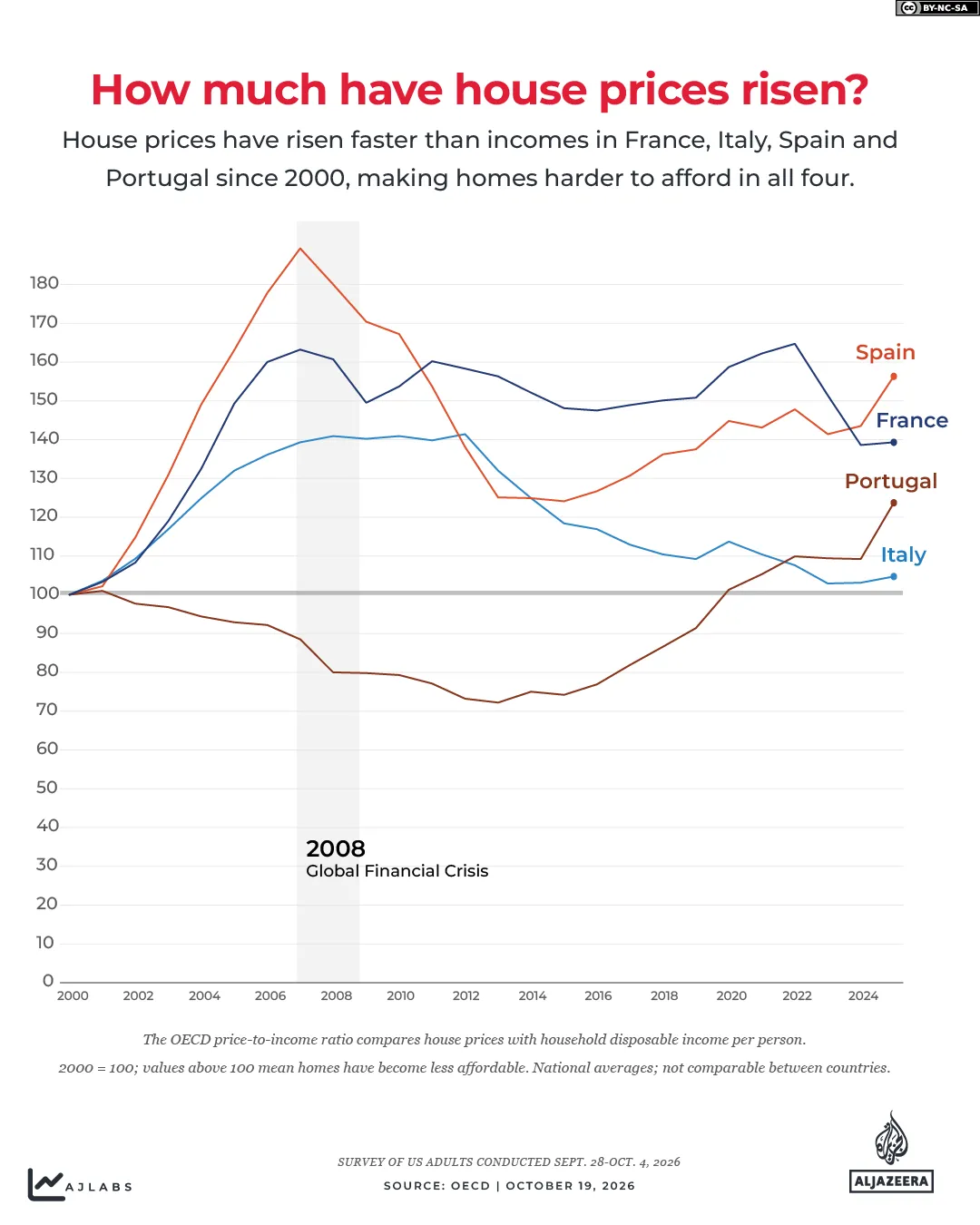
Housing has become harder to afford in all four countries since 2000, according to the OECD’s price-to-income ratio. It provides a broad picture of how house prices have changed relative to incomes over time. When prices rise faster than incomes, the ratio goes up, suggesting homes are becoming less affordable on average.

However, it doesn’t show which households or regions are hit hardest, does not account for mortgage and borrowing costs, and says nothing about the quality of the homes people are paying for.

Spain has seen the biggest change. Its price-to-income ratio is 56 per cent higher than in 2000, even after falling sharply following the 2008 financial crisis.

In France, the ratio is 39 per cent higher than in 2000, though it has eased slightly since peaking in 2022.

Italy is the exception where house prices have broadly kept pace with incomes, leaving the ratio just 5 per cent higher than in 2000.

Portugal has seen the sharpest change in recent years. Its price-to-income ratio fell steadily for 15 years after 2000, meaning homes became more affordable. But since 2015 the ratio has risen by 67 per cent.

The OECD publishes the price-to-income ratio with 2015 as its reference year. To compare it with the wage and price data in this article, which started in 2000, Al Jazeera has reset the figures so that 2000 = 100.

Interactive_Protests_France_Oct19_2026-02-1792423512

How has state expenditure on education changed?

Education has been at the heart of the unrest in France, where protests began because of overcrowded classrooms and teacher shortages. While in Belgium and Albania, demonstrators have rallied against the rising cost of education and access to universities.

According to the latest data from Eurostat, France’s public spending on education amounts to 5.1 per cent of its gross domestic product (GDP) compared to 5.6 per cent in 2000.

Italy spent 4.4 per cent of its GDP on education compared to 4 per cent in 2024, Spain spent 4.1 per cent in 2000 and the same in 2024. Portugal spent 4.8 per cent in 2000 and 4.3 per cent in 2024.

Source link

Cost of living protests hit Belgium, Italy, Portugal and France | European Union News

Hundreds of thousands of Europeans took to the streets for separate demonstrations putting pressure on governments across the EU.

Hundreds of thousands of Europeans have taken to the streets in separate, uncoordinated demonstrations to protest against the rising cost of living in their countries.

Saturday’s protests were in Belgium, France, Italy and Portugal in a wave of unrest that has put pressure on national governments across the European Union.

Recommended Stories

list of 3 itemsend of list

France experienced one of its most turbulent days of protests in decades, with over 550,000 people joining demonstrations and police facing off with protesters across the country – but it was not the only country to see significant demonstrations.

In Belgium’s capital Brussels – which has already seen weeks of protests by students against university registration fees – police fired tear gas and water cannon to disperse protesters, who they accused of launching missiles at them and setting fires.

In Liege, a smaller city east of Brussels, police also deployed water cannon to break up demonstrations. Police did not say how many people attended.

An estimated tens of thousands of protesters marched in Lisbon, the Portuguese capital, against the cost of living crisis, low wages and an inability to access housing in major cities. House prices in Portugal have more than doubled ⁠⁠since 2017, while rents for new leases have increased nearly as much.

Portuguese Parliamentary Affairs Minister Carlos ‌‌Abreu ‌‌Amorim said on Friday that the “government will not yield to shouts from the street”.Protesters said their leaders are “out of touch” with the problem.

In Milan and Bologna, Italian police reported that, alongside peaceful cost of living rallies, protesters threw stones and clashed with officers.

Italian media reported several injuries and arrests.

Demonstrators sit amid 40 tents set up to protest against housing shortage, soaring rents and low wages on Rossio square in central Lisbon on October 17, 2026. Thousands of people marched on October 17, 2026 through the centre of Lisbon at the call of the CGTP trade union to protest against increasingly difficult living conditions. The slogans and demands focus mainly on higher wages and pensions, as well as protests against the rising cost of housing and fuel. [Filipe Amorim/AFP]
Portuguese demonstrators in Lisbon set up tents to protest against the housing shortage, soaring rents and low wages [Filipe Amorim/AFP]

French protests spill over

None of the protests reached the same scale as the nationwide rallies in France but they may be a sign of spilling over into other European nations, according to Alberto Alemanno, Professor of EU Law & Policy at HEC Paris business school.

“France is the epicentre of this movement … and there are signs now that this is spreading beyond France,” Alemanno told Al Jazeera.

He said Saturday’s protests may not be the last in many of these countries and new hotspots could emerge.

In Greece, Germany, and Austria, the “early stages” of a movement is emerging, with mobilisation expected “in the coming week”, he said.

They are not a single movement, he explained, but several protests happening at the same time, with some “shared grievances”: underfunded education, rising costs and, for students, uncertain prospects after graduation.

The unrest comes at a crucial time for Europe, as the continent prepares for what Alemanno called an “unprecedented super-cycle of national elections” in the coming 12 months, with votes scheduled in Spain, France, Italy and Poland.

“Inevitably, all these protests, all these mobilisations, are going to be at the centre of the political conversation,” Alemanno said.

Riot police uses a water cannon against demonstrators in Brussels during a youth protest [Nicolas Maeterlinck/AFP]
Riot police fire water cannon during a youth protest in Brussels [Nicolas Maeterlinck/AFP]

Source link

Buildings and cars set on fire as cost of living protests rock France | Protests

Protesters have set fire to cars and buildings in France as demonstrations against the cost of living and declining public services escalate. There is serious unrest in Paris and multiple locations across the country.

Source link

Breaking Bad star RJ Mitte told those also living with cerebral palsy ‘never give up’ just months before death

BREAKING Bad star RJ Mitte told young people also living with cerebral palsy to “never give up” just months before his death aged 34.

The actor, best known for his role playing Walter White Jr. in the Emmy Award-winning show, died on Monday in Texas, reports said.

RJ Mitte was diagnosed with cerebral palsy at the age of three Credit: Alamy
He was best known for playing Walter White Jr. in Breaking Bad Credit: Alamy

His cause of death was not immediately disclosed, however, TMZ reported that he died by suicide.

The star’s reps told Deadline: “It is with profound sadness that we share the tragic passing of beloved actor, philanthropist, and passionate disability rights advocate RJ Mitte.

“Drawing from his own experience living with cerebral palsy, Mitte brought authenticity to the role and built a platform on disability awareness and inclusion.”

RJ became a leading voice for disability rights in film and TV following his rise to fame with Breaking Bad.

‘I’M HEARTBROKEN’

Aaron Paul pays tribute to RJ Mitte after Breaking Bad star dies aged 34


LAST SHOW

Final picture of RJ Mitte as star appeared at film premiere days before death

He was a leading voice for disability rights in film and TV Credit: Alamy
Bryan Cranston (L), Anna Gunn (C) and RJ Mitte (R) starring in Breaking Bad, 2008 Credit: Alamy

When he was born in Louisiana, he was not breathing and suffered permanent brain damage as a result.

He was diagnosed with cerebral palsy – a neurological condition that affects movement, muscle tone, and motor skills – when he was three years old.

Doctors put his legs in casts to try to strengthen his feet and later he was fitted with leg braces.

RJ spent most of his childhood using crutches, but improved his ability to walk over his teenage years through sports and exercise.

Most read in Entertainment

RJ Mitte attends a screening of ‘Talking To Strangers’ at Fine Arts Theatre on September 30, 2026 in Beverly Hills, California Credit: Getty
RJ Mitte speaks live at BUILD Series London on January 24, 2017 Credit: Getty

The actor previously opened up about his experiences undergoing physical, occupational and speech therapy, which he also started when he was three.

He told Future of Personal Health late last year about routines he used for managing his disability.

The star said: “Stretching has been one of the most important tools for me.

“I also rely on hot showers and baths to relax my muscles, especially to help manage spasticity.

He reportedly died by suicide, according to TMZ Credit: Alamy
RJ Mitte used crutches throughout most of his childhood Credit: Shutterstock Editorial

“With my travel schedule, I’m not always near a gym, so I’ve learned to build small, sustainable routines that keep my body in balance.

“Finding what works for you, and blending those therapies into your daily life, can truly change everything.”

Giving advice to young people with disabilities, he said: “My hope is to inspire a ‘never give up’ mentality.

“If there is something you want in life, pursue it no matter how hard it may be.

RJ Mitte played Walter White Jr. in Breaking Bad
The cast of Breaking Bad (L-R) RJ Mitte, Jonathan Banks, Bryan Cranston, Anna Gunn, Betsy Brandt, Dean Norris, Aaron Paul and Bob Odenkirk pictured in February 2024 Credit: Getty

“Keep your dreams alive. Don’t lose sight of who you want to become.”

RJ, who got engaged last year to Kennedy Suarez, also credited his mum with his success in a 2009 interview.

Opening up about his early diagnosis, he told Ability Magazine: “They told me I was going to need a wheelchair because I couldn’t bend my legs.

“My mom stretched my legs and really pushed me to get to where I am today. Really, I owe my mom.”

He also said playing football helped him overcome his physical problems.

“What most helped me to get out of my braces was playing soccer,” he explained.

“I always wanted to play football… but because of my disability, my hand-eye coordination was off. I couldn’t do that. So I gradually started playing more and more soccer.”

RJ was a Screen Actors Guild spokesman for actors with disabilities, and a celebrity ambassador for United Cerebral Palsy.

In 2013, he received the SAG-AFTRA Harold Russell Award.

The TV star also featured in shows including “Switched at Birth”, and Netflix’s animated series “The Guardians of Justice”.

He starred in several films including the drama “Triumph” from 2021, which he also executive produced.

How to get help

EVERY 90 minutes in the UK a life is lost to suicide.
It doesn’t discriminate, touching the lives of people in every corner of society – from the homeless and unemployed to builders and doctors, reality stars and footballers.
It’s the biggest killer of people under the age of 35, more deadly than cancer and car crashes.
And men are three times more likely to take their own life than women.
Yet it’s rarely spoken of, a taboo that threatens to continue its deadly rampage unless we all stop and take notice, now.
If you, or anyone you know, needs help dealing with mental health problems, the following organisations provide support:
CALM, www.thecalmzone.net, 0800 585 858
Heads Together,www.headstogether.org.uk
HUMEN www.wearehumen.org
Mind, www.mind.org.uk, 0300 123 3393
Papyrus, www.papyrus-uk.org, 0800 068 41 41

If you or someone you know is affected by any of the issues raised in this story, call or text the 988 Suicide & Crisis Lifeline at 988, chat on 988lifeline.org, or text Crisis Text Line at 741741.

Source link

Best town to retire in Spain as expats praise ‘affordable living and amazing food’

The beautiful spot is perfect for pensioners seeking a relaxed lifestyle

New analysis from World Atlas has named the best Spanish towns to relocate to. They are all stunning, overlooked locations, ideal for retirees seeking a peaceful and authentic way of life away from well-known resorts such as Benidorm or the Costa del Sol.

The research highlighted seven picturesque towns with fewer than 50,000 inhabitants across Spain that feature “walkable, historic centres with accessible recreation, including coastal paths, mountain trails, canoeing rivers, and reservoirs a short drive from the front door”. On Reddit, expats praised the “affordable living” and the “amazing regional food” of some of these picture-perfect locations.

Trujillo, in Extremadura, was named the best small town to retire in, with the lowest housing prices of around €717 (£605) per month. Locals praised the town’s authenticity on social media, with one saying that “life is more or less affordable, with no uncontrolled tourism problems, and food is amazing”.

Trujillo was followed by Arcos de la Frontera, in Cádiz, which has an estimated population of 31,046. Experts at World Atlas noted: “For retirees who want a classic Spanish white town with water sports on the doorstep rather than just mountain views, Arcos is a rare combination.”

Baiona, in Galicia, was also named one of the best places to relocate to. The charming town in northern Spain has a population of 12,380. World Atlas stated: “Baiona offers a version of coastal Galicia that pairs history with a genuine beach-town feel, at a price most Mediterranean resort towns can’t match.”

Other places included the picturesque town of Sitges, just half an hour down the coast from Barcelona, and Cangas de Onís, best known as the historic gateway to the Picos de Europa National Park.

Best small towns to retire in Spain

  1. Trujillo, Extremadura
  2. Arcos de la Frontera, Cádiz
  3. Baiona, Galicia
  4. Hondarribia, Basque Country
  5. Cangas de Onís, Asturias
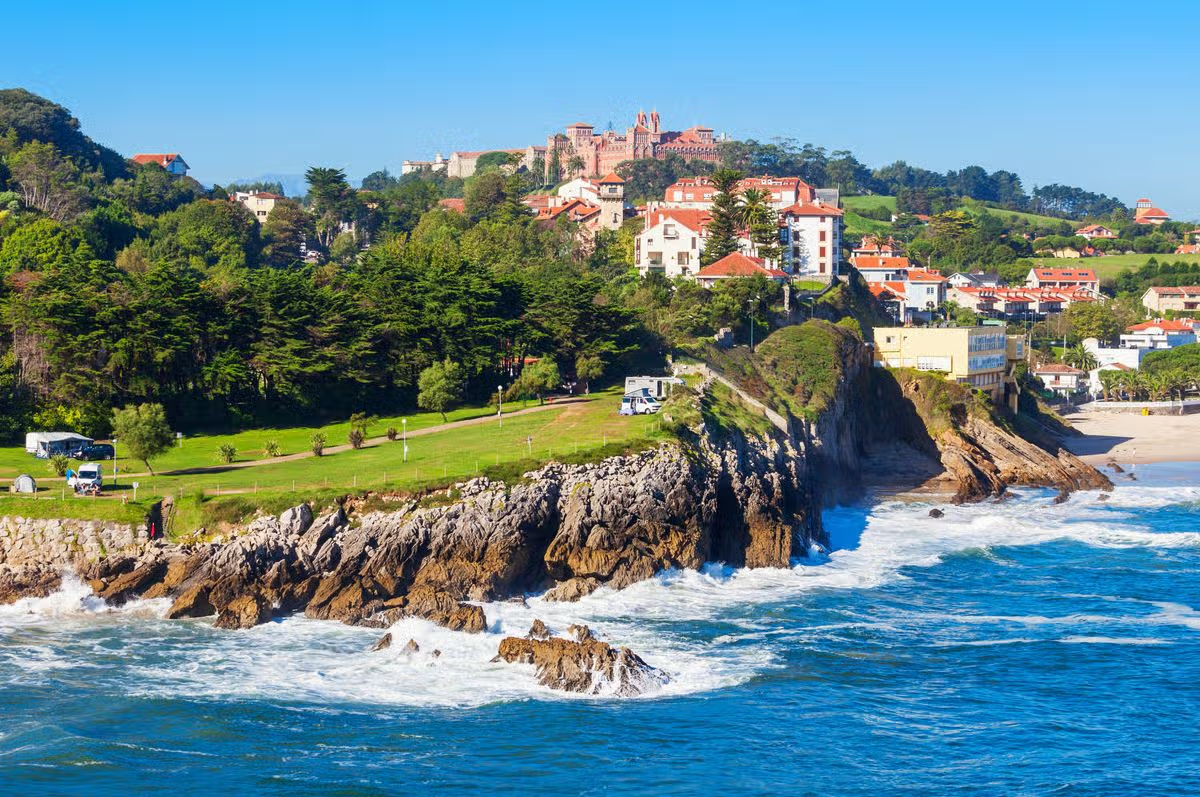
  6. Comillas, Cantabria
  7. Sitges, Catalonia

Source link

From Aden to Sanaa, Yemenis struggle to deal with soaring living costs | Conflict News

Sanaa, Aden and Marib, Yemen – As fighting intensifies across Yemen between the government and the Houthis, millions of people are confronting another battle far from the front lines: the deteriorating living and economic conditions in the country.

With salaries for large segments of the workforce either unpaid or irregularly disbursed – and the prices of goods and services rising – Yemen’s economic struggles have been compounded by a divided banking system that has made moving money between different parts of the country increasingly complicated.

Recommended Stories

list of 3 itemsend of list

From Aden’s struggling shoppers to displaced families in Marib and unpaid public-sector workers in Sanaa, Yemenis are being forced to make difficult choices about what they can afford, and what they must go without.

Aden: Food costs swallow salaries

In Aden, the internationally recognised Yemeni government’s interim capital in the south, the problem is not so much a shortage of goods in markets as people’s inability to afford them.

Salaries have failed to keep pace with the rising costs of food, rent, healthcare and transport, leaving workers with little money left over at the end of the month.

The consequences are evident in the smaller quantities and cheaper products that now make up shoppers’ baskets, and the decisions they are forced to make about what to cut back on.

Bushra Abdullah Abdulwarith is a government employee in Aden. She earns 78,000 Yemeni riyals ($50) a month at the black market exchange rate while typical household food costs in government-held areas run about 130,366 riyals ($83), according to estimates by the Yemen Economic Tracking Initiative. And that’s before she factors in the cost of rent, transport, healthcare and other household expenses.

The economic difficulties facing Yemenis like Bushra illustrate how more than a decade of war has devastated the economy. According to the World Bank, real GDP per capita has fallen by approximately 58 percent since 2015.

The fragmentation of Yemen’s monetary institutions between the government and the Houthis – who have operated their own institutions since seizing the capital, Sanaa, in 2014 – along with the disruption of oil exports, and declining international assistance have all contributed to the economic decline.

Bushra told Al Jazeera that rising prices have forced many households to give up almost all non-essential purchases and cut back on some expensive basics, particularly meat. Other families, she said, have resorted to buying food in smaller quantities, sometimes on credit or loans.


Reduced demand

The impact of rising prices is reflected not only in economic figures but also in the way people shop.

Ayman al-Maqtari, who works at a shopping centre in Aden’s Mansoura district, said that his customers now rarely buy non-essential items.

When it comes to the essentials such as rice, sugar, flour, and cooking oil, he has noticed that customers size up the price of each item before putting it in their baskets. They are also buying smaller quantities, for example, opting for a 5kg (11 pound) over a 40kg (90 pound) bag of rice.

“Many people have come to live day by day, or week by week,” Ayman told Al Jazeera, adding that more families are buying on credit when they run out of money before the end of the month.

The decline in purchasing power is also affecting commercial activity.

Across several streets and shopping centres in Aden, advertisements for discounts and special offers have become increasingly visible in shop windows and on retailers’ social media pages, as businesses attempt to attract customers and boost sales.

Weak demand, retailers say, is particularly evident for items that households can put off buying, such as clothing and household goods. A growing share of family income is spent on food, rent, healthcare and transport.

Limited pay increase

The Yemeni government approved a 20 percent cost-of-living allowance in May for public-sector employees in an attempt to ease the pressure of rising prices. But the amount is calculated based on each employee’s base salary, rather than their total pay, meaning the actual increase is relatively small for many workers.

Bushra, the government employee in Aden, said the increase has done little to improve her family’s financial circumstances. She described the allowance as “a temporary painkiller that does not reflect the scale of the actual pressure on people’s living standards”.

Her experience is far from isolated. In early October, the World Food Programme said its latest monitoring in accessible government-controlled areas showed that 74 percent of households were unable to meet their basic food needs.

One of the places where the crisis is evident is Marib, a government-controlled city east of Sanaa that is home to hundreds of thousands of displaced people. The sharp increase in the population over the war years, in what was previously a provincial backwater, has led to pressure on the city’s housing, employment and public services.

Government employees in Marib see their salaries disappear within the first few days after being paid, labourers struggle to find more than a few days of work and displaced families are forced to choose between buying water and milk.

Salah al-Zuhaifi works for a government institution in Marib. He said the war has separated him from his parents, who live in Houthi-controlled territory.

Alone in Marib, al-Zuhaifi said that inflation had eroded much of his salary’s purchasing power.

“No matter how much you earn, it will not be enough to meet your needs,” he said.

Abu Mohammed Nasser al-Asbahi, another government employee, described a similar struggle.

He told Al Jazeera that he earns 400,000 riyals ($250) a month, but more than half of that goes towards his rent, leaving little for his other expenses.

“We don’t even get to the first one-third of the month before the salary is gone,” he said, explaining that his family spends the rest of the month relying on loans and credit from local shops.

The healthcare sector in Marib has also been affected by widespread household spending cuts.

Pharmacist Khaled Mohsen told Al Jazeera that the rising price of medicines has prompted many patients to decline parts of their prescribed treatment and purchase only what they consider most essential.

People with chronic illnesses, meanwhile, have increasingly begun reducing their medication doses to make their supplies last longer before having to buy more, which creates serious health risks.


Houthi areas

Residents of Sanaa and other areas of Yemen’s populous northwest, controlled by the Houthis – an armed group also known as Ansar Allah (Arabic for Supporters of God) – since 2014, are also facing a worsening economic and cost-of-living crisis similar to that affecting Yemenis elsewhere in the country.

Several factors are driving the crisis, particularly unpaid public-sector salaries, declining purchasing power, rising prices for goods and services, and the continuing consequences of the division of Yemen’s currency and banking systems in the early years of the war.

Many public-sector employees in Houthi-controlled areas have gone years without receiving regular salaries, with some sectors only receiving limited payments or half-salaries at irregular intervals.

Even when payments are made, they cannot cover families’ basic needs amid the rising cost of living.

Meanwhile, private-sector workers and business owners face growing pressures as a result of declining economic activity, multiple fees and levies, and a shortage of employment opportunities. The conditions have undermined incomes and job security.

The Yemeni riyal’s exchange rate in Houthi-controlled Sanaa is more stable than in areas controlled by the government. The Houthis have imposed strict monetary controls, banning the circulation of newer banknotes printed by the Yemeni government, and have also enforced a largely fixed exchange rate.

However, that does not necessarily translate into stronger purchasing power. Markets face difficulties caused by cash shortages and the division between monetary and banking systems operating in different parts of the country, including increased costs for moving funds.

That directly affects the many households relying on domestic and international remittances.

For residents in Houthi-controlled areas, the result is an economy in which the currency may be relatively stable, but livelihoods are precarious. Years of unpaid salaries and limited employment opportunities have left many families struggling to afford basic necessities, with few options beyond borrowing, cutting spending or relying on support from relatives.

Source link