Drivers lined up for free gas in Chicago as fuel prices surge, driven by the US-Israeli war on Iran disrupting global oil supplies, with some blaming President Donald Trump.
Early in “The Drama,” things are still good between Emma (Zendaya) and Charlie (Robert Pattinson). The young happy couple, about a week away from getting married, have enjoyed a whirlwind romance. As this dark comedy’s opening credits roll, they’re blissfully practicing their first dance, laughing and stumbling as they try to get their twirls and steps right.
But the scene’s highlight is the song that plays in the background, airy, gentle and simple. Spare guitar chords give way to a female voice that sounds unpolished but beautiful: “I want to lay with you/ In an open field/ Where yellow flowers are suns of Earth.”
For many viewers, this will be the first time they’ve ever heard “I Want to Lay With You,” one of the most gorgeous love songs of the 1970s. It’s also likely they’ll have no idea who the singer is. Her name is Shira Small, and in 1974, she recorded an incredible album, “The Line of Time and the Plane of Now,” when she was 17. She never recorded another — at least, not yet. Now nearly 70, Small may finally be getting her moment in the spotlight.
“I’m cracking up,” says Small over Zoom from her Cooperstown, N.Y., home, “because I had no idea whatsoever that that movie was coming out until my dear sister informed me via you.” Flashing a relaxed smile and sporting long gray hair, Small knows little about the controversial “The Drama,” an A24 film with a heavily guarded twist.
Robert Pattinson and Zendaya in the movie “The Drama.”
(A24)
But it’s becoming a delightfully frequent occurrence that Small learns after the fact that her music is featured prominently in a movie or television show. “The record company does what they do and then they send me royalties and I get it in a statement,” she explains. “I had a song that HBO bought for ‘Pause With Sam Jay.’ They sent me an email that was not even to me — it was this interdepartmental thing. At the bottom, it said, ‘Oh, by the way, it airs tonight.’”
Jemma Burns, music supervisor for “The Drama,” had been a fan of Small’s album, thinking “I Want to Lay With You” would be perfect for this idyllic scene, right before Emma and Charlie’s relationship implodes over a disturbing revelation that turns their dream wedding into a nightmare.
“He was trying to set up the rom-com tone,” says Burns of the movie’s writer-director Kristoffer Borgli, “one that would contrast with the modernity of the setting and where the film goes. He wanted something that was from a bygone era, but also something that felt disarmingly charming. The two lead characters are very switched-on, fashionable, arty. So it felt like something they would’ve had in their record collection.”
The youngest of five siblings, Small always loved singing. But even as an adolescent growing up in Harlem, she felt like an old soul, her thoughts running deeper than the average kid’s.
“My focus was on not understanding war and hatred and bigotry,” she says. “I was seriously into trying to make love happen everywhere.”
Against the backdrop of the war in Vietnam and the Black Power movement, Small was well on her way to becoming a hippie, a transformation amplified by her enrollment in a private Quaker boarding academy, George School, in Newtown, Penn., on a full scholarship. When she arrived at George School, Small recalls, laughing, it was “very rich and very white. But I’ve always been a flotation device. I can walk around like I don’t have a clue about things.”
Shira Small, photographed in 1971 at George School in Newtown, Penn.
(Courtesy of Shira Small)
At George School, Small sported an Afro and smoked weed. She was drawn to theater and music, impressing music teacher and classical pianist Lars Clutterham, who saw she had talent. They worked on songs together, with Small coming up with the lyrics and vocal melodies. Every student had to complete a senior project, so Small proposed that hers be an album. Not long after, she and Clutterham drove to a Philadelphia studio for a one-day session.
The 10 songs on “The Line of Time and the Plane of Now” — each recorded in only one take — mix folk, soul and jazz, radiating innocence. The arrangements, awash in old-school analog warmth, are straightforward: guitar or piano supplemented with drums, leaving plenty of space for Small’s lilting voice, which contains both idealism and, even as a teen, traces of real-life sorrow.
Her mother died while she was at George School, inspiring “My Life’s All Right,” a ballad about surviving tough times, which later appeared on the Sam Jay show. “Eternal Life” sprang out of her in one burst, celebrating the power of love to transcend life’s harsh realities. As for the movie’s “I Want to Lay With You,” it was about a boy Small liked. She just can’t remember who anymore.
“It was somebody who was just as much a friend as a person that I had a crush on,” she recalls. “I honestly felt that we could have a life together.”
Small laughs at her adolescent self. “Like I knew what it would be like to have a freaking life together! To be able to wake up with somebody and have a beautiful day and always make them smile.”
According to Small, George School’s parents and students raised money to pay for the album and 300 copies were produced. “It was a joyous time,” she recalls. “I was on my way — to somewhere!” After graduation, though, she struggled to find her footing, eventually graduating summa cum laude from the City University of New York with a theater degree. But then she chose pre-med, becoming a physician assistant.
“When I became pre-med, it was so hard for me that I was just tunnel-visioned,” explains Small about why she said goodbye to music. “I had to devote my whole self to it. It was so all-encompassing that I could think of nothing else.”
But there was another reason she walked away from music. From an early age, Small suffered debilitating stage fright. “It was so bad that it would twist my stomach into a knot,” she recalls. She gutted it out to do plays at George School and, later, record her album. After a while, though, “It just got to be too much.”
Still, didn’t she miss singing? “Constantly,” replies Small, who retired about five years ago from the medical profession. “I sang unconsciously a lot. My patients always picked up on it — they’d be like, ‘Every time you come in, you’re singing.’”
But although Small abandoned music, “The Line of Time and the Plane of Now” never went away. In 2006, the Numero Group, an archival record label, put together a compilation, “Wayfaring Strangers: Ladies From the Canyon,” devoted to under-the-radar female singers from the 1970s. Numero Group co-founder Ken Shipley made sure “Eternal Life” was included.
“I was the first person to ever reach out to Shira,” he says proudly in a separate phone interview. Shipley heard “Eternal Life” on a burned CD of femme-folk artists that was making the industry rounds at the turn of the millennium while he was putting together his “Wayfaring Strangers” lineup. “Shira was a top want for me.”
The Numero Group put “Eternal Life” on Spotify in 2013. But when the label released the full album digitally in 2022, “I don’t know that anybody really cared,” Shipley says. Undeterred, he reissued it on vinyl the following year. Maybe listeners just needed time.
“Music finds a way,” Shipley says. “Music’s like water. It’s going to get down the creek into the river into the ocean. It’s going to find its audience.”
Sure enough, strange serendipitous moments started happening for Small. A future bandmate’s ex had one of her songs on a playlist, having no idea it was Small. She recently started working part-time at a local opera house and one of the opera singers adored “Eternal Life,” unaware that Small was an employee.
And now, royalty checks arrive for the usage of her songs in films like “The Drama.” It still feels unreal to Small that her album generates revenue. “It was never for commercial purposes,” she says. “I can’t believe that I am collecting any royalties on that music and that it just keeps going and going.”
Small’s husband died in 2019 after 34 years of marriage. It sent her spiraling, but then something remarkable happened. “The day I came out of it, the music was gushing out of me so fast that I couldn’t keep up with it,” she says. “I had to walk around with a voice memo. I hadn’t spoken to Lars in more than a decade. I sent him all of these voice memos and he sent me a note: ‘Shira, you still got it.’”
In 2024, she released her first song in 50 years, “Why,” which lays out her fears for the world. Her voice is different, deeper, possessing a lifetime of experience that her teenage self couldn’t have possibly imagined. Small is now plotting out an album and has some shows lined up. Even better, she’s worked through her stage fright.
Eventually, she’ll perform her old songs, but she’s figuring out how to hit that higher register from her youth. “I’ve gone through decades of hormones and cigarettes and all the other things that I did that I’m happy I lived through,” she says, wryly.
“I still have a thing about yellow flowers in open fields,” she admits. “We have these huge sunflower fields here. The whole idea of being in such a beautiful place with yellow flowers that light up a great day is what popped into my head when I wrote that lyric.”
I ask her what she makes of that young woman she hears on “The Line of Time and the Plane of Now” today.
“I know her so well,” replies Small. “You know why? Because she’s still here. I am, at this point, everybody I’ve ever been ever, leading up to this moment.
“I still feel the same way about many things,” she continues. “I’m probably angrier now than I was when I was a child, but I still have this underlying thing about looking at a bigger picture to help me keep my lid on. When I think back on ‘Eternal Life’ and ‘My Life’s All Right,’ that music was born from my core. And my core does not have an age.”
More than £7million will be spent on signal upgrades to help reduce failures and improve the reliability of journeys.
Network Rail described WCML as “Britain’s economic backbone”, connecting major cities with “thousands of trains and tonnes of goods every day”.
It said that parts of the line could not manage the service’s more recent demands and needed investment to prevent disruptions.
The network owner said it would provide replacement buses between Milton Keynes Central and Bedford or Potters Bar for passengers to get trains to reach central London.
The WCML operator, Avanti, has warned commuters that its train lines are expected to be busy and has lifted peak restrictions for today.
Normal services on WCML are expected to resume on April 9.
All impacted guests have been offered a full refund or a future cruise credit, and will be supported by the firm’s teams, who will provide rebooking options and assistance.
Milo Boyd Deputy Travel Editor & Commercial Writer and David Hughes and Christopher McKeon Press Association
16:01, 30 Mar 2026
Celestyal Cruises’ Discovery vessel is currently docked in Dubai (stock)(Image: Supplied)
A major cruise line has cancelled all its April sailings as the impact of the Iran war on travel worsens.
Celestyal has confirmed the cancellation of all April 2026 departures as its ships wait to reposition to Athens, Greece.
The line’s fleet is currently positioned in the Arabian Gulf, with Celestyal Discovery in Dubai, UAE, and Celestyal Journey in Doha, Qatar. All guests and non-operational crew have been disembarked, while both vessels remain fully operational. The cruise line announced that staff and crew’s departure from the region will take place in accordance with safety guidance from the relevant authorities.
“Due to the ongoing situation in the Middle East, all sailings scheduled for April 2026 have been cancelled,” a statement from Celestyal read.
• Celestyal Journey – May 2, 2026 (7-night Heavenly Greece, Italy and Croatia)
Lee Haslett, chief commercial officer at Celestyal, said: “Our priority remains the safety and confidence of our guests, crew and partners. While we know this will be disappointing, taking this decision now provides greater clarity and flexibility for those affected. Our teams are working closely with guests and travel partners to support rebooking options and ensure a smooth transition, and we remain focused on returning to service in the Mediterranean as soon as it is safe to do so.”
All impacted guests have been offered a full refund or a future cruise credit, and will be supported by Celestyal’s teams, who will provide rebooking options and assistance.
The news comes as senior figures from the energy, shipping and banking sectors prepare to meet Sir Keir Starmer as Donald Trump hinted the conflict with Iran could intensify.
Oil prices surged after the US president revealed he was weighing up a military operation to take control of Iran’s Kharg Island, a critical component of the country’s export infrastructure.
The Downing Street talks are expected to centre on Iran’s continued blockade of the Strait of Hormuz, which has severely disrupted a key shipping route for the oil and gas industry, as well as supplies of other goods such as fertiliser.
The gathering will include representatives from energy giants Shell and BP, shipping behemoth Maersk, maritime insurance specialist Lloyd’s of London, and banking heavyweights HSBC and Goldman Sachs.
Major General Richard Cantrill, the UK’s maritime operations commander, will also brief those in attendance on the latest developments in the region.
This follows the Royal Navy’s announcement that it is equipping the transport vessel RFA Lyme Bay with minehunting drones — a move widely understood to be aimed at giving ministers options for securing the strait once conditions allow.
Downing Street confirmed the purpose of the meeting was to hear directly from businesses and explore how the Government and private sector can join forces in tackling the ongoing conflict.
The No 10 summit is expected to be followed by a Cobra meeting on Tuesday, where senior ministers will assess the continuing economic damage caused by the war, Sir Keir has suggested. The summit follows Mr Trump’s comments that he could “take the oil in Iran” or potentially seize control of Kharg Island, the country’s main oil export hub.
SCREEN star Sydney Sweeney is rolling in dollar frills — after her new lingerie line helped to quadruple her fortune.
The American actress is now worth $40million, up from $10million just two years ago.
Sign up for the Showbiz newsletter
Thank you!
Sydney Sweeney’s fortune has soared to $40million after her lingerie line helped quadruple her wealthCredit: Instagram/SyrnSydney models underwear from her Syrn brandSydney’s Seductress line launches next week after her original designs sold out in the US
The news came as Sydney, 28, showed off a range of sexy pink and white underwear from her Syrn brand.
The Seductress line launches next week after her original designs sold out in the US.
Sydney launched the business on the back of becoming one of Hollywood’s most in-demand stars.
She was worth some $10million in 2024 thanks to roles in black comedyThe White Lotus, teen drama Euphoria and the rom-com movie Anyone But You.
Lucrative deals with Armani Beauty, Ford and Samsung followed — while controversial adverts for clothing brand American Eagle saw sales shoot up, along with Sydney’s profile and potential earnings.
Last year she raked in $7.5millon for her role in hit psychological thriller The Housemaid.
Sydney launched Syrn in January in a bid to take on fellow celebs Rihanna and Kim Kardashian — who have become billionaires through their clothing brands Savage x Fenty and Skims.
The star’s racy photo shoots have seen her criticised for not being a “girl’s girl”. But hitting back, Sydney said: “People will say, ‘Oh, she’s doing this for guys’.
“I’m like, ‘What’s more ‘girl’s girl’ than owning your body and doing it for yourself?’.”
The star in her controversial advert for clothing brand American EagleCredit: American EagleLast year, Sydney raked in $7.5millon for her role in hit psychological thriller The Housemaid
Morgan missed the first four rounds of the URC after suffering a calf problem on his return from the Lions’ tour to Australia.
The flanker came off the bench in the draw against Dragons at Rodney Parade in October and then went off to Wales duty.
“The guys that have been playing while Jac has been injured have done a terrific job, but it’s always brilliant when you bring a Lion back into your environment and selection,” said Jones.
“It’s good for the competition for places and competitiveness around training. He has added a great energy to the environment, on and off the field.”
This weekend’s fixture against Benetton would be Morgan’s first game since it was confirmed that he will leave Ospreys for Gloucester along with Dewi Lake in the summer.
Jones believes the forward from Brynaman will be determined to finish with a flourish.
“He has put a lot into the Ospreys over the time he has been here, physically and emotionally,” said the head coach.
“We want the whole thing to end on a really positive note. I can’t see anything other than a fully-focused, excited Jac Morgan wanting to go out on a high, and as a team we definitely want to do that.”
Islamabad hits Kandahar facility after Taliban drones strike civilian areas and military sites as conflict intensifies.
Published On 14 Mar 202614 Mar 2026
Share
Pakistan has carried out strikes on an Afghan military facility in Kandahar after Taliban drones targeted civilian areas and military installations across the country.
The strikes on Saturday came after Pakistani President Asif Ali Zardari condemned the overnight drone attacks, warning Kabul it had “crossed a red line by attempting to target our civilians”.
Recommended Stories
list of 3 itemsend of list
Pakistan’s military said the drones, described as locally produced and rudimentary, were intercepted before reaching their targets, though falling debris wounded two children in Quetta and civilians in Kohat and Rawalpindi.
A security source told the AFP news agency that airspace around the capital, Islamabad, had been temporarily closed when the drones were detected.
Islamabad said the Kandahar facility had been used both to launch the drone attacks and as a base for cross-border rebel activity.
The exchange marks the sharpest single escalation yet in a conflict that has been building since late February, when Pakistan launched military operations against what it said were Pakistan Taliban fighters sheltering on Afghan soil.
Islamabad also accuses Kabul of harbouring fighters from the ISIL (ISIS) group’s Khorasan province affiliate.
The Taliban government has denied both charges.
The drone attacks followed Pakistani strikes on Kabul and eastern border provinces in Afghanistan overnight on Thursday into Friday. The Pakistani attacks killed four people in the capital, women and children among them, and two more in the east.
In the Pul-e-Charkhi neighbourhood of Kabul, one resident described being buried under rubble after his home was hit, saying he lay there believing it was his “last breath” before neighbours pulled him free.
A local representative told AFP that those killed were “ordinary people, poor people” with no involvement in the conflict.
Pakistani aircraft also struck a fuel depot belonging to the private airline Kam Air near Kandahar airport, which an airport official said supplied aid organisations, including the United Nations and the International Committee of the Red Cross.
The official added that there were “no military installations” at the site.
Afghanistan’s Ministry of Defence claimed that its forces had captured a Pakistani border post and killed 14 soldiers.
Islamabad dismissed the assertion as baseless, with the prime minister’s spokesman accusing the Taliban of “weaving fantasies” rather than dismantling rebel networks on Afghan territory.
The UN mission in Afghanistan says at least 75 civilians have been killed and 193 injured since hostilities intensified on February 26, a toll that includes 24 children.
According to the UN refugee agency, about 115,000 people have been forced from their homes.
The crisis is unfolding as the wider region remains engulfed by the US-Israeli war with Iran, which began just two days after the Pakistan-Afghanistan clashes escalated.
Chinese Minister of Foreign Affairs Wang Yi has urged both sides to pursue dialogue, warning that further force would only deepen the crisis, though his appeal came as Pakistani jets were already in the air over Kandahar.
WASHINGTON — Republican and Democratic senators vented their frustrations with the lack of progress in funding the Department of Homeland Security, which is resulting in more Americans enduring long lines at airports around the country. It’s a problem that is expected to intensify as the impasse enters its fourth week.
Democrats stressed they were willing to fund some of Homeland Security, but not Immigration and Customs Enforcement as well as Customs and Border Protection, without changes in their operations. Republicans made clear that some of the Democratic demands were a non-starter. The result was that each party blocked the other’s proposal for temporarily resolving the standoff during an hours-long debate Wednesday on the Senate floor.
The stark divide over a shutdown that began on Feb. 14 was acknowledged by members on both sides of the political aisle.
“We are in a negotiation. However, we are not close,” Sen. Brian Schatz (D-Hawaii) said at one point. “You may think this is some issue that we think we’re going to turn to our political advantage, but I promise you, when we saw Renee Good and Alex Pretti killed, this became an issue that was beyond politics.”
“And there are a lot of us who are not going to provide resources to this agency that is acting in such a ways that makes citizens of the United States so unsafe.”
Some Republicans were just as adamant that they oppose some of the changes Democrats are seeking to make.
“Let me be clear, we are going to do nothing — nothing — that kneecaps ICE’s ability to enforce our immigration laws,” said Sen. Eric Schmitt (R-Mo.).
Following the longest federal shutdown in the country’s history last year, Congress completed work on 11 of this year’s 12 appropriations bills. Only the bill for Homeland Security remains outstanding.
Democrats are seeking several changes at the department that include prohibiting ICE enforcement operations at sensitive locations like schools and churches, allowing independent investigations into alleged wrongdoing, requiring warrants to be signed by judges before federal agents can forcibly enter private homes or other nonpublic spaces without consent, and requiring agents to wear identification and remove their masks.
A push for more talks
Senate Majority Leader John Thune (R-S.D.) said his side has made repeated overtures to Democrats on a funding bill. He said the last offer on Homeland Security funding came from the White House nearly two weeks ago and there has been no response from the Democrats.
“Usually, around here, in order to get a deal, there has to be a negotiation where the two sides sit down together,” Thune said. “And my understanding is that has been completely rebuffed by the senator from Washington.”
The senator Thune was referring to, Sen. Patty Murray, the lead Democrat on the Senate Appropriations Committee, said she’s continued to talk with Republican colleagues, but those aren’t “real negotiations.” The White House needs to be at the table for that to occur. She said she needed assurance that Stephen Miller, the influential White House deputy chief of staff, would not upend any agreements that senators reach.
“I am willing to talk to people, but I’m not willing to sit in a room, have coffee, give away a few things and have Stephen Miller override whatever we all agree to,” Murray said. “ … We need to know the White House is serious.”
Homeland Security has been central to President Trump’s sweeping changes in immigration enforcement. Under Trump, the number of people ICE arrests and detains each month has climbed dramatically. The tactics that ICE has employed have generated alarm among Democrats, and some Republicans have also called for a more “strategic” approach.
During bipartisan negotiations earlier this year, appropriators agreed to a Homeland Security funding bill that did include more resources for de-escalation training and $20 million to outfit immigration enforcement agents with body-worn cameras. But that deal unraveled after the Pretti shooting in Minneapolis.
“My side was not going to stand down and say, ‘oh well, nothing happened,’” Murray said.
For the second time in two weeks, Murray offered a proposal to fund all of Homeland Security except for ICE and Customs and Border Protection, but Republicans objected.
Similarly, Sen. Katie Britt (R-Ala.) offered a proposal to fund all of Homeland Security for two weeks so that federal workers could get paid and government operations could continue while the two sides negotiate their differences on immigration enforcement. This time, Democrats objected.
The result was the standoff continues, but lawmakers were at least talking to each other, perhaps one small sign of progress.
Shutdown strains air travel
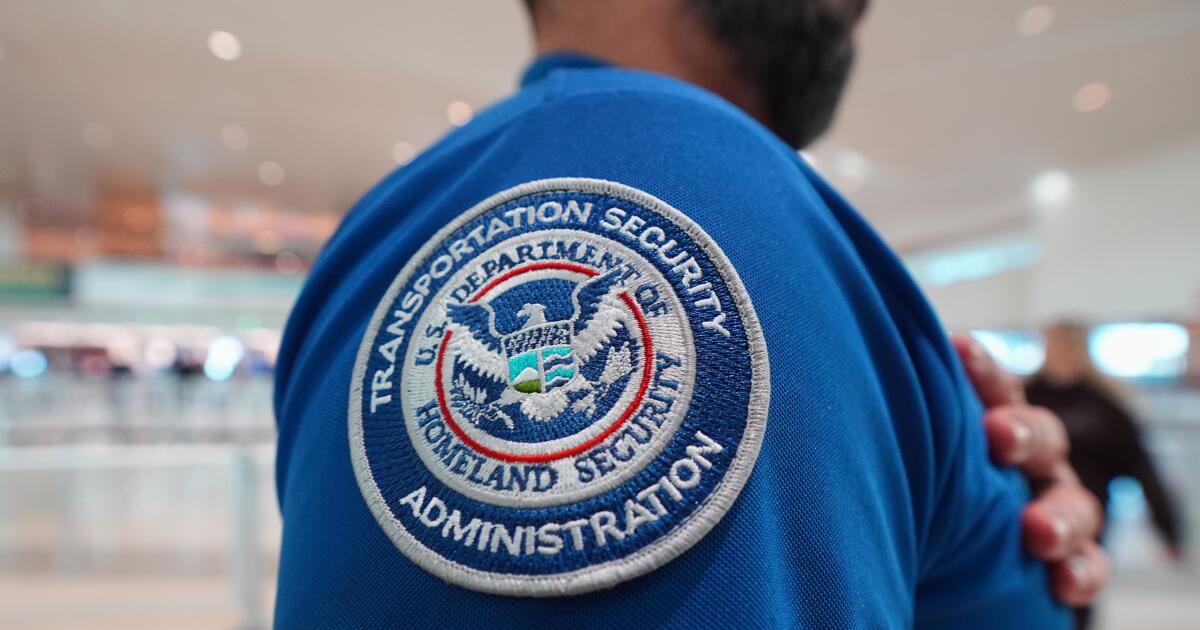
The large majority of the more than 260,000 employees at Homeland Security continue to work but are going unpaid. It’s the second time in recent months they’ve had to work without pay after last fall’s record, 43-day shutdown. The most visible sign of the shutdown has been a shortage of Transportation Security Administration screeners at airports.
Houston’s secondary airport weathered the worst problems, with lines consistently lasting over three hours for much of Sunday and Monday. Passengers also had to wait more than an hour to get through security at several other airports, including in New Orleans and Atlanta.
Homeland Security in a social media post Wednesday blamed Democrats for a shutdown that “has led to HOURS long security lines at airports across the country, leading Americans to miss their spring break flights.”
Trade groups are also worried about the economic impact of the travel delays. The U.S. Chamber of Commerce called on Congress to quickly approve a funding bill and end the department’s shutdown.
“Blocking operational funding and paychecks for those who help us travel safely is wrong and strains the air travel system,” said Neil Bradley, the business group’s executive vice president and chief policy officer.