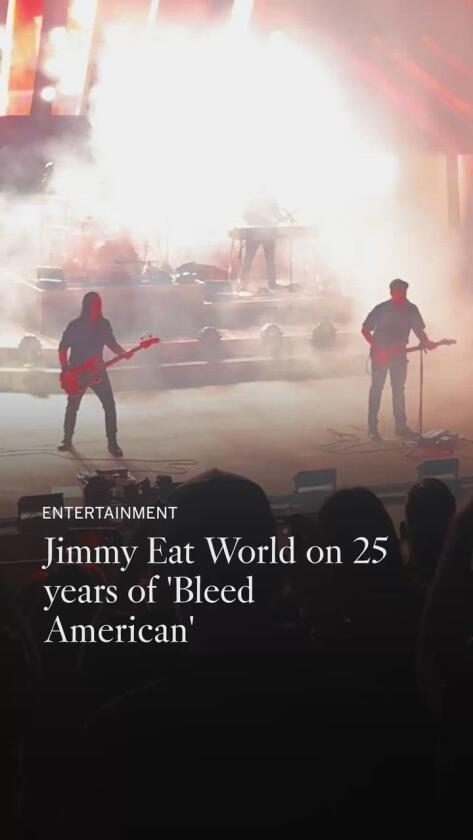
Jimmy Eat World on 25 years of ‘Bleed American’
On stage at Red Rocks Amphitheatre in Colorado, a far cry from the sweaty basement punk shows of the band’s early days, Jimmy Eat World played breakthrough power pop hit “The Middle” as the sold-out crowd sang along with the final chorus that “everything will be all right, all right.”
“It really is incredible to us to think about everyone who bothered to spend time with this record and made something of it for themselves over 25 years. This is your guys’ record as much as it’s ours, really,” singer-guitarist Jim Adkins said from the stage.
The band, which has generally shied away from nostalgia plays over its 30-plus year career, is performing the platinum-selling “Bleed American” album in its entirety on tour this summer, including a stop at Warped Tour in Long Beach on Saturday, a matching bookend to the band’s original promotion of the album.

-
Share via
“It solidified us as, ‘This is what we do. Let the day job go.’ It turned into full-time rock and roll. And that moment only happens once, so it felt appropriate to honor it at 25,” bassist Rick Burch said backstage before the band’s Brooklyn tour stop in June.
Released on July 24, 2001, “Bleed American” was one of the last great rock records of the monoculture, arriving months before Apple’s iPod launched and made shuffle the default and 15 years before streaming became the dominant way to consume music.

“When ‘Bleed American’ took off it was right at the transition of the internet,” says Jim Adkins.
(Evelyn Freja / For The Times)
A hit with Hollywood roots
Just over a quarter of a century ago, four guys from Mesa, Ariz., came to L.A. to record their fourth album.
Jimmy Eat World’s Adkins, Burch, drummer Zach Lind and guitarist Tom Linton earned recording money between tours by working construction, driving around car dealership customers and selling art supplies and auto parts.
The band had cut ties with Capitol Records after 1999’s “Clarity” — a sweeping, lush and highly influential work highly regarded by their contemporaries that would inspire third-wave emo superstars including My Chemical Romance, Fall Out Boy and Paramore — that the major label had no idea how to market, even after “Lucky Denver Mint” got pickup on L.A.’s alt rock tastemaker KROQ-FM.
“If that song would have been on ‘Bleed American,’ that would have been a No. 1 song,” said Jim Suptic, of Kansas-based second-wave emo band the Get Up Kids, who have been on the “Bleed American” anniversary run. Suptic said that he was inspired to start the band after seeing Jimmy Eat World live in the mid-’90s.
With the band’s tight budget, producer Mark Trombino, who produced “Clarity” and predecessor “Static Prevails,” worked with the band for free in L.A., banking on the future success of the album. After recording drums at Cherokee Studios, the band relocated to Harddrive Analog & Digital Recording in North Hollywood to make the bulk of “Bleed American.”
“The studio was so small, it didn’t have a lounge,” Lind recalled.
But there was a bus stop outside they used instead, where they would hang out with “an assortment of characters,” Adkins said.
He and Lind commuted to the Valley from Redondo Beach, where they crashed on the floor of Lind’s brother’s place. Linton fondly remembers the great food in the city and hanging out with friends in other bands while Burch spent downtime skateboarding in L.A.
Even without the cash or support from a label, recording “Bleed American” didn’t feel like a do-or-die moment for the band’s future.
“We just kind of figured we might have to go out and just release this ourselves. Let’s just do the best job we can, and be happy with what we put out,” Linton said.
But with the buzz growing around the new music, record labels came calling.
‘The Middle’ meets the moment
By the time the album dropped in July 2001, the guitar-heavy snarling title track of “Bleed American” had already been in regular rotation on alt-rock stations for a month.
After a stint on the Warped Tour, Jimmy Eat World set out on a U.S. headlining tour in the fall, with Hey Mercedes opening.
“I remember that tour in particular, them sort of really finding their confidence in their voice and their shows and their performance and the whole package. And this was before ‘The Middle’ really broke, but I could tell that they were really firing on all cylinders,” said Hey Mercedes singer-guitarist Bob Nanna, whose influential emo group Braid first played with Jimmy Eat World in 1998.
The album landed on the Billboard charts three weeks after its release, and while its peak position was 31, it remained on the chart for 70 weeks. (A couple of months after the Sept. 11, 2001, attacks, the name of the album was changed to “Jimmy Eat World” on pressings before reverting to the original title in 2008.)
“When ‘Bleed American’ took off it was right at the transition of the internet,” Adkins said.

By 2002, “Bleed American” was taking off due to the popularity of the song “The Middle.”
(Scott Gries / Getty Images)
The media landscape hadn’t yet transformed. Rock music magazines like Spin, NME, Alternative Press and Kerrang! were thriving. The band made the rounds on the late-night talk shows as “The Middle” video clip played on MTV’s popular show “Total Request Live.”
“Things hadn’t splintered out into a zillion niche locations just quite yet,” Adkins said.
By March 2002, “The Middle” had hit the Billboard charts, where it climbed to No. 5 by the summer and spent 33 weeks on the Hot 100.
“They were a real band that had a radio hit, and not a radio band reverse engineered,” the Get Up Kids’ Suptic said.
The success was surreal for the band members as they heard the song on the radio, in restaurants and the gym. Today, you can still summon an entire generation with the opening guitar melody.
“I understand why that song has resonated,” Lind said. “I think there’s a few themes in the album that resonate with people in times when things are going tough. You know, ‘The Middle’ is definitely one of those songs that so many people have found encouragement from, whether they’re dealing with a breakup or going through cancer.”
“It seems like one of those songs that people have used to feel better and I think that’s obviously really powerful.”

“It solidified us as, ‘This is what we do. Let the day job go.’ It turned into full-time rock and roll,” says bassist Rick Burch about the success of “Bleed American.”
(Evelyn Freja / For The Times)
Here we are now
But the fans selling out the tour dates around the U.S. know much more than the hits, singing along to the deep cuts after traveling hundreds of miles to get to the show, in some cases.
Fans traveled from states like Michigan and Texas for the tour kickoff at Red Rocks in Colorado.
Robie O’Donnell took the train up to New York from the Washington, D.C., area to take his 12-year-old daughter to her first Jimmy Eat World show. The Brooklyn show was his 25th after he discovered them in the late ‘90s from a recommendation on the Get Up Kids’ website.
Behind him in line hours before doors opened was Jane Kung, who was only 8 when “Bleed American” was released and got into it when she was in high school. She didn’t want to miss the chance to hear it live.
“The fact that so many people wanted to come see this is something I didn’t expect,” Adkins said about the tour.
The fans get a chance to geek out over the rarely-played deep cuts from the album, like “Your House,” which required a revamp because of the studio work on the song, and the live debut of “(Splash) Turn Twist,” which was on the Japanese import of the album. Even louder than the sing-along to “The Middle” is the call and response from the crowd on the album’s second-biggest hit, “Sweetness.”
“Having this piece that we’ve created be embraced by so many is a very accomplished feeling,” Burch said.
Nanna even ventured into the crowd after Hey Mercedes opened the Brooklyn show, singing along to “A Praise Chorus,” the band’s crunchy guitar-filled love letter to rock music, among others.
“The world is a tough, s— place now and to have these moments where everybody can sing along to something that’s just pure joy was really soul enriching,” he said.