Ty Simpson listens to himself in the evening before he falls asleep. And also when he gets up in the morning and heads to work at the Rams’ practice facility.
The rookie quarterback hears his own voice on audio recordings as he recites the team’s play calls.
“I want to make sure it’s the last thing I think about when I go to bed,” he said recently, “and the first thing that I wake up to.”
The Rams ended their offseason program last week. But Simpson, a Tennessee native, said he would remain in Southern California and continue to study in preparation for training camp at Loyola Marymount in late July.
Simpson began the practice of recording himself at Alabama, where he was the starter in the last of his four seasons with the Crimson Tide.
Now he is the heir apparent to Rams quarterback Matthew Stafford, the reigning NFL most valuable player.
The Rams surprised many when they used the 13th pick in the draft to select Simpson, who started only 15 games. But Simpson is doing everything he can to fit into a position group that includes Stafford, 38, fourth-year signal-caller Stetson Bennett and undrafted free agent Matthew Caldwell.
“Feel like I’m a freshman again — drinking from a fire hydrant,” he said, adding that he knows and is comfortable with high expectations. “The quarterback runs the show here, just how I like it.”
Stafford, entering his 18th season, has said that Simpson has not been shy about asking questions.
“I hope I’m not annoying him,” Simpson said, “but I really appreciate the big brother kind of role he’s playing in my development.”
Stafford is “the MVP for a reason,” Simpson said. “Everything he does, he’s so just aware of everything, aware of how everything works. … I really appreciate him and Stetson taking me in and answering all the questions I have.”
Bennett got limited reps during the offseason program. But his opportunities are expected to increase during training camp as the Rams manage Stafford’s workload.
When asked about Bennett, coach Sean McVay and offensive coordinator Nate Scheelhaase seemingly have gone out of their way to speak generally about rookies.
“They’re way behind in terms of just the overall teaching progression but they’re learning,” McVay said. “Ty, like the rest of the rookies, are doing a really nice job.”
Scheelhaase, who went through several head coach interviews during the offseason, is in his first season as the Rams’ coordinator.
“I’ve been encouraged with all of our rookies, including Ty,” Scheelhaase said. “First things first, you want to see, do they come in? Are they coachable? Are they willing to work? And you’ve seen that from Ty from Day 1.”
Simpson said that, so far, the jump from college to the NFL has not been daunting. Quarterback coach Dave Ragone and teammates have helped ease the transition.
“The biggest thing is just how detail-oriented everybody is,” Simpson said, adding, “It’s really, really cool because, coming from Alabama in the SEC, that’s how pro-ready I felt.”
With Stafford under contract through the 2027 season, Simpson might not play for a few years. But if Stafford were to suffer an injury, his time could come sooner.
Simpson is expected to play extensively during preseason games later this summer.
To make sure he’s prepared, Simpson recites and listens to his play calls.
“So when I get in the game and hear a play call, I can just imagine it and see it,” he said. “That’s a big thing, just knowing the terminology and being detail-oriented just like Matthew and Stetson.”
There is just over one week remaining before the June 2 primary for Los Angeles mayor, city attorney, city controller and eight of the 15 City Council seats.
As of Friday morning, 333,000 mail-in ballots had been cast in the race, up from 321,000 at the same time in 2022, according to the L.A. County Registrar/Recorder.
The Trump card
Spencer Pratt’s foes in the Los Angeles mayor’s race like to say that the former reality television star lacks the experience needed to run a big city.
But Pratt might have an even bigger liability — any sense that he may be aligned with President Trump.
Cygnal, a national polling group that has worked for Republican candidates, found that tying Pratt to Trump and the MAGA movement is a bigger turnoff to Democrats than his reality television past.
According to its poll of 500 likely Los Angeles voters, Pratt’s reality TV resume made 59% of overall Democrats less likely to vote for him. By comparison, tying Pratt to MAGA and Trump made 65% of Democrats less likely to vote for him, Cygnal said.
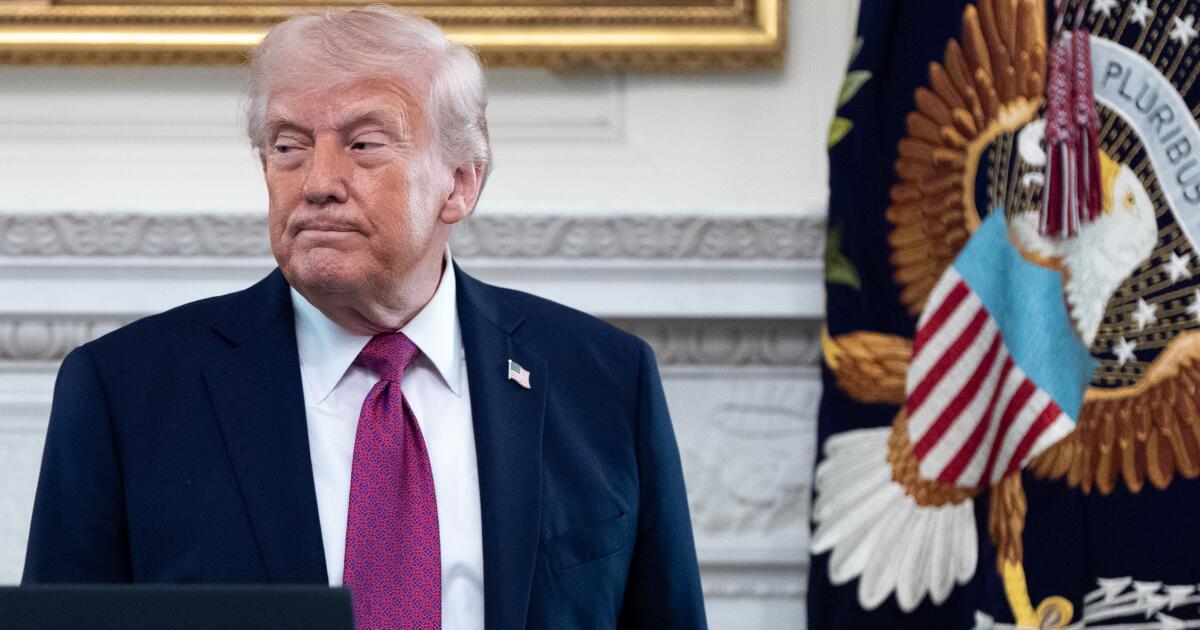
Pratt is a registered Republican and on Wednesday, Trump signaled support for Pratt in the mayoral race. On Thursday, former Trump advisor Steve Bannon said the president didn’t formally endorse Pratt out of fears it would hurt Pratt’s chances in Democrat-dominant Los Angeles.
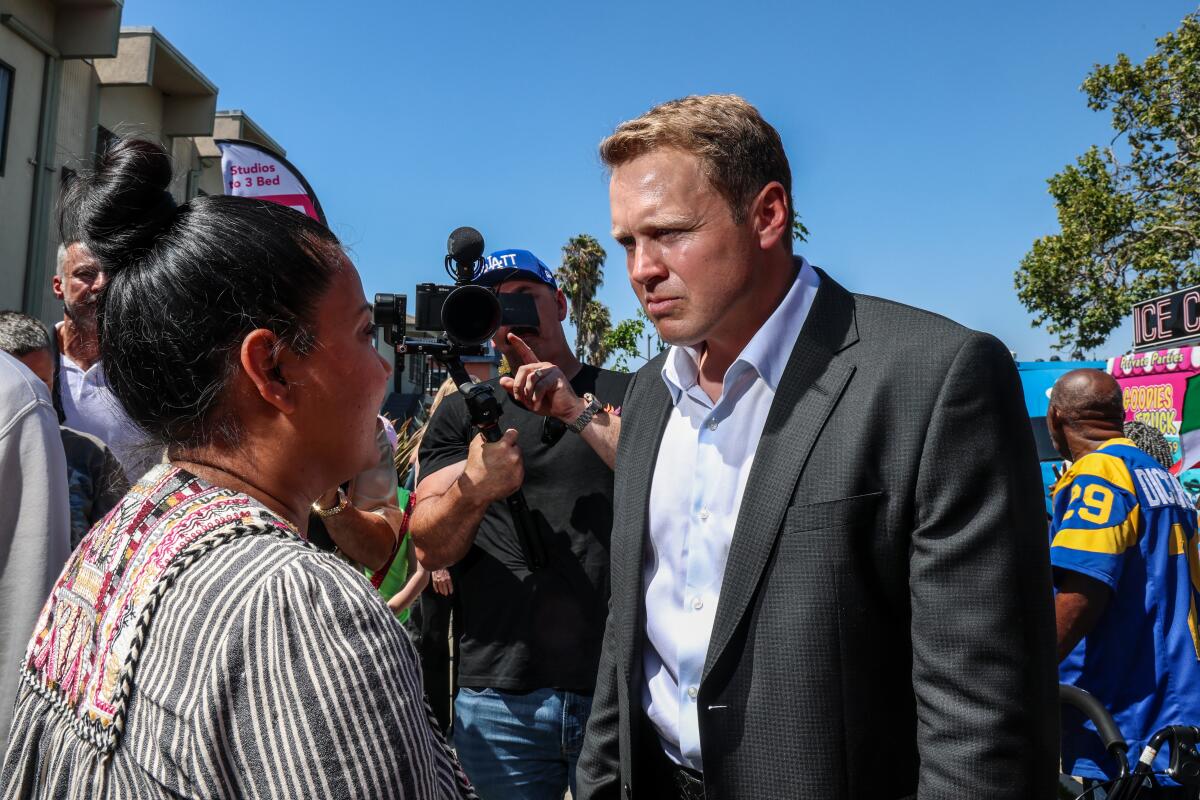
Spencer Pratt at a recent campaign block party in South Los Angeles.
(Robert Gauthier / Los Angeles Times)
Overall, including Democrats and Republicans, 24% of voters said tying Pratt to Trump made them more likely to vote for him while 50% of voters were less likely to vote for him because of it.
“Karen Bass is a fairly reserved individual, but you have to believe that backstage she was doing a happy dance after she heard Donald Trump’s comments,” said Dan Schnur, a professor of politics at USC, UC Berkeley and Pepperdine University.
The strongest pro-Pratt argument is a public safety argument that Pratt will reject “defund the police” policies and hold repeat offenders accountable.
The poll showed Bass at 25% support, Pratt at 22% and Councilmember Nithya Raman at 18%.
You’re reading the L.A. on the Record newsletter
Sign up to make sense of the often unexplained world of L.A. politics.
By continuing, you agree to our Terms of Service, which include arbitration and a class action waiver. You agree that we and our third-party vendors may collect and use your information, including through cookies, pixels and similar technologies, for the purposes set forth in our Privacy Policy such as personalizing your experience and ads.
Big money for Blumenfield seat
It hasn’t had the same sizzle as the mayor’s race, or been as pricey as the acrimonious campaign for city controller. But the battle to replace City Councilmember Bob Blumenfield in the west San Fernando Valley is turning into yet another high-stakes, big-money contest.
In that three-way race, a handful of special interests have now put more than $1 million into various efforts to elect businessman Tim Gaspar.
The Central City Assn., a downtown-based business group, has spent the most so far, pouring more than $400,000 into mail pieces, web videos and other campaign expenses, according to Ethics Commission filings. Most of its money has been coming from Airbnb, which is looking to loosen the city’s rules on homesharing platforms, by allowing second homes to be used as short-term rentals in the run-up to the 2028 Olympic Games.
Political aide Barri Worth Girvan, who is running to replace Blumenfield, criticized Gaspar over the influx of money, saying the “West Valley is not for sale.”
“Airbnb has destroyed countless neighborhoods around Los Angeles, and they clearly believe that my opponent will allow them to do that in the San Fernando Valley,” said Worth Girvan, who works for county Supervisor Lindsey Horvath. “Let me be clear — I will not allow that in our neighborhoods.”
Gaspar, in a statement, said he’s proud of the coalition supporting him.
“Like so many Angelenos, they are ready for change and new ideas that will actually get something done. Barri is offering nothing but the same tired excuses, empty promises, and failed ideas,” he said.
Under the city’s campaign finance rules, donors cannot give more than $1,000 to the campaign of a council candidate. However, independent expenditure groups can spend unlimited amounts, as long as they do not coordinate with the campaigns of their favored candidate.
Some of the other Gaspar backers who are spending large sums include the California Alliance of Family Owned Businesses, which represents McDonald’s franchisees, the California Apartment Assn. and Working Californians, a committee sponsored by International Brotherhood of Electrical Workers Local Union 18, which represents employees of the Department of Water and Power.
That committee is also partly funded by Airbnb, according to the Ethics Commission website.
Ethical supes
The Los Angeles County Board of Supervisors voted this week to establish its first ethics commission.
The creation of the new body aimed at preventing and eliminating corruption in county government was mandated by Measure G, which voters approved about 18 months ago.
That measure overhauled the county charter to create an elected county executive position and increase the number of supervisors from five to nine.
It also stipulated the establishment of an ethics commission and an office of ethics compliance, helmed by an ethics compliance officer.
Polling shows the effort has broad public support, according to Sara Sadhwani, a political science professor at Pomona College who served on a task force that made recommendations to the supervisors.
But there was still controversy before the Board of Supervisors voted 5-0 Tuesday to support to approve the plan.
Supervisor Janice Hahn said the ethics commission was intended to be an independent body whose members were not directly selected and appointed by elected officials.
She proposed an amendment that would have made it so commissioners were chosen from a list of qualified and interested people via a lottery system.
Hahn lost that battle and the county approved the plan without the change. The county assessor, the chair of the Board of Supervisors and starting in 2028, the newly minted county executive, will each appoint one ethics commissioner.
Those three commissioners will then select the other four members of the commission, who are subject to the approval of the supervisors.
State of play
— “THE HILLS” ARE ALIVE: The Times dived deep on Spencer Pratt’s history as well as his campaign, showing how he rose from reality television villain on “The Hills” to become a leading contender for L.A. mayor.
— TRUMP BUMP?: President Trump signaled support for Los Angeles mayoral candidate Spencer Pratt on Wednesday, wading into the local election less than two weeks before the primary.
— FRESH PRINCE: Spencer Pratt’s campaign for Los Angeles mayor has paid the Hotel Bel-Air more than $15,000 since April 7, according to Pratt’s latest campaign finance filings.
— PROGRESSIVE BLOCK: Three members of the L.A. City Council’s progressive bloc endorsed Mayor Bass for reelection, snubbing fellow progressive Nithya Raman in the June 2 primary. The endorsements from Eunisses Hernandez, Ysabel Jurado and Hugo Soto-Martínez underscore fractures on L.A.’s left. All three are members of the Democratic Socialists of America, as is Raman.
— HOLLYWOOD HOPEFULS: In campaign ads, interviews and the recent televised debate, the top three contenders: incumbent Mayor Bass, former reality TV villain Spencer Pratt and Raman, have made the ongoing production slump a pivotal topic, highlighting their plans to revitalize the industry while deploying the issue to undercut one another.
— WHITHER LATINOS?: Latinos make up nearly 37% of the L.A. electorate, making their votes crucial for anyone with mayoral ambitions. That has campaigns putting out ads and social media posts in Spanish, hitting the ground in Latino majority neighborhoods and rallying for key endorsements.
— HUNGRY FOR MORE: It’s the biggest slate of democratic socialists Los Angeles has ever seen. The L.A. chapter of Democratic Socialists of America is looking to push City Hall further left by backing candidates for city attorney and four City Council seats in the June 2 primary.
— OH, AND A BUDGET: The Los Angeles City Council signed off on a $15-billion budget for 2026-27 on Thursday, preserving Mayor Karen Bass’ police hiring plan while socking away more money for potential emergencies.
— AIRPORT DELAYS?: A $30 minimum wage for hotel and airport workers will be delayed after Los Angeles elected officials persuaded a group of business leaders to drop a ballot measure that would have devastated the city budget.
QUICK HITS
Where is Inside Safe? The mayor’s signature program moved 69 people indoors near Chinatown this week in Jurado and Hernandez’s council districts.
On the docket next week: The City Council will vote to approve a formal letter to remove the gross tax repeal from the November ballot.
Stay in touch
That’s it for this week! Send your questions, comments and gossip to LAontheRecord@latimes.com. Did a friend forward you this email? Sign up here to get it in your inbox every Saturday morning.
WASHINGTON — President Trump has turned to naval blockades to pressure the governments of Venezuela, Cuba and now Iran to meet his demands, but his preferred tactic is confronting a very different reality in the Middle East than in the Caribbean.
Unlike Cuba or Venezuela, Iran choked off a crucial trade route for energy shipments, meaning the longer the standoff persists, the more the global economy will suffer. Tehran also poses a greater military threat than those two adversaries in America’s own hemisphere and requires a sustained military presence far from U.S. shores.
Iran’s leverage over the Strait of Hormuz gives it power during a shaky ceasefire because the widening economic risks, especially higher U.S. gas prices in an election year, could force the Republican president to end the blockade on Iran’s ports and coastline, experts say.
“It’s really a question now of which country, the U.S. or Iran, has a greater pain tolerance,” said Max Boot, a military historian and senior fellow for national security studies at the Council on Foreign Relations.
Iran presents ‘major differences’ from other blockades
The effectiveness of Trump’s use of the world’s most powerful navy to block the trade of Iran’s sanctioned oil and other goods is very much up for debate. But it certainly appears to be intensifying as the war grinds on.
The U.S. military on Thursday announced the seizure of another tanker associated with the smuggling of Iranian oil, a day after Iran’s paramilitary Revolutionary Guards took control of two vessels in the crucial waterway.
Trump also announced he has ordered the U.S. military to “shoot and kill” Iranian small boats laying sea mines in the strait.
But the situation in Iran is not exactly analogous to what is playing out with the U.S. operations in Venezuela and Cuba.
Some experts say Trump’s success in Venezuela probably had more to do with the U.S. military raid that captured leader Nicolás Maduro than American warships seizing sanctioned oil tankers to enforce U.S. control over the South American country.
A U.S. oil embargo on Cuba, meanwhile, has caused the island’s most severe economic crisis in decades. While U.S. and Cuban officials have met recently on the island for rare talks, the financial strangulation has failed to produce the Trump administration’s stated goal of leadership change.
“I do think that the success of the Maduro mission in Venezuela has probably emboldened the president,” said Todd Huntley, director of Georgetown University’s National Security Law Program.
That does not make the situations in Venezuela and Iran similar — geographically, militarily or politically. “There are some major differences,” said Huntley, a retired Navy captain and judge advocate general.
While the blockade against Iran has delivered a severe blow to its economy, including stopping freighters from importing various supplies, the country has still been able to move some of its sanctioned oil, ship-tracking companies say.
Iran has rejected Trump’s demands to reopen the strait, where 20% of the world’s oil normally flows, and it has been firing on ships again this week. Stalled shipments through the strait have sent gasoline prices skyrocketing far beyond the region and raised the cost of food and a wide array of other products, creating a political problem for Trump before the November’s elections.
“Blockades are usually just one tool of a mechanism used in a conflict,” said Salvatore Mercogliano, a maritime history professor at Campbell University in North Carolina. “They can be important. But it’s only one element. And I don’t think it’s going to be enough to convince the Iranians.”
Effectiveness of U.S. blockade called into question
Adm. Brad Cooper, head of U.S. Central Command, claimed last week that “no ship has evaded U.S. forces.” The command overseeing the Middle East said it has directed 31 ships to turn around or return to port as of Wednesday.
Merchant shipping groups are skeptical.
Lloyd’s List Intelligence said “a steady flow of shadow fleet traffic” has passed in and out of the Persian Gulf, including 11 tankers with Iranian cargo that have left the Gulf of Oman outside the strait since April 13.
The maritime intelligence firm Windward said this week that Iranian traffic continues to flow “via deception.”
Iranian ships have several ways to sneak through the blockade, including spoofing their location tracking data or traveling through Pakistani territorial waters, Mercogliano said. He also noted that the sheer volume of shipping traffic the military needs to screen is a challenging task.
Blockades require patience to work
The last time the U.S. mounted a blockade similar to the one focused on Iranian ships was during the Kennedy administration in the early 1960s, against Cuba, Huntley said.
“And it wasn’t even called a blockade,” he said. “We called it quarantine.”
Some naval blockades over the course of history have had an impact, such as Britain’s blockade on Germany during World War I. “But they tend to be very long-term impacts, whereas Trump is looking for short-term, quick results,” according to Boot, the military historian.
He said Trump probably saw the blockade on sanctioned oil tankers tied to Venezuela as playing a large role in the success of leadership changes in that country. But Boot said it had more to do with the U.S. ousting Maduro and the subsequent cooperation from his vice president, Delcy Rodríguez, who is now the acting president.
“There is no Delcy Rodríguez in Cuba or Iran,” Boot said. “I think his success in Venezuela led him astray, thinking that this was a template that could be replicated elsewhere. He sees it as a huge success at little cost. And, in fact, it turns out to be a unique set of circumstances.”
Finley, Klepper and Toropin write for the Associated Press.