likely voter

Californians split on proposed tax on billionaires, sour on voter ID requirement, poll shows

California voters are sharply divided over a ballot measure to impose a one-time tax on billionaires to help fund healthcare programs, a proposal already triggering a fierce and expensive political fight as the November election approaches, according to a poll released Friday.

More than half of likely voters oppose a separate measure that would require Californians to provide identification when voting and election officials to verify registered voters are U.S. citizens, the survey showed.

The two controversial proposals are among the 14 ballot measures Californians will decide in the Nov. 3 election. Proposition 40, which would impose the tax on billionaires’ assets, has reached the precipice of nationwide debates over economic inequality and liberal overreach. The Republican-led voter ID measure, Proposition 39, emerged amid President Trump’s baseless claims of widespread voter fraud.

Among likely California voters, 48% support Proposition 40, compared with 41% who oppose the proposed wealth tax and 11% who are undecided, according to a new poll by UC Berkeley’s Institute of Governmental Studies that is co-sponsored by The Times.

Proposition 40’s failure to crack 50% support among voters at this point in the electoral cycle is a potential red flag, said IGS poll director Mark DiCamillo. Traditionally, Californians who are undecided on ballot measures tend to vote against them, he said.

“It’s got an early lead, but it’s not a very large lead, and it’s not a majority,” he said. “Usually, for ballot propositions, you want the yes side to be above 50%, and that’s not where it is right now.”

The proposal was crafted by a healthcare workers’ union to compensate for an estimated $100 billion in federal healthcare cuts approved by Trump and congressional Republicans that it argues will cause devastating harm to millions of California’s most vulnerable residents. Proposition 40 would impose a one-time 5% tax on the assets of billionaires who resided in California as of Jan. 1, with some exceptions.

Democrats and their allies are splintered over the proposal. Some, including Gov. Gavin Newsom, argue it will prompt the wealthy to flee California, further harming its volatile budget, which is dependent on the state’s richest residents. The California Democratic Party and leading progressives support the measure, with Sen. Bernie Sanders (I-Vt.) calling it a modest tax necessary to help Californians struggling because of cuts imposed by Republicans to pay for tax breaks for the wealthy.

While Democratic voters mostly support the ballot measure and Republicans largely oppose it, younger Californians are far more likely to say they plan to vote for it compared to seniors. Minorities, women and lower-income voters are also more supportive of the measure than white voters, men and Californians who earn at least $200,000 annually. Union households support the measure, while non-union families are evenly divided about it.

Turnout will be pivotal, DiCamillo said. While younger Californians are historically less likely to vote, especially in midterm elections, if they are energized by the issues championed by socialist Democrats, including New York City Mayor Zohran Mamdani, that could boost the wealth tax proposal’s prospects.

The survey found that voters are far less aware of two competing ballot measures aimed at nullifying the proposed wealth tax.

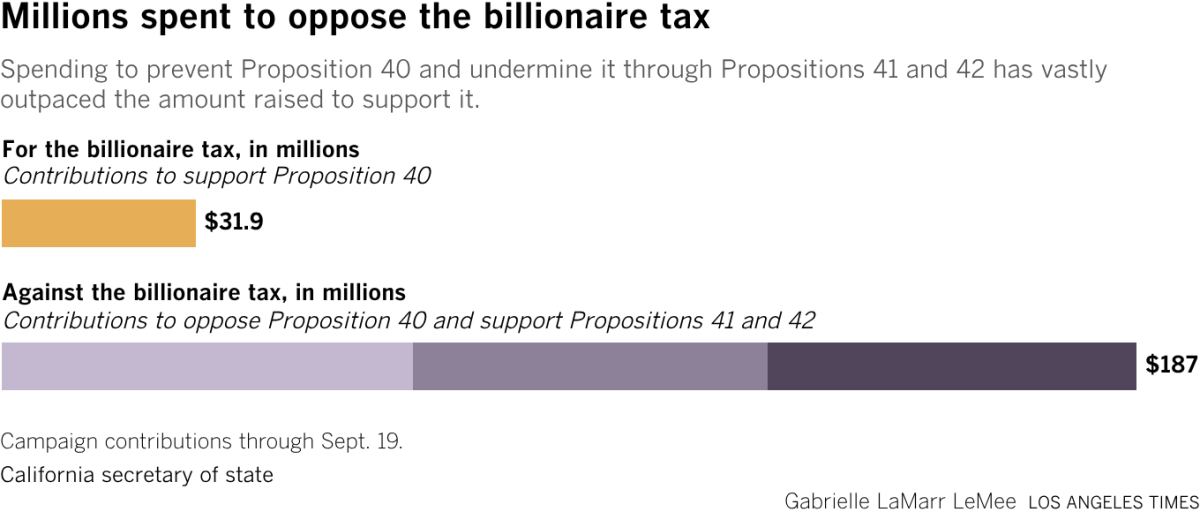
Proposition 41 would prohibit new taxes from being exempt from voter-approved state spending limits and require audits of new levies. Proposition 42 would ban new taxes on personal property and some retroactive state taxes. If the wealth tax is approved and either of the countermeasures receives more votes, the proposed billionaires’ tax would not go into effect.

The poll found that 35% of likely voters supported Proposition 41, with 37% opposing it. On Proposition 42, 40% of voters backed the measure, and 37% opposed it.

Roughly one out of every four of the voters surveyed on those two measures said they were undecided. DiCamillo said he expects that to change as the anti-wealth tax campaigns, which are expected to be well-organized and well-funded, ramp up their messaging to voters.

“There’s going to be a lot of campaigning, apparently on the no side especially. So we’ll see,” he said. “But you know, I think it’s confusing to voters in some ways.”

Among the other controversial measures on the Nov. 3 ballot is Proposition 39, a measure pushed by Republicans that would require all voters in future elections to show government-issued identification every time they vote in person or provide a special PIN or the last four digits of their Social Security number when submitting mail-in ballots.

The measure would also require the California secretary of state and county election officials to verify that registered voters are U.S. citizens by “using government data,” which according to supporters could include information in the federal Social Security Administration database, jury summons information and other government records.

Just over half of California’s likely voters oppose the ballot measure, while 42% support it. Californians are predictably divided along partisan lines. Eight out of 10 Democrats oppose the proposal, while more than nine out of 10 Republicans support it. Voters not affiliated with either major political party oppose it 54%, while 36% support it.

Proponents of voter ID contend that such laws prevent election fraud and, along with proof-of-citizenship mandates, prevent noncitizens from voting. Opponents say ID mandates threaten the fundamental constitutional rights of Americans who do not have the mandated documentation readily available, and that the restrictions are unnecessary given that voting by noncitizens is rare and already outlawed in the U.S.

The Republican-led push for the voter ID initiative comes at a time of growing distrust in the integrity of the electoral process nationwide, a wariness intensified by President Trump’s baseless claims that the 2020 election was stolen from him and false assertions that droves of undocumented immigrants are swaying elections with illegal votes.

“It’s a very traditional Democrat versus Republican split,” DiCamillo said, adding that it would be surprising to see major shifts in the numbers. “Once these things get solidified in terms of the partisan splits, without any other kinds of splits like we’re seeing in Prop. 40, you know that’s usually the dominant theme.”

The Berkeley IGS/Times poll findings are based on an online survey in English and Spanish of 4,207 California registered voters, 2,310 of whom are considered likely voters, from Aug. 3-9. The results are estimated to have a margin of error of about 2.5 percentage points in either direction in the likely voter sample, and larger numbers for subgroups.

Source link

Becerra holds strong lead over Hilton in race for California governor

As the campaign for California governor heads into the general election, Democrat Xavier Becerra maintains a strong lead over Republican Steve Hilton, according to a new poll from the UC Berkeley Institute of Governmental Studies, co-sponsored by the Los Angeles Times.

Buoyed by the state’s liberal voting base, Becerra had support from 55% of likely voters surveyed — compared with Hilton’s 37%. The remaining 7% were undecided.

Like in a previous IGS poll conducted in late May, support for each candidate falls overwhelmingly along partisan lines: 88% of Democrats prefer Becerra and 91% of Republicans plan to back Hilton. No-party-preference voters also lean heavily toward Becerra, a former Biden administration Cabinet member, 58% to Hilton’s 30%.

The two will face off in the Nov. 3 general election to replace Gov. Gavin Newsom, who is barred from running again and considering a 2028 bid for president. Becerra, whose resume includes stints as U.S. Health and Human Services secretary and state attorney general, is heavily favored to win the seat over Hilton, a former Fox News host who advised a prime minister in his native Britain.

“After the unsettled and chaotic primary, this is shaping up to be a fairly standard California general election, where Democrats enjoy a comfortable edge statewide,” said Eric Schickler, a political science professor and IGS co-director. “Hilton would need to make major inroads among traditionally Democratic-leaning groups to make this a highly competitive race.”

According to the poll, majorities of voters across age, gender and racial categories prefer Becerra — with particularly strong support among women, younger voters and Black Californians.

Becerra emerged from the primary ahead of more progressive opponents, including billionaire environmentalist Tom Steyer, and quickly earned the backing of their onetime supporters, said IGS Poll Director Mark DiCamillo.

“These are people who say, ‘I identify as a progressive.’ ‘I identify as a democratic socialist.’ They’re overwhelmingly for Becerra, and it’s mainly because they really don’t think very much of the Republicans as a party. It’s not so much about Hilton himself,” DiCamillo said.

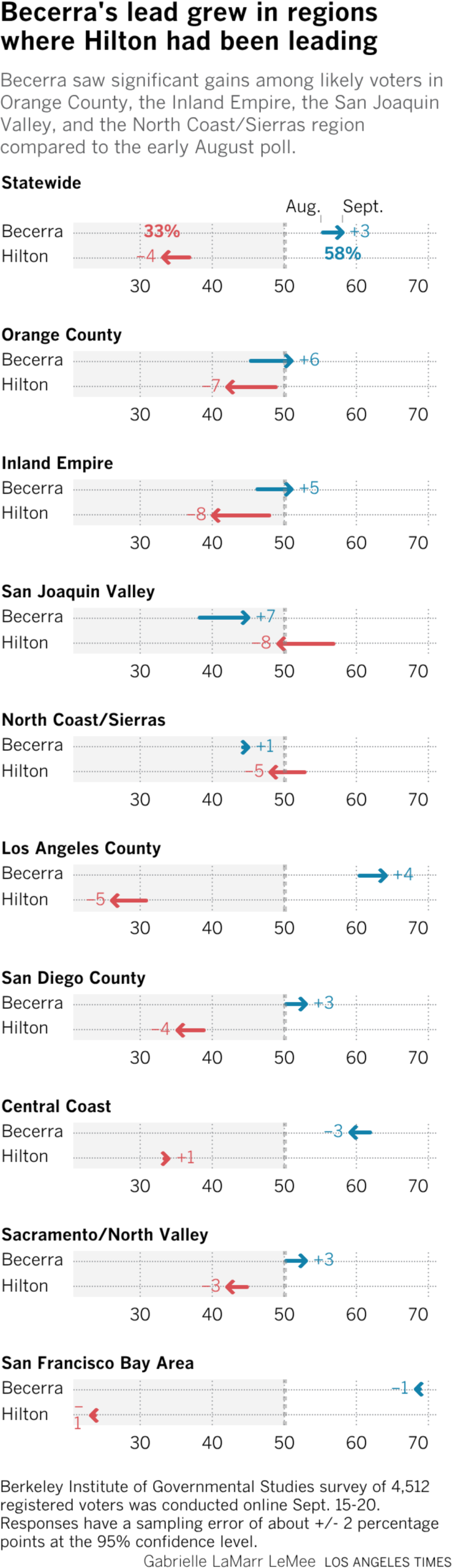
Regionally, the poll found voters in Los Angeles and San Diego counties, along with the Bay Area and Central Coast, prefer Becerra. Hilton leads in the state’s more sparsely populated and conservative-leaning areas, including the Central Valley and North Coast/Sierra region.

Politically purple Orange County and the economically stressed Inland Empire are more closely divided but lean toward Hilton.

When asked why they support each candidate, voters largely cited conventional partisan issues.

More than half of Hilton backers, 55%, pointed to his support for traditionally Republican policies such as cutting taxes and reducing government regulation. It was followed by 28% who said they prefer Hilton because he is not part of California’s political establishment.

Hilton’s platform includes making Californians’ first $150,000 in annual earnings tax-free, slashing government regulations and ramping up oil production in hopes of achieving $3-per-gallon gas prices.

“Those are the benefits, but the underlying mission that I’ve set [for] myself as the next governor is to transform our business climate to make California competitive again, so that we do get the investment and the job creation and start to turn things around. I think it’s an absolute crisis that we’re in if we don’t change direction,” Hilton said Tuesday during a political conference in Sacramento.

Becerra supporters were evenly divided over their top reasons for supporting him; 38% cited his support for Democratic policies such as expanding healthcare and protecting LGBTQ+ rights, while another 38% expect him to aggressively fight the Trump administration.

The poll suggests that, in California, President Trump factors more heavily into Democratic voters’ political decisions than Republicans’.

“One of the reasons Becerra is doing so well is because of his opposition to Trump,” DiCamillo said. “For Hilton supporters, not so much. His endorsement by the president is only cited by 4% as a reason why they’re supporting Hilton.”

The former Health secretary has an extensive plan to lower healthcare costs and frequently touts the more than 120 lawsuits he filed as California attorney general against the first Trump administration. At the Tuesday political event hosted by Politico, Becerra said, “California will become the backstop for healthcare” after Trump signed a tax bill with steep cuts to Medicaid.

To prevent an estimated 2 million people from losing their health insurance because of the cuts and rising premiums, Becerra pitched a deal directly to insurance companies: “I will ensure people stay covered. You ensure that you help me reduce the cost. I ensure that you get paid.”

Thirteen percent said they’re supporting Becerra because he is a Democrat and 7% said the same about Hilton’s Republican affiliation.

Just 4% of Latino respondents and 1% of the total sample of likely voters said they would vote for Becerra because he is a Latino candidate and a child of immigrants.

Each candidate saw a small bump in support since the May poll, which asked registered voters just before the primary election to pick between them in a then-hypothetical matchup. In that survey, 52% chose Becerra and 31% supported Hilton.

Just under half of voters, 49%, have a favorable opinion of Becerra while 43% have an unfavorable view. Hilton’s favorability rating is underwater, with 39% of likely voters viewing him favorably and 50% unfavorably.

The numbers present a challenge for Hilton, who is trying to overcome the state’s pronounced Democratic tilt by appealing to independent voters frustrated with issues such as homelessness and California’s high cost of living.

“That might, for him, be the swing block,” DiCamillo said. “But among no-party-preference voters, his image rating is negative, 59% to 31%, whereas Becerra’s image rating is pretty much the same as it is statewide, which is positive.”

The poll was conducted online in English and Spanish from Aug. 3 to 9. Responses for the governor’s race poll came from a weighted sample of 2,310 respondents considered likely voters in the November election, out of a larger group of 4,207 registered voters throughout California. It has a margin of error of 2.5 percentage points in either direction.

Source link

Poll shows most Californians support Becerra for governor, CEQA reform

Democrat Xavier Becerra holds a commanding lead in the California governor’s race in a new poll, which also shows broad voter support for a ballot proposition to reform the state’s landmark environmental law to speed up housing and infrastructure.

The survey by the Public Policy Institute of California, released Wednesday night, focused primarily on questions related to climate change and environmental policies.

The results show Californians have a strong distaste for building data centers for artificial intelligence technology, and largely favor the state’s efforts to protect the environment and cut emissions — with some exceptions.

The survey showed Becerra with a big lead over Republican Steve Hilton in the race to replace term-limited Gov. Gavin Newsom. Becerra, a longtime Democratic officeholder, received support from 61% of likely voters, compared with 36% for Hilton, a populist conservative who once advised a British prime minister.

California gubernatorial candidate Steve Hilton speaks at a lectern.

Gubernatorial candidate Steve Hilton speaks at the National Assn. of Latino Elected and Appointed Officials conference in L.A. on Wednesday.

(Myung J. Chun / Los Angeles Times)

The results are not surprising in a state where Democratic voters significantly outnumber Republicans. The GOP has not won a statewide election since 2008.

Just 2% of likely voters said they were unsure which candidate to support in the November election. The poll results skewed heavily partisan, with more than 9 in 10 Democratic and Republican voters picking their party’s respective candidate. Most independent voters leaned toward Becerra, 60%, over Hilton, 34%.

The results are similar to data from a poll conducted just before the June 2 primary election that asked voters to pick between the two candidates. In that survey, 52% said they supported Becerra and 31% were for Hilton.

In a statement Wednesday, Hilton characterized the race as “wide open,” contending that Becerra’s support was weaker than the poll’s headline figures would indicate.

“Instead of a 36-year career politician, we need a positive, energetic problem-solver with business experience and plans to make our state ‘Califordable’ — that’s me,” Hilton said.

Becerra spokesman Jonathan Underland said in a statement that “Californians got to know Xavier Becerra during the primary, and they’re ready to make him their next governor. We’re keeping our eyes on the prize — hitting the trail every day ’til November to turn that support into votes.”

Support for CEQA reform

A ballot measure aimed at reforming the California Environmental Quality Act to speed up construction notched a strong showing in the poll.

Nearly three-quarters of likely voters, including majorities of Democrats, Republicans and independents, said that they would vote for Proposition 45. The measure would shorten windows for environmental review, public comment and legal challenges for certain housing, transportation, water infrastructure and other projects.

“At this early stage in the campaign, California voters are feeling more aligned with Democratic candidates on the environment, and it shows in the polling,” said PPIC survey director Mark Baldassare. “But strong support for Proposition 45 reveals their desire to balance environmental priorities with housing and infrastructure needs.”

Strong data center opposition

The poll found large majorities of Californians do not want new data centers to support the AI boom built in their area; 44% of adults say they “strongly oppose” such projects, and 29% “somewhat oppose” them.

The majority opposition holds across political parties, geographic regions, gender, race and income. It’s especially pronounced in the Inland Empire, where plans for a 950,000-square-foot data center came to a halt after fierce resident pushback. Three-quarters of people surveyed in that region said they oppose building new data centers.

“Every day, we are hearing about how local communities across the nation are responding to plans for data centers,” Baldassare said. “Californians have weighed in and they share this growing concern.”

Support for environmental policies — except if they cost more

The poll also shows strong, if somewhat qualified, support for California’s efforts to reduce climate-warming greenhouse gas emissions and protect the environment.

Three-quarters of adults said policies to reduce greenhouse gas emissions have been a good thing overall, and 65% said they support California leaders’ efforts to make their own environmental policies separate from the federal government.

While most respondents — 62% — said they favor a law requiring 100% of the state’s electricity to come from renewable energy sources within the next two decades, just 38% said they were willing to pay more for electricity sourced from renewables.

“With energy prices spiking and affordability a growing concern, Californians are just not willing to pay more for renewable energy,” Baldassare said. A near-unanimous majority, 96%, said the cost of energy — including gasoline, natural gas and electricity — is a problem.

Newsom’s move to ban the sale of new gas-powered vehicles in the state by 2035 also appears to have fallen out of favor. Two-thirds of Californians oppose the policy, a significant slip in approval from 2021, when a PPIC survey showed 49% supported the move.

Still, majorities of likely voters — 53% and 51%, respectively — said they approve of Newsom’s and the state Legislature’s handling of environmental issues.

At 28%, President Trump’s approval rating on the environment was much lower. In his second term, Trump has moved to slash environmental regulations, including easing pollution regulations on coal-fired power plants and pushing for oil drilling off California’s coast.

“Given this ratings gap, it’s not surprising that Californians want to see the state take the lead on climate change policy,” Baldassare said.

The survey polled 1,578 California adults, 1,003 of whom were likely voters, in English and Spanish from June 29 to July 6 and had a margin of error of 3.8 percentage points in either direction.

Source link