Lightning

The Bolt of Lightning From Beyond That Has Wilson Quaking : Primary: Religious Right has fielded and funded candidates against the governor’s in 13 Assembly races. If turnout is low, watch out.

Sherry Bebitch Jeffe, a contributing editor to Opinion, is a senior associate of the Center for Politics and Policy at the Claremont Graduate School

When Vice President Dan Quayle tarred Murphy Brown as a symbol of the “poverty of values” that he claims helped fuel the Los Angeles riots, it was more than another bizarre turn in an already screwball political ride. His attack on “lawless social anarchy” resonates with the rhetoric of the Religious Right. That is no accident. This group assumes great importance as the Bush-Quayle campaign faces the tricky dynamics of a three-way race in the fall.

Quayle’s scolding also exposed a common theme in GOP legislative primaries throughout California, particularly in Orange and San Diego counties. How Republican voters respond could define the soul of the state GOP, the political future of Gov. Pete Wilson and the direction of public policy and spending.

Four years ago, the Religious Right mobilized around the politics of evangelists like Pat Robertson. Now the Robertson crowd has joined with other pro-life groups in stealth campaigns to capture low-visibility local offices.

This strategy has quietly surfaced in California. In GOP primaries in 13 legislative districts, a statewide coalition of Christian fundamentalists is fielding and financing right-wing candidates against moderates backed by Wilson loyalists. Among the more prominent contests:

— Conservative fundamentalist Barbara Alby, of Sacramento’s Capitol Christian Center, is challenging incumbent B.T. Collins (R-Carmichael), the governor’s hand-picked candidate, for the 5th Assembly District nomination.

— In Pasadena, Bill Hoge, running for the GOP nomination in the 44th A.D., enjoys the backing of several fundamentalist Christian groups. Former La Canada-Flintridge Mayor Barbara Pieper, a pro-abortion rights Republican with long-time ties to Wilson, is the moderate candidate.

— Redondo Beach Mayor Brad Parton is the Right’s man in the South Bay’s 53rd Assembly District. Campaign literature from opponent Dan Walker, a Torrance City Council member, blasts Parton for his “attempts to impose his fundamentalist religious views on others.”

On economic issues, there’s little difference among GOP contenders. Most are fiscal conservatives who oppose new taxes and support pro-business agendas. The split comes over social issues. Couched in terms of “traditional family values,” the Right’s agenda is relentlessly anti-gay, anti-choice and anti-Wilson.

Since Wilson took office last year, he’s made it clear he wants to remake the California Legislature into an instrument of his moderate political will. To do that, he has to break the grip of conservatives in the GOP Assembly caucus. That’s what the 1992 primaries were supposed to accomplish. But caucus hard-liners, whose goal is to dump Wilson allies from leadership posts, have joined with the Religious Right to take on Wilsonistas.

The most intense battles are being fought in the governor’s back yard–San Diego. A string of right-wing victories there could be fatal to Wilson’s policy agenda and to his political viability.

For a while, the governor’s people worked to keep this unhappy political prospect suppressed. But when Wilson learned how well organized the conservatives were, he dropped his neutrality and endorsed four GOP moderates running for the Assembly in the San Diego area. Since all four districts lean Republican, the GOP nominee should have the advantage in the general election.

In the 75th, right-wing candidate Connie Youngkin, head of San Diego’s Operation Rescue, trumpets herself as a “Pro-Family Tax Fighter.” She has downplayed her anti-abortion rights activism in the face of attacks from Wilson’s candidate, Poway Mayor Jan Goldsmith.

The nomination battle in the 77th pits political consultant Steve Baldwin, and his army of Christian activists, against former Chula Vista Mayor Greg Cox. Baldwin, who helped engineer Religious Right victories in 1990 races for local offices, opposes abortion and gun control. Wilson-endorsed Cox does not.

In the 78th, former Assemblyman Jeff Marston, a pro-choice moderate, faces Dan Van Tieghem, executive director of the Christian Coalition of California. And in the 76th, Wilson likes former Del Mar Mayor Ronnie Delaney against anti-abortion conservative Dick Daleke.

Conservatives Youngkin, Baldwin and Van Tieghem have all been targeted by the California Abortion Rights Action League as “Enemies of Choice.” Their nominations could assume added importance if the U.S. Supreme Court, as expected, tosses the abortion-rights issue to the state legislatures. These religious conservatives would also likely wield long budget knives, first and most deeply, at health and social welfare programs.

What’s all this got to do with California’s primary?

Religious fundamentalists have boosted their voting numbers by “in-pew” registration drives. Add to this the fact that conservatives tend to be better organized, more motivated and more ideologically committed than middle-of-the-road voters. They turn out.

And with so many competitive races, turnout will likely determine many a political race.

If turnout is low, the extremes of both parties–liberal Democrats and conservative Republicans–will benefit, which means that the Legislature will likely remain factionalized and frozen.

The U.S. Senate races might be affected as well, particularly the tight contests for the six-year seat. On the GOP ballot, a low turnout could help conservative commentator Bruce Herschensohn. But if moderate Republican women come out to support pro-choice candidates running for the Legislature and Congress, pro-choice Rep. Tom Campbell might benefit.

In any case, despite the whining of press and pundits, the California primary is not irrelevant. The stakes are high this year. They include the definition of this state’s goals and priorities. And the selection of leaders capable–or incapable–of moving toward them.

California voters won’t be conned to the polls just to protest or confirm presidential nominees. But they can’t stay home, if they care at all about the future of their communities and state.

Here, too, turnout will tell the tale.

Source link

EasyJet flight makes emergency landing after being struck by lightning

It was hit shortly after taking off from Gatwick Airport. The moment was captured on camera

An easyJet aircraft was forced to make an emergency landing after being struck by lightning shortly following takeoff. Flight U28305 was hit not long after departing from runway 08R at Gatwick Airport on Thursday, 14 May at 2.22pm.

Turbulent weather conditions, including strong winds and heavy rain, were reported in the area at the time. The lightning strike was captured on camera and widely shared across social media platforms.

The aircraft continued to climb briefly before the pilots, having reached 16,000 feet, requested permission to land and turned back to Gatwick for a full inspection. The plane, an Airbus A319 registered as G-EZDH, had been scheduled to travel to Milan, Italy, but touched back down at Gatwick just 27 minutes after taking off.

easyJet confirmed that no passengers or crew were injured, and that the aircraft returned ‘as a routine precaution’. A spokesperson stated: “EasyJet can confirm that flight U28305 from London Gatwick to Milan diverted back to London due to a lightning strike on the aircraft. The aircraft landed safely and was met by emergency services as a routine precaution.”

Content cannot be displayed without consent

According to the National Weather Service, aircraft are struck by lightning on average once or twice annually. It notes: “They are designed and built to have conducting paths through the plane to take the lightning strike and conduct the currents.

“Actually, aircraft often initiate the strike because their presence enhances the ambient electric fields typical for thunderstorms and facilitates electrical breakdown through air.”

Aircraft must undergo a compulsory inspection following a lightning strike to assess any potential damage. Numerous planes aren’t required to be built with lightning protection as standard. There hasn’t been a lightning-related commercial transport aeroplane crash in decades.

Source link

Duststorms and lightning kill at least 96 people in northern India | Weather News

Storms are common in northern India from March to June, before the annual monsoon rains arrive.

Duststorms, heavy rain and lightning have killed at least 96 people in the northern Indian state of Uttar Pradesh and damaged homes and other structures, officials said.

According to them, more than 50 people were injured in these weather-related incidents across several districts of Uttar Pradesh, India’s most populous state, on Wednesday.

Recommended Stories

list of 3 itemsend of list

Storms are common in northern India from March to June, before the annual monsoon rains arrive.

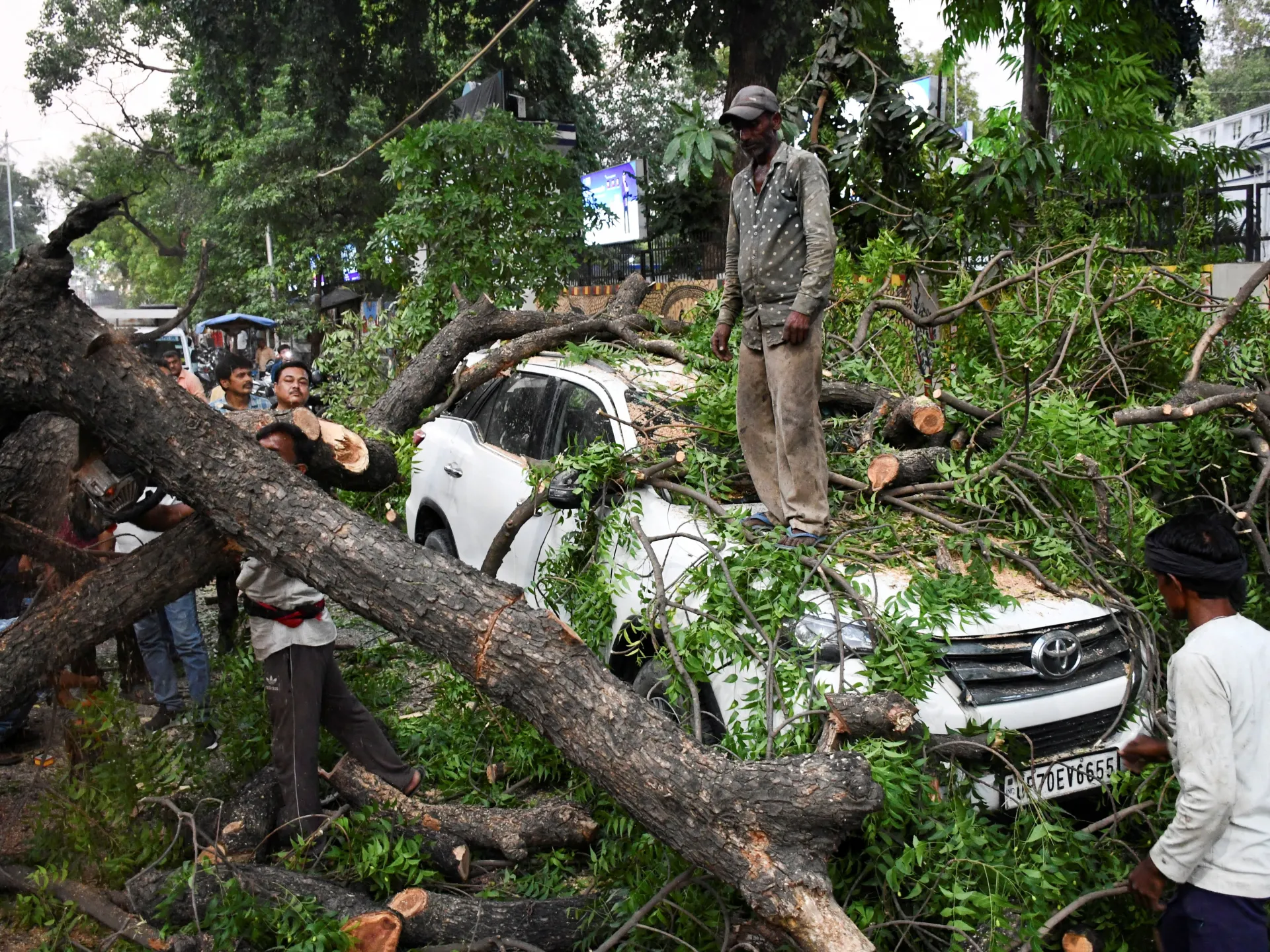
Officials said many deaths were caused by falling trees, collapsing structures and lightning. Police and disaster response teams used chainsaws and cranes to clear fallen trees from roads and railway tracks in several districts.

Narendra Srivastava, an administrative official, said emergency teams were deployed across the affected areas and that homes, crops and power infrastructure were widely damaged, particularly in rural parts.

In Prayagraj district, residents were in panic as strong winds tore through neighbourhoods.

“The storm came suddenly, and the sky turned completely dark within minutes,” Ram Kishore said. “Tin roofs were flying, and people ran indoors. We could hear trees falling throughout the evening.”

In neighbouring Bhadohi district, Savitri Devi said her family narrowly escaped after strong winds damaged their mud house. “We rushed outside when the walls started shaking because of the wind,” she said. “Our roof collapsed moments later. We spent the night at a relative’s house.”

Uttar Pradesh Chief Minister Yogi Adityanath ordered officials to complete relief operations within 24 hours and for authorities to provide emergency aid and compensation to affected families.

Source link

Netball Super League: Leaders Loughborough Lightning beat irmingham Panthers

Netball Super League leaders Loughborough Lightning returned to winning ways with a hard-fought 76-60 victory over Birmingham Panthers on Friday.

Lightning, whose 100% record was ended by defending champions London Pulse last weekend, are now four points clear of second-placed Pulse at the top of the NSL table.

Pulse take on Manchester Thunder, who are six points behind Lightning in third place, on Saturday.

Bottom side Panthers made a quick start to Friday’s game, leading at the end of the first two quarters to take a two-point advantage into half-time.

But Lightning hit back after the break and were four goals ahead at the start of the fourth quarter, before sealing victory with a dominant display in the final 15 minutes of the round 11 match.

Source link

Is baseball next? Ping-pong robot beats elite humans in AI milestone

A few days ago came the astonishing news that the world record in the half-marathon was obliterated by a 5-foot-5 humanoid robot named Lightning in Beijing.

Now a robot named Ace has achieved another milestone for AI and robotics by defeating expert-level humans at table tennis in Tokyo, according to a study published Wednesday in the scientific journal Nature.

What’s next, a robotic baseball player named Babe that swats 500-foot home runs and throws 120 mph pitches, eclipsing Shohei Ohtani’s real-life achievements and commanding a billion dollar contract?

It’s all fun and games until it isn’t.

Extraordinary athletic achievements by AI robots might seem innocuous, especially compared to far more grave threats described by various experts, including the landmark publication “An Overview of Catastrophic AI Risks” by the Center for AI Safety in 2023.

To name a few: Misinformation and social media manipulation; job displacement and economic inequality; cybersecurity threats; lethal autonomous weapons; environmental impact; psychological dependence; and ultimately, the existential risk to humanity of losing control of rogue AI systems.

For now, let’s get back to ping-pong.

Ace was developed by good, old Sony, the 80-year-old makers of gaming consoles, televisions, smartphones, cameras and audio equipment that we enjoy every day.

Of course Sony has an AI research division, and while most consumers were still going ga-ga over PlayStation 5 Pro 2TB, it developed the first robot to attain expert-level performance in a competitive physical sport that requires rapid decisions and precision execution.

Ace integrates nine synchronized cameras and three vision systems to track the spinning plastic ping-pong ball. Its lightning-fast processing time would be the envy of even Lightning, the humanoid robot that broke the world record in the half-marathon by nearly seven minutes.

“Here we present Ace, to our knowledge the first real-world autonomous system competitive with elite human table tennis players,” the study said. “Ace addresses the challenges of physical real-time interaction through a new, high-speed perception system using event-based vision sensors and a new control system based on model-free reinforcement learning, as well as state-of-the-art high-speed robot hardware.”

Ace showed out in matches that followed International Table Tennis Federation rules and were officiated by licensed umpires. Most of the matches took place in 2025 — before table tennis tale “Marty Supreme” even hit theaters — although Ace defeated professional players as recently as March.

One such human is Mayuka Taira, who said in comments provided by Sony AI to Reuters that the robot’s strengths are what one might expect: unpredictability and an absence of emotion.

“Because you can’t read its reactions, it’s impossible to sense what kind of shots it dislikes or struggles with, and that makes it even more difficult to play against,” Taira said.

Initial real-world applications of Ace-like robots likely would be in manufacturing and service industries, although untapped potential lies across sports, entertainment and safety-critical environments, according to the study.

“These results highlight the potential of physical AI agents to perform complex, real-time interactive tasks, suggesting broader applications in domains requiring fast, precise human–robot interaction,” the study said.

Those domains certainly could include baseball diamonds, basketball courts and gridirons. Hockey rinks could be lumped in provided robots can skate.

AI already is used in MLB. The vaunted Automated Ball-Strike system (ABS) uses AI-powered Hawk-Eye camera technology and computer vision to determine if pitches are strikes or balls. Twelve high-speed cameras track ball flight and AI delivers the definitive call to the scoreboard within seconds of a challenge.

A robotic batter facing a robotic pitcher with calls made by ABS might eliminate any disagreements over balls and strikes.

Terrifying.

Reuters contributed to this story.

Source link