For scientists, measuring the water in a river or a lake is relatively straightforward. It’s much more complicated to figure out how much water lies underground.
After years of research, a team of scientists has finally mapped what remains of these hidden waters across the United States, and they’ve produced the most extensive estimate of the country’s groundwater to date.
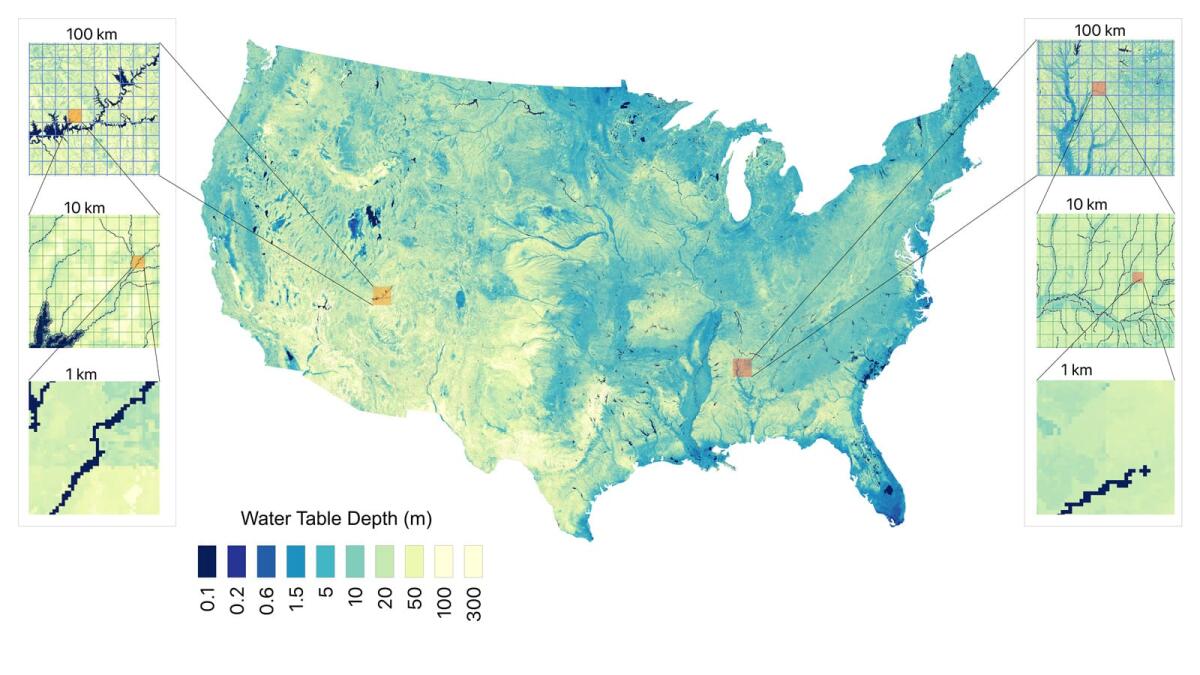
Researchers at Princeton University and the University of Arizona took data from about 800,000 wells and applied a machine-learning model to estimate the depth of the water table nationwide.
“Groundwater is out of sight and out of mind for most people,” said Reed Maxwell, a hydrologist at Princeton and co-author of the recent study in the journal Nature. “Knowing how much we have will be helpful in knowing how to use it wisely.”
They incorporated data on the geology of aquifers and estimated down to nearly 1,300 feet, far deeper than most wells.
You’re reading Boiling Point
The L.A. Times climate team gets you up to speed on climate change, energy and the environment. Sign up to get it in your inbox every week.
By continuing, you agree to our Terms of Service, which include arbitration and a class action waiver. You agree that we and our third-party vendors may collect and use your information, including through cookies, pixels and similar technologies, for the purposes set forth in our Privacy Policy such as personalizing your experience and ads.
The scientists say their detailed map and data could help local decision-makers address overpumping from stressed aquifers, and help researchers estimate how much water has been depleted.
California has seriously depleted groundwater in the San Joaquin, Salinas and Cuyama valleys, Ventura County and other places, with some of the fastest rates of water decline in the world.
In parts of the Central Valley, where large farms draw heavily from wells, aquifer levels have plummeted. The U.S. Geological Survey estimates it has lost 128 million acre-feet, comparable to the volume of Lake Tahoe, since pumps started pulling it out in the early 20th century.
In the desert Southwest, the groundwater is largely considered “fossil water” because it took millennia to accumulate. So once it is pumped out, it’s in effect gone for good.
Even depleting small amounts of water can be a problem, said co-author Laura Condon, a University of Arizona hydrologist. “We see this in Arizona and in Southern California too, where long before you run out of water, you start disappearing wetlands, disappearing small tributaries.”
The total quantity of water underground is still immense. The scientists found nationwide there is roughly 250 billion acre-feet, or 13 times the volume of the Great Lakes.
Data compiled by lead author Yueling Ma show the Colorado River watershed has about as much groundwater as the volume of the Great Lakes, while California has about 70% of that.
Those are vast quantities, but the researchers said that definitely doesn’t mean there is plenty of water to recklessly use up. Declines in groundwater levels have in recent years caused household wells to sputter and run dry, streams and wetlands to dry up, and land to sink, damaging canals and levees. California’s database of dry wells shows about 6,000 have run dry since 2013, but in the last year, only 13 dry wells were reported. So that problem has slowed down for now. It could soon worsen again.
The new map shows groundwater varies widely across the country. In some places, you have to drill down 300 feet to reach it. In others, it’s just a few feet below the soil.
Jay Famiglietti, a hydrologist and professor at Arizona State University who wasn’t involved in the research, called the researchers’ map and estimates a “remarkable achievement for modeling and understanding groundwater” in the United States.
The scientists “convincingly show that it is now possible to simulate groundwater depths and availability at very high resolutions,” he said, and they have made their results “accessible and useful for water managers across the country.”
He said the research adds to satellite measurements that scientists now use to track shifts in water over time. What the country still needs, he said, is a “national-scale network of deep groundwater wells” to track the quantity and quality of water all the way down to bedrock.
More water news
Two years ago, Gov. Gavin Newsom announced a strategy to save declining salmon. Now, as Rachel Becker reports for CalMatters, members of the Winnemem Wintu Tribe say the state is ending its support for an effort to reintroduce endangered winter-run Chinook to waters upstream of Shasta Lake reservoir, and they feel betrayed.
The Trump administration recently announced it will spend $40 million to begin a plan to raise the height of Shasta Dam, which would expand California’s largest reservoir. As Camille von Kaenel reported for E&E News by Politico, dozens of environmental, fishing and tribal groups sent a letter to Newsom urging him to oppose the Trump administration’s renewed effort to raise the dam.
I followed up to ask Newsom’s office about the idea of raising Shasta Dam. “We aren’t getting distracted by conceptual projects, years from viability,” Newsom spokesperson Tara Gallegos said. Instead, she said the governor is focusing on getting the planned Sites Reservoir built northwest of Sacramento, which “will benefit regions throughout California and is much farther along towards construction.” Gallegos added that the state already is “a significant investor in the project, and the federal government should join us in ensuring this project comes to fruition.”
In the San Joaquin Valley, the Delta-Mendota subbasin has become the fourth farming area to avoid being placed on groundwater probation by state regulators. The State Water Resources Control Board voted this week not to impose enforcement measures on the area, Monserrat Solis reported for SJV Water.
More climate and environment news
The Trump administration has a budget proposal that calls for increasing military spending while slashing funding for clean energy and federal science programs. My colleague Hayley Smith wrote about the proposed cuts, which are strongly opposed by Democrats and environmental groups.
A wolf that captured national attention when she ventured into L.A. County earlier this year continues to make history. As Lila Seidman reports for The Times, it’s the first time a wolf has ventured into Inyo County in the Eastern Sierra in more than a century.
Imperial County supervisors voted to combine several parcels of land to clear the way for construction of a massive data center, which has faced opposition from residents who worry about the complex’s environmental footprint, Kori Suzuki reports for KPBS.
California’s last remaining nuclear power plant has received federal approval to run through at least 2030. My L.A. Times colleague Blanca Begert reports that the federal Nuclear Regulatory Commission has renewed Diablo Canyon Power Plant’s license to operate.
PBS SoCal’s new season of its locally produced environmental series Earth Focus premieres April 22, Earth Day, at 7:30 p.m., with an episode focusing on how L.A. stadiums are taking steps to be more environmentally friendly.
This is the latest edition of Boiling Point, a newsletter about climate change and the environment in the American West. Sign up here to get it in your inbox. And listen to our Boiling Point podcast here.
Howe cannot afford to think that far ahead, given the games to come.
A late push for Europe would put a different complexion on a bruising domestic campaign.
But Newcastle must go on a run to do so, which they have failed to do all season.
When Anthony Elanga openly asked whether the dressing room could show they were fighting for the head coach “again, again and again”, in a previous interview with BBC Sport, the forward was alluding to his side’s inconsistency.
“We want to keep on fighting for him because he’s helped us so much,” he said.
“I’d even go as far to say he is one of the best managers I’ve worked for. I’m really grateful to have him as a manager and I try to take everything he says to me on board because I know it’s for my benefit.
“I know he will help me so much. All the players feel the same.”
Yet you never quite know what you are going to get from Howe’s team this term.
Just as Newcastle can beat Manchester United with 10 men and record a rare win at Chelsea, this leaky side can also capitulate and concede seven goals in the Nou Camp or throw away a half-time lead against Sunderland.
All in the same month.
Is there a degree of mitigation for the ups and downs of a campaign where Newcastle reached the last 16 of the Champions League and a third EFL Cup semi-final in four years, but also suffered 13 Premier League defeats?
Even as far back as the autumn, there was a belief internally there would be choppy waters to navigate following a turbulent summer.
Newcastle missed out on a host of top-choice targets, buckled and eventually sold star striker Alexander Isak to Liverpool on deadline day and tackled a crucial window without a chief executive and sporting director in place.
Also, whereas the so-called ‘big six’ are used to fighting on multiple fronts, with deeper squads, this has been relatively uncharted territory for Newcastle, who have played more games (51) than any other side in Europe’s top five leagues this season.
Such has been the relentless nature of the schedule, there has been a feeling within the camp that they “can’t breathe” at times.
But the squad will soon be lifted by the return of talisman Guimaraes, who is understood to have been “working hard every single day” after being sidelined with a hamstring issue, as well as midfielder Lewis Miley and defender Fabian Schar.
Howe will also have clear weeks to prepare for the final seven matches of the season – and a rare extended period to intensively work with record signing Nick Woltemade following the German forward’s curious recent stint in midfield.
The head coach and his staff will need no reminding they need to make that time count in what feels like a defining few months on Tyneside.
NEW YORK — Health Secretary Robert F. Kennedy Jr. is launching a new podcast that he says will begin “a new era of radical transparency in government,” according to a teaser video first obtained by the Associated Press.
The show, titled “The Secretary Kennedy Podcast,” will launch next week and feature Kennedy in conversation with doctors, scientists and agency staff, U.S. Department of Health and Human Services officials told the AP ahead of the launch. In the teaser video, in a slick Health and Human Services-branded studio with ominous music playing in the background, Kennedy bills it as a new way to expose corruption and lies that have made Americans sick.
“We’re going to name the names of the forces that obstruct the paths to public health,” Kennedy says in the 90-second clip.
The new communication effort from the Department of Health comes as the department has faced a bevy of recent setbacks, including widespread criticism of its vaccine policy changes, a federal ruling last month blocking several of those moves, and resistance from key Republican senators that has kept President Trump’s surgeon general pick from taking office. In that way, it could be seen as part of a broader rebranding strategy as the agency redirects away from vaccine efforts and toward a less contentious agenda on healthy food ahead of November’s midterm elections.
But the show, which has been in the works since early in the second Trump administration, also reflects Kennedy returning to a format where he has long felt at ease. An antivaccine crusader and attorney before he entered office, he previously hosted his own podcast and has appeared on dozens to share his perspectives in longform interviews, as recently as this week.
Tyler Burger, Health and Human Services digital communications manager and the producer of the new podcast, said while Food and Drug Administration Commissioner Marty Makary has a podcast, officials believe Kennedy’s will be the first to be hosted by a sitting Cabinet secretary.
“We’re kind of bringing podcasting into the government as an official form and arm of our messaging,” Burger said. He said the set for the show was pieced together largely with items the agency already had, and has the capacity for a total of four people to sit in conversation together.
“This is part of our larger strategy to bring the Make America Healthy Again message to as wide an audience as we can,” said Liam Nahill, Health and Human Services digital director.
Because podcasts are now commonly made not only on audio but video, they are regularly clipped and shared across social media platforms, giving them “massive” reach, according to Melina Much, a postdoctoral fellow for NYU’s Center for Social Media and Politics.
Much said podcasts also tend to be more intimate, conversational and friendly than a traditional interview, allowing administration officials to promote themselves without facing as much pushback.
While Kennedy’s teaser focuses on uncovering lies, Health and Human Services spokesman Andrew Nixon said it will aim to cover affordability and other topics that polls show are salient for American voters ahead of the midterms.
“Americans are united on the need to urgently address chronic disease, improve nutrition, strengthen food quality, and lower health costs,” he said. “The Secretary Kennedy Podcast will cover all those issues.”
The Peak District village was systematically demolished and submerged in the 1940s to provide water for the industrial industries during the second world war – but it’s ruins remain
Passers-by have no idea what lies beneath (Image: Steve_Bramall via Getty Images)
It lies beneath a beloved hiking destination in Derbyshire, but this was once a thriving community before it was deliberately flooded and lost forever.
During the 1940s, the picturesque village of Derwent was methodically demolished and submerged beneath what is today known as Ladybower Reservoir.
The expansive, stunning expanse of water frequently serves as a stopping point for visitors admiring the scenery whilst exploring the Peak District, yet few realise what rests beneath its surface.
The reason for its submersion was to supply water to the booming industrial centres throughout the East Midlands during World War Two.
Locals were relocated, and by 1945 the valley had been flooded, with remnants of the former settlement now resting underwater.
Best Derbyshire holiday cottage deals
This article contains affiliate links, we will receive a commission on any sales we generate from it. Learn more
Derbyshire is known for its dramatic Peak District landscapes, historic market towns and stately country houses. Sykes Cottages has hundreds of places to stay, with prices from £32 per night.
Derwent before it drowned
Prior to the outbreak of war across Britain, Derwent had seemed like a permanent fixture in the moorlands, characterised by its century-old structures and tight-knit community.
Two initial dams were constructed after the water board selected a remote section of the valley. This decision impacted numerous residents. Those who owned farms or smallholdings were relocated to safer areas including Derwent and the neighbouring village of Ashopton.
What they couldn’t have anticipated was that this stretch of the valley, and their cherished village which they’d made their home, would shortly vanish entirely.
The village church conducted its final service for parishioners on March 17, 1943, before being submerged beneath the reservoir. Remnants of the church can be found scattered throughout Derby, with the bell now rehung at St Philip’s Church in Chaddesden.
Whilst nearly the entire area was deliberately flooded, a small number of homes survive above the waterline. Reports indicate that five properties from the original village endure, including several farms and the former village hall.
Mabel, a former Bamford resident who was 92 at the time of her interview, spoke to BBC Travel about growing up nearby and her memories of Derwent.
She revealed: “I may be the last person who remembers Ashopton and Derwent,” explaining that her school was located in Derwent, which she attended whilst the reservoir was being built.
The village emerged
During periods of extreme heat or reduced water levels, the reservoir has receded, and hauntingly, remnants of the village have surfaced. This phenomenon has been documented on several occasions, with the first instance occurring in 1976, leaving locals astounded.
The most recent, and consequently most significant, reappearance of the village occurred in 2018, when reservoir levels dropped dramatically and visitors flocked from across the region to witness the extraordinary spectacle.
An enormous crowd assembled, and the attention drawn to the old structures – which are largely piles of rubble and bricks – resulted in various complications.
On 3 November that year, a man found himself in a sticky situation, requiring mountain rescue assistance after becoming severely stuck in the dense mud surrounding the ruins of Derwent.
In a similar vein, due to the influx of visitors, the remnants were defaced with graffiti, prompting park rangers to discourage further visits as additional items were also taken from the site.