license plate reader

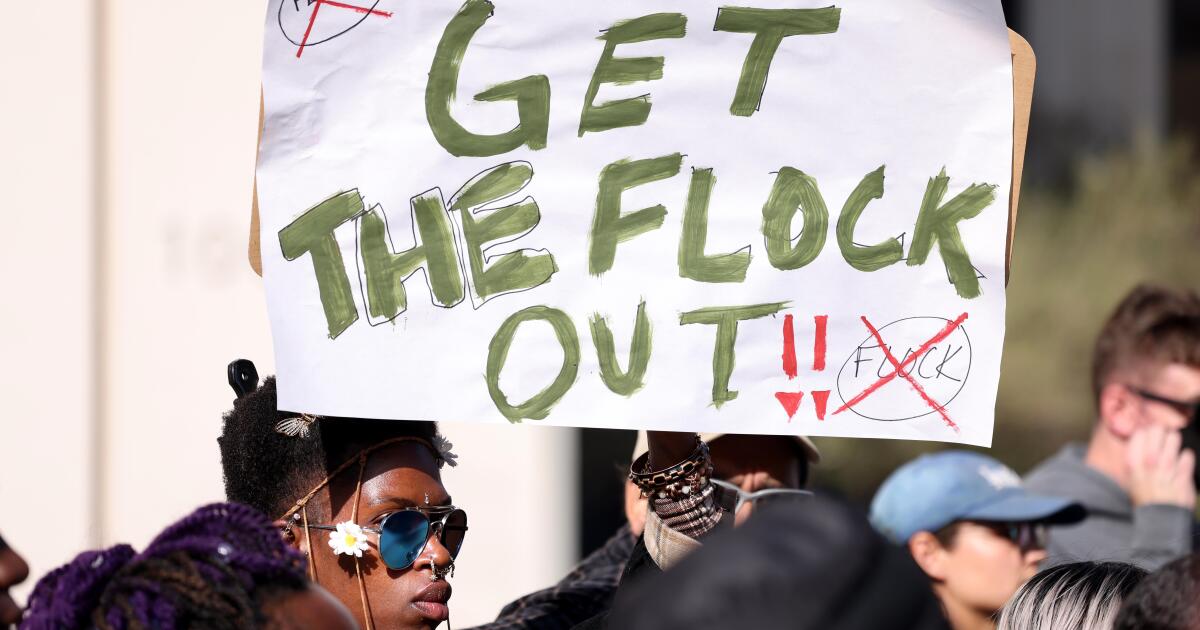
Mayor says LAPD should stop using Flock Safety license plate readers

Mayor Karen Bass said Thursday that the LAPD should stop working with Flock Safety, warning that the company, which operates AI-enabled license plate readers that allow authorities to monitor vehicles around the city, had lost public trust.

In her most forceful comments to date on the topic, Bass said while she supports license plate reading technology generally as a tool for law enforcement, Flock had “lost the trust of Angelenos and residents across the country, especially in immigrant communities targeted by the federal administration.”

“There are many companies that provide this technology to cities nationwide,” Bass said in a statement. “The LAPD needs to identify another company that doesn’t share data.”

LAPD officials have said Flock’s technology enables investigators to solve crimes, helping to find vehicles that have been reported stolen or linked to suspects. Last month, the department announced it was pausing its relationship with Flock, but police officials later said they were in the process of negotiating a new deal with the company that would include more data sharing and collection safeguards.

Dozens of mostly smaller cities have deactivated their Flock cameras or ended their contracts with the company over concerns that it provides data to the Trump administration that can be used to track down immigrants for deportation.

Bass joined the chorus of activists and local officials calling for the LAPD to end its relationship with the company outright.

Her opponent in the November mayoral election, Nithya Raman, said last week on the social media platform X that the city should “cut ties with Flock Safety.”

“Cities across the country are canceling their Flock contracts over the risks its license plate readers pose to privacy, civil liberties, and immigrant communities,” Raman’s post read.

Last month, Bass signed an ordinance that prohibits city personnel from providing anyone outside local government access to data that can be used to determine someone’s immigration status.

A recent Washington Post report uncovered at least 50 instances nationwide in which law enforcement officials were accused of misusing their access to the cameras, largely to stalk former romantic partners or citizens.

A report issued last month by the LAPD inspector general’s office found numerous “limitations” in the department’s existing agreements with its three plate reader vendors — Flock, Axon and Motorola — including a lack of clear language about how long the data are retained and how they are shared with third parties or other law enforcement agencies.

The inspector general recommended that the department update its current license plate reader contracts to address data security and privacy concerns, conduct regular audits and develop standardized rules for traffic stops based on plate reader hits.

Flock has said its customers decide who can access data from their cameras. The company said it doesn’t have contracts with the U.S. Immigration and Customs Enforcement, adding that has taken other steps to assuage public concern, such as barring federal agencies from its lookup tools and restricting immigration-related searches to ensure compliance with laws in California, Washington and other states.

In an interview with ABC7 last month, Flock CEO Garrett Langley said the company had to “tighten up the police and make sure everyone’s aligned and then turn it back on. He said the company retains the data from its plate readers for only 30 days and denied that its cameras employ facial recognition software as some of its critics have suggested.

During a virtual listening session hosted last week by the inspector general’s office, dozens of people sounded off on the department’s use of Flock cameras.

Some speakers, mostly from the fire-ravaged community of Pacific Palisades, supported the use of cameras to deter burglars who have repeatedly hit homes and construction sites in the area.

Jennifer Wolfe, who identified herself as a teacher in Altadena, another community devastated by the 2025 wildfires, urged Flock’s supporters to consider how “surveillance systems can grow far beyond their intended purpose.”

Locating stolen cars is important, she said, but people should be more concerned by this newfound and unchecked ability for the government to collect “vastly more information, with far less effort.”
Source link

Push to install Flock Safety devices targeted L.A. agency, emails show

Since its creation more than a century ago, the Los Angeles Bureau of Street Lighting has been in the lamppost business and little else.

But in recent months, the little-known city agency has found itself pulled into a fierce debate over L.A.’s relationship with Flock Safety, a surveillance technology company that has been criticized for supplying data used to enable the Trump administration’s immigration crackdown.

In L.A., Flock operates dozens of automated license plate readers, which allow authorities to scan for vehicles that have been reported stolen or are registered to known fugitives, tracking their movements throughout the city.

The devices are often mounted on municipal light poles, which makes the Bureau of Street Lighting responsible for their installation.

Reports that Flock has shared license plate data with federal authorities, including U.S. Immigration and Customs Enforcement, have prompted dozens of mostly smaller cities across the country to end their relationship with the company. But in L.A. it still has found willing customers, including the LAPD.

Hundreds of emails obtained by The Times through public records requests reveal how LAPD boosters, homeowner associations and elected officials have engaged in a months-long campaign to pressure the Bureau of Street Lighting to speed up installations of the plate readers.

Flock, headquartered in Atlanta, said that it contracts with roughly 5,000 U.S. law enforcement agencies nationwide, and that its technology complies with a California law that limits what information can be shared with federal authorities. A company spokesperson said that Flock’s technology is “built around transparency, accountability, and local control.”

“Our customers own and control their data, which is deleted after 30 days by default,” the spokesperson, MoMo Zhou, said in a statement to The Times. “Our platform includes safeguards like audit trails to help ensure accountability at every step. Every day, Flock supports communities across the country in addressing crime and locating missing people.”

The Bureau of Street Lighting, with 177 employees and a relatively modest budget of $49.4 million, would seem an unlikely player in the broader debate over police surveillance. It is primarily tasked with repairing and fortifying the city’s more than 210,000 streetlamps — a frequent target of copper wire thieves — and maintaining its network of electrical vehicle charging stations.

The push to put up more plate readers has come amid calls for greater transparency around the Los Angeles Police Department’s dealings with Flock. In March, the Police Commission asked the department to report back on what information the company’s scanners collect and share. In recent months, the commission declined to approve donations of Flock cameras.

People holding large signs outside a building

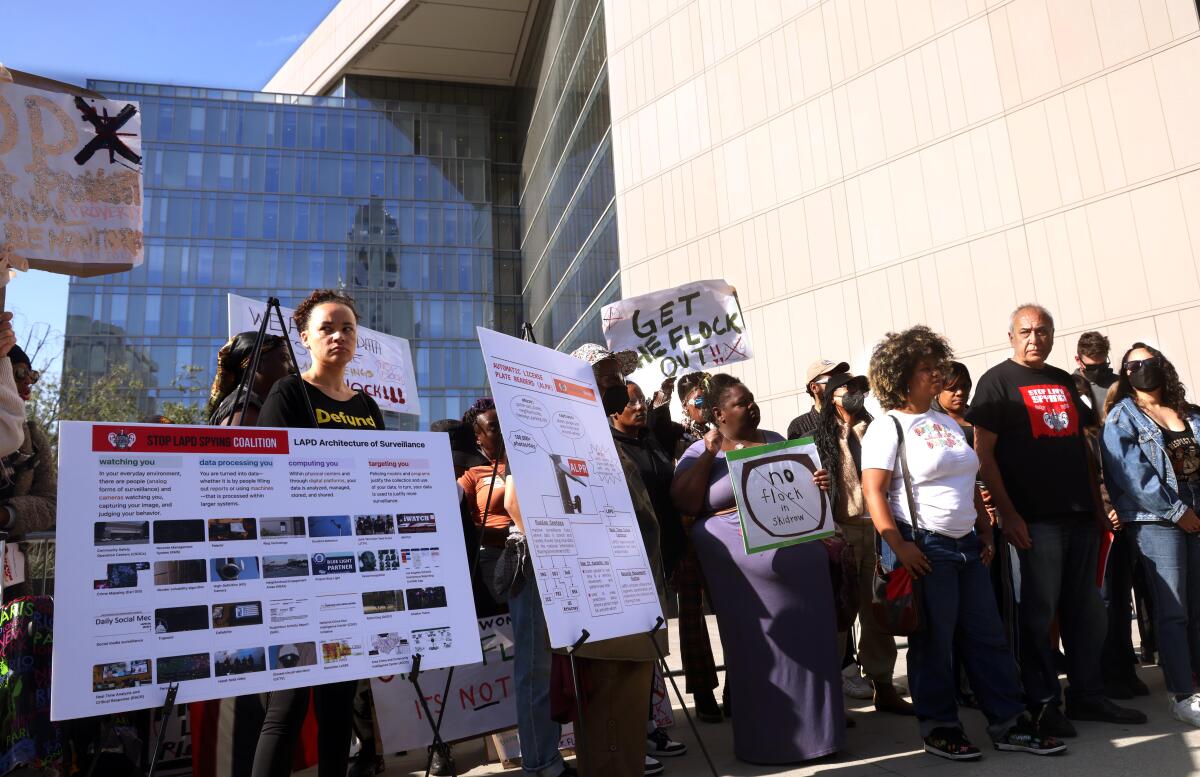
Members of the Stop LAPD Spying Coalition held a news conference to express opposition to Flock Safety, a license plate reader, ahead of a Los Angeles Board of Police Commissioners meeting on March 3, 2026.

(Genaro Molina / Los Angeles Times)

The commission ordered its inspector general to conduct an audit of the LAPD’s use of license plate reader technology, with the findings expected to be released in the summer.

Recently, Councilmember Ysabel Jurado introduced a motion urging the commission to “refrain from entering into any new Memoranda of Understanding, Contracts, or other Agreements, or implement any pilot programs with Flock Safety or its affiliates.” LAPD officials said last month that the city attorney’s office has been working on drawing up a formal contract with Flock.

Behind the scenes, though, the pressure to work with Flock has been ratcheting up from other council offices and community groups.

When a representative from Councilmember Katy Yaroslavsky’s office emailed the streetlighting bureau urging speed, she received a response that said the installation process shouldn’t be rushed because some city light poles can’t support the weight of a Flock reader, which is normally powered by a solar panel.

“The last thing we need is to have a pole fall onto someone or something if there are high winds,” the bureau’s Clinton Tsurui wrote in the June 4, 2025, email.

In another exchange, Tsurui expressed frustration with a colleague who had offered what he thought was an overly optimistic timetable for installing new plate readers.

He wrote: “smh, promising things we can’t do is going to catch up with us one day.”

The Los Angeles Police Foundation, a nonprofit group that has long bankrolled equipment for the LAPD and offered other support, has criticized delays in installing the Flock devices. Last year, the foundation facilitated the donation of dozens of Flock cameras, most of which ended up in affluent neighborhoods on the city’s Westside and in the San Fernando Valley.

Records show that in May 2025, Dana Katz, the foundation’s executive director, reached out to the mayor’s office with a request to waive permit and rental fees associated with installing the new readers. Katz wrote in an email that the extra expense of around $2,000 per device were “cost prohibitive and detrimental to public safety.”

Katz also pointed out that in some places, there are no city-owned poles on which to mount the devices — but offered a possible solution.

“Flock has its own pole that has been accepted by the County of Los Angeles for these situations, and we would like the City to accept the use of them, too,” she wrote to Robert Clark, the city’s then-deputy mayor of public safety.

Three different styles of streetlamps: Two have double bulbs and one features a single bulb

A few of L.A.’s historic streetlights stand outside the Bureau of Street Lighting’s office near Virgil Avenue and Santa Monica Boulevard.

(Jason Armond / Los Angeles Times)

Katz wrote Clark again on Aug. 6 to ask why officials were estimating a six-to-12-month wait for approval of new Flock readers on public property in the neighborhoods of Cheviot Hills and Brentwood Park, where there were no existing city poles to mount them. She noted that the county’s engineering department had already approved the company’s poles, and asked Clark whether there was a way for the city to “piggyback on these other entities’ approvals in order to speed this up so that these neighborhoods don’t have to wait so long for help in preventing these home invasions?”

In the following weeks, Katz’s emails took on an increasingly urgent tone. In one of her last messages, email records show, she told an aide she expected more help than the mayor’s office was offering.

“With all due respect, the answers you have provided are completely generic and do not provide any guidance and direction as to how we can expedite this process,” she wrote.

She added: “I’ve said it before, and I will say it again — these delays are harmful to public safety.”

A spokesperson for the mayor’s office told The Times that ultimately neither Clark nor the aide intervened on the Los Angeles Police Foundation’s behalf.

Email records show Flock’s courtship of the bureau dates at least to spring 2024, when the company agreed to donate two of its plate readers to help combat copper thefts.

Tsurui emailed LAPD Capt. Celina Robles to say that the company’s executives had requested an in-person meeting with the bureau and the LAPD “to discuss the benefits of this product and how it can benefit the city moving forward.”

On June 24, 2024, a lobbyist from the D.C. firm Modern Fortis emailed Bureau of Street Lighting Executive Director Miguel Sangalang seeking to “explore a public-private partnership” between Flock and the city. Sangalang took another meeting to discuss Flock a few months later with former City Councilmember Joe Buscaino, who after leaving City Hall had gone to work for Ballard Partners, a powerful Florida-based lobbying firm.

In January 2025, after wildfires devastated Pacific Palisades, Altadena and other areas, Flock stepped in again. The company agreed to donate more than 50 plate readers, free of charge for six months, to the wealthy Palisades area, where residents and law enforcement officials were on high alert about potential theft.

A device consisting of a flat panel on a pole and a camera

A Flock Safety automated license plate reader in Costa Mesa.

(Courtesy of the city of Costa Mesa)

In the days and weeks that followed, city and police officials continued to pepper the bureau about speeding up the approval process.

On Jan. 21, 2025, records show, Cmdr. Randall “Randy” Goddard of the LAPD’s Information Technology Bureau wrote streetlighting officials to say that the Palisades community “could use a big favor from your department.”

LAPD Chief Jim McDonnell “fully supports this and has been working with the City Attorney’s office to finalize the terms,” Goddard wrote.

Source link