At the Republican Party’s midterm convention, President Trump said he would make his crusade against transgender rights a major campaign issue ahead of the Nov. 3 election — calling the message that “men should not be playing in women’s sports” one of his party’s “great sound bites of all time.”
During a recent campaign trip, Gov. Gavin Newsom, a longtime LGBTQ+ advocate and likely Democratic contender for president in 2028, stood by his remark last year that allowing transgender athletes to compete in girls’ sports is “deeply unfair,” saying, “I haven’t been able to figure out how to make it fair from my perspective.”
For the second election cycle in a row, the rights of transgender people have taken center stage politically, despite their accounting for only about 1% of the U.S. population and many voters identifying other issues as far more important — splitting Republicans and Democrats, but also Democrats among themselves and putting the party on the defensive.
Transgender athlete AB Hernandez, third from right, sits with other athletes at the CIF State Track Championship finals in Clovis on May 30, 2026.
(Tomas Ovalle / For The Times)
The politics are part of a much broader, international battle playing out in education, sports and the law, from local California classrooms and high school sports to the Olympic stage and the U.S. Supreme Court. Polling for years has shown most Americans oppose discrimination against transgender people, but also that a majority — including a substantial portion of Democrats — oppose transgender athletes participating in girls’ sports and children receiving gender-affirming care such as surgery or puberty blockers.
Republicans are pushing a well-funded message that transgender rights should be dismantled across the board, in healthcare, education, sports, the military and public spaces such as restrooms. Conservative mega-donors such as Elon Musk have spent millions amplifying that message in competitive races from Alaska to Ohio to Texas.
And to some degree, those tactics have worked. While many Democrats have ardently defended transgender rights, particularly in California, others in the party have sided with Republicans or softened their support.
Democratic Senate candidate James Talarico appears with Jeffrey Epstein abuse survivors in Dallas on Sept. 10.
(Anja Schlein / Dallas Morning News )
James Talarico, the Democratic U.S. Senate candidate in Texas, backpedaled from past votes by saying young transgender athletes shouldn’t be allowed to play “if it risks safety or fairness,” while others including Rob Sand, a candidate for Iowa governor, and Rep. Marcy Kaptur (D-Ohio) have said they shouldn’t play.
Such messaging has dismayed transgender people and their families, as well as LGBTQ+ rights groups who have been trying to refine Democratic messaging on trans issues since Vice President Kamala Harris — another longtime LGBTQ+ advocate from California — responded to Trump’s anti-trans attacks in 2024 with a message some considered muddled.
Imara Jones, a transgender journalist and founder of TransLash Media, a platform built to spotlight trans people’s own experiences, said the party’s conflicting messaging “underscores the degree to which the Republicans have actually successfully weaponized trans issues.”
“You’re seeing a really sharp political calculus among Democrats,” Jones said, with those “in tight races, where they need to have Republican votes,” bending one way, and others who “want to make a statement about principle” and defending LGBTQ+ rights moving in the other.
Many Democrats in California say they believe the issue is a moral one and that Democrats only hurt themselves by ceding ground on human rights.
A volunteer for Toni Atkins, the former president pro tempore of the California State Senate, is silhouetted holding a Pride flag at the Harvey Milk Coachella Valley Diversity Breakfast, at the Palm Springs Convention Center in Palm Springs Thursday, May 8, 2025.
(Allen J. Schaben / Los Angeles Times)
“The solution is not to be ambiguous, but to be firm that we support basic human rights and the basic humanity of trans people,” said state Sen. Scott Wiener (D-San Francisco), a leader on pro-LGBTQ+ legislation running to replace retiring Rep. Nancy Pelosi (D-San Francisco). “Then go on to talk about the big issues facing our country, like this illegal war, like the fact that Congress has done nothing to regulate AI, like the explosive cost of energy and child care and housing.”
A national conversation
Trump has signed executive orders to bar transgender athletes from competing in girls’ sports, prohibit federal funding for gender-affirming care for youth, oust transgender service members from the military and deny recognition of transgender and nonbinary identities on critical documents such as passports.
The Justice Department has sued California and other states over their trans-inclusive sports policies, and successfully threatened large hospitals into ending gender-affirming care programs. The Centers for Medicare and Medicaid Services barred federal Medicaid spending on gender-affirming medication or surgeries for minors.
Martin Makary, commissioner of the Food and Drug Administration, speaks at Health and Human Services headquarters in Washington on Dec. 18, 2025.
(Stefani Reynolds / Bloomberg)
Trump campaigned on such policies, and he and other Republicans clearly see them as helpful in the midterms. In his convention speech, Trump said he’s been surprised more Democrats haven’t abandoned transgender rights given polling showing a majority of Americans oppose transgender athletes in girls’ sports.
“They say it’s an 80/20 issue,” Trump said, in an apparent reference to a January 2025 New York Times/Ipsos poll that found 79% of respondents believed transgender athletes should not be allowed to compete in women’s sports. More recent polls have shown a smaller majority opposed.
Demonstrators at a Rainbow Families Action march in Emeryville, Calif., on Dec. 8, 2025.
(Jessica Christian / San Francisco Chronicle )
Arne Johnson, a Bay Area father of a transgender child who helps run the advocacy group Rainbow Families Action, said being targeted by Republicans is scary, but watching Democrats “find ways to be more flexible about the rights of human beings” has been profoundly disappointing.
But he said he’s also been encouraged by some more recent polling showing Americans moving back toward the middle on transgender rights, which he believes is in part due to people being deluged with anti-trans ads getting frustrated that the political conversation isn’t focused on issues they care more about, like affordability and healthcare.
Ramiro Sarmiento, a spokesperson for the Human Rights Campaign, which has tracked at least $50 million in anti-trans political ads this cycle, agreed, saying, “MAGA wants to talk about trans kids because they’re losing the conversation voters actually care about.”
Conservative groups reject that framing. Many deny tht transgender people exist, while others say they are working to protect cisgender children or defend religious beliefs. They have also scoffed at Democrats who have changed their positions in the lead-up to the election, with the conservative American Principles Project accusing Talarico of only pretending to shift away from his “gender radicalism” on sports in order to win votes.
Allison Schuster, a White House spokesperson, said the Biden administration “spent four years pushing a radical agenda” of gender-affirming care for children, while Trump “pledged to restore common sense” and has since “delivered by consistently taking strong action to protect children from these dangerous, life-altering medical practices.”
The fight in California
In California, transgender athletes competing in youth sports has been raised as an issue in the governor’s race, where Republican hopeful Steve Hilton has rallied against their inclusion, and featured prominently in the races for the next state attorney general and the next state superintendent of public schools.
Transgender athlete AB Hernandez competes for Jurupa Valley High School at the 2025 CIF state track and field championships.
(Tomas Ovalle / For The Times)
Several Democrats running for Congress in the state have been criticized for their records on transgender rights, including San Diego City Councilmember Marni von Wilpert, who is seeking the redistricted congressional seat of departing Rep. Darrell Issa (R-Bonsall), as well as Reps. Adam Gray (D-Merced) and Derek Tran (D-Orange).
Christian Martinez, a National Republican Congressional Committee spokesperson, has accused Von Wilpert of having a “perverted agenda [that] pushes hormone treatments on kids,” and Gray of being “for they/them, not for Californians.”
Marni von Wilpert, a Democratic candidate for California’s 48th Congressional District, canvasses in a neighborhood Friday, May 29, 2026, in San Marcos, Calif.
(Gregory Bull / Associated Press)
California Atty. Gen. Rob Bonta’s office is fighting on multiple fronts to protect gender-affirming care and successfully rebuffed a Justice Department lawsuit over the state’s transgender sports policies. But pressure is coming not only from the Trump administration.
The California Interscholastic Federation, which oversees high school athletics, also revised its rules to ensure that transgender athletes in individual sports do not displace cisgender ones from rankings or medal podiums. And after local California teachers sued, the U.S. Supreme Court in March ruled against a controversial California student privacy law that precluded teachers from revealing a child’s interest in presenting in gender nonconforming ways in school to their parents if the child requested confidentiality, finding that the policy infringed on parents’ rights and the free exercise of religion.
Meanwhile, state lawmakers just passed at least a dozen measures aimed at bolstering LGBTQ+ rights, including by restoring an LGBTQ+ youth suicide and crisis hotline; helping discharged LGBTQ+ service members find housing and jobs; requiring California gender-affirming healthcare providers who are subpoenaed to inform Bonta’s office if they intend to respond; improving access to HIV prevention care and enhancing LGBTQ+ data privacy.
Newsom signed all those measures into law — his office said California “will not stand” for Trump’s “all-out assault on the LGBTQ community” — but vetoed a bill that would have barred future governors from allowing the extradition of abortion or gender-affirming care providers in California to states where such care is illegal, citing concerns about reduced executive discretion.
The 2026-27 state budget appropriated $66 million for gender-affirming care, including up to $30 million for underinsured patients in the Uncompensated Care Program, $26 million to assist organizations that provide such care and $10 million to cover care for poor children who lost it under the new Medicaid rules. Wiener called the latter a “short-term solution” that will protect kids while the state figures out a more permanent billing pathway under Medi-Cal.
A.W., a Bay Area mother of a transgender teenager who requested anonymity because she fears being targeted by the Trump administration, said her child’s gender-affirming care — a lifeline for him in recent years — was disrupted by the Medicaid rule change, and the state’s temporary fix was too little, too late.
A.W. said families like hers “shouldn’t have to make medical decisions based on politicians in Washington,” particularly for care so critical to her son and other kids. “If he had not had access to gender-affirming care, I don’t know where we would be,” she said. “It scares me to think about it.”
Times staff writer Dakota Smith contributed to this report.
A source has claimed that even though the line-up of The Celebrity Traitors signed NDAs while filming the show, the finalists have become ‘a hot topic’ at showbiz events
22:50, 10 Oct 2026Updated 23:00, 10 Oct 2026
Claudia Winkleman hosts the popular BBC show(Image: BBC )
The Celebrity Traitors has been thrown into chaos with the finalists being “leaked”. The leaks have reportedly become “a hot topic at showbiz parties”, as bosses scramble to protect the identities.
On Friday, October 9, the BBC released record-breaking audience figures for the popular show, revealing that the third episode achieved a peak audience of 10.3 million viewers. Then, on Friday night, an estimated 9.6 million fans watched the fourth episode of the show, hosted by Claudia Winkleman, 54 – but this could all be in jeopardy if the names get out.
While the all-star line-up signed non-disclosure agreements pledging to keep the game’s results secret until the episodes air, a source claimed that news of the final has leaked. Because of this, executives at the BBC are said to be on edge as the finalists are discussed at various celebrity events, with bosses hoping the names don’t become public knowledge.
To see more of the stories you love from The Mirror and to find them easily in Google, make us your preferred source. Free and easy to do, just click on the link here to find more from The Mirror at the top of your feed.
“Because of the leak, who makes the final is now a hot topic at showbiz parties,” the insider told The Sun. “It’s also spread how certain players get on, not helped by the fact that another source has been suggesting who’s been placed for interviews around the final.
“It’s vital the leaks don’t make it to gossip forums online and on social media, where fans can find the information. The BBC is hoping that anyone happening upon the info or hearing it from friends will help keep the secrets of the castle and stay quiet.”
The source added: “The problem is a small group will be aware of The Celebrity Traitors’ secrets, including those who work on the show, the celebrities who ran the course and possibly their close family and friends.”
The BBC show is so popular that even Prince William and Kate Middleton are said to be obsessed with it. Speaking on Palace Confidential on YouTube, Daily Mail royal editor Rebecca English revealed that the Prince and Princess of Wales are huge fans of The Celebrity Traitors, which has an IMDb rating of 8.7.
“Now, William and Catherine are massive Traitors fans. I can tell you that now. They love the programme. Absolutely glued to it,” Rebecca said.
The 2026 celebrity spin-off of the psychological reality game show takes place at Ardross Castle in the Scottish Highlands, where a star-studded cast plays for a £100,000 charity prize pot. The show is currently in the middle of its broadcast run, following the massive success of Series 1 in late 2025, which was won by Traitor Alan Carr.
Currently, there are three Traitors – comedian James Acaster, 41, TV presenter Maya Jama, 32, and mathematician Hannah Fry, 42 – on the show. Actor Richard E. Grant, 69, was banished by the Faithful during the first roundtable.
Episodes air weekly on BBC One and are available to stream on BBC iPlayer.
The fan-favourite baking competition has returned to Channel 4, with 12 amateur bakers hoping to impress Paul Hollywood and new judge Nigella Lawson, who has replaced Dame Prue Leith.
In the first episode of this series, the bakers were tasked with making Nigella’s stout cake and a self-portrait showstopper, and despite two creations collapsing onto the floor, no one was sent home after contestant Shannon had to quit the challenge halfway through on medical advice.
Ahead of biscuit week tonight, Tuesday 29 September, one contestant has recalled his own experience on the show. Howard Middleton took part in the fourth series back in 2013, but was devastatingly sent home during week six.
He’s now revealed that before filming even began, there was a moment that left him feeling sick. Speaking on behalf of Smooth Spins, Howard shared his first impression of the famous white tent.
He said: “It’s interesting because you get two shots of it. So, we were ferried from the hotel to the tent in a little minibus, and you just see the tent emerging from the minibus, and it’s at that point you sort of think, ‘Oh God, I feel a bit sick!’ That’s when it starts to feel real.
“When you actually go into the tent the first time, you get a tour, where someone explains how the ovens work and the hobs and everything around the kitchen. I just remember thinking that I hadn’t understood a word that you’d just said because I was so in awe of actually being in the tent.
“Even after the explanation, I still kept having to ask how to work the oven and the hob afterwards. It’s very overwhelming, and I did feel a bit sick.”
He went on to talk about meeting his fellow bakers, revealing they only met the night before. Howard continued: “Obviously we’ve all gone through the audition process, and you’ve met certain people along the way, but it’s not until the night before you actually start filming that you know who’s got into the tent. It may be that you’ve met one or two of them, or you remember seeing them during the auditions, but most of the time they’re strangers, really.
“On the first night when you meet everyone, you can make up your mind about them. Sometimes people can be very loud if you are out for dinner or something, and you start to understand what they will be like in the tent.”
After their first impressions of each other, Howard shared that the bakers did spend time together when the cameras stopped rolling, though he admitted that his time on the show was likely different to now. Back then, the contestants stayed in a hotel further from the tent, whereas he claimed that now, due to security reasons, they stay much closer.
He went on: “And the security is much tighter than it was. We were free to go out for meals together in the evening, although, to be perfectly honest, you’re so tired by the time you’ve finished a day of filming that you really don’t want to socialise that much.
“We also realised that those of us who would be catching up at the hotel bar late at night – none of us made it through to the finals! So if there’s a lesson to be learned, it’s don’t go out the night before!”
The Great British Bake Off continues tonight at 8pm on Channel 4
JOEY Essex’s most explosive TOWIE brawl has resurfaced 14 years on as he prepares to step back into the boxing ring.
Back in 2012, the reality star was filmed grappling with co-star Ricky Rayment in the street as their castmates screamed for them to stop.
Joey Essex and Ricky Rayment came to blows in a TOWIE scene from 2012Joey and Ricky’s row spilled onto the street as their TOWIE co-stars screamed for them to stop
Footage of the showdown has recently gone viral, with one fan posting it alongside the words: “The moment Joey Essex lost his head on TV.”
The row erupted at the relaunch of Lauren Goodger’s salon after Joey became convinced Ricky had been talking about him behind his back.
Sign up for the Showbiz newsletter
Thank you!
Confronting his co-star, Joey snapped: “You’re chatting s**t behind my back mate.”
Ricky insisted he had been “off his nut” and tried to apologise, but the argument continued.
Ricky Rayment clashed with Joey after a row at Lauren Goodger’s salon relaunchJoey is set to face Dapper Laughs at London’s Copper Box Arena on October 10Credit: Misfits/ boohooMAN
Joey’s sister Frankie Essex stepped in, only for Ricky to tell her: “No one’s talking about you and no one ever will talk about you.”
The pair then headed outside, where cameras caught them grappling and throwing punches as the women shouted for them to stop.
The fan who shared the clip wrote: “This was crazy.”
Another commented: “Even celebs who are meant to be cut crease perfect lose their cool sometimes.”
A third said: “I’ve never seen this before. Respect to Joey for sticking up for his relatives.”
The explosive showdown can still be watched on ITVX in series four, episode nine of The Only Way Is Essex.
It comes as Joey, 36, is now preparing to headline a Misfits Boxing show against controversial comic Dapper Laughs, whose real name is Daniel O’Reilly.
The pair will meet at London’s Copper Box Arena on Saturday, October 10.
It will be Joey’s second bout for Misfits after he beat Portuguese influencer Numeiro on points in Manchester last August.
Misfits have confirmed that Joey has three fights planned with the promotion, making the Dapper Laughs clash the next step in his boxing run.
ONE in five early holiday bookers have been left out of pocket after seeing prices for their trip plummet as the departure date approaches.
Researchers explored whether travellers are more likely to identify with a traditional, take-charge Type A personality (54 per cent), or a laid-back Type B approach (31 per cent), when booking and enjoying a holiday.
Millions of travellers admit to cramming their holiday preparation into just a few daysCredit: SWNSPrices for a trip plummet close to departure timeCredit: Tom Maddick / SWNS
Type A travellers prefer to meticulously plan every detail of their trip well before setting off, while Type Bs would rather go with the flow and embrace the unexpected when away.
However, the study of 2,000 adults who have travelled abroad in the last three years found 20 per cent of Type As later spotted the exact flight or hotel they had spent weeks researching available for significantly less.
Sign up for the Travel newsletter
Thank you!
Another 10 per cent of these travellers have lost money trying to amend or cancel rigid bookings when their plans changed.
Yet 73 per cent of Type As believe booking a holiday just a week before departure feels too risky.
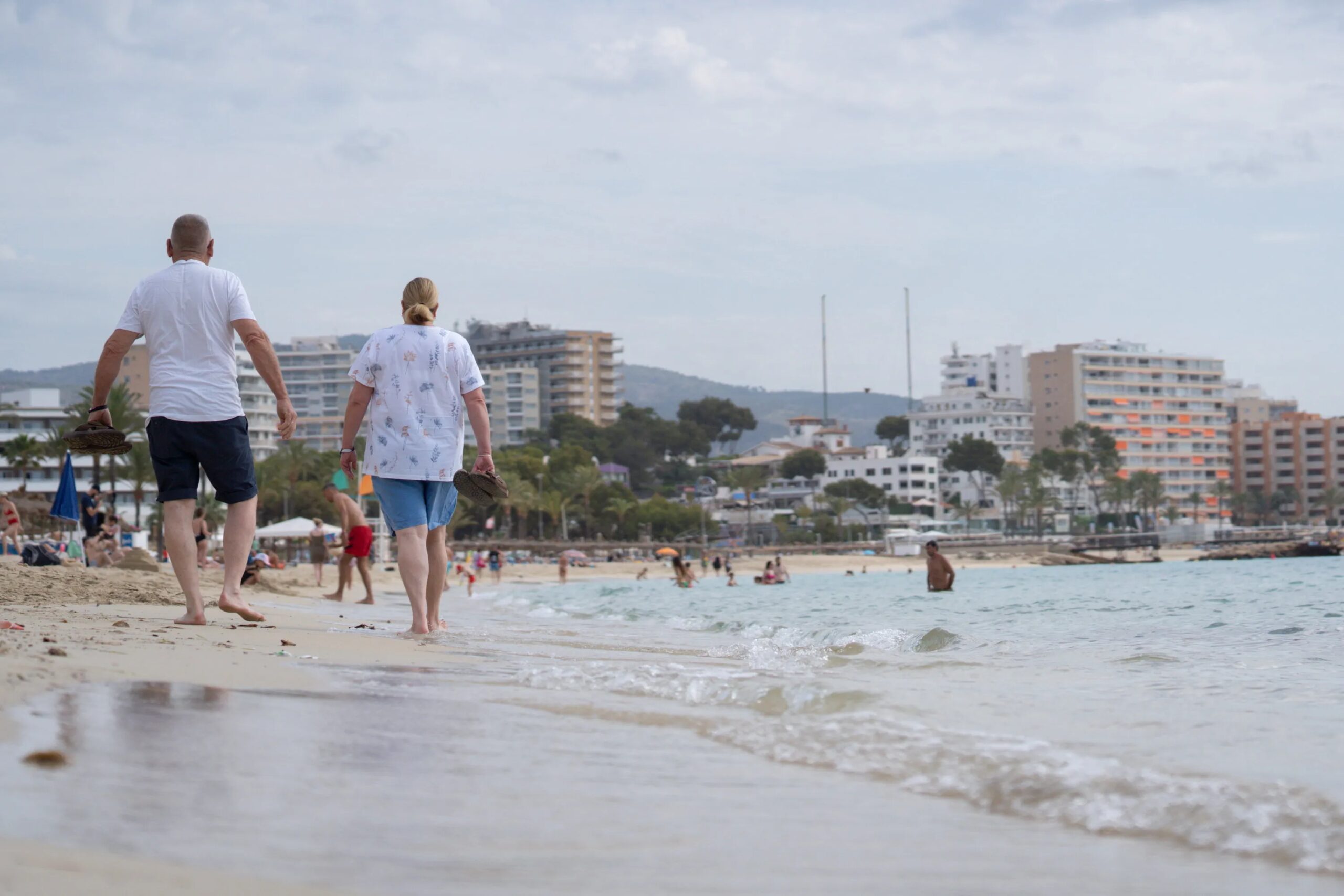
Beachgoers at Magaluf relax on the shoreCredit: SWNSSunseekers take a stroll in MallorcaCredit: SWNS
But 36 per cent of their Type B counterparts feel confident there is little risk of missing out on their dream destination, even without planning months in advance.
The research was commissioned by lastminute.com to mark the launch of its ‘Travel Bgents’ platform, a hub that rewards Type B bookers with extra discounts.
Zoë Fidler, from the holiday firm, said: “There’s a common misconception that Type B travellers are just unstructured non-planners who leave things to chance. In reality, they are the savviest bookers in the game.
“Type B travellers have simply realised that holding off on pressing ‘book’ is the smartest move you can make, knowing they can get what they want and at a great price.”
Yet a quarter (25 per cent) admitted they wish they could embrace this more spontaneous approach and have the confidence to book a trip without overthinking.
With 30 per cent of Type B travellers assured that they could change plans on a whim when leaving it late to lock in their trip.
It’s not just saving money and planning time as 42 per cent of Type B travellers agreed that spontaneous adventures while on holiday create lasting memories, whereas this was true for just 20 per cent of Type A travellers.
With Type B travellers revealed to be more likely to stumble across hidden gems (36 per cent v 28 per cent) or enjoy unexpected moments (42 per cent v 20 per cent).
Zoe Fidler, from lastminute.com, added: “By holding out for the right moment, Type B’s unlock premium trips at a fraction of the cost, without the over-planning.
“Leaving it to the last minute isn’t about compromising or settling for leftovers; it’s an intentional, high-reward strategy.”
The White House signaled Friday night that CNN would be left off Air Force One for President Trump’s Saturday trip, the latest media restriction from the administration in an ongoing dispute with 1st Amendment implications.
The news organization was replaced by Real America’s Voice News, a conservative outlet.
The news came just after journalists from three news outlets that Trump banned last week from the White House grounds — CNN, MS NOW and Politico — returned to the executive complex with TV cameras, laptops and microphones in hand.
A judge temporarily struck down the ban in an overnight ruling early Thursday, but his decision didn’t directly address White House pool reporters. The networks continued to refrain from covering Trump as part of the pool, even as reporters from all three outlets were allowed back in the White House.
The temporary order from the judge mentioned only the White House grounds and said nothing directly about Air Force One.
Theodore Boutrous Jr., the news outlets’ attorney, did not immediately respond to an email and phone call requesting comment Friday night.
For a while during the day, the U.S. network video pool for the White House was back in operation for the first time since Trump banned the three news outlets in an extraordinary showdown over media access.
At noon on CNN, viewers could see Trump and Chinese President Xi Jinping touring the National Archives Museum along with their wives, Melania Trump and Peng Liyuan. The banner along the bottom of the screen read: “Trump and China’s Xi Visit National Archives.” It was a routine report from a state visit — but for the fact that CNN had not aired live video of Trump in several days.
“As of now, all systems are go,” said a person familiar with the pool, speaking on condition of anonymity because of the fluidity of the situation.
The pool consists of five major U.S. broadcast outlets that take turns shooting and sharing video. When the White House banned CNN — which belongs to the pool — from White House grounds, along with MS NOW and Politico, the other four pool providers declined to participate in a show of solidarity.
CNN was not commenting directly earlier Friday, referring instead to its editorial coverage. But Brian Stelter, the network’s media analyst, posted on X that CNN had a pool assignment at the National Archives event and that the White House had approved the network’s credentials.
BRITAIN’S oldest Lido has vowed to “definitely reopen” after being left to rot.
The historic swimming facility has been closed for over two years, despite receiving a £9.3million makeover.
It was first built in 1815 and is the oldest of its kind to exist in the UK, but closed in 1984.Credit: Cleveland Pools
Cleveland Baths, first opened in 1815 and is the oldest of its kind to exist in the UK, but closed in 1984.
A huge campaign and a mulit-million pound refurbishment saw it reopen for just four months in 2023 before it was forced to close again due to flood damage.
Sign up for the Travel newsletter
Thank you!
But now trustees have promised to reopen the 200-year old pool, telling the BBC it is “moving as quickly and responsibly” as possible
It’s definitely going to happen,” Peter Askew, chair of Cleveland Pools Trust, told the outlet.
The trust has set out a timetable that includes a consultation and more fundraising, with repair works restarting in 2028.
In January 2024, the River Avon burst its banks and destroyed the facility.
A subsequent investigation revealed mechanical and structural damage.
“The first is that floodwater entered the door of the plant room.
“And then, secondly, in the process of emptying the pool of floodwater, the groundwater level wasn’t properly managed, and that led to further damage,” Peter explained.
Some ITV The Chase viewers complained on X minutes into Monday’s programme.
ITV The Chase viewers issued the same complaint (Image: ITV)
The Chase viewers have been left asking the same question.
The ITV gameshow returned on Monday, September 21, but viewers were quick to notice a repeat episode was airing, rather than the new series, which launched weeks ago.
During the show, Bradley Walsh and Chaser Darragh Ennis put four contestants to the test, Faith from Holmfirth, George from Hertfordshire, Anne from Pontypool, and Jamie from Liverpool.
However, after noticing the episode had aired in 2025, viewers were left asking the same question, with one writing: “Why is it back on repeats already? For the coming week. Perhaps they’re really struggling with their contestant quota,” reports the Express.
“Repeats already?” another echoed. “At least repeat the decent episodes!” someone else fumed. Another fan wrote: “Is it just me, or is this a repeat I’m watching? As far as I know, this ep was first shown in January 2025! What is going on, ITV?!”
The episode saw the four contestants ultimately lose against The Chaser. “I hope you’ve enjoyed your day, all of you, it’s been lovely meeting you,” Bradley told them.
“Sadly, I’ve got to take the £4,000 away and tell you that you that Faith, Anne, George and Jamie, you have been caught.” He added: “Once more, the Menace is triumphant! Could you take him down? Get together and apply, we’ll see you on The Chase.”
The Chase’s repeat comes after spin-off series, The Chase Around The World, aired earlier this year on ITV. The six-part special saw six teams of two battling to win £100,000 as they took on the beloved quiz show in destinations all over Europe.
ITV had teased: “The Chasers – The Beast and The Governess – have set a series of quiz questions, puzzles and cryptic clues that the teams must solve in order to navigate their way across the city and find Bradley at the finish line.
“Their route could take them to some of Rome’s iconic landmarks, such as the Colosseum, the Trevi fountain and the Spanish Steps. The teams must answer questions correctly to complete the course but they better be correct as wrong answers have serious consequences, costing them time and taking them off-course.
“Competition is fierce as the team that finishes last in each city will face a head-to-head showdown with the Chasers themselves. In Rome, the Beast and The Governess await. The final pair will need to beat them to stay in the competition. Lose, and it’s the first flight home.”
Speaking about the series, Bradley shared: “I would describe it as The Chase… but around the world! It’s out and about. It was very different doing it on location, in these incredible places, instead of being in a studio.
“I’ve been locked in Elstree Studios for 17 years! The locations were unbelievable. I loved it, I really did, but then again, I wasn’t chasing around, literally chasing around, the cities we were in.
Thousands of protesters took to the streets of Buenos Aires for the ‘March of Anger’, organised largely by left-wing groups opposing the Milei government’s austerity policies. Protesters say the cuts are hurting working families.
Byron Sher, a Stanford law professor-turned California legislator who wrote some of the state’s most far-reaching environmental laws, died Saturday. He was 98.
Cerebral and soft-spoken, Sher was the antithesis of politicians nowadays. He rarely issued press releases, didn’t convene news conferences, and disliked raising campaign money.
But he left an indelible mark on the environment, authoring legislation offering incentives to recycle, limiting advertisers’ inflated claims about products’ environmental benefits and combating water and air pollution.
He helped lead the effort to preserve ancient redwoods in Headwaters Forest in Humboldt County in 1999, pushing the state and federal government to buy it from Texas financier Charles Hurwitz, who owned Pacific Lumber Co. and was preparing to log it.
A decade earlier, in 1988, Sher authored legislation requiring that California take stock of the sources of greenhouse gases. It was the first time the legislature in California — or any other state — embedded the term “global warming” into a state law, and became the foundation for bills in later decades to combat climate change.
“The heat is on,’’ Sher said presciently, as quoted by the Sacramento Bee on May 5, 1989. “The state can either ignore what science is telling us, or we can respond to this challenge in a responsible way.’’
Because of his legislation, manufacturers today sell more products in spray bottles rather than aerosol cans, people can more easily dispose of televisions and other electronic waste, and underground gasoline storage tanks rarely leak and foul groundwater.
“Byron Sher built the legal and research foundation for California’s climate change regime and by extension helped shape how the world has tried to handle climate change,” said Joe Mathews, a Berggruen Institute fellow who is working on a book about the state’s legislative efforts to confront global warming.
Today, Sher’s 1989 legislation creating state wild and scenic rivers is a barrier to President Trump’s proposal to raise Shasta Dam north of Redding to increase water storage, an idea backed by Central Valley farming interests. His legislation protects the McCloud River, which feeds Shasta Reservoir. Raising the dam would inundate habitat along the McCloud.
That Sher placed such ideas into law reflected his ability to persuade and compromise. Gov. George Deukmejian, a Republican, signed the wild rivers legislation, and Sher’s Clean Air Act, which helped shape federal clean air legislation signed in 1990 by President George H.W. Bush.
Their partisan differences aside, Deukmejian viewed Sher as having “great personal integrity,” said Steve Merksamer, who was Deukmejian’s chief of staff.
“When Byron Sher wanted to come into the office and had the bill, would he get in? Absolutely. Would the governor listen to him? Yes,” Merksamer said.
Sher did fall short of convincing Deukmejian to sign one of his bills — a whimsical measure inspired by a Camp Fire girls and boys troop to proclaim the banana slug to be the official state mollusk. Deukmejian vetoed the bill, though Gov. Gavin Newsom signed legislation in 2024 designating the slimy yellow creature as the official state slug.
Sher was born in St. Louis in 1928, graduated from Harvard Law School in 1952, and joined the Stanford Law School faculty in 1957. He served on the Palo Alto City Council in the 1960s, got recalled in 1967 over his opposition to development and won back his seat in the 1970s. Sher was Palo Alto mayor in 1980 when he won an Assembly seat. He remained in the Assembly until 1996 when he was elected to the state Senate, serving until 2004 when term limits forced him to step aside.
Among the students who passed through his Stanford classrooms was Newsom’s father, William Newsom, who became a state court of appeals justice.
Sher and his aide and friend Kip Lipper attended a 2010 banquet in San Francisco at which the California League of Conservation Voters honored Justice Newsom with the Byron Sher Lifetime Achievement Award. In his acceptance speech, Newsom recalled that Sher was the only Sanford professor who gave him a C. When Lipper asked whether the story was true, Sher deadpanned, “He deserved it.”
“There aren’t a lot of tales to tell about Byron Sher,” said Bill Lockyer, who was Senate leader when Sher won a state seat in 1996. “He went home at night and tended not to get into the Capitol gossip.”
In 1996, Lockyer entrusted Sher to serve on a joint Assembly-Senate conference committee that produced landmark legislation that sought to deregulate California’s electricity system.
Sher added provisions expanding requirements that the state use renewable sources of electricity and called the legislation “an extraordinary result” given the issue’s complexity. Lockyer said Sher’s additions, while important, were “the cherry on top of the toxic sundae.”
The legislation was blamed for California’s electricity crisis in 2000 and 2001 when swashbuckling energy traders manipulated the markets, causing prices to spike, resulting in rolling blackouts, and fueling the 2003 recall of Gov. Gray Davis.
Sher was notable for measures he refused to support. With a few other liberal Democrats, nicknamed the Grizzlies, Sher would pick through turgid language of legislation looking for provisions that reflected the undue influence of special interests.
Sher voted against 1986 legislation that purported to open the way for a shrimp processing facility in West Sacramento. The bill turned out to be part of an elaborate FBI sting that resulted in 14 legislators, lobbyists and others being sent to prison.
“He wasn’t a comfortable politician,” said San Mateo County Supervisor Jackie Speier, a former Democratic congresswoman who served in the Legislature with Sher. “He didn’t speak up a lot. So, when he did, people listened.”
He displayed partisan side in 1994 when Republicans took a 41-seat majority in the 80-seat Assembly, and Republican Assemblyman Jim Brulte was in line to be elected speaker. But Democratic Speaker Willie Brown had a Republican supporter, Paul Horcher, who voted to retain Brown as speaker, plunging the two parties into a yearlong fight for control.
To wrest control from Republicans, Brown asked the professorial Sher to challenge one Republican’s right to remain in the Assembly. That Republican, Richard Mountjoy of the San Gabriel Valley, won two elections that November — one to the Assembly and the other in a special state Senate election to fill the seat vacated when the incumbent, Frank Hill, was sentenced to prison in the corruption scandal.
Sher reasoned that Mountjoy had to make up his mind — stay in the Assembly or move to the Senate. Facing term limits in the Assembly, Mountjoy joined the Senate in January 1995. The partisan battle went on all that year.
Brulte, who never did become speaker, was elected to the Senate in 1996, as was Sher. On Sunday, he called Sher “a wonderful man.”
“Everything in politics today is personal. It wasn’t personal,” Brulte said of Sher’s role in the speakership battle. “Somebody may have taken it personally, but I certainly didn’t.”
Sher retired to a pear orchard in the Sierra Nevada foothills and served on Tahoe Regional Planning Agency and Sierra Nevada Conservancy.
His wife of 62 years, Linda Bowser Sher, died in 2014. He is survived by three children, five grandchildren and a great-granddaughter.
MADRID: The Spanish government on Sunday said more than 5,300 of the migrants who remained in Ceuta after July’s influx had returned to Morocco in a month, as it faces pressure to restore normality to the increasingly tense city.
The new figures come as criticism over the speed at which the migrants are being returned from the Spanish north African territory damages Socialist Prime Minister Pedro Sanchez before next year’s election.
More than 70,000 migrants entered Ceuta on July 30 and 31 in an unprecedented and deadly rush, with most returning to Morocco in the following hours.
The government has had to identify the thousands of migrants who have remained for weeks to check if they are entitled to asylum, while unaccompanied children cannot be summarily deported.
Angel Victor Torres, the minister tasked with leading the government’s response, said in a video posted to social media that 5,321 people had “voluntarily returned” to Morocco since August 10.
Ninety people had “given up” their request for international protection and “almost 1,000 people are being registered with the aim of being able to complete their return proceedings,” Torres added.
The minister did not say how many migrants remained in Ceuta after those returns, a figure that has consistently sparked controversy between the leftist government and the conservative-run city.
On Friday, Ceuta’s leader Juan Jesus Vivas, of the main opposition right-wing Popular Party, put their number at 13,000, but the government’s estimations have been significantly lower.
Locals have protested regularly as the migrants continue to camp on beaches and sleep in the streets, accusing the government of abandoning the overwhelmed city amid a humanitarian crisis.
The migration ministry announced on Sunday the creation of another 864 places in temporary migrant shelters, taking the total to around 4,300 and with a view to reaching 6,000 “in the near future.”
Doubts about what the government knew beforehand and the possible role of Morocco, with which Madrid has spent years trying to improve relations, have also increased the political fallout for Sanchez.
The competition series fronted by Gary Lineker took an uncomfortable turn as lies told by one of the cast finally came to light
The Box stars were left unimpressed after one of their fellow contestants came clean about some ‘white lies’(Image: ITV)
ITV’s The Box cast were stunned after learning their co-star had lied to them.
The star-studded competition series sees celebrities taken to a series of locations where they are then given a challenging task to complete. As per ITV’s synopsis: “Plunged into the unknown while enclosed in a box, 10 celebrities emerge in mystery locations to face their fears in tricky challenges.”
While the line-up initially featured 10 famous faces, that has now been whittled down to just eight at the start of the third episode, which aired this evening (September 12). Remaining in the contest was YouTuber Danny Aarons; comedian Ellie Taylor; reality star Joey Essex; JLS star JB Gill; The Chase’s Jenny Ryan; former politician John Bercow; presenter Ranvir Singh and Love Island star Shakira Khan.
The opening challenge saw the cast thrust into a debate at the prestigious Oxford Union in front of a packed audience. Their debating partner was a fellow celebrity, with reality stars Joey and Shakira going head-to-head in an argument over whether cats or dogs made the better pet.
Just before the start of their debate, Shakira revealed that not only had she been Head Girl at her school, but that she had also been “head of the debate club”, leaving the audience erupting into gasps and Joey immediately doubting his chances at a win.
“I’ve no chance, have I?” he said, before show host Gary Lineker revealed that Joey had to argue for cats being better pets, while Shakira was assigned the counter-argument during which she claimed a scar on her face had been at the hands of a cat.
Despite his passion for the subject matter, Shakira was ultimately crowned the winner of their debate by the watching audience. However, when Gary brought the cast together later on, it emerged Shakira had not been entirely honest.
“Shakira, as head of the school debating society how relieved were you not to lose to Joey Essex?” Gary asked, prompting a sheepish admission from the Love Island star.
“That was actually a fib Gary,” she started, as a stunned Gary replied: “It was a fib was it? I didn’t think you had that in you.”
“The scar from my chin is also not from a cat,” Shakira added, leaving her co-stars open-mouthed. “So a few white lies don’t hurt in politics.”
Following the admission, her co-star Aaron fumed: “Shakira has shown her true colours today. She lied to the audience and I think that shows a snake.”
The Box continues tomorrow night at 8pm on ITV1 and ITVX. Episodes 3 and 4 are also available to stream now on ITVX.
Gaza City, Gaza Strip – For more than four hours, Hajj Rabhi al-Fairi, 79, has been standing outside his home in Gaza City with his children and neighbours waiting their turn to use a small generator.
The generator’s owner pours in the fuel, starts a timer and switches on the machine.
Recommended Stories
list of 4 itemsend of list
Each family gets a few minutes to operate a pump that pushes water up to a storage tank on the roof, before the generator moves on to the next house.
For al-Fairi and his neighbours, this is how they get water.
“We have an old water pump, but there is no electricity to run it. We have to rent a generator,” al-Fairi tells Al Jazeera.
Since the family returned to their home in October 2025, after fleeing a month earlier during Israel’s assault on their neighbourhood, the generator has become a familiar sight on the streets of Nassr.
When it arrives, residents gather around it, each carrying a jerrycan of diesel to operate the machine, which they have to pay for themselves.
“We came back and found the place a tragedy,” he says.
Their neighbourhood and home were badly damaged from years of Israeli bombing, with no municipal electricity or water supplies functioning. The family depends on an old pump – but without electricity, it cannot bring water up to the rooftop tank.
Each family needs only about seven or eight minutes to fill up their tanks, but with the number of flats in their building, the generator needs to be rented for about an hour.
The cost has also risen. Al-Rabhi says families used to pay about 80 to 90 shekels ($26-30) to rent a generator for an hour. At different times, the price has risen to about 100 or 120 shekels ($33-40) an hour, excluding the cost of diesel.
A generator passes through a northern Gaza neighbourhood [Abdelhakim Abu Riash/Al Jazeera]
A generator on wheels
Khalil Abu Ouda, 39, takes a machine mounted on a horse-driven cart from one house to another. The generator’s metal body is covered in black soot and grease, and white smoke rises from the engine when it operates.
At each house, Abu Ouda connects long electrical cables to the water pump. The cables stretch across the street as neighbours gather around the machine to wait their turn.
“Go on, switch it on,” someone calls.
For Abu Ouda, this machine is both a service for the neighbourhood and an essential source of income for his family.
He says there are very few small, mobile generators, like his, left in working condition in Gaza. Many have broken down, while spare parts are difficult to find or too expensive to source due to Israel’s siege.
Mechanics are also expensive to hire, while fuel and engine oil are increasingly scarce and costly.
“If I could, I would lower the price as much as possible,” he says.
At the same time, demand has never been higher.
“People are under pressure and they need water. If I stayed working until morning, I would keep working,” Abu Ouda says.
To cope with the demand, he often works for 10 to 12 hours a day, putting pressure on himself and the machine.
“But this is our livelihood. There is no alternative,” he said.
When the home stops providing
With most Palestinians in Gaza having no home or losing their possessions due to Israel’s genocidal war on Gaza, they have to rent or hire items or services for the most basic household chores.
This includes washing clothes, something once done at home but now impossible to do with no power.
Earlier in the war, Abeer Ghorab, 52, used to wash everything herself. Now she gathers clothes from her tent and takes them to a nearby laundry, where they can be washed and dried in far less time and with less effort.
“When these laundries started opening, they gave us some relief,” Ghorab said.
The difference is particularly important in winter, when heavy clothes, blankets and bedding can take time to dry.
“In winter, the tracksuits are heavy. They need another day to dry,” she said. “When I bring them here, they wash and dry them for me, and I get them back clean and dry. That really helps.”
Abeer Ghorab, 52, a displaced Palestinian woman, takes her clothes to a commercial laundry, paying to wash and dry them as water and electricity remain scarce [Abdelhakim Abu Riash/Al Jazeera]
But due to a limited income, Ghorab cannot afford to use this laundry service every day.
Before the war, Ghorab had a washing machine, a refrigerator and regular electricity at home.
“Things we once took for granted have become dreams. Now we have to pay for every little thing we used to do at home.”
The loss of the household
Across Gaza, the infrastructure that once allowed families to carry out everyday tasks at home has been severely disrupted.
A recent United Nations assessment found that 91 percent of surveyed households experienced moderate-to-high water shortages in early August.
A separate damage assessment by the authority found that 107,941 of the 178,632 housing units inspected – about 60 percent – were severely damaged, destroyed or otherwise considered uninhabitable.
Water systems, electricity, sanitation and household appliances, which families relied on to manage daily life, have also been disrupted.
For families living in damaged homes, tents or makeshift shelters, everyday tasks must be paid for.
A laundry adapting to shortages
Fadi Abu Shawarb, 23, has worked at his family’s al-Hurriya laundry for six years.
Residents now rely on communal washing machines for cleaning clothes [Abdelhakim Abu Riash/Al Jazeera]
Before the war, the business relied on large, 50kg (110lb) washing machines for carpets, blankets and other heavy loads. But due to the high cost of operation, these machines are far too expensive to run.
“We started replacing the 50kg machines with 25kg ones because there is not enough electricity,” Fadi says. “There are no solar panels, no reliable power, and the generators are always breaking down.”
Most of his customers are displaced families who lack electricity, water or washing machines at home.
The laundry now handles about 20 to 30 loads a day, with clothes-washing among the most in-demand services.
A load costs six shekels ($2) when the laundry can use solar power and 12 shekels ($4) when it relies on a generator.
But even that is hard for people to pay. “People’s situation is difficult,” he says.
For Ghorab, the laundry is only one of the many expenses she now has to budget for.
“I feel like I’m going through a difficult time,” she says. “I have to pay for every little thing in my day, and with how difficult things are, it’s hard to keep up with everything.”

























![A generator passes through a northern Gaza neighbourhood [Abdelhakim Abu Riash/ Al Jazeera]](https://i0.wp.com/occasionaldigest.com/wp-content/uploads/2026/09/873A2309-copy-1789208507.jpg?w=640&ssl=1)
![Abeer Ghorab, 52, a displaced Palestinian woman, takes her clothes to a commercial laundry, paying to wash and dry them as water and electricity remain scarce. [Abdelhakim Abu Riash/ Al Jazeera]](https://i0.wp.com/occasionaldigest.com/wp-content/uploads/2026/09/873A2195-copy-1789208594.jpg?w=640&ssl=1)
![Residents wait for a mobile generator to reach their homes so they can pump water, paying by the hour to use the machine [Abdelhakim Abu Riash/ Al Jazeera]](https://i0.wp.com/occasionaldigest.com/wp-content/uploads/2026/09/873A1950-copy-1789208427.jpg?w=640&ssl=1)