He was tentatively scheduled to start Wednesday against the Phillies, after promising initial reports on his recovery from an injection in his left knee. But after seeing his knee’s response to playing catch, the team decided to give him more time.
“We just want to continue to give it the best chance to kind of get into a good spot,” manager Dave Roberts said. “And as he said, as we feel, it’s the pitching and the torque of landing on that leg that kind of gets it upset.”
It was clear enough from catch play that Ohtani’s start would have to be pushed back that Ohtani did not feel the need to test it by throwing off a mound, Roberts said.
“Where we’re at right now, how we’re proceeding, I would say that it’s going to be some time,” Roberts said. “It’s not going to be a day-to-day thing.”
That left a wide range of timeline possibilities, from days to weeks. Roberts did, however, rule out shutting Ohtani down from pitching for the rest of the season.
“I guess anything is possible, but I just don’t think that’s a possibility,” he said.
To fill Ohtani’s spot in the rotation this week, the Dodgers moved right-hander Emmet Sheehan’s start to Monday. Before the rainout bumped the second game of the series against the New York Yankees, Sheehan was scheduled to start Saturday.
For Sunday’s doubleheader, right-hander Yoshinobu Yamamoto will take the mound in the first game. The bullpen, and potentially multiple innings from the 27th man, will cover the nightcap.
“Honestly, a lot of it is where we’re at and how we’ve put ourselves in a good spot,” Roberts said of the MLB-leading Dodgers. “Could [Ohtani] probably do it? Sure. But right now, the benefits just don’t seem to outweigh the cost at this time of the season. So I think we still have plenty of time to get him to a good spot to then pitch.”
Ohtani, who went hitless in four at-bats as the designated hitter in Friday’s 2-1 win, was set to DH and hit leadoff in Sunday’s first game.
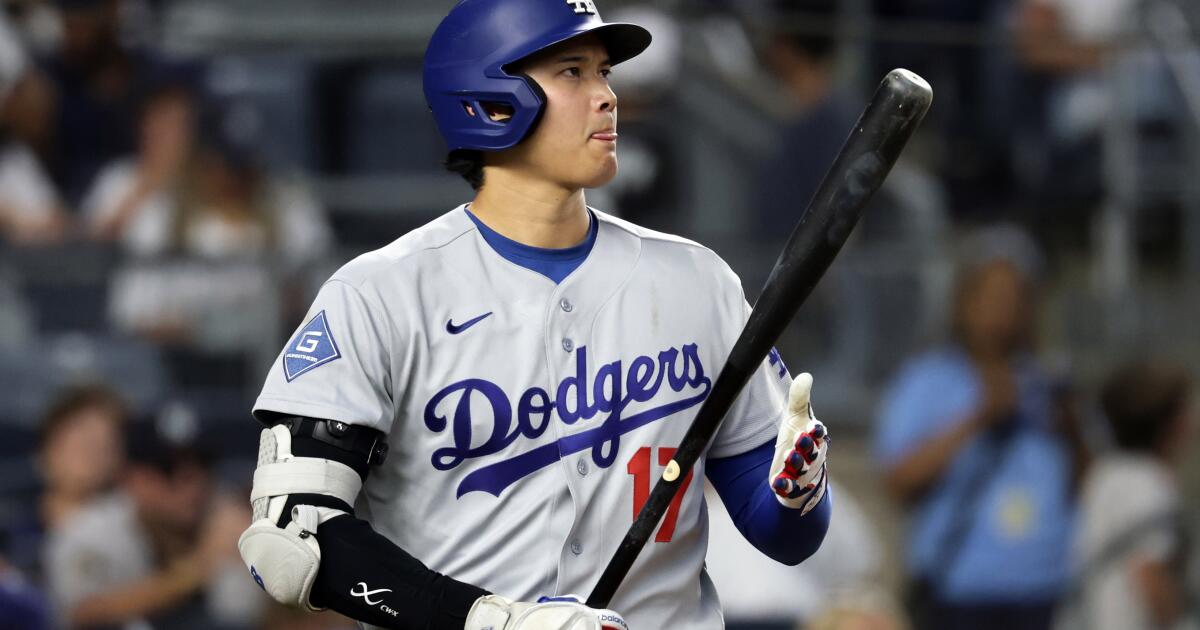
CHICAGO — Dodgers superstar Shohei Ohtani stepped into the Rate Field batter’s box for the first time this series on Saturday, greeted by a smattering of boos from White Sox fans.
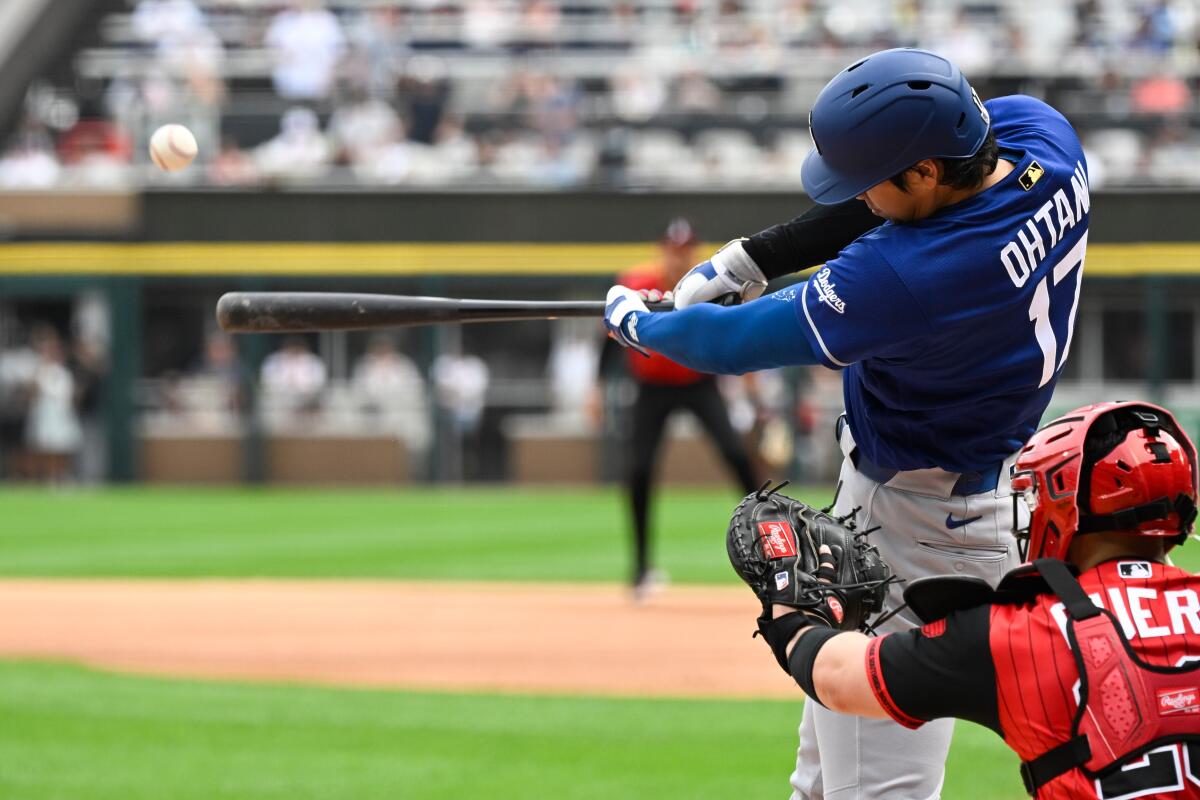
He took his first swing at the second pitch of the game. And he sent it into the right-field stands. A no-doubter, proclaiming that his availability was no longer in doubt.
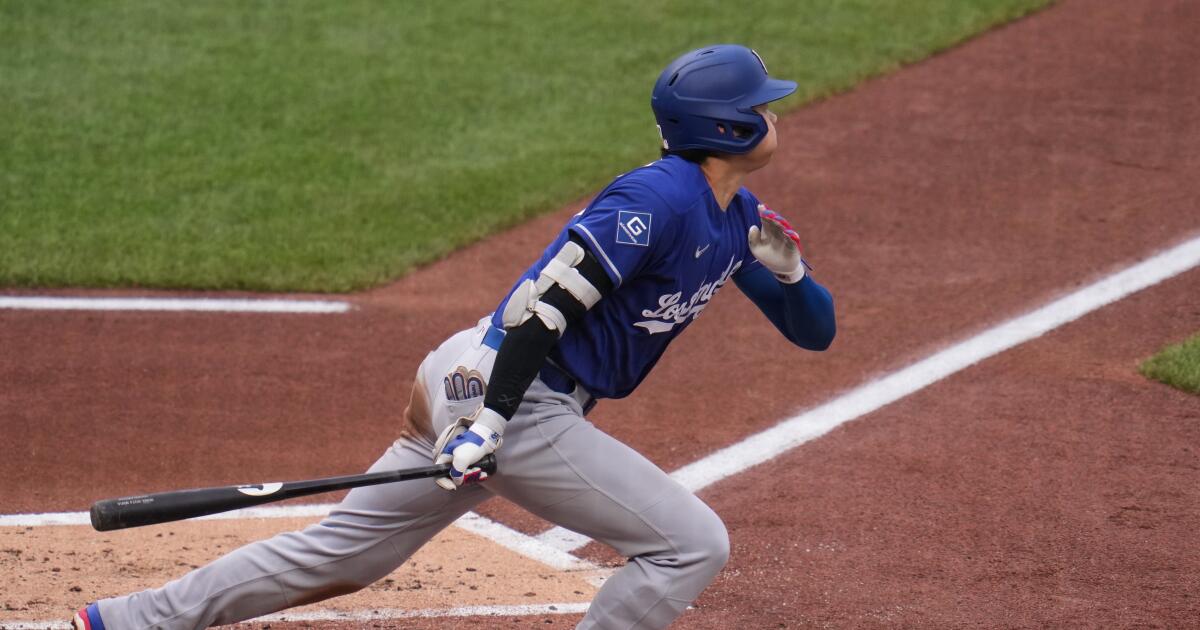
Ohtani returned to the lineup for the Dodgers’ 7-1 win against the White Sox on Saturday, after exiting the Dodgers’ game Thursday against the Pittsburgh Pirates and missing Friday against the White Sox because of inflammation in his left knee.
“I felt good waking up in the morning,” Ohtani said through interpreter Will Ireton after going one for three with a home runs and three walks Saturday. “I feel good now. So I’m pretty confident that I’ll be able to stay healthy, and should be good to go [Sunday] as well.”
Ohtani also tested his knee playing catch before the game Saturday. And the Dodgers will continue to monitor him as he prepares to take the mound Wednesday against the Tampa Bay Rays at Dodger Stadium.
“It wasn’t 100% today,” Ohtani said. “But with the next three, four days, I feel pretty confident, with enough recovery, that I should be able to make the next start.”
Even Ohtani said he hasn’t been able to pinpoint the cause of the swelling. But he has a theory.
“All I can really know for sure is that I think my mechanics weren’t quite great in terms of my pitching side,” he said, “so I believe that had something to do with this.”
Even before Ohtani’s knee swelled the Dodgers planned to have him pitch the day before their Thursday off day.
They switched Ohtani and left-hander Justin Wrobleski in the rotation order, having Wrobleski pitch Thursday on regular rest.
That remains the plan, even after Wrobleski was hit in the leg by a comebacker during his start Thursday. He left the game after that play in the fifth inning with a bruised right hamstring.
The Dodgers considered bringing in a spot starter, manager Dave Roberts said, in order to keep the full rotation on extra rest.
Shohei Ohtani leads off the game with a home run to spark the Dodgers to a 7-1 win over the White Sox on Saturday.
(Matt Marton / Associated Press)
“But considering how Wrobo’s start went short, feels good after it, we feel the four days’ rest will be fine for him,” Roberts said. “And then where Shohei is at, we feel good about just leaving it status quo.”
Ohtani returned Saturday without restrictions in his designated hitter role — except one request from his manager, after a couple days of parsing whether a steal attempt that was snuffed out by a foul ball had contributed to Ohtani’s injury.
Though they didn’t find a clear cause for the injury, Roberts made it clear Saturday: “There will be no basestealing.”
CHICAGO — Dodgers superstar Shohei Ohtani was out of the lineup Friday against the White Sox after exiting the game before with discomfort in the back of his left knee.
Manager Dave Roberts had expressed optimism Thursday night, after the Dodgers’ 8-6 win against the Pirates at PNC Park, that Ohtani would not miss additional time for the ailment. But he added: “Obviously with the travel [to Chicago on Thursday night], we’ll just kind of see how he comes in.”
Especially at this point in the season, the Dodgers have incentive to play it safe with Ohtani’s recovery. Pushing him to return early and exacerbating the injury would be a larger blow to a team seeking its third straight World Series championship.
With Ohtani out, left fielder Alex Call was in the leadoff spot, and Santiago Espinal served as the designated hitter.
It was not immediately clear whether the injury would affect Ohtani’s next pitching start. He’s lined up to take the mound Wednesday against the Rays, before the Dodgers’ off day Thursday.
Will Smith crouched, his left knee on the ground and his mitt grazing the dirt as his Team USA teammate Mason Miller strode towards the plate.
From there, the only way for his glove to go was up and through the slider that fell out of the strike zone as the Dominican Republic’s Geraldo Perdomo stopped his swing. But, in a full count, home plate umpire Cory Blaser called it strike three.
“That’s the work we do in the cage, and off the machine, and drills, and all that coming to fruition, and being applied to in-game,” Smith said in a recent conversation with The Times.
He has a slim chance of replicating that moment during the season, with the ABS challenge system implemented in MLB. If it had been in play during the WBC — as long as the Dominican Republic had challenges left — Perdomo surely would have used one on the final pitch of that 2-1 game.
And yet, as counterintuitive as it may sound, Smith dedicated time and effort during spring training to improving his framing.
“It’s important because you only get two challenges a game, offensively and defensively,” Smith said. “The whole team only gets those two. So the harder I can make it on the other team to challenge pitches, the better. The more strikes I can get and not have to challenge, the better. I think overall, it almost makes it more important, in a way.”
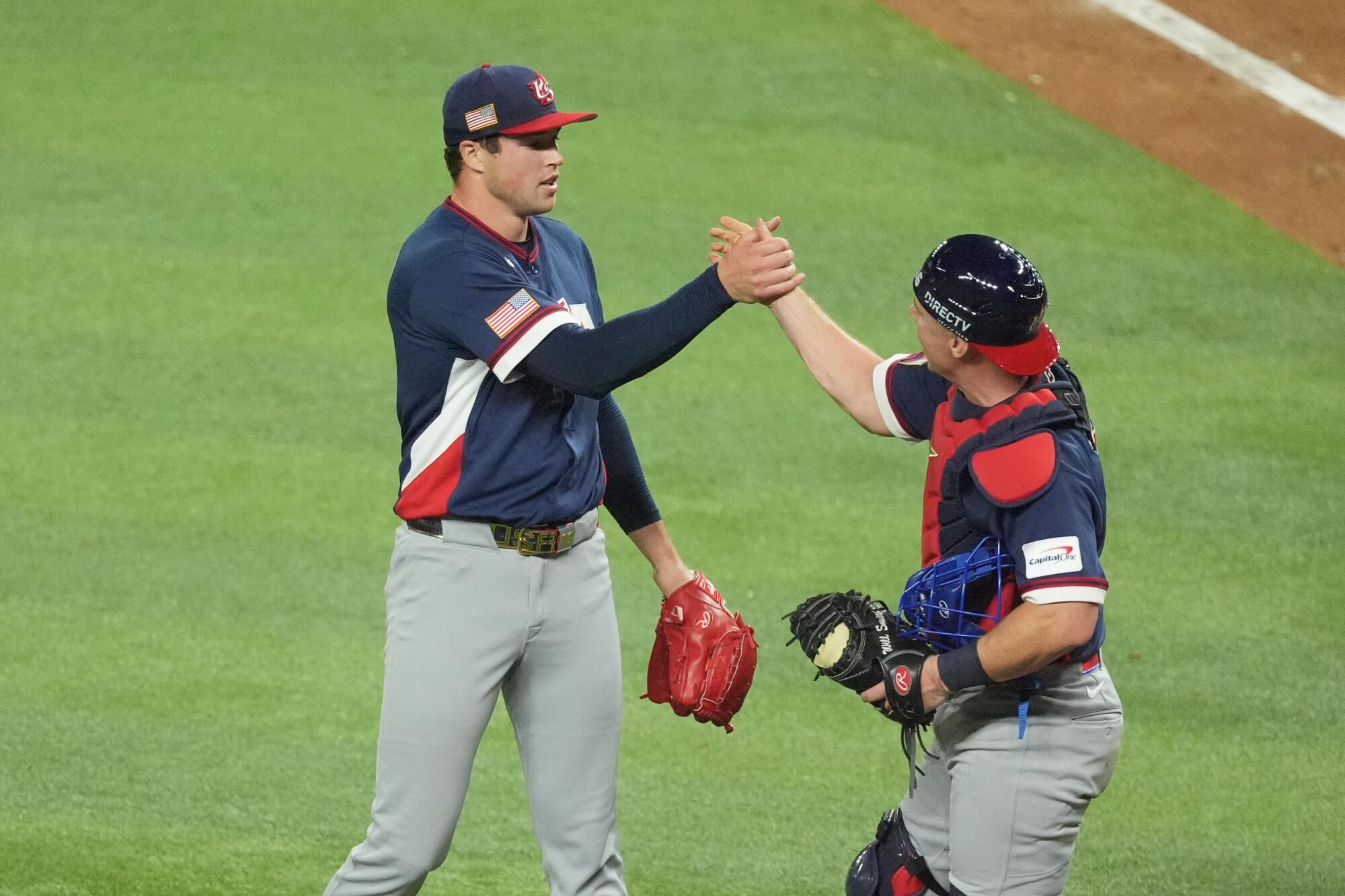
United States pitcher Mason Miller and catcher Will Smith celebrate a WBC semifinal win over the Dominican Republic.
(Rebecca Blackwell / Associated Press)
Framing had been a weakness in Smith’s game in recent seasons, according to Statcast’s catching metrics. His best season was 2023, when he recorded four runs saved via pitch framing. But he slipped to minus-eight and minus-10 the next two seasons. Entering the Dodgers’ series against the Phillies this weekend, he was at an even zero after 43 games at catcher this season, including 39 starts.
And now, when Smith doesn’t get a call, he has ABS to fall back on. Entering Friday, he’s challenged 41 calls through the ABS system from behind the plate, the 10th-most of any catcher. And he had a 71% success rate, the ninth-best mark among catchers with at least 20 challenges.
Because the catcher has the best vantage point, teams across the majors have made their catchers, not their pitchers, the point men for ABS challenges on defense.
ABS as a skill, however, isn’t just about getting the challenges right. Knowing the right times to take a risk is also key.
“There’s so many games within the game,” Smith said, “and that’s just another one of them.”
As Smith alluded to, under the challenge system — as opposed to fulltime ABS, which MLB also tested in the minors — it’s still possible to steal strikes.
“I like the challenge system because you still have the human error element to the game,” Smith said. “…Everyone always talks about how it’s a game of life, dealing with failure and dealing with ups and downs — the umpire screwing you or catching a break, that’s part of the game.”
Dodgers catcher Will Smith walks to the dugout after the fifth inning of a Dodgers-Marlins game at Dodger Stadium on April 27.
(Ronaldo Bolanos/Los Angeles Times)
Now, the players have recourse for the egregious calls and the biggest moments of the game.
The margins are so slim, however, that if a hitter isn’t convinced enough on a borderline strike call, and the situation dictates caution, he may not challenge.
The same goes for a catcher on a borderline ball call.
That’s where Smith’s work on framing comes in. He describes it as a change in philosophy.
“For me, it’s more just understanding the move,” Smith said. “I had to drill it in a little bit obviously, but more understanding the move of going farther out to get it, working through the ball, more like towards the pitcher, as opposed to letting the ball kind of come back to you. That was just not how I’d ever done it.”
That’s what he did on that last pitch of the WBC semifinals. Moving through the ball creates a more seamless motion, compared to pulling it into the strike zone, making the frame job more convincing. And catching it out in front also stops the ball’s own movement before it gets too far out of the zone.
That’s how Smith made a pitch that appeared to cross the plate below Perdomo’s knees look like a strike from Blaser’s vantage point.
The effect Smith’s spring training work behind the plate will have on the Dodgers’ season will be subtler. Instead of a singular game-defining moment, it’ll be an edge here and there.
But over the course of a long season, that adds up.