How a baseball coach led Mission College to a tennis title
When Joe Cascione walked into the athletic director’s office at Los Angeles Mission College with the idea of starting a women’s tennis team, he knew how it would sound. He had spent his entire life in baseball—27 years as a coach—and had never coached women or a racquet sport.
“I told him, ‘I have an idea. I’d love to start a women’s tennis team. I don’t have any background in tennis, but I think I can surround myself with people who know the technical side of the sport, and I love it so much that I think we can do well,’” recalled Cascione, a successful former baseball player at Pierce College and Cal Lutheran.
It was understandable that few understood the decision.
“Everyone thought I was going through a midlife crisis,” Cascione said with a laugh. “They’d say to me, ‘What are you doing? You’re having a breakdown.’”
College administrators also wondered if it wouldn’t be better to have a women’s soccer team, given the demographics of the San Fernando Valley. But Cascione presented them with a list of potential players who could attend Mission College.
“At first I was against it,” recalled Steve Ruys, director of athletics at Mission College. “I told him that women’s soccer was better for this area. But he was persistent.”

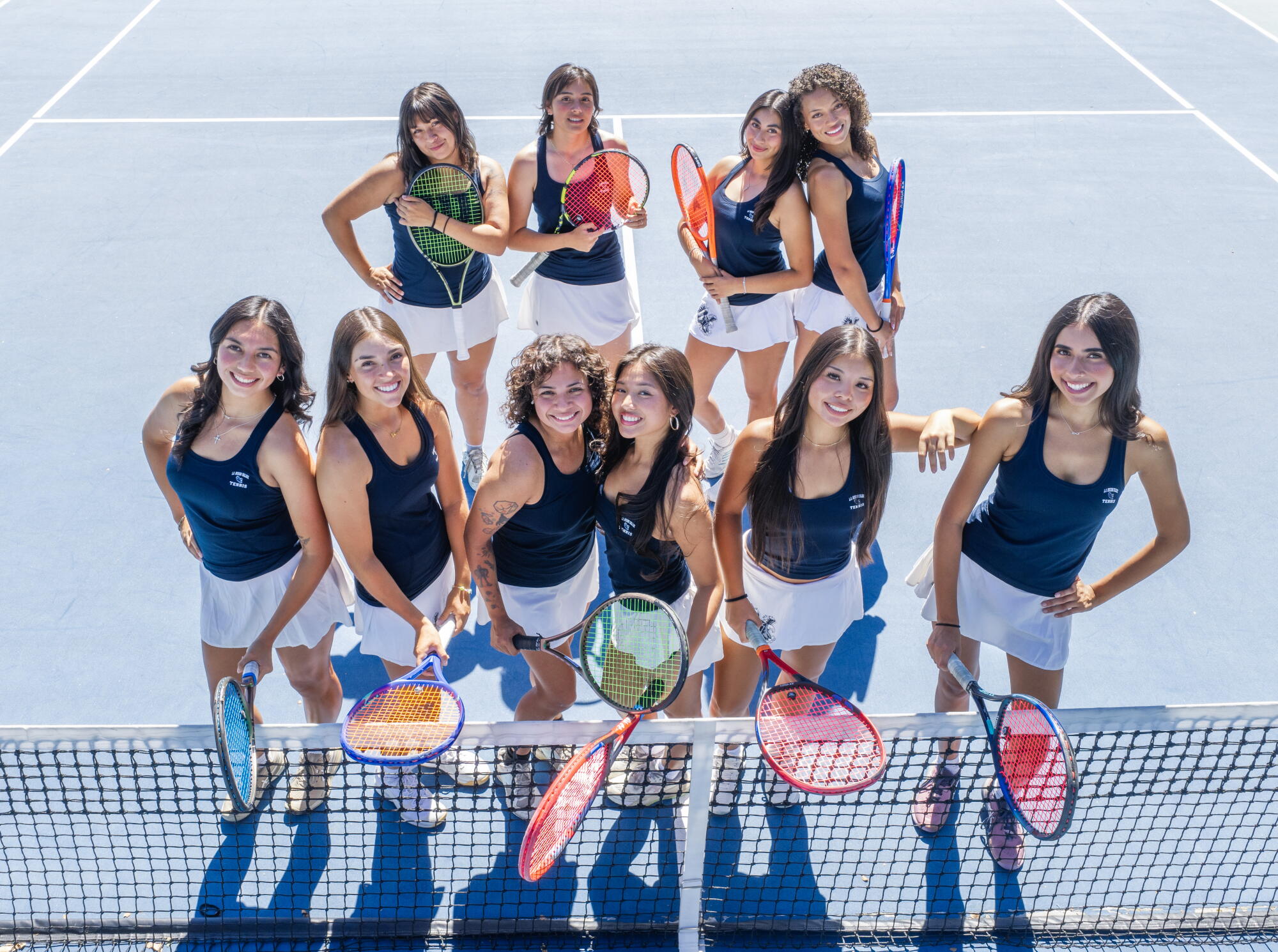
In the front row, from left to right, bottom, are the Mission College sophomores: Jaelyn Rivera, Priscilla Grinner, CiCi Díaz, Kirsten Bonzon, Amy Nghiem and Natalia Ponce. In the second row, from left to right, top, are the four new team members: Dsyray Chan, Daisylynne Castaneda, Julieta Sierra and Lena Onejeme.
(Myung J. Chun/Los Angeles Times)
Four years later, the gamble paid off in a big way. Last April, the Mission College Eagles won the first California Community College Athletic Assn. (CCCAA) state team championship in the school’s history, and they did so with a perfect 25-0 record.
Not only did they win the community college’s first championship, but they did so with local players and against powerhouse schools—some of which even fielded international players. Unlike other schools, Mission College does not have its own tennis courts and rents courts at a nearby park to practice and play its home matches.
In CCCAA tennis, colleges face off against each other in team matches. Each match consists of a set number of singles and doubles matches, and the winner is determined by the team’s cumulative score.
In the final of a four-day tournament in Ojai, Mission College faced Sierra College — the top seed from Northern California and also undefeated — and won a dramatic match. The Eagles dominated the doubles, but Sierra fought back in the singles and took a 4-3 lead.
Then, Genesis Nochez (West Ranch) tied the series at 4-4, and everything came down to Josilyn Rivera (Birmingham) in a head-to-head match against Autumn Holmes of Sierra. To add to the drama of the day, Rivera lost the first set, bounced back with a 6-1 victory in the second and clinched the championship in a tiebreak she won without giving up a single point, for a final score of 3-6, 6-1, 7-6 (7-0).
In addition, the duo of Jaelyn Rivera (Birmingham) and Priscilla Grinner (Granada Hills) were crowned state doubles champions after defeating a Chabot College pair.

Amy Nghiem takes a shot during Mission College practice at El Cariso Regional Community Park in Sylmar.
(Myung J. Chun/Los Angeles Times)
“I had always thought about winning the Ojai tournament, but I never thought it would actually happen,” said Grinner, 19, a two-time CIF champion with Granada Hills.
“Winning that tournament meant everything to me and my family; it was like giving back to the community where I grew up, and that meant so much to me,” said Jaelyn, 20, Josilyn’s older sister.
Amy Nghiem was one of Mission College’s key players. The Granada Hills Charter alumna joined the Eagles alongside her teammates Grinner and América Fragoso, both from Granada Hills.
Cascione was also named Western State Conference coach of the year.
For the players, the sense of teamwork that the coach instilled was vital to building a competitive program.
“The coaches encourage us to be our best. Without our teammates, without that connection, without that camaraderie, and without all the time we spent together, it wouldn’t have been possible,” Grinner said of the championship.

Jaelyn Rivera serves during her team’s practice at El Cariso Regional Community Park in Sylmar.
(Myung J. Chun/Los Angeles Times)
Cascione stepped down as head baseball coach at Mission College in 2019 after 19 years at the helm of the program. Then came the pandemic — and with it, a year and a half to reflect on what the next step in his athletic and professional life would be. The answer lay in the other sport he had loved since childhood, as he had always played tennis in his free time.
“If I had to do it all over again, I’d probably choose to play tennis instead of baseball,” confessed Cascione, who was twice named State West Conference coach of the year in baseball. “Baseball was my life, and I owe it everything. But there’s something about tennis. When I was seven, I’d watch it on TV and enjoy every minute of it.”
But convincing the first female players to join a new tennis program — in the midst of a pandemic and without its own courts — was no easy task. In the community college system, recruitment is crucial, and competing against schools such as Glendale, College of the Canyons, and Pierce—which have their own facilities—is always an uphill battle for Mission College.
“I couldn’t tell them, ‘We’re going to be a good team,’’ Cascione said. “I really didn’t know. ”
Nor was it easy to convince a tennis player to join a program led by a baseball coach. That’s where another of Cascione’s strengths came into play: his candor.
“The only thing I kept telling them was, ‘You’re going to work hard, and you’re going to have a coach who’s going to push you to your limits and who’s going to be there for you every time we’re on the court,’” Cascione said. “There has to be a belief that, even when things go wrong, you’ll hear your teammates cheering you on. And that’s not something you mention just once or twice; it’s something we talk about almost every day in this program.”
Seven young women accepted the challenge in the first year and nine in 2023. Faced with a lack of dedicated facilities, Cascione applied the same philosophy he used when his baseball team had to rent a field: adapt and overcome the obstacle.
In its first season, in 2022, the team surprised everyone by finishing second in its division in the State Western Conference. Since that first season, Cascione has worked to bring the team-oriented mindset he preached in baseball over to tennis.
“I think he’s very articulate,” said Grinner, who hopes to transfer to Cal Lutheran after this year to play alongside her teammate Jaelyn. “He’s able to explain things to you and encourage you even when you’re feeling really, really down, and I think that’s one of his best qualities.”
Said assistant coach Yulia Zhytelna, “First and foremost, he’s a baseball coach, and on the court he shows exactly who he is — in the way he talks, how he cheers, and how he addresses the girls. He doesn’t try to hide anything; that’s just who he is, and I’ve loved that about him.”
Recruiting the talented Nghiem was one of the championship team’s greatest successes. Cascione himself gave her a tour of the school.
“It’s not a very big school, but they’ll go above and beyond for you. They’ll stand by you,” said Nghiem, who also highlighted the team’s culture of camaraderie. “We all went to practice every day. Even if you were sick, you were there. You didn’t have to practice, but you were there. You always supported each other.”
Mission College, located in an area with a strong Latino presence in the northern San Fernando Valley, competed against programs with a long history, their own facilities and international players —such as Glendale, College of the Canyons, Santa Barbara, Ventura, and Santa Monica — so the coaching staff was key to instilling a positive mindset in the players, without letting them get pigeonholed.
“Not many people see us as a community capable of achieving something this big,” said Jaelyn. “So being able to bring the title home to this community really shows the people around us—our peers, our community, and our ethnic group — that it’s possible to achieve something when you put in all your effort.”
Cascione, originally from New York, has lived in the San Fernando Valley since childhood and attended St. Genevieve High in Panorama City. He emphasizes that his coaching staff, which is also deeply rooted in the community, understands the realities of their players’ lives.
“Many of these young women face challenges in various ways. Many hold down two jobs; some come from broken homes and need our support,” said Cascione, who was mentored by Bob Lofrano at Pierce College and Rich Hill at Cal Lutheran.
His assistants, Porfirio Cervantes and Zhytelna — a former Cal State Northridge player who is now a professional — also maintain strong ties to the Valley community.
“I’ve seen the girls’ motivation, especially among the freshmen,” said Zhytelna, the female voice on the coaching staff and a mentor to the players. “I’ve seen in their eyes that they want to give their best.
“At the end of the day, tennis is just a game, and you have to enjoy it — because that’s how the best experiences come about, when you’re enjoying yourself.”
At a community college, where the players change every one or two years, continuity depends on the culture being passed down from one generation to the next.
“The most effective way is through the players themselves,” explained Cascione. “The sophomores pass it on to the newcomers. We talk almost every day about being a great person, a great sister, a great daughter and they have to believe that all of that contributes to making a great tennis player and a great team.”
For Cascione, the success of the tennis program at Mission College — a school with fewer than 10,000 students — boils down to one word: belief.
“The moment you let someone tell you that you can’t, you’re letting negativity in,” said the coach. “Here, we dream big. Sometimes we’ll fall short, but we’re always going to give it our all.”
The results are already beginning to show across the entire athletics department. Mission College recently launched its men’s tennis program — also featuring local players — using the same formula that led to the women’s team’s success.
Mission College is currently in the first phase of construction on its own facilities, which will include soccer and softball fields. Phase two will include tennis courts.