It marked the first time UCLA defeated Oregon since 2017. The win was the Bruins’ first at Autzen Stadium since 2004. And Bob Chesney became the first UCLA head coach to start his tenure 5-0.
Sunday came with one more breakthrough: The Bruins cracked the top 15 in the Associated Press’ Top 25 for the first time since 2022.
UCLA’s 17-15 victory over Oregon proved that the Bruins deserved a spot in the upper echelons of the Big Ten. Not only did UCLA leave Oregon with an undefeated record — one win away from being bowl eligible — but the Bruins also will returned to Los Angeles with three consecutive home games on the schedule, a stretch that could push them farther up the totem pole.
“It doesn’t matter. Now we have to get better,” Chesney told reporters after the win. “How do we get better? We go back and look at the things we need to fix. We evaluate our personnel and see where we stand once we figure out whether some of these guys are coming back next week. There’s a lot of football left to be played, so it doesn’t matter. Getting better is always the message when we turn the corner.”
Newsletter subscription change
Starting Sept. 21, this newsletter will be available to Los Angeles Times subscribers only. A free press isn’t free, and we depend on reader support to report on the stories that make a difference. If you’re already a subscriber, nothing will change. If you’re not, there’s never been a better time to sign up. Get started here.
Here are three takeaways from UCLA’s fifth win, which kept the Bruins among nine remaining undefeated Football Bowl Subdivision schools and avenged one of Chesney’s two losses last season when his magical run at James Madison ended against Oregon.
Colin Hitschler can bounce back with the best
The week leading up to defensive coordinator Colin Hitschler’s rematch against Oregon featured reminders about how the Ducks steamrolled his Dukes’ defense last season in the College Football Playoff, finishing with 51 points and 514 yards.
And Hitschler acknowledged that Ducks coach Dan Lanning’s offense got the best of him, leaving him with a chip on his shoulder.
His “Bruin Bullies” made their presence felt from the first whistle to the last, forcing seven turnovers — five fumble recoveries and two interceptions, categories in which UCLA now ranks first and second, respectively, in the nation.
And while Oregon quarterback Dante Moore remained sidelined because of a head injury, backup Dylan Raiola — who spent the previous two seasons as Nebraska’s starter — was a highly regarded talent and expected to challenge the UCLA defense, particularly after throwing for 289 yards and two scores against USC last month.
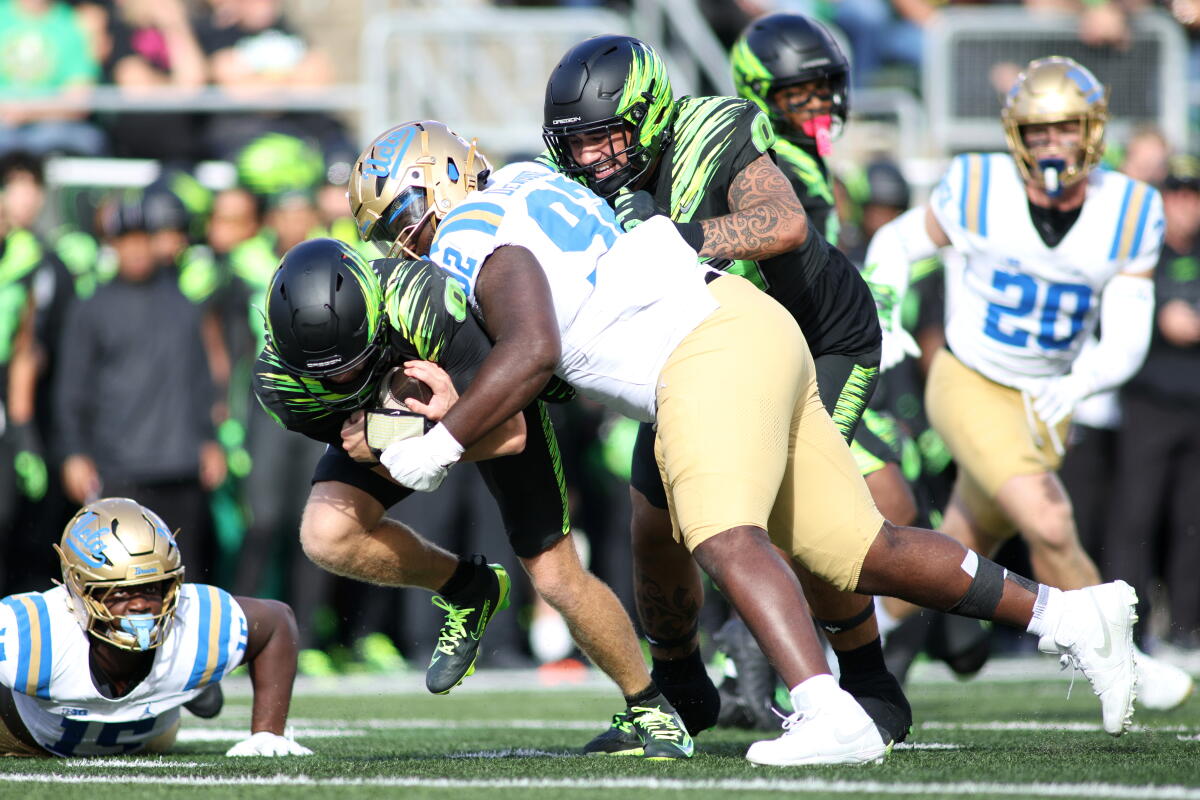
UCLA defensive lineman Darold DeNgohe tackles Oregon quarterback Brock Thomas on Saturday in Eugene.
(Lydia Ely / Associated Press)
The Bruins gave Raiola more headaches than anything else as he finished with 43 passing yards and three turnovers before he was benched for third-stringer Brock Thomas in the fourth quarter.
And even when Thomas entered for Raiola, the Ducks’ offensive weapons largely flatlined despite their perceived superior status.
Running back duo Dierre Hill Jr. and Jordon Davison — who combined for 238 all-purpose yards and three touchdowns against the Trojans — and tight end Jamari Johnson, who torched the USC defense for seven catches and 119 yards, were limited to a combined 111 all-purpose yards and just one score.
The Bruins’ defense was everywhere in Eugene, limiting the run game to 2.7 yards per carry, largely blanketing pass catchers in coverage downfield and forcing turnovers at every level.
“We don’t focus on outside chatter,” senior linebacker Sammy Omosigho said after the win. “That has no meaning to us, no focus to us, no value to us. We focus on ourselves.”
Bruins’ QB concerns aren’t going anywhere
Many observers who watched Saturday’s showdown will tell you the Bruins should have won more handily.
The Bruins almost doubled the Ducks in time of possession, yet there was a chance for Oregon to win on the last drive of the game.
UCLA had to overcome its own problems, with quarterback Nico Iamaleava battling Raiola for most turnovers and questionable decisions under pressure.
UCLA coach Bob Chesney calls to his players.
(Lydia Ely / Associated Press)
Iamaleava got off to a slow start this season as UCLA relied on its potent rushing attack. He rebounded against Purdue and Maryland, combining for 485 yards and four touchdowns with zero turnovers.
While Iamaleava went 10 for 17 for 162 yards in the first half, his mistakes came at especially costly times for the Bruins.
During UCLA’s second drive, the Bruins were pinned on their 10-yard line. With Oregon outside linebacker Nasir Wyatt blitzing, Iamaleava attempted to throw the ball away to the flat and instead fumbled, giving the Ducks the ball on the Bruins’ one-yard-line. Oregon scored one of its two touchdowns immediately after the turnover.
Later in the half, Iamaleava threw two interceptions, the first at midfield and the second coming at Oregon’s 22-yard line, wiping out a field-goal opportunity.
Iamaleava struggled with accuracy and timing, underthrowing a deep ball to wide receiver Aidan Mizell on the first play of the game — a pass that arguably could have been a touchdown if Mizell was hit in stride — and mistiming a pass to running back Jaivian Thomas, who was wide open in the end zone, on third and goal during the same drive.
Iamaleava was facing a formidable Ducks defense, the best unit the Bruins have played to date, and was injured during the second interception. He did not return to the field after sustaining a leg injury near the end of the first half, and it is unclear how long he will be sidelined.
Backup Ty Dieffenbach steered UCLA to a win, but the Bruins need better quarterback depth.
UCLA is a playoff contender
The Bruins celebrate their win over the Oregon Ducks.
(Tom Hauck / Getty Images)
Saturday was more than just a win. It was a bold announcement to the rest of the Big Ten and the nation that UCLA is a playoff contender.
Chesney told fans during a UCLA men’s basketball game shortly after he was hired that the football team is playing for banners. And Saturday’s win proved that his plan to pursue championships — something that seemed absurd amid a lost 2025 season — has a real possibility of paying off with one.
The Bruins have one of the easier schedules in the Big Ten with seven games remaining. UCLA will play five home games, including with 2-4 Michigan State, 2-3 Nevada of the Mountain West and 3-3 Illinois.
While UCLA still has road games at Michigan and Minnesota and competitive home games against Wisconsin and USC, the Bruins proved Saturday that they can hang in any environment, frustrating the Ducks at hostile Autzen Stadium.
Sign up for UCLA Unlocked
A weekly newsletter offering big game takeaways, recruiting buzz and everything you need to know about UCLA sports — exclusive to L.A. Times subscribers. Free Members receive a partial preview of each edition.
By continuing, you agree to our Terms of Service, which include arbitration and a class action waiver. You agree that we and our third-party vendors may collect and use your information, including through cookies, pixels and similar technologies, for the purposes set forth in our Privacy Policy such as personalizing your experience and ads.
Big Ten confirms a big mistake
The Big Ten released a statement Sunday announcing its officials placed the ball at the wrong spot during Oregon’s final failed two-point conversion attempt after a UCLA penalty. The ball should have been placed at the half-yard line instead of the 1½-yard line. The lead officially announced the correct placement, but the crew never moved the ball.
UCLA’s defense stuffed the two-point conversion attempt, and the Bruins went on to secure a 17-15 win.
The mistake has drawn limited outrage, with fans more concerned about the number of errors by Big Ten officials this season than about them potentially thwarting Oregon’s chance to tie the score. That probably has a lot to do with the number of mistakes the Ducks made and the perception the Bruins outplayed them.
Dieffenbach has long embraced change
Before Ty Dieffenbach was asked to lead UCLA’s offense in the second half at Oregon, he began his high school career in Southern California as a wide receiver.
The Times’ Eric Sondheimer spoke with Dieffenbach ahead of his senior season about his switch to playing quarterback for Agoura, a team that needed a signal-caller and quickly developed a prolific one.
Agoura coach Dustin Croick told Sondheimer he wouldn’t have asked Dieffenbach to play the position just because of the 6-foot-5 athlete’s arm strength. Croick detected something else.
“We can teach kids how to throw, how to read defenses, but the leadership has to be a natural thing,” Croick said.
The two have stayed in touch as Dieffenbach spent two seasons at Pittsburgh without playing before transferring to Cal Poly and starting for one season. Dieffenbach then joined UCLA during the offseason and prepared as though he could be asked to play at any time.
Dieffenbach celebrated with the high school coach who first believed in his quarterback skills via Facetime after UCLA’s win.
Agoura football coach Dustin Croick was busy with relatives in town. He turned off his phone. Then he saw 173 text messages. Then he faced timed with his former QB Ty Dieffenbach after UCLA beat Oregon. Emotional day. pic.twitter.com/eyn5YD6Uva
The Valkyries became the first WNBA expansion team to reach the playoffs in its first season and the Finals in its second.
“I told them that I was proud of our whole team, the whole 14, because I saw another level of fight tonight,” Nakase said after the clinching win. “And that’s what I was really proud of. We talked about leveling up one more as a team and I think that overtime proved strength in numbers. We really left it all out there on the floor. We really emptied the tank.”
Golden State hosts the Atlanta Dream at 12:30 p.m. Saturday to open the Finals. The Dream notably are led by UCLA alum Jordin Canada, the the starting point guard and ignition to their offense.
Bruins on deck
Wednesday, Oct. 14 Women’s basketball at California (exhibition)
Thursday, Oct. 15 Women’s tennis at ITA Regional Championships, all day Men’s tennis at ITA Regional Championships, all day
Friday, Oct. 16 Women’s tennis at ITA Regional Championships, all day Men’s tennis at ITA Regional Championships, all day Women’s golf at Stanford Intercollegiate, all day Men’s golf at Golf Club of Georgia Collegiate Invitational, all day Men’s soccer at Wisconsin, 5 p.m. Women’s volleyball vs. Penn State, 7 p.m. Women’s soccer vs. Washington, 8 p.m.
Saturday, Oct. 17 Women’s tennis at ITA Regional Championships, all day Men’s tennis at ITA Regional Championships, all day Cross country at UC Riverside, 8 a.m. Men’s water polo at USC, 1 p.m. Football vs. Wisconsin, 4:30 p.m.
Sunday, Oct. 18 Women’s tennis at ITA Regional Championships, all day Men’s tennis at ITA Regional Championships, all day Women’s volleyball vs. Ohio State, 3 p.m.
Do you have a comment or something you’d like to see in a future UCLA newsletter? Email newsletters editor Houston Mitchell at houston.mitchell@latimes.com. To get this newsletter in your inbox, click here.
Sports editor Iliana Limón Romero contributed to this report.
There was a sense of inevitability that England captain Kane would be the star turn in Tuesday’s 3-0 win over the Czech Republic as he celebrated equalling Peter Shilton’s record of 125 England caps.
Kane, still irreplaceable at 33, added to his goals tally as England’s all-time record scorer, his total of 91 now 38 ahead of Wayne Rooney, who is in second place in the listings with 53 goals in 120 games.
And, with Kane still looking in his prime and fully fit, it now seems only a matter of time before he makes history as the first player to score 100 goals for England.
This alone will have delighted Tuchel, but even more satisfying for the German is that he now presides over an attacking quartet that can pose a threat to any side in world football.
Kane is the peerless spearhead, but Anthony Gordon – on target in the three Nations League games against Spain, the Czech Republic and Croatia before being rested here at Wembley – has moved his game on to another level since joining Barcelona from Newcastle.
Gordon is a creator with burning pace, while on the right flank Bukayo Saka has looked rejuvenated after a World Cup during which he was hampered by an Achilles injury, as he proved with two goals in Croatia.
And, just behind them all, with everything he does stamped with world class, is Jude Bellingham, England’s player of the year and the golden future of his country at only 23.
This may be bad news for Chelsea’s Cole Palmer, whose withdrawal from England’s squad has allowed others to cement their place in front of him, with Nottingham Forest’s Morgan Gibbs-White proving his commitment by cutting short a family holiday to join the squad after being excluded initially.
England’s front four looks a natural fit, augmented by Chelsea’s Morgan Rogers, while Liverpool’s 18-year-old Rio Ngumoha will be an international contender for years to come.
If Tuchel can keep his fab four fit and firing, England will be a danger to any opponents.
For aerospace aficionados, it’s like we have entered into an alternate dream reality. The idea that we are seriously talking about the possibility of bringing back the SR-71 Blackbird to flight status is hard to comprehend, but amazingly this is where we are at. The biggest question I am getting about all this is why? We touched on the likely primary answer to that in our original reporting — high-speed is back in tactical vogue, and the Blackbird can sustain it in a realm of great interest, between Mach 3 and 4, and do it over and over again. It can also carry very large things and even launch them off its back at those extreme speeds. But those are not the only potential reasons for taking on such a gargantuan, high-profile, and costly technical challenge. Learning from the journey itself could be just as valuable as the actual flight test data a revived SR-71 produces.
Let me explain.
(NASA)
The Blackbird was as close to alien tech as it gets over 60 years ago, and even today, we have nothing like it in known operation. Yet it has been dormant for nearly three decades. Much of the expertise that built, supported, and operated it is sadly gone. But the exercises of reverse engineering and leveraging breakthroughs in additive manufacturing and rapid prototyping, as well as injecting new material sciences, avionics, propulsion and other technologies where applicable, and above all else, building the digital toolkit to make it all happen as fast and efficiently as it can be done, are all of extreme learning value.
I would not be surprised if a ‘digital twin’ is being created right now of the SR-71 using NASA’s SR-71 tail number 844 — the jet in question that has mysteriously disappeared from its display pad. Once such a model exists, breakthroughs in digital engineering can be brought to bear to see how fast the program can be accelerated, both in terms of development and flight testing. This could include not only getting the SR-71 back in the air, but improving its performance and reliability, possibly substantially, using all the new technologies we have today. It’s even possible a clone of sorts leveraging all these advances could be built using digital engineering tools.
The SR-71 served as an integral part of NASA’s flight test fleet at Dryden Flight Research Center, located on the premises of Edwards AFB. (NASA)
This is not necessarily an unprecedented concept. Just look at similar exploratory engineering programs like the X-55. But when it comes to partially reverse-engineering an airframe you have no support for, and few, if any, spare parts, America’s highly-secretive foreign materiel exploitation (FME) community could potentially lend a hand.
Operating in the shadows, they have been able to not only get totally foreign aircraft divorced from American supply chains pieced back together and flying, but they sustained them for years in total secrecy. They also did this long before the advent of rapid prototyping and digital engineering assets that we have today. Imagine what they can do now. They could be a top source for NASA to pull in to help in its far less sensitive but uniquely similar endeavor. This is just one example of many of how government and industry could come together to support and benefit from the SR-71 resurrection program.
Now, about those supply chains. During its heyday, the SR-71’s logistical tail was one of the most exotic ever created. It supported the Blackbird, as well as its progenitor, the A-12, for the better part of half a century. Reestablishing this supply chain would be a highly challenging, but rewarding exercise that could have major impacts across the aerospace industry, as well as others. So, how can we use all the capabilities we have now to jump-start the sustainment of the highest-performing air vehicle from an era of slide rules and drafting tables?
NASA SR-71 on the ramp in the evening. (NASA)
The idea of putting aircraft out of production back into production is not a foreign one to the U.S. military, either. NASA’s SR-71 program could serve as a pathfinder for better evaluating such proposals and their costs, while pushing the envelope forward on exactly how it can be done efficiently. The same can be said for simply keeping aging aircraft (or any vehicle or system for that matter) operating longer and for cheaper, by applying cutting-edge technologies and practices. NASA can create the playbook for doing so, and that playbook could end up being more valuable than the flight testing a reborn SR-71 does.
I think it’s fairly clear that we have lost something when it comes to aerospace engineering as of late. With all our advances and incredible tools even legendary Skunk Works founder Kelly Johnson could have only dreamed of, it seems like we have to relearn even simple lessons from decades ago, and oftentimes that can be a very expensive, time consuming, and even deadly process. In some ways, it seems like we have gone backward, or at least stalled out in certain engineering areas. The simple things become hard and hard things have become simpler. How did they do so much protractors and pencils way back then? Getting a Blackbird flying again can help explore and possibly answer this and other questions, and help mitigate these deficiencies going forward, as well.
NASA Blackbird tail 844 refueling behind the specialized, JP-7-filled KC-135Qs that supported the program. (NASA)
Even if NASA’s dormant SR-71 never ends up getting back in the air, even attempting such a challenge could be considered a success. Doing so could identify core areas across multiple disciplines that could be improved and areas of existing technology that could be better exploited for a whole array of tasks. It can also develop and refine new technologies in the process. All this sits at the core of NASA’s mission, and there is no vehicle on Earth that could drive people and organizations to give it their all for such a comeback dream as the Blackbird. It’s even possible that we could see corporations or even individuals help foot the bill for it.
And yes, all these benefits need to be weighed against cost. Surely there is a limit to how much the government can invest in such a program. Now corporations and individuals, that’s a different story.
So, yes, the main goal of this effort will likely be high-speed flight testing, but so much can be learned in the journey to get there that it must be quantified in the ‘business case’ for reviving the Blackbird.
The Real Rooneys gives fans a real insight into the lives of Wayne and Coleen Rooney and also some surprising details of what goes on
Wayne and Coleen have opened their home to the Disney+ cameras
The Real Rooneys throws up some interesting and surprising scenes and a lot of nuggets of information and Wayne and Coleen which will be new for fans. Coleen says of the series: “We live in this in this extraordinary world, but we are normal at the end of the day.”
Wayne adds: “When you know you’re on TV or you’re doing something, you maybe tone things down a little bit, but at home with four young boys, that’s impossible. It’s real what you see.” Here are some of the more shocking and surprising things I spotted previewing the first four episodes…
WAYNE’S WINDOWLESS REQUEST
The Rooneys live in an incredible mansion with dozens of rooms and grounds which are big enough for them to race around in go karts, as we see on the show. But despite paying for the property, Wayne had just two slightly odd requests when it was built. He says: “I only wanted two things in here, a small little room with no windows, not because I am a psycho for playing PlayStation or watching a movie. And a snooker table. I didn’t really care what else.” Thanks to Coleen there is also other great rooms which have fun things in them like a swimming pool and a boxing ring.
COLEEN LUCKY TO BE ALIVE
Coleen’s mum reveals that her beloved daughter may never have met Wayne or survived beyond a brief childhood having been very ill as a small child.
Colette McLoughlin tells the cameras: “When Coleen was three, she got really sick. It turned out it was encephalitis, and her brain was swelling. She couldn’t walk. She couldn’t speak. She was stumbling her words. When we got to Alder High Hospital, she ended up in a coma. For 24 hours it was touch and go. She had to learn to walk again. All the coordination had gone, but I’m so grateful because she was alive.” This help she got at hospital is one of the reasons Coleen’s parents became foster carers.
WAYNE WATERWORKS AT TV SOAPS
Wayne admits now he is older he gets emotional about lots of things. The subject comes up when Kai’s football career is being discussed and he is asked if he will cry if his eldest son gets a scholarship at Manchester United. Wayne replies: “Probably. I cry at everything anyway. I’ve cried over some mad things, Coronation Street, X Factor, when Barry got pushed off the hill by Janine in EastEnders, I’m pretty sure I was crying.”
COLEEN CONSIDERED SPLIT FROM WAYNE
His bad behaviour down the years is well documented and Wayne is not perfect husband material in the series either. Like most married couples there are some rows and at one stage Coleen says: “There’s times where I think ‘Is the answer to see what it’s like if we were separated?’.”
She then adds: “But the we still care for each other, we still have good times. You know, we still love each other.”
At another point she tells Wayne: “It’s been a bit of a lads holiday for you, staying up all night. You can’t just keep doing what you do. It is not fair of everyone else. It is only you that can fix it because no one else is doing it. I’m just hoping that things change.”
KAI MOCKS HIS DAD
It seems Wayne struggles with early starts as he is shown sleeping through alarms and missing doing the school run on at least one occasion.
But one morning – seemingly the first time the Disney+ cameras are at the home – Wayne is seen up early, although he seems in need of coffee. His eldest son Kai is clearly not used to seeing his dad before school. With a grin he says: “Bro’s up for the cameras”.
Kai also states he is the best footballer in the family, and that he wants people to “know the name Kai Rooney” so he is a star footballer in his own right in the future.
WAYNE SOMETIMES HATES FAME
Wayne and Coleen take their two youngest children Kit, 10; and Cass, eight to Poland for an educational trip.
Initially it goes well and Wayne goes unrecognised but a trip on a horse drawn cart in Krakow blows his cover and he is soon swamped for autographs and selfies, and then family need to beat a sharp exit.
Afterwards Wayne reflects on what happened and says his level of fame has changed him as a person and he would love to be able to live unrecognised more often. He says: “I’m not a celebrity. People who know me know, know that I want to be as normal as possible.
“Back to when I was a kid, and you wanted to be a football player. That’s all I ever wanted to do, and didn’t care about fame or money or whatever. I just wanted to be a football player. I think I’d be such a better husband, dad, person, friend without it(fame). It affects places I go, things I do.
“I bought a mask I saw on TikTok[to use as a disguise], it looked incredible but it was terrible.”
WAYNE’S JEWISH ROOTS
As part of the break with Kit, 10; and Cass, the family visit Auschwitz because Kit asked to visit while learning about the Second World War at school.
Wayne tells the cameras: “I recently found out my mum’s mum, so me nan, her family were Polish Jews.”
He is told by producers that would make him technically jewish. Wayne replies: “I’m Catholic, but then I’ve always asked questions like, why aren’t we Jewish?”
Told it could make a whole spin off show he says with a grin: “Roo the jew!”
* Stream The Real Rooneys on Disney+ from September 24.
Morocco’s Justice and Development Party (PJD) went from a decade of being the main political beneficiary of the country’s post-2011 reforms to suffering a dramatic electoral defeat in 2021.
The party won 107 of the 395 seats in Parliament in the November 2011 election, after protests that year called for political reform, greater accountability and a more responsive government. Its leader, Abdelilah Benkirane, became head of government.
Morocco’s 2011 constitutional changes expanded the formal powers of Parliament and government while retaining significant authority for the monarchy. The king appoints the head of government from the party that comes first in the House of Representatives, while he chairs the Council of Ministers, where strategic orientations of state policy are considered.
In the 2016 election, the PJD increased its seats to 125, but Benkirane spent months unable to form a governing coalition. In March 2017, King Mohammed VI ended his mandate and appointed Saadeddine Othmani to replace him. The PJD remained in government until its electoral collapse four years later.
In the September 2021 election, the party fell from 125 seats to just 13, losing 112. The National Rally of Independents (RNI) won 102 seats and became the largest party.
How much of the comeback rests on Benkirane?
Benkirane’s return raises another question: How much of the PJD’s comeback is being built around him?
A recent Al Jazeera Studies analysis describes Benkirane as a political “brand” whose long public career, media presence and direct communication style have created a personal profile that can function as electoral capital for the party.
It examines whether his visibility and personal appeal can help the PJD rebuild after its 2021 collapse.
Benkirane remains one of Morocco’s most recognisable political figures. But his return does not by itself show that the PJD has rebuilt its support.
The party lost 112 seats in 2021; its task now is to turn the attention generated by its leader into support for the party itself.
A broader programme
The PJD’s 2026 programme contains 467 measures across five broad areas: identity and family; political and institutional reform; public services and social protection; the economy and employment; and foreign policy.
It calls for greater transparency in public procurement, rules addressing conflicts of interest and illicit enrichment, and improvements to public services. It also highlights housing, social protection, food, water and energy sovereignty.
Its programme foregrounds practical issues such as prices, jobs, schools, hospitals and corruption.
The PJD is campaigning on public services, jobs, purchasing power and political reform as it seeks to rebuild after its 2021 electoral collapse [Abdel Majid Bziouat/AFP]
Saad al-Sabahi, 38, who works with the PJD’s regional secretariat in Casablanca-Settat, said the programme was developed through studies, consultation meetings and proposals submitted through an online platform.
“These commitments cover a range of sectors and areas affecting the lives of the Moroccan people,” he told Al Jazeera, pointing to political participation, fighting corruption, public education, healthcare, employment and economic sovereignty.
“These commitments, among others, form the basis of the agreement between the party and voters. We will work to fulfil and implement them with integrity and competence,” al-Sabahi said.
What changed after 2021?
The PJD says one of its main lessons from the 2021 defeat has been the need to reorganise internally and examine more critically its years in government.
“The party was able to overcome its crisis following its extraordinary and regular congresses, and after Secretary-General Abdelilah Benkirane took over the leadership,” al-Sabahi said. “The party also reorganised its internal affairs through communication and the renewal of its structures.”
The party’s own assessment of the 2021 defeat includes criticism of its political and organisational choices. It has also accused unnamed actors of undermining democratic choice and pointed to what it describes as electoral corruption and disinformation.
Those are the PJD’s explanations for the result, rather than independently established findings. But the scale of its losses forced the party to confront how far its record in government had separated it from parts of its former support base.
That matters particularly when it comes to younger voters.
Imane Traifi, 37, of the PJD Youth, said the party needed to create sustained opportunities for young people to take part in political life rather than treating them simply as voters during election campaigns.
“We are keen to ensure that young people move from being recipients to becoming participants, initiators and people who take on responsibility,” she told Al Jazeera.
The ghosts and crocodiles
However, a question for any future PJD government is not only what it would seek to change, but what it could change once in office.
Benkirane repeatedly referred to “ghosts and crocodiles” as a metaphor for powerful or hidden interests that he said had obstructed his government when it was in power.
The clearest example is the party’s position on Israel.
The PJD has campaigned against Morocco’s normalisation with Israel and continues to support the Palestinian cause. Its 2026 programme explicitly calls for opposition to normalisation. Yet Morocco restored diplomatic ties with Israel in 2020 while the PJD was in government and Saadeddine Othmani was head of government.
The PJD opposed the move, while Othmani later defended it as a state decision and said Morocco’s support for the Palestinian cause remained unchanged. The agreement went ahead in December 2020 as part of a US-brokered deal that included Washington’s recognition of Moroccan sovereignty over Western Sahara.
Six years later, the relationship has moved further. On September 16, Morocco and Israel agreed to elevate their diplomatic missions to embassy level and appoint ambassadors, while also expanding air travel and advancing economic and trade agreements.
The PJD reaffirmed its opposition to normalisation and cooperation with Israel the following day, describing its position as longstanding.
But it also leaves a question for the party’s return: If such forces were powerful enough to constrain the government then, what has changed?
Has the PJD developed a different understanding of the limits of government authority or will it find itself once again beset by “ghosts and crocodiles”?
The limits of government power
The PJD has made clear on several occasions that the change it seeks is from within Morocco’s existing political and constitutional system, rather than a challenge to the monarchy itself.
Benkirane has repeatedly reaffirmed his support for the monarchy while arguing that elected institutions should play their role in governing and improving the country.
That distinction is important to understanding the PJD’s return. Its opposition to policies such as normalisation with Israel sits alongside its acceptance of a constitutional and political framework in which the monarchy retains a central role in strategic state decisions.
Under the constitution, the king chairs the Council of Ministers, which considers the strategic orientations of state policy.
That applies not only to Israel but to other areas where major policy decisions remain closely tied to the monarchy.
For the PJD, rebuilding means more than recovering the seats it lost in 2021. It means showing what it learned from a decade in government, what it can deliver and how it would avoid the political costs of its collapse.
Al-Sabahi said the party wanted to regain what he described as the gains citizens had previously enjoyed.
“We will work to restore the gains that citizens previously enjoyed and to restore their dignity and rights,” he told Al Jazeera.
Yassine Elachiri, a member of the National Bureau of PJD Youth and the party’s National Council, said the relationship with younger Moroccans had to be built over time rather than during campaigns.
“Earning the trust of a new generation of young people cannot be reduced to electoral mobilisation or short-term campaigns in the run-up to voting day,” he said. “Rather, it is a cumulative process built on sustained engagement, guidance, training and creating opportunities for young people to participate actively in public affairs.”
“Our goal is not simply to reach young people at the moment of an election, but to build a lasting relationship with them based on trust, training and active participation,” Elachiri said.








![The PJD is campaigning on public services, jobs, purchasing power and political reform as it seeks to rebuild after its 2021 electoral collapse [Abdel Majid BZIOUAT / AFP]](https://i0.wp.com/occasionaldigest.com/wp-content/uploads/2026/09/AFP__20260912__C84F3GR__v1__MidRes__MoroccoPoliticsElection-1789565328.jpg?w=640&ssl=1)