LAWS

Prompted by new California and U.S. laws, two new lawsuits demand return of Nazi-looted art

For the first time since California and Congress passed a pair of laws bolstering U.S.-based claims to Nazi-looted artwork around the world, two lawsuits have been filed in California demanding prominent museums relinquish pieces seized during World War II.

In one case, filed in federal court in Los Angeles on Monday, the daughters of Auschwitz survivor Dina Gottliebova Babbitt sued the Auschwitz-Birkenau Memorial and Museum in Poland for the return of watercolors Babbitt was forced to paint of fellow prisoners for the Nazi physician and war criminal Josef Mengele.

In the other, filed in Los Angeles Superior Court on Monday, the Jewish Federation of Greater Los Angeles and Daniel Gryczman, the federation’s board chair, sued the Norton Simon Museum in Pasadena for the return of the diptych “Adam and Eve,” a pair of 16th century masterpieces by Lucas Cranach the Elder.

The lawsuits revive legal battles waged unsuccessfully for the watercolors and the diptych for years, on the premise that their claims are newly viable under the new laws — one passed by California lawmakers in 2024 and the other signed into law by President Trump earlier this year.

Both laws were inspired in part by another legal battle over looted art between a California family and a prominent museum, which is still ongoing.

Lilly Cassirer Neubauer escaped Germany at the dawn of World War II by relinquishing to a Nazi art broker the exquisite impressionist masterpiece “Rue Saint-Honoré in the Afternoon. Effect of Rain,” by Camille Pissarro. The painting is now worth millions. Her grandson Claude Cassirer, who moved to California, and great-grandson David Cassirer have been fighting for the painting’s return from the Thyssen-Bornemisza Collection in Madrid for the last two decades.

Amid that battle, California lawmakers rewrote state law to make clear that in situations where it and another jurisdiction’s law on looted artwork are in conflict, California law applies and requires the return of the art to its original owners regardless of the passage of time. In an unusual moment of bipartisanship, Congress followed up by passing its own measure — the Holocaust Expropriated Art Recovery Act of 2025 — to further bolster such family claims.

The two new lawsuits — neither of which provide a valuation for the artwork in question — were filed just ahead of a deadline under the California law for claims to artwork with long-known locations.

David Cassirer said his father would be “extremely proud” to know a California law passed in part in response to his family’s fight has also given other families another chance “to vindicate their ancestors’ artistic legacies.”

Auschwitz watercolors

Michele Babbitt Kane, of Ben Lomond, Calif., and Karin Wendy Babbitt, of Las Vegas, say in their lawsuit that Mengele demanded their mother produce the seven watercolors in question — each depicting a Roma prisoner later murdered — to support his “pseudo-scientific” and racist work studying the Roma people. Known as the “Angel of Death,” Mengele conducted gruesome medical experiments on Auschwitz prisoners.

They said their mother obliged “with deep sympathy for her subjects,” on the condition Mengele “spare her and her mother from the gas chambers.”

After liberation, the lawsuit says, their mother moved to California and worked for nearly 20 years as an animation assistant for Hollywood studios such as MGM and Warner Bros., where she contributed to familiar cartoon characters such as Wile E. Coyote, Tweety, Daffy Duck and Speedy Gonzales.

They say theirs is exactly the sort of case California’s new law was enacted to allow — involving “a California family seeking the return of watercolors created by their Jewish mother under Nazi coercion at Auschwitz and withheld by a Polish state museum for decades despite the Museum’s own repeated acknowledgments of the family’s rights.”

Paweł Sawicki, a spokesperson for the Auschwitz Memorial, said in a statement to The Times that the Babbitt paintings “must remain in the Memorial as part of the documentation of the crimes of Mengele,” and that many in the Roma community agree.

“We fully understand the emotional approach of Dina Gottliebova’s family to the works she made on the orders of Josef Mengele in circumstances that certainly affected her life, but in carrying out our statutory responsibility, we express the deep conviction that the watercolors should remain at the Memorial,” Sawicki said. “The portraits of Roma victims are the few remaining fragments of the documentation made by Mengele as part of his criminal experiments. Therefore, they should be treated as unique documents related to the history of Auschwitz.”

‘Adam and Eve’ diptych

According to the Jewish Federation’s lawsuit, the “Adam and Eve” paintings were part of a vast collection seized from prominent Dutch Jewish art dealer Jacques Goudstikker by Hermann Göring, Hitler’s second-in-command. The collection was later recovered by Allied forces and given to the Dutch government, with the diptych being sold to the Norton Simon in 1971.

The lawsuit says Marei von Saher, Goudstikker’s surviving heir, has long sought the return of the Goudstikker collection, and years ago was successful in forcing the Dutch government to return 200 pieces still in its possession. She first demanded the “Adam and Eve” paintings from the Norton Simon in 2000, without success.

The new lawsuit says Von Saher on Monday signed her claimed rights to the paintings over to Gryczman and the Jewish Federation, which said in a statement that they will use a majority of any proceeds from the return of the paintings to “care for Los Angeles-area Holocaust survivors living in poverty.”

Von Saher’s daughter, Charlène von Saher, said in an interview that her family gave the painting rights to the Jewish Federation because of that shared mission. She said she wishes California and Congress had acted sooner but hopes a win now will help other Jewish families reclaim what is rightfully theirs in the future.

“My grandfather lost his life fleeing the Nazi invasion, and many of his family members were sent to Auschwitz and did not survive,” she said. “Victory would be justice, and a piece of the puzzle to restoring my grandfather’s legacy and his collection.”

The Norton Simon Art Foundation said in a statement to The Times that it was reviewing the new lawsuit, but that various courts, including the U.S. Supreme Court, have over decades of litigation confirmed that the foundation “has proper title” to the diptych paintings, and the foundation “will continue to make these important artworks accessible to the public.”

The Pissarro

The Thyssen-Bornemisza Collection and the Kingdom of Spain, which owns it, have fought the Cassirer family’s claims to the Pissarro painting since Claude Cassirer, now deceased, first sued for its return in 2005. Spain has argued the painting was legally obtained by the collection prior to its 1993 sale to the country by Baron Hans Heinrich von Thyssen-Bornemisza, a prolific art collector whose wealthy industrialist family helped finance Adolf Hitler’s rise.

The matter has repeatedly wound its way through the U.S. courts, including to the Supreme Court, which remanded the case to the lower courts for additional review in light of California’s new law. A hearing is set for next month.

The museum has contended California’s new law is unconstitutional, which California is contesting. David Cassirer has argued the law clearly requires the museum to return the painting — and has pledged to support other looting victims with any proceeds.

He said both California and Congress “acted decisively to guarantee that stolen art victims, and victims of political persecution in particular, can have a fair shot to recover family legacies the Nazis ruthlessly tried to destroy,” and that “the momentum at all levels of government in favor of restitution is very encouraging.”

Source link

DHS voter probe may break state laws and wrongly implicate U.S. citizens, whistleblower alleges

A last-ditch Trump administration effort to hunt for noncitizen voters ahead of November’s elections is requiring federal employees to misrepresent themselves on voter lookup tools in a way that likely violates state laws, according to a federal whistleblower’s statement released Monday.

The Department of Homeland Security probe known as the “Unlawful Voter Initiative” also asks employees to create federal law enforcement records about voters based on unreliable data, the account warns. That could potentially wrongly implicate U.S. citizens in official documentation that could spur further investigation.

The anonymous, nearly 30-page disclosure was published Monday by Democratic Senate Minority Leader Chuck Schumer of New York and Democratic Sen. Alex Padilla of California, the ranking member of a Senate committee overseeing federal elections.

It features screenshots and transcripts of a DHS training for a group of U.S. Citizenship and Immigration Services staffers, who it says were forced in late August to drop their other work, complete a less than two-hour training session and begin running DHS-provided lists of individuals through state voter registration systems to find “unlawful voters.”

The whistleblower contends that agents have been asked to review 40 individuals per day, giving them about 12 minutes to determine whether each person is a legal voter and create federal records of anyone who is not.

Padilla and Schumer said Monday the initiative was an example of President Trump attempting to interfere in elections and the short timelines would impede officials from conducting proper investigations. They noted that the data DHS has on voters can be unreliable and differ from state records, making any federal findings based on that data potentially problematic.

“We just got more proof of Trump’s vile schemes to rig our elections,” Schumer told reporters in a news conference. “The lengths Trump will go to cheat, lie and steal in this upcoming election are simply beyond the pale.”

The White House did not immediately respond to a request for comment.

The Trump administration has been targeting noncitizen voting to allege it could be a source of significant fraud during the midterm elections, even as research shows voting by people who are not citizens is extremely rare. Trump has been pushing for the U.S. Postal Service to send mail ballots only to voters verified as U.S. citizens, and his Justice Department has sued to force the release of detailed voter data in 30 states and the District of Columbia, though it has not yet succeeded in those cases.

The whistleblower report details an effort by the federal government to work around a lack of data from the states by directing Citizenship and Immigration Services employees to pose as individual voters to access their state voter records.

Some states, such as Virginia, explicitly limit their voter lookup tools to individuals who attest under penalty of law that they are looking up their own records. In other states, like California, personally identifiable information such as a driver’s license number or partial Social Security number is needed to look up individual voter records.

The whistleblower said that when officers raised concerns about liability for searching the tools against state guidance, agency leaders told them to proceed with the searches anyway.

Schumer and Padilla on Sunday sent a letter to DHS Secretary Markwayne Mullin requesting more information about the initiative and demanding that it be stopped.

Asked about the whistleblower report, a DHS spokesperson said it is “laser focused on prosecuting and removing aliens who vote and preventing the dilution of the votes of U.S. citizens.”

“The department accessed publicly available data from states’ voter rolls and cross referenced them with known aliens in our systems,” the spokesperson said in an emailed statement. “It’s not rocket science; it’s an easy step to secure our elections.”

In response to complaints about the timing, limited training and quotas for agents, the spokesperson said that “far from being rushed or untrained, these investigative efforts are conducted diligently and professionally.”

The New York Times first reported on the DHS initiative in early September.

The whistleblower account released Monday was produced by the watchdog group Democracy Defenders Fund. The group, which said it represents the whistleblower as a client, said the person is anonymous because of “an extreme fear of retaliation but they feel an obligation to speak up about the misconduct and gross mismanagement they have witnessed.”

Swenson writes for the Associated Press.

Source link

UK needs new laws for AI in healthcare, says watchdog

The UK needs new regulations for AI products used in the NHS and other healthcare settings, says Britain’s industry watchdog.

The Medicines and Healthcare Products Regulatory Agency (MHRA), which regulates all medical devices and licenses treatment drugs in the UK, has published 44 recommendations to update its policies as the use of AI in the sector rises.

The technology will soon be routinely used within the NHS, MHRA chief Lawrence Tallon told the BBC.

“What I would expect is that patients will… increasingly see AI as part of the way that normal NHS healthcare is delivered,” he said.

“That should happen in a way that they can maintain their trust and their confidence in what’s happening.”

The report was compiled by an independent commission and involved input from more than 12,000 people including patients and clinicians.

The recommendations include:

  • Continuously monitoring AI products and removing them from regulatory approval if they malfunction or become less effective over time

  • Giving patients the right to know whether AI is involved in their care, and easy access to information about the products involved

  • The power to penalise the developers of an AI product if it fails to meet required standards

  • An AI “L plate” system which would make it easier for new AI models to be trialled by healthcare professionals under close supervision

“The medical devices regulatory framework predominantly dates from a period where we were thinking about things like hip replacements and knee replacements, or smaller things like stethoscopes and plasters,” Tallon said.

He added while current guidelines may work for simple AI products trained to spot known symptoms on scans, for example, the rules do not apply to more complex models.

“Unlike most of the medical products we’re used to regulating, these products continue to change after the point of authorization,” he said.

“As new data gets fed in, they learn, they adapt, they drift.”

And he acknowledged trying to regulate AI is a global challenge.

“I don’t think at this moment in time we can point to a single country, a single regulatory framework, and say that they have absolutely cracked it,” he said.

Source link

DOJ sues 4 more states over noncitizen tuition benefit laws

The Justice Department under Attorney General Todd Blanche announced four additional lawsuits were filed Thursday asking the courts to enjoin Arizona, New Mexico, Oregon and Washington from enforcing laws that require secondary learning institutions to offer in-state tuition benefits to certain noncitizens. Photo by Daniel Heuer/UPI | License Photo

Aug. 28 (UPI) — The Justice Department is suing four more states over offering in-state tuition benefits to qualifying undocumented students, for a total of 21 lawsuits filed against so-called Dream Acts amid the Trump administration’s anti-immigration push.

The lawsuits against Arizona, New Mexico, Oregon and Washington — all Democratic-led — were individually filed Thursday, alleging their laws providing undocumented students with in-state tuition and financial assistance unconstitutionally discriminate against out-of-state U.S. citizens to whom such benefits are not offered.

“By granting illegal aliens in-state tuition, Washington, Oregon, New Mexico and Arizona are pushing citizens to the side and ignoring federal law. No more,” Associate Attorney General Stanley Woodward Jr. said in a statement.

“Our efforts will not cease until President Trump’s promise is fulfilled: illegal aliens will not receive benefits denied to American citizens.”

The Trump administration is asking the courts to enjoin the states from enforcing their so-called Dream Acts that require colleges and universities to offer the in-state benefits to certain noncitizen students. The lawsuits argue the laws conflict with a 1996 federal statute that bars states from offering in-state tuition to people not lawfully present in the United States unless a citizen of the United States is eligible for the same benefit without regard to whether they are a resident of the school’s state.

Washington Gov. Bob Ferguson said he plans to fight the lawsuit.

“Washington State won’t be bullied into changing how we provide opportunities for young people in our state,” he said in a statement.

“We’ll see them in court, and we expect to win.”

The Justice Department has been targeting these laws following an April 2025 Trump-signed executive order that directed the attorney general to identify and stop enforcement of policies that favor “aliens over any groups of American citizens,” specifically highlighting Dream Act laws.

Proponents of these laws argue that they put postsecondary education within reach of those who otherwise would never have the opportunity to attend university, while reducing high school dropout rates as well as raising student incomes and tax contributions.

Of the 21 lawsuits, five states have been enjoined from enforcing their laws, while the other lawsuits continue to be litigated.

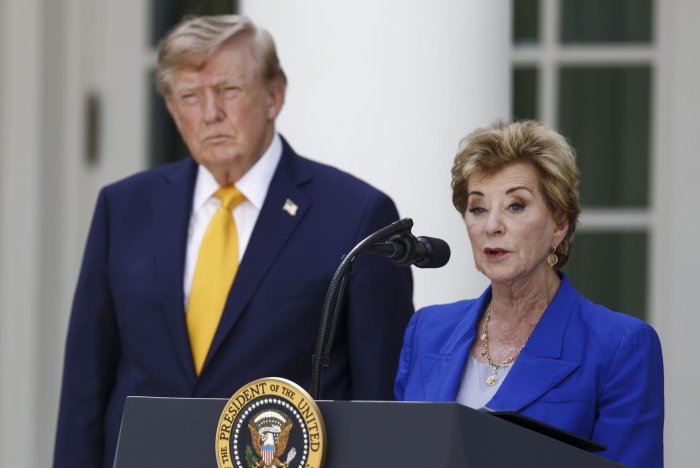
President Donald Trump looks on as Secretary of Education Linda McMahon speaks during a back-to school event in the Rose Garden of the White House on Monday. The event focused on education and the Trump administration’s education policies. Photo by Will Oliver/UPI | License Photo

Source link

‘Every advocate’s nightmare’: Inside ICE’s strategy to sidestep local oversight laws

Immigration and Customs Enforcement is taking more and more steps to avoid oversight by local and state authorities of immigration detention centers amid growing complaints alleging unsanitary and unsafe conditions at the facilities.

The efforts to sidestep laws in California and elsewhere take many forms. In some instances, contracts have been changed to declare that the centers are simply not subject to certain local or state laws.

In other instances, ICE has purchased facilities owned and operated by private companies. Though the companies continue to run the centers holding thousands of detainees, federal ownership could aid their defense in the event of legal action.

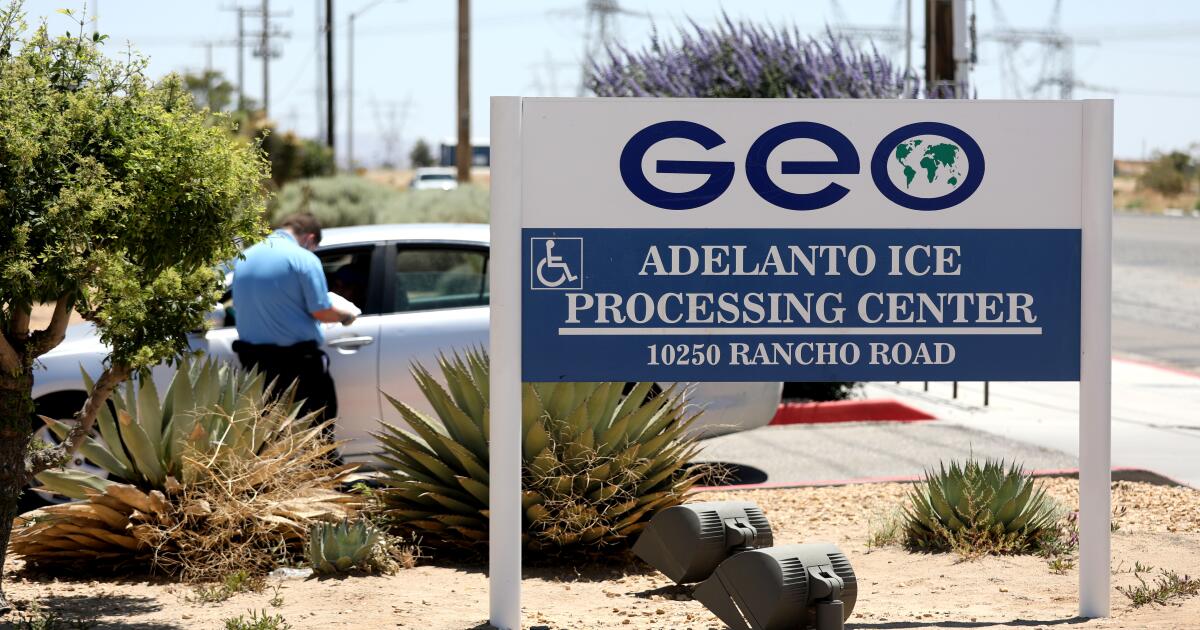
George Zoley, the chief executive of GEO Group, which contracts with ICE to run detention centers in California and across the country, said as much to company shareholders this year. In an earnings call in May, he said that ownership bolsters the facilities’ protection from “unwarranted litigation” around medical care and other detention conditions.

The federal ownership strategy has become particularly crucial, he said, “as some blue states are considering more active involvement in oversight of facilities.”

Local oversight has taken on greater significance since the Trump administration hollowed out federal offices that were charged with investigating civil rights and safety issues at detention centers and began restricting visits by members of Congress. A recent analysis by the Project on Government Oversight found detention center inspections under the second Trump administration have increasingly resulted in “superior” grades.

Eunice Cho, a former American Civil Liberties Union attorney and an expert in immigration detention, called ICE’s efforts a “naked strategy” to evade local scrutiny of detention centers.

“This is a huge sea change in the way that immigration detention is expanding and hardening in the United States,” she said, adding that “this was every advocate’s nightmare scenario.”

In California, state leaders once attempted to shut down privately run detention centers and, after losing, resorted instead to proposing other oversight measures. California is home to eight ICE detention centers with a combined capacity of nearly 9,000 people.

State laws allow monitoring and investigation of the facilities by the California Department of Justice and local health authorities.

A 2021 law allows people to sue for damages when private detention center operators fail to follow the care standards laid out in their contracts. Starting in January, another law will require independent medical investigations into deaths in law enforcement custody, including in immigrant detention facilities.

Several bills are being considered by the California Legislature that would further regulate detention centers. Among them are bills that would authorize the California attorney general to bring civil action and impose fines to protect detainees’ constitutional rights and require the disclosure of public records, such as 911 calls from the facilities.

Recent attempts to limit California’s oversight actions haven’t been successful. CoreCivic turned San Diego health inspectors away from the Otay Mesa Detention Center in February, but after legal action the visit took place in June.

Another oversight battle concerns the rights of detainees who work at a facility, perhaps as a janitor, for $1 per day.

GEO Group recently settled with California regulators after a years-long fight over workplace health and safety violations. The settlement affirmed that immigrants who perform work while detained are considered employees.

Weeks earlier, ICE released new detention standards in June declaring that detainees who participate in the voluntary work program aren’t employees “and are not entitled to wages or benefits under applicable wage laws or labor regulations.”

Because the new standards will take effect as contracts are established or modified, the rules don’t yet apply to existing facilities in California, though they were implemented at a new facility in Minnesota.

An ICE spokesperson did not respond to questions but said the agency consulted with a variety of stakeholders, including facility operators, while revising its standards. The spokesperson, who did not provide their name in an emailed statement, said the agency consistently looks for ways to improve detention facilities to ensure they provide detainees the best care.

“ICE is regularly audited and inspected by external agencies to ensure that all ICE facilities comply with performance-based national detention standards,” the spokesperson wrote, adding that “ICE has higher detention standards than most U.S. prisons that hold actual U.S. citizens.”

An oversight battle involving changes to contracts is also playing out in other states.

For the last three years, GEO Group has blocked Washington health officials from inspecting the Northwest ICE Processing Center near Seattle despite 3,500 complaints from detainees about black mold, unsafe drinking water and substandard medical care.

A previous contract for the facility stated that services must comply with “federal, state and local laws and standards. Should a conflict exist between any of these standards, the most stringent shall apply.”

But in March, ICE and GEO Group established a new contract that says the opposite — that “applicable or more stringent state or local laws or regulations shall not apply.”

A federal district judge, rejecting that contract provision, ruled last month that GEO Group must let health inspectors in, writing that “GEO’s new contract cannot preempt state law, even if it purports to.” That decision is now paused under appeal.

But this week, GEO Group had a court victory in Colorado, where a federal judge prevented the state from enforcing a law that requires unannounced public health inspections of detention facilities and stiff penalties for refusal. Colorado health officials wanted to investigate a tuberculosis case at the Aurora ICE Processing Center near Denver, but have been refused entry and records.

The judge wrote that GEO Group’s contract with ICE “plausibly” requires the company to follow only state laws that existed when the contract was signed. At GEO Group’s suggestion, the judge’s order remains in effect until Oct. 15, when the contract expires.

Meanwhile, ICE appears to be trying a different route to apply the same restrictive contract language to the facilities near Seattle and Denver, among others.

Last month, the agency posted a solicitation with draft contract terms seeking 5,500 detention beds in Colorado, Florida, Pennsylvania and Washington. The locations and requirements match four existing GEO-owned facilities where operating contracts are set to expire in the coming months. During a shareholder call earlier this month, Zoley, the GEO Group CEO, indicated that the four facilities could also be sold off to the federal government while the company would continue to operate them.

The facilities would be governed by the new 2026 detention standards and include terms that mirror those from the Northwest facility’s contract, that stricter state or local laws “shall not apply.”

Zoley said ICE is contemplating buying more than 10 facilities, and that number “could continue to grow.”

GEO Group’s main competitor, CoreCivic, recently sold four detention centers to ICE — two of them in California — for a combined $2.2 billion. Spokesman Ryan Gustin said the facilities were valuated using independent appraisers and federal acquisition standards “to determine objective fair market value.”

ICE paid for them using $45 billion approved by Congress for ICE detention last year, enough for the agency to meet the administration’s goal of 100,000 detention beds. ICE is about 30,000 beds shy of meeting that goal.

Among more than 200 facilities ICE now relies on nationwide (most being local jails) are 36 privately owned detention centers. Those facilities hold the vast majority of detainees.

A Homeland Security spokesperson previously told The Times that it’s crucial for ICE to own detention centers on the West Coast so the agency can maintain the detention capacity it needs.

“Unlike in states like Florida and Oklahoma, ICE can not rely on local state and county partners for detention space in California,” the spokesperson said last month. “The state’s sanctuary politicians continue to push legislation to outlaw or make private prisons financially [unfeasible].”

GEO Group didn’t respond to a request for comment. Gustin, of CoreCivic, said its facilities operate under substantial government oversight, including “on-site government personnel, regular audits and inspections, detention-standard reviews, independent accreditation processes, and routine visits by government officials, attorneys, families and community representatives.”

How much power the federal government would be required to grant states is an open question if more facilities become federally owned, even if private companies continue to run the day-to-day operations.

Claire Trickler-McNulty, a former Homeland Security official who led efforts to reform detention standards, said federal ownership of detention facilities isn’t, on its face, a bad idea. If the goal was to own facilities that would be needed long term, she said, the agency could slowly transition to staffing those facilities with its own employees and cut out the need for private contractors.

Trickler-McNulty said federal ownership of detention centers could make state oversight “slightly more complicated.” But that doesn’t mean the centers can be operated without any review.

“I don’t think it shields the government from liability in total,” she said. “If the government owns a facility whose negligence causes harm or death in the government’s custody, I don’t think you can just buy away liability.”

Source link