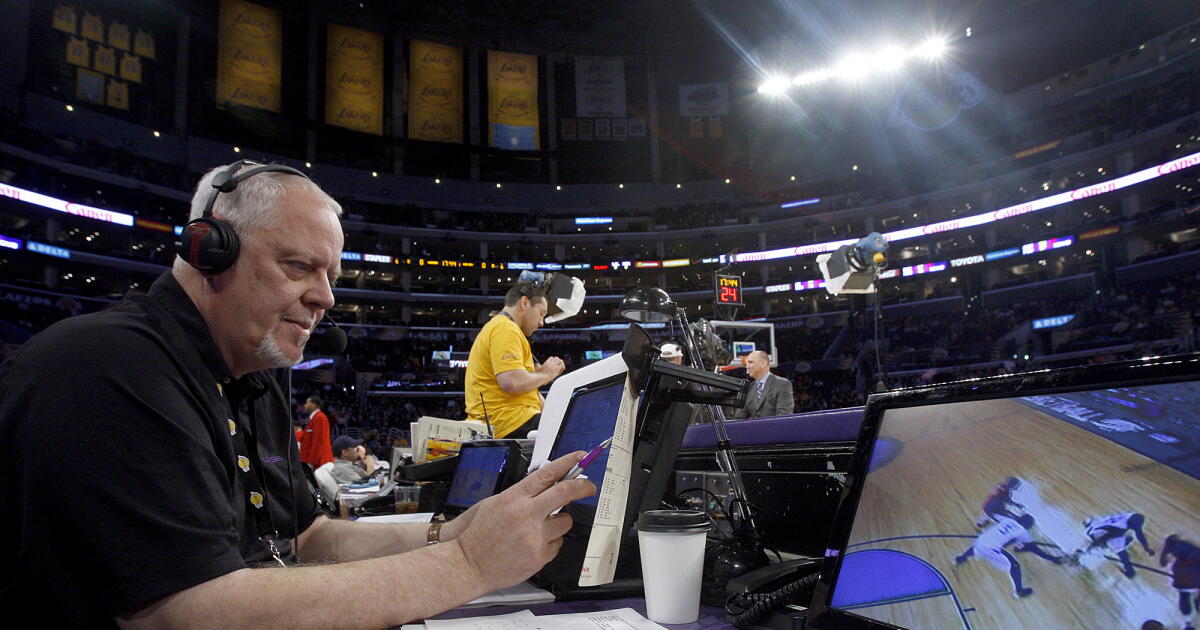
Lawrence

Beloved Lakers public address announcer Lawrence Tanter dies at 76

The Lakers’ longtime public address announcer Lawrence Tanter died Wednesday, the team announced. He was 76.

Remembered for his smooth, baritone voice, Tanter served as the voice of the Lakers for more than four decades. Tanter narrated chapters of Kareem Abdul-Jabbar and Magic Johnson, Kobe Bryant and Shaquille O’Neal, LeBron James and now Luka Doncic. After a stroke suffered in March forced him to retire from his game-day role, he transitioned to an advisory role in June.

“For 43 years, LT’s voice served as the soundtrack to Lakers games at the arena,” the team said in a statement Wednesday. “He will be remembered as a cherished member of the Lakers family.”

Tanter started with the team in 1982 when the Lakers played in the Forum. His signature calls — “toooo many steps,” “Kobeee Bryant,” “Lllaker Girlsss” — were not boastful or over the top. For a franchise that came to embody old Hollywood glamour, Tanter’s voice became the ideal soundtrack.

“A true original that added his unique style to Showtime,” Lakers governor Jeanie Buss wrote on X. “Rest in peace, LT.”

He backed fans up as they celebrated 10 championships during his tenure. He offered comfort in other painful times.

Days after Lakers legend Kobe Bryant died in a helicopter crash in 2020, Tanter guided a sold-out crowd through a tearful pregame routine, introducing all five of the Lakers’ starters with a familiar call: “Number 24, 6-6, 20th year out of Lower Merion High School, Kobeeee Bryant.”

The 6-foot-7 Tanter towered over many, but greeted everyone with a kind smile and warm conversation. Just as the players he serenaded with his calls became institutions in the sport, so did he. Tanter was inducted into the Southern California Sports Broadcaster Hall of Fame.

“I hope the team wears an LT patch this season,” former Lakers center and current team broadcaster Mychal Thompson wrote on X on Tuesday.

“He was a great vibe dude, always engaged me in conversation about jazz, he was a music lover and the best announcer in the NBA,” Red Hot Chili Peppers bassist and longtime Lakers fan Flea wrote on X. “I realized when attending many other NBA arenas that no one else came close.”

While many in his profession brought energy with loud, hyped-up calls, Tanter held firm with his cool style. He “never tried to be a cheerleader,” Tanter told The Times’ Bill Plaschke in June.

“It’s been a great run,” Tanter said after announcing his retirement. “I’ve been blessed.”

Source link

Lawrence F. O’Brien, 73; He Was Target of 1972 Watergate Break-In

Lawrence F. O’Brien, who while serving as Democratic National Committee chairman was the target of the Watergate break-in that spelled the downfall of then-President Richard M. Nixon, has died in New York City. He was 73.

O’Brien, who also was a key strategist for four presidential election campaigns, a former U.S. postmaster general and a commissioner of the National Basketball Assn., died Thursday night of cancer in New York Hospital-Cornell Medical Center.

His office was the scene of the June 17, 1972, bungled break-in that eventually led to Nixon’s resignation and the imprisonment of several of his aides. O’Brien believed that the Republican Party, seeking Nixon’s reelection against Democratic contender George McGovern, authorized the burglary in search of information to discredit him and the Democrats.

Nixon’s White House papers released by the National Archives in 1987 revealed that in 1974, Nixon had asked the Internal Revenue Service to search for embarrassing information in the income tax files of McGovern and O’Brien. The IRS refused.

O’Brien called the break-in “an incredible act of political espionage” and urged citizens to reject the claim that the incident and other “tricks” ordered by Nixon were “politics as usual.”

O’Brien also expressed concerns that the Watergate scandal would turn the public against the political process. In 1974, he discussed the implications of Watergate in his critically acclaimed memoir, “No Final Victories: A Life in Politics from John F. Kennedy to Watergate.”

“I’ve been a politician for most of my life and I’ve never dreamed of bugging an opponent’s telephone or breaking into his office,” O’Brien wrote. “If a generation of Americans becomes convinced that burglary and wiretapping are ‘politics as usual,’ then there’s not much hope for our political system.”

Born July 7, 1917, in Springfield, Mass., O’Brien was brought up on politics by his Irish immigrant father. After Army service in World War II and completing night law school at Boston’s Northeastern University, O’Brien worked for Massachusetts Rep. Foster Furcolo, and then, in 1952, took over John F. Kennedy’s campaign for the U.S. Senate.

Lauded for his pragmatic ability to organize and compromise, O’Brien was put in charge of Kennedy’s successful 1960 presidential campaign and later headed the ill-fated campaign by the President’s younger brother, Robert F. Kennedy. O’Brien was with both Kennedys when they were slain.

“I remember standing in the hospital with Ken O’Donnell (another member of President Kennedy’s so-called ‘Kennedy Mafia’) for a half-hour, refusing to tell the world he was dead–because we couldn’t accept it,” O’Brien told the Los Angeles Times 20 years after the Dallas assassination of John F. Kennedy.

“But then, years later, I was with Bobby in Los Angeles when he, too, was shot,” O’Brien added. “My reaction was: ‘That’s it.’ At that moment, I became a fatalist.”

After President Kennedy was assassinated, O’Brien worked for Kennedy’s successor, Lyndon B. Johnson, and ran Johnson’s successful 1964 presidential campaign against Barry Goldwater.

Johnson named him postmaster general and, in that position, O’Brien prepared a report that moved the postal department from Cabinet status to a semi-public corporation.

After Robert Kennedy was assassinated in 1968, O’Brien headed the presidential campaign of Sen. Hubert H. Humphrey, who lost to Nixon.

O’Brien served as chairman of the Democratic National Committee from 1970 to 1972, when the party was in shambles because of anti-Vietnam debates. He left politics after McGovern was defeated by Nixon.

O’Brien became commissioner of the NBA in 1975 and served until 1984. He was credited with settling the so-called “Oscar Robertson suit” in 1976, providing free agency in the league, and with supervising a smooth merger between the NBA and the rival American Basketball Assn.

He also avoided a 1983 players’ strike by negotiating a landmark collective bargaining agreement for professional sports. The agreement, which stabilized the troubled league, provided an innovative cap on how much money teams could spend on salaries and benefits in return for giving players 53% of the league’s gross revenues.

Larry Fleisher, head of the Players Assn. and one of O’Brien’s chief adversaries, said O’Brien left the sport of basketball “better off by far” than he had found it.

O’Brien is survived by his wife, Elva Brassard O’Brien; a son, Lawrence F. O’Brien III; a sister, and two grandsons.

Funeral services are planned for Tuesday in Springfield, Mass.

RELATED STORY, C5

Source link