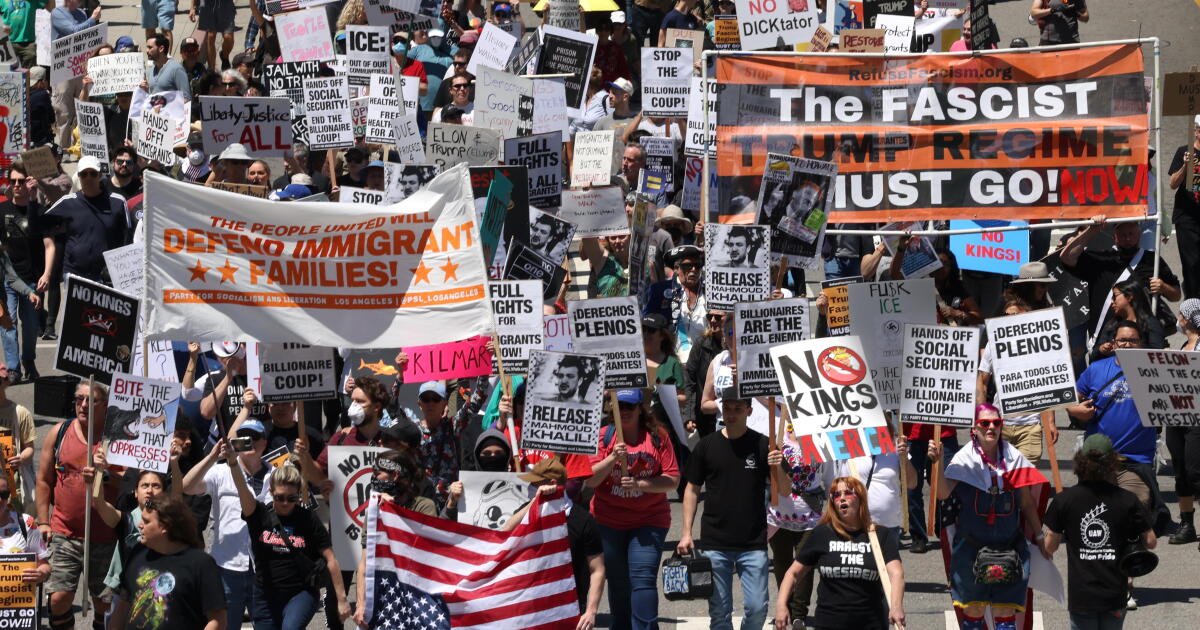
MONTGOMERY, Ala. — Thousands of people rallied Saturday in the cradle of the modern civil rights movement to mobilize a new voting rights era as conservative states dismantle congressional districts that helped secure Black political representation.
U.S. Sen. Cory Booker of New Jersey called Montgomery “sacred soil” in the fight for civil rights.
“If we in our generation do not now do our duty, we will lose the gains and the rights and the liberties that our ancestors afforded us,” Booker said in the Alabama capital.
The crowd was led in chants of “we won’t go back” and “we fight.”
“We are not going down without a fight. We are not going down to Jim Crow maps,” Shalela Dowdy, a plaintiff in the Alabama redistricting case said, alluding to racial gerrymandering in several states that has followed the recent Supreme Court decision to roll back the Voting Rights Act.
A crowd of thousands gathered in front of the city’s historic Alabama Capitol, where the Confederacy was formed in 1861 and where the Rev. Martin Luther King Jr. spoke in 1965 at the end of the Selma-to-Montgomery voting rights march. The stage, set in front of the Capitol, was flanked from behind by statues of Confederate President Jefferson Davis and civil rights icon Rosa Parks — dueling tributes erected nearly 90 years apart.
Speakers said the spot was once the temple of the Confederacy and transformed into holy ground of the civil rights movement.
Some in the crowd said the effort to redraw lines has echoes of the past.
“We lived through the ’60s. It takes you back. When you think that Alabama’s moving forward, it takes two steps back,” said Camellia A. Hooks, a 70-year-old Montgomery resident.
The rally began in Selma, where a violent clash between law enforcement and voting rights activists in 1965 galvanized support for passage of the Voting Rights Act. It then moved to the state Capitol, where King gave his “How Long, Not Long” speech the same year.
The Supreme Court ruling involving Louisiana hollowed out a tenet of the Voting Rights Act that was already weakened by a separate high court decision in 2013 and then narrowed further over the years. That helped clear the way for stricter voter ID laws, registration restrictions and limits on early voting and polling place changes, including in states that once needed federal pre-clearance before they could change voting laws because of their historical discrimination against Black voters.
Veterans of the civil rights movement are alarmed by the speed of the rollbacks, noting that protections won through generations of sacrifice have been weakened in little more than a decade.
Kirk Carrington, 75, was a teen in 1965 when law enforcement officers attacked marchers in Selma on what became known as Bloody Sunday. A white man on a horse wielding a stick chased Carrington through the streets on that day, he said.
“It’s really just appalling to me and all the young people that marched during the ’60s, fought hard to get voting rights, equal rights and civil rights,” Carrington said. “It’s sad that it’s continuing after 60-plus-odd years that we are still fighting for the same thing we fought for back then.”
The effect in Montgomery
Montgomery is home to one of the congressional districts that is being altered in the wake of the Supreme Court ruling.
A federal court in 2023 redrew Alabama’s 2nd Congressional District after ruling that the state intentionally diluted the voting power of Black residents, who make up about 27% of its population. The court said there should be a district where Black people are a majority or near-majority and have an opportunity to elect their candidate of choice.
But the Supreme Court cleared the way for a different map that could let the GOP reclaim the seat. While the matter remains under litigation, the state plans special primaries Aug. 11 under the new map.
Democratic Rep. Shomari Figures, who won election in the district in 2024, said the dispute is not about him but rather people’s opportunity to have representation.
“When Republicans are literally turning back the clock on what representation, what the faces of representation look like, what the opportunities, legitimate opportunities for representation look like across this country, then I think it starts to resonate with people in a little bit of a different way,” Figures said.
Alabama House Speaker Nathaniel Ledbetter, a Republican, said the Louisiana ruling provided an opportunity to revisit a map that was forced on the state by the federal court.
“People tend to forget what happened. When this thing went to court, the Republican Party had that seat, congressional seat 2,” Ledbetter said last week. “There’s been a push through the courts to try to overtake some of these red state seats, and that’s certainly what happened in that one.”
Evan Milligan, the lead plaintiff in the Alabama redistricting case, said there is grief over the dismantling of the Voting Rights Act, but it is crucial that people recommit to the fight.
“We have to accept that this is the new reality, whether we like it or not,” Milligan said. “We don’t have to accept that this will be the reality for the next 10 years or two years or forever.”
Chad Bianco’s campaign for California governor leans heavily on his years as Riverside County sheriff, a record that has drawn praise from voters yearning to return to a tough-on-crime era and harsh criticism from others who consider him a far-right affront to the rule of law.
The stout, mustached Republican is running an unapologetic campaign against the “Democrat policies that have destroyed this state,” launching into angry diatribes about, as he sees it, the left’s failed record in California in debate after debate, on social media and in news interviews, during which where he often accuses the media of being complicit.
In an interview with The Times, Bianco said he is sick of what he calls soft-on-crime Democrats in Sacramento undermining him and other law enforcement leaders across the state, whom he wants to unleash if given the power.
Part of Bianco’s prescription for turning California around: cracking down on theft and drug offenses, stiffening sentences for both petty and violent crime, building more detention facilities, collaborating with federal immigration forces to deport immigrant offenders, and demanding greater personal accountability from homeless people suffering from mental illness and drug addiction.
Riverside County Sheriff Chad Bianco, a GOP candidate for governor, and Kate Monroe, CEO of VETCOMM, speak with people in the Skid Row area of Los Angeles. .
(Jason Armond / Los Angeles Times)
“It is impossible for me to keep my county safe because of politics. It is impossible for me to run my jails correctly because of politics. It is impossible for me to prosecute someone to the fullest extent of the law because of politics,” Bianco said. “Politics is destroying the state of California — and unfortunately for the Democrat Party, they are 100% to blame.”
It’s a message that has clearly resonated with a slice of the California electorate. Bianco has consistently polled above 10% among likely voters, putting the MAGA-aligned sheriff among the top tier of gubernatorial candidates in deep blue California thanks to a slew of Democratic candidates still splitting their party’s much bigger base.
It’s also a message receiving increased scrutiny as the June 2 primary nears, from rival candidates on both sides of the political aisle.
A spokesman for Democrat Xavier Becerra, who served as California attorney general during part of Bianco’s time as sheriff, called Bianco a “tyrant” and said he has run his department “like a man who answers to no one — not the president, not the courts, not the people he was elected to serve.”
Republican Steve Hilton, a former Fox News commentator endorsed by President Trump, has attacked Bianco for essentially the opposite reason — suggesting Bianco has literally and figuratively bent the knee to liberal forces in the state.
Despite Hilton’s attacks, Bianco’s political record is far right and fully in line with the MAGA base, including on sanctuary policies, election integrity and other issues favored by Trump.
LAPD officers and DEA agents converge along Alvarado Avenue near MacArthur Park targeting an open-air drug market on Wednesday.
(Genaro Molina / Los Angeles Times)
On crime
Crime has been a top issue for California voters for years, and Bianco will no doubt benefit among a portion of the electorate from having the title of sheriff attached to his name on the ballot.
According to a Times analysis of state-collected data through 2024, Bianco’s record on crime has been mixed. The data show violent crime rising for years under his leadership and being solved at lower rates than in surrounding counties. The data also show a more recent turnaround, with declines in such crime and improved clearance rates.
Bianco challenged the accuracy of the state data and offered his own snapshot of crime figures that painted a different picture — of much higher clearance rates, but also a much larger volume of violent crime in his jurisdiction.
Bianco, 58, joined the Sheriff’s Department in 1993 and was a lieutenant when he defeated the incumbent sheriff in 2018, taking over policing and jail oversight in 2019 for a vast swath of one of California’s largest counties. He won reelection in 2022.
Riverside County Sheriff Chad Bianco takes a knee with demonstrators after thousands marched to the Robert Presley Detention Center and were met with a roadblock of law enforcement during a protest against the death of George Floyd in 2020.
(Gina Ferazzi / Los Angeles Times)
According to the state data, overall violent crime in that county jumped in 2019, fell slightly in 2020, then increased each year from 2021 to 2023 before falling again in 2024. Homicides increased in 2019 and again in 2020, when the COVID-19 pandemic raged and cities across the country saw similar spikes, but declined each of the next four years, the data show.
Vehicle thefts have fluctuated during Bianco’s tenure but have been on the decline since 2021, according to the state data. Other forms of theft, as well as drug offenses — something Bianco said is crucial to address while backing Proposition 36, a ballot measure state voters passed in 2024 to increase penalties for such crimes — have also fluctuated in the county for years.
Meanwhile, Bianco’s deputies have struggled to reduce violent crime — like their counterparts in other counties — though they have made improvements under Bianco, according to state statistics.
The department cleared about 38% of violent crimes in 2018 and about 47% in 2024, with several fluctuations within that range in the years between, according to state data.
Law enforcement from surrounding communities, including San Bernardino County sheriff’s deputies and CHP officers, close off streets and lock down the perimeter at Loma Linda University Medical Center after a report of a gunman in the emergency department of Children’s Hospital on March 12, 2025.
(Gina Ferazzi / Los Angeles Times)
By comparison, the San Bernardino County Sheriff’s Department during the same time period saw violent crime clearance rates between about 50% and nearly 64%, while the Los Angeles County Sheriff’s Department saw rates between about 55% and 63%, the data show.
The Sheriff’s Department is responsible for law enforcement in the county’s unincorporated areas, which include deserts and mountains, as well as cities that contract with the agency — including Temecula, Moreno Valley, Lake Elsinore, Rancho Mirage and others. The Times analyzed state crime and clearance data from all those areas.
In 2021, the ACLU of Southern California wrote a letter to the California attorney general’s office demanding that it investigate Bianco’s department for “racist policing practices, rampant patrol and jail deaths” and noncompliance with past court orders requiring improvements.
In 2022, 19 people died in Riverside County jails, making them among the deadliest in the nation. An investigation by the Desert Sun later blamed “neglect by jail employees, access to illicit drugs, and cell assignments that put detainees at increased risk of violence or did not allow for close oversight.”
In 2023, California Atty. Gen. Rob Bonta launched a sweeping civil rights investigation to determine whether the Sheriff’s Department had “engaged in a pattern or practice of unconstitutional policing amid deeply concerning allegations relating to conditions of confinement in its jail facilities, excessive force, and other misconduct.”
Bonta’s office declined to comment on the ongoing investigation, which has yet to produce any public findings. Bianco pointed to the lack of results to date as proof there is nothing to uncover in his jails, which he claimed are the best-run in the state.
“If there was all of these bad things that I were doing, are you telling me that he was going to allow me to continue to do them for three years?” Bianco said. “There is not going to be anything because our attorney general is an absolute lying fraud and an embarrassment to law enforcement.”
Gubernatorial candidate Chad Bianco greets supporters during a break at the California Republican Convention at the Sheraton San Diego Resort on April 11.
(John Gastaldo / For The Times)
Bianco argued that crime data put out by the state has been cherry-picked by liberals to make law enforcement look bad.
He said crime was underreported in Riverside County before he took office because residents and business owners didn’t believe anything would be done about it, and that he actually “wanted our crime stats to go up” when he took over because it would mean trust had improved.
He said his agency had been struggling to retain deputies amid poor morale when he took over, but has since rebounded and become “one of the most proactive law enforcement agencies in the country” thanks to his focus on addressing crime “hot spots” and “broken windows” policing — a much-criticized theory that says addressing urban blight and enforcing laws against petty offenses also drives down violent crime.
Rep. Ken Calvert (R-Corona), who has endorsed Bianco, called him a “real law enforcement champion” for Riverside who despite challenges has “consistently made it harder for criminals to succeed in our communities.” Calvert said drug cartels operating in rural stretches of the Inland Empire make solving crime in the region difficult, but Bianco has “done a good job of trying to face up to it and move it in the right direction,” including as an outspoken critic of “soft-on-crime laws” in Sacramento.
Speaker of the House Mike Johnson (R-La.,) center, listens to Riverside County Sheriff Chad Bianco speak at a news conference in the U.S. Capitol as part of Police Week on May 15, 2024.
Speaking with The Times, Bianco defended the Oath Keepers — which he did again during a recent debate — and said it wasn’t right to judge the entire organization based on the actions of some members. He also said Trump was right to pardon many of the people charged in connection with Jan. 6 — who he said “did absolutely nothing” wrong and were “politically prosecuted with lies” — but that he disagreed with the president’s pardoning of others who were caught on video attacking U.S. Capitol police.
Bianco has claimed expansive powers as sheriff, including to buck state directives, as with COVID; has said his Christian faith is a driving force in his life; and has described his comment about a felon in the White House as a tongue-in-cheek criticism of bogus attacks on Trump.
He joined Huntington Beach in a lawsuit challenging California’s sanctuary policies, which generally bar localities and their law enforcement agencies from participating in federal immigration raids or initiatives, and has sent mixed messages on whether his deputies would work with Immigration and Customs Enforcement agents despite California’s laws.
In November 2024, he told Fox 11 L.A. that if keeping Riverside County residents safe meant “working somehow around” state laws and “with ICE so we can deport these people victimizing us and our residents, you can be 100% sure I’m going to do that.” In February 2025, he said Riverside County deputies “have not, are not and will not engage” in immigration enforcement, which he said is a federal responsibility.
Riverside County Sheriff Chad Bianco kicks off his campaign to run for governor at the city’s Avila’s Historic 1929 event center on Feb. 17, 2025.
(Gina Ferazzi / Los Angeles Times)
Also this year, Bianco caused an uproar when he seized more than 650,000 ballots from last November’s election as part of what he said was an investigation into whether they were fraudulently counted — a claim he is entertaining from a fringe group of election deniers, despite assurances from county and state officials that the allegations are baseless.
Bonta sued to stop the investigation, arguing there is no basis for it and that Bianco has no such authority without buy-in from him and oversight from state elections officials. He accused Bianco of having gone “rogue” and creating “a constitutional emergency in the process.”
The California Supreme Court halted the investigation as it weighs arguments in the case.
Bianco slammed Bonta for trying to halt his investigation, which he said was “probably one of the most easy criminal investigations you could ever, ever imagine” and normal work for a sheriff.
Bob Shrum, a longtime Democratic strategist and director of the Dornsife Center for the Political Future at USC, said much of what Bianco does, including his seizure of ballots, is “performative Trumpism” — and “out of step with California.”
Chad Bianco, left, answers a question as Tom Steyer watches during a gubernatorial debate at Pomona College on Tuesday, April 28, 2026 in Claremont, CA.
(Eric Thayer/Los Angeles Times)
Joy Silver, chair of the Riverside County Democratic Party, said Bianco has been cultivating an image as a tough-on-crime candidate for years, but in recent debates has shown his true colors as an angry ideologue with few policy ideas and little willingness to work across the aisle.
Silver said Bianco’s simplistic “own the libs” approach to governing has already harmed Riverside, and would serve no one were he governor.
“There’s no policy or solutions or anything that are packed into that,” she said. “It’s just a hateful message.”
WASHINGTON — A man charged with attacking the White House Correspondents’ Assn. dinner is seeking to disqualify top Justice Department officials from direct involvement in prosecuting him because they could be considered victims or witnesses in the case, creating a potential conflict of interest.
Acting Atty. Gen. Todd Blanche and U.S. Atty. Jeanine Pirro were attending the April 25 event at the Washington Hilton when Cole Tomas Allen allegedly ran through a security checkpoint and fired a shotgun at a Secret Service officer.
In a court filing late Thursday, Allen’s attorneys argued that it creates at least the appearance of a conflict of interest for Blanche and Pirro to be making any prosecutorial decisions in the case.
“As this case proceeds closer to trial, the country and the world will continue to wonder — how can the American justice system permit a victim to prosecute a criminal defendant in a case involving them?” defense attorneys Eugene Ohm and Tezira Abe wrote.
Ohm and Abe, who are assistant federal public defenders, suggested that the appointment of a special prosecutor might be warranted. They urged U.S. District Judge Trevor McFadden, a Trump nominee assigned to Allen’s case, to disqualify Pirro, Blanche and possibly other Justice Department officials from direct involvement in the investigation and prosecution.
“Both heard gunshots, which presumably forced them to duck below the tables with the rest of the occupants. They were quickly evacuated. Shortly thereafter, they learned that law enforcement believed the target was certain administration officials,” Ohm and Abe wrote.
Pirro said her office will respond to the defense lawyers’ arguments in its own court filing.
“We will not tolerate people who come to the District of Columbia to engage in antidemocratic acts of political violence; and we will prosecute all such acts to the fullest extent of the law,” Pirro said in a statement.
Allen is scheduled to be arraigned Monday on charges in an indictment handed up Tuesday by a grand jury in Washington.
The charges include attempting to assassinate President Trump, who is a longtime friend of Pirro’s. Blanche served as a personal attorney for Trump before joining the Justice Department last year.
Blanche, through a spokesperson, referred a request for comment to Pirro’s office.
Allen also is charged with assaulting a federal officer with a deadly weapon and two additional firearms counts. He faces a maximum sentence of life in prison if convicted of the attempted assassination charge alone.
The Secret Service officer who was shot once in a bullet-resistant vest fired his own weapon five times without hitting anybody. Allen, 31, of Torrance, was injured but was not shot.
According to Acting Atty. Gen. Todd Blanche and other top administration officials, the U.S. Secret Service did a fine job protecting President Trump and Cabinet members from the gunman who breached the White House Correspondents’ Assn. dinner Saturday.
“That horrible act was stopped because of the courage and professionalism of law enforcement — the officers who responded without hesitation and did their jobs as they were trained to do,” Blanche said Monday.
However, according to a detailed accounting filed Wednesday by federal prosecutors in the criminal case against suspect Cole Tomas Allen, the performance of the nation’s preeminent protection agency was marred by inattentiveness and misfires and saved by “extraordinary good fortune” and the gunman falling to the ground.
“The defendant, armed with a 12-gauge shotgun, a .38 caliber pistol, two knives, four daggers, and enough ammunition to take dozens of lives, was apprehended by [Secret Service] officers mere feet away from the ballroom where his primary target was located, along with other members of the Cabinet,” prosecutors wrote Wednesday, in a filing arguing for Allen to be held in detention pending trial on one charge of trying to kill the president and two firearms charges.
Contradicting a prior claim by Blanche that officers had “promptly tackled and detained” Allen, prosecutors wrote that the 31-year-old tutor from Torrance simply “fell to the ground” after blowing past a team of agents just two open flights of stairs from the ballroom.
They wrote that one officer fired at Allen five times, but never hit him.
The same officer saw Allen fire his shotgun “in the direction of the stairs leading down to the ballroom,” prosecutors wrote, and officers later discovered “one spent cartridge in the barrel and eight unfired cartridges in the magazine tube.”
Prosecutors said nothing about the Secret Service officer who Blanche said was shot in his ballistic vest during the incident — adding to speculation that the officer may have been shot not by Allen, but by a fellow officer, or not at all.
Agency critiqued before
In all, the court filing brought further into focus a chaotic Secret Service response that appeared flawed from the start, including in a video Trump posted shortly after the incident in which agents appeared to be idling around an unobstructed entrance when Allen ran past them.
It added to concerns that law enforcement, security experts and members of Congress had raised about the performance of an agency that has been repeatedly called on to improve after previous attempts on Trump’s life. At a 2024 campaign rally in Butler, Pa., a gunman fired a bullet that grazed Trump’s ear, and that same year, another assailant prepared to shoot him from the unsecured perimeter of a Florida golf course.
Robert D’Amico, a former FBI deputy chief of operations for hostage rescue teams who is now a security consultant, said the security failures he saw in the Secret Service’s preparation for Saturday’s dinner — including its failure to set up basic barriers to prevent people from sprinting into the secured area — were stunning, especially given the past threats and the fact the nation is at war with Iran.
“It’s for a person like Trump, who’s had two assassination attempts before and is at war with Iran, which has terrorist training and proxies up, and you still don’t have the basics?” D’Amico said. “It’s unfathomable.”
Other concerns have been voiced by members of Congress, including Republicans.
The House Oversight Committee has requested a briefing from the Secret Service, and Sen. Josh Hawley (R-Mo.) has called for a hearing before the Senate Homeland Security and Governmental Affairs Committee, which also investigated the Butler incident.
In a letter urging the hearing, Hawley said the latest incident “raises questions about presidential security arrangements, potential resource needs, and the degree to which reforms previously proposed by Congress have been adopted.”
House Speaker Mike Johnson (R-La.) told Fox News that from “a layman’s perspective,” event security “looked a little lax in terms of getting into the building,” and that it “doesn’t sound like it was sufficient.”
Sean M. Curran, director of the Secret Service, has been on Capitol Hill in recent days briefing lawmakers.
He told CBS News that agents did a “great job,” but also that the incident remains under review. White House Press Secretary Karoline Leavitt has said that White House Chief of Staff Susie Wiles would be leading discussions on potential updates to Secret Service plans for securing the president.
Fear of graver threats
Blanche has argued that proof of the Secret Service’s effectiveness at the press gala was in the result: Allen was stopped, Trump and other officials were unharmed and no one was killed, despite Allen’s alleged intent.
However, the concerns being raised have to do with the vulnerabilities that were exposed as much as those that were exploited.
Because the dinner was not designated a major “national special security event” — such as a political convention — there were no trained counterassault agents on standby to prevent a breach or to take down a person with a weapon, officials have said.
Law enforcement experts said that was clearly a mistake given so many top officials — Trump, Johnson, Vice President JD Vance, Secretary of State Marco Rubio, Treasury Secretary Scott Bessent and Defense Secretary Pete Hegseth, among others — were in the room.
Such a gathering could have been targeted by foreign adversaries or others with far more experience, less regard for human life and much greater firepower than Allen, experts said.
“Most of my military friends are all saying the same thing,” said D’Amico, who is also a former infantry platoon commander in the U.S. Marines. “If you had had a team of three or four [gunmen], they would have gotten to [Trump].’”
In the initial criminal complaint against Allen, prosecutors included the text of an email Allen sent to family just as he was preparing to rush the security perimeter, in which he allegedly wrote that he had chosen to use buckshot in order to “minimize casualties” and prevent bystanders from being wounded by more powerful bullets penetrating walls.
He also allegedly wrote that he was willing to “go through most everyone” at the event to get to top administration officials, but that guests and hotel staff were “not targets at all.”
In Wednesday’s filing, prosecutors describe Allen’s actions as “premeditated, violent, and calculated to cause death,” and say he was “laden with weapons” as he breached security. But none of those weapons included assault-style rifles that can fire multiple bullets rapidly and have been used to kill civilians in mass shootings across the country for years.
The filing described Allen — a Caltech graduate and high school tutor — not as some trained tactical expert, but as an ideologue who spent part of his Amtrak journey from California to Washington waxing poetic about the landscape around him, describing Pennsylvania’s woods as “vast fairy lands filled with tiny trickling creeks in spring.”
Could have been worse
D’Amico said he and other Marines learned early on in Iraq that entrances to secured locations have to be designed in a “serpentine” fashion, forcing anyone approaching to move more slowly through the area and giving security officers more time to assess their intentions. And at an event the size of the correspondents’ dinner, with so many top officials gathered in a public hotel, you would want to make entrances “even more difficult.”
And yet no barriers seemed to be in place at the event, he said — something anyone trained more than Allen could have capitalized on.
“If they just had come through in a team of three or four who were coordinated and trained, there absolutely would have been penetration into the ballroom,” D’Amico said. “It would have been a gunfight.”
Allen himself questioned the security at the event, according to court records, allegedly writing that he had walked into the Washington Hilton with multiple weapons and no one considered “the possibility that I could be a threat.”
He wrote that if he “was an Iranian agent, instead of an American citizen,” he “could have brought a damn Ma Deuce in here and no one would have noticed” — referring to a powerful machine gun.
“It is fortunate he was only armed with what he had,” said Ed Obayashi, a California law enforcement expert on use of force.
Another woman came forward Tuesday to describe rape allegations against Rep. Eric Swalwell, who announced his resignation from Congress on Monday amid a torrent of sexual misconduct accusations.
Lonna Drewes said at a news conference called by her attorneys that she was drugged and raped by Swalwell (D-Dublin) in 2018 while she was working as a model in Beverly Hills.
Drewes said she met Swalwell three times as she was growing her fashion software company and toying with the idea of a political career.
On the third occasion, she said, she believed he drugged her glass of wine. She said they were supposed to go to a political event and they stopped by his hotel room to retrieve some paperwork.
She said she found herself incapacitated despite having had only one drink.
“He raped me and he choked me and while he was choking me I lost consciousness and I thought I died,” she said. “I did not consent to any sexual activity.”
Swalwell’s attorney Elias Dabaie did not immediately respond to a call or email requesting comment. Swalwell has previously denied allegations against him, while acknowledging undefined “mistakes.”
Swalwell and his team threatened legal action against several individuals over the claims, Dabaie previously confirmed to The Times.
Lonna Drewes, left, says she met Rep. Eric Swalwell (D-Dublin) on three occasions in Beverly Hills in 2018. She says he sexually assaulted her on the third occasion.
(Myung J Chun / Los Angeles Times)
Drewes said she didn’t undergo a rape kit test, but disclosed the assault to people close to her and described it in her calendar. She did not have contact with Swalwell again, one of her attorneys said.
Drewes said she had no interest in Swalwell romantically and was drawn to his friendship, she said, in part because he touted connections that she believed could help her grow her businesses. She was in a relationship at the time, and he had a pregnant wife, she said.
The alleged rape had a severe impact on her mental health, causing her to self-medicate, she said. She said she also went to therapy sessions at a sexual assault center.
“I did not want to live anymore,” she said. “I cried all the time for years.”
She said she’d been considering a run for Beverly Hills City Council at the time. After the incident, she said, she feared a political backlash and felt like she had no choice but to remain silent.
Lonna Drewes walks behind her lawyer Arick Fudali during a news briefing in Beverly Hills on Tuesday.
(Myung J. Chun / Los Angeles Times)
“My delay in taking action against Eric was driven by fear, not doubt,” she said. “I have never doubted what happened.”
The L.A. County Sheriffs Department said Tuesday that it is investigating the case.
“The investigation remains in its preliminary stages and is ongoing,” the department said. “Investigators are in the process of gathering information, reviewing available evidence and conducting follow-up inquiries as part of a comprehensive investigative process.“
A spokesperson for the L.A. County district attorney’s office said the Sex Crimes Division had been assigned to work with law enforcement partners in an unfolding investigation.
Arick Fudali, one of the attorneys representing Drewes, said he hoped his client’s account would encourage other women to come forward.
“This is not about Democrat versus Republican,” Fudali said. “This is about accountability versus silence.”
“Lonna deserves what all women deserve — autonomy over her own body,” said attorney Lisa Bloom.
Bloom is well-known for representing high-profile victims of sexual misconduct, including women in cases against actor Bill Cosby and commentator Bill O’Reilly. Bloom said they would be providing text messages, journal entries and photographs to the police. Those include a photo of Drewes and Swalwell at the opening of a restaurant called Avra that was displayed Tuesday for reporters.
Bloom said she wanted to assist with an investigation by the Manhattan district attorney, who has opened a case into allegations against Swalwell. She said three other women have reached out to her.
Swalwell, who has served in the House of Representatives since 2013, has said he plans to fight the “serious, false” allegations made against him.
“However, I must take responsibility and ownership of the mistakes I did make,” Swalwell wrote in a statement Monday.
Bloom called Swalwell’s recent statements about the accusations against him “blather and spin” and a “slap in the face” to victims.
“Stop it,” she said. “Own your behavior.”
Swalwell had been a Democratic front-runner in the hotly contested and crowded race to be California’s next governor. Then in two bombshell reports in the San Francisco Chronicle and CNN on Friday, women accused the congressman of sexual assault and misconduct.
Candidates in the California gubernatorial race reacted to the new allegations with horror.
“The level of my disgust and outrage just continues to grow,” former state Controller Betty Yee told The Times after a business forum in Sacramento. “The fact that this is still being uncovered, that it could be bigger than what we already know?”
Swalwell said he would resign from his congressional seat under intense pressure from lawmakers of both parties. The resignation came on the heels of the House Ethics Committee opening an investigation into the sexual misconduct allegations and bipartisan threats to expel him from the House if he did not resign as women continued to come forward.
One woman told CNN that after messaging with Swalwell about her interest in Democratic politics last year, she met him for drinks and tried to deflect his advances without jeopardizing potential job opportunities. She said she began to feel “really fuzzy” and intoxicated and later found herself in his hotel room with no memory of how she got there.
Another woman, a former staff member who accused Swalwell of rape, told CNN she met him for drinks in 2019, blacked out and awoke naked in his hotel bed and could tell she had had intercourse. She said that in a separate encounter years later, he forced himself on her while she was too intoxicated to consent and despite her protests.
Gov. Gavin Newsom on Tuesday called a special election for Swalwell’s Alameda County seat on June 16, two weeks after the state’s regularly scheduled primary. If no candidate receives 50% of the vote, a second special election will be held on Aug. 18.
The June 2 regular primary and Nov. 3 general election will decide who will represent the recently reconfigured district for the next term, starting in January 2027. The special election decides who will represent the district for the remaining months of Swalwell’s term.
Times staff writers James Queally, Dakota Smith and Seema Mehta contributed to this report.