7 essential moments from the 2026 Tony Awards
The 79th Tony Awards went off without a hitch at Radio City Music Hall, Sunday. The show, hosted by Pink, ran just over three hours and was relatively unsurprising when it came to the wins it delivered. Although each year it seems more marquee film and television stars appear in the audience as celebrities of a certain caliber continue to flock to the stage in search of a more authentic—and immediate—connection to their audience.
This year viewers could see Adrien Brody, John Lithgow, Laurie Metcalf, Rose Byrne, Daniel Radcliffe, Nathan Lane, Alden Ehrenreich and more. Despite, or perhaps because of the star power, the show stuck to its expected script with “Schmigadoon!” winning best musical, “Ragtime” best musical revival, “Liberation” best play and “Death of a Salesman” best revival.
Still, the night had enough laughs, groans and tender moments to keep things interesting. Here are seven of our favorites.
Vampires as metaphor for what ails America

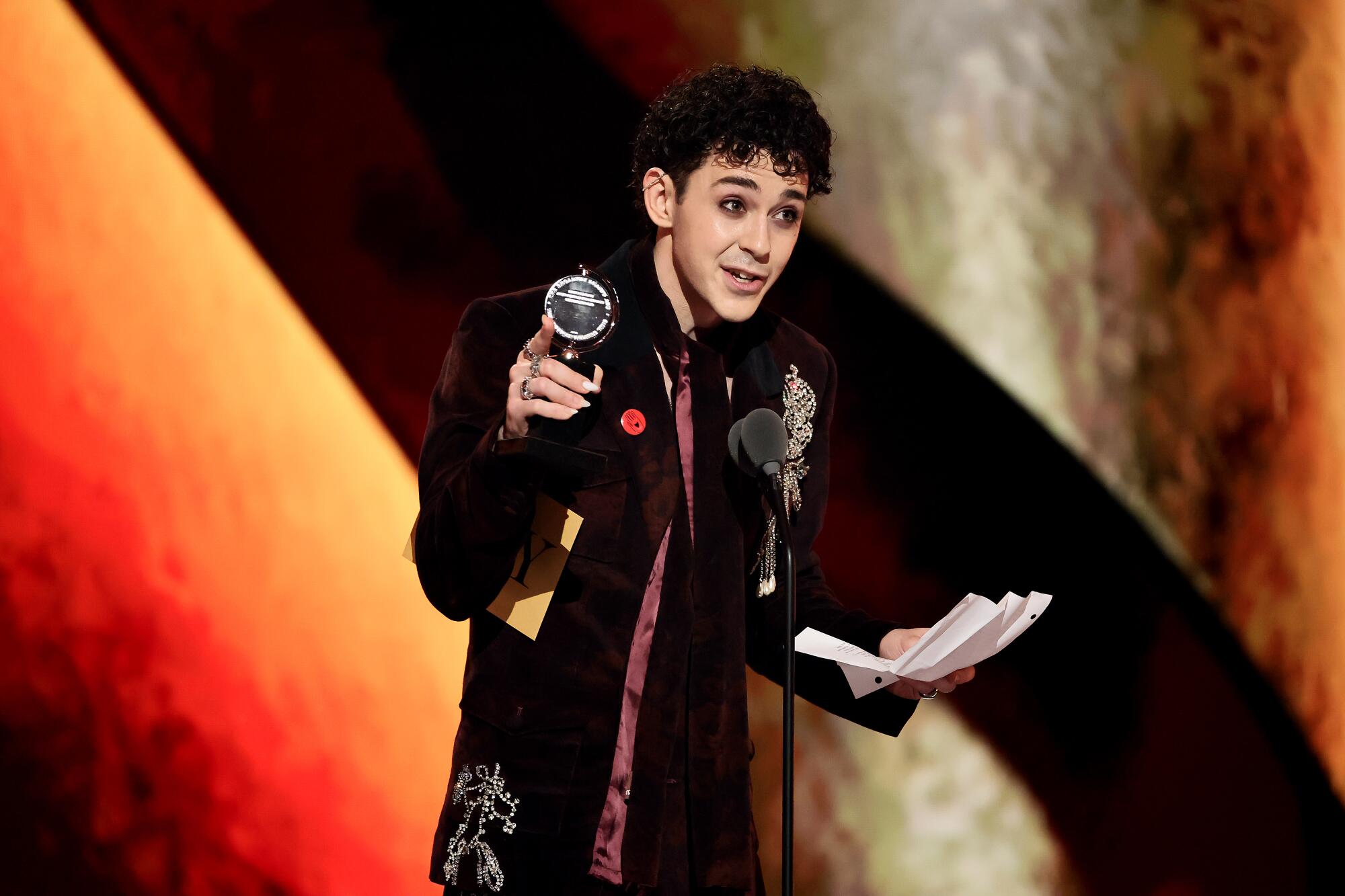
Ali Louis Bourzgui used vampires as a metaphor for American folly in his acceptance speech for performance by an actor in a featured role in a musical at the 2026 Tony Awards.
(Theo Wargo / Getty Images for Tony Awards Productions)
Who knew vampires made such a good metaphor for America’s worst excesses? When 26-year-old Ali Louis Bourzgui took to the stage at Radio City Music Hall after an upset win for performance by an actor in a featured role in a musical, he used the undead to poignantly describe the country’s biggest sociopolitical challenges.
“Vampires represent those who have shunned their own humanity in order to achieve a nonexistent sense of superiority. The billionaires will never find happiness from their money. The colonizers will never find fulfillment from the land and lives they steal. The fascists will never find meaning from their conformity, not in this lifetime or eternity,” said Bourzgui, who originated the role of David in the musical adaptation of the cult vampire horror film “The Lost Boys.”
—Jessica Gelt
A Tony trifecta for John Lithgow and Laurie Metcalf

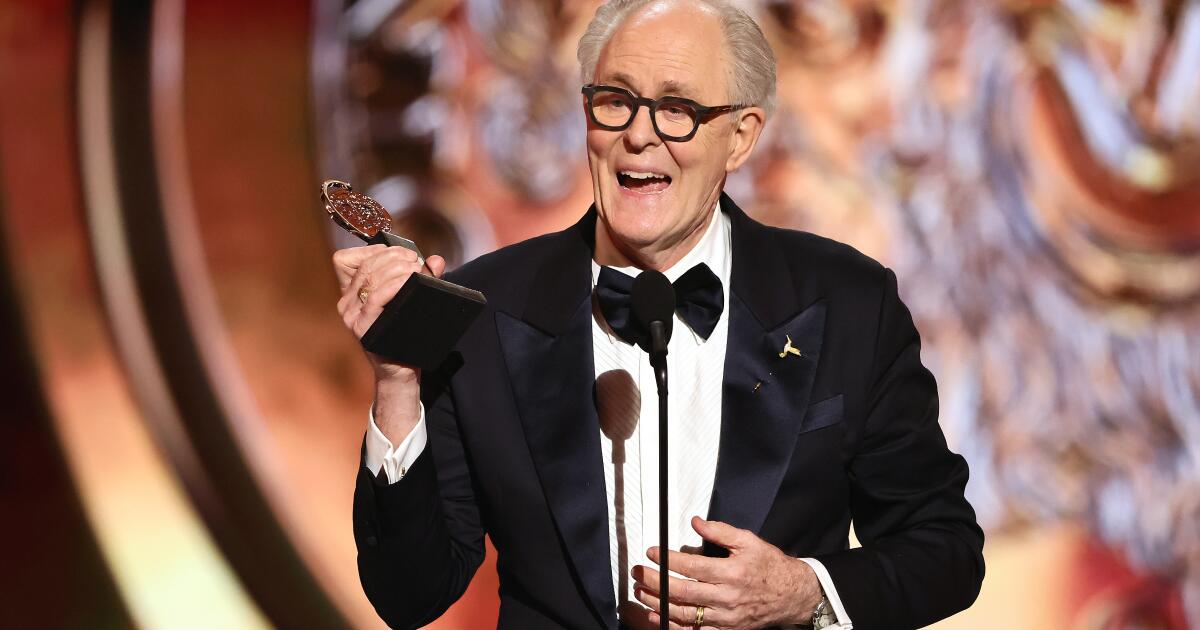
John Lithgow won the third Tony Award of his career at the 2026 Tony Awards at Radio City Music Hall.
(Theo Wargo / Getty Images for Tony Awards Productions)
It’s always a good feeling when actors we have known and love get rewarded by a well-deserved win, and so it was on Sunday night when John Lithgow and Laurie Metcalf took back-to-back wins early in the show. The former for performance by an actor in a leading role in a play for his portrayal of the controversial, beloved British author Roald Dahl in Mark Rosenblatt’s drama “Giant.” The latter for featured actress for her portrayal of Willy Loman’s protective wife, Linda, in “Death of a Salesman.” The plays were quite different, but the winners shared a very specific honor: the night marked the third Tony win for each actor.
Lithgow won his previous trophies in 1972 and 2002, and Metcalf in 2017 and 2018.
—Jessica Gelt
Nathan Lane is an ‘American theatrical treasure’

Nathan Lane accepts the best revival of a play award for “Death of a Salesman” at the 2026 Tony Awards.
(Theo Wargo / Getty Images for Tony Awards Productions)
Unless Nathan Lane gets a crack at playing King Lear, his Willy Loman in Joe Mantello’s production of Arthur Miller’s “Death of a Salesman” will go down as one of the peak challenges of his acting career. Not winning the Tony for his indefatigable performance must sting, but John Lithgow was favored to win for his brave turn as the baleful Roald Dahl of Mark Rosenblatt’s “Giant.” Lane had to have been prepared but a subtle wince of disappointment could be detected when the camera pryingly caught his immediate reaction.
So it was gratifying to see Lane receive his due from Mantello, who upon accepting his award for directing credited Lane with being the inspiration for the production. And when “Salesman” won for best revival, it was only fitting that Lane accepted the award on behalf of the company about a play that, ultimately, he pointed out, is about a family.
It was a point that Laurie Metcalf, who won for her featured performance as Linda Loman, also raised when she thanked Lane, Christopher Abbott (who played Biff) and Ben Ahlers (who played Happy) —her ferocious Loman family— for making her better.
A three-time Tony-winner already, Lane doesn’t need another trophy to assure him that he’s an American theatrical treasure. But this wasn’t just another Broadway outing for him. This was Miller’s masterwork in a production that will be remembered long after the tally of this year’s Tony Awards are long forgotten.
—Charles McNulty
Joshua Henry is a good person, a great actor and everybody loves him

Joshua Henry won a Tony Award for performance by an actor in a leading role in a musical at the 79th Annual Tony Awards, earning perhaps the most rousing standing ovation of the night.
(Theo Wargo / Getty Images for Tony Awards Productions)
The biggest standing ovation of the night came when Joshua Henry won the award for performance by an actor in a leading role in a musical for his critically acclaimed portrayal of Coalhouse Walker Jr. in the revival of “Ragtime.” Wearing a show-stopping black suit with golden flowers, Henry rushed to the stage as the star-studded crowd leapt to its feet to deliver a rousing standing ovation.
Henry first came to the full attention of fans playing Aaron Burr in the 2017 national tour of “Hamilton,” and has since gone on to distinguish himself as one of Broadway’s most charming and relatable stars. His optimism and kindness shine through, as does his fierce love of his art form, which was apparent as he gave his acceptance speech, thanking — in particular — his first vocal coach for believing in him. He also gave a poignant shout-out to the show’s original cast members Brian Stokes Mitchell and Audra McDonald, and sent all the love to his three young sons.
—Jessica Gelt
Pink had fun, but didn’t seem to know why she was there

Neil Patrick Harris and Pink perform during The 79th Annual Tony Awards at Radio City Music Hall.
(Jenny Anderson / Getty Images for Tony Awards Productions)
Pop star Pink kicked off the show with a wink and a nod to her hit “Lady Marmalade,” and went on to wow the audience with an action-packed opener filled with more than 150 performers and riffs from every Broadway show imaginable, plus a spirited appearance by Megan Thee Stallion. But the line that resonated most came early on when she spun hopelessly on a rope above the stage dressed as Peter Pan and a worried Neil Patrick Harris appeared to ask why she was performing in such an old-fashioned show.
“I just want to show how much I love theater even though I’ve never been on Broadway,” Pink said, still dangling, but nailing a few tricks. “I’m just concerned people might be like, ‘Why’s Pink hosting the Tonys?’”
That wasn’t the first time she seemed to be apologizing to the audience for being there.
—Jessica Gelt
Darren Criss gives happy endings

Darren Criss and Nicole Scherzinger joked it up during the 79th Annual Tony Awards at Radio City Music Hall.
(Theo Wargo / Getty Images for Tony Awards Productions)
Darren Criss is a Broadway superstar who consistently delivers “Happy endings,” according to co-presenter Nicole Scherzinger.
In what might have been the show’s most racy and deliciously groan-worthy joke, Scherzinger, stood side-by-side with the “Maybe Happy Endings” star to deliver the penultimate awards of the night, and noted, “You gave the world happy endings.”
“I did?” asked Criss, feigning innocence.
“You’re a giver,” said Scherzinger.
The pair took a beat through bubbling titters from the audience before knowingly yelling, “Happy Pride everyone!”
—Jessica Gelt
Leslie Odom Jr. delivers a moving in memoriam

Leslie Odom Jr. performs the In Memorium tribute during The 79th Annual Tony Awards at Radio City Music Hall.
(Theo Wargo / Getty Images for Tony Awards Productions)
Tony Award winner Leslie Odom Jr. sang a soulful rendition of “Without You” from “Rent” during the ceremony’s In Memoriam segment, which honored artists who died in 2025 and 2026, including Diane Keaton and Robert Redford. These annual segments are mournful — and tricky — and the “Hamilton” star managed to create an understated atmosphere that set the perfect tone for the somber projection of recently lost greats such as Robert Duvall, Tom Stoppard and Carmen de Lavallade.
—Jessica Gelt