




launch

Navy’s New Frigate Will Not Have A Vertical Launch System For Missiles

The U.S. Navy has confirmed to TWZ that the armament package for its first “flight” of its new FF(X) frigates will not include a built-in Vertical Launch System (VLS). There had been widespread questions about whether the ships would include a VLS array after renderings were released with no such feature readily apparent.

A lack of any type of VLS on the FF(X) design is a glaring omission that can only raise questions about the operational utility and flexibility of the ships. At the same time, the new frigates will be able to carry modular payloads, including containerized missile launchers, on their sterns. The Navy also has an explicit plan to employ the FF(X)s as “motherships” for uncrewed surface vessels (USV), likely offering a distributed arsenal, as well as additional sensors, for the frigates to leverage during operations.

One of the renderings the Navy released last week of the FF(X) design. USN via USNI News

The Navy announced its plan to acquire a fleet of new FF(X) frigates last Friday, which followed the cancellation of the abortive Constellation class program earlier in the month. The service previously confirmed that the FF(X)s will be based on the Legend class National Security Cutter (NSC), which Huntington Ingalls Industries (HII) first developed for the U.S. Coast Guard.

I have directed a new Frigate class as part of @POTUS Golden Fleet. Built on a proven American design, in American shipyards, with an American supply chain, this effort is focused on one outcome: delivering combat power to the Fleet fast. pic.twitter.com/ovnASiHYaF

— Secretary of the Navy John C. Phelan (@SECNAV) December 19, 2025

“The initial flight of FF(X) will have a 57mm gun, 2 x 30mm guns, a Mk 49 Rolling Airframe Missile [launcher], various countermeasures, and a flight deck from which to launch helicopters and unmanned systems. Aft of the flight deck, there will be a flexible weapons system, which can accommodate containerized payloads (Counter-UAS, other missiles),” a Navy spokesperson told TWZ today. “Much like the successful DDG-51 [Arleigh Burke class destroyer] program, we are building this in flights. The frigate will be upgraded over successive flights to evolve and has the space reservations needed to improve capability over time.”

“The goal is to get [FF(X)] hulls in the water ASAP,” another Navy official told TWZ. “Minimal design changes will be incorporated into the first flight so that we can get hulls into the water as soon as possible.”

“The [FF(X)] design changes are in the process of being finalized and we are confident that our extensive experience and collaboration with the U.S. Navy will lead to a successful approval process,” a HII spokesperson also told us. “Specific and targeted changes will be implemented to meet unique mission requirements. The process will be similar to a baseline upgrade on the DDG program, which has been successfully used to introduce new capabilities multiple times over the class’ history. Design work is ongoing and we understand the Navy’s intent is to minimize changes in order to expedite procurement.”

One of the US Coast Guard’s existing Legend class National Security Cutters. USCG

As we mentioned in our initial reporting on FF(X), the size of the Mk 41 VLS array on the previously planned Constellation class frigates was a hot topic of debate. Questions had been raised whether the 32-cell VLSs on those ships would be sufficient to meet their expected operational taskings, as you can read about more in this past TWZ feature.

A rendering of a Constellation class frigate. USN

Overall, the Mk 41 VLS requirement was central to the FFG(X) program that led to the Constellation class design. This was viewed as a key element of righting the wrongs of the Navy’s chronically underperforming Littoral Combat Ship (LCS) program. The Independence class and Freedom class LCSs both lack a VLS array. In addition, it’s worth remembering here that HII’s losing FFG(X) bid was notably a Patrol Frigate concept derived from the National Security Cutter that featured a VLS. The company had also pitched other VLS-equipped Patrol Frigate variations to the Navy before then, as seen in the video below.

Patrol Frigate Variants – Information Video


Integrating a VLS into future flights of FF(X) frigates is certainly an option, but one that could be complex and costly if the design is not configured to accommodate one to begin with. As TWZ previously highlighted, the FF(X) configuration, as it has been seen so far, has a significantly redesigned main superstructure compared to the Coast Guard’s Legend class and previous Patrol Frigate concepts. This includes a prominent ‘shelf’ that extends forward into the space on the bow utilized for VLSs on previously seen Patriot Frigate configurations. With what we know now, that extension seems more likely to be utilized in the future as a mounting place for some type of point defense system, possibly even a laser directed energy weapon. It’s possible it could be adapted to accommodate a small VLS array in the future, as well. The lack of an integrated VLS could explain the lack of a more advanced radar in the renderings of the FF(X) that have been shown so far.

A rendering showing the FF(X) design from the top down with the ‘shelf’ extending forward of the main superstructure clearly visible. USN capture

Installing missile launchers on the FF(X)’s fantail would give the ships a boost in firepower in the absence of an integrated VLS array. Renderings so far have shown what look to be launchers for up to 16 Naval Strike Missiles (NSM) installed in that position. NSM is an anti-ship cruise missile with secondary land-attack capability that the Navy has already integrated onto a portion of its LCSs and at least one Arleigh Burke class destroyer, and that the Marine Corps is fielding now in a ground-based configuration. There also looks to be space there for a least one containerized Mk 70 Payload Delivery Systems (PDS), another capability the Navy is already acquiring. Each Mk 70 contains a four-cell launcher derived from the Mk 41 VLS, and similarly capable of firing a variety of weapons, including SM-6 multi-purpose missiles and Tomahawk land-attack cruise missiles. FF(X)s could also leverage sensors on larger crewed warships for targeting purposes when operating as part of a surface action group.

An SM-6 missile seen being fired from a Mk 70 containerized launcher mounted on the stern flight deck of a US Navy Independence class LCS. USN

“The FF(X) will be designed to command groups of unmanned vessels, acting as a sort of ‘mothership,’ providing the commander tailored force packages based upon the weapons and sensors fielded on those unmanned craft,” a Navy spokesperson also told TWZ today.

In this way, an FF(X) could still call upon a deeper and more flexible array of weapon options without having to have a VLS integrated directly onto the ship. The uncrewed platforms would also be able to operate across a much broader area than any single crewed frigate and present a different risk calculus for operating in higher-risk environments. All of this would expand the overall reach of the combined force and present targeting challenges for opponents. But there are also substantial development and operational risks with this kind of arrangement. As it sits, this kind of autonomous vessel and manned vessel teaming is still in development. Operationally, leaving the ship without, or with very limited, area defense capability is at odds with many future threat scenarios.

The Navy is already separately pursuing a family of larger uncrewed surface vessels (USV) able to carry an array of containerized payloads to bolster the capability and operational capacity of its crewed surface fleets as part of a program called Modular Surface Attack Craft (MASC), which you can read more about here.

Even with all this in mind, the lack of a VLS still raises significant questions about the FF(X) plans, especially about the ability of the ships to operate more independently. This has been a key issue for the Navy’s existing LCS fleets, and one that the Constellation class was supposed to help address.

The USS Freedom, seen at the rear, sails alongside the USS Independence. USN The USS Freedom, at rear, sails alongside the USS Independence, in the foreground. The lead ships in both of their classes of Littoral Combat Ships (LCS), these vessels were both been decommissioned in 2021. USN

Omitting a VLS capable of at least employing Evolved Sea Sparrow Missiles (ESSM) imposes particular limitations on the ship’s ability to defend itself against aerial threats. Navy experiences during recent operations in and around the Red Sea have served to put a notable spotlight on the ever-growing dangers posed by anti-ship missiles and drones, which would be far more severe in any future high-end fight in the Pacific. All of this also means FF(X)s will not be able to provide area defense for convoy operations without a modular containerized payload, and that would only offer a very limited supply of munitions compared to a highly efficient VLS array.

The Navy is also clearly focused on just trying to get more hulls into service as quickly as it reasonably can. The service has major operational demands for more surface warships, in general, and now has an additional gap to fill following the collapse of the Constellation class program. The goal is for the FF(X) to be launched in 2028.

“We will start as soon as a funding contract and material are available,” the HII spokesperson told TWZ today. “We are confident in our ability to launch the first ship into the water in 2028, then conduct final outfitting, systems activation, and testing before delivering to the Fleet.”

HII also plans to leverage materials already acquired under the Coast Guard’s Legend class National Security Cutter program to help accelerate work on the first FF(X) hull. The current timeline for that ship to enter operational service remains unknown.

Overall, just how aggressively the Navy is moving to get these new frigates into the fleet as fast and cheaply as possible is now clear with today’s news. While expanded variants in the future with VLS arrays and more exquisite combat systems seem like a real possibility, when it comes to installed armament, America’s next frigate is set to be just as lightly armed as the LCS that came before it.

Contact the author: joe@twz.com

Joseph has been a member of The War Zone team since early 2017. Prior to that, he was an Associate Editor at War Is Boring, and his byline has appeared in other publications, including Small Arms Review, Small Arms Defense Journal, Reuters, We Are the Mighty, and Task & Purpose.


Howard is a Senior Staff Writer for The War Zone, and a former Senior Managing Editor for Military Times. Prior to this, he covered military affairs for the Tampa Bay Times as a Senior Writer. Howard’s work has appeared in various publications including Yahoo News, RealClearDefense, and Air Force Times.


Source link

Hollywood stars launch Creators Coalition on AI

A group of entertainment industry workers launched a new coalition that aims to advocate for the rights of creators amid the growing AI industry.

The group, called Creators Coalition on AI, was founded by 18 people, including writer-director Daniel Kwan, actors Joseph Gordon-Levitt and Natasha Lyonne and producer Janet Yang, former president of the Academy of Motion Picture Arts and Sciences.

Gordon-Levitt said the group is not limited to Hollywood luminaries and is open to all creators and the skilled workers around them, including podcasters, digital content creators and newsletter writers.

“We’re all frankly facing the same threat, not from generative AI as a technology, but from the unethical business practices a lot of the big AI companies are guilty of,” he said in a video posted on X on Tuesday. “The idea is that through public pressure, through collective action, through potentially litigation and eventually legislation, creators actually have a lot of power if we come together.

The coalition’s formation comes at a time when Hollywood has been grappling with the fast growth of artificial intelligence tools. Many artists have raised concerns about tools that have used their likenesses or work without their permission or compensation.

The tech industry has said that it should be able to train its AI models with content available online under the “fair use” doctrine, which allows for the limited reproduction of material without permission from the copyright holder.

Some studios have partnered with AI companies to use the tools in areas including marketing and visual effects. Last week, Walt Disney Co. signed a licensing deal with San Francisco-based ChatGPT maker OpenAI for its popular Disney characters such as Mickey Mouse and Yoda to be used in the startup’s text to video tool Sora.

Kwan told The Hollywood Reporter that when Disney and OpenAI’s deal was announced many people felt “completely blindsided.”

“On one hand, you can say that this is just a licensing deal for the characters and that’s not a big deal, and it won’t completely change the way our industry works,” Kwan told THR. “But for a lot of people, it symbolically shows a willingness to work with companies that have not been able to resolve or reconcile the problems.”

There has also been lawsuits filed against some AI companies. Earlier this year, Disney, Universal and Warner Bros. Discovery sued AI business Midjourney accusing it of copyright infringement.

The Creators Coalition on AI said it plans to convene an AI advisory committee “to establish shared standards, definitions, and best practices as well as ethical and artistic protections for if and when AI is used.” Some of the principles the group lists on its website include the importance of transparency, consent, control and compensation in the use of AI tools, sensitivity to potential job losses, guardrails against misuse and deepfakes and safeguarding humanity in the creative process.

“This is not a full rejection of AI,” the group said on its website. “The technology is here. This is a commitment to responsible, human-centered innovation.”

“This is not a dividing line between the tech industry and the entertainment industry, nor a line between labor and corporations,” the group said . “Instead, we are drawing a line between those who want to do this fast, and those who want to do this right.”

The idea for the coalition was sparked by Kwan, who produced a documentary about AI, which comes out next year, Gordon-Levitt said in his video. He said work on the group began in the middle of this year. Already the collective has many signatories, including actors Natalie Portman, Greta Lee, Kirsten Dunst and Orlando Bloom.

Source link

Famous ‘chocolate hotel’ to finally launch in the UK

A FAMOUS hotel chain known for serving free desserts every day is opening its first ever UK location.

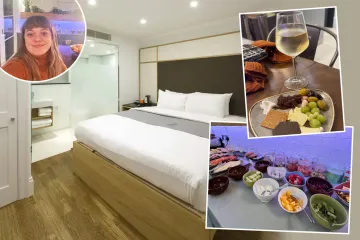
Mövenpick Hotels has locations across multiple continents and became famous for its guests getting to eat free desserts for 60 minutes daily.

Mövenpick Hotels & Resorts serve free desserts for 60 minutes everyday to guestsCredit: Mövenpick Hotels & Resorts
The Old Thorns Hotel & Resort will be renovated to become Mövenpick’s new hotelCredit: Old Thorns Hotel & Resort

The hotel will be located at the Old Thorns Estate in Liphook, Hampshire, and is expected to open in late 2027.

Graham Dodd, VP development for UK & Ireland, premium, midscale and economy brands at Accor, said: “Bringing Mövenpick to the UK marks an important step in strengthening our premium brand portfolio and reinforcing our growth commitment for this important market.

“Mövenpick is a world-renowned brand that is recognised for its culinary excellence and environmental responsibility, which align perfectly with the expectations of UK guests.

“The Old Thorns estate provides an exceptional backdrop to introduce the brand in this incredibly important destination for Accor.”

CAMP ON

Jet2 to offer holiday park packages with Eurocamp for the first time


ISLE GO

Forget Mykonos and Santorini – 4 less-popular Greek islands set to be huge in 2026

Mövenpick, a Swiss hospitality brand, will be running the property in Hampshire which was acquired by a Dubai-based real estate firm, Select Group, earlier this year.

Mövenpick, which is known for their wide range of ice-cream flavours, offers guests a free “dessert” for an hour every day.

Guests staying at any of the hotels can enjoy Chocolate Hour all kinds of treats such as éclairs, brownies, truffles, chocolate fountains and other snacks which change on a regular basis.

In-house chefs also host live demonstrations and experiences which include rolling truffles to icing cupcakes during the hour.

The Old Thorns Estate will be transformed into a 194-bedroom hotel and resort.

The improvements will include a championship golf course, 2,500 sq m of conference and meeting spaces, four restaurants, a wellness centre with spa, and a ballroom accommodating over 500 guests.

Renovations of the 30 acres property are expected to take place over the next two years.

Mövenpick was founded in 1948 by Swiss restaurateur Ueli Prager and has since grown into a portfolio of over 120 hotels globally in over 35 countries.

Its ice cream business was acquired by Nestlé in 2003.

Mövenpick Hotels & Resorts was bought by Accor 2018 and is now part of its premium brand portfolio.

The brand offers its culinary experiences in countries like Germany, Switzerland, Egypt, and many others across the world.

Israr Liaqat, group chief executive of Select Group, added: “Together with our trusted and established partner Accor, we will elevate this iconic property into a world-class resort destination, blending heritage with the sophistication of the Mövenpick brand.”

Mövenpick Hampshire – Old Thorns will join Accor’s existing portfolio of more than 5,700 hotels across 110 countries.

Mövenpick will open its first UK hotel in late 2027Credit: Mövenpick Hotels & Resorts
Mövenpick Hotels & Resorts is a Swiss hotel management companyCredit: Unknown

Source link

Futuristic ‘flying taxi’ service could launch by 2029 – but there’s one big obstacle

A British company has unveiled plans for a new ‘flying taxi’ service that would whisk passengers to the airport in a matter of minutes, but there are still some regulatory hurdles to overcome

A British firm has revealed bold plans for a ‘flying taxi’ service that will transport passengers to airports, with this cutting-edge travel option expected to cost no more than an Uber.

Vertical Aerospace claims its electric Valo aircraft, engineered to reach speeds of up to 150mph across distances of up to 100 miles, could provide swift and effective city-to-airport links, enabling travellers to bypass airport traffic jams. For instance, a journey from Canary Wharf to Heathrow Airport would take just 12 minutes by aircraft versus an hour by road.

The firm, which recently conducted flight trials at Cotswolds Airport, is now targeting airline-standard safety approval by 2028 before launching commercial operations in early 2029.

Vertical Aerospace has released images of its prototype aircraft, which it claims delivers a luxurious experience for up to six passengers, featuring ample baggage capacity. Pictures of the aircraft reveal a sleek, contemporary design with an interior boasting comfortable seating and big windows, reports the Express.

Despite the aircraft’s high-end appearance, the company intends to provide an affordable and accessible service. A spokesman confirmed: “Ultimately, the potential is for this aircraft to be a similar cost as hiring an Uber.”

Vertical has also announced its proposed route network at launch, which would initially link Cambridge and Oxford -Bicester with the capital as well as Heathrow and Gatwick Airport. Aside from airport transfers, the firm suggests these innovative aircraft could be used for emergency medical services, cargo delivery, and even defence operations.

Vertical confirmed plans to build seven aircraft in the UK for testing with the UK Civil Aviation Authority (CAA) and the European Union Aviation Safety Agency (EASA).

In a statement, Vertical announced approximately 1,500 pre-orders for Valo. The company projected that manufacturing these aircraft could generate 2,000 skilled jobs in the UK by 2035.

Stuart Simpson, CEO of Vertical Aerospace, stated: “Electric flight will transform how cities move, and London is one of the best places in the world to prove it. With Skyports and Bristow, we have the aircraft, infrastructure and operational strength to lead this market. These plans show the commercial potential of services we aim to see operating following regulatory approval in 2028 and we look forward to bringing them to life with our partners.”

READ MORE: Exact easyJet and Ryanair seats to pick for extra legroom with no further priceREAD MORE: Avoid packing 4 particular items in your hand luggage – or risk delays at airport

However, gaining CAA approval could pose a challenge for these futuristic vehicles. At present, the CAA is conducting a consultation on vertical take-off and landing (VTOL) aircraft to ensure their safe operation within the UK.

The consultation commenced last month and will continue until the end of January 2026, inviting interested parties to share their views. This process will help establish safety standards for pilot licenses, aircraft, and landing sites, ensuring the proper regulation of VTOLs.

Have a story you want to share? Email us at webtravel@reachplc.com

Source link