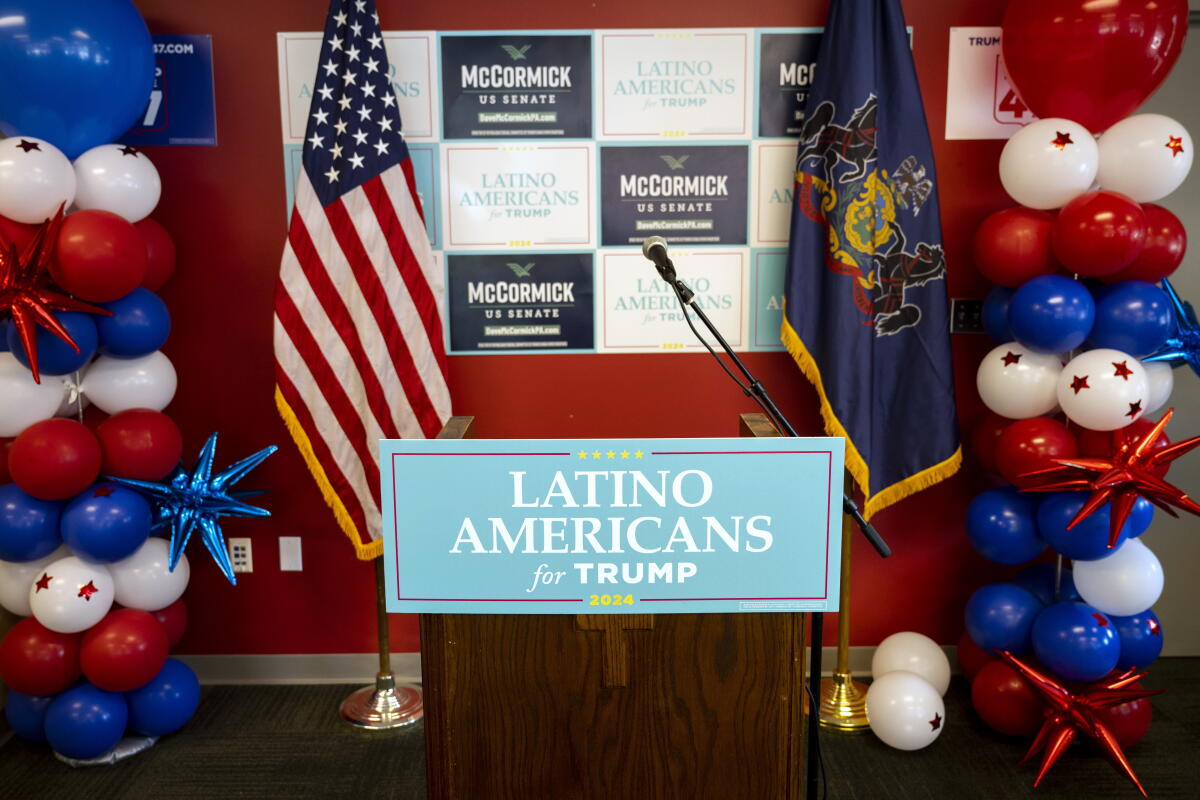
Latino

A second offering to Spencer Pratt, and 5 points about the L.A. mayor’s race

Well, I gave him a chance, offering my services.

I was willing to give the young novice a primer on what a mayor can and can’t do, and let him know City Hall is a reality show like no other he’s been on. But Spencer Pratt didn’t call me in response to my column last week.

I did, however, hear from a slew of his most ardent supporters.

Steven C. had this to say: “You’re a left-wing idiot, and … it’s time for you to retire. You’re a joke!!! You always have been!!! God bless Spencer Pratt and the 45th and 47th President of the United States Donald Trump!!!!!”

You may be onto something, Steven!!! I’ve been thinking about retiring!!!! But then a former reality TV star like Pratt comes along and tells Vanity Fair he had a chat with God, who told him He wants Pratt to be mayor of L.A!!!!! With people like this running for office, how can I retire?!!!!!

R.W. wrote to say: “You say Spencer has never done anything in his life…What credentials do you have? From what I’ve read about you, you are a lousy commie journalist who has never accomplished anything in your life!!”

Just recently, R.W., I replaced a broken toilet tank flush valve and I learned two Willie Nelson songs on the guitar. That’s not nothing.

Peter did not mince words: “Your piece on Pratt is a hit piece filled with bull— . You should go f— yourself before someone takes you out, which is the appropriate response to a s—bag like yourself. So please f— off and drop dead, which is exactly what you deserve.”

Peter, I did drop dead once. Cardiac arrest. While on the other side, I saw God, who told me to snap out of it because He was going to tell Spencer Pratt to run for mayor. Who knew God had a defibrillator?

All of these, by the way, were actual emails, and there were many more just like them. But it’s only fair to note that despite the fulminating knucklehead wing of Pratt’s posse, he’s tapped into a justifiable sense of frustration with City Hall, given homelessness, the Palisades inferno and budget issues that squeeze all manner of basic city services.

That’s why Mayor Karen Bass is paddling furiously, trying to keep her political career afloat. In the latest UC Berkeley-L.A. Times poll, Bass is at 26%, Nithya Raman at 25% and Pratt at 22%. That’s so tight, it appears that no one will get the 50% needed to win outright, and if we get a top-two runoff, it’s not clear who will go to the dance.

So as we close out the primary, with the election on Tuesday, five talking points come to mind.

Which candidate knows the city best?

Los Angeles has 114 distinct neighborhoods spread across 470 square miles (that’s 10 times the size of San Francisco), with an estimated 220 languages spoken. Diversity is a defining characteristic, and roughly half the population is Latino, which makes it a shame there’s no Latino candidate for mayor, especially given the raids and roundups by President Trump.

A mayor doesn’t have to speak six languages and know every corner of the city, but residents want to be seen and heard, and feel like they’re understood and represented.

Raman is well-versed on homelessness policy, and she’s spot-on about the need for greater urgency in problem-solving, but as my colleague Noah Goldberg reported, constituents in her district complain that they haven’t seen enough of her.

As I said, Pratt has wisely targeted municipal failure. But in the realm of outsider candidates with Republican credentials, Rick Caruso, who ran against Bass last time, was comfortable whether he was in the Valley, South L.A. or anywhere in between. And he easily connected with people. Would Pratt be a tourist in his own city?

By virtue of her job the last four years, Bass — who raised a blended Black and Latino family — knows the city best, although her unfavorability rating is a big problem.

What about the other candidates?

In the aforementioned poll, minister and housing activist Rae Huang had 9% and former educational technology businessman Adam Miller had 5%. Virtual unknowns, neither had a legit chance of winning, but they could be spoilers for one of the top three candidates.

I spoke to both, and if you’re undecided, you should read up on them before voting. On Huang’s website, the first words are “Homes are for people, not profit.” Miller wants to bring his success in the business world to City Hall, and when you consider his policy agenda along with his nonprofit work with veterans and homelessness, he’s a better candidate than Pratt.

But he wasn’t on a reality TV show.

Democrats ruined L.A. and California, right?

If only I had a nickel for every time a reader suggested that.

By 101 measures, Los Angeles is one of the great cities of the world and California has built the world’s fourth-largest economy while leading on climate change, so apocalyptic diagnoses are a bit off the mark.

Also, local elections are nonpartisan. You don’t run for mayor as a D or an R.

And yet it’s true that Democrats and their policies and sensibilities rule the day, and they have a lot to answer for in Los Angeles and in California.

But would the same critics suggest that in conservative cities like Fresno and Bakersfield, which have their own homelessness and other problems, Republicans are to blame?

When it comes to housing, poverty, healthcare and streets occupied by people who are addicted or mentally ill, the failures go back decades, touch all levels of government, and cross party lines.

Have I given up on Los Angeles?

When I pointed out that Pratt seemed unaware of these complexities, and of the structural limits of mayoral power, readers suggested he was rising to the challenge while I was giving up on L.A.

Not at all. I care about L.A. enough to hold its leaders to a higher accountability, and to scrutinize posers and pretenders who think they can do a better job.

My advice for the next mayor.

Fix what’s broken, celebrate what works and take responsibility for what doesn’t.

Now let me try one more time:

Spencer, give me a call.

You can’t tell us you had a conversation with God about running for mayor and not share more details.

Did God scold you for referring to the mayor as Karen “Basura,” which means trash in Spanish?

Did He say we should pull out of the ‘28 Olympics, or have any advice on how to fill potholes and fix sidewalks?

If you’re having regular conversations about City Hall with the Father, the Son and the Holy Spirit, we’re dying to know:

On homelessness, what would Jesus do?

steve.lopez@latimes.com

Source link

Trump won over more Latino voters in 2024. Can he keep them?

As Sandra Ramirez watched footage of immigration officers cracking down on migrants over the past year, she knew her 2024 vote for Donald Trump was a mistake.

“There are a lot of people who are being harassed for the color of their skin, and that’s not right,” said Ramirez, who broke from her Democrat-voting family to cast a ballot for Trump.

“I’ll never go Republican again,” she said.

Trump made inroads with Latino voters like Ramirez during the 2024 elections, earning support that helped propel him to a second term in the White House.

As Republicans gear up for midterms this fall and look ahead to presidential elections in 2028, all eyes are on whether they can hold on to that key support or whether the administration’s sweeping immigration crackdown and an economy beset by high prices may drive Latino voters away.

In a sign of looming danger, recent polling from the Pew Research Center shows support for Trump falling fast among that electorate.

Support among Latino Trump voters shows signs of softening

Latino voters have historically been largely aligned with the Democratic Party but during the 2024 election, they shifted significantly toward Trump. A majority still supported Democrat Kamala Harris for president, but Trump made big gains: 43% of Latino voters nationally voted for him, compared with 35% in the 2020 presidential election, a change attributed in part to their concerns about the economy.

Trump returned to office pledging to crack down on immigration, a promise that prompted arrest sweeps, often against Latino migrants, in homes, workplaces and schools, among others. According to an AP-NORC poll, more than half of Latino adults report knowing someone impacted by the Trump administration’s aggressive immigration enforcement.

More than a year into Trump’s second term, polling suggests a significant drop in support for the president among Latinos who voted for him in 2024, although a majority still supports him.

According to a Pew Research Center poll conducted in April, support for the president fell among non-Latino voters from 95% to 79% between February of last year and April of 2026. But among Latino voters who cast their ballot for Trump, the drop-off was more dramatic: 66% approved of his job performance in April compared with 93% at the beginning of his second term.

That national drop could prove crucial in a tight election in swing counties like Maricopa, the largest battleground county in the nation, which encompasses Phoenix and its suburbs. A third of Maricopa County residents are Latino, and one in four of them is an immigrant, according to the Latino Data Hub at UCLA.

Arizona, which also saw a slight increase in Latino support for Trump in 2024, has been a flashpoint in the immigration debate for years. Maricopa County Sheriff Joe Arpaio conducted high-profile raids in Latino communities and, later, the state saw large influxes of migrants during the Biden administration.

In outh Phoenix, opinions on Trump reflect deep divisions

On a warm afternoon in the predominantly Latino neighborhood of south Phoenix, a vendor at a street fair sold shirts imprinted with phrases like “Lowriders Sunday” while car club members polished their Chevrolets. The parking lot of the nearby Catholic church was full of parishioners attending Spanish-language Sunday Mass.

Albert Rodriguez, a Phoenix tattoo artist, said he once supported Trump. But then he saw how the administration was carrying out enforcement operations in Chicago, Minneapolis and Los Angeles.

He said the president promised to go after immigrants who were criminals, but instead Immigration and Customs Enforcement agents have been “hitting the paleta man,” referring to ordinary people trying to make a living from selling frozen treats.

“Big time, I regret it,” Rodriguez said of his 2024 vote for Trump.

Phoenix resident Ronnie Martinez, an Army veteran, backs Trump’s effort to stem crossings at the southern border.

“The border is only a hop, skip and a jump to our south. And I don’t want illegal alien criminals coming from Guatemala, Venezuela, Central America,” he said.

He didn’t like some of the images he’d seen of ICE arresting people in front of their children. But he was also sympathetic to ICE officers, who he said were doing the best they could in difficult situations, and he blamed Democratic officials who weren’t cooperating with immigration enforcement. He also cited economic initiatives as a reason for his continued support for the president, including the removal of taxes on tips and overtime.

Guadalupe Alaffa, another Phoenix resident, blamed President Biden’s policies for prompting Trump’s immigration crackdown.

“He left that damn border wide open,” said Alaffa.

Arizona battleground politics shaped by Latino voter influence

The growing influence of Latino voters is one of several factors that have eroded the GOP’s decades-long dominance in Arizona, putting the state at the center of congressional and presidential elections. Both of Arizona’s senators are now Democrats, along with the top three state officials.

Winning back some of the Latinos who shifted to Trump will be crucial to the reelection prospects of Gov. Katie Hobbs, Secretary of State Adrian Fontes and Atty. Gen. Kris Mayes, all Democrats first elected in 2022.

Democrats in Maricopa County have benefited from more than a decade of political organizing among Latinos mobilizing against hard-line immigration enforcement. The Republican-controlled Legislature in 2010 passed a state law known as SB1070, which required police to check the immigration status of anyone they suspected of being in the country illegally.

Around the same time, Arpaio was building a national profile on the right with immigration sweeps in largely Latino neighborhoods.

Some activists see the nationwide crackdown on immigrants as an extension of what Latinos in Arizona endured under Arpaio.

“We were the lab where they implemented a lot of this with Sheriff Joe and now it’s all over the United States,” said Salvador Reza, a longtime activist in Phoenix who advocates for the rights of day laborers.

For more than two decades, Arpaio was repeatedly elected while his department faced accusations of racially profiling Latino drivers and conducting sweeps in Latino neighborhoods and day labor areas. Deputies often stopped residents for traffic violations and turned noncitizens over to ICE, according to rights groups.

In 2013, a federal judge ruled his office had illegally profiled and detained Latinos, and a 2011 Justice Department report found widespread discrimination. After losing reelection in 2016, Arpaio was convicted of criminal contempt for defying court orders. He was later pardoned by Trump.

Rising prices and immigration enforcement erode Latino support

The GOP is at risk of losing some of the Latinos that Trump won over, said former Republican Gov. Jan Brewer, who signed the controversial 2010 bill. She cited economic concerns as a possible reason for the drop in support.

“With the inflation and the cost of living and the gasoline and the wars, I don’t know if they can afford to be a Trump Republican,” Brewer said.

Earl Wilcox, a longtime activist and restaurant owner in Phoenix, said between affordability issues and immigration enforcement, he believes Latino support for Trump is waning. Wilcox’s restaurant hosted Biden in 2024 when he launched an initiative meant to rally Latino support for the Democratic ticket.

“I don’t think the Republican Party will have the support it did the second time around,” Wilcox said, “and I think it started with the raids.”

Santana writes for the Associated Press. AP writers Jonathan J. Cooper and Amelia Thomson DeVeaux contributed to this report.

Source link

Steve Hilton and Spencer Pratt need Latinos, not Trump

With less than two weeks before the primary election, Steve Hilton is leading in the polls for governor, and Los Angeles mayoral hopeful Spencer Pratt is making the city’s progressive class sweat.

If the former Fox News commentator and the reality television bad boy move on to November’s general election, they’ll be running as conservatives in a super-blue state and city where most voters loathe President Trump.

The president endorsed Hilton last month, posting on social media that he “is a truly fine man, one who has watched as this once great State has gone to Hell.” On Wednesday, Trump said he wants Pratt to “do well … I heard he’s a big MAGA person,” before claiming that California elections are rigged and that he would have won the state two years ago “if we had Jesus Christ come down and count the votes” because “I do great with Hispanics.”

Trump was right about one thing — the importance of Latino voters. If Hilton and Pratt are to pull off historic upsets, they’ll need this bloc, which has emerged as a mercurial swing vote in local, state and national elections — but only if stirred into action by anger. And if ever there was a year for Latino anger, 2026 is it.

In recent years, Latinos in California have drifted rightward as they tire of Democratic policies, from L.A. City Hall to Sacramento. Rick Caruso captured a majority of the Latino vote in his unsuccessful bid for L.A. mayor four years ago, and there are more Latino Republicans in the state legislature than ever. Some of the most Latino areas in Southern California saw the biggest shifts toward Trump from 2020 to 2024.

Hilton has held town halls in small, Latino-majority cities across a state that’s about 41% Latino. He frequently appears alongside lieutenant governor candidate Gloria Romero, a pioneer in challenging disaffected Latinos to not always vote Democrat.

Pratt has shared AI-generated salsa and merengue songs that hail him as a savior and uses Spanglish when referring to Mayor Karen Bass as “Basura” — trash. He’s starting to roll out endorsements from Latino business groups and held a block party in South L.A. this week for which a Instagram post tried to draw supporters with the promise of a taco truck.

So if the candidates know that Latinos are essential to their long-shot campaigns, why the hell aren’t they running as far and fast from Trump as possible?

Two years ago, Trump — the most anti-Latino president since James Polkgrabbed a larger share of the Latino electorate than any Republican presidential candidate ever had. GOP leaders predicted that Latinos were finally theirs. But Trump annihilated that advantage by launching his deportation deluge. Now, he has turned off even some die-hard supporters by starting a war in Iran, which has further strained an already shaky economy.

President Donald Trump

Trump annihilated the advantage the GOP had with Latinos by launching his deportation deluge.

(Manuel Balce Ceneta / Associated Press)

A New York Times/Siena poll released this month found that only 20% of Latinos support Trump — the lowest during his two terms. A Pew Research Center survey, meanwhile, found that only 66% of Latinos who voted for Trump now approve of him, compared to 81% of white Trump supporters.

Instead of running away, Hilton and Pratt seem fine with hitching their prospects to this political Titanic.

Hilton sought and received Trump’s endorsement, arguing that it’s better to have a friendly relationship with the White House than the antagonistic path California’s elected leaders have chosen.

But most voters want no part of Hilton’s kumbaya. Proposition 50, a direct rebuke of Trump’s gerrymandering efforts in other states, passed with more than two-thirds of the vote last fall. A CalMatters analysis found that Latino-majority precincts voted in bigger numbers for the ballot initiative than for Kamala Harris two years earlier.

Hilton can promise Latinos his “Califordable” agenda and eat all the tacos he wants. But our economic malaise was caused in large part by Trump, who recently said he thinks about Americans’ financial struggles “not even a little bit.”

For Hilton not to decry such cluelessness is almost as ridiculous as his recent boasts that he — the British son of Hungarian refugees who became a U.S. citizen just five years ago — is the candidate of “legal” immigrants. That’s a callback to the days of Proposition 187, when Republicans obsessed with the state’s changing demographics turned off my generation of Latinos by demonizing our undocumented friends and family. The GOP was finally starting to emerge from the political wilderness with Latinos, but Hilton cozying up to Trump will drag the party back into that weak salsa place.

Pratt has been coyer on his thoughts about Trump, but at least he seems to realize that the president might be a liability. The Republican said his party affiliation doesn’t since the mayor’s race is nonpartisan. He has portrayed himself as focused solely on improving Los Angeles, telling CBS News, “I don’t do national politics. I don’t do tribal politics.”

But for someone who says he wants to make L.A. a world-class city, Pratt seems unconcerned about Trump’s assault on us, including last summer’s unchecked immigration raids and temporary occupation by the Marines and the National Guard. Rather than denounce those moves, Pratt has instead denounced L.A.’s sanctuary city ordinance and vowed to work with ICE and other federal immigration agencies to target bad hombres if he becomes mayor, even though a majority of those rounded up in the raids had no criminal history.

It’s as if Pratt’s understanding of Latino L.A. ends with an Erewhon burrito. He continually platforms supporters who portray L.A. as a multicultural wasteland. And when another mayoral candidate, City Councilmember Nithya Raman, posted Trump’s praise of Pratt on social media, he responded with a snippet of himself making a dismissive face during a debate.

But this is nothing to dismiss. For Pratt and Hilton to win, they need Latinos to believe in them. And why would we believe anyone who hitches their wagon, even a little, to Trump?

Source link

Tom Steyer courted Latino voters in Santa Ana. Did he succeed?

When a friend asked if Tom Steyer could stop by my wife Delilah’s downtown Santa Ana restaurant, I had to explain to her who he was.

It’s not political apathy in my honey’s case. She’s just exhausted from running her small business, Alta Baja Market, in these inflationary times. She’s one of the 16% of undecided voters in a recent California Democratic Party poll — a group that may determine which two candidates for governor face each other in the general election.

Delilah agreed that Steyer could visit on Saturday after I told her that many of our friends support the billionaire’s progressive platform.

“Politics is your job, not mine,” she joked as we drove to Alta Baja and I named the other major candidates. The only ones she had heard of were Antonio Villaraigosa (“I liked him as mayor, but he needed to keep his pants on,” referring to his extramarital affairs) and Katie Porter (“Some of my workers like her, but I don’t know what she’s done”). She might be the last person left in the Golden State who hasn’t seen any of Steyer’s television and YouTube ads.

His campaign seems to have stalled in the polls even as he has spent more than $150 million of his own money amid doubts from some voters about whether they want a billionaire to lead the state.

So a visit to Santa Ana, the heart of Latino Orange County, was a good move. At Alta Baja, he could talk to my Mexican American wife and other blue-collar Latinos.

When rival Xavier Becerra came to O.C. a few weeks ago, on the other hand, he appeared at a private fundraiser attended mostly by professional Latinos.

“I just want someone who tells us where our taxes are going and treats this country like a business, and we’re not wasting money,” Delilah said. She’s a socially liberal and fiscally conservative Democrat who has been especially angered by President Trump’s deportation deluge, which left the streets of downtown Santa Ana empty for months last summer. “Because right now, our government is a hot-ass mess.”

I asked what questions she had for Steyer.

“So insurance had to cover all the disasters that happened with the fires,” Delilah replied. “So why is everybody else having to pay for it? And what are you really gonna do to help the state?”

She paused. “Tom is a Democrat, right?”

Delilah prepared for Steyer’s noontime stop as if it were any other day. She has fed the likes of U.S. Sen. Alex Padilla, Orange County Dist. Atty. Todd Spitzer and former Speaker of the Assembly Anthony Rendon. Republican gubernatorial candidate Steve Hilton is a fan of Alta Baja’s blue cornbread; Oakland Mayor Barbara Lee held a meet-and-greet there when she ran for president two years ago.

“You know who should ask questions?” Delilah said after she set the till for the day. “Angela.”

That would be 19-year-old Alta Baja employee Angela Nino, who will be voting in her first election.

“She’ll always be telling me, ‘Did you see the debate? Did you see the debate?’ And I always say, ‘No, I’m too tired to watch.’”

Nino soon clocked in.

“Guess who’s coming, Angela?” Delilah said before looking at me. “Is his name Tim or Tom?”

“It’s like I agree with some of his things, but he’s a billionaire,” said the Orange Coast College student and Santa Ana resident when I asked about Steyer. “His answers at debates have been pretty broad so far.”

Delilah smiled.

“You’re the future, girl, so ask him anything.”

Almost everyone who came in as we waited for Steyer was a campaign worker or volunteer. Former state Controller Betty Yee, who ended her campaign for governor last month and endorsed Steyer, sat at a table with her husband. Orange County Supervisor Vicente Sarmiento, who initiated Steyer’s Santa Ana visit, thanked Delilah for the opportunity. He has known her since the start of his political career on the Santa Ana City Council nearly 20 years ago,

“This is a city where our residents were criminalized because of ICE, our downtown suffered because of construction, and all this on the heels of a pandemic,” he told me. “These are the folks Tom needs to listen to.”

Sarmiento’s staffer got his attention. Steyer was here.

The candidate strolled in with a videographer and photographer. He wore his usual casual billionaire outfit — white-and-cardinal Nikes, jeans, checkered shirt with rolled-up sleeves and a colorful Southwestern-style fabric belt.

Steyer went straight to the counter.

“Are you running for governor?” he cracked while shaking Delilah’s hand.

“I don’t want to,” she replied.

“I knew you were a smart woman!”

He listened with wide eyes and a stern face as Delilah complained about a years-long light-rail project in front of Alta Baja “that has been worse for businesses here than COVID.” Insurance rates have gone up 30% in the last year alone, she said.

“Well, look, that’s my whole thing,” Steyer responded in his low, gravelly voice. “I’m willing to take on the big corporations who are ripping off California. And they’re all spending a lot of money against me.”

It was the Steyer I’ve heard on too many commercials: pugnacious, compassionate but spouting a whole bunch of boilerplate. Delilah smiled weakly.

“I appreciate that,” she said. “And we need more of that.”

Then she waved Nino over. Usually shy, the architecture major now channeled her inner Lesley Stahl.

“Why do you have to be governor in order to do something while you have billions of dollars?” she said.

Steyer didn’t flinch as he explained how he has funded ballot propositions and nonprofit initiatives to fight for a more equitable California.

“So I’ve been able to do something, but what I see in California — and what Delilah and I were just talking about — is big corporations actually run the state,” he said.

“That’s true,” Nino conceded.

“You have to take on the big corporations that are screwing everybody. And you can really only do that as governor,” Steyer continued.

“You want to tax the billionaires, is that correct?” Nino asked next, as Steyer nodded. “How come on some [campaign disclosure] forms, it shows that your billions are in different [countries] besides in the U.S.?”

The candidate vigorously shook his head.

“I might have investments outside the United States, but there’s nothing I’m doing to not pay — I pay full California and American taxes on everything, promise. There’s a lot of ways I could avoid taxes, but I don’t. And so, anything that I’m doing overseas is not to avoid taxes. … I give you my word.”

One more from Nino!

“And how can the people trust billionaires when currently they have been very disappointing towards us?”

“I understand why people are skeptical,” Steyer replied. “They couldn’t be more skeptical than I am.”

He argued that other moguls “are supporting every other candidate. Those people hate me — like, they think I stand for something really bad, which is making them pay their fair share,” referring to a proposed November ballot initiative that would impose a one-time 5% tax on billionaires like Steyer (he supports the measure).

“And they’re right,” Steyer concluded. “And so it’s like, they hate me, and that’s fine.”

Nino stayed silent. Delilah thanked Steyer, who was off to visit other local businesses owned by friends of ours. He bought a bottle of rosé, posed for photos with Delilah and Sarmiento and went off — but not before a staffer adjusted the back of his collar.

Delilah and Nino went back to prepping lunch orders. What did they think about Steyer?

“To be honest, I’m so skeptical,” Nino said. “I don’t think he has enough experience as some of the other candidates, and I feel like he could have been more into detail about his policies.”

What about you, honey?

“Gracious, very kind and not pompous, which is what I would expect from most politicians,” Delilah said. “I like that he heard out Angela — that’s important [that] politicians listen to the next generation, and I think everybody should be doing that. But I wasn’t satisfied with my insurance question.”

“And we don’t know if this is a performance,” Nino added, drawing a playful gasp from Delilah. “We’ve seen, like, throughout the years, many political people go into, like, regular [businesses] to seem like, ‘Oh, we’re relatable to the people. We know your struggles.’”

“Do they really?” Delilah interjected.

Nino frowned.

They could just be putting on a show for the cameras, she said.

Source link

Latino leaders surge into local office as Trump-era attacks fuel new urgency

Rhetoric dehumanizing immigrant and Latino communities may appear more open and in-your-face in the current political climate. But that has not been a barrier for Latinos seeking elective office or high-level roles in government.

Voters are choosing an increasing number of nonwhite Hispanic leaders to local elective office — and many of the leaders are the first Latinos to hold their seats. Some political science experts attribute the rise of Latino leadership to years of grassroots organizing, coupled with ongoing demonization of their communities by Trump administration officials and conservative activists.

“That’s the difference now, is that there’s this extra incentive of an unrelenting attack on Latinos across the country,” said Anna Sampaio, an ethnic studies professor at Santa Clara University who specializes in race and gender politics.

There are currently an estimated 7,700 Latino elected officials nationwide, according to data from the National Association of Latino Elected and Appointed Officials. That’s up from 6,883 officials in 2020.

Estimated to number as many as 55 million people — 16% of the U.S. population — Latinos are the largest ethnic minority in the country, with politics, interests and priorities as diverse as the national origins represented within their population. But Latinos also are underrepresented as a demographic across elective offices.

Since the beginning of President Trump’s second term, Latino communities have been a target of his hard-line immigration tactics. The feeling of attack doesn’t stop there. From memes shared from the official White House page perpetuating Hispanic stereotypes, a federally led English-only initiative and an anti-diversity, equity and inclusion push have painted a target on Latinos across the country.

It’s all led to more Latinos seeking office to defend their communities and give voice to those who may be afraid to speak out in the current political climate. As a result, legislators have proposed measures that include providing community members with protections against the U.S. Immigration and Customs Enforcement, halting the approval of ICE detention centers in their cities, and calling for a stop to ICE funding, among other actions.

Pennsylvania Latino mayor makes history

Lancaster, Pennsylvania, with a roughly 40% Hispanic population, recently elected Jaime Arroyo their first Latino mayor. Arroyo took office in January, after being elected with 85% of the vote.

“I think being the first Latino to be in this role and the first person of color to be mayor of Lancaster City has been exciting,” Arroyo told The Associated Press, adding that he finds it “extremely exciting to lead and represent our community in this role.”

With rhetoric and national policies — such as heightened immigration enforcement — hurting the Latino communities, Arroyo said, diverse representation in government is more important than ever. He also believes that the rise of elected Latino officials over the last couple of years is the result of generations of Latinos being politically active fighting for civil rights.

“We’re starting to see a lot of the fruits of that labor come to fruition,” Arroyo said. “There’s never a perfect time to serve your community, there’s the right time. And I think right now is the right time for a lot of Latinos to step up into these roles, especially with everything that is going on.”

Latino representation expanding in city councils

Many more Latinos made history when they took office in earlier this year.

In Iowa, Rob Barron was sworn in Jan. 12 as the first Latino representative on the Des Moines City Council. Antonio Pacheco was sworn on Jan. 7 to be the first Latino member of the city council in Conyers, Georgia. In Ohio, Eileen Torres became the first Mexican American women to win a city council seat in Lorain. Sabrina Gonzalez also took office there as the first Puerto Rican women to serve.

And in Michigan, Clara Martinez and Deyanira Nevarez Martinez were sworn in Jan. 1 to the Lansing City Council, making the city the first in the U.S. to have a council with majority Latino representation.

Martinez said her election, and that of Nevarez Martinez, makes a bit statement about “what people are truly open to despite the national rhetoric.”

“I think because of the rhetoric that we are having to face and some of the backlash on the national stage, I think that’s just fueled the fire for so many people,” she said.

The Salt Lake City Council also has a Latino majority, with four of seven seats, after Erika Carlsen, the granddaughter of Mexican immigrants, was sworn in on Jan. 5. Carlsen said her success is possible because of current and previous generations that put in the work to create spaces where Latinas were encouraged to take leadership positions.

“I feel like I’m building on early generations of leadership,” Carlsen said. “That’s both an honor and responsibility to improve Salt Lake City for the people who live here.”

Carlsen said even if representation at the federal level is not high or visible she said having representation at the local level can have a huge impact.

“I think that it’s critically important that we continue to build on this momentum,” Carlsen said. “The majority of change that can happen starts locally, it doesn’t start in Washington but in City Hall, school boards and neighborhoods conversations. That’s the kind of momentum I’d love to see all across the United States.”

Carolina Welles, executive director of The First Ask, an organization that supports first-time female candidates at the state level, said the reason why Latino representation is more visible at the local level is because those leaders are able to built trust with their community much easier given their proximity.

“They actually know what people care about,” Welles said. “They have a stake because they are facing similar things.”

Local level Latino leadership builds on state and federal representation

It’s not just at the local level. Latinos are making inroads at the federal level too.

The 119th Congress has 56 Hispanic or Latino members. That shakes out to 10.35% of total membership, according to the Congressional Research Service.

For comparison, there were only 14 Hispanic or Latino members and all were male in the 99th Congress, 40 years ago.

At the start of 2025, there were seven Hispanic U.S. senators. That number decreased to six when then Sen. Marco Rubio resigned to become the Secretary of State, the first Latino to hold the position.

Last year also marked a record for Latinas at the state level. Latinas held 214, or 2.9%, of seats in state legislatures, according to the Center for American Women and Politics. That was up from 192 seats in 2024.

Currently, New Mexico Gov. Michelle Lujan Grisham is the only active Latina governor in the U.S. Only two Latinas have been elected governor in U.S. history, and both were in New Mexico.

In March, Gina Hinojosa won the Democratic nomination for governor, making her the second Latina to win a major party gubernatorial nomination in Texas.

Latinos saw the biggest rise in elected officials during the Trump administration in response to attacks on their fundamental rights, said Sampaio, the Santa Clara University professor. She said that trend is likely to continue as the administration continues its attacks on immigrant communities.

“We’re likely to see more Latinos run for office at the local level, at the state level and even at the national level in response to the attack on simply their existence,” Sampaio said. “It is unwittingly both terrorizing the Latino community as well as mobilizing communities.”

Figueroa writes for the Associated Press.

Source link