US-led anti-cartel alliance backs sanctions against crime groups after Trump urges stronger action.
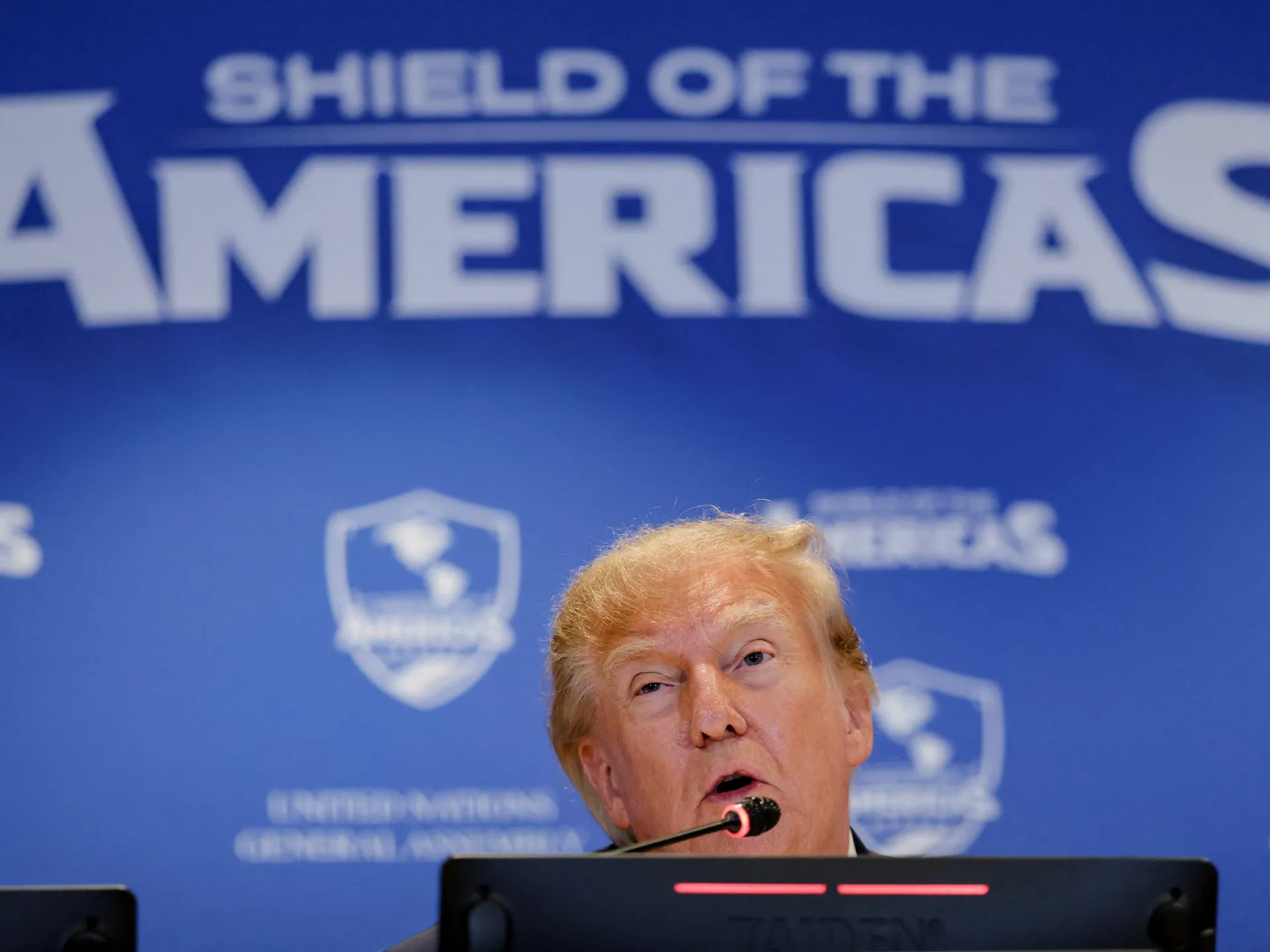
United States President Donald Trump has pledged to use “unmatched military might” against drug cartels in the Western Hemisphere during a meeting of the Washington-led Shield of the Americas coalition in New York City.
In a meeting with leaders and foreign ministers from the anti-cartel alliance, Trump on Tuesday urged member countries to join the US in targeting 24 criminal organisations, which he earlier described as the “ISIS of the Western Hemisphere”.
Recommended Stories
list of 3 itemsend of list
He said he was asking “all nations in the Shield of the Americas to formally designate narco-terrorists as common threats to stability and apply crushing sanctions” against all of the groups. The meeting took place on the sidelines of the annual United Nations General Assembly (UNGA) in New York City.
The coalition’s 15 governments later issued a joint statement saying they intended to impose asset freezes and visa restrictions on members and supporters of the groups and to pursue criminal charges against them.
At the top of the list are two groups that have been declared “terrorist” organisations by Washington: Mara Salvatrucha (MS-13) – one of Central America’s most powerful criminal gangs – and Tren de Aragua, a Venezuelan gang that is also active in Colombia, Peru and Chile.
The list also includes major Mexican cartels, Colombian armed groups such as the National Liberation Army, Brazil’s Primeiro Comando da Capital and Comando Vermelho groups, and Peru’s Shining Path.
Al Jazeera’s Alessandro Rampietti, reporting from Bogota, Colombia, said the statement was largely symbolic for now, because each country must follow its own legal procedures.
“For example, here in Colombia, it will require a law to pass in Congress. We understand that the government here has asked Congress to move forward in drafting such a law. So while the consequences may not be immediate, this is clearly an important step towards building what the US has been trying to do in Latin America [through] this alliance,” he added.
The coalition is made up of governments closely aligned with Trump, including Argentina, Ecuador and El Salvador, whose leaders he has praised or endorsed. Colombia and Peru joined after Trump-aligned presidents took office in recent months.
Brazil and Mexico have not joined.
US Secretary of State Marco Rubio, who also attended, praised “the emergence of strong leaders who are committed to the challenge of taking on transnational terrorism”.
The gathering was the administration’s latest effort to rally the region behind a more aggressive approach to drug trafficking. Since returning to office last year, Trump has designated cartels as foreign terrorist organisations and ordered dozens of strikes on boats in the Caribbean and eastern Pacific that US officials say were carrying narcotics bound for the US.
The strikes have killed more than 223 people, and UN experts say they violate international law and could amount to crimes against humanity.
The Trump administration’s National Security Strategy, released late last year, laid out plans for a revamped Monroe Doctrine, the 19th-century policy asserting US primacy in the hemisphere that critics associate with decades of US intervention.
Trump has also spoken of retaking the Panama Canal and annexing Greenland and Canada. On Tuesday, he signed an agreement on Greenland that stopped short of his demand that the island become US territory.
The focus on the hemisphere has raised concerns across the region.
Brazilian President Luiz Inacio Lula da Silva, in his UN speech, bristled at the approach, warning countries in Latin America and the Caribbean of “renewed hegemonic temptations”.
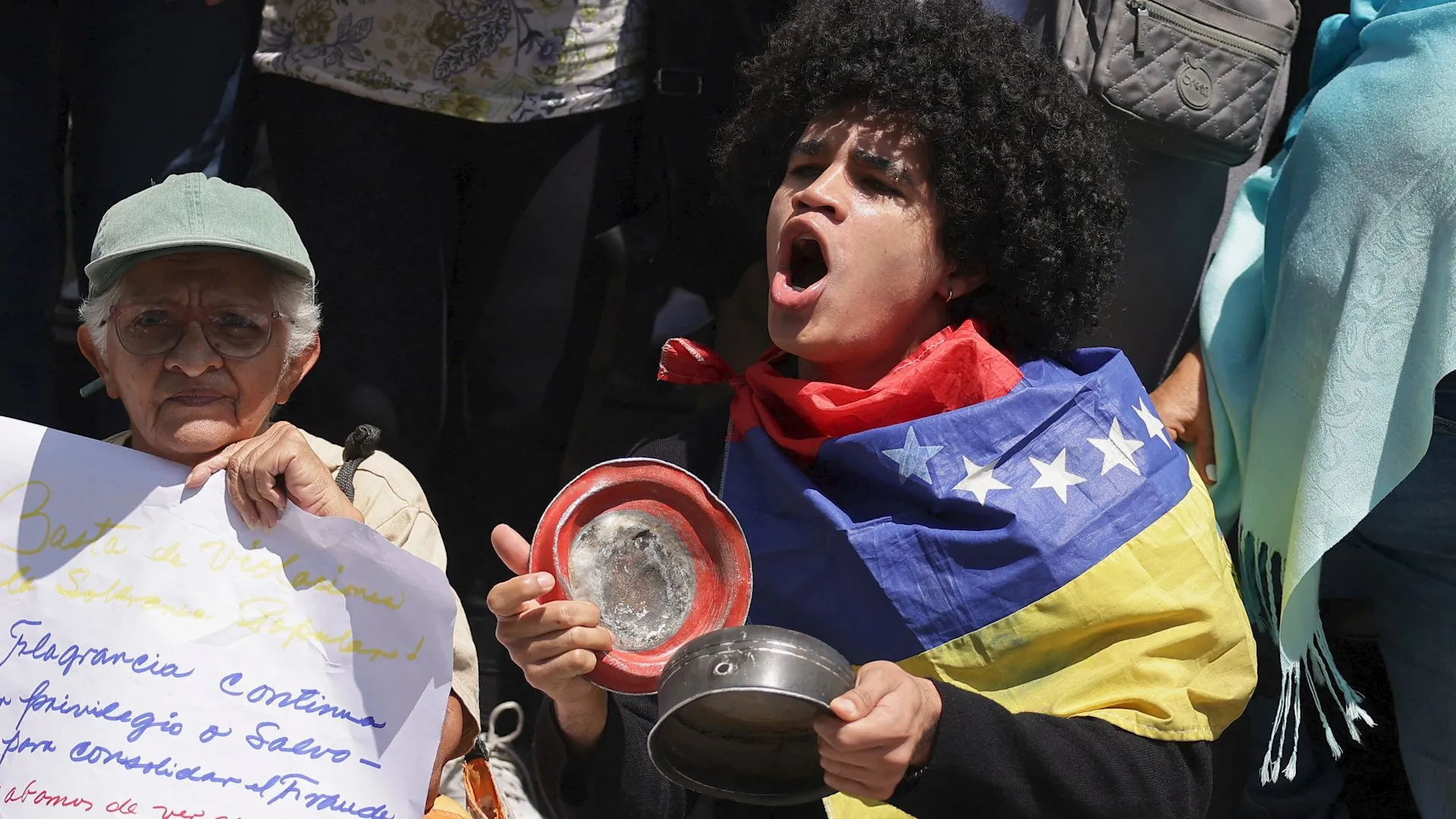
Venezuelans protested in New York against interim President Delcy Rodriguez’s participation in the UN General Assembly, calling for world leaders not to normalise relations with what they call an illegitimate government. Rodriguez took power in January after Nicolas Maduro was captured by the US military.
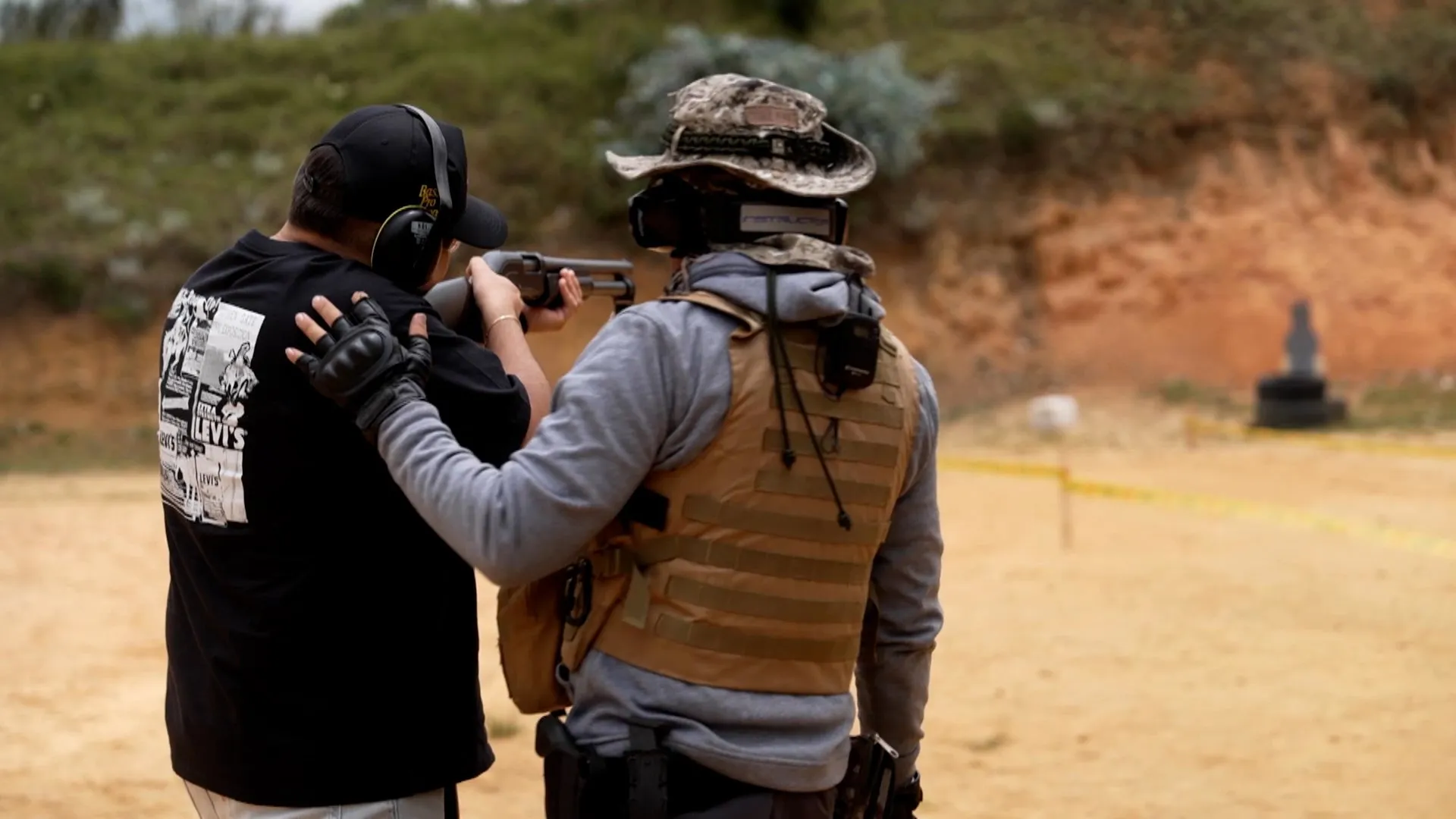
Colombia has loosened gun laws after more than a decade of restrictions. The government says it will help people protect themselves, but some fear it will lead to an increase in even more violence.
Luiz Inacio Lula da Silva is running in October’s election for a fourth non-consecutive mandate as Brazil’s president.
Published On 22 Sep 202622 Sep 2026
Brazilian President Luiz Inacio Lula da Silva and Senator Flavio Bolsonaro remain deadlocked in the latest polls, with the first round of Brazil’s election less than two weeks away.
Two new polls on Monday showed that the pair are statistically tied in simulated runoffs ahead of next month’s election. If no candidate wins more than 50 percent of valid votes in the October 4 first round, the two frontrunners advance to a runoff on October 25.
Recommended Stories
list of 3 itemsend of list
Lula is seeking a fourth non-consecutive term as Brazil’s president, but faces a challenge from the political right in Flavio Bolsonaro, the son of former far-right President Jair Bolsonaro, an ally of US President Donald Trump.
Brazilian presidential candidate Flavio Bolsonaro speaks at an agribusiness fair as he campaigns in Esteio, Brazil, on September 2, 2026 [Diego Vara/Reuters]
The elder Bolsonaro was ruled ineligible for office after Brazil’s top electoral court found he had abused his power while in office. He was later convicted separately over a plot to overturn his 2022 election loss to Lula.
A Quaest poll released on Monday showed Bolsonaro with 42 percent of voter support in a potential runoff, versus 41 percent for Lula.
Meanwhile, a BTG Pactual/Nexus poll has Lula receiving 46 percent of voter support, compared with 45 percent for Bolsonaro in a potential runoff.
The latest polls mark a narrowing from an earlier Quaest poll on August 5, which put Lula ahead by a wider five-point margin, 44 percent to 39 percent.
New York City Mayor Zohran Mamdani and Brazilian President Luiz Inacio Lula da Silva speak to reporters after a meeting in New York on September 21, 2026 [Dave Sanders/Reuters]
US pressure looms over election
Lula launched his re-election bid on August 2 at the Workers’ Party convention in Sao Paulo, casting himself as a defender of Brazilian “sovereignty” as pressure from the US administration looms over the race.
The US imposed two fresh rounds of tariffs on Brazilian products in July, which Lula denounced as an attempt to influence the elections through economic pressure.
The Brazilian leader is currently in New York, where he is preparing to address the United Nations General Assembly.
Lula met New York City Mayor Zohran Mamdani for the first time on Monday. In a brief statement to reporters after the meeting, the Brazilian president said the two had talked about problems common to both Brazil and the United States, particularly the rising cost of living.
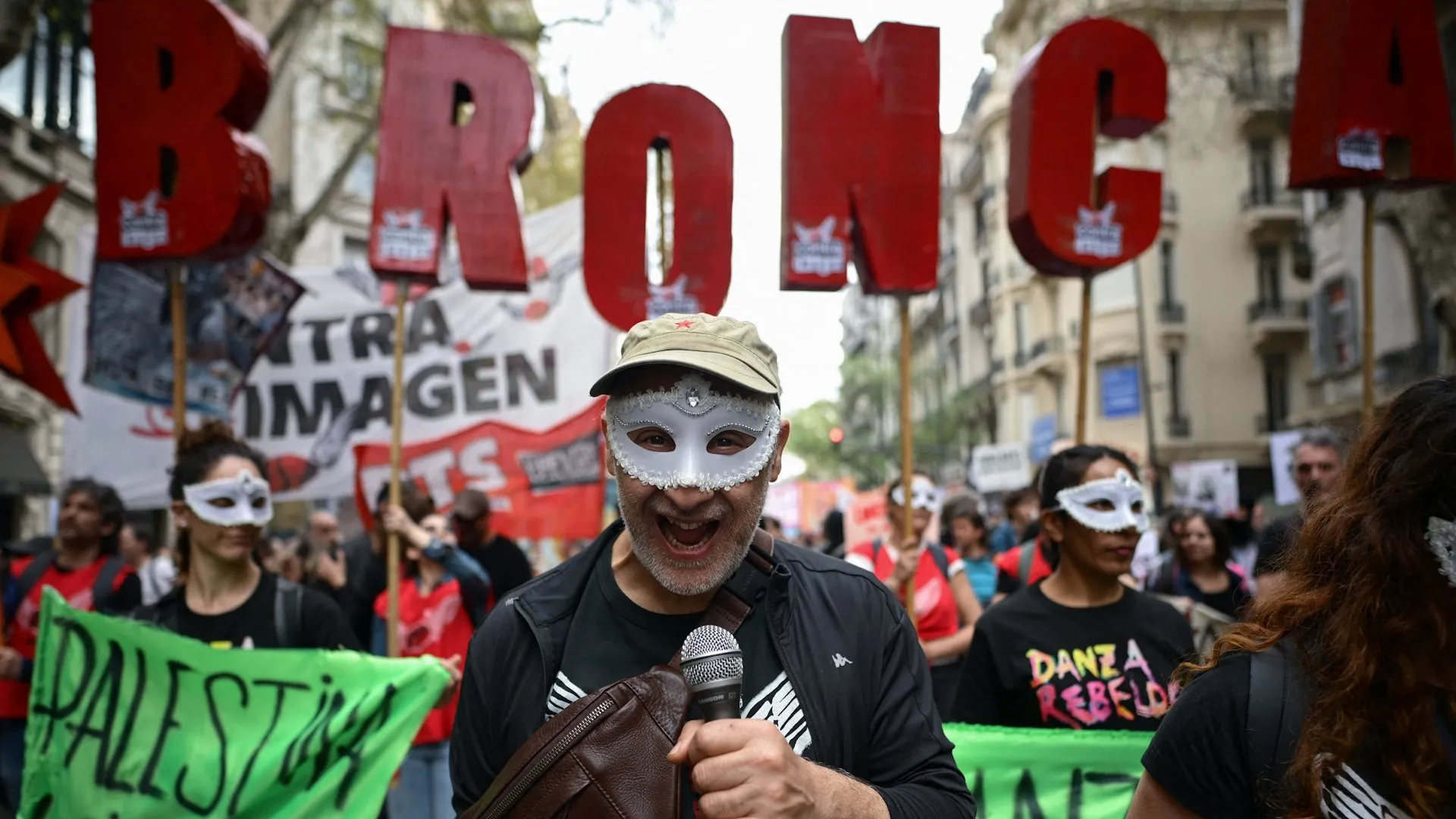
Thousands of protesters took to the streets of Buenos Aires for the ‘March of Anger’, organised largely by left-wing groups opposing the Milei government’s austerity policies. Protesters say the cuts are hurting working families.
The country has battled multiple wildfires amid record-breaking temperatures fueled by El Nino and intense drought conditions.
Published On 20 Sep 202620 Sep 2026
A massive wildfire has broken out in central Colombia, threatening the popular tourist town of Villa de Leyva, according to local officials.
The forest fire is near the Andean town in the Boyaca department, with flames engulfing the San Marcos hillside above the colonial architecture and cobblestone streets that attract more than a million visitors annually.
The blaze has already consumed 40 hectares of native forest, sending massive plumes of smoke that are visible from the town’s central square, according to Colombian authorities.
On Saturday night, Colombian President Abelardo de la Espriella posted on X that “Villa de Leyva is not alone”, pledging to mobilise all state resources to fight the fire and protect “this historical jewel” and “beautiful city that is the pride of Colombia”.
To combat the flames, the Boyaca department government said it is dispatching two aircraft. A military helicopter will also join the effort, along with firefighters from the capital, Bogota, Interior Minister Rodrigo Lara said.
The mayor of Bogota, Carlos Fernando Galan, will be sending a team of firefighters to join local crews from Tunja and Boyaca, reinforcing containment efforts and securing the urban centre, Lara said.
In the equatorial Andes, forest fires peak during the dry season, but this year they are fuelled by a severe El Nino weather pattern. Record high temperatures and lack of moisture have turned vast expanses of the Andean vegetation into tinderboxes. That has intensified a crisis that has already started 18 active wildfires across the country, according to the latest official data from Colombia’s National Unit for Disaster Risk Management (UNGRD).
The impacts of El Nino, a natural weather pattern, are felt globally and do not affect the entire South American continent in the same way, inducing extreme droughts in some regions and torrential flooding in others. This year, it comes supercharged by the effects of climate change, which is worrying many scientists, governments and aid workers.
The warming of the adjacent Pacific has triggered catastrophic flash floods and landslides in countries such as Peru and Ecuador.
Unlike in the southern part of the continent, where countries including Argentina, Chile and Uruguay have been expecting unseasonably heavy rainfall, El Nino has the opposite effect in the northern part of the continent. A significant reduction in rainfall leads to severe drought conditions which can suppress cloud formation and displace normal rain patterns, driving average temperatures well above normal.
The soaring heat rapidly evaporates moisture from the ground and water basins, leaving countries such as Colombia with extended periods of drought and critically low precipitation.
“El Nino can bring devastating climate extremes on its own, but it’s unfolding today on a much warmer planet, increasing the likelihood that heat, drought, floods and fires will push communities and ecosystems beyond anything they have experienced before,” said Stephanie Roe, lead climate scientist with the World Wildlife Fund.
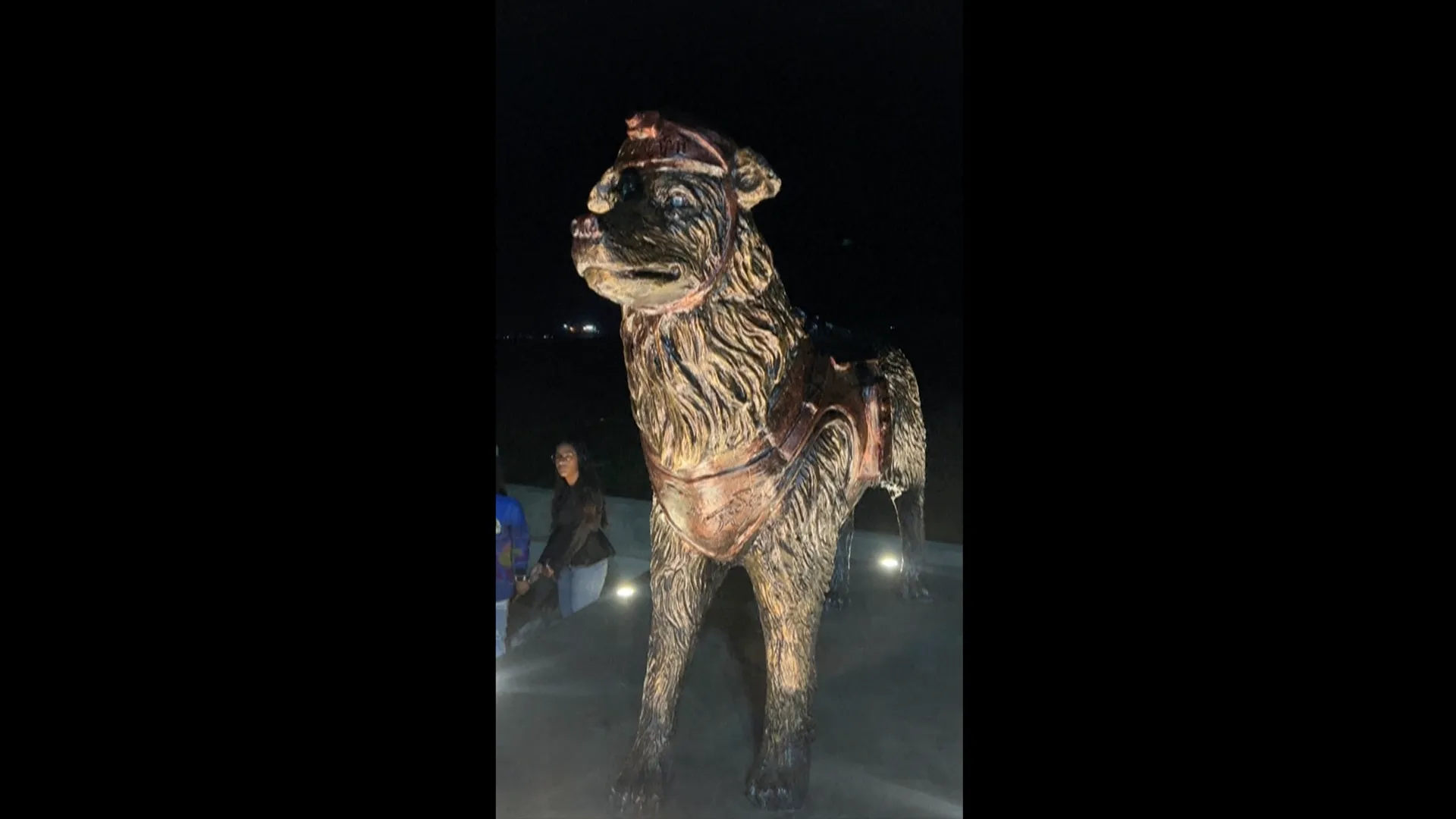
Venezuelan rescue dog ‘Tsunami’ has been honoured with a bronze statue in Maracaibo for his search-and-rescue work after deadly earthquakes in June. The Border Collie reportedly helped locate at least 26 survivors in the aftermath of the quakes, which killed more than 6,500 people.
The outage marks at least the sixth one this year after a United States-imposed energy blockade went into effect.
Published On 19 Sep 202619 Sep 2026
Cuba has worked to restore power after suffering a significant blackout that left many parts of the country in the dark.
The state-run company in charge of operating the country’s electrical system, Union Electrica (UNE), said nearly half of its customers in the capital of Havana had regained power on Saturday.
Recommended Stories
list of 3 itemsend of list
“The re-establishing is being done gradually, as conditions permit,” UNE posted on social media.
The latest blackout, at least the 12th since late 2024, first affected five of Cuba’s eastern provinces, including Havana, before spreading across the whole island. It is at least the sixth this year alone.
Cuban authorities told the Reuters news agency on Friday the collapse was the result of a failure in high-voltage transmission lines in the central part of the country. UNE said “unstable weather conditions” also played a role.
For years, Cuba’s ageing infrastructure and fuel shortages have led to sporadic blackouts. But power outages have become more frequent after the United States, in a bid to put political and economic pressure on the country’s government, imposed an energy blockade in January.
United Nations human rights experts have condemned the US oil blockade, calling it a violation of international law and warning that Cuba risks becoming a “silent Gaza” as shortages and blackouts grow ever more critical.
Some of the island’s residents said they were already out of power when Friday’s blackout happened.
“Yesterday, I’d gone without power for 24 hours. They turned the lights on for an hour, and then the grid collapsed,” Havana resident Frank Lorenzo, 23, told Reuters.
Others, like Lidia Fernandez, told the news agency AFP that a lack of fuel makes it difficult to power backup generators, which run on imported diesel.
“It’s one thing after another: no water, no gas for cooking, no electricity,” the 36-year-old teacher said.
Fernandez added, “Honestly, I don’t know how we haven’t gone crazy.”
Brazilian police say they will reopen dozens of cases after they arrested a self-confessed serial killer disguised as a woman. Jorlan Lopes da Silva, 33, confessed to 80 murders after he was arrested in Paraiba State in the country’s north east, trying to flee in a wig and holding a baby.
US judges affirm migrants must have opportunities to voice safety concerns before deportation to unfamiliar nations.
Published On 19 Sep 202619 Sep 2026
A US federal appeals court has rejected the Trump administration’s policy of rapidly deporting migrants to countries other than their own – a ruling that could next go before the Supreme Court.
On Friday, a three-judge panel of the 1st US Circuit Court of Appeals in Boston largely upheld a February decision that found the Department of Homeland Security’s so-called third-country removal policy unlawful.
Recommended Stories
list of 3 itemsend of list
The case stems from a class-action lawsuit testing what due process migrants are owed before being sent to nations with which they have no ties.
Writing for the panel, US Circuit Judge Seth Aframe said migrants must be given a “meaningful” chance to raise safety concerns before removal, rejecting the Trump administration’s narrower reading of the law.
The court did overturn part of the ruling on procedural grounds, concerning whether officials must first try deporting migrants to countries they have ties to.
Trina Realmuto, a lawyer for the plaintiffs at the National Immigration Litigation Alliance, said the decision confirmed that “due process and the protections Congress enacted against persecution and torture cannot be circumvented by putting someone on a plane to a country that was never part of their removal proceedings”.
The DHS did not immediately comment. The Trump administration is expected to appeal the ruling.
Under Trump, the US has struck agreements allowing it to send more than 25,000 migrants to at least 29 third countries, most often Mexico, according to Third Country Deportation Watch, a tracker run by the rights groups Refugees International and Human Rights First.
The policy, adopted in March 2025, allowed removals with only minimal notice if officials had diplomatic assurances against persecution.
The controversial programme has reached the Supreme Court twice.
In 2025, the justices cleared the way for eight men, including nationals of Cuba, Myanmar and Vietnam, to be deported to South Sudan, a country the US State Department advises against visiting because of “crime, kidnapping, and armed conflict”.
The DHS called the removals “a win”, while rights groups said they flouted basic protections.
The Trump administration’s immigration agenda has faced a string of setbacks this month.
A federal judge blocked planned caps on student and journalist visas, calling the government’s justification “exceptionally weak”, while a coalition of 22 states and Washington, DC, sued to stop a separate rule that would let officials deny green cards to immigrants who lawfully use public benefits.
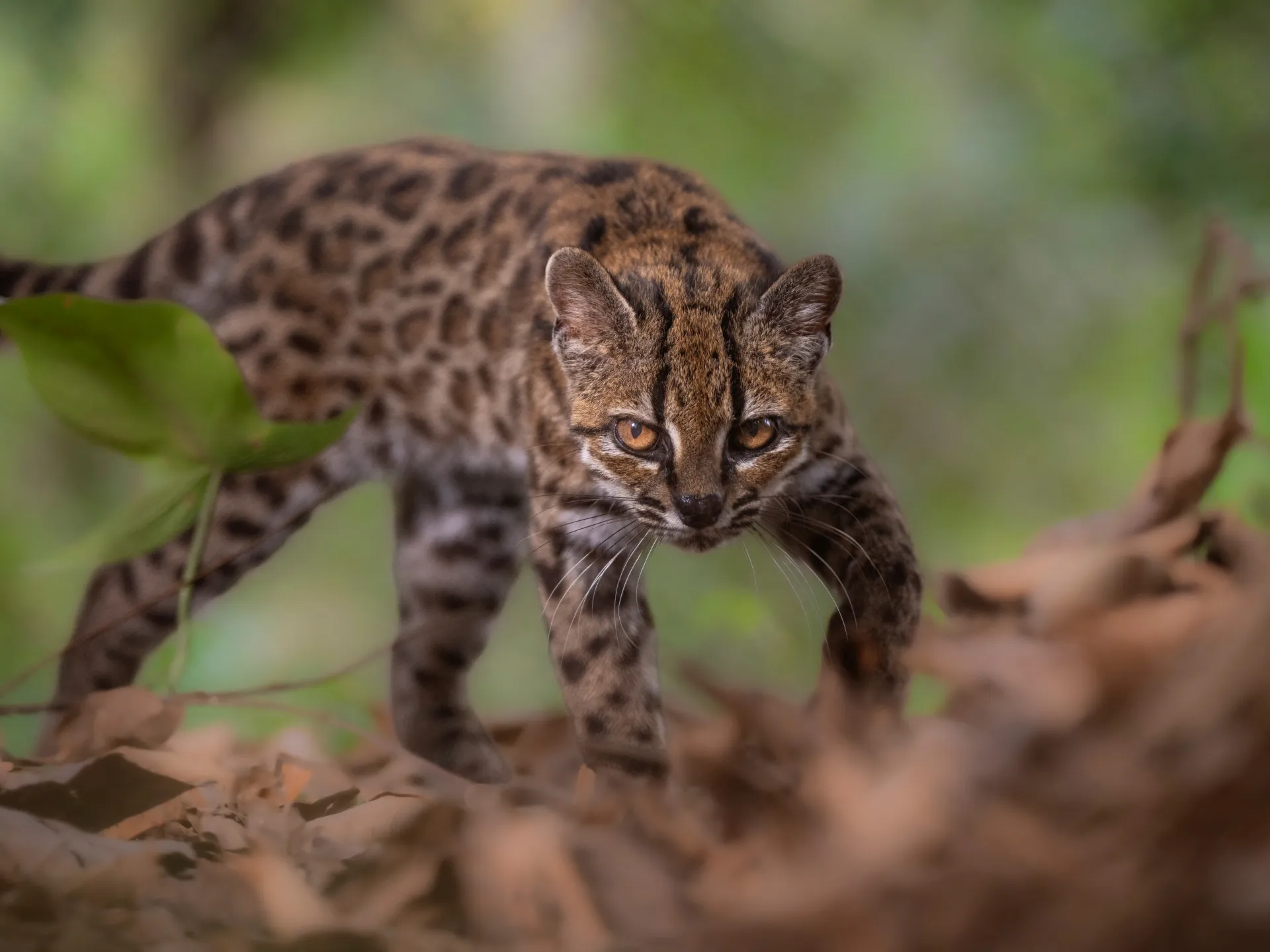
A new species of living cat has been identified for the first time in more than a century. Found in Bolivia’s Yungas forest, it is smaller than a regular house cat, weighing just around 3 pounds and measuring 18 inches long. Known locally as Tilcayo, it belongs to the group of tiger cats.
Leopardus tilcayo is the first new living cat species named and described in more than a century.
Published On 18 Sep 202618 Sep 2026
A tiny wild cat that lives in Bolivia’s lush cloud forests has been identified as a previously unknown species, marking the first time in more than a century that a new living feline species has been formally named and described.
Called “tilcayo” by local communities, the cat is part of a group called tiger cats, which are found across much of South America.
Recommended Stories
list of 2 itemsend of list
It was discovered in the Yungas forest, a mountainous region where forests are often covered by clouds and surrounded by high humidity, according to the researchers.
Given the scientific name Leopardus tilcayo, the cat measures 46cm (18 inches) long and weighs about 1.4kg (3 pounds), making it smaller than an average domestic cat.
“Its fur is light brown … with irregularly shaped rosettes across its body,” according to Paola Nogales-Ascarrunz, a National Geographic Explorer and one of the authors of the study describing the newly identified species published on Thursday in the journal Current Biology.
Little is known about the cat’s biology and lifestyle. Remains of small rodents in scat samples suggest they may form part of its diet, while camera-trap evidence indicates it could be more active at night, Nogales-Ascarrunz said.
Tiger cats are so-called cryptic species, meaning they cannot easily be distinguished merely by appearance, evolutionary biologist and study co-lead author Jonas Lescroart of the University of Antwerp in Belgium said.
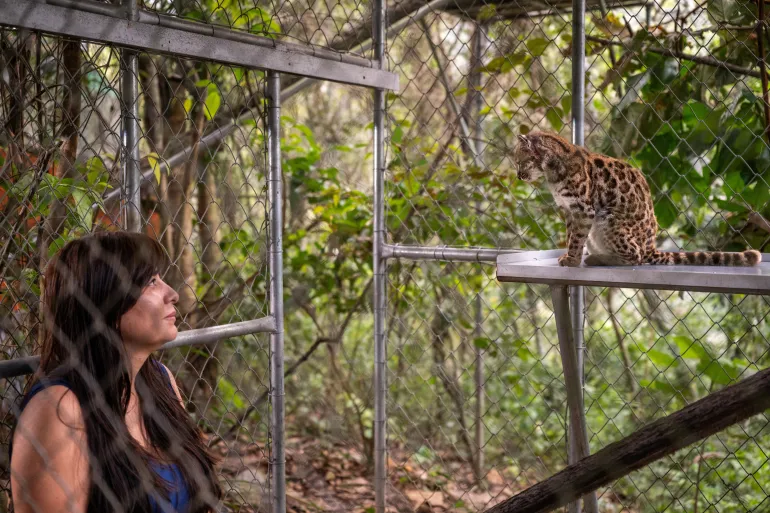
National Geographic Explorer Paola Nogales Ascarrunz, who led the research that identified Leopardus tilcayo as a new species, observes the cat at the Senda Verde animal refuge in the Yungas region, in Bolivia, September 1, 2026 [Handout/Fernando Faciole/Reuters]
Observing the Bolivian cat drew interest because “its characteristics did not match the descriptions, most of them based on Brazilian cats”, Nogales-Ascarrunz said. “This made us wonder, what tiger cat do we actually have in Bolivia?”
The team analysed DNA from 38 cats sampled across several South American countries, including eight museum specimens. The study found that tiger cats are in fact five genetically distinct species.
“We never expected this Bolivian tiger cat to be a separate species, and no one had ever proposed it as a different animal, subspecies or otherwise,” Jonas Lescroart said.
Genetic analysis suggested that the tilcayo lineage separated from other tiger cats about 1.4 million years ago.
The research team also described a new tiger cat subspecies in Peru’s Yungas, naming it Leopardus tigrinus antisuyo, after Antisuyu, the region of the old Inca Empire that included the area it inhabits.
Lawyers criticised mass arrests under emergency powers that allowed authorities to detain people without charge.
Published On 17 Sep 202617 Sep 2026
The Caribbean country of Trinidad and Tobago has ended a state of emergency that granted the government extraordinary powers to combat crime, including the ability to imprison people without charge.
The country’s prime minister told parliament on Wednesday that the government would not extend the state of emergency. One was issued in 2024 and another in 2025, with extensions lengthening both. Instead, the government would seek a “permanent legal framework”.
Recommended Stories
list of 3 itemsend of list
“The proposed legislation will establish a permanent legal framework for targeted operations against violent crime, gangs, illegal weapons and the criminal networks that finance them, while providing safeguards for law-abiding citizens, judicial oversight and parliamentary accountability,” Prime Minister Kamla Persad-Bissessar said in a social media post.
The government had faced criticism for a campaign of mass arrests that suspended key civil liberties in what it said was in the name of cracking down on crime and those the government deemed threats to security. A prominent businessman and his wife were among those arrested over alleged involvement in a plot to assassinate the prime minister, but were never charged and later released.
The measures were last extended in June, with the prime minister stating that more than 5,800 people have been arrested since a March extension. About 2,250 of those have yet to be charged, and it remains to be seen whether they will be released now that the state of emergency has ended.
Lawyer Criston Williams told The Associated Press news agency that he expects some of those detained without charge to bring lawsuits against the government and called for the Inter-American Commission on Human Rights to investigate possible abuses by the government.
“They are transported to us blindfolded, shackled, hands behind their backs, a gray knapsack over their heads,” he said, adding that meetings with lawyers took place in the presence of five armed men from law enforcement, “who refer to themselves as operator one, two, three, four, five. There’s a camera above, so guess what, there’s nothing like attorney-client privilege.”
Police reported a record 624 killings in the country of about 1.4 million people in 2024, a figure that police say dropped to 369 in 2025. Police state that 255 killings have been recorded this year, compared with 268 over the same period in 2025.
Brazil has opened the UN’s General Debate for decades, with the US traditionally second in line as the host country. Here’s how that tradition began and how the rest of the speaking order is decided.
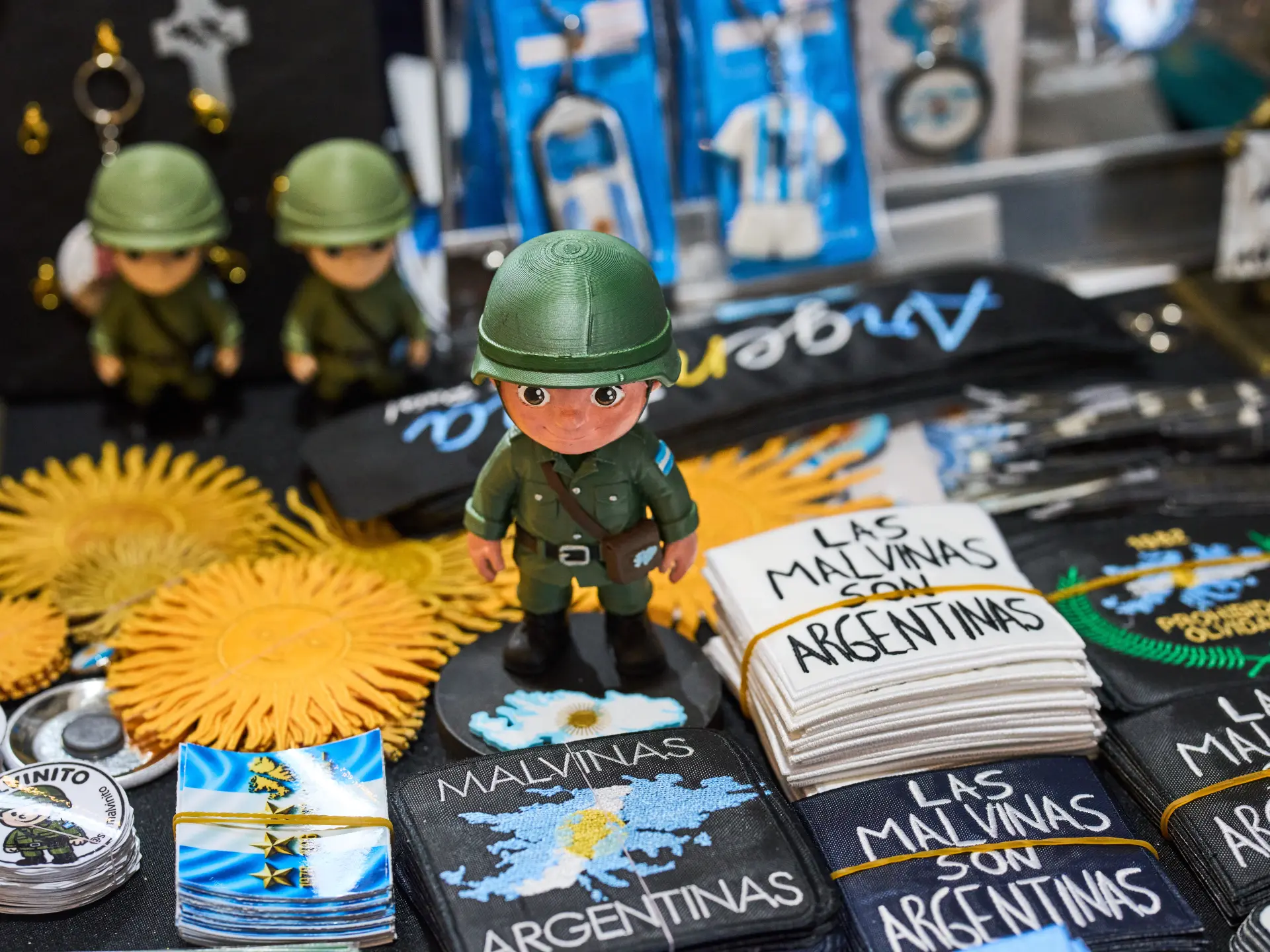
The symbolic move comes as Argentina escalates its claim over the British-administered territory.
Published On 17 Sep 202617 Sep 2026
An Argentinian judge has ordered the suspension of a British-Israeli oil project near the Falkland Islands in a purely symbolic move as Argentina escalates its claim over the British-administered territory.
Wednesday’s interim ruling issued by a court in Argentina’s southernmost province, Tierra del Fuego, follows a lawsuit filed by 1982 war veterans and environmental lawyers earlier this month.
Recommended Stories
list of 3 itemsend of list
The plaintiffs sought to block Britain’s Rockhopper Exploration and Israel’s Navitas Petroleum from the Sea Lion oilfield, located about 220km (137 miles) from the islands.
The judge ordered the companies to “refrain from initiating, pursuing, carrying out or having carried out any material actions” that would involve drilling, installing infrastructure or extracting hydrocarbons, according to a ruling seen by the AFP news agency.
Additionally, the suspension applies “until such time as the environmental impact assessment procedure has been conducted before the national authority competent in environmental matters”.
The judge gave the parties 10 days to provide information, including details about the status of the project, its contractors and its financiers.
President Javier Milei’s administration has also taken legal action against the project, arguing it violates a United Nations resolution calling for both sides to desist from unilateral actions in the islands until their dispute is resolved.
The court order comes just a day after Argentina announced it would file further legal complaints against companies exploring for oil near the islands, intensifying its campaign against businesses operating in the British overseas territory.
Britain and Argentina fought a brief but bitter 10-week war in 1982 over the South Atlantic islands, known to Argentines as the Malvinas.
The 1982 war ended with an Argentinian surrender after 74 days of conflict that killed 649 Argentines and 255 British troops, as well as three Falkland Islanders.
Buenos Aires has doubled down on its claim over the Falkland Islands after US President Donald Trump said Washington was open to reviewing its historically neutral stance on the territory.
London maintains the islands are British and rejects the jurisdiction of Argentinian courts in the Falklands.
The islanders themselves voted overwhelmingly in 2013 to remain British.
But Argentina rejects that outcome, arguing that the principle of self-determination does not apply to a population it considers implanted by Britain after 1833.
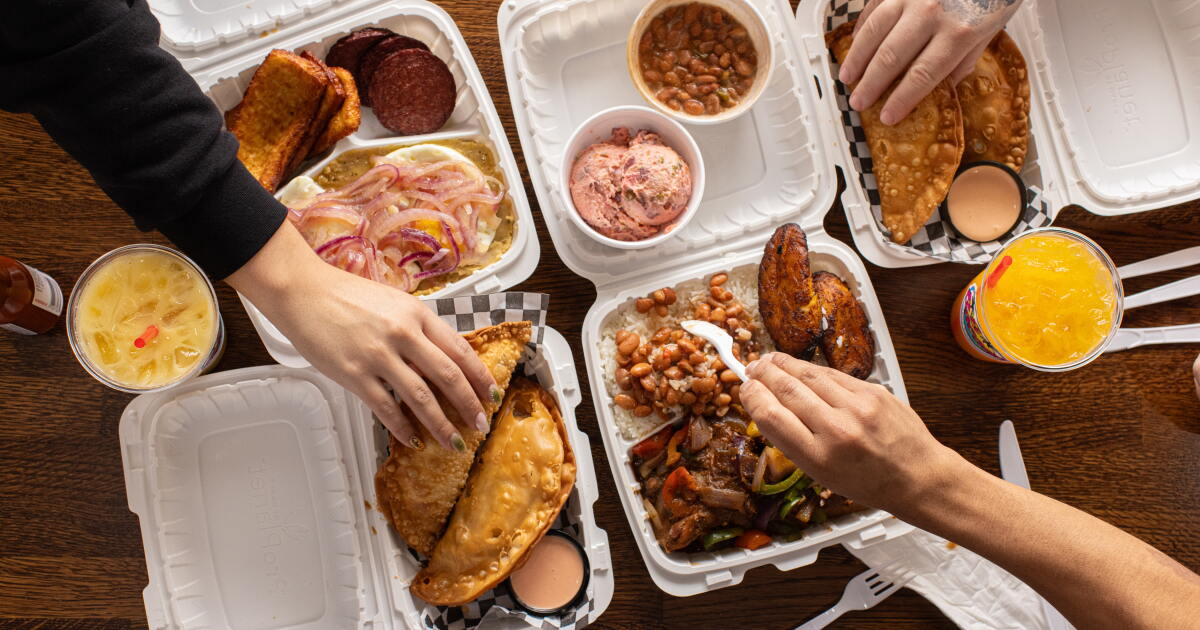
The line at Holbox during the midweek lunch hour has become a cultural sensation, a queue of locals and visitors trailing past the automatic doors and around the parking lot like devotees angling for the latest iPhone series or limited-release sneakers. Believe the lauds, including ours when we named Holbox as The Times’ 2023 Restaurant of the Year. Gilberto Cetina’s command of mariscos is unmatched in Southern California — his ceviches, aguachiles and tostadas revolutionary in their freshness and jigsaw-intricate flavors. The smoked kanpachi taco alone — clinched with queso Chihuahua and finished with salsa cruda, avocado and drizzles of peanut salsa macha — is one of the most sophisticated things to eat in Los Angeles.
Holbox could be considered for the top ranking on its own strength. But in a year when disasters tore at our city, honoring the power of community feels more urgent than ever. Cetina’s seafood counter doesn’t thrive in a vacuum. Holbox resides inside the Mercado La Paloma in South L.A. The mercado is the economic-development arm of the Esperanza Community Housing Corp., a nonprofit organization founded in 1989 that counts affordable housing and equitable healthcare among its core missions. When the mercado was in the incubation stage, Esperanza’s executive director Nancy Ibrahim interviewed would-be restaurateurs about their challenges and hopes in starting a business. Among the candidates was Cetina’s father, Gilberto Sr., who proposed a stall serving his family’s regionally specific dishes from the Yucatán. Their venture, Chichén Itzá,was among the eight startups when the mercado opened in a former garment factory nearly 25 years ago, in February 2001.
Step into the 35,000-square-foot market today, and the smell of corn warms the senses. Fátima Juárez chose masa as her medium when she began working with Cetina at Holbox in 2017. Komal, the venue she opened last year with her husband, Conrado Rivera, is the only molino in L.A. grinding and nixtamalizing heirloom corn varieties daily. Among her deceptively spare menu of mostly quesadillas and tacos, start with the extraordinary quesadilla de flor de calabaza, a creased blue corn tortilla, bound by melted quesillo, arrayed with squash blossoms radiating like sunbeams.
Wander farther, past the communal sea of tiled tables between Holbox and Komal, to find jewels that first-timers or even regular visitors might overlook.
Taqueria Vista Hermosa, run by Raul Morales and his family, is the other remaining original tenant. Order an al pastor taco, or Morales’ specialty of Michoacan-style fish empapelado smothered in vegetables and wrapped in banana leaf. The lush, orange-scented cochinita pibil is the obvious choice next door at still-flourishing Chichén Itzá, but don’t overlook crackling kibi and the brunchy huevos motuleños over ham and black bean puree. The weekends-only tacos de barbacoa de chivo are our favorites at the stand called Oaxacalifornia, though we swing through any time for the piloncillo-sweetened café de olla and a scoop of smoked milk ice cream from its sibling juice and snack bar in the market’s center. Looking for the comfort of noodles? Try the pad see ew at Thai Corner Food Express in the far back.
The everyday and the exquisite; the fast and the formal (just try to score a reservation for Holbox’s twice-a-week tasting menu); a food hall and sanctuary for us all. Mercado La Paloma embodies the Los Angeles we love.
Prosecutors said that the group worked on behalf of Russian intelligence services to carry out attacks and murders around the world.
Published On 16 Sep 202616 Sep 2026
Five people have been charged over alleged Russian intelligence-linked plots involving surveillance, recruitment and planned killings, according to an indictment unsealed by the United States Department of Justice.
Prosecutors said on Tuesday that the group worked on behalf of Russian intelligence services to carry out attacks and murders internationally, including within the US, and that all five remain at large.
Recommended Stories
list of 3 itemsend of list
The defendants were identified as Russian national Yuri Khrameev, 63, his son Kirill Khrameev, 27, Cubans Oemis Romagoza Durruthy and Yaidel Delgado Suarez, both 35, and 22-year-old Venezuelan Angel Eduardo Castro.
All five were charged with conspiring to finance terrorism, while Khrameev, Suarez and Castro face additional charges of conspiring to commit murder for hire.
At a news conference, Attorney General Todd Blanche said the plots included attempts to kill a Russian dissident believed to be living in the Washington, DC area.
Justice Department officials said the network had recruited several people in the US to carry out surveillance on Russian dissidents, targeting individuals both domestically and in Lithuania.
In one instance, a recruit was reportedly promised $40,000 to make a US-based target “disappear”. A separate recruit was allegedly offered $25,000 the previous year to kill someone in Lithuania.
Russia’s embassy in the US has not commented on the case. Moscow has consistently rejected accusations that it has orchestrated assassination operations on foreign soil, including in the US.
Chavez’s eyes still gaze from walls across Caracas. So too do the eyes of other figures, like Maduro and independence leader Simon Bolivar. Some images are faded. Others are accompanied by slogans like “To doubt is treason”.
Forastero has worked on government projects, including under Rodriguez. But he is critical of some of the newer images. He remembers a time when he painted murals of Chavez playing with children or riding a bicycle, not slogans.
“When Chavez was alive, people painted Chavez because we loved him very much. It’s as simple as that,” he said.
In recent decades, he argues that Venezuela’s public art has fallen increasingly under government control, with murals commissioned to carry explicitly political messages.
“Muralism is a story told on a wall,” Forastero said. “What we really see on the walls now are propaganda posters. I’m a chavista, and I’m disgusted by it.”
Still, the removal of the artwork is another form of propaganda, in Forastero’s eyes. He believes the Rodriguez government is seeking to project a more “neutral” appearance to better appeal to the US.
He also accuses Rodriguez of abandoning ideals key to the chavismo movement: namely, anti-imperialism and revolution. He pointed to the US’s role in shaping Venezuelan policy.
“The United States is forcing our government to behave this way,” Forastero said.
Forastero believes the removal of Hugo Chavez murals is part of an effort by Venezuela’s government to appeal to the US [Catherine Ellis/Al Jazeera]
Rafael Araujo, a Venezuelan activist, has a different view of the changing landscape.
To him, there was something “jarring” about seeing chavista figures plastered across city walls, especially the leaders who have caused the country so much pain.
During their time in power, Chavez and Maduro both faced allegations of overseeing human rights abuses, including through the violent suppression of dissent. Venezuela’s last two presidential elections have been widely denounced as illegitimate.
Known in Caracas as Senor Papagayo, Araujo has used colourful, handmade kites to protest against government violence and economic policy.
He sees the Chavez murals as a form of oppression, an ever-visible reminder of a repressive government apparatus.
His kites are a way of sending a different message. His favourite carries aloft a single word: “Freedom”.
“Freedom is what all countries need. Democracy is the most balanced system a citizen can live under,” Araujo said.
MEXICO CITY — He’s been called the “MAGA man” of Latin America, a brash political provocateur whose social media assaults boosted right-wing campaigns from his native Argentina to Central America.
His career as political consultant and co-founder of an ultra-right online outlet made him a rich man and helped elect Trump-aligned politicians across the region. The Economist gave him the “MAGA Man” label, while political commentators gave him another nickname — the “Steve Bannon of Latin America” — a nod to the longtime Trump ally and advisor.
Now, however, Fernando Cerimedo, 45, sits in a maximum-security prison in Bolivia, accused of masterminding a murder-for-hire plot: The attempted femicide of his pregnant mistress, Nadia Beller, 33, a Bolivian lawyer and activist.
It’s a stunning collapse for a onetime ad man with a dodgy reputation who rose to become the go-to digital campaign guru for Latin America’s ascendant right wing. Cerimedo’s signature boasts, exaggerations and peddling of false election-fraud narratives reflected those of his political model, President Trump.
Cerimedo also is another example of how right-wing political operatives outside the United States — as recently in Colombia and Germany — have adopted Trumpian tactics and messaging.
The fall of the “King Midas of the Latin American right,” said Daniel Matamala, a prominent Chilean journalist, stunned “the ecosystem of fake news, bots, trolls and disinformation that has taken this region by storm in recent years.” Speaking on his podcast, Matamala added, “The name of Cerimedo looms like a ghost over the summit of the radical right.”
The Aug. 17 attack on Beller was a seemingly well-planned ambush that was captured by security cameras, the grainy images widely disseminated on social media.
One of two would-be assassins dressed as fast-food deliverymen pulled out a pistol and shot Beller point blank outside a hotel in the eastern Bolivian city of Santa Cruz. She fell to the ground and, according to her account, feigned death. The next day, at dawn, Cerimedo was arrested as he was about to board a plane to Buenos Aires.
Cerimedo set up the hit, prosecutors charge, in a nefarious attempt at damage control. Beller had threatened to expose his alleged criminal behavior and physically abusive behavior toward her while revealing Cerimedo, a married man with two children, as the father of her unborn child.
Cerimedo is also under investigation for alleged illegal enrichment and potential links to cocaine trafficking.
He has denied any wrongdoing.
Even before Cerimedo’s arrest, Latin American journalists had begun unmasking Cerimedo as a prodigious purveyor of fake news — about himself. New reports revealed that his frequent boasts about U.S. connections — that he attended Harvard, trained with U.S. Navy SEALs, worked in the Obama White House — were fanciful.
“He certainly exaggerated things,” said Damian Merlo, a Miami-based consultant who worked with Cerimedo on the 2023 campaign of Argentine President Javier Milei, a Trump favorite. “I never really got the impression that Cerimedo was ‘MAGA’s man in Latin America.’ The guy could hardly speak English! But that’s how he sold himself.”
Many times, the sales pitch worked. It was Cerimedo who helped broker then-candidate Milei’s celebrated 2023 interview with Tucker Carlson, at the time a Trump confidant, an appearance that thrust Milei into the international spotlight.
Like Milei, Cerimedo seemed to relish any proximity to Trump-land.
In February, at the inaugural “Hispanic Prosperity Gala” — a right-wing pep rally held at Trump’s Mar-a-Lago estate — Cerimedo was honored as “Hispanic Political Consultant of the Year.’” From the podium, he spoke of Latin America’s “culture war” and the need to ensure that “the left never again returns” to governments that have elected conservative leaders.
Switching to heavily accented English, Cerimedo gave a shout-out to Brad Parscale, Trump’s former campaign manager, whom Cerimedo thanked for “believing [in] me all the time and giving me your technology.”
Parscale declined to comment.
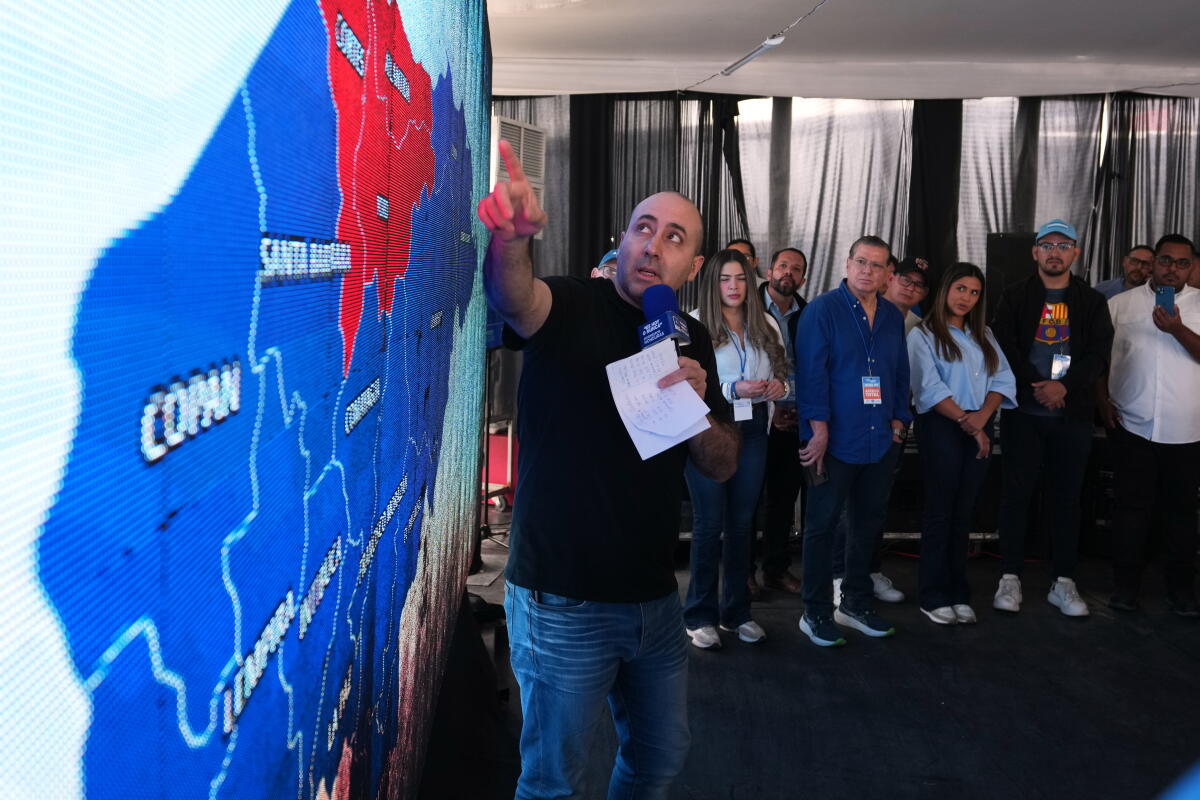
Fernando Cerimedo, an advisor to the National Party, points at a map of Honduras on Dec. 1, 2025, one day after voters went to the polls to elect Nasry Asfura president.
(Moises Castillo / Associated Press)
Both Cerimedo and Parscale were involved in last year’s campaign that resulted in the election of Honduran President Nasry Asfura, whom Trump backed publicly.
Last year, Cerimedo was a key player in the election of Bolivian President Rodrigo Paz, the center-right, U.S.-educated son of a former president who transitioned from Marxist firebrand to moderate. The ascension of Paz broke almost two decades of leftist rule by the Movement for Socialism party of ex-President Evo Morales.
Cerimedo had no official capacity in Paz’s government, but he enjoyed insider status. He accompanied Paz in March to Trump’s anti-narco “Shield of the Americas” summit, a confab of mostly conservative leaders at Trump’s Doral resort in south Florida.
Among the items found in searches of Cerimedo-linked properties, authorities say, was a business card listing him as Paz’s “chief adviser” — a nonexistent post.
“Mr. Cerimedo never had the authorization to represent … the presidency, the government or my family,” a deeply discomfited Paz said in Facebook message last month.
How exactly Cerimedo got into politics — and how he became a right-wing rabble-rouser — remains somewhat opaque. According to media accounts, he worked a series of uninspiring jobs — including stints as a taxi driver, a schoolteacher and an employee of insurance and computer firms — before veering into advertising. In 2019, he assisted the campaigns of several leftist Peronist candidates in provincial races in Argentina, and later founded his own consultancy, Numen.
Cerimedo first gained prominence in neighboring Brazil. That’s where he championed false election-fraud narratives following the narrow reelection defeat in 2022 of President Jair Bolsonaro — a MAGA stalwart — in his reelection bid against Luiz Inácio Lula da Silva, a leftist. Cerimedo’s “Brazil Was Stolen” livestream exacerbated the sense of outrage among Bolsonaro loyalists, who took to the streets in mass protests.
The Brazil exposure helped catapult Cerimedo into successful presidential campaigns in Argentina (Milei), Honduras (Asfura) and Bolivia (Paz). His arrest prompted Chilean lawmakers to create a commission to investigate Cerimedo’s possible role in that nation’s recent electoral shift to the right.
With Cerimedo’s name now toxic, Paz, Milei and other former allies have distanced themselves.
Also ditching Cerimedo was his close partner, Javier Negre, a right-wing Spanish media entrepreneur who, in 2024, purchased 50% ownership of Cerimedo’s La Derecha Diario (The Daily Right), an online, Spanish-language MAGA megaphone. The site strongly backed Colombian President Abelardo de la Espriella — who had Trump’s support — during his tight campaign this summer.
Following Cerimedo’s arrest, Negre announced that he had bought out his former partner in La Derecha Diario.
In Bolivia, the Cerimedo scandal has taken on the character of a Latin American telenovela.
A recovering Beller, shot three times in her upper body, granted interviews from her hospital bed, dishing on her lover’s alleged brutality and criminality.
According to Beller’s testimony to authorities, Cerimedo tricked her into the near-fatal rendezvous outside the hotel. He told her that a source was waiting to share details about the purported rape of a 13-year-old, she said. The supposed rapist? Bolivian ex-President Morales — a despised figure on the Latin American right.
The case has seen the once high-flying Cerimedo reduced to a slumping presence in a hoodie as authorities have shuffled the baldish, heavyset figure to hearings and lockups. Last week, he was transferred while awaiting trial to Bolivia’s maximum-security Chonchocoro prison, infamous for its high-altitude, ill-heated confines.
“I want to see my children!” a sobbing Cerimedo declared at one point in earshot of the media.
His legal team has pushed back. A defense lawyer, Margarita Arce, questioned whether Cerimedo had impregnated Beller and asserted to reporters that Beller staged a “self-inflicted attack” to smear Cerimedo and undermine the Bolivian government.
But prosecutors have sided with Beller, who told the Argentine daily Clarín: “Fernando Cerimedo wanted to kill me because I can tell everything that I know.”
Times staff writer Ana Ceballos in Washington and special correspondents Andrés D’Alessandro in Buenos Aires and Cecilia Sánchez Vidal in Mexico City contributed to this report.
United States President Donald Trump has made no secret of his hostility towards BRICS.
Last year, he threatened an additional 10 percent tariff on any country aligning itself with what he called the bloc’s “anti-American policies”. Since then, his administration has continued to wield tariffs aggressively against trading partners, including BRICS members such as Brazil, India and China.
The message appears straightforward: Countries that challenge US economic power should expect to pay a price.
But coercion has consequences. And as BRICS leaders meet in New Delhi today, Trump may be strengthening the very incentives that made the bloc attractive in the first place. The more Washington demonstrates its willingness to use access to its markets, its financial system and the dollar as instruments of political leverage, the more reason other countries have to reduce their exposure to them.
This does not mean BRICS is becoming an anti-US alliance. Far from it.
The bloc’s 11 members – Brazil, China, Egypt, Ethiopia, India, Indonesia, Iran, Russia, Saudi Arabia, South Africa and the United Arab Emirates – have enormous political and economic differences. Together, they account for nearly half the world’s population and about 40 percent of global gross domestic product, but they do not share a common ideology, security policy or even geopolitical orientation.
Recent events have made those divisions impossible to ignore. Iran, Saudi Arabia and the UAE find themselves on opposite sides of a growing regional conflict. In May, Iranian and Emirati representatives clashed during a foreign ministers’ meeting in New Delhi. India and China have had a heated border dispute that led to deadly skirmishes in 2020-2021; only in the past two years have their relations gradually stabilised.
So Trump is not producing a united geopolitical front against Washington.
He may, however, be giving countries with otherwise divergent interests a common reason to cooperate economically: Protection against vulnerability to US power.
For countries outside the Western core, dependence on US-centred economic infrastructure carries risks.
The dollar’s centrality gives the US enormous structural advantages. International transactions pass through financial institutions subject to US jurisdiction; access to US markets can be restricted; sanctions can isolate governments and companies from parts of the global financial system.
BRICS’s efforts to diminish dependence on the US financial system do not mean the dollar is about to lose its position as a global reserve currency. This claim is often made around BRICS summits, usually accompanied by breathless predictions of a new BRICS currency. The evidence does not support it.
The dollar remains overwhelmingly dominant. According to the International Monetary Fund, it accounted for 57.1 percent of global foreign-exchange reserves in the first quarter of 2026. The Chinese renminbi accounted for just 2 percent. Indeed, the dollar’s share rose slightly during the quarter.
But replacing the dollar and reducing dependence on it are two very different things.
BRICS countries are already experimenting with the latter. South Africa has connected to China’s Cross-Border Interbank Payment System, allowing transactions with China to be settled directly in renminbi. Brazil and China are increasingly using their own currencies in bilateral trade, while India and the UAE have settled transactions in rupees and dirhams. China and Russia have shifted much of their bilateral trade into their national currencies.
BRICS itself is also moving cautiously towards greater financial connectivity.
Last year, its leaders called for continued work on a cross-border payments initiative and greater interoperability among members’ payment systems. In August, Reserve Bank of India Governor Sanjay Malhotra confirmed that BRICS countries are discussing linking their fast-payment networks and potentially their central bank digital currencies. India itself is also encouraging greater use of the rupee in international trade.
The New Development Bank offers another example. Established by the original BRICS countries as an alternative source of development finance, it has made lending in members’ currencies an explicit strategic objective. Its current strategy targets 30 percent of financing in local currencies, partly to reduce borrowers’ exposure to foreign-exchange risks and costly currency swaps; the number could increase to 40-50 percent for the next cycle, 2027-2031.
None of this amounts to a rival global financial system. Much of it remains experimental, bilateral or limited in scale.
But that is precisely why the fixation on whether BRICS can “replace” the dollar misses what is happening. The more significant development is the gradual construction of options that allow governments and businesses to conduct a number of transactions without relying on the dollar and Western-dominated financial infrastructure.
Trump’s policies give this process additional urgency.
Consider Brazil. Washington imposed a new 25 percent tariff on a range of Brazilian products in July, affecting billions of dollars in exports, despite running a trade surplus with the country. The Trump administration has also scrutinised Brazil’s hugely successful Pix instant-payment system, which competes with established card-payment networks.
Sanctions demonstrate the same vulnerability more dramatically. Russia and Iran have been pushed towards alternative payment and trading arrangements precisely because their access to Western financial networks has been restricted. Washington is now considering further measures that could penalise countries heavily reliant on Russian energy, including China and India.
No BRICS member needs to sympathise with Moscow or Tehran to understand what this implies.
US financial power depends not simply on possessing the world’s largest economy or issuing its dominant currency. It also depends on other countries continuing to regard participation in a US-centred system as more advantageous than the alternatives.
The more frequently Washington turns that system into an instrument of coercion, the stronger the incentive to construct escape routes from it.
That said, most BRICS countries do not appear eager to exchange dependence on Washington for dependence on Beijing.
India maintains extensive relations with the US while buying Russian energy and pursuing closer economic cooperation within BRICS. Brazil has long sought greater autonomy without becoming a Chinese satellite. Saudi Arabia and the UAE remain deeply intertwined with Western economies while expanding their relationships with China.
Their objective is less likely to be replacing one hegemon with another than increasing their ability to manoeuvre between competing centres of power.
That distinction matters. A trade transaction settled in rupees, a loan denominated in renminbi or rand, or a payment made through a system that does not depend on the same Western intermediaries will not overthrow dollar dominance.
But multiply such arrangements across countries and over time, and they begin to reduce the costs of saying no to Washington.
This is why portraying BRICS simply as an anti-US threat risks becoming self-defeating. Punishing countries for seeking alternatives gives them another reason to develop those alternatives.
Trump wants to make challenging US power costly. Instead, he may be making dependence on US power costlier still.
The views expressed in this article are the author’s own and do not necessarily reflect Al Jazeera’s editorial stance.
Protesters and police have clashed in Chile, as the country marked 53 years since Augusto Pinochet overthrew President Salvador Allende in a US-backed coup. Many Chileans say the current far-right government is trying to rehabilitate Pinochet’s image.
Members of the high court have exchanged accusations after one justice was accused of involvement in a bank scandal.
By AFP and The Associated Press
Published On 11 Sep 202611 Sep 2026
Brazil’s Supreme Court has cancelled a second straight day of deliberations as suspicions of corruption, political bias and police interference loom over several of its members.
Cancellations are rare at the high court. But on Thursday, Chief Justice Luiz Edson Fachin nixed a second consecutive session, calling for the court to reconvene on Tuesday instead.
Recommended Stories
list of 3 itemsend of list
The decision was spurred by an ongoing crisis among the court’s members.
The divisions emerged on September 1, when one justice, Andre Mendonca, unsealed a series of federal police documents that appeared to show a disgraced banker, Daniel Vorcaro, seeking advice from another justice, Alexandre de Moraes.
De Moraes has rocketed to prominence in recent years for his roles in high-profile cases.
He presided over the trial of former President Jair Bolsonaro after prosecutors accused the far-right leader of plotting a coup following his 2022 election defeat. De Moraes also oversaw suspensions of platforms like X and Rumble for failing to abide by court orders, making him a target for Brazil’s right wing.
The document release authorised by Mendonca, a Bolsonaro appointee, contains roughly 30 text messages sent to a phone number associated with de Moraes, allegedly from Vorcaro.
In response, de Moraes has accused Mendonca of abusing his authority on the court for political gains. He requested a probe into whether Mendonca interviewed Vorcaro without the presence of police or prosecutors.
Tuesday’s session will involve the full Supreme Court bench, and 10 of the justices will discuss whether the 11th member, de Moraes, should be investigated over the text messages.
The tit-for-tat on Brazil’s high court is the latest fallout from the Banco Master corruption scandal.
Vorcaro, the head of the Banco Master financial institution, was arrested in November 2025 on accusations he defrauded investors of billions in lost funds, in one of the biggest banking scandals in the country’s history.
The collapse of Banco Master’s private banking arm left behind more than $7bn in debt.
Lawmakers from across the political spectrum have become embroiled in the unfolding scandal as new details emerge.
The turmoil risks affecting October’s general elections, including a pivotal presidential election.
Left-wing incumbent Lula Inacio Lula da Silva is set to compete for the presidency against Jair Bolsonaro’s eldest son, Senator Flavio Bolsonaro.
Both Lula and Senator Bolsonaro have called for investigations into the Supreme Court justices.
The Bolsonaro family itself has been dragged into the Banco Master scandal. In May, the publication Intercept Brasil released a report showing that Senator Bolsonaro petitioned Vorcaro for funds to finance a film about his ex-president father, who is now serving a 27-year prison sentence.
Senator Bolsonaro has denied wrongdoing, claiming he did nothing more than seek private sponsorship for the film, entitled Dark Horse.
But on Thursday, Brazilian police executed dozens of raids related to the Banco Master scandal, including some that targeted two figures involved in the film: Karina Gama, the head of a production company, and Congressman Mario Frias, who served as executive producer.
Senator Bolsonaro has called the probes “attempted political interference” ahead of the elections.




![National Geographic Explorer Paola Nogales Ascarrunz, who led the research that identified Leopardus tilcayo as a new species, observes the cat at the Senda Verde animal refuge in the Yungas region, in Bolivia, September 1, 2026 [Fernando Faciole/Handout via Reuters]](https://i0.wp.com/occasionaldigest.com/wp-content/uploads/2026/09/2026-09-17T154150Z_381273466_RC2N9NAU7NUJ_RTRMADP_3_SCIENCE-CAT-1789702964.jpg?w=640&ssl=1)