So the appeal is clear for those who manage the financial spreadsheets, but what about everybody else?
US Open organisers have not yet commented in the wake of the Williams-Kenin match, but they have previously argued late scheduling is a benefit to fans.
“Without question late-night matches were heavily discussed and reviewed after the 2022 US Open,” tournament director Stacey Allaster said in 2023, after opting to maintain the late schedule.
“We looked at starting the evening session earlier, instead of 7pm start at 6pm, but it’s not really a possibility because it’s hard for New Yorkers to get here even at 7pm.
“We talked about [changing to] one match at night, but we felt that’s not fair to our fans. One of the realities we have in tennis is that we are not defined by a start and an end time. We can have a short match or we can have a five-hour match.”
And that lack of certainty is where the problems arise. Organisers might not think all matches will run long, but they definitely know it’s a possibility.
A five-set men’s match can easily run for over four or even five hours and a women’s match that goes the distance can comfortably pass the three-hour mark. Put those two matches back-to-back on Arthur Ashe with a short break in-between and suddenly whoever is playing second isn’t finishing until about 3am.
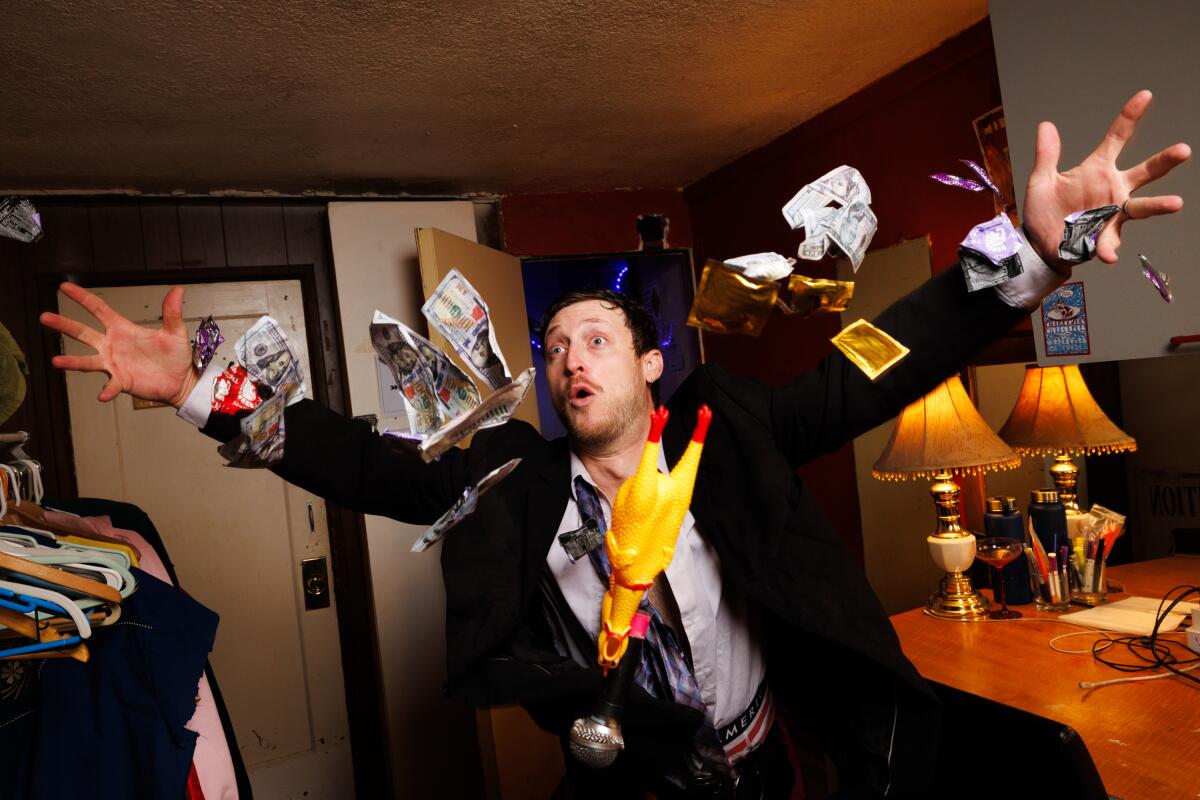
Jack Tucker descends from the rafters inside L.A.’s Montalbán Theatre like a kamikaze crash landing into his big moment. He’s flanked by fountain fireworks while a buff guitarist with a blond mullet and glittery spandex shorts wails on guitar to the tune of Lenny Kravitz’s cover of “American Woman.” With the garish gusto of a WWE wrestler, Tucker’s entrance as the ringleader of the show “Stamptown” electrifies the stage.
But the show truly starts when it falls apart with technical mishaps. Everything breaks, guns go off, an illusionist loses his clothes and jumps fully nude into the crowd — all within the first five minutes.
It’s a chaotic comedy world created by classically trained performers, including clowns, who’ve studied the art of physical humor and shredded the rule book. For more than 10 years the Stamptown troupe led by Tucker, the alter ego of comedian Zach Zucker, has created an insane asylum on stage — from Elysian Theater in Echo Park to the Edinburgh Festival Fringe in Scotland. The show’s comedy thrives on failure, interruption and never actually getting to the “script.” This week the madness leaps from the stage to the screen as Stamptown premieres its first Netflix special Tuesday.
“This is a lot of people’s first time being exposed to this,” Zucker said, cracking a mischievous smile while sitting in a red velvet chair inside the empty Elysian Theater where his crew has performed “Stamptown” for years. “I have seen a man light his penis on fire 45 times in my show. I forget that when it comes to comedy, most people are used to seeing a person with one microphone stand still and talk.”
Filmed over the course of three performances during Netflix Is a Joke Fest in May, the spliced together “Stamptown” special directed by Rachel Lee Goldenberg and edited by show co-creator Dylan Woodley captures the chaos of clowning mixed with a cerebral roast of traditional comedy and plenty of playful danger. The result isn’t a piece of art but rather “a pile of art,” Zucker said.
“Our strength is being a ‘you gotta see it to believe it’ type of performance, but if I really had to boil it down, it’s a modern day vaudevillian variety show that features any and all alternative performances … our ethos is, ‘against all odds, this show works,’ ” Zucker said.
Zach Zucker tosses props in the air inside the Elysian Theater.
(Carlin Stiehl / For The Times)
On a recent afternoon, the lanky, mustachioed Zucker, wearing a T-shirt, ballcap and small hoop earrings, bears little resemblance to his comic alter ego who sports a tattered suit with gag props stuffed in every pocket. In real life, the New York native is a former baseball and basketball star athlete who went down an extremely different path to become “a bisexual traveling clown.” After enrolling in what he assumed would be an easy acting class during his senior year of high school, Zucker became obsessed with improv and comedy. His teacher advised him to check out the renowned improv troupe Second City. So he flew to Chicago to see the show “Spoiler Alert: Everybody Dies” featuring Tim Robinson, Sam Richardson, Timothy Edward Mason and more. “It changed my life,” he said.
After taking up comedy classes and street performances on the East Coast, Zucker quickly transitioned to working in theater and eventually moved to L.A. at 18 to pursue comedy, interning at Upright Citizens Brigade. He scrubbed toilets in exchange for free improv classes. It was at UCB where he first crossed paths with celebrated clown teacher Philippe Gaulier, whose former students include Sacha Baron Cohen, Rachel Weisz and Geoffrey Rush. The wily, frizzy-haired Frenchman with red-framed spectacles taught Zucker everything he knows about clowning.
“Our strength is being a ‘you gotta see it to believe it’ type of performance, but if I really had to boil it down, it’s a modern day vaudevillian variety show that features any and all alternative performances … our ethos is, ‘against all odds, this show works,’” Zach Zucker said.
(Carlin Stiehl / For The Times)
“Philippe is by far my greatest influence,” Zucker said. “There’s not a day that goes by that I don’t think about him or that I’m not actively implementing all the lessons he taught me as a man and as an artist.”
One of those lessons became the ethos of “Stamptown”: “If you’re having fun, maybe we like you. If you’re not having fun, for sure we hate you.”
Inspired by his wisdom, Zucker moved to France for two years to study with Gaulier. It was there that he met his future “Stamptown” collaborator Jonny Woolley, a Canadian performer who became the show’s sound tech, adding to the menagerie of aural mayhem through sound effects that punctuate the show’s every move.
“There’s a lot of different ways of approaching clowning, but ultimately, for us, it’s more of a philosophical approach to making art than it is like a rigorous set of rules or styles. It’s just being a lovable idiot,” Woolley said.
The name “Stamptown” is a tribute to the place where they learned their artform: the town of Estampes (which loosely translates to “Stamp”) in France where they studied with Gaulier, who died this year before the special was filmed.
Though he‘s known for his offbeat humor, Zucker’s brain is firing on a perpetual metronome. He’s snapping his fingers incessantly during our interview while describing the comedic timing of each show, which grooves like a jazz band on stage.
”Sometimes there’s a few different rhythms that I’m balancing at once. I can really zone in on what is the most fruitful at the moment while still keeping these other balls in the air,” he said. “Thankfully we’re not always pushing a message. Sometimes it is just about entertaining the crowd at all costs.”
Before “Stamptown,” Zucker was performing with Norwegian friend and fellow clown Viggo Venn as “Zach & Viggo,” a side act in the original variety show Zucker started with his friends in 2017 in Melbourne called “Midnight Madness” that eventually turned into “Stamptown.”
Working with Venn, Woolley and Woodley, Zucker devised the show to include a rotating cast of clowns, and comedic performers from around the world, including L.A. Staples in the local clown community include the slapstick of clown kingpin Chad Damiani playing a janitor, comedic actor Natalie Palamides as a comedy nepo fetus birthed by Riki Lindhome of “Garfunkel and Oates” and the riotously robotic gyrations of Courtney Pauroso as fembot temptress Vanessa 5000.
“‘Stamptown’ is extraordinary; it’s finely calculated nonsense,” said actor Neil Patrick Harris, a longtime friend and supporter of Zucker who appears on the Netflix special, in a statement to The Times. “Each performance is unique — stand-ups colliding with circus artists, and improvisers swapping talents and fluids, even the stagehands’ utter chaos and running gags, a ridiculous fever dream … it’s absurdly genius.”
The international performers who have become part of the “Stamptown” universe run the gamut from jugglers to steel drum players to acrobats to pianists. Trans comedian Jordan Gray is extremely unafraid to bare it all, including her soul, when behind the piano. The physicality of the performances goes beyond regional references and punchlines that might get some laughs in one country but not in others. Venn says it’s clear that at their core people tend to share the same sense of humor.
“It was fascinating to us to see that in Australia and France and England and the U.S., they really laugh at the same things if it’s like a deeply human kind of failure,” Venn said. “That’s the beauty of this show.”
Zach Zucker sits inside the Elysian Theater in Los Angeles.
(Carlin Stiehl / For The Times)
A tangled web of masterfully timed sound effects has unintentionally become the heartbeat of “Stamptown” . With Woolley now living full time in London, the duties for the U.S. shows were recently passed down to fellow performer Jeremy Elder, who did the sounds for the Netflix special tapings. He says the show is at its best when they throw out the game plan for the night, even while filming for Netflix.
“I think it’s as soon as we went off script, the audience could feel that. In the final product, we planned so much, but once you’re in the room with people it’s a very clown-like sentiment to just roll with what the audience is feeling,” Elder said.
While traditional stand-up is Netflix’s bread and butter for comedy programming, this form of comedy is mostly a target for mockery in “Stamptown” to show how limiting it is compared with the physical comedy of clowning. The one caveat, Zucker says — a clown is by far the most embarrassing brand of comedian you can be.
“It’s not cool, you don’t do this to be cool,” he said, laughing. “The whole point is that with all the love and fantasy and pleasure of your life, you have to step in a bucket of s— over and over and over and enjoy it. ‘Isn’t it awesome how I humiliate myself for you?’ And you embrace it.”