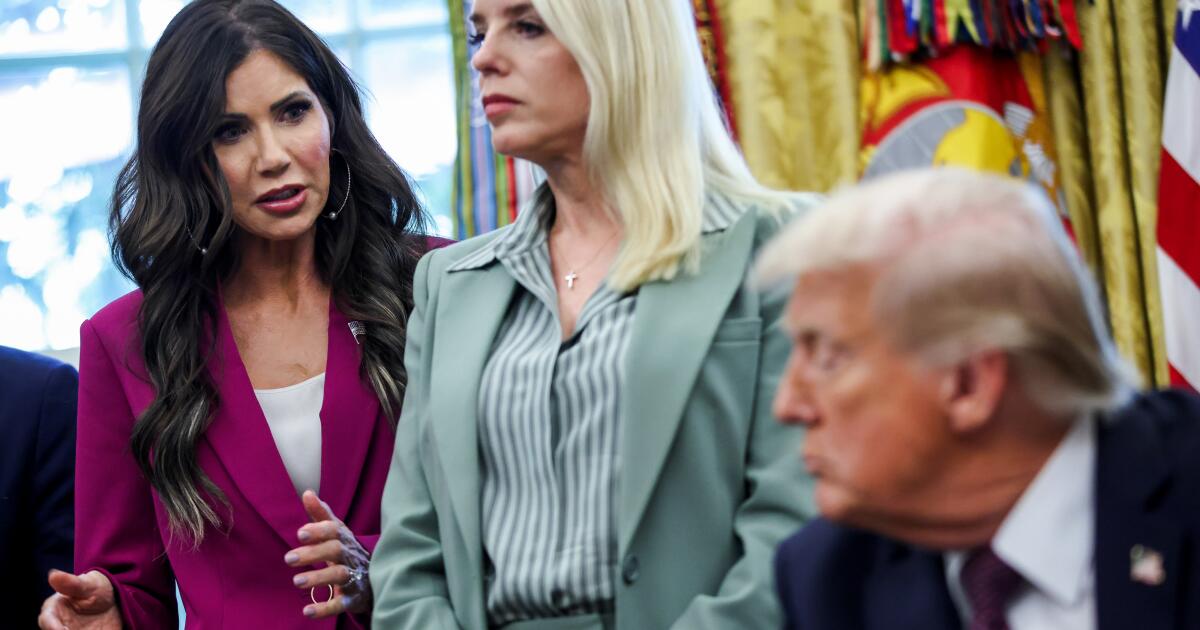
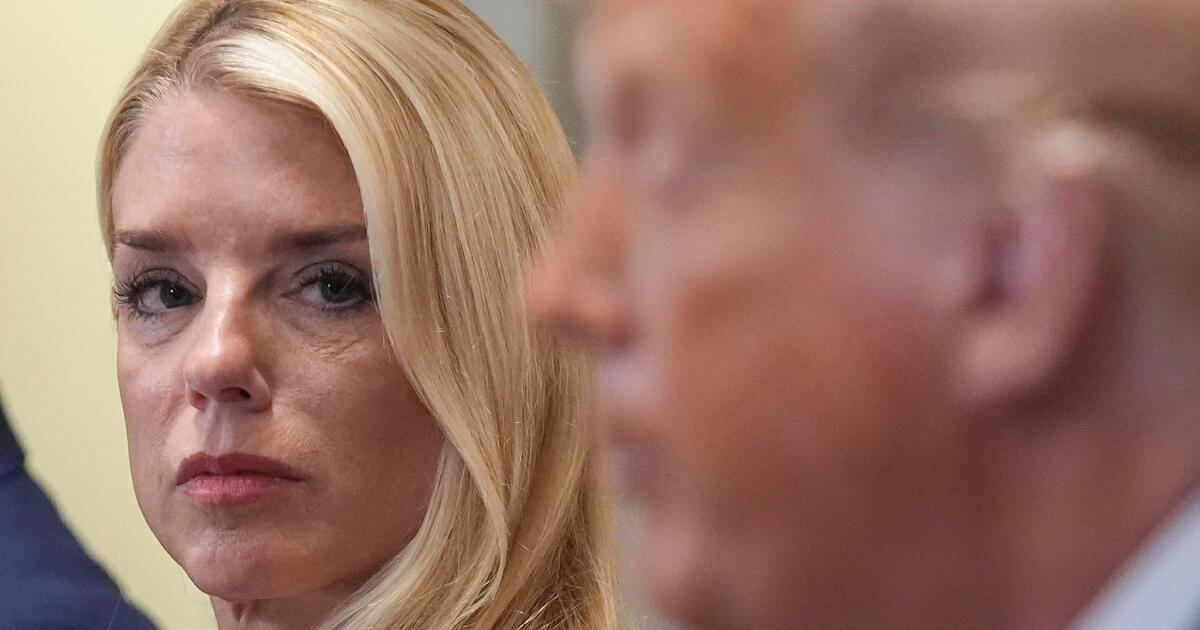
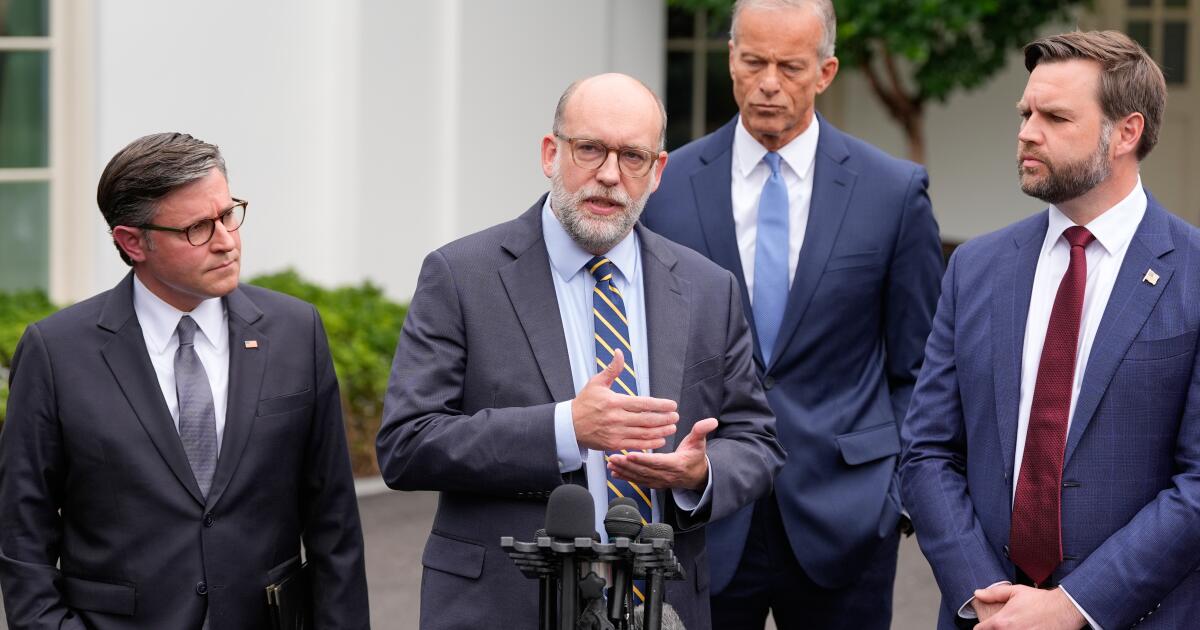
The FBI was secretly listening last year when a high-ranking advisor to Gov. Gavin Newsom unleashed a stream of profanities as she vented about a public records request from an unnamed individual.
“Double f— her!” said Dana Williamson, Newsom’s chief of staff, repeating the f word throughout the conversation. She also called another person an “a—,” according to federal court documents made public this week.
Before Wednesday, few people outside of California’s political bubble likely knew Williamson’s name.
Now she’s engulfed in a scandal involving political consultants and illicit payments that threatens to haunt her former boss, Newsom, as he challenges President Trump and looks toward the 2028 presidential race.
A smart and savvy negotiator who bridged Sacramento’s overlapping worlds of government, business and labor, Williamson is also someone who picked unnecessary fights and launched cruel missives, political consultants and friends said this week.
Federal agents arrested Williamson Wednesday at her home in Carmichael, a Sacramento suburb. Her lawyer, former U.S. Atty. McGregor Scott, was furious about how the arrest was handled, saying she was seriously ill and in need of a liver transplant.
Federal prosecutors allege that she conspired to funnel money out of one of her one-time client’s state campaign accounts for bogus services, and falsified documents related to her COVID loan.
She also is accused of lying on her tax returns about luxury items and services, including a $150,000 birthday trip to Mexico, that she allegedly sought to pass off as business expenses, according to the government.
Williamson, who pleaded not guilty to the charges this week, appeared in a courtroom in Sacramento. She appeared solemn during the hearing, at one point reportedly lifting her cuffed hand to wipe away a tear, and left without talking to reporters.
Court documents filed this week paint an image of both a conniving player and a fragile individual. “I’m scared,” she wrote in a February 2022 text message to a colleague as they discussed the alleged money-laundering scheme, which was allegedly in the early planning stages.
Public affairs consultant Steven Maviglio has known her since the two worked in President Clinton’s administration — and then later the administration of Gov. Gray Davis. He is now trying to put together a legal defense fund for her.
He described Williamson as a “no nonsense, no BS, get it done” person who was “straight-talking, sometimes to the point of offensive to people.”
She regularly dropped f-bombs, he added.
In another recording captured by the FBI, Williamson joined two colleagues last year in a restaurant near the state Capitol in Sacramento. The government was asking questions about money she received through her COVID loan.
She complained about the “f—” drama and said her Paycheck Protection Program (PPP) loan got “popped” — before adding another swear word. According to federal officials, she created false contracts in an attempt to show the COVID money was appropriately used.
There is little sympathy from her detractors. Gil Duran, the former press secretary to Gov. Jerry Brown, who worked alongside Williamson, likened her to a “mafia boss” in an interview with CNN. She also has numerous defenders in Sacramento, many of them women, who view her as a tough and inspiring figure.
The details in the federal filings sent shock waves beyond Sacramento and the state Capitol this week.
“I’m stunned about the allegation and find it hard to believe,” said Alison Gaulden, who supervised Williamson when she worked as an associate vice president of public affairs for Planned Parenthood Mar Monte from 2002 to 2004.
Gaulden described her as “incredibly bright and well versed in policy. I’ve admired how she grew in her career.”

Williamson, who grew up in Santa Rosa, moved between the private and public sectors, and was employed by three governors, Davis, Jerry Brown and Newsom.
At Pacific Gas and Electric Co. (PG&E), she worked alongside two other women who would be remarkably influential in her life: Nancy McFadden, the late advisor to Brown and Alexis Podesta, a longtime California political insider who also appears in the federal court documents filed this week.
Podesta is the person identified as “Co-Conspirator 2,” but has not been charged and is cooperating with investigators, according to her attorney.
Williamson was hired as a senior advisor for Brown and was later promoted to Cabinet secretary.
While working for Brown, Williamson publicly advocated for children’s health, testifying in favor of legislation that would eliminate the state’s personal-belief exemption for childhood vaccines. She said the issue was meaningful to her because she was a mother of four.
“Usually, staff doesn’t speak on bills, the great thing about the governor is that he respects that we are people first,” Williamson told the San Francisco Chronicle. “This was important to me.”
Business advocates appreciated her direct approach when she worked for Brown.
“She was very straightforward, she was a good person to work with,” said Stuart Waldman, president of Valley Industry and Commerce Assn. He said he hadn’t dealt with her in years.
She flip-flopped between private and government work, drawing criticism from groups like Consumer Watchdog for her “revolving door” career.
In one episode, she was allegedly seen negotiating for her energy clients in Brown’s office as the state hammered out details over a grid deal, drawing outrage from the watchdog group.
She started her own government relations firm, Grace Public Affairs, which handled an array of campaigns, including the online sports betting initiative Proposition 27, which appeared on the 2022 ballot, but failed to pass.
Her clients included California Insurance Commissioner Ricardo Lara, and former Atty. Gen. Xavier Becerra, whose campaign fund was allegedly raided by Williamson, and others.
By 2017, she had a close group of female friends, who had also risen to the top of their professions. But to those who weren’t in her inner circle, she was all elbows, one political insider said this week.
At the California Democratic Party headquarters in downtown Sacramento, a bronze statue of Williamson’s then-5-year-old daughter was installed as part of a campaign to promote female empowerment following Democratic presidential candidate Hillary Clinton’s 2016 loss.
Those behind the statue included Williamson’s friends Robin Swanson, a Democratic communications consultant, and Angie Tate, then a chief fundraiser for the California Democratic Party.
The installation was intended to mimic the “Fearless Girl” statue at New York’s Wall Street, which shows a 4-foot young woman looking defiantly at the famous charging bull statue.
In 2022, Newsom’s office announced Williamson was joining his office as chief of staff. Though the two weren’t particularly close when she joined, she quickly became part of his inner circle, Politico reported at the time.
Anthony York, Newsom’s former communications director and a former L.A. Times reporter, told Politico at the time that Williamson was not intimidated by the governor’s celebrity status. “She gives zero f—s, which is part of what makes her so great,” York said.
During her time in Newsom’s office, she worked with former Senate leader Darrell Steinberg on the successful passage of Proposition 1, which borrows billions of dollars for mental health services, and was a personal issue for her family.
“I had a particularly tough experience with my husband that I learned a lot from… when the incident happened with him, I learned about all the holes in the system,” she told KQED.
She moved from Elk Grove last year to Carmichael, purchasing a home for $1.695 million, according to property records. The records show her linked to several homes in Elk Grove, including one that went into foreclosure in 2012.
Williamson would send off combative messages, including social media posts or texts, often at night. Among her targets: California Labor Federation President Lorena Gonzalez and U.S. Rep. Kevin Kiley (R-Rocklin), whom she called an “entertaining idiot” on X.
She took aim at former Assemblymember Kevin McCarty during his campaign last year for Sacramento mayor. She called him a “devil” on X and urged others not to vote for him, before her comment was taken down a few days later.
Newsom placed Williamson on leave when she informed him last year she was under criminal investigation. Her last day in office was in November 2024. At the time, the governor said in a statement that “her insight, tenacity, and big heart will be missed.”
This week, a spokesperson for the governor struck a different tone: “Ms. Williamson no longer serves in this administration. While we are still learning details of the allegations, the Governor expects all public servants to uphold the highest standards of integrity.”
James Van Der Beek is ‘bouncing back’ amid cancer battle, says wife
There goes West Canaan High School’s hero.
“Varsity Blues” actor James Van Der Beek donned a familiar uniform to toss around a pigskin amid his cancer battle in an Instagram video shared Monday, and his wife Kimberly was in the comments to cheer him on.
“You’re a Wizard. Bouncing back baby!!” she wrote in response to the post. Her comment was accompanied by three heart-eyes emoji. Van Der Beek revealed last year that he had been diagnosed with Stage 3 colorectal cancer.
In the short clip, Van Der Beek wears a white football jersey with the number 4 and the name Moxon on the back. He played backup quarterback Jonathan “Mox” Moxon in the Texas-set 1999 coming-of-age film.
“Maybe it was all fun plays we got run in the football sequences for the away games… but I always loved putting on the varsity whites,” Van Der Beek wrote in the caption of the video featuring his “favorite jersey.” He also shared that limited quantities of the commemorative jersey are available for fans to purchase with or without his autograph. The actor sold a similar offering last year. The proceeds will “go directly to families undergoing cancer treatment,” according to his website.
Van Der Beek went on to thank his fans for their outpouring of support since he shared his diagnosis.
“Last year when I released the Blues jersey, I was blown away by the love and support I received from all of you,” he wrote. “It has meant more than I can ever express. … Thank you — for the love, the prayers, the support, and for making this jersey mean something far bigger than a movie. Endlessly grateful for all of you.”
Earlier this month, the “Dawson’s Creek” actor announced that he is also auctioning off memorabilia from his personal collection to help pay for his cancer treatments.
Source link
‘My Undesirable Friends’ review: Crackdown on Russian media, told in real time
Great documentaries are sometimes lucky accidents, the product of being at the right place at the right time and then having the wherewithal to produce something extraordinary out of those unlikely circumstances. When director Julia Loktev traveled to Russia in October 2021, all she wanted was to chronicle a handful of smart, dogged journalists trying to tell the truth who, for their trouble, had been branded foreign agents by Vladimir Putin’s vindictive government. She didn’t know she would be arriving mere months before Russia’s full-scale invasion of Ukraine. But thanks to a quirk of coincidence, she ended up having a front-row seat to history.
She made the most of it: Running five-and-a-half hours without a minute wasted, “My Undesirable Friends: Part I — Last Air in Moscow” takes us inside TV Rain, one of Russia’s last independent television channels. Divided into five chapters, the documentary begins as Loktev, who was born in the former Soviet Union before leaving when she was 9, returns to her homeland armed with an iPhone to shadow veteran TV Rain reporter and host Anna Nemzer. Over the next four months, a period that ended shortly after the invasion began, Loktev embedded herself not just with Nemzer (who is credited as the film’s co-director) but several other journalists as they fear being arrested for their reporting.
Loktev hasn’t completed a film since 2011’s “The Loneliest Planet,” which starred Gael García Bernal and Hani Furstenberg as soon-to-be-wed lovers backpacking through the Georgian countryside, their seemingly close bond shattered after a harrowing encounter. In that movie and her previous feature, 2006’s “Day Night Day Night,” a spare procedural about a nameless suicide bomber in New York, Loktev explored the mysteries of human behavior under pressure. But with “My Undesirable Friends,” she takes that fascination to a new level, introducing viewers to a group of compelling subjects, many of them women in their 20s, who open up in front of her camera while hanging out at TV Rain, their apartments or in cafes, candidly processing their country’s terrifying descent into authoritarianism in real time.
These intrepid journalists couldn’t foresee the invasion that was coming, nor the brutal local crackdown on free speech in its wake, but Loktev makes those dire certainties clear from the start, solemnly intoning in voice-over, “The world you’re about to see no longer exists.” Since its premiere at last year’s New York Film Festival, “My Undesirable Friends” has been compared to a horror movie and a political thriller but perhaps more accurately, it’s a disaster film — one in which you know the characters so intimately that, when the awful event finally occurs, you care deeply about the outcome. (“My Undesirable Friends” bears the subtitle “Part I” because Loktev has nearly finished a second installment, which catches up with the women after they fled Russia.)
In its avoidance of interviews with experts or historians, the documentary offers a kind of personal scrapbook of Loktev’s subjects, showing what everyday life is like in an oppressive society: strikingly banal with a constant background hum of paranoia. Each woman comes into empathetic focus. Nemzer, who is a little older than her colleagues, balances her demanding job with marriage and motherhood. Meanwhile, her younger co-worker Ksenia Mironova keeps diligently filing stories despite her fiancé, journalist Ivan Safronov, being imprisoned for more than a year. (He would subsequently be sentenced to 22 years.) Investigative reporter Alesya Marokhovskaya has a girlfriend, whose face we never see, and eventually details grim memories of a violent childhood. And then there’s Marokhovskaya’s best friend and partner Irina Dolinina, who combats anxiety while her politically unconscious mother harangues her about not being able to find a man now that she’s been labeled a foreign agent.
The stress and uncertainty of these conversations is palpable but, remarkably, so is a spiky sense of humor. When a co-worker is temporarily locked up, Mironova cracks jokes outside his prison while awaiting his release. The journalists wear their foreign-agent designation as a badge of honor, mocking the comically lengthy disclaimer text they’re forced to run with their broadcasts, a pitch-black coping mechanism to make sense of their tense, surreal moment.
“My Undesirable Friends” captures dark times with some of the funniest people you’d ever hope to have as sisters-in-arms. Defiant, emotional and life-affirming, the film presents us with endearing patriots who love their country but hate its leaders, sucking us into a riveting tale with a powerful undertow.
The audience anticipates the frightening future that awaits these journalists, which makes their relentless advocacy all the more moving. If our 20s are a period of unbridled optimism — a hopefulness that slowly gets beaten out of us as we grow older — “My Undesirable Friends” stands as a touching display of the resilience of youth. There is nothing naive about these women who came of age during Putin’s cruel regime, but they nonetheless believe they can change things. While Loktev rarely inserts herself into this epic, we feel her admiration from behind the camera. The film inspires while it challenges: What were any of us doing at that age that was comparably heroic or meaningful? What are we doing now?
Those questions should stick in the craw of Americans who watch this masterwork. Loktev has made a movie about Russia but its themes spread far beyond that country’s borders. During a year in which the worst-case scenarios of a second Trump presidency have come to fruition, “My Undesirable Friends” contains plenty of echoes with our national news. The canceling of comedy shows, the baseless imprisonment of innocent people, the rampant transphobia: The Putin playbook is now this country’s day-to-day. Some may wish to avoid Loktev’s film because of those despairing parallels. But that’s only more reason to embrace “My Undesirable Friends.” Loktev didn’t set out to be a witness to history, but what she’s emerged with is an indispensable record and a rallying cry.
‘My Undesirable Friends: Part I — Last Air in Moscow’
In Russian, with subtitles
Not rated
Running time: 5 hours, 24 minutes
Playing: Opens Friday, Nov. 28 at Laemmle Royal
Source link
Rose Lavelle leads Gotham FC to its second NWSL title
SAN JOSÉ — Rose Lavelle scored in the 80th minute and eighth-seeded Gotham FC beat the Washington Spirit 1-0 on Saturday night to win their second National Women’s Soccer League championship.
Second-half substitute Bruninha drove into the box on the left wing and sent the ball across to Lavelle, whose left-footed shot sailed past Spirit goalkeeper Aubrey Kingsbury into the bottom corner of the net.
It is the first NWSL championship for Lavelle, who scored in the 2023 final playing for the Seattle Reign against Gotham in a 2-1 loss.
After a strong opening 10 minutes of the match for Gotham, with three shots from Jaedyn Shaw, the final began to mature into a tense affair.
There were few chances and the best of the first half came when Spirit midfielder Hal Hershfelt perfectly timed a slide tackle and cleaned out Midge Purce with the follow-through.
Early in the second half, Trinity Rodman was brought off the Spirit bench for Sofia Cantore, bringing the crowd to its feet. The U.S. women’s team star was on a minutes restriction after suffering a knee sprain in October.
Even with Rodman, the Spirit continued to struggle to create chances. They had marginally more control of the ball, 53%, but were outshot by Gotham 12-6 and finished the game without a shot on target. Rodman had zero chances created.
The second-seeded Spirit (14-6-8) suffered a second consecutive defeat in the NWSL final, having lost last year to the Orlando Pride. The Spirit reached this final by overcoming Racing Louisville 3-1 in a penalty shootout in the quarterfinals and then beating the Portland Thorns 2-0 in the semifinals.
Gotham (11-8-9) defied the odds to make the final, going on the road twice to defeat the top-seeded Kansas City Current 2-1 in the quarterfinals and the defending champion Pride 1-0.
Gotham are the first eighth seed to win the championship. In 2023, when there were only six playoff spots, Gotham became the first sixth seed to lift the trophy.
Coach Juan Carlos Amoros has seven playoff wins in his career and two championships.
Source link
A California Democrat broke with party to end government shutdown. His vote tells a broader story.
WASHINGTON — Rep. Adam Gray was one of only six House Democrats — and the only one from California — who voted with Republicans in favor of a deal to end the government shutdown, and there was a calculated reason behind that decision.
Gray, a first-term Democrat from the Central Valley, is running for reelection in a majority Latino district that national Republicans are expected to heavily target as they defend their narrow House majority in next fall’s midterm elections. Last year, Gray won his seat by 187 votes, and although redistricting has since made the 13th District more favorable to Democrats, it remains highly competitive.
The Merced Democrat’s vote reflects the political reality of representing one of the nation’s few battleground districts. Gray is positioning himself as an independent-minded Democrat willing to buck leadership on politically divisive issues. The shutdown deal gave him a rare opportunity to put that in practice, even at the risk of frustrating members of his own party.
“I know it is not comfortable, and I know there’s people that are going to be mad at me,” Gray told The Times. “But I am not here to win an argument. I am here to actually help fix problems with people in my community, and I know I did the right thing.”
Democratic representatives and senators for weeks were steadfast in opposing a shutdown deal that did not include language to extend Obamacare tax credits that are set to expire at the end of the year, and as a result, leave millions of Americans with higher healthcare costs.
In Gray’s district, more than half of residents rely on Medi-Cal or have coverage through the Affordable Care Act marketplace, making them vulnerable to rising healthcare costs — a pocketbook issue that is likely to factor into an already competitive congressional race.
Beyond healthcare, nearly 48,000 families in his largely rural district rely on food benefits through the Supplemental Nutrition Assistance Program, known as SNAP, according to the latest data provided by the Department of Agriculture. Those benefits were put at risk during the shutdown as funding for the federal program commonly called food stamps was caught up in legal disputes.
As the shutdown dragged on without meaningful negotiations on healthcare, Gray said, he grew concerned that Republicans were too comfortable “using vulnerable Americans as political leverage.”
Ultimately, Gray was among just 13 Democrats — six in the House, seven in the Senate — who went against their party to end the shutdown that had dragged on an historic 43 days.
“The government is reopening because Democrats were willing to compromise,” Gray said.
The deal, which was signed by President Trump last week, will fund the government through January 2026 and reinstate federal workers who were laid off during the shutdown. It will also fund SNAP through September 2026, a provision that Gray says he wanted to secure because he worries that partisanship could lead to another shutdown in January.
Republicans attack his position
Although Gray voted with Republicans over the shutdown, national Republican operatives still see his seat as a main target ahead of next year’s election — and there is good reason for that.
The seat has a history of party flipping.
In 2024, Gray won his seat by 187 votes, the slimmest margin of any race in the country. His opponent, Republican John Duarte, who cast himself a centrist in the race, had only held the seat for one term before being beat. (And he defeated Gray two years earlier by just 564 votes.)
President Trump carried the 13th last year by five points, underscoring the competitiveness of the Central Valley district which backed Joe Biden in the first Biden-Trump matchup of 2020.
The passage of Proposition 50 has made the district safer for Democrats as the new congressional map shifts parts of Stockton, Modesto and northern Stanislaus County into the district, while removing more conservative, rural territory west of Fresno. Still, it remains a highly competitive district.
Like Duarte, Gray has positioned himself as a centrist, but that hasn’t stopped Republicans from portraying him as being from the party’s far-left flank.
Christian Martinez, a spokesperson for the National Republican Congressional Committee, is now focusing on Gray’s voting history on the shutdown as a reason to criticize the incumbent. Specifically, how Gray in September abstained from voting on a bill that would have prevented the shutdown.
“Instead of delivering results for Californians, out-of-touch Democrat Adam Gray is too busy appeasing his radical socialist base, and now he’s fully responsible for holding Americans hostage with the longest government shutdown in history,” Martinez said.
Martinez added that “hardworking Californians paid the price for his refusal to vote to keep the government open, and next November, they’ll send him packing.”
Gray is now facing a Republican challenge from former Stockton Mayor Kevin Lincoln. When Lincoln announced his bid on Nov. 6, before the shutdown deal vote, he criticized Gray for not doing enough to prevent the shutdown in the first place.
“Washington politicians like Adam Gray have fallen in line with a failed liberal agenda that’s made life less affordable and less safe,” Lincoln said in a statement.
Moving forward, Gray sees the vote as an opportunity to reset negotiations and find a bipartisan solution before funding runs out again on Jan. 30, 2026.
“I think we’re moving in the right direction,” Gray said. “I hope my colleagues have the courage to do the right thing over the next days.”
Back in his district, Democrats have had a mixed reaction to his vote. As for his congressional colleagues, they have not offered up much criticism, choosing to let Gray explain his vote to the ever-changeable 13th District.
Source link
One issue is uniting Americans in a time of polarization, according to a new poll
DES MOINES, Iowa — Pessimism about the country’s future has risen in cities since last year, but rural America is more optimistic about what’s ahead for the U.S., according to a new survey from the American Communities Project.
And despite President Trump’s insistence that crime is out of control in big cities, residents of the nation’s largest metropolitan centers are less likely to list crime and gun violence among the chief concerns facing their communities than they were a couple years ago.
Optimism about the future is also down from last year in areas with large Hispanic communities.
These are some of the snapshots from the new ACP/Ipsos survey, which offers a nuanced look at local concerns by breaking the nation’s counties into community types, using data points like race, income, age and religious affiliation. The survey evaluated moods and priorities across the 15 different community types, such as heavily Hispanic areas, big cities and different kinds of rural communities.
The common denominator across the communities? A gnawing worry about daily household costs.
“Concerns about inflation are across the board,” said Dante Chinni, founder and director of ACP. “One thing that truly unites the country is economic angst.”
Rising optimism in rural areas, despite economic anxiety
Rural residents are feeling more upbeat about the country’s trajectory — even though most aren’t seeing Trump’s promised economic revival.
The $15 price tag on a variety pack of Halloween candy at the Kroger supermarket last month struck Carl Gruber. Disabled and receiving federal food aid, the 42-year-old from Newark, Ohio, had hardly been oblivious to lingering, high supermarket prices.
But Gruber, whose wife also is unable to work, is hopeful about the nation’s future, primarily in the belief that prices will moderate as Trump suggests.
“Right now, the president is trying to get companies who moved their businesses out of the country to move them back,” said Gruber, a Trump voter whose support has wavered over the federal shutdown that delayed his monthly food benefit. “So, maybe we’ll start to see prices come down.”
About 6 in 10 residents of Rural Middle America — Newark’s classification in the survey — say they are hopeful about the country’s future over the next few years, up from 43% in the 2024 ACP survey. Other communities, like heavily evangelical areas or working-class rural regions, have also seen an uptick in optimism.
Kimmie Pace, a 33-year-old unemployed mother of four from a small town in northwest Georgia, said, “I have anxiety every time I go to the grocery store.”
But she, too, is hopeful in Trump. “Trump’s in charge, and I trust him, even if we’re not seeing the benefits yet,” she said.
Big-city residents are worried about the future
By contrast, the share of big-city residents who say they are hopeful about the nation’s future has shrunk, from 55% last year to 45% in the new survey.
Robert Engel of San Antonio — Texas’ booming, second most-populous city — is worried about what’s next for the U.S., though less for his generation than the next. The 61-year-old federal worker, whose employment was not interrupted by the government shutdown nor Trump’s effort to reduce the federal workforce, is near retirement and feels financially stable.
A stable job market, health care availability and a fair economic environment for his adult children are his main priorities.
Recently, the inflation outlook has worsened under Trump. Consumer prices in September increased at an annual rate of 3%, up from 2.3% in April, when the president first began to roll out substantial tariff increases that burdened the economy with uncertainty.
Engel’s less-hopeful outlook for the country is broader. “It’s not just the economy, but the state of democracy and polarization,” Engel said. “It’s a real worry. I try to be cautiously optimistic, but it’s very, very hard.”
Crime, gun violence are less a concern in urban America
Trump had threatened to deploy the National Guard to Chicago, New York, Seattle, Baltimore, San Francisco and Portland, Ore., to fight what he said was runaway, urban crime.
Yet data shows most violent crime in those places, and around the country, has declined in recent years. That tracks with the poll, which found that residents of America’s Big Cities and Middle Suburbs are less likely to list crime or gun violence among the top issues facing their communities than they were in 2023.
For Angel Gamboa, a retired municipal worker in Austin, Tex., Trump’s claims don’t ring true in the city of roughly 1 million people.
“I don’t want to say it’s overblown, because crime is a serious subject,” Gamboa said. “But I feel like there’s an agenda to scare Americans, and it’s so unnecessary.”
Instead, residents of Big Cities are more likely to say immigration and health care are important issues for their communities.
Big Cities are one of the community types where residents are most likely to say they’ve seen changes in immigration recently, with 65% saying they’ve seen a change in their community related to immigration over the past 12 months, compared with only about 4 in 10 residents of communities labeled in the survey as Evangelical Hubs or Rural Middle America.
Gamboa says he has witnessed changes, notably outside an Austin Home Depot, where day laborers regularly would gather in the mornings to find work.
Not anymore, he said.
“Immigrants were not showing up there to commit crimes,” Gamboa said. “They were showing up to help their families. But when ICE was in the parking lot, that’s all it took to scatter people who were just trying to find a job.”
Hispanic communities are less hopeful about the future
After Hispanic voters moved sharply toward Trump in the 2024 election, the poll shows that residents of heavily Hispanic areas are feeling worse about the future of their communities than they were before Trump was elected.
Carmen Maldonado describes her community of Kissimmee, Fla., a fast-growing, majority-Hispanic city of about 80,000 residents about 22 miles south of Orlando, as “seriously troubled.”
The 61-year-old retired, active-duty National Guard member isn’t alone. The survey found that 58% of residents of such communities are hopeful about the future of their community, down from 78% last year.
“It’s not just hopelessness, but fear,” said Maldonado, who says people in her community — even her fellow native Puerto Ricans, who are American citizens — are anxious about the Trump administration’s aggressive pursuit of Latino immigrants.
Just over a year ago, Trump made substantial inroads with Hispanic voters in the 2024 presidential election.
Beyond just the future of their communities, Hispanic respondents are also substantially less likely to say they’re hopeful about the future of their children or the next generation: 55% this year, down from 69% in July 2024.
Maldonado worries that the Trump administration’s policies have stoked anti-Hispanic attitudes and that they will last for her adult child’s lifetime and beyond.
“My hopelessness comes from the fact that we are a large part of what makes up the United States,” she said, “and sometimes I cry thinking about these families.”
Beaumont, Parwani and Thomson-Deveaux write for the Associated Press. Parwani and Thomson-DeVeaux reported from Washington. The American Communities Project/Ipsos Fragmentation Study of 5,489 American adults aged 18 or older was conducted from Aug. 18 – Sept. 4, 2025, using the Ipsos probability-based online panel and RDD telephone interviews. The margin of sampling error for adults overall is plus or minus 1.8 percentage points.
Source link
What to know about ex-Newsom aide tangled in a corruption probe
The FBI was secretly listening last year when a high-ranking advisor to Gov. Gavin Newsom unleashed a stream of profanities as she vented about a public records request from an unnamed individual.
“Double f— her!” said Dana Williamson, Newsom’s chief of staff, repeating the f word throughout the conversation. She also called another person an “a—,” according to federal court documents made public this week.
Before Wednesday, few people outside of California’s political bubble likely knew Williamson’s name.
Now she’s engulfed in a scandal involving political consultants and illicit payments that threatens to haunt her former boss, Newsom, as he challenges President Trump and looks toward the 2028 presidential race.
A smart and savvy negotiator who bridged Sacramento’s overlapping worlds of government, business and labor, Williamson is also someone who picked unnecessary fights and launched cruel missives, political consultants and friends said this week.
Federal agents arrested Williamson Wednesday at her home in Carmichael, a Sacramento suburb. Her lawyer, former U.S. Atty. McGregor Scott, was furious about how the arrest was handled, saying she was seriously ill and in need of a liver transplant.
Federal prosecutors allege that she conspired to funnel money out of one of her one-time client’s state campaign accounts for bogus services, and falsified documents related to her COVID loan.
She also is accused of lying on her tax returns about luxury items and services, including a $150,000 birthday trip to Mexico, that she allegedly sought to pass off as business expenses, according to the government.
Williamson, who pleaded not guilty to the charges this week, appeared in a courtroom in Sacramento. She appeared solemn during the hearing, at one point reportedly lifting her cuffed hand to wipe away a tear, and left without talking to reporters.
Court documents filed this week paint an image of both a conniving player and a fragile individual. “I’m scared,” she wrote in a February 2022 text message to a colleague as they discussed the alleged money-laundering scheme, which was allegedly in the early planning stages.
Public affairs consultant Steven Maviglio has known her since the two worked in President Clinton’s administration — and then later the administration of Gov. Gray Davis. He is now trying to put together a legal defense fund for her.
He described Williamson as a “no nonsense, no BS, get it done” person who was “straight-talking, sometimes to the point of offensive to people.”
She regularly dropped f-bombs, he added.
In another recording captured by the FBI, Williamson joined two colleagues last year in a restaurant near the state Capitol in Sacramento. The government was asking questions about money she received through her COVID loan.
She complained about the “f—” drama and said her Paycheck Protection Program (PPP) loan got “popped” — before adding another swear word. According to federal officials, she created false contracts in an attempt to show the COVID money was appropriately used.
There is little sympathy from her detractors. Gil Duran, the former press secretary to Gov. Jerry Brown, who worked alongside Williamson, likened her to a “mafia boss” in an interview with CNN. She also has numerous defenders in Sacramento, many of them women, who view her as a tough and inspiring figure.
The details in the federal filings sent shock waves beyond Sacramento and the state Capitol this week.
“I’m stunned about the allegation and find it hard to believe,” said Alison Gaulden, who supervised Williamson when she worked as an associate vice president of public affairs for Planned Parenthood Mar Monte from 2002 to 2004.
Gaulden described her as “incredibly bright and well versed in policy. I’ve admired how she grew in her career.”
Williamson, who grew up in Santa Rosa, moved between the private and public sectors, and was employed by three governors, Davis, Jerry Brown and Newsom.
At Pacific Gas and Electric Co. (PG&E), she worked alongside two other women who would be remarkably influential in her life: Nancy McFadden, the late advisor to Brown and Alexis Podesta, a longtime California political insider who also appears in the federal court documents filed this week.
Podesta is the person identified as “Co-Conspirator 2,” but has not been charged and is cooperating with investigators, according to her attorney.
Williamson was hired as a senior advisor for Brown and was later promoted to Cabinet secretary.
While working for Brown, Williamson publicly advocated for children’s health, testifying in favor of legislation that would eliminate the state’s personal-belief exemption for childhood vaccines. She said the issue was meaningful to her because she was a mother of four.
“Usually, staff doesn’t speak on bills, the great thing about the governor is that he respects that we are people first,” Williamson told the San Francisco Chronicle. “This was important to me.”
Business advocates appreciated her direct approach when she worked for Brown.
“She was very straightforward, she was a good person to work with,” said Stuart Waldman, president of Valley Industry and Commerce Assn. He said he hadn’t dealt with her in years.
She flip-flopped between private and government work, drawing criticism from groups like Consumer Watchdog for her “revolving door” career.
In one episode, she was allegedly seen negotiating for her energy clients in Brown’s office as the state hammered out details over a grid deal, drawing outrage from the watchdog group.
She started her own government relations firm, Grace Public Affairs, which handled an array of campaigns, including the online sports betting initiative Proposition 27, which appeared on the 2022 ballot, but failed to pass.
Her clients included California Insurance Commissioner Ricardo Lara, and former Atty. Gen. Xavier Becerra, whose campaign fund was allegedly raided by Williamson, and others.
By 2017, she had a close group of female friends, who had also risen to the top of their professions. But to those who weren’t in her inner circle, she was all elbows, one political insider said this week.
At the California Democratic Party headquarters in downtown Sacramento, a bronze statue of Williamson’s then-5-year-old daughter was installed as part of a campaign to promote female empowerment following Democratic presidential candidate Hillary Clinton’s 2016 loss.
Those behind the statue included Williamson’s friends Robin Swanson, a Democratic communications consultant, and Angie Tate, then a chief fundraiser for the California Democratic Party.
The installation was intended to mimic the “Fearless Girl” statue at New York’s Wall Street, which shows a 4-foot young woman looking defiantly at the famous charging bull statue.
In 2022, Newsom’s office announced Williamson was joining his office as chief of staff. Though the two weren’t particularly close when she joined, she quickly became part of his inner circle, Politico reported at the time.
Anthony York, Newsom’s former communications director and a former L.A. Times reporter, told Politico at the time that Williamson was not intimidated by the governor’s celebrity status. “She gives zero f—s, which is part of what makes her so great,” York said.
During her time in Newsom’s office, she worked with former Senate leader Darrell Steinberg on the successful passage of Proposition 1, which borrows billions of dollars for mental health services, and was a personal issue for her family.
“I had a particularly tough experience with my husband that I learned a lot from… when the incident happened with him, I learned about all the holes in the system,” she told KQED.
She moved from Elk Grove last year to Carmichael, purchasing a home for $1.695 million, according to property records. The records show her linked to several homes in Elk Grove, including one that went into foreclosure in 2012.
Williamson would send off combative messages, including social media posts or texts, often at night. Among her targets: California Labor Federation President Lorena Gonzalez and U.S. Rep. Kevin Kiley (R-Rocklin), whom she called an “entertaining idiot” on X.
She took aim at former Assemblymember Kevin McCarty during his campaign last year for Sacramento mayor. She called him a “devil” on X and urged others not to vote for him, before her comment was taken down a few days later.
Newsom placed Williamson on leave when she informed him last year she was under criminal investigation. Her last day in office was in November 2024. At the time, the governor said in a statement that “her insight, tenacity, and big heart will be missed.”
This week, a spokesperson for the governor struck a different tone: “Ms. Williamson no longer serves in this administration. While we are still learning details of the allegations, the Governor expects all public servants to uphold the highest standards of integrity.”
Source link
Trump ‘knew about the girls,’ Jeffrey Epstein claims in explosive emails
Donald Trump “spent hours at my house” and “knew about the girls,” Jeffrey Epstein, the disgraced financier accused of orchestrating sex trafficking of young girls, wrote in private emails House Democrats released Wednesday.
“Of course he knew about the girls,” Epstein said of Trump in an email to author and journalist Michael Wolff in early 2019, when Trump was nearing the end of his first term as President.
After months of political bickering over the well-connected sex offender’s documents, dubbed “the Epstein files,” Democrats on the House Oversight Committee publicly released some of Epstein’s emails to Wolff and Epstein’s longtime associate Ghislaine Maxwell, who was convicted of sex trafficking after Epstein’s death.
The emails are just a small part of a collection of 23,000 documents Epstein’s estate released to the committee and are sure to revive questions about what the president knew about Epstein’s sexual misconduct with girls and young women.
Trump has denied knowing anything about Epstein’s crimes and no investigation has tied Trump to them.
“The more Donald Trump tries to cover up the Epstein files, the more we uncover,” California Democrat Robert Garcia (D-Long Beach) said in a statement as he released the documents.
“These latest emails and correspondence raise glaring questions about what else the White House is hiding and the nature of the relationship between Epstein and the President,” Garcia added. “The Department of Justice must fully release the Epstein files to the public immediately. The Oversight Committee will continue pushing for answers and will not stop until we get justice for the victims.”
Epstein, 66, died by suicide in a New York jail in August 2019, weeks after he was arrested and federally charged with sex trafficking and conspiracy to commit sex trafficking of minors. A watchdog report released last year found that negligence, misconduct and other failures at the jail contributed to his death.
More than a decade earlier, Epstein evaded federal criminal charges when he struck a plea deal in a south Florida case related to accusations that he molested dozens of girls.
As part of the agreement, Epstein pleaded guilty to state charges, including soliciting prostitution. He registered as a sex offender and served 13 months in jail but was allowed to leave six days a week to work at his office.
Source link
Letters to Sports: Dodger fans savor back-to-back titles
I have been a diehard baseball fan for more than 60 years, and this year’s Dodger team is the toughest, gutsiest and most resilient team I have ever seen. Toronto is an absolutely fabulous baseball team, and would’ve beaten anybody else in all of baseball without much stress.
And as for Yoshinobu Yamamoto, that young man ought to be on Mt. Rushmore.
Let’s go for a three-peat in ‘26!
Drew Pomerance
Tarzana
No doubt about it. The best team won the World Series. The Dodgers found ways to win without great hitting. Their pitching and defensive skills exceeded our expectations. Thank you everyone for another amazing baseball season.
Cheryl Creek
Anaheim
How wonderful to see grown men acting like little boys during their victory celebration. While I am not a fan of the gyrations on the bases after a hit (even when way behind), the pure joy emanating from the players at the end was to be cherished. How sports enables us to forget our problems is what has made me a lifelong sports fan.
Mark Kaiserman
Santa Monica
Who would imagine that Games 6 and 7 would both end on double plays while the losing team had men in scoring position? One different swing of the bat would have reversed the outcome of the games and series. How suddenly agonizing and euphoric. How uniquely baseball!
Mel Spitz
Beverly Hills
The Toronto Blue Jay fans taunted Shohei Othani early in the series, “We don’t need you!” I guess they did!
Edward Jimenez
Whittier
Consideration should be given to incorporating the Japanese flag into the design of the 2025 World Series ring.
Greg Thompson
Chatsworth
It took until Games 6 and 7, but the 2025 World Series lineup needed to include Miguel Rojas.
Ken Feldman
Tarzana
Dodgers manager Dave Roberts’ haters and naysayers can take a seat. Whether it was confidence in the starting rotation, masterful management of the bullpen, being unafraid to tinker with the lineup or making brilliant defensive replacements, every lever Roberts pulled in Games 6 and 7 ultimately resulted in another championship.
Ron Yukelson
San Luis Obispo
As my fellow Monday morning baseball critics always say, “Dave Roberts is a genius. Mookie is great at short. Last year no starting pitchers. This year no bullpen.”
So many contributed big plays. Constant tension, excitement, tenacity and, ultimately, exhilaration. Thank you Dodgers for a playoffs and World Series for the ages. Encore!
Rafael Serna
Hacienda Heights
While we bask in the euphoria of the Dodgers’ World Series win, let’s not overlook but sing the praises to the last man standing! Without the heroics of Will Klein, there might not have been a Game 6 or a Game 7.
Stan Shirai
Torrance
The World Series finished on Dia de los Muertos, but our Dodgers lived to win again. Against all odds in Game 7, the Dodgers solidified a dynasty. What a game. What a series. What a team. So many clutch moments and players. This one will be enjoyed and cherished FOREVER.
Michael Lee Manous
San Dimas
A phrase that will never be used in the same sentence with Yoshinobu Yamamoto: “load management.”
Dave Ring
Manhattan Beach
Orel, meet Yoshi!
Brian Lipson
Beverly Hills
Source link
California women celebrate reprieve on losing SNAP food benefits
For Zuri Crawford, the last several weeks have been an emotional whirlwind — swinging from fears to frustration to now partial relief.
A 20-year-old single mother and Riverside City College student, Crawford depends on the federal Supplemental Nutrition Assistance Program to buy groceries for herself and her young son. Earlier this week, she braced herself for the possibility that — because of the federal shutdown — she would not receive the $445 that typically gets loaded onto her state-issued debit card on the sixth day of every month.
“I really feel like I’m going to be burnt out. I feel like it’s going to be hard on me because I am a single mom,” she said on a recent afternoon. “I have to push through, but I am going to be overwhelmed.”
On Thursday, however, Crawford was surprised to learn that the $445 payment had showed up on her card. Soon after, Gov. Gavin Newsom announced that, because of a court victory, “food benefits are now beginning to flow back to California families” — at least temporarily.
Crawford is one of roughly 5.5 million statewide who depend on this food aid — known in California as CalFresh — and one of 42 million people nationwide. In recent weeks, this group has been caught in the crosshairs of a political battle that has shifted from Congress to courtrooms amid a federal shutdown that has now lasted more than five weeks.
As of early Friday, two federal judges had ordered the U.S. Department of Agriculture to use billions of dollars in contingency funding to continue providing SNAP support — the reason Crawford and many others nationwide received their full benefits Thursday. On Friday the Trump administration asked a federal appeals court to block one of those orders. The appeals court let the order stand, and then late Friday the Trump administration succeeded in persuading the Supreme Court to block the judicial rulings and — at least temporarily — withhold food benefits from millions of Americans.
Many recipients in California already have their payments, but the legal drama late Friday may add to their anxieties. Many were already improvising, and may have to do so again.
Zuir Crawford, 20, loads groceries bought using gift cards supplied by Riverside City College.
(Gina Ferazzi / Los Angeles Times)
In Crawford’s case, she already juggles college coursework, picks up shifts as an UberEats driver and cares for her 1-year-old. When she learned her food aid would be delayed this month, she made a plan: She would drop two classes and then pick up additional work as a caregiver so she and her son could afford to eat. She would use that money to supplement the support she is receiving from her school and community.
Even with food aid, she depends on food pantries to help her obtain items such as canned ravioli, Rice-a-Roni and frozen dinners for the last two weeks of the month.
Single parents could be hit especially hard by the delay in food benefits. Nationwide, single-adults make up nearly two-thirds (62%) of all SNAP households with children, according to the USDA. In California, almost a quarter of single working parents (23.2%) are in poverty, according to the Public Policy Institute of California.
Households headed by single mothers are especially vulnerable amid a worsening gender wage gap and rising costs for education, housing and child care, said Jesseca Boyer, vice president of policy and strategic initiatives for the Institute for Women’s Policy Research. “All of those factors require a single mother to stretch their already limited dollars even further,” she said.
In the Bay Area city of Mountain View, Abigail Villavicencio usually gets between $500 and $700 each month loaded onto her CalFresh cards, she said. It depends on her fluctuating income delivering food for apps such as Uber Eats. A single mom with three children, she first qualified for SNAP in 2021, and at that time was able to stretch the money to cover groceries for an entire month.
“But over the last year, it hasn’t been enough. I spend $500 in 2 weeks. I noticed prices were going up,” she said, and her weekly grocery trip often now costs $200 to $300. “I have two weeks when I have to figure out what to do.”
Villavicencio said she augments her benefits by collecting donated food at her son’s school twice a month.
The last few weeks have been particularly hurtful, she said, when she sees commenters on social media deriding food stamp recipients as “lazy.” She notes that she has to show her bank accounts every six months to qualify for CalFresh. For the past three years, she’s been home with her twin daughters as they went through intensive behavior therapy for autism.
News of the delayed SNAP benefits gutted her carefully calibrated food plan. She dipped into her savings for the last grocery trip and bought enough to make meals she could sell to construction workers to earn a few extra dollars.
Now that her twin daughters are in kindergarten, she’s also been searching for more consistent work — but it’s been challenging, she said, to find one that will allow her to drop off and pick up her children from school.
Holding her dog Bear, Zuir Crawford, 20 fears losing her SNAP benefits because of the federal government shutdown. “I really feel like I’m going to be burnt out. I feel like it’s going to be hard on me because I am a single mom,” she said on a recent afternoon. “I have to push through, but I am going to be overwhelmed.”
(Gina Ferazzi / Los Angeles Times)
As for Crawford, she said she experienced “trauma after trauma” growing up, bouncing between homes in Los Angeles and Riverside counties. She has sought stability since becoming a teen mom to her son, whom she affectionately calls Baby Z.
She is in her second semester at Riverside City College, where she is taking prerequisite courses to pursue a nursing career. She makes “little to nothing” driving for Uber Eats, she said, “but it’s enough for me to at least put gas in my tank.”
Without the financial support of her family or a partner, she relies on a patchwork of government programs.
Two months ago, she, her son and her fluffy white dog Bear moved into a one-bedroom apartment that she obtained through a county housing program for the homeless. She uses the nearly $900 a month she receives through CalWorks, a state welfare program, to cover her rent, utilities and phone bill. Along with CalFresh, she gets a monthly allotment of healthy food through the Women, Infants and Children program.
She said she’s also sustained by her Christian faith. She attends regular Bible studies and uses a portion of her food budget to make meals for the homeless.
Inside the college’s Basic Needs Resource Center on Wednesday afternoon, Crawford filled a black basket with peanut butter, jelly, oatmeal, a can of pozole and hygiene products. While students can typically access the pantry every two weeks, they can collect staples once a week during the shutdown, a volunteer explained.
Crawford is in her second semester at Riverside City College, where she is taking prerequisite courses to pursue a nursing career.
(Gina Ferazzi / Los Angeles Times)
As a community college student and single parent receiving public assistance, she is also eligible for additional support including meal vouchers and grocery gift cards.
With SNAP beneficiaries becoming pawns in the shutdown fight, she said she’s grateful for the public assistance, which she views as a “stepping stone” to a more financially secure life.
“It’s not my fault that I was born into the family I was born into,” she said later that day, as she sliced and spiced chicken and steamed vegetables for a low-cost meal. “I can’t control that. But what I can control is my outcome. And I know that if I keep on working hard, if I keep on persevering through all the hardships, I’m going to be OK.”
Zuir Crawford, 20, carries groceries from a local market and also from a food pantry to her apartment in Riverside.
(Gina Ferazzi / Los Angeles Times)
Up until Thursday, both Villavicencio and Crawford were preparing for hard times. The Mountain View mom was worried about telling her children about a diminished Thanksgiving this year. Crawford was calculating how to further improvise on using her food budget wisely.
Both women were relieved that, on the sixth day of the month, their benefits had fully reloaded.
“I can breathe now,” Villavicencio said Friday.
“I’m super-shocked,” added Crawford with a laugh. “I feel relieved. I just feel happy.”
This article is part of The Times’ equity reporting initiative, funded by the James Irvine Foundation, exploring the challenges facing low-income workers and the efforts being made to address California’s economic divide.
Source link
Latinos are blowing the whistle on Trump’s reign
CHICAGO — When I turned on my phone after landing at O’Hare Airport on Wednesday, texts poured in from friends and colleagues warning that I was about to enter a region under siege.
Many sent a video from that morning of immigration agents running into a day care facility in Chicago’s Roscoe Village neighborhood to pull out a teacher. It was the latest attack against the metropolis by President Trump’s deportation Leviathan, whose so-called Operation Midway Blitz this fall has made its earlier occupation of Los Angeles look like a play date.
Armed agents have sauntered through downtown and manned a flotilla of boats on the Chicago River. They shot and killed a fleeing immigrant and raided an apartment building with the help of a Black Hawk helicopter. In nearby Broadview, home to the region’s main ICE detention facility, rooftop migra shot pepper balls at protesters below, including a pastor. They even tear-gassed a neighborhood that was about to host a Halloween children’s parade, for chrissakes.
From Back of the Yards to Cicero, Brighton Park to Evanston, immigration agents have sown terror throughout Chicagoland with such glee that a federal judge declared that it “shocks the conscience” and issued an injunction limiting their use of force — which they no doubt will ignore.
I was in town to speak to students at the University of Chicago about the importance of reporting on things one may not like. Heaven knows that’s been my 2025. But as I waited to deplane, I checked my email and found something I’ve sorely needed this year:
Hope.
On Tuesday, Democrats won governor’s races in New Jersey and Virginia by wide margins. Democratic socialist Zohran Mamdani was elected mayor of New York, telling Trump to “Turn. The. Volume. Up” during a soaring victory speech.
Back home in California, 64% of voters favored Proposition 50, the ballot initiative crafted by Gov. Gavin Newsom to create up to five Democratic-leaning congressional districts in response to Trump’s gerrymandering in Texas.
It was a humiliating rebuke of Trumpism. And the tip of the Democratic spear? Latinos.
Rep. Mikie Sherrill, the Democratic governor-elect in New Jersey, takes a photo during an election-night party. Democrats reclaimed political momentum Tuesday with gubernatorial victories in New Jersey and Virginia, early signs that voter unease with the economy in President Trump’s second term could give them a path to winning control of Congress next year.
(Michael Nagle/Bloomberg via Getty Images)
In New Jersey, where Trump received 46% of the Latino vote in 2024, a CNN exit poll showed just 31% of Latinos siding with the losing GOP candidate for governor. Nearly two-thirds of Latinos in Virginia went against Cuban American Atty. General Jason Miyares, a Republican who also lost. The CNN poll also found that more than 70% of California Latinos voted for Proposition 50, a year after GOP Latino legislators made historic gains in Sacramento.
At the same time, support for Trump has dropped among Latinos. Only 25% of Latinos surveyed in October by the Associated Press-NORC Center for Public Affairs Research viewed Trump favorably — a cratering from the 45% who liked him in April. Even more telling, two-thirds of Latino men thought negatively of Trump — despite 51% of that demographic choosing him in 2024.
Latinos’ leftward shift on election night already set off as many thought pieces as Trump did when he captured 48% of the Latino vote — the most a Republican presidential candidate has earned, despite his long history of slurring, maligning and insulting America’s largest minority. Democrats, who have long depended on Latino voters, were shocked, and GOP leaders were delighted, feeling that a demographic that had long eluded them was finally, truly within reach.
This week Latinos sent a loud message: You had your chance, y nada.
House Speaker Mike Johnson tried to play off his party’s collapse among Latinos to NBC News, sniffling, “I do believe that the demographic shift that we were able to see and experience in the 2024 election will hold.”
Mike: time to bring the Republican Party out of its Stockholm syndrome. Your guy has blown it with Latinos. Let him keep doubling down on his madness, and Latinos will continue to flip on ustedes like a tortilla.
Trump’s 2024 victory was the culmination of an extraordinary shift in the Latino electorate that few saw coming — but I did. As I’ve written ad nauseam since 2016, Latinos were beginning to favor the GOP on issues like limited government, immigration restrictions and transgender athletes in high school sports because Democrats were taking them for granted, obsessing over woke shibboleths while neglecting blue-collar issues like gas prices and high taxes.
A voter holds a sign in Spanish while riding with other voters to the Maricopa County Tabulation and Election Center as part of a 2024 event organized by LUCHA (Living United For Change In Arizona) for Latinx voters and volunteers in Arizona.
(Anna Watts/The Washington Post via Getty Images)
All this was was happening as the Biden administration made it easier for newly arrived undocumented immigrants to remain, angering those who have been here for decades without similar help. The long-standing tendency for Latinos to sympathize with the latest Latin Americans to cross over eroded, and some became more receptive to Trump’s apocalyptic words against open borders.
Last year 63% of Latinos in California considered undocumented immigrants to be a “burden,” according to a poll by UC Berkeley’s Institute of Governmental Studies and co-sponsored by The Times.
That happened to be the same percentage of California voters who favored Prop. 187, the infamous 1994 initiative that sought to make life miserable for undocumented immigrants and showed the GOP that xenophobic politics can work.
After the 2024 election, Latinos seemed to be joining earlier Catholic immigrants who were once cast as invaders — Irish, Italians, Poles, Germans — on the road to assimilation and the waiting arms of the Republican party. All Trump had to do was improve the economy and clamp down on the border. If he did the former, Latinos would have been largely supportive of the latter, as long as deportations focused on newcomers.
Instead, Trump wasted his opportunity.
U.S. Immigration and Customs Enforcement agents knock on the door of a residence during a targeted enforcement operation in Chicago.
(Christopher Dilts/Bloomberg via Getty Images)
The economy remains stagnant. Trump effectively declared war on Latin America with tariffs real and threatened and by bombing Venezuelan and Colombian boats suspected of carrying drugs without asking permission from Congress.
Trump officials keep issuing punitive policies that crush the dreams of Latinos, like a crackdown on English fluency in the trucking industry and ending federal grants that helped colleges and universities recruit and retain Latino students.
Federal agents leave the area of North A Street as residents and community members protest an early morning federal enforcement action in Oxnard.
(Julie Leopo/For The Times)
But Trump’s biggest mistake has been his indiscriminate deportation raids. His toxic alphabet soup of immigration enforcement agencies — HSI, ERO, CPB, ICE — largely has ignored the so-called “worst of the worst” in favor of tamale ladies, fruteros and longtime residents. Nearly three-quarters of immigrants in ICE detention as of September have no criminal convictions, according to Syracuse University’s Transactional Records Access Clearinghouse.
Trump’s deportation deluge has rained down across the country as his administration repeatedly has exhibited white supremacist tendencies, from effectively blocking all new refugees except South African Boers to pumping out social media garbage extolling a mythical America where white makes right and Latinos exist only as blurry mug shots of alleged illegal immigrants.
A federal agent holds his weapon as law enforcement officers conduct a raid on street vendors. New Yorkers witnessing the attempted detainments began protesting and attempted to block agents.
(Michael Nigro/LightRocket via Getty Images)
No wonder 65% of Latinos feel it’s a “bad time” to be Latino in the U.S. — a 25-percentage-point drop in optimism from March of last year, according to an Axios-Ipsos poll done with Telemundo and released this week.
Trump even is losing credibility among Latino Republicans, with a September 2024 AP-NORC poll finding that 83% of them had a “very” or “somewhat” positive view of the president last year.
Now? Sixty-six percent.
Trump very well can win back some of those Latinos in 2026 if the economy improves. But every time his migra goons tackle innocents, another Latino will turn on him and get ready to fight back.
At the University of Chicago, orange whistles hung around a bronze bust just outside the room where I spoke. They’ve become a symbol of resistance to Trump’s invasion of the City of Strong Shoulders, blown by activists to alert everyone that la migra is on the prowl.
A bronze bust with whistles around it inside Swift Hall at the University of Chicago. They’ve become a symbol of resistance, blown by activists to alert everyone that la migra is on the prowl.
(Gustavo Arellano/Los Angeles Times)
I grabbed one as a memento of my time here and also as a reminder of what’s happening with Latinos right now. Nationwide, we’re warning everyone from the front lines — the streets, the ballot box, the courtroom, everywhere — about the excesses of Trump and warning him what happens if he doesn’t listen.
So, Trump: Turn. The. Volume. Up.
Source link
Republican U.S. Rep. Elise Stefanik is running for governor of New York
NEW YORK — U.S. Rep. Elise Stefanik, a close Republican ally of President Trump, announced Friday that she’s running for governor of New York, a place she depicted in a campaign launch video as being “in ashes” because of lawlessness and a high cost of living.
In her video, a narrator declares “The Empire State has fallen” as it paints a grim picture of urban, liberal leadership and life in New York City, though the message appeared to be aimed at audiences in other, more conservative parts of the state.
Her candidacy sets up a potential battle with Gov. Kathy Hochul, a centrist Democrat, though both candidates would have to first clear the field of any intraparty rivals before next November’s election.
Stefanik, 41, has teased a run for months, often castigating Hochul, 67, as the “worst governor in America.” She’s also assailed Hochul for endorsing the ascendent, democratic socialist Zohran Mamdani, now the mayor-elect of New York City.
In a written statement, Stefanik said she is running to make “New York affordable and safe for families all across our great state.”
“Our campaign will unify Republicans, Democrats, and Independents to Fire Kathy Hochul once and for all to Save New York,” she said.
Hochul’s campaign released its own attack ad Friday against the Republican, dubbing her “Sellout Stefanik,” and blamed her for enabling Trump’s tariffs and federal funding cuts to education and health care.
“Apparently, screwing over New Yorkers in Congress wasn’t enough — now she’s trying to bring Trump’s chaos and skyrocketing costs to our state,” said Hochul campaign spokesperson Sarafina Chitika.
Representing a conservative congressional district in northern New York, Stefanik had once been a pragmatic and moderate Republican who would avoid uttering Trump’s name, simply calling him “my party’s presidential nominee.”
But in recent years she has reshaped herself into a brash disciple and ardent defender of Trump’s MAGA movement, rising through the ranks of the Republican Party’s congressional hierarchy as it molded to Trump’s political style.
Last year, Stefanik was tapped to become the president’s ambassador to the United Nations, though her nomination was later pulled over concerns about her party’s tight margins in the House. She then began to angle toward a run for governor, and very quickly got a public nod of support from Trump.
Her announcement video, which was titled “From the Ashes,” casts New York as a dangerous place plagued by “migrant crime” and economic crisis, placing the blame on “Kathy Hochul’s failed policies,” as urgent, ominous music plays in the background.
New York City police officials have long touted drops in crime and this week said the city is in its eighth consecutive quarter of major crime decline.
The Republican primary field remains unclear ahead of the 2026 race.
On Long Island, Republican Nassau County Executive Bruce Blakeman has said he’s weighing a run for governor. In a statement Friday, he said he has “tremendous respect” for Stefanik but that the GOP needs to nominate a candidate who has “broad based appeal with independents and common sense Democrats.”
“The party must nominate the candidate with the best chance to defeat Kathy Hochul and I have been urged by business, community and political leaders across the state to make the run and I am seriously considering it,” said Blakeman, who handily won reelection to another four-year term on Tuesday.
U.S. Rep. Mike Lawler had been contemplating a run but instead decided to seek reelection in his battleground House district in the Hudson Valley.
Hochul faces a contested primary, with her own lieutenant governor, Antonio Delgado, running against her.
Democrats have a major voter registration edge in New York. The state’s last Republican governor was former Gov. George Pataki, who left office about two decades ago.
Still, Republican Lee Zeldin, a former Long Island congressman and current head of the Environmental Protection Agency, made a serious run for the office in 2022, coming within striking distance of upsetting Hochul.
Izaguirre writes for the Associated Press. AP writer Philip Marcelo contributed to this report.
Source link
Mamdani announces transition leaders, vows to deliver on ambitious agenda
NEW YORK — Fresh off winning New York City’s mayoral election, Zohran Mamdani announced Wednesday that a team including former city and federal officials — all women — would steer his transition to City Hall, and that he would “work every day to honor the trust that I now hold.”
“I and my team will build a City Hall capable of delivering on the promises of this campaign,” the mayor-elect said at a news conference, vowing that his administration would be both compassionate and capable.
He named political strategist Elana Leopold as executive director of the transition team. She will work with United Way of New York City President Grace Bonilla; former Deputy Mayor Melanie Hartzog, who was also a city budget official; former Federal Trade Commission chair Lina Khan; and former First Deputy Mayor Maria Torres-Springer.
With his win over former Gov. Andrew Cuomo and Republican Curtis Sliwa, the 34-year-old democratic socialist will soon become the city’s first Muslim mayor, the first of South Asian heritage, the first born in Africa and the youngest mayor in more than a century.
He now faces the task of following through on his ambitious affordability agenda while navigating the bureaucratic challenges of City Hall and a hostile Trump administration.
“I’m confident in delivering these same policies that we ran on for the last year,” he said in an interview earlier Wednesday on cable news channel NY1.
More than 2 million New Yorkers cast ballots in the contest, the largest turnout in a mayoral race in more than 50 years, according to the city’s Board of Elections. With roughly 90% of the votes counted, Mamdani held an approximately 9 percentage point lead over Cuomo.
Mamdani, who was criticized throughout the campaign for his thin resume, will now have to begin staffing his incoming administration and planning how to accomplish the ambitious but polarizing agenda that drove him to victory.
Among the campaign’s promises are free child care, free city bus service, city-run grocery stores and a new Department of Community Safety that would expand on an existing city initiative that sends mental health care workers, rather than police, to handle certain emergency calls. It is unclear how Mamdani will pay for such initiatives, given Democratic Gov. Kathy Hochul’s steadfast opposition to his calls to raise taxes on wealthy people.
On Wednesday, he touted his support from Hochul and other state leaders as “endorsements of an agenda of affordability.”
His decisions around the leadership of the New York Police Department will also be closely watched. Mamdani was a fierce critic of the department in 2020, calling for “this rogue agency” to be defunded and slamming it as “racist, anti-queer & a major threat to public safety.” He has since apologized for those comments and has said he will ask the current NYPD commissioner to stay on the job.
Mamdani has already faced scrutiny from national Republicans, including President Trump, who have eagerly cast him as a threat and the face of a more radical Democratic Party that is out of step with mainstream America. Trump has repeatedly threatened to cut federal funding to the city — and even take it over — if Mamdani won.
”…AND SO IT BEGINS!” the president posted late Tuesday to his Truth Social site.
Mamdani, for his part, said at his news conference that “New Yorkers are facing twin crises in this moment: an authoritarian administration and an affordability crisis,” and that he would tackle both.
While saying he was committed to “Trump-proofing” the city — to protect poor residents against “the man who has the most power in this country,” as he explained — the mayor-elect also reiterated that he was interested in talking to the president about ”ways that we can work together to serve New Yorkers.” That could mean discussing the cost of living or the effect of cuts to the SNAP food aid program amid the federal government shutdown, Mamdani suggested.
“I will not mince my words when it comes to President Trump … and I will also always do so while leaving a door open to have that conversation,” Mamdani added.
Mamdani also said during his news conference and interviews that he had not heard from Cuomo or the city’s outgoing mayor, Eric Adams. He did speak with Republican candidate Curtis Sliwa.
A spokesperson for Cuomo, Rich Azzopardi, said he would “let their respective speeches be the measuring stick for grace and leave it at that.”
In his victory speech to supporters, Mamdani wished Cuomo the best in private life, before adding: “Let tonight be the final time I utter his name, as we turn the page on a politics that abandons the many and answers only to the few.”
Asked about the comments Wednesday on NY1, Mamdani said he was “quite disappointed in the nature of the bigotry and the racism we saw in the final weeks.” He noted the millions of dollars in attack ads that were spent against him, some of which played into Islamophobic tropes.
Izaguirre and Colvin write for the Associated Press. AP writers Jake Offenhartz and Jennifer Peltz contributed to this report.
Source link
Dodgers celebrate repeat World Series title with another stadium rally
The celebration had hardly begun, when Shohei Ohtani first voiced the theme of the day.
“I’m already thinking about the third time,” he said in Japanese, standing atop a double-decker bus in downtown Los Angeles with of thousands of blue-clad, flag-waving, championship-celebrating Dodgers fans lining the streets around him for the team’s 2025 World Series parade.
Turns out, he wasn’t alone.
Two days removed from a dramatic Game 7 victory that made the Dodgers baseball’s first repeat champion in 25 years, the team rolled through the streets of downtown and into a sold-out rally at Dodger Stadium on Monday already thinking about what lies ahead in 2026.
With three titles in the last six seasons, their modern-day dynasty might now be cemented.
But their goal of adding to this “golden era of Dodger baseball,” as top executive Andrew Friedman has repeatedly called it, is far from over.
“All I have to say to you,” owner and chairman Mark Walter told the 52,703 fans at the team’s stadium rally, “is we’ll be back next year.”
“I have a crazy idea for you,” Friedman echoed. “How about we do it again?”
When manager Dave Roberts took the mic, he tripled down on that objective: “What’s better than two? Three! Three-peat! Three-peat! Let’s go.”
When shortstop Mookie Betts, the only active player with four World Series rings, followed him, he quadrupled the expectation: “I got four. Now it’s time to fill the hand all the way up, baby. ‘Three-peat’ ain’t never sounded so sweet. Somebody make that a T-shirt.”
For these history-achieving, legacy-sealing Dodgers, Monday was a reminder of the ultimate end goal — the kind of scene that, as they embark on another short winter, will soon fuel their motivations for another confetti-filled parade this time next year.
“For me, winning a championship, the seminal moment of that is the parade,” Friedman said. “The jubilation of doing it, when you get the final out, whatever game you win it in, is special. That night is special. But to be able to take a breath and then experience a parade, in my mind, that is what has always driven me to want to win.”
Share via
“[To] do this for the city, that’s what it’s all about,” first baseman Freddie Freeman added. “There’s nothing that feels as important as winning a championship. And if so happens to be three in a row, that’s what it is. But that’s what’s gonna drive us to keep going.”
Last November, the Dodgers’ first parade in 36 years was a novelty.
Much of the group had been part of the 2020 title team that was denied such a serenade following that pandemic-altered campaign. They had waited four long years to experience a city-wide celebration. The reception they received was sentimental and unique.
Now, as third baseman Max Muncy said with a devious grin from atop a makeshift stage in the Dodger Stadium outfield, “it’s starting to get a little bit comfortable up here. Let’s keep it going.”
“Losing,” star pitcher and World Series MVP Yoshinobu Yamamoto added, in English, in a callback to one of his memorable quotes from this past October, “isn’t an option.”
Doing it won’t be easy.
This year, the Dodgers’ win total went down to 93 in an inconsistent regular season. They had to play in the wild-card round for the first time since the playoffs expanded in 2022. And in the World Series, they faced elimination in Games 6 and 7, narrowly winning both to complete their quest to repeat.
“I borderline still can’t believe we won Game 7,” fan favorite Kiké Hernández said in a bus-top interview.
But, he quickly added, “We’re all winners. Winners win.”
Thus, they also get celebrations like Monday’s.
As it was 367 days earlier, the Dodgers winded down a parade route in front of tens of thousands of fans from Temple Street to Grand Avenue to 7th Street to Figueroa. Both on board the double-decker buses and in the frenzied masses below, elation swirled and beverages flowed.
Once the team arrived at Dodger Stadium, it climbed atop a blue circular riser in the middle of the field — the final symbolic steps of their ascent back to the mountaintop of the sport.
Anthony Anderson introduced them to the crowd, while Ice Cube delivered the trophy in a blue 1957 Chevy Bel-Air.
Familiar scenes, they are hoping become an annual tradition.
“Job in 2024, done. Job in 2025, done,” Freeman said. “Job in 2026? Starts now.”
The Dodgers did take time to recognize their newfound place in baseball history, having become just the sixth MLB franchise to win three titles in the span of six years and the first since the New York Yankees of 1998 to 2000 to win in consecutive years.
Where last year’s parade day felt more like an overdue coronation, this one served to crystallize their legacy.
“Everybody’s been asking questions about a dynasty,” Hernández said. “How about three in six years? How about a back-to-back?”
And, on Monday, all the main characters of this storybook accomplishment got their moment in the sun.
There was, as team broadcaster and rally emcee Joe Davis described him, “the Hall of Fame-bound” Roberts, who now only trails Walter Alston in team history with three World Series rings.
“We talked about last year, wanting to run it back,” he said. “And I’ll tell you right now, this group of guys was never gonna be denied to bring this city another championship.”
There was Game 7 hero Miguel Rojas calling up surprise October closer Roki Sasaki, on his birthday, to dance to his “Bailalo Rocky” entrance song; a request Sasaki sheepishly obliged by pumping his fist to the beat.
Yamamoto, coming off his heroic pitching victories in Games 6 and 7, received some of the day’s loudest ovations.
“We did it together,” he said. “I love the Dodgers. I love Los Angeles.”
Muncy, Ohtani and Blake Snell also all addressed the crowd.
“I’m trying to get used to this,” Snell said.
“I’m ready to get another ring next year,” Ohtani reiterated.
One franchise face who won’t be back for that chase: Clayton Kershaw, who rode into the sunset of retirement by getting one last day at Dodger Stadium, fighting back tears as he thanked the crowd at the end of his illustrious (and also Hall of Fame-bound) 18-year career.
Share via
“Last year, I said I was a Dodger for life. And today, that’s true,” Kershaw said. “And today, I get to say that I’m a champion for life. And that’s never going away.”
Kershaw, of course, is one of the few still around from the club’s dark days of the early 2010s, when money was scarce and playoff appearances were uncertain and parades were only things to dream about — not expect.
As he walks away, however, the team has been totally transformed.
Now, the Dodgers have been to 13 straight postseasons. They’ve set payroll records and bolstered their roster with a wave of star signings. They’ve turned the pursuit of championships into a yearly expectation, proud but unsatisfied with what they’ve achieved to this point.
“I think, definitionally, it’s a dynasty,” said Friedman, the architect of this run with the help of Walter’s deep-pocketed Guggenheim ownership group. “But that to me, in a lot of ways, that kind of caps it if you say, ‘OK, this is what it is.’ For me, it’s still evolving and growing. We want to add to it. We want to continue it, and do everything we can to put it at a level where people after us have a hard time reaching.”
On Monday, they raised that bar another notch higher.
“This parade was the most insane thing I’ve ever witnessed, been a part of,” Kershaw said. “It truly is the most incredible day ever to be able to end your career on.”
On Tuesday, the Dodgers’ long road toward holding another one begins.
“I know they’re gonna get one more next year,” Kershaw told the crowd. “And I’m gonna watch, just like all of you.”
Source link