LAFD

LAFD leaders tried to cover up Palisades fire mistakes. The truth still emerged

Pacific Palisades had been burning for less than two hours when word raced through the ranks of the Los Angeles Fire Department that the agency’s leaders had failed to pre-deploy any extra engines and crews to the area, despite warnings of life-threatening winds.

In the days after the fire broke out, and as thousands of homes and business continued to go up in flames, then-Fire Chief Kristin Crowley said little about the lack of pre-deployment, which was first disclosed by The Times, instead blaming those high winds, along with a shortage of working engines and money, for her agency’s failure to quickly knock down the blaze.

Crowley’s comments did not stand up to scrutiny. To several former LAFD chief officers as well as to people who lost everything in the disaster, her focus on equipment and City Hall finances marked the beginning of an ongoing campaign of secrecy and deflection by the department — all designed to avoid taking full responsibility for what went wrong in the preparations for and response to the Jan. 7 fire, which killed 12 people and leveled much of the Palisades and surrounding areas.

“I don’t think they’ve acknowledged that they’ve made mistakes yet, and that’s really a problem,” said Sue Pascoe, editor of the local publication Circling the News, who lost her home of 30 years. “They’re still trying to cover up … It’s not the regular firefighters. It’s coming from higher up.”

With the first anniversary of the fire a week away, questions about missteps in the firefight remained largely unanswered by the LAFD and Mayor Karen Bass. Among them: Why were crews ordered to leave the still-smoldering scar of an earlier blaze that would reignite into the Palisades inferno? Why did the LAFD alter its after-action report on the fire in a way that appeared intended to shield it from criticism?

The city also has yet to release the mayor’s communications about the after-action report. The Times requested the communications last month, and the report — which was meant to pinpoint failures and enumerate lessons learned, to avoid repeating mistakes — was issued in early October. Nor has the city fulfilled a records request from The Times about the whereabouts of fire engines in the Palisades when the first 911 call came in. It took the first crews about 20 minutes to reach the scene, by which time the fierce winds were driving the flames toward homes.

A Bass spokesperson has said that the mayor did not demand changes to the after-action report, noting that she pushed for its creation and that it was written and edited by the LAFD.

“This administration is only interested in the full truth about what happened before, during, and after the fire,” the spokesperson, Clara Karger, said earlier this month.

The LAFD has stopped granting interviews or answering questions from The Times about the matter, vaguely citing federal court proceedings. David Loy, legal director of the First Amendment Coalition, said that the federal prosecution of a man accused of starting the earlier blaze does not preclude the department from discussing its actions surrounding both fires.

In a December television interview, Fire Chief Jaime Moore acknowledged that some residents don’t trust his agency and said his mandate from Bass was to “help guide and rebuild the Los Angeles Fire Department to the credibility that we’ve always had.”

The Lachman fire

Shortly after midnight on New Year’s Day, a man watched flames spread in the distant hills and called 911.

“Very top of Lachman, is where we are,” he told the dispatcher. “It’s pretty small but it’s still at the very top and it’s growing.”

“Help is on the way,” the dispatcher said.

A few hours later, at 4:46 a.m., the LAFD announced that the blaze, which later became known as the Lachman fire, was fully contained at eight acres.

Top fire commanders soon made plans to finish mopping up the scene and to leave with their equipment, according to text messages obtained by The Times through a state Public Records Act request.

“I imagine it might take all day to get that hose off the hill,” LAFD Chief Deputy Phillip Fligiel said in a group chat. “Make sure that plan is coordinated.”

Firefighters who returned the next day complained to Battalion Chief Mario Garcia that the ground was still smoldering and rocks still felt hot to the touch, according to private text messages from three firefighters to a third party that were reviewed by The Times. But Garcia ordered them to roll up their hoses and leave.

At 1:35 p.m., Garcia texted Fligiel and Chief Deputy Joseph Everett: “All hose and equipment has been picked up.”

Five days after that, on the morning of Jan. 7, an LAFD captain called Fire Station 23 with an urgent message: The Lachman fire had started up again.

LAFD officials were emphatic early on that the Lachman fire was fully extinguished. But both inside and outside the department, many were certain it had rekindled.

“We won’t leave a fire that has any hot spots,” Crowley said at a community meeting in mid-January.

“That fire was dead out,” Everett said at the same meeting, adding that he was out of town but communicating with the incident commander. “If it is determined that was the cause, it would be a phenomenon.”

The department kept under wraps the complaints of the firefighters who were ordered to leave the burn site. The Times disclosed them in a story in late October. In June, LAFD Battalion Chief Nick Ferrari had told a high-ranking fire official who works for a different agency in the L.A. region that LAFD officials knew about the firefighters’ complaints, The Times also reported.

Bass has directed Moore, an LAFD veteran who took charge of the department in November, to commission an “independent” investigation of the Lachman fire mop-up. The after-action report contained only a brief mention of the earlier fire.

No pre-deployment

The afternoon before hazardous weather is expected, LAFD officials are typically briefed by the National Weather Service, using that information to decide where to position firefighters and engines the following morning.

The weather service had been sounding the alarm about critical fire weather for days. “HEADS UP!!!” NWS Los Angeles posted on X the morning of Jan. 6. “A LIFE-THREATENING, DESTRUCTIVE” windstorm was coming.

It hadn’t rained much in months, and wind gusts were expected to reach 80 mph. The so-called burning index — a measure of the wildfire threat — was off the charts. Anything beyond 162 is considered “extreme,” and the figure for that Tuesday was 268.

In the past, the LAFD readied for powerful windstorms by pre-deploying large numbers of engines and crews to the areas most at risk for wildfires and, in some cases, requiring a previous shift of hundreds of firefighters to stay for a second shift — incurring large overtime costs — to ensure there were enough personnel positioned to attack a major blaze.

None of that happened in the Palisades, with its hilly terrain covered in bone-dry brush, even though the weather service had flagged it as one of the regions at “extreme risk.”

Without pre-deployment, just 18 firefighters are typically on duty in the Palisades.

LAFD commanders decided to staff only five of the more than 40 engines available to supplement the regular firefighting force citywide. Because they didn’t hold over the outgoing shift, they staffed the extra engines with firefighters who volunteered for the job — only enough to operate three of the five engines.

On Jan. 6, officials decided to pre-deploy just nine engines to high-risk areas, adding eight more the following morning. None of them were sent to the Palisades.

The Times learned from sources of the decision to forgo a pre-deployment operation in the Palisades. LAFD officials were mum about the inadequate staffing until after The Times obtained internal records from a source in January that described the department’s pre-deployment roll-out.

The officials then defended their actions in interviews. Bass cited the LAFD’s failure to hold over the previous shift of firefighters as a reason she removed Crowley as chief less than two months after the fire.

The after-action report

In March, a working group was formed inside the LAFD to prepare the Palisades fire after-action report. A fire captain who was recommended for the group sought to make sure its members would have the freedom to follow the facts wherever they led, according to internal emails the city released in response to a records request by an unidentified party.

“I am concerned about interference from outside entities that may attempt to influence the direction our report takes,” Capt. Harold Kim wrote to Battalion Chief Kenneth Cook, who was leading the review. “I would like to ensure that the report that we painstakingly generate be published as is, to as reasonable an extent as possible.”

He worried about revisions, saying that once LAFD labor unions and others “are done with many publications, they become unrecognizable to the authors.”

Cook, who had been involved with review teams for more than a decade and written numerous reports, replied: “I can assure you that I have never allowed for any of our documents to be altered in any way by the organization.”

Other emails suggest that Kim ultimately remained in the group.

As the report got closer to completion, LAFD officials, worried about how it would be received, privately formed a second group for “crisis management” — a decision that surfaced through internal emails released through another records request by an unidentified party.

“The primary goal of this workgroup is to collaboratively manage communications for any critical public relations issue that may arise. The immediate and most pressing crisis is the Palisades After Action Report,” LAFD Asst. Chief Kairi Brown wrote in an email to eight others, including interim Fire Chief Ronnie Villanueva.

“With significant interest from media, politicians, and the community, it is crucial that we present a unified response to anticipated questions and concerns,” Brown wrote. “By doing so, we can ensure our messaging is clear and consistent, allowing us to create our own narrative rather than reactive responses.”

Cook emailed a PDF of his report to Villanueva in early August, asking the chief to select a couple of people to provide edits so he could make the changes in his Word document.

The following week, Cook emailed the chief his final draft.

“Thank you for all your hard work,” Villanueva responded. “I’ll let you know how we’re going to move forward.”

Over the next two months, the report went through a series of edits — behind closed doors and without Cook’s involvement. The revised report was released publicly on Oct. 8.

That same day, Cook emailed Villanueva, declining to endorse the public version because of changes that altered his findings and made the report “highly unprofessional and inconsistent with our established standards.”

“Having reviewed the revised version submitted by your office, I must respectfully decline to endorse it in its current form,” Cook wrote in the email obtained by The Times. “The document has undergone substantial modifications and contains significant deletions of information that, in some instances, alter the conclusions originally presented.”

Cook’s version highlighted the failure to recall the outgoing shift and fully pre-deploy as a major mistake, noting that it was an attempt to be “fiscally responsible” that went against the department’s policy and procedures.

The department’s final report stated that the pre-deployment measures for the Palisades and other fire-prone locations went “above and beyond” the LAFD’s standard practice. The Times analyzed seven drafts of the report obtained through a records request and disclosed the significant deletions and revisions.

Cook’s email withdrawing his endorsement of the report was not included in the city’s response to one of the records requests filed by an unknown party in October. Nearly 180 of Cook’s emails were posted on the city’s records portal on Dec. 9, but the one that expressed his concerns about the report was missing. That email was posted on the portal, which allows the public to view documents provided in response to records requests, after The Times asked about it.

The LAFD did not respond to a query about why the email was not released with Cook’s other emails. Karger, the Bass spokesperson, said the link to the document was broken and the city fixed it after learning the email wasn’t posted correctly. The Times has inquired about how and why the link didn’t work.

Former LAFD Asst. Chief Patrick Butler, who worked for the agency for 32 years and now heads the Redondo Beach Fire Department, said the city’s silence on such inquiries is tantamount to deceiving the public.

“When deception is normalized within a public agency,” he said, “it also normalizes operational failure and puts people at risk.”

Pringle is a former Times staff writer.

Source link

Author of LAFD Palisades fire report declined to endorse final version, called it ‘highly unprofessional’

The author of the Los Angeles Fire Department’s after-action report on the Palisades fire declined to endorse it because of substantial deletions that altered his findings, calling the edited version “highly unprofessional and inconsistent with our established standards.”

Battalion Chief Kenneth Cook emailed then-interim Fire Chief Ronnie Villanueva and other LAFD officials with the subject line “Palisades AARR Non-Endorsement,” about an hour after the highly anticipated report was made public Oct. 8.

“Having reviewed the revised version submitted by your office, I must respectfully decline to endorse it in its current form,” Cook wrote in the email obtained by The Times. “The document has undergone substantial modifications and contains significant deletions of information that, in some instances, alter the conclusions originally presented.”

Battalion Chief Kenneth Cook complained to former interim Fire Chief Ronnie Villanueva about deletions and revisions

Battalion Chief Kenneth Cook complained to former interim Fire Chief Ronnie Villanueva about deletions and revisions in the Palisades fire after-action report.

(L.A. City Mayor’s Office)

He continued, “While I fully understand the need to address potential liability concerns and to modify certain sections in consultation with the City Attorney to mitigate litigation risks, the current version appears highly unprofessional and inconsistent with our established standards. I strongly urge you to reconsider publishing the report as it stands.”

In the email, Cook also raised concerns that the LAFD’s final report would be at odds with a report on the January wildfires commissioned by Gov. Gavin Newsom’s office, which has yet to be released.

“I am concerned that substantial disparities may exist between the two reports,” Cook wrote.

Izzy Gardon, a spokesperson for Newsom, said in a statement Tuesday, “The Governor commissioned an independent review by the world’s leading fire safety experts to ensure the public receives a complete, accurate, and unvarnished accounting of the events leading up to the Palisades fire and how responding agencies carried out their response.”

Cook — who emails show provided a final draft of the after-action report to Villanueva in August — has declined to comment. Attempts to reach Villanueva were unsuccessful.

The LAFD has refused to answer questions from The Times about the deletions and revisions. Mayor Karen Bass’ office said the LAFD wrote and edited the report, and that the mayor did not demand changes.

On Sunday, The Times reported that Cook was upset about the changes to the report. The previous day, The Times had disclosed the watering down of the after-action report after analyzing seven drafts obtained through a public records request. The most significant changes involved the LAFD’s failure to order firefighters to stay on duty for an additional shift and to fully pre-deploy engines in high-risk areas before the Jan. 7 fire, as the wind warnings became increasingly dire. It’s unclear who exactly directed the revisions.

Cook’s Oct. 8 email laying out his concerns in stark language adds to the growing evidence that city and LAFD officials attempted to burnish the LAFD’s image in a report that should have been an honest assessment of the department’s failings in preparing for and fighting the fire, which killed 12 people and destroyed thousands of homes. The goal of such a report is to prevent similar mistakes.

Cook’s email reached Bass’ office in mid-November, according to Bass spokesperson Clara Karger.

Karger said last week that “the Mayor has inquired with Chief Moore about the concerns,” referring to Jaime Moore, who became LAFD chief last month.

The Times submitted a public records request last month for all of the mayor’s emails about the after-action report, a request that the city has not yet fulfilled. Bass’ office provided Cook’s email to The Times on Tuesday.

The city had withheld Cook’s email from its response to a separate records request filed by an unknown party in October. Almost 180 of Cook’s emails were posted on the city’s records portal on Dec. 9, but the one that expressed his concerns about the report was missing. That email was only posted on the portal Tuesday, after The Times asked about it.

The LAFD did not respond to a Times query about why the email was not released with Cook’s other emails. Bass’s office also did not respond to a query about Cook’s concerns and the fact that they were withheld from the public.

Gene Cameron, who lived in the Palisades for 50 years before his home burned down in the Jan. 7 fire, was disturbed by the LAFD’s revisions, which he said amounted to a cover up.

“I appreciate his bravery to stand up against these unprofessional immoral edits,” he said of Cook, adding that the point of the report is not to assign blame, but to prevent future mistakes. “It’s just to establish a set of rules, procedures and guidelines so that this doesn’t happen again.”

City Councilmember Traci Park, whose district includes the Palisades, said in a statement Tuesday that the city can’t fix systemic failures or rebuild public trust without full transparency.

“I’ve said from the beginning that LAFD should not be investigating itself. After a disaster of this magnitude, the public deserves a full, unfiltered accounting of what went wrong and why — and my independent after-action report will provide exactly that,” she said, referring to a report she requested that the City Council approved and funded earlier this year, though it hasn’t been completed.

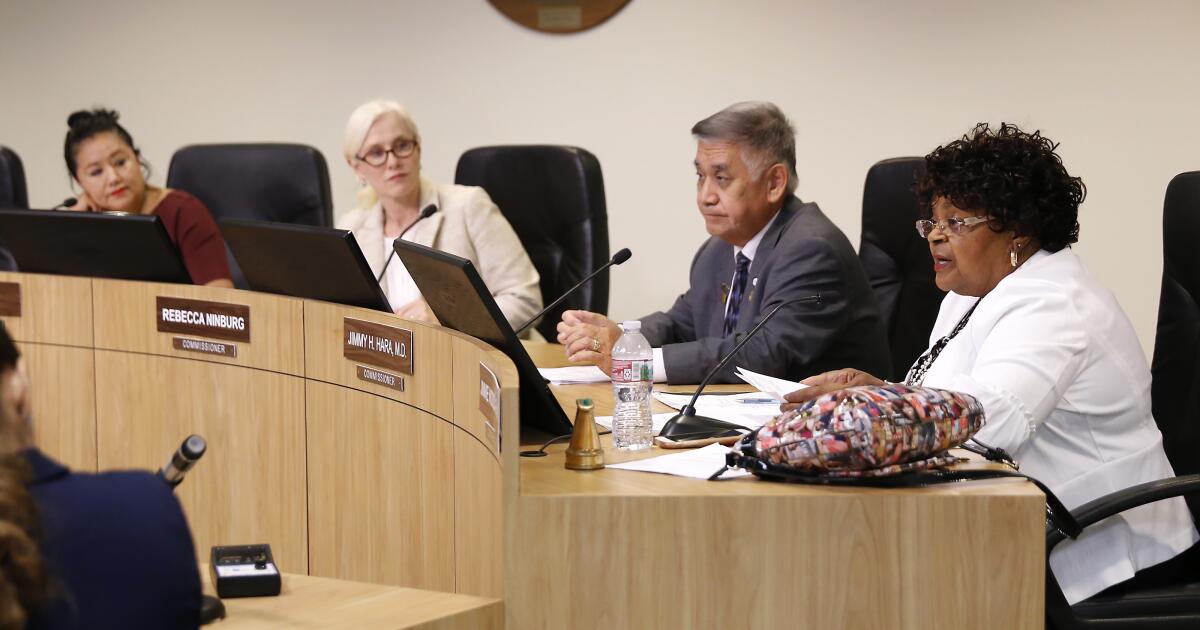
Genethia Hudley Hayes, president of the Board of Fire Commissioners, did not immediately respond Tuesday to a request for comment. She previously told The Times that she heard rumors that the author of the report was unhappy, but that she did not look into the matter.

A July email thread reviewed by The Times shows concern over how the after-action report would be received, with the LAFD forming a “crisis management workgroup.”

“The primary goal of this workgroup is to collaboratively manage communications for any critical public relations issue that may arise. The immediate and most pressing crisis is the Palisades After Action Report,” LAFD Asst. Chief Kairi Brown wrote in an email to eight other people.

“With significant interest from media, politicians, and the community, it is crucial that we present a unified response to anticipated questions and concerns,” Brown wrote. “By doing so, we can ensure our messaging is clear and consistent, allowing us to create our own narrative rather than reactive responses.”

Cook was not included on that email thread. It’s unclear how much of a role, if any, that group had on the revisions.

The after-action report has been widely criticized for failing to examine a New Year’s Day fire that later reignited into the Palisades fire. Bass has ordered the LAFD to commission an independent investigation into its missteps in putting out the earlier fire.

One edit to the after-action report involved language stating that the decision to not fully staff up and pre-deploy all available crews and engines ahead of the extreme wind forecast “did not align” with the department’s policy and procedures during red flag days.

The final report did not include that language, saying instead that the number of engine companies rolled out ahead of the fire “went above and beyond the standard LAFD pre-deployment matrix.”

A section on “failures” was renamed “primary challenges,” and an item saying that crews and leaders had violated national guidelines on how to avoid firefighter deaths and injuries was scratched.

Another passage that was deleted said that some crews waited more than an hour for an assignment the day of the fire.

Two drafts contain notes typed in the margins with suggestions that seemed intended to soften the report’s effect and make the Fire Department look good. One note proposed replacing the image on the cover page — which showed palm trees on fire against an orange sky — with a “positive” one, such as “firefighters on the frontline.” The final report’s cover displays the LAFD seal.

The final version listed only 42 items in the section on recommendations and lessons learned, while the first version reviewed by The Times listed 74.

Source link

For Bass and LAFD, there’s no watering down how bad 2025 has been

The year was already a debacle for the Los Angeles Fire Department and Mayor Karen Bass, with multiple stumbles before and after the epic January blaze that obliterated Pacific Palisades, so it was hard to imagine that things could get worse in the closing days of 2025.

But they have.

A blistering Times investigation found that the Fire Department cleaned up its after-action report, downplaying missteps.

In other words, there was a blatant attempt to mislead the public.

And Bass representatives said they requested that her comments in the final minutes of a video interview — in which she admitted that “both sides botched it” in the Eaton and Palisades fires — be edited out because she thought the interview had ended.

Please.

Together, these developments will echo through the coming mayoral election, in which Bass will be called out repeatedly over one of the greatest disasters in L.A. history. We’re a long way from knowing whether she can survive and win a second term, but Austin Beutner and any other legitimate contenders are being handed gifts that will keep on giving.

In the case of the altered report, kudos to Times reporters Alene Tchekmedyian and Paul Pringle, who have been trying all year to keep the LAFD honest, which is no easy task.

In the latest bombshell dropped by the two reporters, they dug up seven drafts of the department’s self-analysis, or after-action report, and found that it had been altered multiple times to soften damning conclusions.

Language saying LAFD did not fully pre-deploy all crews and engines, despite the forecast of extreme conditions, was removed.

Language saying some crews waited more than an hour for their assignments during the fire was removed.

A section on “failures” became a section on “primary challenges.”

A reference to a violation of national guidelines on how to avoid firefighter injury and death was removed.

The central role of the earlier Lachman fire, allegedly started by an arsonist, was also sanitized. A reference to that unchecked brushfire, which later sparked the inferno, was deleted from one draft, then restored in the final version. But only in a brief reference.

Even before the smoke cleared on Jan. 7, I had one former LAFD official telling me he was certain the earlier fire had not been properly extinguished. Crews should have been sitting on it, but as The Times has reported, that didn’t happen.

What we now know with absolute clarity is that the LAFD cannot be trusted to honestly and thoroughly investigate itself. And yet after having fired one chief, Bass asked the current chief to do an investigation.

Sue Pascoe, who lost her home in the fire and is among the thousands who don’t yet know whether they can afford to rebuild because their insurance — if they had any — doesn’t cover the cost of new construction. Pascoe, editor of the local publication Circling the News, had this reaction to the latest expose:

“To kill 12 people, let almost 7,000 homes/businesses burn, and to destroy belongings, memorabilia and memories stored in the homes — someone needs to be held accountable.”

But who will that be?

Although the altered after-action report seems designed to have minimized blame for the LAFD, if not the mayor, the Bass administration said it wasn’t involved.

“We did not red-line, review every page or review every draft of the report,” a spokesperson told the Times. “We did not discuss the Lachman Fire because it was not part of the report.”

Genethia Hudley Hayes, president of the Board of Fire Commissioners, told The Times she noticed only small differences between the final report and an earlier report she had seen.

“I was completely OK with it,” she said, adding that the final report “did not in any way obfuscate anything.”

Well I’m not OK with it, and I suspect a lot of people who lost everything in the fire feel the same way. As I’ve said before, the conditions were horrific, and there’s little doubt that firefighters did their best. But the evidence is mounting that the department’s brass blew it, or, to borrow a phrase from Bass, “botched it.”

As The Times’ David Zahniser reported, Bass said her “botched” comment came in a casual context after the podcast had ended. She also said she has made similar comments about the emergency response on numerous occasions.

She has made some critical comments, and as I mentioned, she replaced the fire chief. But the preparation and response were indeed botched. So why did her office want that portion of the interview deleted?

Let’s not forget, while we’re on the subject of botching things, that Bass left the country in the days before the fire despite warnings of catastrophic conditions. And while there’s been some progress in the recovery, her claim that things are moving at “lightning speed” overlooks the fact that thousands of burned out properties haven’t seen a hammer or a hardhat.

On her watch, we’ve seen multiple misses.

On the blunderous hiring and quick departure of a rebuilding czar. On the bungled hiring of a management team whose role was not entirely clear. On a failed tax relief plan for fire victims. On the still-undelievered promise of some building fee waivers.

In one of the latest twists on the after-action report, Tchekmedyian and Pringle report that the LAFD author was upset about revisions made without his involvement.

What a mess, and the story is likely to smolder into the new year.

If only the Lachman fire had been as watered down as the after-action report.

steve.lopez@latimes.com

Source link

LAFD report on Palisades fire was watered down in editing process, records show

For months after the Palisades fire, many who had lost their homes eagerly awaited the Los Angeles Fire Department’s after-action report, which was expected to provide a frank evaluation of the agency’s handling of the disaster.

A first draft was completed by August, possibly earlier.

And then the deletions and other changes began — behind closed doors — in what amounted to an effort to downplay the failures of city and LAFD leadership in preparing for and fighting the Jan. 7 fire, which killed 12 people and destroyed thousands of homes, records obtained by The Times show.

In one instance, LAFD officials removed language saying that the decision not to fully staff up and pre-deploy all available crews and engines ahead of the extreme wind forecast “did not align” with the department’s policy and procedures during red flag days.

Instead, the final report said that the number of engine companies rolled out ahead of the fire “went above and beyond the standard LAFD pre-deployment matrix.”

Another deleted passage in the report said that some crews waited more than an hour for an assignment the day of the fire. A section on “failures” was renamed “primary challenges,” and an item saying that crews and leaders had violated national guidelines on how to avoid firefighter deaths and injuries was scratched.

Other changes in the report, which was overseen by then-interim Fire Chief Ronnie Villanueva, seemed similarly intended to soften its impact and burnish the Fire Department’s image. Two drafts contain notes written in the margins, including a suggestion to replace the image on the cover page — which showed palm trees on fire against an orange sky — with a “positive” one, such as “firefighters on the frontline,” the note said. The final report’s cover displays the LAFD seal.

The Times obtained seven drafts of the report through the state Public Records Act. Only three of those drafts are marked with dates: Two versions are dated Aug. 25, and there is a draft from Oct. 6, two days before the LAFD released the final report to the public.

No names are attached to the edits. It is unclear if names were in the original documents and had been removed in the drafts given to The Times.

The deletions and revisions are likely to deepen concerns over the LAFD’s ability to acknowledge its mistakes before and during the blaze — and to avoid repeating them in the future. Already, Palisades fire victims have expressed outrage over unanswered questions and contradictory information about the LAFD’s preparations after the dangerous weather forecast, including how fire officials handled a smaller New Year’s Day blaze, called the Lachman fire, that rekindled into the massive Palisades fire six days later.

Some drafts described an on-duty LAFD captain calling Fire Station 23 in the Palisades on Jan. 7 to report that “the Lachman fire started up again,” indicating the captain’s belief that the Palisades fire was caused by a reignition of the earlier blaze.

The reference was deleted in one draft, then restored in the public version, which otherwise contains only a brief mention of the previous fire. Some have said that the after-action report’s failure to thoroughly examine the Lachman fire reignition was designed to shield LAFD leadership and Mayor Karen Bass’ administration from criticism and accountability.

Weeks after the report’s release, The Times reported that a battalion chief ordered firefighters to roll up their hoses and leave the burn area on Jan. 2, even though they had complained that the ground was still smoldering and rocks remained hot to the touch. Another battalion chief assigned to the LAFD’s risk management section knew about the complaints for months, but the department kept that information out of the after-action report.

After The Times report, Bass asked Villanueva to “thoroughly investigate” the LAFD’s missteps in putting out the Lachman fire, which federal authorities say was intentionally set.

“A full understanding of the Lachman fire response is essential to an accurate accounting of what occurred during the January wildfires,” Bass wrote.

Fire Chief Jaime Moore, who started in the job last month, has been tasked with commissioning the independent investigation that Bass requested.

The LAFD did not answer detailed questions from The Times about the altered drafts, including queries about why the material about the reignition was removed, then brought back. Villanueva did not respond to a request for comment.

A spokesperson for Bass said her office did not demand changes to the drafts and only asked the LAFD to confirm the accuracy of items such as how the weather and the department’s budget factored into the disaster.

“The report was written and edited by the Fire Department,” the spokesperson, Clara Karger, said in an email. “We did not red-line, review every page or review every draft of the report. We did not discuss the Lachman Fire because it was not part of the report.”

Genethia Hudley Hayes, president of the Board of Fire Commissioners, told The Times that she reviewed a paper copy of a “working document” about a week before the final report was made public. She said she raised concerns with Villanueva and the city attorney’s office over the possibility that “material findings” were or would be changed. She also said she consulted a private attorney about her “obligations” as a commissioner overseeing the LAFD’s operations, though that conversation “had nothing to do with the after-action” report.

Hudley Hayes said she noticed only small differences between the final report and the draft she reviewed. For example, she said, “mistakes” had been changed to “challenges,” and names of firefighters had been removed.

“I was completely OK with it,” she said. “All the things I read in the final report did not in any way obfuscate anything, as far as I’m concerned.”

She reiterated her position that an examination of missteps during the Lachman fire did not belong in the after-action report, a view not shared by former LAFD chief officers interviewed by The Times.

“The after-action report should have gone back all the way to Dec. 31,” said former LAFD Battalion Chief Rick Crawford, who retired from the agency last year and is now emergency and crisis management coordinator for the U.S. Capitol. “There are major gaps in this after-action report.”

Former LAFD Asst. Chief Patrick Butler, who is now chief of the Redondo Beach Fire Department, agreed that the Lachman fire should have been addressed in the report and said the deletions were “a deliberate effort to hide the truth and cover up the facts.”

He said the removal of the reference to the LAFD’s violations of the national Standard Firefighting Orders and Watchouts was a “serious issue” because they were “written in the blood” of firefighters killed in the line of duty. Without citing the national guidelines, the final report said that the Palisades fire’s extraordinary nature “occasionally caused officers and firefighters to think and operate beyond standard safety protocols.”

The final after-action report does not mention that a person called authorities to report seeing smoke in the area on Jan. 3. The LAFD has since provided conflicting information about how it responded to that call.

Villanueva told The Times in October that firefighters returned to the burn area and “cold-trailed” an additional time, meaning they used their hands to feel for heat and dug out hot spots. But records showed they cleared the call within 34 minutes.

Fire officials did not answer questions from The Times about the discrepancy. In an emailed statement this week, the LAFD said crews had used remote cameras, walked around the burn site and used a 20-foot extension ladder to access a fenced-off area but did not see any smoke or fire.

“After an extensive investigation, the incident was determined to be a false alarm,” the statement said.

The most significant changes in the various iterations of the after-action report involved the LAFD’s deployment decisions before the fire, as the wind warnings became increasingly dire.

In a series of reports earlier this year, The Times found that top LAFD officials decided not to staff dozens of available engines that could have been pre-deployed to the Palisades and other areas flagged as high risk, as it had done in the past.

One draft contained a passage in the “failures” section on what the LAFD could have done: “If the Department had adequately augmented all available resources as done in years past in preparation for the weather event, the Department would have been required to recall members for all available positions unfilled by voluntary overtime, which would have allowed for all remaining resources to be staffed and available for augmentation, pre-deployment, and pre-positioning.” The draft said the decision was an attempt to be “fiscally responsible” that went against the department’s policy and procedures.

That language was absent in the final report, which said that the LAFD “balanced fiscal responsibility with proper preparation for predicted weather and fire behavior by following the LAFD predeployment matrix.”

Even with the deletions, the published report delivered a harsh critique of the LAFD’s performance during the Palisades fire, pointing to a disorganized response, failures in communication and chiefs who didn’t understand their roles. The report found that top commanders lacked a fundamental knowledge of wildland firefighting tactics, including “basic suppression techniques.”

A paperwork error resulted in the use of only a third of the state-funded resources that were available for pre-positioning in high-risk areas, the report said. And when the fire broke out on the morning of Jan. 7, the initial dispatch called for only seven engine companies, when the weather conditions required 27.

There was confusion among firefighters over which radio channel to use. The report said that three L.A. County engines showed up within the first hour, requesting an assignment and receiving no reply. Four other LAFD engines waited 20 minutes without an assignment.

In the early afternoon, the staging area — where engines were checking in — was overrun by fire.

The report made 42 recommendations, ranging from establishing better communication channels to more training. In a television interview this month, Moore said the LAFD has adopted about three-quarters of them.

Source link

After Palisades failures, is LAFD prepared for the next major wildfire?

As the Palisades fire raged, then-Los Angeles Fire Department Chief Kristin Crowley went on a television blitz, calling out city leadership for systematically underfunding her agency.

The LAFD, she said, didn’t have enough firefighters, based at enough fire stations, to quench the wind-driven flames that were tearing through the hills.

“We need more. This is no longer sustainable,” she said in one interview Jan. 10.

Nearly a year after the fire destroyed much of the Palisades, LAFD officials continue to highlight financial concerns, with Crowley’s successor requesting a 15% budget increase and the firefighters union proposing a sales tax that could bring in an extra $300 million per year.

A Jan. 9 aerial view of neighborhoods destroyed by the Palisades fire.

A Jan. 9 aerial view of neighborhoods destroyed by the Palisades fire.

(Robert Gauthier / Los Angeles Times)

But the LAFD’s hyper-focus on money obscures its leaders’ failures in managing the resources they had, beginning with a decision to leave the scene of a New Year’s Day fire despite signs it hadn’t been fully extinguished.

Days later, that fire reignited into the Palisades fire, which killed 12 people and destroyed thousands of homes. Despite forecasts of catastrophically high winds, LAFD officials didn’t pre-deploy engines in the area or increase manpower by ordering a previous shift of firefighters to stay on duty.

As the flames spread, the firefighting response was disorganized and chaotic, with the LAFD’s own after-action report describing major failures by high-ranking commanders in communication, staffing and basic wildland firefighting knowledge.

City leaders have highlighted changes they have made since the fire, including appointing 30-year LAFD veteran Jaime Moore as chief and drafting new protocols for staffing on high hazard weather days.

But the question remains: Is Los Angeles prepared for the next major wildfire? Some city officials and fire experts don’t think so, pointing to an LAFD that hasn’t evolved with the times and an incomplete review of how the Palisades fire started.

Moore, who was appointed chief last month, declined to comment.

Mayor Karen Bass said in an interview earlier this month that the city is “on the path to be completely ready” for a major wildfire, with the LAFD now taking a more proactive approach to weather warnings.

“The Fire Department has been way more aggressive, has done pre-deployment, has been very visible, alerts going out early, trying to be very, very aggressive,” she said.

But Genethia Hudley Hayes, president of the Board of Fire Commissioners, said that the LAFD is still unprepared and that there hasn’t been enough time to make the necessary changes. She cited the LAFD’s technology, which she said is about two decades behind.

“I am not confident there would be a different result” if a similar disaster strikes, she said.

City Councilmember Traci Park, whose district includes Pacific Palisades and who has advocated for more Fire Department funding, agreed with Hudley Hayes.

Some essential changes have been made, such as requiring firefighters to stay for an additional shift during red flag warnings, Park said. But she said that too many fire engines are out of service, there are not enough mechanics, and most important, questions about the origin of the Palisades fire remain unanswered.

In October, after federal prosecutors charged a former Palisades resident with deliberately setting the Jan. 1 Lachman fire, The Times reported that a battalion chief ordered firefighters to roll up their hoses and leave the burn area on Jan. 2, even though they had complained that the ground was still smoldering and rocks remained hot to the touch. The Times reviewed text messages among firefighters and a third party, sent in the weeks and months after the fire, describing the crew’s concerns.

The LAFD’s after-action report, released in October, only briefly mentioned the Lachman fire. Critics have flagged this as a crucial lapse in the report, which prevents the department from figuring out what went wrong and avoiding the same mistakes.

After the Times report, Bass ordered an investigation into the LAFD’s handling of the Lachman fire.

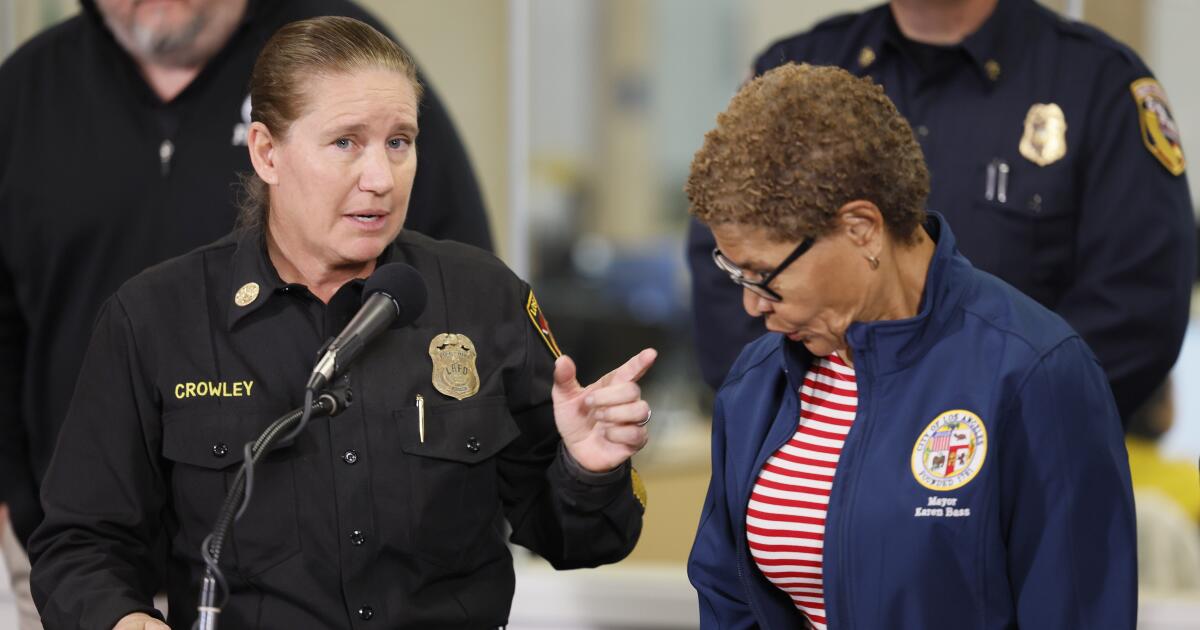
Mayor Karen Bass and then-Fire Chief Kristin Crowley

Mayor Karen Bass, right, and then-Fire Chief Kristin Crowley speak during a news conference in January. Bass ousted Crowley less than two months after the Palisades fire.

(Allen J. Schaben / Los Angeles Times)

Bass had ousted Crowley less than two months after the Palisades fire, citing the LAFD’s failure to properly deploy resources ahead of the winds and potentially have a chance to extinguish the fire before it exploded out of control, an issue that was exposed by a series of reports in The Times.

Bass also countered Crowley’s financial complaints, saying that the budget did not affect the department’s ability to fight the fire. The LAFD’s 2024-25 budget had actually increased 7% from the previous year, due in part to generous firefighter raises.

More money won’t solve bad decision-making by top officials, said Marc Eckstein, an emergency physician who served as LAFD’s medical director and commander of its emergency medical services bureau until he retired in 2021.

He said that without transparency and accountability, “the fallback is always going to be what it has been: We need more of everything — more people, more money, more fire trucks, more fire stations.”

A modern fire agency needs the flexibility to surge its staff during a disaster, he said, while also addressing day-to-day needs. Most 911 calls are for medical problems, he said, yet the LAFD functions more or less the same as it did decades ago, when structure fires were more common.

He said a panel of outside experts should have been given access to the LAFD’s records to offer an unbiased look at how the department performed leading up to and during the Palisades fire.

“And it’s a playbook. OK, how do we prevent this from happening again?” he said. “And the fact that didn’t happen is a disgrace.”

How much the department transforms after the Palisades disaster will depend, in large part, on its new chief. Moore, who joined the LAFD in 1995 and most recently was deputy chief of the Operations Valley Bureau, was chosen by Bass to lead the department over a fire chief from a major city outside California.

At stations around L.A., firefighters told Bass that they wanted an insider for the job, which she said factored into her decision.

“Given that the Fire Department was under such scrutiny, such a difficult time, morale is in the toilet, infighting that’s going on, the last thing in the world they needed, in my opinion, was somebody from the outside,” Bass told The Times.

Moore had signaled before his appointment was confirmed last month that he was troubled by the LAFD’s missteps with the Lachman fire and was going to bring in an outside organization to investigate.

But the following week, he appeared to change course, alleging that the media was trying to “smear” firefighters while saying he still planned to investigate the Lachman fire.

Moore will be in charge of implementing the 42 recommendations in the after-action report, which range from establishing better communication channels to how to defend homes where hidden embers could ignite.

The report drew the conclusion that top LAFD commanders had startlingly little knowledge about combating wildfires, including “basic suppression techniques.” It suggested that all LAFD members undergo training on key skills such as structure defense and how to draw water from swimming pools when hydrants don’t work.

In an interview with ABC7, Moore said that the LAFD has adopted about three-quarters of the recommendations and is considering creating a division specializing in wildland fires.

Hand crew members work outside

Members of Crew 4, the department’s new full-time wildland hand crew, practice cutting fire lines near Green Verdugo Fire Road in Sunland.

(Myung J. Chun / Los Angeles Times)

Since the Palisades fire, the LAFD has hired a 26-member wildland hand crew that uses chainsaws and other tools to chop paths through brush to stop a fire from spreading. When they aren’t battling fires, they do brush clearance throughout the city.

Earlier this month, as hand crew members practiced cutting fire lines through the brush in Sunland, the crew’s leader, Supt. Travis Humpherys, declined to say whether they would have changed the outcome of the Palisades fire.

Travis Humpherys is the Crew 4 superintendent.

Travis Humpherys is the Crew 4 superintendent.

(Myung J. Chun / Los Angeles Times)

But they have already “made a dramatic impact” with brush clearance and fighting wildfires, including a 20-acre fire in Burbank in June, Humpherys said.

Moore’s requested budget of more than $1 billion for the coming year — a 15% increase over this year’s budget — includes money for a second wildland hand crew, as well as nearly 200 additional firefighter recruits and helitanker services to attack fires from the air. That amount could be pared down during the months-long city budgeting process, as the City Council and the mayor find ways to balance the overall budget amid financial headwinds.

Meanwhile, United Firefighters of Los Angeles City Local 112 is charting an ambitious course to reduce the department’s dependency on the city budget, pushing for a ballot measure that, if approved by voters in November 2026, would raise nearly $10 billion by 2050 through a half-cent sales tax. But after the LAFD’s failures in the Palisades fire, some voters may be reluctant to entrust its leaders with more money.

“It’s hard to believe that we are fully prepared for the next major emergency,” Doug Coates, the union’s acting president, said in a statement. “We desperately need more firefighters and paramedics, more trucks, engines, and ambulances and more wildfire resources and neighborhood fire stations.”

E. Randol Schoenberg, whose family lost four homes in the fire, including his in Malibu — along with documents that belonged to his grandfather, the composer Arnold Schoenberg — said he would be happy to pay more taxes for more services.

But Schoenberg, an attorney who is representing Palisades fire victims in a lawsuit against the city and the state, said he expects the LAFD to honestly examine its mistakes.

“If they don’t really grapple with the issues of how this happened, then no matter how much money we throw at it, it’s going to happen again,” he said.

Times staff writer David Zahniser contributed to this report.

Source link