LACMAs

Puppets, performers and politics filled the streets at LACMA’s first-ever Art Parade

Instead of the usual phalanx of cars and buses, Saturday evening traffic on Wilshire Boulevard was replaced by massive balloons, mobile sculptures, gaggles of gallerists and an endless array of elaborate costumes.

The first-ever Los Angeles Art Parade, a collaboration between the Los Angeles County Museum of Art (LACMA) and famed gallerist Jeffrey Deitch, transformed the stretch of Wilshire known as Museum Row into a human-powered exhibition of the city’s dynamic art scene.

About 146 groups, made up of more than 1,400 participants, marched in the parade, with projects ranging from larger-than-life marionette dolls to squads of children in do-it-yourself costumes to mobile re-creations of LACMA’s most iconic art pieces.

The parade followed an all-day block party thrown by LACMA as part of its Grand Opening Weekend, celebrating the new David Geffen Galleries and the completion of the 20-year-long, $724-million campus construction project. Together, the block party and art parade attracted an estimated 60,000 attendees, who swarmed the galleries, danced to explosive DJ sets, and lined the streets to watch the eclectic procession of artists.

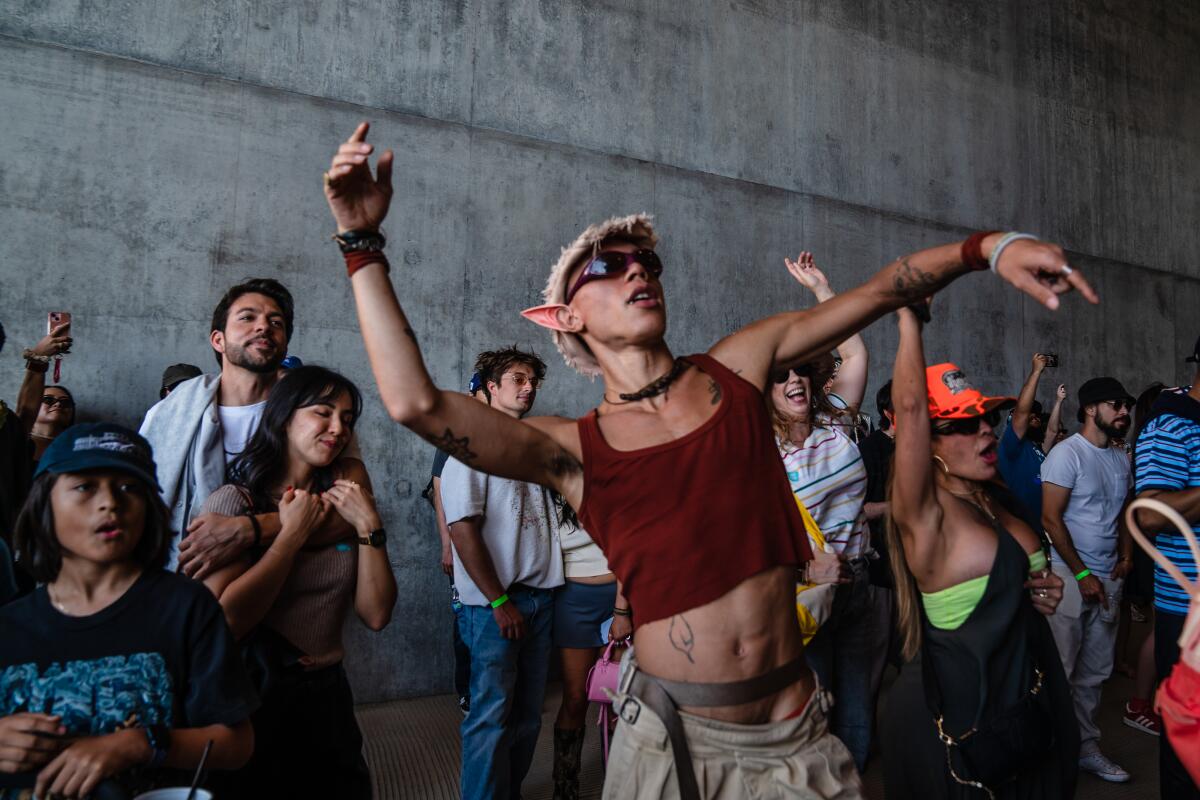
People dance

People dance during Flying Lotus’ DJ set at the Los Angeles County Museum of Art (LACMA) in Los Angeles.

(Ariana Drehsler/For The Times)

According to LACMA Director and Chief Executive Michael Govan, the event was a long time coming and “just the beginning” of how his team plans to use the campus space, which he previously called the city’s “living room.”

“We’re not gonna close Wilshire every weekend, but it’s an example of what we can do,” Govan said. “It’s really exciting to see the building work.”

Following a crowd-drawing DJ set from electronic low-fi hip-hop artist Flying Lotus, Govan introduced L.A. County District 2 Supervisor Holly J. Mitchell. She said the event made her “proud to represent LACMA” and to be a Metro board member, referencing the recently-opened Metro D-line extension, which dropped attendees off a quick stroll from LACMA’s entrance.

“Just seeing you all at this amazing public facility does my heart good,” she said. “This is your local government at work.”

1

Silhouettes of people watching the parade.

2

A man and woman wearing tulle over them walk in the parade.

3

The crowd at the Los Angeles County Museum of History, Science, and Art (LACMA) Block Party.

1. Silhouettes of people watching the parade. 2. A man and woman wearing tulle over them walk in the parade. 3. The crowd at the Los Angeles County Museum of History, Science, and Art (LACMA) Block Party. (Ariana Drehsler/For The Times)

As the party raged on LACMA’s campus, hundreds of parade participants hurriedly prepared for their debuts in the corners of nearby streets and parking lots. One group inflated a giant disco ball, while another smeared themselves with body paint next to a line of rehearsing dancers. Elsewhere, a megaphone-wielding leader herded dozens of black cats in the style of artist Gary Baseman into some semblance of order.

Deitch originally staged the first Art Parades in New York City’s SoHo neighborhood between 2005 and 2008. While those took a more art-world-exclusive approach, Deitch said the Los Angeles version was designed with inclusion in mind. The call for parade proposals was open to “emerging and established artists and creatives of all ages and backgrounds,” according to guidelines, as long as the work was appropriate for all ages and didn’t require a motorized element.

“The New York one was much more oriented toward people in the art community. We didn’t put out this kind of open call,” Deitch explained. “This is very different in its openness and its diversity. There are some famous artists and famous choreographers, L.A. legends. But there are also mothers from the San Fernando Valley with their children. I really love that.”

Devil Jack in a Box with Crocodile

Artist Jordan Rountree’s rolling woodcut-sculpture called the Devil Jack in a Box with Crocodile appeared in Saturday’s Block Party and Art Parade hosted by the Los Angeles County Museum of Art’s (LACMA).

(Ariana Drehsler/For The Times)

“It’s just a very open platform, so you don’t have to have an M.F.A. to express yourself as an artist,” he added.

The procession was dizzying in its variety and scale. While many projects leaned into beauty and whimsy, others took a more overtly political approach, displaying anti-ICE messages on T-shirts and signs, sporting trans pride flags, or, in the case of performance artist Amy Kaps, wearing an unraveling U.S. constitution.

Some even referenced local causes, such as the “Boo Boo Bandage Brigade for Safe Streets,” which advocated for fixing sidewalks and increasing accessibility downtown. One particularly moving display by the Pali-Altadena Collective featured participants carrying miniature models of buildings and landmarks lost in the 2025 fires.

Chicana artist Nao Bustamante and Track 16 Gallery brought “Brown Disco” to the streets, which featured a giant gold disco ball and figures from decades of L.A. queer nightlife.

The crowd at the Los Angeles County Museum of Art (LACMA) Art Parade.

The crowd at the Los Angeles County Museum of Art (LACMA) Art Parade.

(Ariana Drehsler/For The Times)

“As a brown, queer person, I think that this really brought a light into our community, and now its presence [creates] an intergenerational conversation,” said Track 16 Assistant Director Steve Galindo. “The nightlife scene is how we come out as queer people, so it’s really special to be in the parade.”

For Joie Mitchell, volunteer coordinator for the Bob Baker Marionette Theater, which recently purchased its permanent Highland Park home, the parade was an opportunity to “show up for L.A. and be involved in the art history of this city.”

“Puppetry has been part of the arts for so many years,” added Daisy Hernandez, the theater’s production manager. “It’s a way that people express themselves, just like every other art form. So that’s what we’re here to do: express ourselves through puppetry.”

Source link

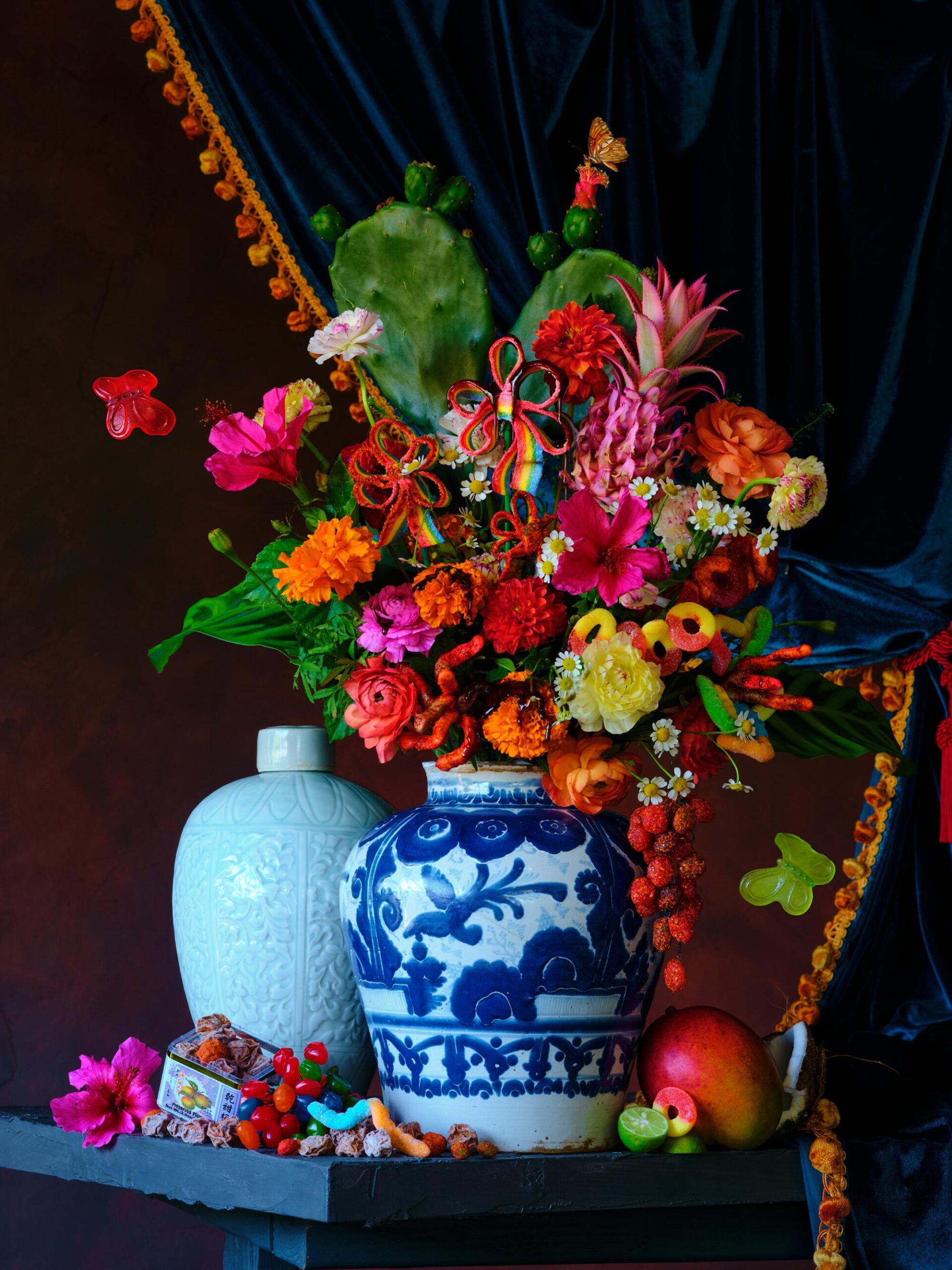
Stephanie Shih’s site-specific still life at LACMA’s David Geffen Galleries

Stephanie Shih, “梅國 (Still life with chamoy and Dirty T Tamarindo),” 2025/2026

Stephanie Shih, “梅國 (Still life with chamoy and Dirty T Tamarindo),” 2025/2026. Archival pigment print on wood panel, varnish, glue, acrylic, frame. 38.25×48.25×3.75.

(From the artist)

Much has been written about the experience of aimlessness in the new David Geffen Galleries at LACMA, but it is another thing to experience it firsthand. The meandering floor plan, with its rooms of various sizes and orientations alongside their resulting passageways and corners, demands that you wander, not map, your perusal of the galleries. As a result, a visitor can easily feel disoriented, or in my case, a touch deconstructed. A little depersonalized, if you will.

Fortuitously, I was there to meet with multidisciplinary artist Stephanie Shih, whose photo-based compositions have the opposite effect, grounding the viewer in their personhood and experience. Her still lifes are made both beautiful and meaningful through their intentional arrangement of specific food, florals and ephemera, touching on diasporic understandings of self, Western and European appropriations of the “exotic” and the juxtaposition of the natural with the fabricated. In other words, to view a Shih piece is to collaborate with the artist on reconstructing or, in some cases, reclaiming an understanding of place and self.

We were talking about, and in front of, Shih’s new piece, “梅國 (Still life with chamoy and Dirty T Tamarindo),” which was not only commissioned by LACMA, but created in a temporary studio Shih constructed within the gallery itself over the course of two weeks late last year. The image features two ceramic vessels, one slightly in front of the other, within a traditional still life scene. The background jar stands alone, while the piece in the foreground overflows with a rainbow of plants, flowers, fruit, chamoy candies, gummies and a single real butterfly. To get to the small but sunny corridor that houses the work, one might make a few indirect turns and cross the gallery containing Andreas Gursky’s “Ocean” series. Flanked by four wall-size photographs of vast, overhead perspectives of the deep blue Indian Ocean, it’s easy to feel small among the giant panels. Luckily, when I met Shih at LACMA, she intercepted me outside and led us confidently up the Geffen’s dramatic exterior staircase and to “The Global Appeal of Blue-and-White Ceramics” installation — no crossing of oceans necessary.

After our conversation, I stayed to wander the galleries for a few more hours. I am a completist and I wanted, no, needed to see everything. Without the prescribed navigation I was accustomed to in a museum, this became a fool’s errand. I got physically lost and a bit lost to myself. Had I already seen that statue or did it just look like another visage also rendered in marble a few galleries back? I was pretty sure I had already taken these two rights and then a left before, but what if I hadn’t and would then miss a whole other room? The 360-degree curved glass walls encasing the galleries offered many glimpses of a face that belonged to me but somehow wasn’t mine. Who was I? I felt like I would never see everything on display, but also maybe never again exist beyond the funhouse of the Geffen Galleries. In my confusion, I passed by “梅國 (Still life with chamoy and Dirty T Tamarindo)” more than once and was reminded of Shih’s ability to articulate complex reconstructions of self through her exquisite, serene compositions. It was enough to reassure me that I could find myself again, if only I slowed down and considered my context with curiosity instead of fear.

This curiosity led me to “Shaping Dutch Identity: The Mr. and Mrs. Edward Carter Collection.” It was a serendipitous encounter for two reasons: One, the visual and symbolic correlation between Shih’s painterly use of shadow in her food- and floral-centered compositions, and the still life masterpieces of the 17th century Dutch. And two, because much like her work itself, our interview included layered discussion of constructing and shaping identities. Take the new Peter Zumthor-designed building in which we found (and in my case, lost) ourselves, which builds upon the existing galleries of LACMA while redefining the museum’s identity. Or Shih’s in-situ studio, which was created for creation’s sake, then taken down with only a photo of its contents remaining — contents which were constructed by the artist, too.

There was also the progression across cultures and continents of blue-and-white ceramics, which mirrors the evolution of chamoy, a pickled fruit condiment in Mexican cuisine that, along with a blue-and-white Talavera jar, is at the center of Shih’s piece. Both the ceramic and the chamoy traditions symbolize layers of culture as shaped by globalism and localism.

At one point in our conversation, I was momentarily embarrassed when I couldn’t recall the Filipino term for dried sour plums (kiamoy), a precursor to Mexico’s chamoy. It was an aspect of my identity as a third-generation Filipina that was also irretrievable to me that day. Shih was understanding and gracious in her response: “One of the really fun parts of the work I get to do is learning a lot of these histories that get hidden from us.” Given Shih’s academic background — she holds a PhD from Stanford University in linguistics — it makes sense that she brings deep research to her practice. Her art is rich with symbolism and history. But Shih’s work is also playful and, much like her response to me, generous in the invitation it extends to viewers to bring their own identities to her pieces in order to construct meaning for themselves. I may have felt unmoored among the Geffen’s myriad corners and paths, but never when I was standing in front of Shih’s piece.

Installation of Stephanie Shih's 梅國 (Still life with chamoy and Dirty T Tamarindo) (2025- 26) and (bottom) Jar (c. 1700-50).

Installation view of the inaugural presentation in the David Geffen Galleries, April 2026, featuring (top) Stephanie Shih’s 梅國 (Still life with chamoy and Dirty T Tamarindo) (2025- 26) and (bottom) Jar (c. 1700-50).

(Museum Associates / LACMA)

Claire Salinda: Your composition captures flowers, chamoy and other candies and fruit sumptuously arranged in and around a ceramic jar from LACMA’s permanent collection. How did you decide on chamoy as a subject? And how is it contextualized within the new David Geffen Galleries?

Stephanie Shih: “梅國 (Still life with chamoy and Dirty T Tamarindo)” is on display in “The Global Appeal of Blue-and-White Ceramics.” The gallery presents a condensed history of blue-and-white ceramics globally in dishes, starting in the Middle East with a 9th century Iraqi piece. From the Middle East we really got the use of cobalt in designs, and that married with the introduction of porcelain from China. We also have the Iznik kilns in Turkey, which are still operating today, and influences into Southeast Asia, and so on. Later on, the influence spread farther afield into Japan and France, where they started adding even more to it. The blue-and-white tradition has really spread globally, so this gallery is a nice microcosmic story of the effects of globalism before modern globalism.

For a long time I’ve been wanting to make a piece about chamoy and was just waiting for the opportunity to do so. The story of chamoy really parallels this journey of blue-and-white ceramics, which got to Mexico because of Spanish colonialism and then was adopted by local artisans. They really made it their own in the Talavera tradition. Chamoy similarly comes from Asia through pickled plums, particularly China via the Philippines. Filipino laborers came to Mexico via colonialism, and adapted and adopted champoy with spices and chilies from Mexico to become chamoy.

The curator, Susie Ferrell, gave me a whole list of blue-and-white surveys that they were looking at. We went to storage and to the conservation labs to look at all the pieces and we ended up choosing two pieces to work with. The one in “梅國 (Still life with chamoy and Dirty T Tamarindo)” is a Mexican Talavera jar from the 1700s. It’s the first non-Asian origin institutional ceramic I’ve gotten to work with in my career, which is the reason that I gravitated toward it.

Chamoy has been used by a lot of modern day food makers and chefs with American nostalgic candies, like peach rings and gummy worms, and my personal favorite, Gushers. One of these food makers, Alana Solis, who’s based in Tucson, runs Dirty T Tamarindo, a chamoy candy business she started during the pandemic. It was from her that I learned the history of chamoy, and so I wanted to do a piece with her candies for a long time. And this is just a really perfect opportunity with the Talavera jar.

I had pitched to Susie that it might be nice to have a second ceramic in the piece, a companion that demonstrates the origins and precursors of the blue-and-white ceramics in Mexico, a Chinese piece or something. She actually picked the one pictured here, which is also from the LACMA collection. It’s a 12th century Qingbai ware prunus vase, a meiping jar. When Susie pitched it to me, I didn’t even realize how perfect it was: A prunus vase is usually what they put plum blossoms in, and meiping means beautiful plum vase. It just ended up being a really, really good pick from her.

CS: You built a studio space within the gallery to create the piece. I’m curious about the constraints and what was surprising for you.

Artist Stephanie Shih

Light tests in the LACMA

Artist Stephanie Shih’s makeshift set in the Los Angeles County Museum of Art (LACMA) David Geffen Galleries for her two-week commission project residency; Light test detail.

(Stephanie Shih)

SS: I was here for two weeks. I had a friend build a wall, we painted it downstairs and then brought it in and had it in the gallery with the light coming in through the windows. They gave me a refrigerator to store all the food, because I wasn’t supposed to have it out in the gallery space. We built out work tables too … it’s hard to kind of imagine with all the other stuff here now.

It was in December, and so the building was in several stages of installation with the art. There were just stacks of crates and boxes, which is amazing — it was very cool to just see statues half unpacked.

And actually, seeing everything get installed affected my thinking about the frame. Originally I wasn’t going to do a framed piece, it was just going to be on a panel. But then as I saw everything else go up, there was a weightiness to the way everything was framed and thought about. A lot of the frames are gold gilded, which are incredibly beautiful and historical. I wanted something that played off of that tradition, but using a red frame made it really obvious that it’s not 100% within tradition.

CS: How does this commission fit into your practice?

SS: My work started out really thinking about the artistic references we get as people working in food and still life. So many of the references are of this very Eurocentric art historical tradition. But if you look at that tradition, many things are taken from other cultures and used to symbolize the access and wealth and value that was assigned to these objects from the perspective of European imperialists, to put it nicely. It wasn’t until very recently that people were even thinking, “Well, where are these things from? What other artistic traditions does that mean that we’ve sort of borrowed from?” And so a lot of my work thinks about responding to that, but also taking back some of that tradition to tell stories of diaspora communities today here in the U.S.

From there, I’ve really started thinking a lot about the construction of identity and how we get to the things that symbolize who we are, and how we use symbols as we move through the world. As a cognitive scientist and linguist, a lot of my research training is about symbols and about the construction of identity in that way.

CS: Do you think that this piece could have been made anywhere else?

SS: No, I don’t think so. There’s something so special about the mission with the new building, how it’s so much more fluidly built and how LACMA is trying to think curatorially outside of the silos that have been set up by traditional art history. Thinking about that really, really influenced my approach to these pieces in terms of trying to collapse in each piece the timescales of historical influences and contemporary identity, but also the locality.

There’s stuff in “梅國 (Still life with chamoy and Dirty T Tamarindo)” that’s very global and far away, but also hyper local and here in L.A. For instance, the butterfly was found by my friend just a couple miles north in WeHo while I was working at LACMA. It’s native to California.

Do you know who Rachel Ruysch is? She was one of the big Dutch still life painters and in some of her later work, she was able to access flowers and plants from the American West, which was really rare at that time. She has a piece with prickly pear cactus as well as datura in it, which is crazy. We see those plants right here, but not in England and the Netherlands, where she was working at the time. Seeing that piece was part of the influence as well. In my piece, we have candy stripe ranunculus, which I was able to find for the candy. The cactus is from my backyard. There’s marigold and chamomile for their significance in Mexican culture, and the hibiscus flower, which has a long history across the Pacific Rim, tracing a lot of the places that ended up with chamoy and sour plums. I wanted a little nod to Hawaii with the pineapple because that’s where we also get salted plum culture.

Artist Stephanie Shih

Artist Stephanie Shih poses on set.

(From the artist)

CS: As we stand and chat in front of “梅國 (Still life with chamoy and Dirty T Tamarindo),” I can’t help but notice folks stopping to take it in. How is it being here and seeing people interact with the work?

SS: Oh, really fun!

CS: Do you ever want to interrupt them to answer a question you overhear?

SS: No. I think my favorite part of watching people interact with the pieces is what they bring to it. Some people see the chamoy immediately and they recognize their experiences in it, which is really lovely to see. Like, I can see someone’s been pointing at it, there’s a nice fingerprint mark. That’s funny. Some people recognize the candy in it. Kids often ask me, “How did the gummy butterflies fly?” and that’s really fun to answer. I appreciate that everyone brings their own experiences to it, and that sort of completes the piece for me.
Source link

How to navigate LACMA’s new David Geffen Galleries? Get lost

It’s not only easy to get lost in the Los Angeles County Museum of Art’s new David Geffen Galleries, it’s inevitable, intentional — and one of the best things about the place.

The museum has deconstructed the traditional, boxy narrative of art history and rendered the story itself a matter of curves and continuities. Art in the collection is freed from its departmental silos and put into conversation across genre lines, place and time.

The museum has physically invalidated the binaries of center and periphery, major and minor arts. In a startling and largely gratifying way, LACMA has done what the poet Audre Lorde, alluding to a different but not unrelated aspect of patriarchal dominance, deemed impossible: used the master’s tools to dismantle the master’s house.

The change goes far beyond a remodel. It’s a reinvention, a recalibration, a revisionist fever dream.

The vision conceived by museum director and Chief Executive Michael Govan and architect Peter Zumthor is not perfect, and brings with it a modest set of frustrations, but as a whole, the installation registers as ravishing and bracingly fresh. It thrusts us midstream into the ageless, ceaseless flow of makers worldwide reckoning with life, earth and being.

It prompts us, as we bob about, to reflect on our own proclivities and preconceptions, our patterns of reception and perception.

It compels us to recognize that what matters is not just what we see in the museum but how we see, what pulls us close and why, what private histories we bring to the occasion, what expectations, what tools.

Over two visits to the new building, getting my physical bearings mattered less and less as I surrendered to the generative sensations of not knowing. The museum has produced a dense guidebook to the new galleries, whose title, “Wander,” doubles as invitation and imperative. Even at 430 pages, the book is only minimally useful as an orientation device. For help with that internal navigation, Rebecca Solnit’s moving 2005 book, “A Field Guide to Getting Lost,” proved a better compass.

A row of small guidebooks.

LACMA’s guidebook to the David Geffen Galleries, called “Wander,” doubles as invitation and imperative.

(Museum Associates / LACMA)

Solnit, citing the cultural critic Walter Benjamin, writes, “to be lost is to be fully present, and to be fully present is to be capable of being in uncertainty and mystery.” She goes on to recall how roaming freely as a child was key to developing self-reliance, which feels apt to the LACMA strategy. We are put in charge of making our own way, through tapestries and tea sets, past ancient jug and contemporary sphinx, without heavy-handed authoritative direction.

The history of art reads here as one long, free verse poem-in-progress, gorgeous and absorbing. Even so, many of the most memorable moments come in the form of cogent micro-essays, smartly curated ensembles of work bearing a legible, lucid premise. Some of these are contained within four (rectilinear) walls; some occupy less demarcated spaces. “Tonal Variations: Photography and Music,” for instance, gathers images by Paul Caponigro, William Eggleston, Lisette Model and others. These artists were also serious pianists, attuned, no matter which instrument they were using, to the qualities of rhythm, pattern and progression.

Lisette Model, "Window at 5th Avenue," 1940, Los Angeles County Museum of Art

Lisette Model, “Window at 5th Avenue,” 1940, Los Angeles County Museum of Art

(Museum Associates / LACMA)

In a section headed “The Global Appeal of Blue-and-White Ceramics,” a long display case houses a timeline articulated sculpturally. The sequence advances from a 9th century bowl made in Iraq to a 13th century vessel from China, a 14th century example from Thailand, another from 15th century Syria, up to work by a 20th century German artist who transformed a functional vessel into personal adornment by cutting a string of beads out of the planar surface of the bowl.

Dish, Turkey, Iznik, c. 1530-35, Los Angeles County Museum of Art,

Dish, Turkey, Iznik, c. 1530-35, Los Angeles County Museum of Art

(Museum Associates / LACMA)

On the wall facing this display is a huge vitrine containing an 18th century Talavera jar from Mexico, paired with a 2025/26 color photograph by Brooklyn-based Stephanie H. Shih. In the still-life composition, a cheeky visual lesson on the collision and convergence of cultures, the jar holds flowers, cactus and edible Mexican treats influenced by Chinese and Filipino flavors.

Top, Stephanie H. Shih, 梅國 "(Still life with chamoy and Dirty T Tamarindo)," (2025- 26); bottom, Jar (c. 1700-50)

Top, Stephanie H. Shih, 梅國 “(Still life with chamoy and Dirty T Tamarindo),” (2025- 26); bottom, Jar (c. 1700-50)

(Museum Associates / LACMA)

Shih is one of a handful of artists commissioned to create new work using the museum’s collection as muse. L.A.-based Lauren Halsey is another. Her formidable, untitled 2026 sphinx regally commands its space among ancient Egyptian and Roman sculpture, a marvel of the cross-temporal and cross-spatial, spiked with specific references to Black self-determination.

Setting recent works among older ones is an effective element of LACMA’s overall plan to shed outworn hierarchies. It recasts every piece of art by every artist throughout the single-story space as equally relevant. The seamless integration of old and new feels stealthy, and a touch subversive, a doubling-down on the museum’s approach to time as nonlinear, sinuous and delightfully slippery.

A sphinx in a museum.

Lauren Halsey’s untitled 2026 sphinx.

(Museum Associates / LACMA)

That said, a few words readily available would help connect the dots without undermining the provocation. Text — where and how it appears, or doesn’t — is my only major complaint about the installation of the new galleries.

Text panels announce, in one or two paragraphs, the themes of each given section: “Images of the Divine in South Asia”; “The Evolution of Abstract Painting in Modern Korea”; “Textile Conversations: Africa and Black America.” Individual object labels are kept minimal, containing only basic identification about each work, no commentary. When asked about this decision during my first walkthrough, Govan replied that more time reading means less time looking — “and we have the internet.” Every thematic text panel has a QR code that links to the Bloomberg Connects app, an aggregate guide to museums and other cultural sites that offers selected, augmented entries.

Determining how much didactic information is insightful and sufficient, and how much constitutes excessive artsplaining, is a delicate, ongoing challenge for museums. Where LACMA landed on this contested plain strikes me as unfortunate and counterproductive.

A few lines of explanation or context on a wall label can add perspective for even the most informed visitor, and provides crucial support to those with less foundational exposure and access to art.

You can take or leave text on a wall without breaking your stride, but text accessed via QR code is another matter. (Never mind that connectivity is spotty inside a sprawling concrete shell, and several times when I tried to get information from the app, I couldn’t.) Encouraging us to shift our gaze from the wall to our devices — to assume that accursed downward tilt of the neck when splendors abound before our eyes — is simply detrimental. It breaks the spell of being fruitfully lost in the present, and retethers us to the digital distractions that dominate our days.

Text on a museum wall.

Wall text beside Francis Bacon’s “Three Studies of Lucian Freud” (1969), at Los Angeles County Museum of Art.

(Museum Associates / LACMA)

Shouldn’t the imaginative minds that created this space, this opportunity to revel in direct sensual experience, want us to keep our attention where our bodies are? Why this fallback to current convention, when the rest of the experience is about radical reinvention? This feels like a missed opportunity. I’m hoping a more experimental, exploratory approach to providing information, context and interpretation, in keeping with the rest of the enterprise, might yet come.

Does the new structure serve the art? Mostly, very well.

The lighting is varied, treated as another texture in the space, palpable and rich. There’s a generous amount of natural sunlight, but some spots are noticeably dim. Some gallery walls are glazed in deep hues (reddish and eggplant), and the intensity of the color is jarring at first. But neutral, white-box viewing spaces (with even, predictable lighting) can be found elsewhere on LACMA’s campus and pretty much anywhere art is shown. Here, the very irregularity of the interior environment, including the concrete surfaces — richer and more textured than I expected — heightened my alertness. And keener senses tend to make for more consequential experiences.

In deciding how to organize roughly 2,000 works of art across 110,000 square feet of exhibition space, LACMA devised a conceptual schema that isn’t apparent in the galleries themselves. The “Wander” guide maps out the division of the space into four regions correlating to bodies of water: the Indian, Atlantic and Pacific oceans, and the Mediterranean Sea. While the zones and their boundaries aren’t indicated by obvious signage, and I caught one laughable categorization (Ansel Adams’ photographs of the Pacific shoreline landing in the Atlantic section), this schema at least doesn’t get in the way.

And what does work about the propositional structure is its comprehensive realignment. It moves to retire art historical frameworks of the past, dependent on borders between places and times.

Throughout this installation, we are repeatedly reminded of the impact of trade and migration, the fluid movement of resources and belief systems. We’re reminded of porousness and simultaneity, and that all art histories are, in the end, propositional structures.

Here’s a new one, the Geffen Galleries say. Try it out. You might get lost. Indeed, you will get lost. And what wonders await you in the uncertainty and mystery.

Source link

How L.A., LACMA’s David Geffen Galleries changed architect Peter Zumthor

During a recent Zoom interview from his studio in Switzerland, Peter Zumthor offered a candid look at the making of the Los Angeles County Museum of Art’s new David Geffen Galleries.

The Pritzker Prize-winning architect addressed long-standing criticisms of the building and answered questions about his craft. He noted that the structure is a rejection of the overly “slick” architecture he believes defines the present moment, and shed light on the building’s early development, describing a contained process in which the concept was shaped before being presented to the public.

Finally, he discussed the broader ambition of the endeavor: dissolving traditional circulation and prioritizing emotional experience over institutional order.

The following interview excerpts have been edited and condensed for length and clarity.

You are wellknown as both an architect and a craftsman. I think the biggest place for that focus was the concrete. I’m curious about how you formed it. It’s not the typical museum concrete.

I work like an artist in building. This means I custom-make buildings. I can use a few standard details or products, like in the basement. But where the building has an identity, becomes visible, it’s almost all handmade. I have an image of what I want to do, what the building should do, how it should look. So I need people who can help me make custom-made products.

The people who did the formwork — the concrete pouring — [worked in] groups of 100 or more. They were fantastic. They loved their work. At the beginning, formwork leaked on a door, and it looked terrible. They said, “Peter, we’re sorry. We made a mistake. We can fix this. You will not see this afterwards.” But if you make a mistake, you cannot mend it, because what you’re doing here is a concrete sculpture. Sculptures are never mended.

It’s not a perfectly smooth concrete. I’m assuming that’s on purpose?

I love this kind of rawness. This was what I gladly learned. Michael [Govan] in a very friendly, careful way let me know that he would like more “American details” and fewer “European details.” OK, my European details, they stand. That’s what I did 20, 30 years ago. My background as a furniture maker shows, and I can do this. But the challenge in this museum is to get the right “American” roughness. And I think I pretty much succeeded.

What I learned in California [came] back to Europe, and many times we now say in the office, “Let’s do this more L.A.-style.” Because we have too many slick magazines in the world. We have this corporate architecture which doesn’t want to see any touch of a hand. No mistakes. What we need is not refinement. We need wholehearted directness. This is what I take back from America. There’s a certain freshness. It’s not overly refined. I’m proud of that. The roughness has to do with our times. Because our time is slick and glossy, right? The time to make refined, slick architecture is over.

A concrete museum gallery.

Horizontal light enters from floor-to-ceiling windows around the perimeter of LACMA’s new David Geffen Galleries, which use concrete as a kind of living building material.

(Iwan Baan)

In a 2023 interview with [architecture critic] Christopher Hawthorne, you said there were no “Zumthor details” left in the building. Do you think there are any Zumthor details now?

Of course there are Zumthor details. And I love them. They are not Swiss details. I think Christopher got this wrong. I was actually proudly speaking of how I learned a new way of looking at details. It doesn’t have to be refined all the time.

[Editor’s note: Zumthor told Hawthorne verbatim, “There are no Zumthor details any more,” in the 2023 interview with the New York Times.]

There’s always a tension with every building when it comes to value engineering. Were there any other places where you would want [David Geffen Galleries] to be different?

Basically, I say no. I’m very proud of this building. This is what I wanted to do, and this is what Michael helped me to do. This is exactly it. It’s one of my children and I love it.

Do you see this approach as an evolution in your work? Or is it more specifically for L.A.?

L.A. has changed me. And it’s in a good way. I would [not] have changed and reacted to our slick times the same way without L.A.

There were complaints that the project, and the process, were not as public as some people thought they should be. What is your reaction to that criticism?

I think I can say this: Michael said, “We cannot make a competition or anything like it, because competitions in the U.S. always end up with a winner who doesn’t build because he found out his own way of staging this whole procedure. The first, the most important thing, is that we start on a small budget, just the two of us.” That’s what we did. So when we started to talk about this museum, it was him and me, basically, and he gave me a little bit of money. And he said, “There will come a time when we will have to show something to the public. Let’s see whether people say yes.” They could have said no, but I think what they saw at that point was already too convincing.

Architect Peter Zumthor speaks at the press preview for the David Geffen Galleries at Los Angeles County Museum of Art.

Architect Peter Zumthor speaks at the press preview for the David Geffen Galleries at Los Angeles County Museum of Art.

(LACMA/ Museum Associates / Gary Leonard)

Because the museum’s not organized in a traditional way, it might be harder than normal to navigate for some people. It might be a little confusing. What do you say to that concern?

This will take some time, to see the benefits of this new type of museum. I think if you start to like this building in one corner or in another, or you get lost, you start to understand what it is all about. When something new comes, you have to learn, right? But I hope you can see this building never looks down on you. This building is, in a way, deeply human. And it lets you have your opinion.

There are people who have said, very loudly, this space shouldn’t have lost square footage. What is your response to that?

Small museums are beautiful, big museums tend to be really difficult. And the bigger the museum gets, the more difficult it is to make it easily accessible. So I’m very glad that this is not bigger. But it feels bigger.

What is this with bigness? What kind of a hang-up is this? You don’t have to be big. It has the right scale. We were often asked, “Can you experience this building and this collection in one day?” And we said, “Maybe. But maybe it will be better to come back.” Start from the other end. You have your own personal path. And then you research a little bit further. I think these are the beautiful ideas of how to experience the building. And I think it’s endless.

The interior of a concrete museum.

The interior of LACMA’s new David Geffen Galleries encourages guests to wander and make their own connections rather than follow a linear path.

(Eric Thayer / Los Angeles Times)

Can you go back to the beginning and talk about the core concept for the museum?

There are three major things that I always have to answer, whatever I do. What does the building do with the place? Does it help the place? Does it interpret the place? And then, what is the content of the building? What does the building have to do? Why are we building this?

To start out, there was a museum here which was modeled a bit after Lincoln Center. Later, it got clogged up with new buildings and you didn’t recognize the initial idea anymore. These things we took away. Whenever a building is there, whether it’s beautiful or ugly, it will always have grown into the soul of somebody. There will always be people saying, “No, no, I want to keep it.” This is part of my life. I understand this kind of thing always comes up.

The place was rather difficult because I couldn’t see any big urbanistic concept in L.A. L.A. [is] not urban in the European sense with, for instance, the market square.

There was a master plan, which was made by Renzo Piano. And this presented a long axis, and I tried to follow it. It just did not feel right. So I started to react in a more organic way, inspired by the tar pits. This whole area, which to me, is the ancient part of the site, became the starting point.

There was more: like the idea that side light is the most human light. Yeah, no skylights. And another thing was the museum had to be open to its surroundings. So contemporary L.A. should be present at all times. It should come in, whenever you can look out.

Another important thing … was to create or enlarge the public space that Michael [Govan] had started to create between his buildings. Friday evenings, Saturday, you saw so many families there. There is a desire here, a wish, for public space. This is not exactly the strength of L.A. So I think it was amazing that we were allowed to lift up the building and have the whole ground free for people.

Also, let’s do the museum on one level only. Classical museums have a main level, then they have a second level and a third level, a south wing and north wing and so on. And then, as an artist, you can have your work on the main level in the most beautiful spot. But as an artist, you can also land top left, third level near to the attic. So let’s make a building type which treats everybody equal.

A lofted museum building.

LACMA’s David Geffen Galleries are hoisted above the ground on discrete piers, allowing for ample public space below.

(Eric Thayer / Los Angeles Times)

And then we started to think about how we wanted something open for wandering, experiencing and dreaming. This is always difficult to explain — let’s have the knowledge of art, of the history of art, coming second. It’s not because I think this is a secondary thing. It’s just because our experience should come first.

As a boy, I saw the opposite. There’s a tour and there’s a guide, and the guide starts to tell you what you should think. And I never liked this. We thought we should lay out things on a big plane where you can stroll and wander and develop your interest in art. Follow your own path.

You’re overturning a lot of unspoken rules in the art world. And I guess that’s the point in a lot of ways?

This is our point. You see other rules. For instance, if you do a new museum, the conservators say art can be exposed to less daylight. I told them as a joke, “If it goes on like this, soon the art will be in the basement, locked away.”

We have a building wide and long enough that within the building, you can find strong daylight for, let’s say, china or pottery, which love daylight. Then you can go deep into the building where it gets darker, and you can put pieces you don’t want to expose too much to the light. All without having to flip a switch.

Source link

Inside LACMA’s David Geffen Galleries lavish opening gala

Finding a revolutionary artist during cocktail hour at the opening gala of Los Angeles County Museum of Art’s new David Geffen Galleries was like shooting fish in a barrel.

Gaze over the rim of your glass to notice Jeff Koons and Ed Ruscha talking closely beside the DJ booth. Mark Bradford strides by with a beneficent smile — towering over everyone, including AI art maker Refik Anadol. Todd Gray, whose 27-foot-long photo sculpture “Octavia’s Gaze” graces the hallway near the building’s south entrance, chats with Wim Wenders, who is making a documentary about architect Peter Zumthor’s controversial new $724 million concrete behemoth. Zumthor is there too — in bright red sneakers — talking to LACMA director and chief executive Michael Govan before Govan turns to take a selfie with immersive installation artist Do Ho Suh.

Jeff Koons talks with Ed Ruscha.

Jeff Koons, left, talks with Ed Ruscha at the opening gala for LACMA’s new David Geffen Galleries on Thursday.

(Jessica Gelt / Los Angeles Times)

Lauren Halsey walks by in her distinctive white shirt, long shorts and ball cap, beset on all sides by friends and admirers.

“It’s beautiful, it’s fantastic,” she said of Zumthor’s creation.

It’s an artist’s world on this breezy evening, as the sun sets golden over the looming gray concrete of the building, and the lights that gird the structure’s underbelly flicker on and twinkle like stars overhead. In this milieu, Hollywood A-listers like Will Ferrell and Sharon Stone, who occupy separate cliques nearby, pale in comparison to the mingling artistic luminaries.

Peter Zumthor and Michael Govan chat.

Architect Peter Zumthor, left, and Michael Govan attend LACMA’s opening gala for the David Geffen Galleries. Govan said he hopes the building lasts 500 years.

(Gina Ferazzi / Los Angeles Times)

“It’s ready for us,” Bradford said of the building. “It’s ready for artists. I walked in and I was overwhelmed with a space that was made for us, and I can’t wait for everything I can do.”

“Snazzy. Does the job,” said Ruscha, looking bemused and speaking in short bursts of headline-style phrases like one of his famous paintings.

Gray said he was glad to see his art during “magic hour,” noting how the setting sun shone warm through the building’s glass windows — diffused by textile designer Reiko Sudo’s chromium spattered curtains — to imbue his photo installation with a distinctive warmth.

“I’ve never seen it at dusk,” Gray said with a smile. “It was a totally different experience to see it at that time of day. And [the light was] actually yellow, so the piece changed … and the concrete warmed up because of that warmer light. It was a lovely chromatic experience, which is wonderful because then you’re aware that you’re experiencing something in a very particular space and time.”

James Goldstein, the owner of architect John Lautner’s famed Sheats-Goldstein Residence, which he promised as a gift to LACMA in 2016, agreed with Gray that the gloaming light was lovely.

“If it were up to me the curtains wouldn’t be closed,” Goldstein said, noting that the curtains in his home — which is also made of concrete and glass — are never closed, and that the views from the Geffen Galleries are extraordinary and worth leaning into.

Koons said the building, and the moment in time that defines its unveiling, has the potential to bring the world together.

“It’s an amazing evening for all these people that love and believe in the value of art and humanity to be together and to celebrate architecture,” said Koons, noting that he looks forward to showing his art inside the new galleries. “LACMA is a place that’s here for future generations and Peter’s building is amazing.”

Will Ferrell and Viveca Paulin pose in front of a building.

Will Ferrell and Viveca Paulin were among the major Hollywood stars at the gala.

(Gina Ferazzi / Los Angeles Times)

Chatter about the building could be heard in every cluster of guests. One group talked about how striking it was to see ancient Greek sculptures juxtaposed against the rush of traffic along Wilshire Boulevard; another discussed their hope for more landscaping, noting that the concrete ground and concrete building begged for some lush greenery.

Govan basked in the limelight nearby, shaking hands and doling out hugs and back pats. His vision for the building has been 20 years in the making, and he’s faced an enormous amount of pushback, but the structure is here and his enthusiasm for it has not waned.

“I’ve just always imagined people in the building — it’s for people,” Govan said. “And I want it to last 500 years, I want those little drill marks to accumulate, I want change. I want this to be something that generations will care for.”

Zumthor also seemed deeply pleased with the moment, saying, “I’ve always been happy,” and emphasized that working in L.A. taught him to embrace a certain frontier-like lack of refinement.

LACMA’s staff was elated, especially those who have been watching the project develop for decades and absorbing the large amounts of criticism that have accompanied its manifestation.

Stephanie Barron, LACMA’s senior curator and modern art department head, said, “This is the first night with our art world colleagues and donors, and it’s thrilling to see how they are responding, and how they are a little confused, at first, about where to go. Then they realize, that’s the point of this — and they are just going with the flow and they are smiling and happy and looking at the art. It’s a game changer.”

“I’ve been here nearly 20 years and seeing this going from concept to reality has been the greatest thing,” said Tiffany August, associate vice president of LACMA’s people and culture department, which oversees human resources. “So much soul and heart and effort went into this.”

Arun Mathai, budget officer and head of finance, has also been with the museum for 20 years and said it’s exciting to finally be on the other side of the project. “To see it happen in such a beautiful way is very gratifying. The notion of no hierarchy, of wandering around and seeing art from all over the world, from all time periods beautifully juxtaposed, it’s just so enlightening,” Mathai said.

A group pf people talk and smile.

Michael Govan, left, Peter Zumthor, Holly J. Mitchell and Mayor Karen Bass attend the opening gala.

(Gina Ferazzi / Los Angeles Times)

Later, during a four-course meal of broiled oysters, tuna tostadas, braised Wagyu short ribs and berry meringue, various LACMA supporters, including board co-chair Tony Ressler; life trustee and major donor Lynda Resnick; and L.A. County Supervisor Holly J. Mitchell, whose district houses LACMA, took to the stage in a tent set up west of the new building to sing the praises of the Geffen Galleries — and to note that the evening’s dinner raised a record-setting $11.5 million. (The Geffen Galleries’ ongoing fundraising campaign now stands at $869 million.)

“This is a great, great example of what can be achieved when government and philanthropy work hand in hand for the public good,” Ressler said before thanking Govan for “taking bold risks.” “Your legacy is now permanently etched in the stunning galleries that will open to the public very soon.”

Mitchell was full of praise for Govan and Zumthor.

“The Geffen Galleries didn’t come to fruition overnight. And frankly, nothing that changes the status quo ever does,” Mitchell said. “To Michael, Peter, David [Geffen] and our dear Elaine [Wynn], thank you for your patience, because visionaries like yourselves often have to wait for the rest of the world to catch up with you.”

Resnick got a big laugh when she described her first meeting with Govan and his wife 21 years ago.

“An exquisite couple walked into [vice chair of the board] Bobby Kotick’s house. There was Michael Govan, a true intellectual, Zen thinker, movie star handsome, and under consideration to run LACMA. By the end of the evening, I was sitting on his lap feeding him peeled grapes.”

She concluded on a more serious note, calling the Geffen Galleries a “masterpiece of public art.” “Only one person in the world could have done all this with the signature elegance and his provocative style,” she said of Govan. “Generations will cross that bridge and watch the cars stream below, and feel the power of being embraced by art above all the gorgeous chaos of our city.”

After a standing ovation, Govan introduced musicians Sean Watkins, Gabe Witcher and T Bone Burnett, who sang — quite fittingly — “The Times They Are A-Changin.’”

Source link