Prime Minister Balendra Shah told the UN that world leaders must act on climate change.
Published On 25 Sep 202625 Sep 2026
Nepal’s Prime Minister Balendra Shah has appealed for action to combat the rising threat of climate change, calling the flood that devastated his country last month “a warning to the world”.
Shah made the comments during his address to the 81st Session of the United Nations General Assembly in New York on Thursday night. He told the gathering that the August disaster “was not just a local tragedy”, asking them the question, “Have you really heard that warning?”
Recommended Stories
list of 3 itemsend of list
Political leaders “have been negligent to translate those warnings in action at the speed and scale that the vulnerable people require,” he said.
An excavator clears mud from damaged houses following deadly flash floods and a mudslide, in Nuwakot district, Nepal, on September 21, 2026 [Navesh Chitrakar/Reuters]
At least 1,453 people died when a torrent of mud, rock and water struck northern Nepal and the China-Tibet border on August 26, triggered by a glacial collapse.
According to Nepal’s National Disaster Risk Reduction and Management Authority, 5,500 people were still missing and 13,795 had been rescued.
Researchers from the World Weather Attribution (WWA) group said in a report released last week that the disaster was not caused by a single extreme weather event, but rather a “compound crisis” shaped by long-term warming, glacier retreat, permafrost thaw and geological instability.
Shah said climate change was hurting people not responsible for the crisis but who “are paying a colossal price for it”.
He said Nepal contributed less than one-tenth of 1 percent of the heat-trapping gases behind climate change. About 99 percent of the country’s electricity comes from hydropower, and many workers were trapped in tunnels by the flooding.
“Our glaciers are retreating, our mountain slopes are becoming unstable, our rivers are becoming less predictable, and every major disaster threatens to erase years of development,” Shah said.
Nepal Prime Minister Balendra Shah addresses the 81st United Nations General Assembly at UN headquarters in New York City, US, on September 24, 2026 [Eduardo Munoz/Reuters]
Shah urged the international community to help bear the cost of helping Nepal adapt to climate change.
He proposed to create a ‘Himalaya Climate Resilience Mechanism’ which would include Nepal and neighbours India and China, and would allow them to share satellite data and expertise, monitor glacial lakes and strengthen joint early warning systems.
Nepal has asked the UN’s loss and damage fund for $20m in aid, the maximum allowed, but a tiny fraction of what it needs. A preliminary assessment by the government has placed the cost of the disaster at $5bn.
The fund, established in 2022 in the aftermath of catastrophic floods in Pakistan, has yet to make even its first disbursement, and observers see Nepal as a key test of its credibility.
Earlier this week, the United States pledged an additional $31m in new flood recovery support.
Two years ago, the biggest record labels took artificial intelligence music generators to court for copyright infringement. Now several of them are licensing their catalogs to those same companies, and the deals are starting to turn into products.
The latest example came earlier this month, when Suno, an AI music company valued at $5.4 billion, released its first models built with licensed music from Warner Music Group, BMG and Believe. Rival Udio has licensing deals with Universal Music Group and Warner.
The companies are pitching AI as a new revenue stream for artists. But so far, none of them have disclosed what artists will be paid, how many artists have opted in, or how much input individual musicians have over whether their work is used. And some musicians and songwriters are fearful of how these AI deals might affect livelihoods.
“It’s sort of a creepy and ominous cloud,” said Matt Evans, a 35-year-old Pasadena resident who’s played brass instruments on shows like “The Late Late Show With James Corden” and Netflix’s “Dr. Seuss’s Red Fish, Blue Fish.” “The fact that I could do something once and then it could be reused, and if that’s not negotiated in a contract, then I never got to make a choice to receive additional compensation. It all comes down to the loss of money.”
The American Federation of Musicians sued Universal and Warner in June, alleging the labels licensed recordings its members played on to Suno and Udio without paying those musicians or telling the union which recordings were involved. The labels have moved to dismiss the case.
In 2024, Universal, Sony Music Entertainment and Warner sued Suno and Udio for copyright infringement, alleging the AI companies trained their models on copyrighted songs spanning many artists, genres and time periods. The settlements began the following year. Universal settled with Udio in October and became its partner, and Warner settled with both Udio and Suno in November, signing licensing deals with each.
“The reason why they would settle this is they think they’re going to profit more from licensing music to them rather than from the outcome of a lawsuit,” said Jane Davidson, an entertainment attorney at Nolan Heimann who specializes in copyright and trademark infringement.
More deals followed. Udio signed with Merlin, which licenses music on behalf of independent labels, and with independent publisher Kobalt. Suno signed with BMG in August and with Believe, owner of the DIY distribution platform TuneCore, this month. Spotify, which wasn’t part of the lawsuits, struck deals with Universal and Merlin.
Not everyone is settling. Sony filed a second lawsuit against Udio over more than 30,000 recordings, and it is still suing Suno alongside Universal, which is licensing its music to Udio and Spotify at the same time. Sony and Universal also filed a new lawsuit last week alleging that Suno’s latest model still infringes on their copyrighted works. In July, a Munich court ruled against Suno in a case brought by GEMA, which collects royalties for German songwriters and publishers.
The deals between labels and AI music platforms — on which consumers can create full songs from text prompts — share a basic promise. Artists signed to the participating labels can opt in and will be credited and paid.
But each company is building something different. Udio operates under a “walled garden” model favored by Universal, in which songs made on the platform can’t be downloaded or distributed elsewhere. Spotify’s tool, a planned paid add-on for Premium subscribers, has no launch date. Suno lets users download what they make and release it elsewhere, with download caps and watermarks meant to curb abuse; songs made with its new models can be distributed through Believe and TuneCore.
Whether an artist opts out depends on who owns the rights. Songs typically carry two copyrights — one for the composition, usually held by songwriters and their publishers, and one for the sound recording, usually owned by the label. Every contract is different, so it’s unclear how AI products will handle music where those rights are split.
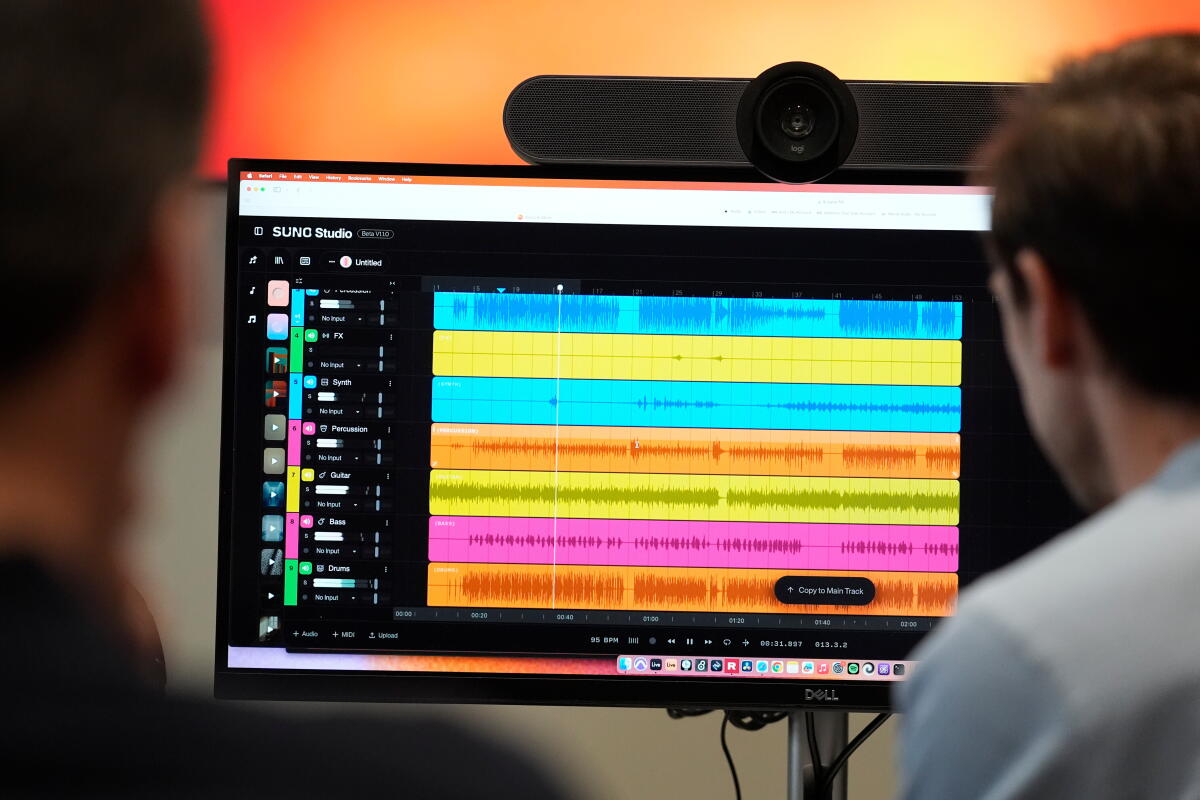
Waveforms of audio files from various instruments are displayed on a computer screen during the making of an AI musical piece at Suno.
(Robert F. Bukaty / Associated Press)
“These companies are able to make deals on behalf of their artists, and their control over their music is pretty significant based on what major label contracts typically say,” Davidson said. “But I expect that we will have some artists that push back against this and say that they didn’t authorize the use of their music for this purpose.”
Warner’s agreement with Suno, for example, lets artists opt in to having their names, likenesses, voices and compositions used in AI-generated music. But Jack Brody, Suno’s chief product officer, acknowledged that labels “ultimately have their contracts in place that will have some say in what an artist can and can’t do.” It’s also not always clear whether opting out keeps an artist’s recordings out of AI training, or only out of fan-facing features.
Michelle Lewis, a songwriter and the co-founder and chief executive of the nonprofit Songwriters of North America, said the composition side of that copyright split is often the harder one to defend.
“With AI, it’s so much easier to tell if you’ve infringed on the sound recording. You know what Beyoncé and Drake’s voices sound like,” said Lewis, who wrote Cher’s “A Different Kind of Love Song,” Little Mix’s “Wings” and the music for the Disney Jr. show “Doc McStuffins.” “But songwriting is so much more nebulous, so much harder to sue.”
“From the creator side, nobody asked for this. We like our job,” added Lewis. “The job is the process and what makes it special, interesting and artful.”
Some musicians argue the deals can’t cover rights the labels don’t control. A proposed class action filed last month by Jason Isbell and other musicians alleges Suno lets users generate songs that evoke specific artists’ identities without their consent, a right-of-publicity claim the plaintiffs say belongs to performers no matter who owns their recordings. Suno disputes the claims.
Session musicians like Evans are pushing back through their union.
“By licensing our members’ performances to AI platforms like Suno and Udio without consent, credit, or compensation, companies like Universal, Warner Records, and Atlantic are bypassing the very human creators who made their catalogs valuable in the first place,” AFM International President Tino Gagliardi said in a statement.
The labels have disputed the claims and argue that these deals advance the interests of artists and songwriters.
Jonathan Wyner, head of artistic technology initiatives at Berklee College of Music’s Emerging Artistic Technology Lab, compared the AI deals to the arrival of streaming services. Wyner has advised Suno.
“It’s a good step, and I think it was an inevitable step, especially if you want to stay engaged with musicians and the creative community,” he said.
That comparison cuts both ways. Streaming grew the industry while fueling years of complaints about artist pay.
Damon Krukowski, a musician and the legislative director at United Musicians & Allied Workers, said the deals so far don’t seem to benefit working-class musicians and could be used to cut them out entirely.
“It’s a new technology, but it’s not a new corporate story,” Krukowski said. “But the tools are even more powerful. It seems within their possible reach to destroy the labor market. The major labels are just seeing dollar signs without any regard to the long-term health or sustainability of this industry, because they’re envisioning an industry without artists who can push back.”
Brody disputed that, saying Suno is building ways for independent and unsigned artists to benefit, such as its deal with Believe and TuneCore.
With terms under wraps, it’s too early to know whether any of this will pay off for artists. The tests are still ahead — whether Sony and Universal win or settle, and what the first payouts actually look like.
“A label making a deal and an individual artist having a choice are not necessarily the same thing,” said Drew Silverstein, the senior advisor for AI at music tech company BandLab Technologies. “Our music industry has a long history of new revenue streams coming into existence that benefit certain folks, and create great financial opportunities for rights holders.”
Acclaimed Russian film director who won 2026 Grand Prix award at Cannes, has been critical of the war in Ukraine.
Published On 18 Sep 202618 Sep 2026
The winner of a prestigious Cannes Film Festival award has been declared a foreign agent by Russian authorities for his criticism of Moscow’s war in Ukraine.
Acclaimed Russian film director Andrey Zvyagintsev was designated a “foreign agent” by the Kremlin on Friday, according to state news agency TASS.
Recommended Stories
list of 3 itemsend of list
Zvyagintsev won the 2026 Grand Prix at the Cannes Film Festival for, Minotaur, a film depicting a Russian businessman who is forced to decide which of his employees should be mobilised to go and fight in Ukraine.
“Millions of people on both sides of the front line dream of only one thing: for the massacres to stop,” Zvyagintsev said in his acceptance speech, adding that Russian President Vladimir Putin was the only person capable of ending the war.
Moscow has kept casualty numbers from the fighting in Ukraine heavily restricted and has not provided timely or complete public updates, but estimates of Russian soldiers killed in the four-year war range from anywhere from 200,000 to half a million.
Russia’s Ministry of Justice on Friday accused Zvyagintsev of disseminating “false information about decisions taken by the public authorities of the Russian Federation and the policies they pursue”.
“He interacted with foreign agents and resides outside the Russian Federation,” it said.
The 62-year-old director, who has lived outside Russia since the COVID pandemic, is known for a series of other films including, The Return, The Banishment, and, Leviathan, a bleak portrayal of life in rural Russia.
People listed as foreign agents are subjected to onerous bureaucratic requirements and restrictions on their income in Russia.
They are barred from holding public office and forced to register their activities with the authorities.
They also have to add warnings on everything they publish, including on social media, that the content was produced by a foreign agent.
The label adds connotations of espionage to numerous people, including public figures, whom it deems to be engaging in anti-Russian activity with support from abroad.
Previously, writer Boris Akunin and rock musician Boris Grebenshchikov have been labelled as foreign agents by Moscow.

![An excavator clears mud from damaged houses following deadly flash floods and a mudslide, in Nuwakot district, Nepal, September 21, 2026 [Navesh Chitrakar/Reuters]](https://i0.wp.com/occasionaldigest.com/wp-content/uploads/2026/09/2026-09-25T021410Z_709369844_RC2ENNAUM1TN_RTRMADP_3_NEPAL-FLOODS-BALEN-UN-1790312192.jpg?w=640&ssl=1)
![Nepal Prime Minister Balendra Shah addresses the 81st United Nations General Assembly at UN headquarters in New York City, US, September 24, 2026 [Eduardo Munoz/Reuters]](https://i0.wp.com/occasionaldigest.com/wp-content/uploads/2026/09/2026-09-25T002524Z_1559668133_RC20QNACRCWK_RTRMADP_3_UN-ASSEMBLY-1790312740.jpg?w=640&ssl=1)