At Casa 0101, Chicana punks revel in unapologetic mindset
Last Saturday night, a multigenerational crowd of about a hundred people packed the Casa 0101 Theater in Boyle Heights to watch supergroup Cron66 make its world debut. Some rocked facial piercings and wore all-black outfits, while others showed up with polos, sports coats and an occasional hearing aid here and there.
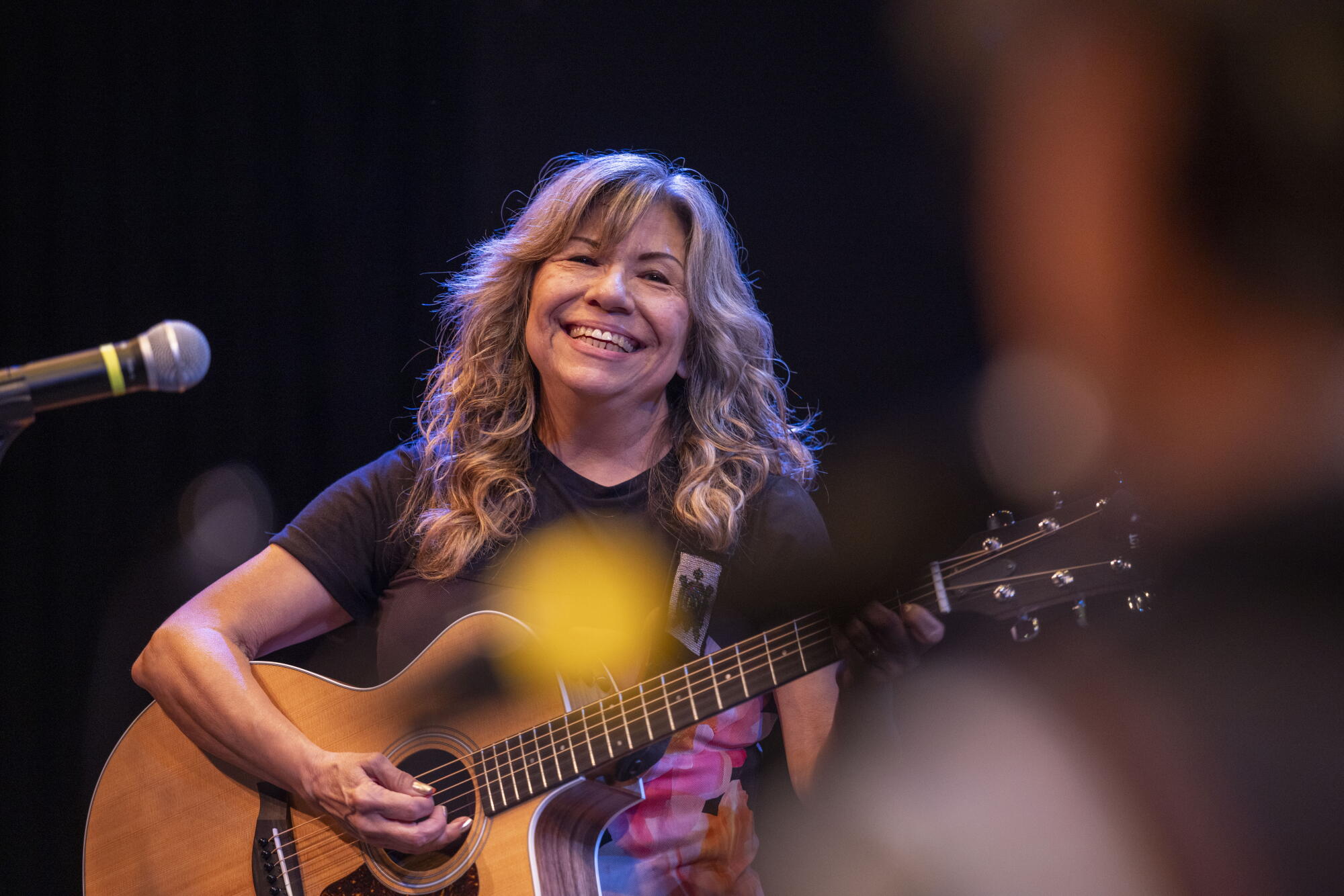
While the quartet has a folksy, singer-songwriter sound, Cron66 is anchored by L.A. punk legends Teresa Covarrubias — former frontwoman of the seminal band the Brat — and Monica Carrillo — key member of East L.A. group the Odd Squad.
An acoustic guitar, a ukulele and sound-dampening drum rods awaited the musicians onstage, along with vestiges of their rebellious past— an antifa flag hung from the top of an amplifier.
The performance was part of “Chicano Rock: the Women,” a three-day celebration of the women who helped shape the genre for more than four decades that featured live music, panel discussions and an exhibit. Saturday was devoted to highlighting the East L.A. Chicana punk movement of the late ’70s and early ’80s.
The three-day event was organized by David Reyes, 75, and Maria Elena Yepes, 76, of Brownfist Productions, an entertainment company promoting Latino heritage, history and culture. The duo say they were inspired to honor Chicana rockers after putting together an event this spring highlighting the work of ’60s East L.A. Chicano rock band the Midniters.

(Jill Connelly / For De Los)
“Greater society has made these artists feel less than, and we wanted to show just how talented they are and how much they contributed not just to our culture but to American rock ’n’ roll,” Yepes said of their decision to focus on these women.
Yepes added that she hoped the three-day affair would push young women toward exploring their own artistic endeavors.
“It’s very important they see women who are very much themselves, who are poised, who are open and that show people what it’s like to be an artist,” she said. “In these last few years, with the administration we’ve had in the U.S, they definitely need words of inspiration, they need music, they need art that brings them joy and encourages them to think.”
Covarrubias echoed Yepes’ sentiment, adding that she felt heartened by how vocal female rockers had become over the last few decades.

(Jill Connelly / For De Los)
“The community now is really empowered and more organized too,” Covarrubias said. “Now the women say, ‘F— you’ and that should’ve been our attitude back then.”
She praised the younger rockeras currently leading the punk movement for creating safe spaces where they are included and heard in a society that is increasingly looking to silence them.
For Covarrubias and Carrillo, nothing is more punk than embracing blemishes artistically — they both rage against AI’s pursuit of perfection — or physically. Though they see punk’s future as resting in the hands of young people, they also have noted a resurgence among women in their 60s.

(Jill Connelly / For De Los)
“In the ’80s we were the inspiration for this generation of women coming up, and now we could be the inspiration for how you age and how you embrace aging without feeling like you need to be eternally youthful or buying into this whole thing of believing you’re invisible because you’re older,” Covarrubias said. “Maybe I can make things easier for those coming up by embracing my wrinkles and my saggy, because that’s human.”
One Chicana in punk who has continually found a well of inspiration from her rocking elder sisters is Erika Lares, the 35-year-old frontwoman of the L.A. punk band Futura. Lares was part of a panel that featured Covarrubias and Carrillo.
In the few minutes before meeting Carrillo and Covarrubias in person and performing a headbanging set with her band, Lares told The Times she was grateful for her Chicana foremothers.
“Because of the whole history of Mexican Americans [in L.A.], it’s amazing knowing that they started making music in the ’70s and ’80s, just a couple of years after the whole Chicano movement,” Lares said. “People were still kind of weird about seeing Mexicans, so their presence makes me proud to be Chicana and see how far we’ve come.”
As Lares belted in her microphone and her bandmates banged away at their instruments, several young girls freely hopped along in the aisle to the music as some of the older folks reached back and pumped out a couple of headbangs.