l.a. mayor

In L.A. mayor’s race, everyone is campaigning on change — even the incumbent

Mayor Karen Bass has had a lengthy political career, spending six years in the state Legislature, 12 years in Congress and the last three in the top elected office at Los Angeles City Hall.

Now, facing the toughest reelection battle of her career, Bass is marketing herself in a way that might surprise some Angelenos: She’s running as a champion of change.

And she’s not alone.

City Councilmember Nithya Raman, who has represented a Hollywood Hills district since 2020, says her last-minute decision to enter the race was fueled by “a sense of urgency that things needed to change.”

Three other major candidates, all political newcomers, argue that an outsider is needed to shake up the status quo.

“We can no longer keep our city together with duct tape and slurry,” said Rae Huang, a leftist community organizer, at a recent candidate forum on housing and transportation.

The race to embrace the mantle of change in the June 2 primary election comes at a moment of political peril for Bass, a veteran Democrat who has racked up high disapproval numbers in several voter surveys.

In recent months, Bass has revamped her messaging, saying she’s been tackling problems that have “been around for multiple decades,” such as homelessness, sluggish police hiring and trash-strewn streets.

Last week, speaking to the Pacific Palisades Democratic Club, Bass said she wants another four years to finish that work. She also implied that, in her zeal to fix the city’s problems, she quietly pushed out a dozen high-level bureaucrats, including those who dealt with trash pickup and police recruitment.

“Let me just tell you that in three years and three months, it is difficult to change what has been a practice for over four decades,” Bass told the group. “I am very clear that there needs to be massive change, and I’ve done a lot of change.”

Raman has portrayed herself as someone who shook up the system while in office, securing a 4% cap on rent increases for more than 600,000 apartments and opposing initiatives she viewed as “disastrous” for the city’s budget. She said the city is falling short on an array of issues, including traffic deaths and housing affordability.

“So much of what’s happening in L.A., our inability to address our biggest crises — our housing crisis, our homelessness crisis, but also essential services like lights and potholes — so much of this has resulted from a lack of clear urgency in decision-making at City Hall,” said Raman, the first L.A. council member to win office with the backing of the Democratic Socialists of America.

Those types of arguments have elicited salty responses from Huang, tech entrepreneur Adam Miller and conservative reality TV personality Spencer Pratt.

Miller, who described himself as a lifelong Democrat, pointed out that Raman runs the powerful five-member council committee on housing and homelessness. He argued that both she and Bass have failed on those issues, as well as on public safety and much needed infrastructure repairs.

“These are the people who have been running the government,” said Miller, who made a fortune developing education software. “So I don’t understand how they could describe themselves as change-makers. They’re the ones who have been the problem.”

Pratt offered a similar take on social media, calling Raman and Bass “two peas in a pod,” while portraying himself as a change agent.

“I’m a wrecking ball to the status quo,” he said in one post.

Neither Pratt nor his representative responded to an interview request.

In one recent high-profile poll, about 56% of respondents said they had an unfavorable view of Bass. In another, about 40% of those surveyed said they had not yet made up their minds about who should lead the city.

“It’s clear that there are concerns among voters about the direction of the city — and the state, quite frankly,” said Pomona College politics professor Sara Sadhwani, referring to the race for governor. “In both instances, there are lackluster candidates, and so we see voters being very much undecided in both of these incredibly consequential races.”

The election season got underway a little more than a year after the Palisades fire, which destroyed thousands of homes and left 12 people dead.

Bass, who was out of the country when the fire broke out, was unsteady in her early public appearances and, since then, has faced sharp criticism over the pace of the rebuilding. She has defended her record on the recovery, saying she cut red tape and suspended city permit fees, while also pressing the Trump administration to crack down on insurance companies that fail to compensate wildfire survivors.

The back-and-forth over change and the status quo broke to the surface during last month’s housing forum in downtown L.A.

At one point, Raman voiced alarm over the city’s elevated “people mover” being built at Los Angeles International Airport, saying it is so far behind schedule that it won’t be ready before the World Cup, which starts in June.

Raman said that as mayor, she would ensure that such projects are finished on time — and replace airport leadership if it fails to happen.

“Nithya, you’ve been on City Council for six years, though,” Huang shot back. “Why have you not moved this forward?”

(At five years and four months, Raman’s tenure is slightly less than that.)

Raman countered that, as a council member, she only has control over certain issues.

“So much of what’s going wrong in Los Angeles requires the mayor to get involved,” she said.

Bass did not attend the forum, traveling instead to New Orleans for a reelection fundraiser. Pratt also skipped. In their absence, the three remaining candidates pounded on a wide array of municipal ills, including broken sidewalks, high rents and sluggish housing production.

Raman, at that event and elsewhere, has sought to differentiate herself from Bass, and City Hall more broadly, by highlighting her dissenting votes.

In 2023, Raman opposed a package of police pay increases negotiated by Bass, saying they were too expensive and would deprive other city departments of funding. Last year, she voted against a $2.6-billion upgrade of the Convention Center, citing similar long-term cost concerns.

Bass, for her part, said she’s been shifting the direction of the city in critical ways. Previous city leaders were too hesitant to build temporary housing for homeless people, she said, leaving them to languish on sidewalks while waiting for government-funded apartments to be built.

After taking office in 2022, Bass declared a local emergency on homelessness and launched her Inside Safe initiative, which has put thousands of people into hotels and motels. Raman signed off on the emergency and the funding for Inside Safe but now says the program is too expensive.

The mayor said she also pushed for changes in LAPD hiring, not just by making officers’ salaries more competitive, but by hacking away at a slow and bureaucratic recruitment process. Speaking to the Palisades Democrats, Bass said she got that done, in part, by changing the leadership and staff at the city’s personnel department.

Bass told the group she’s preparing to launch an initiative to clean up the city’s streets — and that she made a personnel move in that regard as well.

“In terms of cleanliness, I’ve had to change the leadership of the Department of Sanitation, because I couldn’t get the job done,” she said.

Sadhwani, the Pomona College professor, said she doubts that voters will view Bass as a reform candidate. Raman, she argued, is also part of the establishment.

“They cannot run from the fact that they have been in power,” she said.
Source link

Bass leads the field for L.A. mayor, but many voters view her unfavorably, poll finds

Los Angeles Mayor Karen Bass has a lead over her challengers in her bid for reelection, but more than half of voters view her unfavorably, according to a poll released Sunday.

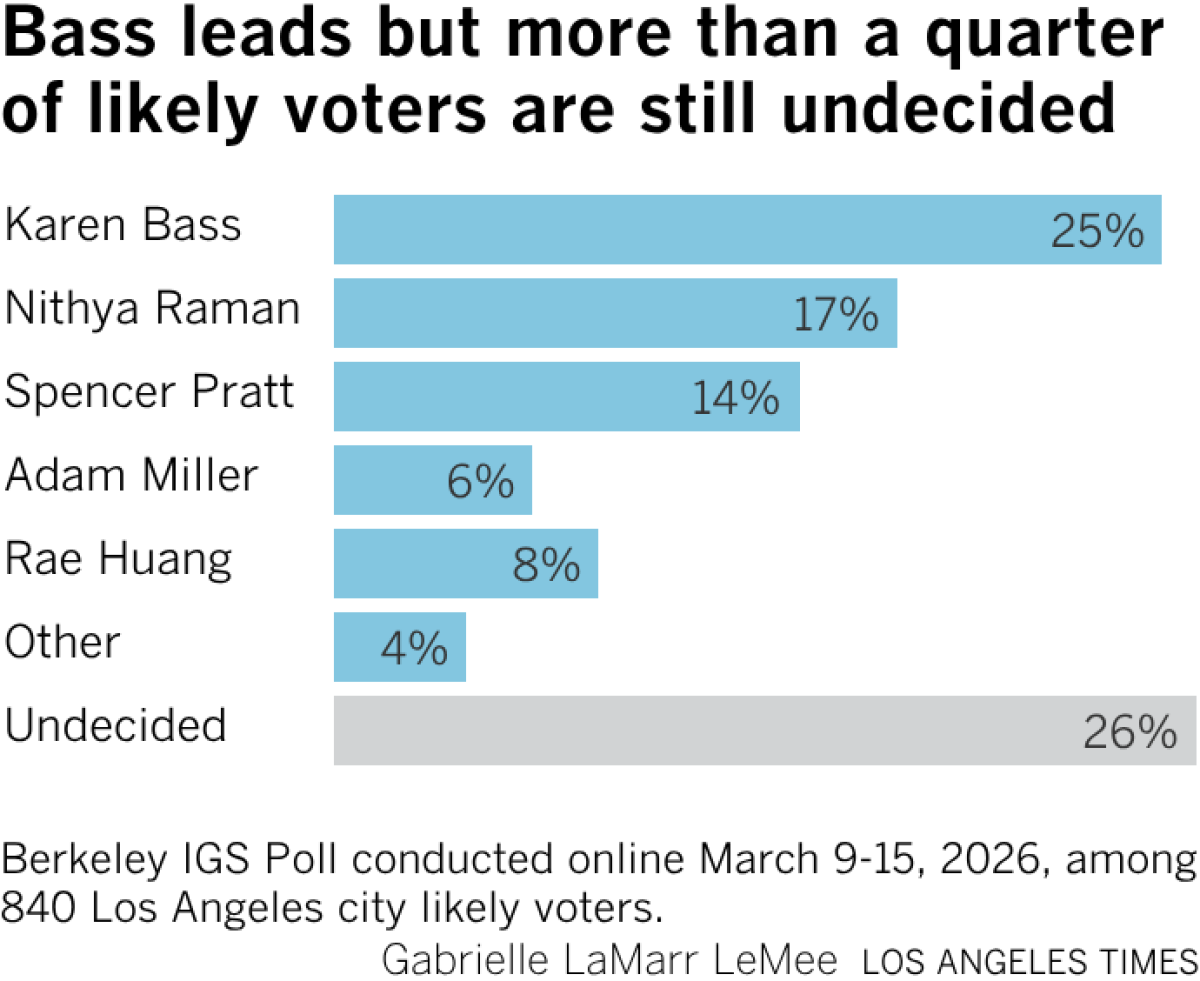
Bass was supported by 25% of voters, while City Councilmember Nithya Raman drew 17% and conservative reality TV star Spencer Pratt came in third at 14% in the poll by the UC Berkeley Institute of Governmental Studies, co-sponsored by The Times.

About a quarter of voters were undecided, the poll found.

Bass has come under heavy criticism for her handling of the devastating Palisades fire. More than a year later, 56% of those polled said they had an unfavorable view of her, while 31% viewed her favorably.

The survey of 840 likely voters between March 9 and 15 provides one of the first snapshots of the mayoral race, less than three months before the June 2 primary.

Beyond the top three, leftist Rae Huang notched support from 8% of those polled, while tech entrepreneur Adam Miller drew 6%.

Despite Bass’ lead, the poll is “borderline catastrophic” for her, because the field of candidates is so weak, said Dan Schnur, a politics professor at USC, UC Berkeley and Pepperdine.

“That she’s having this much trouble against this field, against such a little-known field of opponents, bodes very, very poorly for her,” Schnur said. “The only thing saving her at this point is that the top tier of potential candidates who were considering running against her decided to stay out of this race.”

The mayoral race solidified in early February, when Raman shocked the political establishment by jumping in against her ally Bass, hours before the filing deadline.

By that time, other well-known politicians, including billionaire developer Rick Caruso and L.A. County Supervisor Lindsey Horvath, had opted to stay out of the race. Former Los Angeles schools Supt. Austin Beutner dropped out following the death of his 22-year-old daughter.

Those decisions have left Angelenos with a field of candidates they hardly know. While they have strong views about Bass, slightly more than half of those polled said they didn’t know enough about Raman to have an opinion. Even more voters were unfamiliar with the other candidates.

Bass was on a diplomatic trip to Ghana when the Palisades fire ignited on Jan. 7, 2025, killing 12 people and destroying thousands of homes. She was unsteady in her initial public appearances and has since come under attack by Pratt, Caruso and others over the LAFD’s management of the fire and the pace of the recovery as well as allegations that she ordered an after-action report on the fire to be watered down.

Bass’ campaign has pointed to declining homelessness and crime as among the successes of her first term as mayor.

“It’s clear Angelenos are frustrated by decades of inaction on major issues,” Douglas Herman, a spokesperson for the Bass campaign, said in a statement. “This campaign will show that it’s Karen Bass who changed the direction on these issues and that others running responded with reports while Karen Bass took action.”

Raman, who represents Los Feliz and parts of Silver Lake and the San Fernando Valley, was viewed favorably by 26% of those polled and unfavorably by 23%. The 51% who said they didn’t have an opinion of her could be an indication that she has yet to expand her name recognition citywide.

She has said that her decision to run was driven in part by her frustration with city leaders’ inability to get the basics right, such as fixing streetlights and paving streets.

“I am very grateful that our campaign to make our city more affordable is resonating with so many Angelenos,” she said in a statement.

Former City Councilmember Mike Bonin, who runs the Pat Brown Institute for Public Affairs at Cal State L.A., said that after the shock of Raman’s entry into the race, the mayoral campaign has taken on a sleepier pace.

“Candidates are raising money and doing their due diligence … but it’s felt like a staid, quiet race,” he said. “This poll reflects that.”

Bonin said the most important number is the gap between Raman and Pratt.

If no candidate gets more than 50% of the vote in the primary, the top two finishers will proceed to a November run off. According to Bonin, Raman and Pratt will likely be jockeying to face off against Bass.

“While voters are clearly looking for an alternative [to Bass], they haven’t chosen one,” Bonin said.

The poll showed Bass — the city’s first female mayor and first Black female mayor — with strong support from Black voters, at 43%, while Raman has 6%.

Raman, who if elected would be the city’s first South Asian mayor, leads with Asian and Pacific Islander voters at 34%, with Bass at 10%.

Bass performs better with older voters, while Raman and Huang are appealing to younger voters, the poll found. Huang led the pack at 19% with voters between 18 and 29 years old.

In the poll, Angelenos ranked their top priorities for the next mayor to address. Building more affordable housing came in first, followed by fixing streets, sidewalks and streetlights and then moving homeless Angelenos indoors.

One potential bright spot for Bass was policing.

The poll found that 39% of Angelenos think the LAPD needs to increase in size, with 29% saying the department should stay the same size and 19% saying it should shrink.

Bass has called on the City Council to hire more police officers.

Raman, meanwhile, has said that she believes the police force is the right size at around 8,700 officers, down from a peak of 10,000 in 2020.

“Bass is going to make Raman look like AOC’s liberal sister,” said Schnur, referring to progressive U.S. Rep. Alexandria Ocasio-Cortez (D-N.Y.). “If she ends up in a runoff against Raman, she can run as a tough-on-crime centrist.”

Source link

Democratic Socialists of America won’t endorse in race for L.A. mayor

The Los Angeles chapter of the Democratic Socialists of America will not endorse a candidate for mayor.

After City Councilmember Nithya Raman decided at the last minute to run against her former ally Mayor Karen Bass, the group called a vote on whether to reopen the endorsement process, which it had closed without supporting a candidate.

DSA-LA backed Raman’s two successful city council runs, but she has been at odds with the group on some issues.

Also in the mix was another mayoral candidate, community organizer Rae Huang, whose positions align more closely with those of the group.

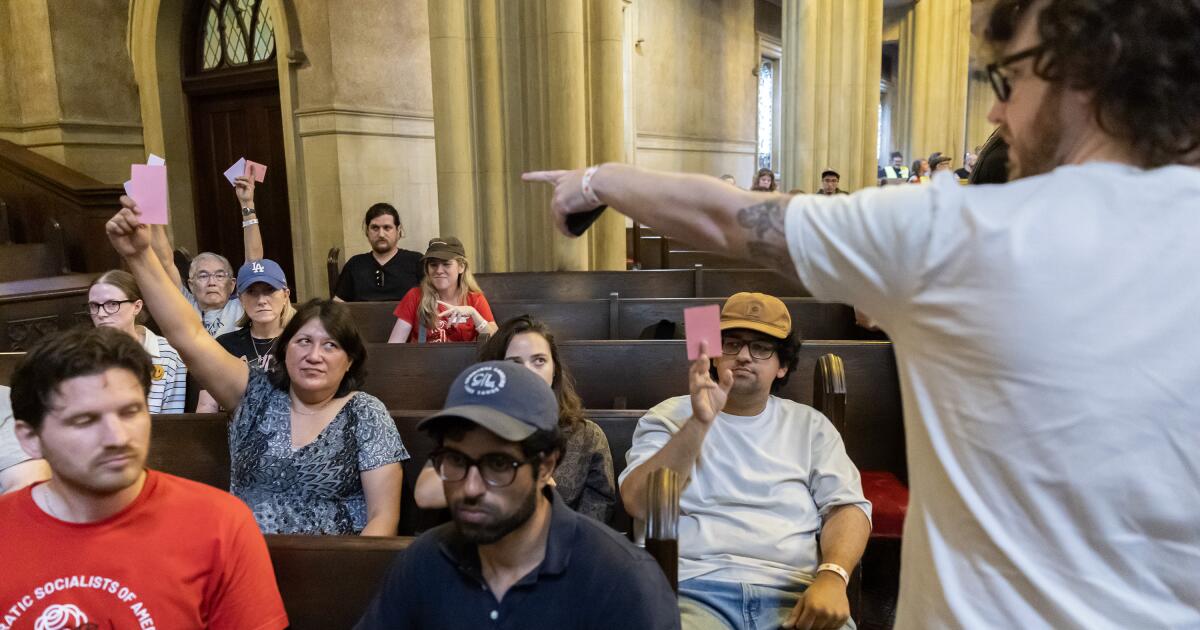
The two candidates were present for Saturday’s vote at Immanuel Presbyterian Church in Koreatown, though neither spoke.

The left-wing organization, which has about 5,000 members, is known for running strong ground game campaigns that include canvassing, door-knocking and phone banking. In addition to Raman, three other DSA-backed politicians now sit on the 15-member City Council.

Before the vote, DSA-LA members argued for and against reopening the endorsement process.

“The worst thing we can do right now for our movement is to say, ‘Well, actually, we’re not going to endorse Rae or Nithya. We’re going to do a third thing, which is to issue no endorsement.’ Who is the audience for this message?” said Leslie Chang, a co-chair of DSA-LA.

DSA-LA member Anna Gross argued that neither candidate was ideal, with Huang, who has little political experience, being a long shot and Raman hesitating to fully embrace the group.

“I do want a democratic socialist mayor, but as it stands, we have one candidate who is not going to win … and a candidate who will not openly identify as a democratic socialist,” Gross said.

Of the 488 members who voted Saturday, about 55% supported reopening the endorsement process, falling short of the required two-thirds majority.

If the process had been reopened, the group would have then voted on whether to endorse Raman, Huang or neither.

Huang’s earlier attempt to get the endorsement while the window was still open had failed because she did not obtain enough valid member signatures to qualify.

If the race is not decided in the June 2 primary, DSA-LA can still endorse a candidate in the runoff.

Besides Bass, Raman and Huang, the field of 14 candidates includes conservative reality TV star Spencer Pratt and tech entrepreneur Adam Miller.

Some members believed that a mayoral endorsement would take resources away from the slate of six local candidates they have already endorsed.

In city council races, DSA-LA is backing incumbents Hugo Soto-Martínez and Eunisses Hernandez; Faizah Malik, who is running against incumbent Traci Park on the Westside; and Estuardo Mazariegos for an open South L.A. seat.

The group is also backing Marissa Roy, who is challenging City Atty. Hydee Feldstein Soto, and Rocío Rivas, an incumbent L.A. Unified school board member.

Source link

Inside Democratic Socialists of America’s decision on whether to endorse for L.A. mayor

The same day she announced her surprise bid for mayor, Los Angeles City Councilmember Nithya Raman called a member of the local Democratic Socialists of America chapter.

She wanted to meet with the group’s leadership to explain her late-breaking decision to challenge Mayor Karen Bass, her longtime ally, which took just about everyone in the city by surprise.

Two days later, Raman gathered at her Silver Lake home with leaders of DSA-LA, which has endorsed her two runs for City Council but has been at odds with her on some issues.

Leslie Chang, a co-chair of the 5,000-member chapter, recalled Raman saying, “‘The media is going to paint me as a DSA candidate, and I have a relationship with you, and I’m interested in maintaining that relationship. So let’s talk.’”

DSA-LA, which had declined to endorse in the mayor’s race, will decide on Saturday whether to reopen its endorsement process.

Some members believe that a mayoral endorsement would take valuable phone-banking and door-knocking resources away from the slate of six local candidates they have already endorsed.

If the process moves forward, the question would then be whether to back Raman or Rae Huang, a housing activist viewed by some members as more aligned with socialist principles, while others see her as less electable. The group could also decide not to endorse either candidate.

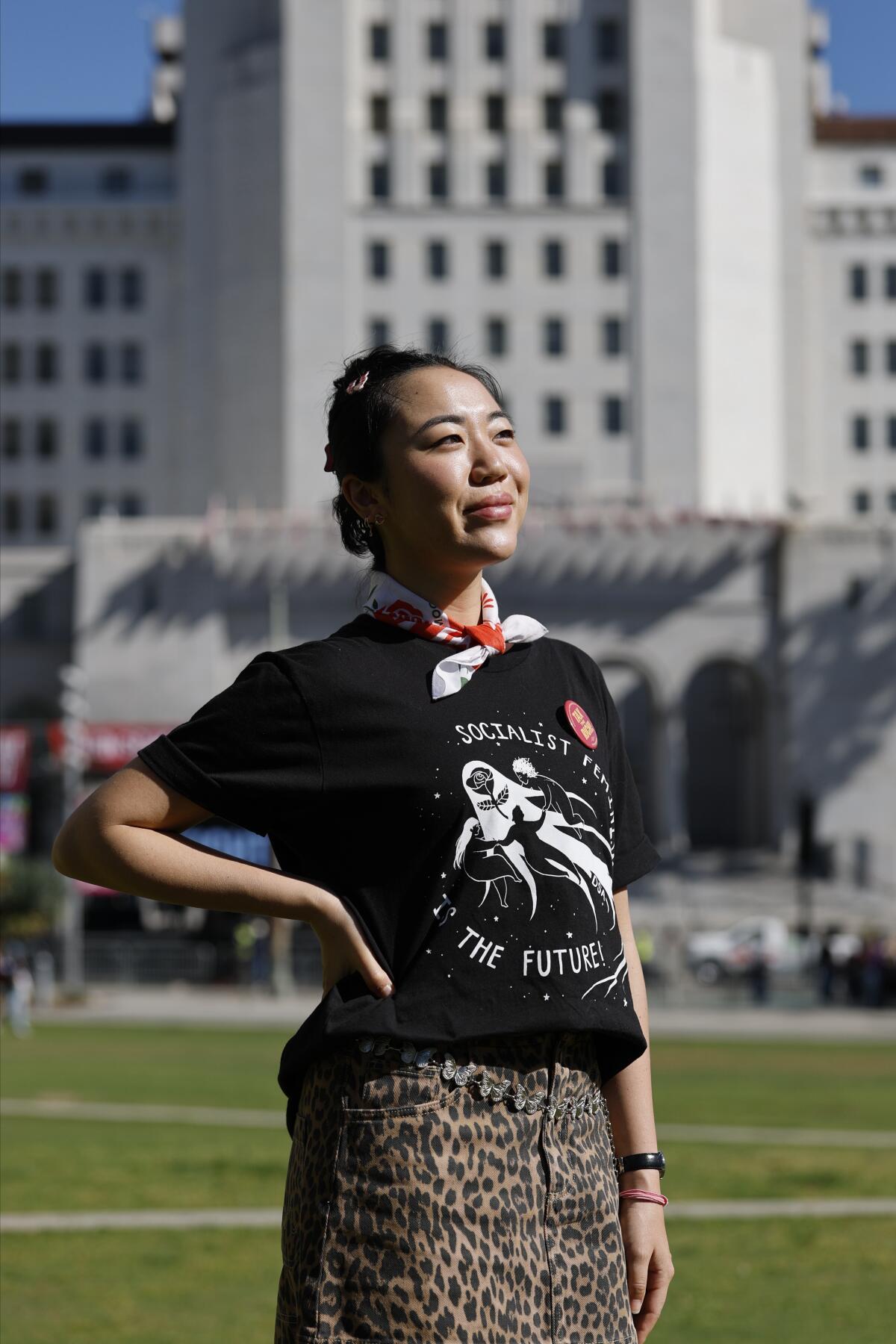
A woman poses for a portrait in front of Los Angeles City Hall.

Leslie Chang, co-chair for the Los Angeles chapter of the Democratic Socialists of America, at a rally at Molina Grand Park in Los Angeles on March 18.

(Gina Ferazzi / Los Angeles Times)

Going to bat for a mayoral candidate would be the highest-profile drive the local organization has run in a city where its influence has expanded since it knocked on doors for Raman’s first council campaign in 2020. In addition to Raman, three other DSA-backed politicians now occupy seats on the 15-member City Council.

In New York, DSA member Zohran Mamdani was recently elected mayor on a platform of rent freezes and free city buses.

“It would be a major coup for DSA to have one of their candidates be elected mayor [of Los Angeles],” said Sara Sadhwani, a politics professor at Pomona College.

The Rev. Rae Huang

The Rev. Rae Huang, who is running for mayor of Los Angeles, joined the Fair Games Coalition to announce the launch of the Overpaid CEO Tax Initiative in front of the Tesla Diner in West Hollywood on Jan. 14.

(Genaro Molina / Los Angeles Times)

As a city council member, Raman has delivered several major wins celebrated by DSA members, including strengthening renter protections and passing the first reform to the city’s rent stabilization ordinance in decades.

But she has sometimes been out of step with the group, approving budgets that increased police spending and seeking to revise Measure ULA, also known as the city’s “mansion tax,” to offer a 15-year exemption to developers of multifamily and commercial projects.

Raman’s most visible split with DSA occurred over the Oct. 7, 2023, Hamas attack that killed more than 1,200 Israelis.

DSA released a statement saying “this was not unprovoked.” Raman called the statement “unacceptably devoid of empathy for communities in Israel.”

In early 2024, DSA censured Raman for seeking and accepting an endorsement from Democrats for Israel-Los Angeles, a liberal Zionist group, chiding her for “accepting support from [DSA’s] enemies.”

“Why are people wary of endorsing Nithya for mayor? A lot of people who were in leadership at the time are hesitant because of that situation,” said Noah Suarez-Sikes, a member of DSA-LA’s steering committee.

In a statement to The Times, Raman called herself an “independent leader.”

“While I share the DSA’s emphasis on uplifting the working class and those who have been left behind by the political establishment, I don’t always agree with my allies on how to accomplish our goals,” she said.

Some DSA members see Huang, who has little citywide name recognition or political experience, as more connected to the group’s platform than Raman. Huang has called for “Fast and Free Buses” as well as for more public input on the city budget.

Huang highlighted her support for keeping the “mansion tax” as is, also telling The Times that she would reduce the Police Department budget and the number of officers.

Raman has said she believes the Los Angeles Police Department should maintain its current staffing of around 8,700 sworn officers.

Konstantine Anthony, a DSA member and Burbank City Council member who gathered signatures to reopen the endorsement window, is supporting Huang.

“She is the exact candidate DSA across the country should be running for every seat,” he said.

Keshav Kundassery, a DSA member since 2019, supports Raman.

While he called Huang’s campaign for mayor “inspiring,” Kundassery said he does not think that she can get enough support.

“DSA should be in the business of running campaigns to win,” he said.

DSA-LA has already endorsed in four city council races, backing incumbents Hugo Soto-Martínez and Eunisses Hernandez; Faizah Malik, who is running against incumbent Traci Park on the Westside; and Estuardo Mazariegos for an open South L.A. seat.

The group is also backing Marissa Roy, who is challenging City Atty. Hydee Feldstein Soto, and Rocío Rivas, an incumbent L.A. Unified school board member.

“Any consideration we make now we will make understanding the balance of resources of our six candidates and a potential seventh,” said Chang, the DSA-LA co-chair.

Times staff writer David Zahniser contributed to this report.

Source link