Los Angeles Council pushing for more Olympic contracts in L.A.
Top Los Angeles officials have reached what they are calling an unprecedented preliminary agreement to help businesses based within the city limits get a meaningful share of the estimated $4 billion in contracts needed to stage the 2028 Summer Olympics.
The deal offers the promise of substantial financial gains for the host city of the Olympics, without forcing event organizers to spend more than they believe is prudent, according to people familiar with the negotiations at City Hall and at LA28, the private nonprofit group organizing the Games.
The deal must still be given final approval by LA28, the City Council and mayor. The people involved spoke on condition of anonymity to describe delicate negotiations nearing completion.
The linchpin of the deal is a commitment by LA28 to spend between 5% and 20% of its overall contracting budget on businesses headquartered in the city of Los Angeles, according to two high-ranking city officials.
LA28 leaders previously estimated their spending with outside firms would total about $4 billion. Five percent of that would be $200 million, and 20% would be $800 million, which provides the range of what L.A.-based companies would stand to pick up as Los Angeles hosts its third Olympiad.
Both sides said the final deal will set a specific dollar target for LA28 spending with L.A.-based businesses, though they declined to say at this time what that amount will be.
If the deal is approved later this month as expected, the parties said it would make Los Angeles the first Olympic city to win such spending pledges. Previous organizing committees agreed to target spending within national borders, not local ones, they said.
The pact would settle one of the most protracted and at times bitter disagreements between city and Olympic leaders since they agreed more than a decade ago to bring the Games back to L.A. for the first time since 1984.
“We’ve always wanted to be thoughtful and to have a big impact in L.A.,” said one leader of LA28. “That’s why we are happy to be setting this goal and to have a target for our contract spending.”
One city official expressed relief that a deal appeared close at hand.
“There had been a lot of concern that there was not enough of the city of L.A. reflected in the Olympic preparations,” said the official. “This is a big concession for LA28 and it’s big for L.A. businesses, something to look forward to.”
Los Angeles officials like the deal because it forces LA28 to publicly commit to spending a good chunk of its $7.2-billion overall budget within the city limits. The Olympic organizers like it because it establishes only goals, not a binding commitment to give contracts to L.A. businesses.
LA28 leaders have said they feared that committing to L.A. businesses would drive up their costs because of the city’s strict regulations and high minimum wage. The L.A. minimum wage is $18.42 an hour — and higher for hotel and some other workers — while California requires pay of $16.90 an hour.
The debate over LA28’s future spending dragged on for months because the two sides didn’t settle the matter in the 2021 contract that set the terms of their partnership.
One city official who helped negotiate the so-called “Games Agreement” in 2021 said that “many, many, many hours” were spent trying to get the Olympic organizers to agree to a specific set-aside for L.A. businesses. But the city failed to win that concession.
Councilmember Hugo Soto-Martinez called the Games Agreement a “terrible deal” that left the city with little leverage, and only the “bully pulpit to try to get what we want.”
That contract outlined broad aspirations, with LA28 promising to work with the city to “endeavor to ensure that small, local, and underrepresented businesses have awareness of and access to applicable contract opportunities.”
City officials, led by former Mayor Eric Garcetti, believed the details could be worked out later. LA28 Chairman Casey Wasserman also signed the 2021 contract, saying that it gave LA28 maximum flexibility in preparing for an Olympics that he and others have described as the biggest and most complex athletic event in history.
LA28 leaders subsequently agreed they would attempt to direct 75% of their massive contracting budget toward “local” businesses, which they defined as those based in five Southern California counties — Los Angeles, Orange, Ventura, Riverside and San Bernardino.
That wasn’t good enough for Mayor Karen Bass and many City Council members. At a tense council hearing in April, several city lawmakers slammed LA28 Chief Executive Reynold Hoover for refusing to make a binding commitment to L.A. businesses.
City Council President Marqueece Harris-Dawson told Hoover that his plan “misses the mark” by not giving the city special consideration while recognizing a five-county area “that [has] a lot less at stake.”
Councilmember Monica Rodriguez said that given L.A.’s commitment to cover debts if the Games lose money, “our businesses in the city of Los Angeles should be … first in line” for contracts.
Hoover responded that LA28 had conducted significant outreach to L.A. businesses to help them get a piece of Olympics action. But he said LA28 couldn’t ignore cost considerations.
In essence, Hoover’s message was that overpaying local businesses for goods and services would raise the risks of the Games losing money — and if that were to happen, the city would be stuck with the tab.
“If I focus solely, first and foremost, on the city of L.A., for … small business, then I am artificially reducing the pool of competition,” Hoover told the council, “placing greater risk on city taxpayers and placing greater risk on the [financial] backstop of the city of L.A., because prices will go up when there is no competition.”
Although fears of an Olympic deficit can’t be dismissed, many of the officials and organizers involved with the Games expect a profit, based on robust advance ticket sales and lucrative sponsorship deals already inked.
One LA28 executive said that initial spending on contracts — which reached a total of $687 million last year — is already on track to reach the goals outlined in the pending agreement with the city. The Olympic organizing group has reported that its fundraising has kept pace with expenditures of $7.2 billion.
On L.A.’s left political flank, an agreement to favor the city’s businesses would be welcome but seen as not nearly enough.
Kurt Petersen, co-president of Unite Here Local 11, which represents workers in hotels, restaurants and sports arenas across Southern California, said he wants the Olympics to spur much more lasting change.
“We’re talking about legacies — it’s what’s going to happen when the Olympics leave,” Petersen said at a rally Wednesday outside the Los Angeles Memorial Coliseum announcing the Fair Games Coalition’s Olympic demands.
The coalition — a band of immigrant rights groups, faith organizations and labor unions, including Petersen’s — demanded in a letter to the International Olympic Committee last week that funding for 50,000 new affordable housing units and a ban on Immigration and Customs Enforcement officers at the Games.
“We want jobs. We want housing. We don’t want ICE here,” Petersen said. “What good is a procurement if ICE shows up here?”
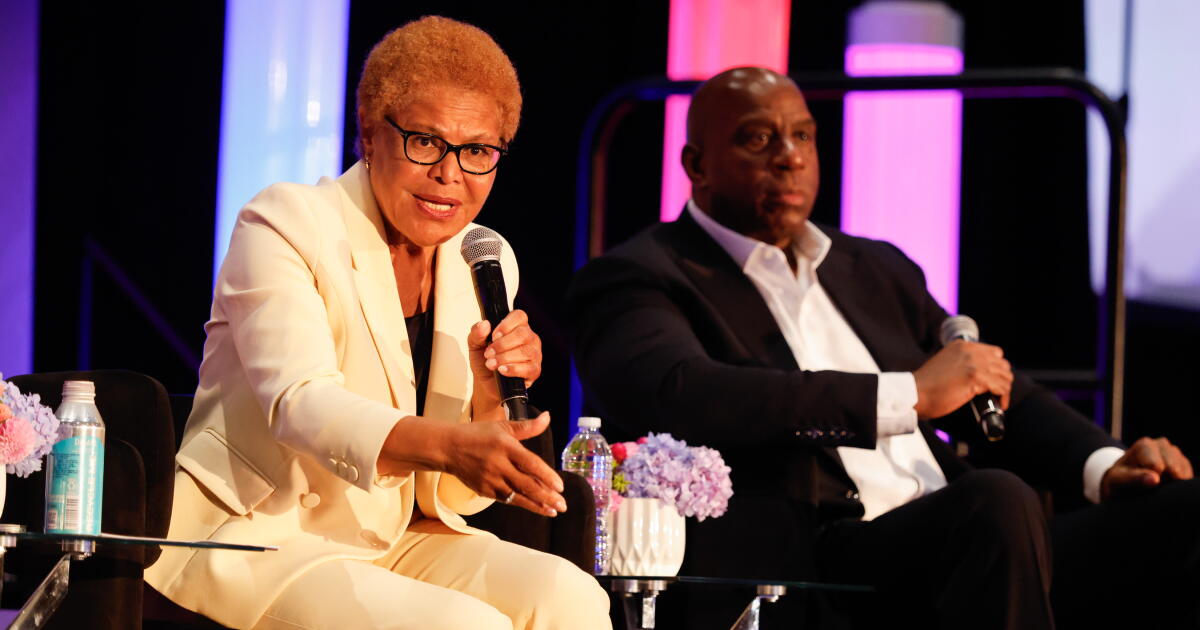
To help small businesses get Olympics contracts, Bass recently convened a Sports & Entertainment Procurement Summit at the Convention Center, where she and Lakers great Magic Johnson gave pep talks.
Said Bass: “We have to take advantage of the Games coming to fast-track a lot of things that we have needed to do in the city for a very, very long time.”