Koreas

Can AI cure loneliness? South Korea’s robot companions for seniors | Newsfeed

NewsFeed

South Korea is using AI-powered companion dolls to help tackle loneliness in its ageing population. The robots remind seniors to take medication, monitor wellbeing and call for help in emergencies. As AI expands, concerns remain over whether it can ever replace human connection.

Source link

BOK lifts S. Korea’s growth forecast to 2.6 pct for this year amid robust chip-driven exports

The central bank on Thursday raised its economic growth forecast for South Korea to 2.6 percent for 2026 amid solid semiconductor exports. This file photo shows containers stacked at a port in Pyeongtaek on May 8. Photo by Yonhap

The central bank on Thursday raised its economic growth forecast for South Korea to 2.6 percent for 2026 amid solid exports driven by a semiconductor super cycle.

The revision by the Bank of Korea (BOK) represents a 0.6 percentage-point increase from its previous forecast of 2 percent issued in February.

It is the largest upside revision since May 2021, when the BOK raised its growth projection by 1 percentage point from 3 percent to 4 percent.

For 2027, the central bank estimated its growth outlook at 2.1 percent.

The South Korean economy grew 1.7 percent in the first quarter, marking the sharpest quarterly growth in 5 1/2 years.

The revised outlook broadly aligned with forecasts from other institutions.

The International Monetary Fund (IMF) projected growth of 1.9 percent this year, while the Asian Development Bank (ADB) projected 1.9 percent growth.

The Korea Development Institute (KDI) earlier improved its growth forecast to 2.5 percent for 2026 from 1.9 percent.

The BOK also revised up its inflation prediction to 2.7 percent from 2.2 percent, citing higher international oil prices in the aftermath of the U.S.-Iran war.

For 2027, consumer prices are estimated to rise 2.3 percent, according to the BOK.

“The Korean economy is projected to expand by 2.6 percent this year, well above the February forecast of 2 percent, driven by robust semiconductor exports, while government measures, including the supplementary budget, partially offset the Middle East-driven supply shock,” the BOK said in a release.

BOK Gov. Shin Hyun-song said in a press conference that strong exports will likely contribute 0.7 percentage point to the country’s growth this year, alongside the 0.2 percentage point gains generated by the government’s fiscal support and the 0.1 percentage-point increase brought on by the local stock market rally. On the other hand, the ongoing U.S.-Iran war will drag down the economy by 0.4 percentage point, he added.

“Based on our analysis, we concluded that if the situation in the Middle East is resolved early, this year’s growth rate could exceed 2.6 percent,” he said. “We do not think the growth is a short-lived trend.”

The central bank presented an optimistic scenario in which semiconductor-driven exports gain further momentum, raising its growth forecast by 0.5 percentage point for 2026 and 0.3 percentage point for 2027.

Under a pessimistic scenario, however, a possible slowdown in artificial intelligence investments would lower economic growth by 0.3 percentage point this year and 0.2 percentage point next year, the central bank said.

In line with the upbeat outlook, the BOK kept the key interest rate unchanged at 2.5 percent but signaled a possible rate hike in the second half.

Copyright (c) Yonhap News Agency prohibits its content from being redistributed or reprinted without consent, and forbids the content from being learned and used by artificial intelligence systems.

Source link

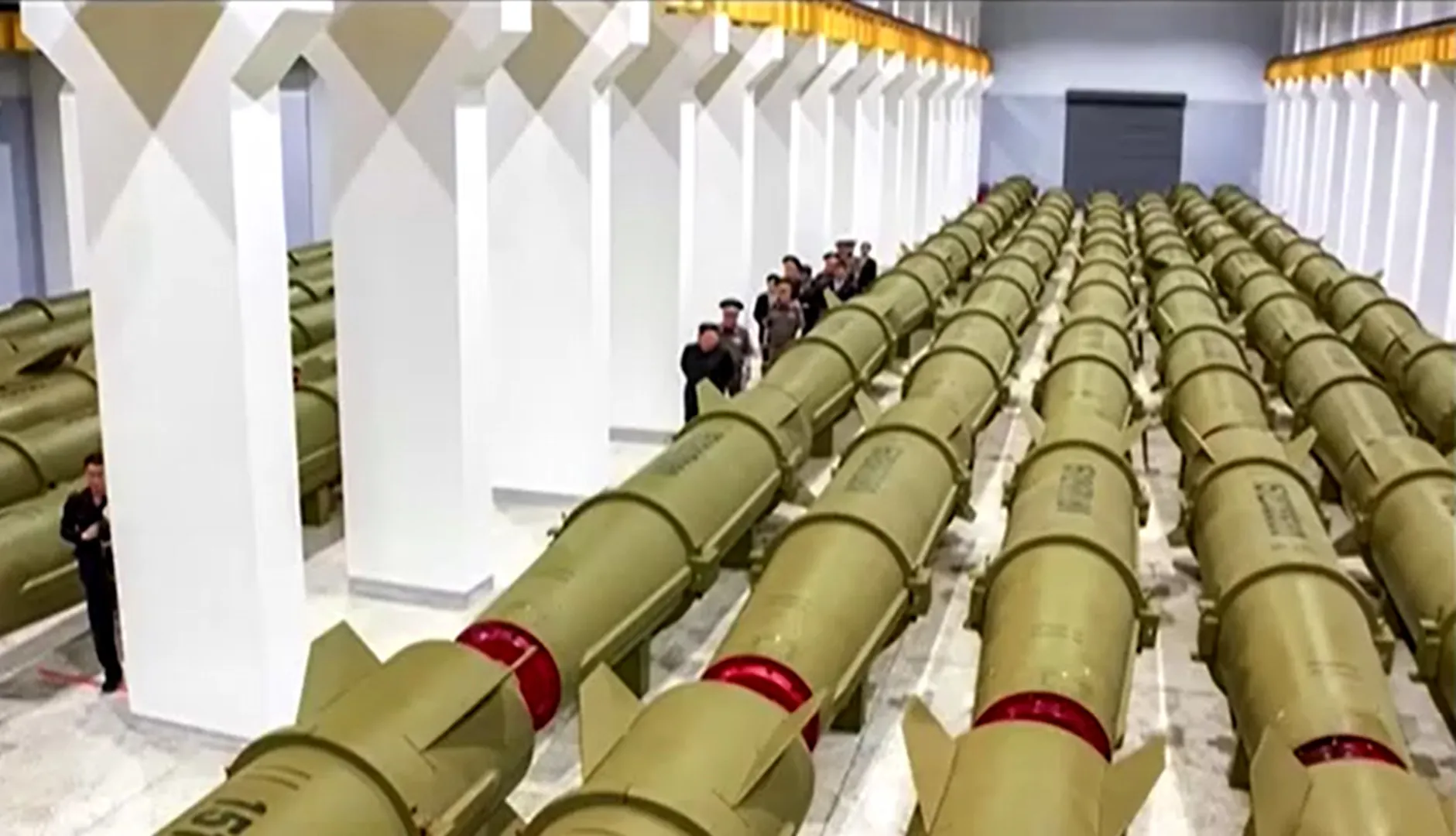
North Korea’s Kim calls for ‘impregnable fortress’ at southern border

SEOUL, May 18 (UPI) — North Korean leader Kim Jong Un convened a meeting with commanding officers from across the country’s armed forces and called for strengthening frontline defenses along the border with South Korea to create an “impregnable fortress,” state-run media reported Monday.

Kim held the meeting at the headquarters of the ruling Workers’ Party Central Committee on Sunday, the official Korean Central News Agency said. It was the first known gathering of all division and brigade commanders since Kim took power in 2011.

Kim called for the “rapid modernization of the military and technical equipment of our army” and stressed the need to adapt military training to the changing nature of modern warfare, KCNA said.

He emphasized the country’s “territorial defense” policy, including “strengthening the first-line units in the southern border and turning the border line into an impregnable fortress,” according to the report.

KCNA said Kim outlined plans to reorganize the military structure and bolster frontline and other major units with upgraded weapons and technology as part of efforts to strengthen deterrence.

Earlier this month, North Korea announced plans to deploy new 155 mm self-propelled howitzers to three battalions assigned to long-range artillery units along the southern border this year.

The meeting comes as Pyongyang hardens its military posture toward Seoul and formally abandons decades-old reunification language.

North Korea recently revised its constitution to remove all references to reunification with South Korea, cementing Kim’s push to redefine inter-Korean ties as relations between two separate states.

The two Koreas remain technically at war because the 1950-53 Korean War ended in an armistice rather than a peace treaty.

South Korea’s Unification Ministry assessed Monday that the meeting appeared aimed at encouraging the military while reinforcing ideological discipline and modernization efforts.

“North Korea has adopted a two-state stance, and there appear to be trends in that regard,” ministry spokesman Yoon Min-ho said at a regular press briefing. “We will continue to closely monitor related trends in the future.”

Asked whether the North’s latest moves could escalate the situation along the border, Yoon said Seoul would continue efforts to reduce military tensions and build trust on the Korean Peninsula.

South Korean President Lee Jae Myung has sought to reduce tensions since taking office in June, including by dismantling border propaganda loudspeakers and calling for renewed dialogue, but Pyongyang has largely ignored the overtures while continuing to expand its military capabilities.

On Monday, the Unification Ministry released its annual white paper, which defined Seoul’s new “Korean Peninsula peaceful coexistence policy.”

The policy is based on principles President Lee outlined in August, including respecting North Korea’s system, rejecting unification by absorption and avoiding hostile acts.

Source link

Cannes 2026: Korea’s Na Hong-jin on his new sci-fi thriller ‘Hope’

The movies of Na Hong-jin aren’t hard to love — they’re as obsession-worthy as the stylish rigor with which they are made. His 2008 debut, “The Chaser,” found new febrility in the post-Fincher serial killer thriller. “The Wailing” somehow added ghosts, demon-possessed children and inky black crows to the mix with a near-crazed sense of showmanship.

That was 10 years ago. Na, 51, now sits on the other side of a project that has consumed him for years, a sci-fi action film called “Hope” that arrives with expensive CGI, a pair of A-list stars (Michael Fassbender and Oscar-winner Alicia Vikander) and James Cameron-sized franchise ambitions. It will undoubtedly make Na’s gallows-humor-inflected brand more global, even if it lifts him out of the cult niche that’s nourished him to date.

Cannes is an unlikely place to launch “Hope.” That could be seen as a sign that the festival’s increasing accommodation of blockbuster bigness doesn’t need Hollywood. Na sits in the corner of a Côte d’Azur waterfront lounge on a glorious midday, the sky an almost abstract blue. He tugs at his goatee distractedly. His world premiere is tonight.

Neon, the distributor currently enjoying a six-year Palme d’Or winning streak, will release “Hope” in America sometime after its summer bow in Na’s native South Korea. The following conversation has been edited for length and clarity. It also contains significant spoilers.

Two people peer through a window, nervously.

A scene from the movie “Hope,” directed by Na Hong-jin.

(Neon)

When did you realize that you had a big sci-fi alien monster movie in you?

The idea came to me in 2017 in Seoul. The premise started off with somebody watching news in a diner or a small restaurant. It was that image that I had in my head. So I started developing that initial image in more detail. By 2018, I was able to write my first draft.

“Hope” brings to mind several genre classics, from “Jaws” and John Carpenter movies like “The Thing,” to something more homegrown such as Bong Joon Ho’s “The Host.” Were those inspiring to you?

I must have looked all the genre films that I could find, including the ones you mention, before I went into filming. And, as I hope you noticed, I was looking more at films from before 2000 and I tried to reflect that look.

It seems like you’re using Cannes as a moment to pivot or reinvent yourself. Is that intentional?

I didn’t intend for this to be a turning point in terms of style or direction going forward. I never thought of it that way. What I really dwelled on was thinking about how to tell this story in a way that was approachable and entertaining for people.

Why did you set the story in the demilitarized zone?

If you look at it from a universal perspective, what happens in this very shabby, humble, small, insignificant space potentially creates an impact that can go on infinitely. I think none of the characters in the film do anything with any malice. I guess the underlying story I want to tell is that there is no reason for evil intention behind anything, but innocent acts can build up to something tragic.

Michael Fassbender and Alicia Vikander are wonderful surprises in the movie as some rather dignified aliens. What led you to them?

When I was casting the alien roles, I had a bigger story in mind. I don’t know whether there’ll be a sequel after this one, but if so, that sequel is going to be centered around them. So picking the right actors was very important for me. We asked them to learn this invented alien language, which they prepared and came onto set knowing.

How important to you is comedy and releasing tension with laughs?

Very. I try to really think it through and if it comes out the way I intended, that gives me such a thrill. I tried to incorporate it in many places.

A lot of the movie feels like a virtuoso chase sequence, people barreling down the road, guns blazing. But it took me a minute to realize that the more interesting question is: Who’s doing the chasing? Is “Hope” meant to make us examine our own violence?

Yes, very much so. And two of the major chase scenes were designed so that what starts off as righteous somehow tilts toward being unjust. I wanted the action to bring up that transition in perspective.

You’ve premiered at Cannes before but, in a way, it feels like the wrong festival for a movie like this. You’re laughing because I think you agree with me.

It goes without saying. I’m incredibly nervous. And I feel so grateful that you’re treating me so nicely and gently.

A man rides a horse in the woods.

A scene from the movie “Hope,” directed by Na Hong-jin.

(Neon)

Why did it take you 10 years to make this film?

There was a pandemic in the middle of that. But except for the pandemic where everything stopped, I was working my ass off before and after. It still took this long. I’m a little concerned myself, like: How did this happen?

With “Hope,” are you saying goodbye to the filmmaker you once were?

Not at all. Throughout the entire process of making this film, I was bloodthirsty. I was thirsting for blood. I have another script written already.

And maybe now it’ll go faster because there won’t be a pandemic. Are you hoping that this movie is going to have an impact on the Korean film industry?

It’s not my place to say that. I’m not sure. I want things to be freer.

Would it be a mistake to read this film as an allegory for what’s happening now in the world? Is it a plea for understanding?

I don’t regard it as a plea for understanding. Rather, let’s hope people will be able to relate to it and be empathetic about the story and realize for themselves, understand for themselves. Maybe there’s something more to it, but you take away what you will from that.

Your dark humor flares on occasion. Did you make it a point to try to preserve that?

Well, you can’t just do something like this without having that. It’s not fun.

This doesn’t feel like an “Avatar”-style film. There’s an openness to it, a sense of exploration. Do you believe in heroes?

I do believe in heroes, but, as I tell in the story, anyone can be a hero.

Source link