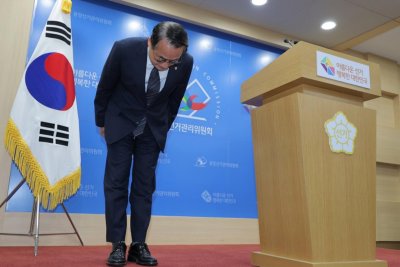
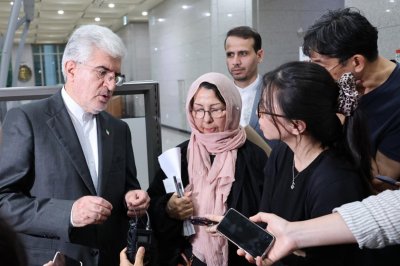
Heo Cheol-hoon, secretary general of the National Election Commission, issues a public apology after a shortage of ballot papers prompted the temporary suspension of voting in the local elections at some polling stations in southern Seoul, South Korea, 03 June 2026. South Koreans voted on 03 June to elect mayors, governors, local council members and regional education chiefs in nationwide local elections. Photo by YONHAP / EPA
June 5 (Asia Today) — South Korea’s election chief said Friday he will resign to take responsibility for ballot shortages that disrupted voting during the June 3 local elections.
Roh Tae-ak, chairman of the National Election Commission, made the announcement during a public apology at the commission’s headquarters in Gwacheon, Gyeonggi Province. NEC Secretary-General Huh Chul-hoon also offered to resign.
“The high public interest in local autonomy and the active expression of the people’s will through voting were damaged by the ballot shortage,” Roh said. “As chairman of the National Election Commission, I feel devastated and bear unlimited responsibility for the situation, which has damaged public trust in election management and led to distrust in the election process.”
The commission said ballot shortages occurred at 50 polling stations nationwide, including 14 in Seoul’s Songpa district. Voting was temporarily halted at 22 polling stations, the commission said. Outside reports also said the shortages caused delays and protests in parts of Seoul.
The commission said the shortages were linked to a decision to print ballots for at least 50% of eligible voters in some areas, reflecting internal discussions about reducing unused ballots as early voting rates have risen in recent elections.
Yoon Jae-soo, head of the commission’s election policy office, said the minimum number of ballots was set at 50% of eligible voters but could be adjusted depending on local conditions.
“In Songpa district, when the early voting rate of 23.3% was included, ballots equal to 73.3% of eligible voters were secured,” Yoon said. “But shortages occurred because there were differences among individual polling stations.”
The commission said it will create a fact-finding committee made up of outside experts to examine the cause of the shortages, identify problems in the response and prepare measures to prevent a recurrence.
Roh said the commission will cooperate fully with any process to determine responsibility, including a possible National Assembly investigation.
“We will sincerely take part in all procedures to confirm the commission’s responsibility for this incident and will not avoid responsibility depending on the results,” Roh said.
On Wednesday, voters at some polling stations in Seoul’s Gangnam, Gwangjin and Songpa districts had to wait because of ballot shortages. The disruption has drawn criticism from political parties, civic groups and universities over the commission’s election management.
Oh Min-seok, chairman of the Seoul Election Commission, also issued a public apology Friday.
“This was the commission’s fault, with no excuse,” Oh said. “We deeply feel responsibility for damaging public trust through poor election management that ran counter to common sense.”
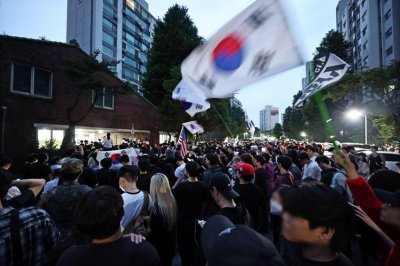
Protesters demonstrate in front of a polling station in Songpa District, Seoul, South Korea, 04 June 2026, to call for the suspension of ballot counting. A shortage of ballot papers forced an extension of voting at several polling stations in the area during the local elections held the previous day. Photo by YONHAP / EPA
June 5 (Asia Today) — Protesters who had blocked a polling station in Seoul’s Songpa district for two nights and three days moved Friday to a vote-counting center, demanding a new election after ballot shortages disrupted voting in the June 3 local elections.
The ballot boxes from the No. 2 polling station in Jamsil 7-dong were transferred and counted after about 1,000 police officers were deployed. But protesters said they could not accept the result and effectively occupied the entrance area of the counting center, calling for a revote.
About 300 people, including citizens and conservative YouTubers, gathered near the entrance of the Olympic Park handball arena, according to an unofficial police estimate.
Even after the counting was completed, protesters chanted slogans including “revote” and “invalidate the vote.” Some protesters have alleged election fraud, but election authorities have attributed the disruption to a shortage of ballot papers during voting.
The atmosphere grew tense as access for election workers and arena employees was effectively blocked. Some arena employees who tried to leave were reportedly stopped by protesters and remained inside.
Police continued to guard the area around the arena after the vote count ended. Officials at the scene were considering sending election commission workers home first and removing vote-counting materials separately.
The protest followed a broader ballot shortage controversy in South Korea’s local elections. The National Election Commission said ballot shortages occurred at 50 polling stations nationwide and temporarily halted voting at 22 sites. The disruption drew public criticism and led the commission’s chairman, Roh Tae-ak, to announce his resignation Friday.
Earlier, protesters blocked the removal of ballot boxes from Jamsil 7-dong’s No. 2 polling station after a ballot shortage left voters waiting for hours. Police later escorted officials to retrieve the remaining ballot boxes, and the final count ended Friday afternoon.
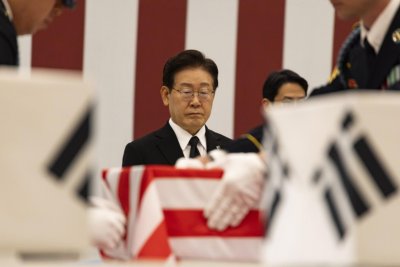
South Korea President Lee Jae Myung attends the ROK and the U.S. repatriation ceremony for Korean remains at Seoul Military Air Base in Seongnam, South Korea, 05 June 2026. The remains of ten South Koreans and the three U.S. soldiers killed in the Korean War were sent back to their homeland. Photo by JEON HEON-KYUN / EPA
June 5 (Asia Today) — South Korean President Lee Jae-myung said Friday that the mutual repatriation of Korean War remains by South Korea and the United States is “the most compelling evidence” of an alliance forged in blood.
Lee made the remarks at Seoul Air Base in Seongnam, where South Korea and the United States held a mutual repatriation ceremony for Korean War remains. It was the first time the ceremony was held in South Korea. Previous mutual repatriation ceremonies had been held in Hawaii.
“Today’s repatriation is a meaningful milestone that deepens and strengthens the South Korea-U.S. alliance, which was built on the blood and dedication of veterans,” Lee said.
“The effort to find not only one’s own warriors but also those of an ally and return them to their families is the most compelling evidence of an alliance forged in blood,” he said.
The ceremony returned the remains of 10 South Korean service members from Hawaii to South Korea. The remains of three U.S. service members were returned to the United States.
Lee said the repatriation was a promise by both countries to remember the heroes who devoted themselves to freedom and peace, calling it “the most noble tribute to their sacrifice.”
“More than 70 years ago, we were able to defend freedom and peace because of the noble sacrifice of heroes who gave their most precious lives to protect the freedom and peace of the Republic of Korea,” Lee said.
“But there are heroes who, long after the war ended, have still not returned to their hometowns,” he said. “Returning them fully is the historical duty of those of us who survived.”
Lee said trust built through battlefield promises has sustained the U.S.-South Korea alliance for decades.
“The trust that keeps promises made on the battlefield, even after decades have passed, is the strong root that has supported the South Korea-U.S. alliance,” Lee said. “With the firm South Korea-U.S. alliance as nourishment, the Republic of Korea is writing a new history of prosperity that amazes the world.”
Lee said the two allies should continue working together for peace and mutual prosperity.
“If South Korea and the United States join hands and move unwaveringly toward the future, complete peace will take root on this land and the flower of mutual prosperity will bloom,” Lee said. “We will continue to carry forward, with future generations, the noble history of solidarity for freedom and peace.”
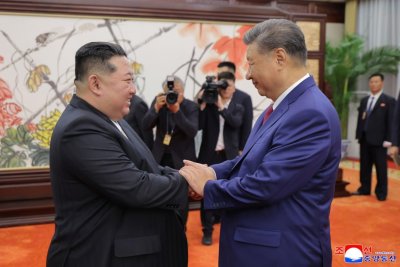
Chinese President Xi Jinping (R) will visit North Korea next week, state media from both countries reported Friday. This photo shows North Korean leader Kim Jong Un and Xi shaking hands during a meeting at the Great Hall of the People in Beijing in September 2025. File Photo by KNCA/EPA
SEOUL, June 5 (UPI) — Chinese President Xi Jinping will visit North Korea next week, state media in both countries reported Friday, marking his first trip to the isolated state since 2019.
Xi will make the visit on June 8-9 at the invitation of North Korean leader Kim Jong Un, China’s official Xinhua News Agency reported. North Korea’s Korean Central News Agency also reported the upcoming trip, but neither outlet provided further details.
The trip will be Xi’s second to North Korea. He last made a two-day state visit in June 2019.
It comes amid a stretch of renewed high-level engagement between the longtime allies. Kim traveled to Beijing in September for a military parade marking the 80th anniversary of the end of World War II, where he held summit talks with Xi.
China has long been North Korea’s largest trading partner, and international observers say it continues to help Pyongyang skirt punishing economic sanctions. Ties had appeared to cool in recent years, however, as North Korea deepened military cooperation with Russia following Moscow’s invasion of Ukraine.
In exchange for providing troops and munitions to Russia, North Korea is believed to be receiving economic support and advanced military technology for its weapons programs, reducing its dependence on China and giving Kim greater leverage in dealings with Beijing.
The announcement of Xi’s visit comes one day after North Korea unveiled a new uranium enrichment facility used to produce fissile material for nuclear weapons, with Kim calling for an “exponential” increase in the country’s nuclear arsenal.
The visit also comes amid growing uncertainty over Beijing’s approach to North Korea’s nuclear ambitions.
After Xi met with U.S. President Donald Trump last month, the White House said the two leaders had reaffirmed their shared commitment to the denuclearization of North Korea. China’s Foreign Ministry, however, said only that the leaders had “exchanged views” on the Korean Peninsula.
Some analysts have suggested that China increasingly views North Korea’s nuclear capabilities as a “geopolitical asset” that helps constrain Washington as competition between the two powers intensifies.
The visit will be closely watched in Seoul, where President Lee Jae Myung has sought to ease tensions with Pyongyang since taking office last year.
Unification Minister Chung Dong-young on Thursday proposed a four-way dialogue involving the two Koreas, the United States and China aimed at establishing a peace regime on the peninsula.
South Korea’s Foreign Ministry said Friday that it hopes Xi’s visit will “play a constructive role in addressing issues related to the Korean Peninsula,” according to Yonhap News Agency.
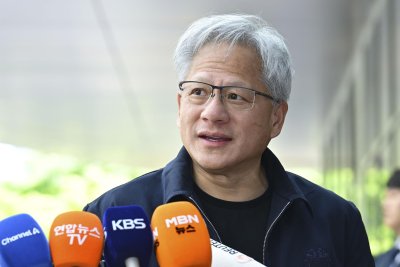
Nvidia Corp. CEO Jensen Huang speaks to reporters after arriving at Gimpo International Airport in western Seoul on Friday. Photo by Yonhap
Nvidia Corp. Chief Executive Officer (CEO) Jensen Huang said Friday that he views robotics as the next major growth sector in South Korea, adding that the domestic market is well-positioned for growth.
Huang, a central figure in the global artificial intelligence (AI) boom, made the remarks after arriving at Gimpo International Airport in western Seoul aboard his private jet for a four-day visit.
“(South) Korea has many sectors to invest in. Robotics is going to be the next major sector,” Huang told reporters, adding that the Korean “market is doing very well.”
Asked whether he had brought any gifts for South Korea, Huang responded with a smile.
“Did I bring any gifts for Korea? I brought a lot of business for Korea,” he said. “I have some surprises.”
The trip comes less than a year after Huang’s previous trip to South Korea in October, which coincided with the Asia-Pacific Economic Cooperation (APEC) CEO Summit in the southeastern city of Gyeongju.
During that visit, Huang drew widespread attention when he joined Samsung Electronics Chairman Lee Jae-yong and Hyundai Motor Group Executive Chair Euisun Chung for a late-night meal of Korean fried chicken and beer, commonly known as “chimaek.”
One of the most anticipated events during Huang’s visit is an informal dinner with SK Group Chairman Chey Tae-won, LG Group Chairman Koo Kwang-mo and Naver Chairman Lee Hae-jin. Hyundai Motor Group’s chief who had earlier been expected to join the group has since confirmed he will be unable to attend.
Together, the companies represented at the gathering span nearly every layer of the AI value chain, including semiconductors, data centers, AI models, software and robotics.
Huang is also set to hold talks with executives from the gaming industry, AI and robotics startups, university researchers and students, according to industry sources.
“Because Korea is a manufacturing center of the world, we can apply the robotics technology, the physical AI technology that we invent here for the industry,” he said.
He further said Nvidia will partner with domestic manufacturing firms in robotics and AI.
“The manufacturing of semiconductors will become increasingly robotics and increasingly AI driven in the future, and so we have a great opportunity to partner with the semiconductor companies here as well,” he added.
Later in the day, Huang visited an internet cafe in Seoul and met with esports players, including gaming superstar Faker.
“This is the birthplace of esports,” Huang said, emphasizing that Korean gamers have long been among the world’s most competitive players who are using Nvidia’s graphics processing units (GPUs).
Nvidia’s GeForce graphics cards are designed to deliver the high frame rates demanded by professional gamers.
Huang is also expected to meet Krafton Executive Director Chang Byung-gyu and other senior executives from the gaming company, though the exact schedule has yet to be confirmed.
The two companies are expected to discuss potential cooperation involving Nvidia’s RTX Spark platform for premium Windows laptops, as well as physical AI technologies.
Earlier this year, Krafton established a robotics subsidiary called Ludo Robotics.
During his stay, Huang is also expected to meet Science Minister Bae Kyung-hoon to discuss cooperation in AI, including the supply of GPUs.
Details regarding the timing, venue and agenda of the meeting are still being finalized.
Copyright (c) Yonhap News Agency prohibits its content from being redistributed or reprinted without consent, and forbids the content from being learned and used by artificial intelligence systems.
As the rally in AI stocks fades, investors were cautious at the open on Friday, with European markets opening to mixed sentiment following steep falls in Asian markets.
ADVERTISEMENT
ADVERTISEMENT
Indices in London and Frankfurt quickly moved into negative territory, with the FTSE 100 dropping nearly 0.4% and the DAX losing 0.3% right after the opening. The Paris CAC 40 and the IBEX 35 in Madrid were both up 0.3%, while Milan’s main index was flat. So was the EURO STOXX 50, a benchmark index of 50 blue-chip companies from the eurozone.
Investors are awaiting the latest US non-farm payrolls report and keeping an eye on developments in the Middle East.
The US job data is important for forecasting what the Fed’s next move could be. Kathleen Brooks, research director at XTB, said in a market note, “There is now a near 40% chance of a rate hike by year-end. We expect financial markets to be extremely sensitive to today’s data,” adding that this will be the first such report with Kevin Warsh as chairman of the Federal Reserve.
In the UK, the latest data from Halifax showed that house prices unexpectedly declined in May. House prices fell 0.1% month on month, but were still up 0.5% year on year, missing expectations for a 1% jump.
Oil markets are awaiting further direction
Oil prices stabilised after falling on Thursday. Brent crude, the international benchmark, was slightly down and traded at $94.73 per barrel at 10:00 CET. It had been trading at about $70 per barrel before the start of the war in late February.
Benchmark US crude was little changed at $92.51 a barrel.
Oil prices remain under pressure as the Strait of Hormuz, a narrow waterway crucial for global oil and natural gas transport, remains effectively closed, and the war-induced energy shock is threatening to slow economic growth and fuel inflation in many countries.
American and Iranian negotiators reached a tentative deal last week to extend their ceasefire, but the agreement has not been finalised. Meanwhile, developments in Lebanon have cast doubt on the prospects for a permanent end to the conflict.
On Thursday, the Iran-backed Lebanese militant group Hezbollah rejected the latest ceasefire agreement between the Lebanese and Israeli governments.
“While there are few signs of progress in US-Iran talks, the oil market continues to trade on expectations of an imminent deal that would resume flows through the Strait of Hormuz,” ING commodities strategists Warren Patterson and Ewa Manthey wrote in a report.
Asian markets lose steam as AI craze cools
Wall Street rallied on Thursday after falling oil prices and bond yields eased pressure on US stocks. Banks, small-cap companies and other stocks that had previously been left behind by the euphoria around artificial intelligence led the gains.
Banks also helped lead the market, including gains of 5% for Goldman Sachs, 4.7% for Fifth Third Bancorp and 4.4% for U.S. Bancorp.
They helped to more than make up for losses among some AI stocks, which took a sudden back seat after dominating the market. Analysts have been saying AI stocks may have run too high, becoming too expensive, and that the broader US stock market may be set for a slowdown following an unrelenting streak of nine straight winning weeks for the S&P 500, its longest since 2023.
On Wall Street on Thursday, computer chipmaker Broadcom’s shares sank 12.6% after it issued guidance that fell short of investors’ expectations, raising concerns about the wider AI and technology sector.
US memory chip maker Micron Technology dropped 7.7%, and cybersecurity company CrowdStrike Holdings fell 3.8%.
Still, the benchmark S&P 500 climbed 0.4%, and the Dow Jones Industrial Average gained 1.7% to a record high. The tech-heavy Nasdaq Composite edged 0.1% lower.
But in Asia, investors dumped key AI-related shares, with South Korea’s SK Hynix plunging 8.6% and Samsung Electronics shedding 5.4%.
The Kospi dropped 5.1% to 8,199.44. The index has roughly doubled over the past year, lifted by gains in major technology companies.
Japan’s Nikkei 225 slipped 1.3% to 66,573.85, with technology shares leading the decline, even as official data showed that Japan’s real wages rose for the fourth consecutive month. Chip equipment maker Tokyo Electron’s shares fell 7%.
Hong Kong’s Hang Seng declined 1.2% to 24,948.96, while the Shanghai Composite Index fell 0.3% to 4,045.45.
Australia’s S&P/ASX 200 fell 0.7% to 8,623.50.
Taiwan’s Taiex gave up 1.3%, while India’s Sensex was up 0.1%.
In other trading early on Friday, the US dollar fell to 159.96 Japanese yen from 160.03 yen. The euro was trading at $1.1635, up 0.2%. Gold prices were down 0.3%, trading at around $4,490.70.
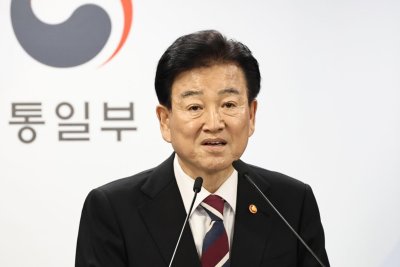
South Korean Unification Minister Chung Dong-young speaks to reporters at a press briefing in Seoul, South Korea. File. Photo by YONHAP / EPA
June 4 (Asia Today) — South Korean Unification Minister Chung Dong-young on Thursday proposed resuming four-way talks among South Korea, North Korea, the United States and China to help establish peace in Northeast Asia.
Chung, who is visiting Mongolia, also called for expanding the framework to include Mongolia, Japan, Russia and other regional countries. He made the proposal during a special address at the 11th Ulaanbaatar Dialogue in Mongolia.
Chung said Northeast Asia needs to build a new “peace identity” by restoring trust between South and North Korea and rebuilding peace on the Korean Peninsula.
It was the first visit to Mongolia by a South Korean unification minister. The trip was made at the invitation of the Mongolian government.
The Ulaanbaatar Dialogue is a regular international forum that covers security issues in Northeast Asia. It began in 2014 as a private academic conference and was upgraded in 2017 to a Track 1.5 forum involving government and nongovernment participants. North Korea has not attended the forum since 2019.
On the Korean Peninsula peace process, Chung said, “A four-party dialogue among the Republic of Korea, the Democratic People’s Republic of Korea, the United States and China is possible.”
“We should expand this framework so that other Northeast Asian countries, including Mongolia, Japan and Russia, can also join,” he said.
Chung also referred to the Sept. 19 Joint Statement adopted during the six-party talks in 2005. He said the six parties had agreed to promote lasting peace and security in Northeast Asia.
“It is time to apply that experience to today’s reality and rekindle the flame of dialogue,” Chung said.
Chung also proposed strengthening cooperation under the Greater Tumen Initiative, a multilateral platform for development and economic cooperation in Northeast Asia.
He called for connecting regional railway networks, including the Trans-Siberian Railway, Trans-China Railway, Trans-Mongolian Railway and a proposed Seoul-Beijing high-speed rail link, with the Arctic shipping route.
“By connecting transportation networks with regional markets and trade flows, we can build an innovative logistics network across Eurasia,” Chung said.
“To turn these ideas into reality, I urge the Democratic People’s Republic of Korea to rejoin the Greater Tumen Initiative as a full member,” he said. “They would be the biggest beneficiary of this vision.”
North Korea was an early member of the Greater Tumen Initiative but withdrew in 2009.
Chung said three goals must move forward together: rebuilding trust between the two Koreas, institutionalizing a peace regime on the Korean Peninsula and advancing multilateral dialogue in Northeast Asia.
“If these three pillars move forward together, we can build a new peace order across Northeast Asia,” he said.
After his special address, Chung met separately with Mongolian Foreign Minister Battsetseg Batmunkh and President Ukhnaa Khurelsukh. Chung left South Korea on Wednesday to attend the forum and is scheduled to return Friday.
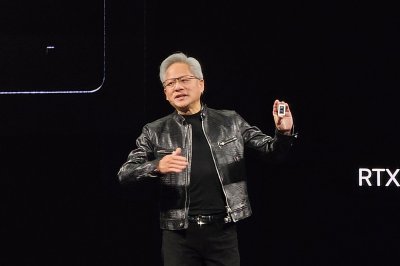
Jensen Huang, CEO of U.S. chip giant Nvidia Corp., will visit South Korea later this week, industry sources said Thursday. Huang is seen here speaking at conference in Taipei on June 1. Photo by Yonhap
Jensen Huang, chief executive officer (CEO) of U.S. chip giant Nvidia Corp., will visit South Korea later this week for a series of meetings with the heads of major conglomerates and researchers that could pave the way for broader cooperation in artificial intelligence (AI) and robotics, industry sources said Thursday.
Huang is scheduled to arrive at Gimpo International Airport in western Seoul aboard his private jet on Friday afternoon for a four-day visit, following his appearance at the Computex trade show in Taipei, the sources said.
During his stay, Huang is expected to meet with leading business figures, as well as executives from the gaming industry, AI and robotics startups, university researchers and students.
On Friday evening, he is expected to visit a Korean barbecue restaurant in Seoul’s Seongsu neighborhood for a gathering with SK Group Chairman Chey Tae-won, Hyundai Motor Group Executive Chair Euisun Chung, LG Group Chairman Koo Kwang-mo and Naver Chairman Lee Hae-jin.
Industry observers expect the participants to discuss a wide range of potential cooperation areas between Nvidia and South Korean companies, including high-bandwidth memory (HBM), AI data centers, autonomous driving, robotics and physical AI.
During his previous visit to South Korea in October, which coincided with the Asia-Pacific Economic Cooperation (APEC) CEO Summit in the southeastern city of Gyeongju, Huang drew widespread attention when he joined Samsung Electronics Chairman Lee Jae-yong and Chung for a late-night meal of Korean fried chicken and beer, commonly known as “chimaek.”
On Sunday, Huang is expected to meet with Kim Taek-jin, CEO of NC Corp., a South Korean gaming company, they said.
While the agenda has not been disclosed, discussions are expected to focus on cooperation in gaming and AI.
On Monday, Huang is also expected to hold a closed-door meeting with executives from South Korean AI and robotics startups in Seoul.
The meeting would mark the first known occasion on which Huang has met with robotics startup founders in South Korea.
The Nvidia chief is also coordinating plans to visit the country’s top-notch Seoul National University’s AI institute and robotics research center.
Separate from the visits, Huang has reportedly expressed interest in meeting directly with university students.
Huang is reportedly meeting Krafton’s Executive Director Chang Byung-gyu, and other senior managers from the company, though the exact dates have yet to be confirmed, the sources said.
The two companies are likely to discuss gaming partnerships related to Nvidia’s RTX Spark, a type of semiconductor designed for premium Windows laptops, as well as physical AI.
Krafton has founded a robotics company called Ludo Robotics early this year.
Copyright (c) Yonhap News Agency prohibits its content from being redistributed or reprinted without consent, and forbids the content from being learned and used by artificial intelligence systems.
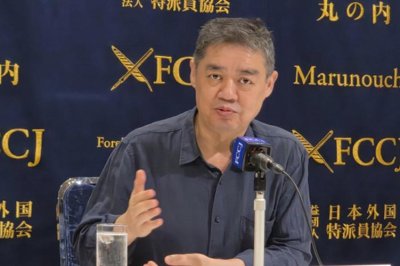
Wu’er Kaixi, a former student leader of the 1989 Tiananmen pro-democracy movement, speaks at a news conference at the Foreign Correspondents’ Club of Japan in Tokyo on Wednesday. Photo by Asia Today
June 3 (Asia Today) — Wu’er Kaixi, a former student leader of China’s 1989 Tiananmen pro-democracy movement, warned South Koreans on Wednesday not to view North Korea only as a country of the same ethnic people.
“North Koreans are certainly Koreans. They speak the same language and eat the same food,” Wu’er said at a news conference at the Foreign Correspondents’ Club of Japan in Tokyo, one day before the anniversary of the June 4 Tiananmen crackdown. “But they have been affected by the disease of communism, and that influence has seeped into their bones and DNA.”
Wu’er, also known as Uerkesh Davlet, was listed by the club as a former student leader of the 1989 Tiananmen movement for its Wednesday news conference, titled “Tiananmen 37 Years Later.”
Asia Today asked Wu’er about the future of China and what it could mean for the Korean Peninsula, noting China’s influence on the Korean War, the division of the peninsula and North Korea’s nuclear issue.
Wu’er responded by directly addressing North Korea.
“I understand that Koreans dream of unification,” he said. “But that is not simply a matter of meeting lost brothers and sisters again. It is the process of rebuilding half of a country that has been affected by communism.”
Wu’er expressed concern about what he described as a nationalist approach within parts of South Korean society.
“When I talk with friends in Seoul, I often sense conservative and nationalist sentiment,” he said. “I fully understand such feelings because South Korea has faced North Korea’s military threat directly.”
“But South Koreans who enjoy liberal democracy should have a mindset of using that freedom for the freedom of North Koreans,” he said.
Wu’er also warned against accepting North Korean propaganda at face value.
“North Korea’s military threats are calculated actions,” he said. “You should not be misled by the nationalist slogans they put forward.”
He said propaganda is used to control hungry citizens.
“North Koreans are still hungry, but they are ruled by regime propaganda,” Wu’er said.
“North Korea is no longer the North Korea we think of,” he said. “If one day South Koreans have the chance to embrace North Koreans, they will realize they are no longer the brothers and sisters they remember from the past.”
“They may be closer to Russians or Chinese,” he said. “You have to understand how a communist system changes human beings and society.”
Wu’er said South Korea’s government and people should understand the nature of the Chinese Communist Party system when considering North Korea.
During the news conference, Wu’er sharply criticized the Chinese Communist Party, saying many people mistakenly view China as a state driven by nationalism or communist ideology.
“The Chinese Communist Party is simply a criminal group,” he said. “They are not pursuing the interests of the state or the rejuvenation of the Chinese nation. They are only interested in maintaining their own power and wealth.”
He dismissed Chinese President Xi Jinping’s slogan of “the great rejuvenation of the Chinese nation” as propaganda meant to deceive the Chinese people.
“The Chinese Communist Party is driven more by interests than ideology,” Wu’er said. “Like a criminal organization seeking more profits, it endlessly tries to expand power and control.”
“To understand China, ask a criminologist rather than an international politics scholar,” he said. “If you approach it through the behavior of a criminal group, you can understand China’s foreign policy much more accurately.”
Wu’er said the Chinese Communist Party “is never satisfied” and urged liberal democracies to respond firmly as Beijing seeks to expand its control and influence.
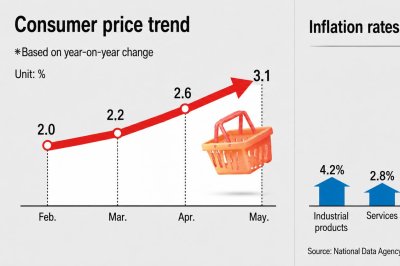
Consumer prices in South Korea rose 3.1% in May from a year earlier, driven by sharp increases in petroleum products, international airfares and overseas group tour fees. Data from National Data Agency. Graphic by Asia Today and translated by UPI
June 2 (Asia Today) — South Korea’s consumer price growth topped 3% in May for the first time in 26 months as a prolonged Middle East war drove up global oil prices, raising concerns that high inflation could continue through the second half of the year.
The consumer price index stood at 119.92 in May, with 2020 set as the base year of 100, up 3.1% from a year earlier, according to consumer price data released Tuesday by the National Data Agency. It was the first increase of 3% or more since March 2024.
Industrial products rose 4.2% from a year earlier, while service prices increased 2.8%. Petroleum prices showed the sharpest increase, jumping 24.2%, the largest gain in three years and 10 months since July 2022, when the Russia-Ukraine war was at its height.
Gasoline prices rose 23.1%, diesel prices climbed 33.3% and kerosene prices increased 21.7%.
Among services, international airfares, which are directly affected by fuel costs, rose 33.5%, while overseas group tour fees increased 26.3%.
The living price index, which tracks frequently purchased items with a high share of household spending, rose 3.3% from a year earlier, showing a worsening burden felt by consumers.
Lee Doo-won, an official in charge of economic trend statistics at the data agency, said petroleum prices rose more sharply because of higher international oil prices caused by the Middle East war.
“International airfares and prices for travel and lodging-related items rose sharply as fuel surcharges linked to global oil prices increased and the number of peak-season days, including holidays, grew,” Lee said.
The government said it will work to reduce price uncertainty by stabilizing petroleum prices.
A Finance Ministry official said the government’s petroleum price cap and fuel tax cut reduced the May consumer price increase by 0.6 percentage point.
“We will make every effort to stabilize prices felt by households through petroleum price stabilization measures and a task force on livelihood prices,” the official said.
Experts said inflation led by higher global oil prices is likely to continue in the second half.
“Although the United States and Iran have announced plans to discuss reopening the Strait of Hormuz, the high oil price trend is likely to continue in the second half even if the war ends, given the destruction of local oil facilities,” said Jeong Se-eun, an economics professor at Chungnam National University.
“For South Korea, which imports all of its oil, oil prices affect overall inflation. There is also concern that abnormal weather forecast for this summer could raise agricultural prices,” Jeong said.
“With no notable downward factor in the second half, inflation is expected to stay around 3%,” she added.
Park Jin, a professor at the Korea Development Institute School of Public Policy and Management, said prices are determined by market supply and demand.
“On the supply side, there are inflation concerns caused by unstable oil prices. On the demand side, there are price-increase factors such as a strong domestic stock market,” Park said. “Preemptive steps, including consideration of an interest rate hike, are needed.”
President Lee Jae Myung (L) attends a meeting with his senior secretaries at the presidential office Cheong Wa Dae in Seoul, South Korea, 28 May 2026. Photo by YONHAP / EPA
June 1 (Asia Today) — South Korea is expected to begin procedures to appoint a special inspector general after Wednesday’s local elections, potentially reviving a presidential watchdog post that has been vacant for nearly a decade.
The special inspector general is tasked with inspecting possible misconduct involving the president, the president’s relatives and senior presidential office officials.
The system was introduced in 2014 under then President Park Geun-hye, but the post has remained vacant since 2016. Neither the Moon Jae-in administration nor the Yoon Suk Yeol administration appointed a special inspector general.
Political sources said Sunday that the ruling Democratic Party is preparing to begin the recommendation process shortly after the June 3 local elections.
The main opposition People Power Party has already selected Kang Ji-sik, a former prosecutor and lawyer at Baeksong Law Firm, as its candidate for the opposition’s share of the nomination process. Kang graduated from the Judicial Research and Training Institute in its 27th class.
The Democratic Party formally said it would begin the recommendation process after Presidential Chief of Staff Kang Hoon-sik publicly asked the National Assembly in April to move forward. But the process appears to have been delayed by the party’s floor leader election and the local elections.
Han Byeong-do, floor leader of the Democratic Party, said the party would proceed under the rules and procedures, though he did not specify a date.
A presidential official said the Blue House had asked that the appointment process move as quickly as possible.
“With the new party leadership in place and the election nearing completion, the process appears likely to begin immediately after the election,” the official said.
Under the law, the National Assembly recommends three candidates and the president selects one. The ruling and opposition parties each recommend one candidate, while the Korean Bar Association selects the third, who is jointly recommended by both parties.
The president’s nominee must then go through a parliamentary confirmation hearing before final appointment. The special inspector general serves a three-year term.
Lee said at a news conference marking his first 30 days in office last July that power should be subject to checks.
“Power should be checked,” Lee said at the time. “Even for the safety of those who hold power, it is better to be checked. I have already ordered the appointment of a special inspector general.”
After the National Assembly showed little movement, Kang Hoon-sik again urged lawmakers in December to quickly recommend candidates.
Lee renewed the request on April 19 before leaving for visits to India and Vietnam.
“President Lee believes the appointment of a special inspector general is essential under the principles of democracy and popular sovereignty, which require all power to be subject to institutional oversight,” Kang Hoon-sik said at the time.
“As the president has expressed his firm will, we ask the National Assembly to begin the relevant procedures as soon as possible,” he said.
Weekly insights and analysis on the latest developments in military technology, strategy, and foreign policy.
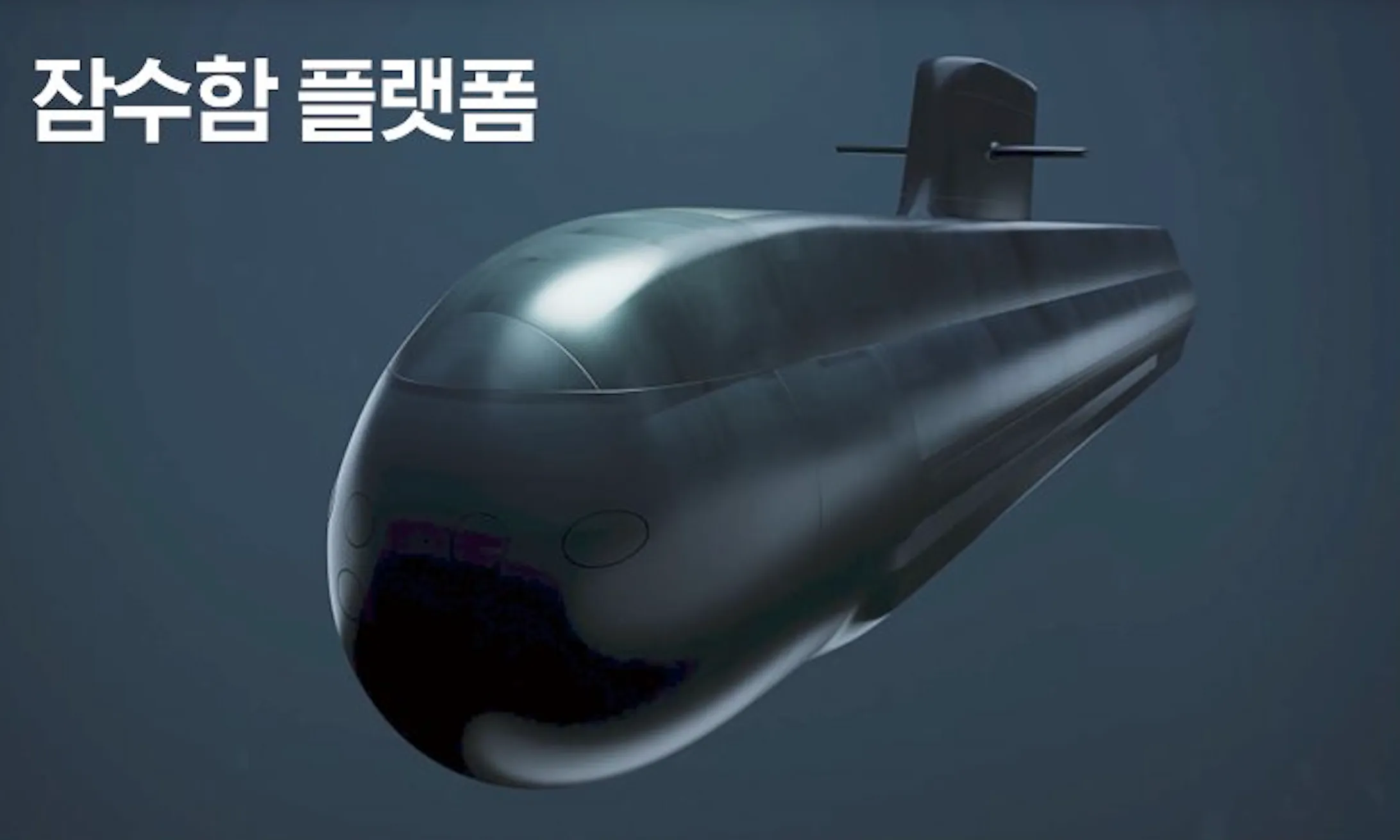
South Korea has confirmed plans to develop a new class of nuclear-powered submarines under the Jang Bogo N Project. These will put South Korea in an exclusive class of nations operating nuclear-powered subs, with currently only China, France, India, Russia, the United Kingdom, and the United States having them in active service. The move has larger implications than providing the Republic of Korea Navy (ROKN) with just more capable submarines.
A Ministry of National Defense rendering shows how the Jang Bogo N Project boats may look. MND
South Korea’s Ministry of National Defense (MND) today published a document, the Basic Plan for the Development of Nuclear-Powered Submarines in the Republic of Korea, that sets out its ambition for a major advance in the country’s naval capabilities. The name of the program alludes to South Korea’s first submarine, the Jang Bogo class.
📌「대한민국 핵추진잠수함 개발 기본계획」 발표
국방부는 5월 26일(화)에 「대한민국 핵추진잠수함 개발 기본계획」을 발표했습니다.
「대한민국 핵추진잠수함 개발 기본계획」은 대한민국이 핵추진잠수함을 체계적으로 개발하기 위한 추진 방향을 국내·외에 최초로 제시하는 문서로서 주요 내용은… pic.twitter.com/jkVjS3soQt
The MND has presented the thinking behind its nuclear-powered sub plans, noting that the vessels will offer “dramatically enhanced operational capabilities” compared to the ROKN’s existing diesel submarines. As well as their functionally unlimited range, the MND says the new nuclear-powered submarines will offer “higher mobility” than their predecessors, which pairs with nuclear submarines’ abilities to travel farther, and do so faster, as well as their underwater agility, at least in certain performance envelope areas.
The ministry also outlines that the new submarines “will play a core role in responding to threats such as North Korea’s submarine-launched nuclear and missile threats.”
“The Republic of Korea will transparently and firmly fulfill its nuclear non-proliferation obligations based on the trust of the international community,” the MND adds.
Clearly, this is a long-term program, with it being Seoul’s first venture into nuclear propulsion for a military application, although it does develop reactors for civilian purposes, which could be leveraged for such work.
An official rendering showing one of the Jang Bogo N Project boats under construction. MND
The defense ministry expects that the construction process will take up to 10 years, after which the boats will be operated for more than 30 years.
A precise timeline has not been released, and it is also unclear how many hulls are expected to be built.
Back in October last year, TWZreported on a key milestone toward the program launch, when U.S. President Donald Trump announced that he’d signed off on the plan.
“Our Military Alliance is stronger than ever before and, based on that, I have given them approval to build a Nuclear Powered Submarine, rather than the old fashioned, and far less nimble diesel powered submarines that they have now,” Trump wrote in a post on Truth Social.
The U.S. leader also claimed that at least some of the boats would be built in the United States. The MND hasn’t mentioned this possibility, and the wording of its announcement stresses the sovereign nature of the program and local industrial participation. However, with South Korean firms already building ships in Philadelphia and the United States needing more nuclear shipbuilding capacity, this dynamic could also come into play as a result of the Jang Bogo N Project.
Collapse of U.S. shipbuilding poses national and economic security risks | 60 Minutes
However, the plans long faced pushback, including from the United States, especially over nuclear proliferation concerns.
The ROKN already operates a sizable diesel-electric submarine force made up of 12 Jang Bogo class boats, nine Sohn Won-yil class submarines, and three Dosan Ahn Changho class vessels — these are also referred to under the Korean Submarine (KSS) nomenclature, being the KSS-I, KSS-II, and KSS-III, respectively.
The Republic of Korea Navy’s submarine Jang Bogo, one of the KSS-I boats. U.S. Navy
The Jang Bogo and Sohn Won-yil classes are based on the German Type 209 and Type 214 designs, respectively, while the Dosan Ahn Changho class is a fully South Korean design.
The KSS-III submarine ROKS Dosan Ahn Changho during trials. Defense Acquisition Program Administration
Last year, South Korea also launched the first of three planned Jang Yeongsil class (KSS-III Batch II) submarines, the nation’s largest and most technologically advanced submarine class so far. You can read more about them here.
The launch ceremony for the ROKS Jang Yeongsil, the first of the KSS-III Batch II boats. ROKN
Whatever Seoul’s plan is for the production of the new boats, it is still possible, indeed likely, that the United States will provide assistance at least in relation to their propulsion systems.
Last year, South Korea’s defense minister said that South Korea would build its own submarines and modular reactors, but would receive a supply of enriched uranium fuel from the United States. Seoul’s Defense Acquisition Program Administration (DAPA), meanwhile, said that the country was already working on developing small nuclear reactors.
This fuel issue is interesting, bearing in mind that one of the hurdles for the program is a bilateral agreement that prevents it from enriching uranium and reprocessing spent fuel without Washington’s approval. Today’s announcement would suggest that the U.S. government has given the program the green light.
The Ohio class guided-missile submarine USS Michigan in Busan, South Korea, in 2017. U.S. Navy
When it comes to the nuclear issue, it’s worth noting that, as it now stands, all nations operating nuclear-powered submarines also field nuclear weapons. Already, however, Australia is moving to acquire nuclear-powered submarines through the trilateral Australia-United Kingdom-United States (AUKUS) defense cooperation agreement. Canberra has no plans for fielding nuclear weapons.
A rendering of what the AUKUS nuclear-powered submarine design for Australia may look like. U.K. Ministry of Defense
North Korean Premier Kim Jong-un on board one of the country’s Soviet-era Romeo class submarines. KCNA
As a signatory of the Non-Proliferation Treaty (NPT), this would also stand in the way of South Korea acquiring nuclear weapons. Indeed, separate from weapons, the process of building enrichment or other nuclear facilities, or otherwise acquiring the highly enriched fissile material to power the submarines, would be an issue for the NPT.
The Jang Bogo N Project is certainly ambitious, and not just in terms of constructing the boats and securing the fuel required for them.
Beyond that, there is the question about the degree to which Seoul even needs nuclear-powered submarines. South Korea is already developing conventionally-armed submarine-launched ballistic missiles (SLBM) that can be fired from some of its more modern diesel submarines. These would already offer a conventional second-strike capability to help deter North Korea. The ranges involved in striking North Korean targets hardly need a launch platform with nuclear propulsion.
At the same time, South Korean diesel-electric submarine technology already outstrips North Korea’s limited anti-submarine warfare capabilities.
South Korea Test Launches Ballistic Missile From Submarine
On the other hand, while South Korea’s new diesel-electric subs offer a conventional quasi-second strike capability, it is not anywhere comparable to a true strategic nuclear second-strike deterrent of the kind that highly survivable nuclear-powered boats could provide, if South Korea one day chooses to go nuclear. Even with just conventional ballistic missiles aboard, the ability of a nuclear submarine to disappear out to sea for long periods is unmatched, which would enhance the survivability of the boats and their missiles, and help the credibility of a far more limited conventional second strike deterrent.
Beyond the North Korean threat, the nuclear-powered submarine program promises boats with extreme endurance and a higher level of underwater performance that can range much farther afield, reflecting Seoul’s growing focus on a broader regional security picture. With this in mind, it’s clear that the Jang Bogo N Project is also directed against the threat posed by China. Beijing’s military capabilities are a growing concern for South Korea, a fact reflected in Seoul looking increasingly toward security challenges beyond the peninsula.
A stock picture of a Chinese Type 039A or Yuan class nuclear attack submarine. via U.S. Navy
The Chinese government has also previously spoken out against South Korea’s nuclear-powered submarine plans, calling for Seoul and the U.S. “to fulfill their nuclear non-proliferation obligations and do things to promote regional peace and stability, and not the other way around,” according to Reuters.
South Korea’s burgeoning submarine plans underscore how quickly its naval ambitions in general are evolving from coastal defense to a far more capable regional deterrent force, and one that will increasingly be able to undertake long-duration bluewater operations.
With the Jang Bogo N Project now underway, the ROKN can look forward to fielding its most advanced vessels yet. Depending on final plans for the production of these boats, it may well also cement its position as one of the few countries capable of designing and building nuclear-powered vessels. At the very least, it should put yet another piece in place should South Korea decide it needs a true second-strike strategic nuclear deterrent.
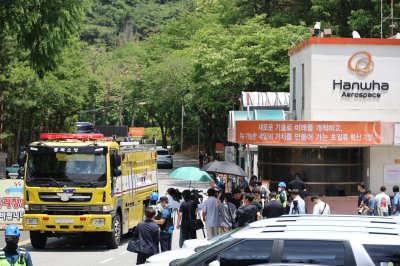
A fire truck exits the Hanwha Aerospace facility in Daejeon on Monday, following an explosion at the company’s factory that killed five and injured two. Photo by Yonhap
SEOUL, June 1 (UPI) — Five workers were killed and two others injured Monday after an explosion and fire at a Hanwha Aerospace defense facility in the central South Korean city of Daejeon, officials said.
The blast occurred around 10:59 a.m. at Hanwha’s plant in Yuseong District, fire authorities told reporters. Some 100 personnel were dispatched and extinguished the blaze shortly after 1 p.m.
All five fatalities were found inside the work area, while two injured workers were rescued and taken to nearby hospitals, officials said. One suffered burns over his entire body and remained in critical condition, while the other sustained relatively minor burns to the neck.
Authorities said the bodies of the victims were severely damaged, making identification difficult.
Hanwha officials said the explosion occurred during a cleaning operation involving tools and equipment used in the rocket-propellant manufacturing process. The company said the exact cause of the blast remains under investigation.
A company official said the cleaning process had not previously been regarded as particularly hazardous because it involved washing equipment with water. The seven people involved in the accident were site workers rather than researchers, he added.
South Korean President Lee Jae Myung ordered authorities to mobilize all available resources for emergency response efforts and conduct a thorough investigation into the cause of the accident, according to his office.
Prime Minister Kim Min-seok issued similar instructions, calling for all available personnel and equipment to be deployed for firefighting and rescue operations and to prevent additional casualties.
Hanwha Aerospace Chief Executive Officer Son Jae-il apologized to the victims and their families following the deadly incident.
“We failed to protect the lives of those who were working at what should have been a safe workplace,” Son said. “As the company’s chief executive, I feel a heavy responsibility for this accident.”
Son pledged full cooperation with authorities investigating the cause of the explosion and said the company would conduct a comprehensive review of its safety systems to prevent a recurrence.
The company said it had established an emergency response headquarters at the site and was working with fire, police and other authorities on response and recovery efforts.
The Daejeon facility is one of Hanwha Aerospace’s key defense production sites and develops propulsion systems and tactical weapon technologies.
The accident was the latest in a series of deadly incidents at the complex. Explosions at the facility killed five workers in 2018 and three more in 2019.
Iranian Ambassador to South Korea Saeed Koozechi (L) speaks to reporters as he exits the foreign ministry building in Seoul, South Korea, 27 May 2026. The ministry summoned Koozechi to lodge a protest over a 04 May attack on the HMM Namu, a South Korean-operated vessel, in the Strait of Hormuz. The ministry said Iranian-developed anti-ship missiles were likely used in the attack earlier this month. Photo by YONHAP / EPA
May 29 (Asia Today) — South Korean defense experts said the government should take a tougher position toward Iran after investigators concluded that an Iranian-developed anti-ship missile was likely used in an attack on the HMM Namu.
Experts said Thursday that Seoul needs a firm diplomatic response to the results of the government investigation into the unidentified aerial objects that struck the HMM-operated vessel.
The government said Wednesday that the objects were highly likely to have been Noor-series anti-ship missiles developed by Iran. Technical analysis found the engine resembled an Iranian-made turbojet engine, and some components carried markings believed to be from an Iranian manufacturer.
South Korean officials said the evidence points toward Iran but stopped short of making a final judgment on who carried out the attack or whether it was intentional. The government summoned Saeed Koozechi, Iran’s ambassador to South Korea, but Koozechi denied that Iran was involved.
“If it was actually confirmed to be an Iranian missile, it should be viewed as an act by the Iranian government,” said Kwon Yong-soo, professor emeritus at Korea National Defense University. “The missile’s maximum range is short, and because of the flame at launch, it would have been visible where it came from.”
Kwon said the government should be able to explain whether the missile was fired from land, a ship or a fast boat.
“If it was not Iran’s act, Iran itself should present evidence,” he said.
Yang Uk, a research fellow at the Asan Institute for Policy Studies, said the evidence points to an Iranian-made anti-ship missile.
“Even if Iran denies it, that denial is not persuasive,” Yang said. “Anti-ship missiles are weapons that only states, governments and militaries can operate.”
Yang said Iran may have provided missiles to an armed group, such as the Houthi rebels, but the distance would have been too far for such a launch.
“If the Islamic Revolutionary Guard Corps fired it and the Iranian government pretends not to know, that would prove Iran’s own command and control is inadequate,” he said.
Some experts said the South Korean government’s response has been too weak, even though it summoned Koozechi immediately after announcing the investigation results.
A Foreign Ministry official said summoning Iran’s ambassador was a serious diplomatic measure.
“Summoning the Iranian ambassador to South Korea is by no means meaningless,” the official said. “The measure itself shows our firm position.”
The official said Seoul had sent investigation teams twice, collected debris, reached its conclusion through analysis by expert agencies, publicly announced the findings and explained them to the other country.
“That itself is a serious diplomatic step,” the official said.
Yang said some may argue South Korea does not need to create unnecessary conflict with Iran. But he said Seoul should at least secure something from the Iranian government if it takes that position.
“Given that the evidence points to Iran, we should at least apply pressure to ensure our ships are allowed to return safely,” Yang said. “If we do not even do that, then we are refusing to do what a state should do.”
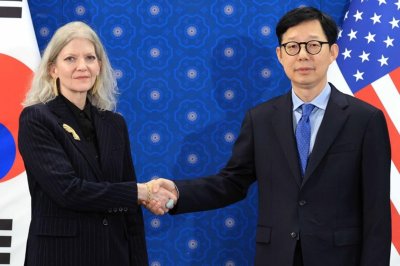
South Korean Vice Foreign Minister Park Yoon-joo (R) shakes hand with his US counterpart, Allison Hooker, at the foreign ministry in Seoul, South Korea. Photo by YONHAP / EPA
May 29 (Asia Today) — South Korea and the United States will hold their first meeting in Seoul next week to discuss security issues agreed to at last year’s bilateral summit, including South Korea’s acquisition of nuclear-powered submarines.
South Korea’s Foreign Ministry said Friday the two sides will hold a launch meeting June 2-3 in Seoul for follow-up consultations on the security provisions of the joint fact sheet issued after the summit.
The meeting will come eight months after the two leaders announced agreements in the security section of the joint fact sheet in October.
The two sides are expected to discuss specific measures related to South Korea’s construction of nuclear-powered submarines, as well as expanded authority over uranium enrichment and spent nuclear fuel reprocessing.
With U.S. midterm elections scheduled for November, negotiations in individual areas are expected to gain momentum.
South Korea will send an interagency delegation led by First Vice Foreign Minister Park Yoon-joo. Officials from the presidential National Security Office, Foreign Ministry, Defense Ministry, Ministry of Climate and Energy, Ministry of Science and ICT, Ministry of Trade, Industry and Resources and Nuclear Safety and Security Commission will also attend.
The U.S. delegation will be led by Allison Hooker, under secretary of state for political affairs. Officials from the White House National Security Council, State Department, Energy Department and War Department are expected to travel to Seoul for the talks.
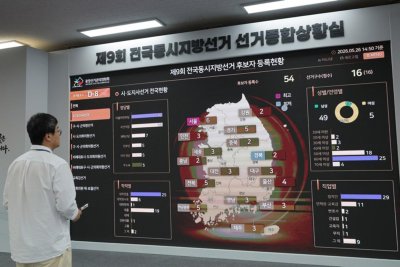
Election-related information is displayed on an electronic board at the National Election Commission’s situation room in Gwacheon, south of Seoul, South Korea, 26 May 2026, eight days ahead of the 03 June local elections. Photo by YONHAP / EPA
May 29 (Asia Today) — Leaders of South Korea’s rival political parties urged voters to cast ballots Friday, the first day of early voting for the June 3 local elections, but their strategies showed different approaches.
Chung Chung-rae, leader of the Democratic Party, and Han Byung-do, the party’s floor leader, both voted on the first day of early voting. People Power Party leader Chang Dong-hyeok and floor leader Song Eon-seok divided their roles, with Chang choosing to vote on Election Day and Song planning to vote early.
Chung began his schedule Friday by casting an early ballot at the Seongsan 2-dong Community Service Center in Mapo District, Seoul. After voting, he attended a meeting of the party’s central election committee in Seoul and urged voters to participate.
“Voting is stronger than bullets,” Chung said. “Power does not come from the barrel of a gun. It comes from the polling place.”
Han also visited an early voting station before heading to campaign events in Namwon, North Jeolla Province.
“Early voting will be held for two days starting today,” Han said. “Please exercise your precious vote for the future of South Korea.”
The major opposition People Power Party took a different approach. Chang plans to vote on Election Day, while Song is scheduled to cast an early ballot Saturday.
The move is seen as a strategy to appeal both to the party’s hard-line conservative base and more moderate conservative voters. Chang and Song have also divided campaign duties during the election period, focusing on separate schedules.
Chang campaigned Friday in Sejong and western Gyeonggi Province.
“The atmosphere is changing as we lead this election, but if we lose by even one vote, there is no future for South Korea,” Chang said. “Everything depends on your one vote. Please do not leave yourself with regret by failing to go to the polling place.”
Song said he plans to vote early Saturday in Gimcheon, North Gyeongsang Province, his electoral district.
At a news conference at the National Assembly earlier Friday, Song acknowledged that some political figures have argued against early voting.
“It is true that there are some movements in political circles saying people should not vote early, but I will not say that is our party,” Song said. “There is a big difference between holding voting over three days and holding it for only one day.”
“In reality, the number of votes cast during the two days of early voting and on Election Day is close to half and half,” he said. “I think voters should vote over the three days, including early voting, according to their circumstances and schedules.”
Park Sung-hoon, chief spokesperson for the People Power Party, said both early voting and Election Day voting are important exercises of political rights.
“To strategically encourage both early voting and Election Day voting, we decided that the floor leader would vote early and the party leader would participate in Election Day voting, taking his schedule into account,” Park said.
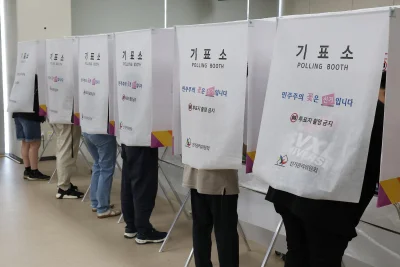
Voters cast ballots on the first day of early voting for nationwide local elections at a polling station in the Eulji Nuri Center in Seoul on Friday. Photo by Yonhap
Many South Koreans headed to the polls Friday in early voting for next week’s local elections and parliamentary by-elections, widely seen as a referendum on President Lee Jae Myung’s first year in office.
Eligible voters can cast ballots at 3,571 polling stations nationwide from 6 a.m. to 6 p.m. until Saturday, according to the National Election Commission (NEC).
As of 11 a.m., turnout for the local elections came to 3.81 percent, according to the NEC. The rate was higher than the 3.59 percent recorded at the same time on the first day of early voting for the 2022 local elections.
More than 44.6 million people are eligible to vote in this year’s local elections.
Up for grabs are 16 mayoral and gubernatorial posts, along with 227 heads of local governments and some 4,000 members of local councils.
Eyes are also on the parliamentary by-elections that will fill 14 vacant Assembly seats, with political heavyweights, such as Han Dong-hoon, former leader of the main opposition People Power Party (PPP), vying for seats.
In a poll released by the NEC last Thursday, 73.6 percent of respondents said they will definitely vote in the upcoming elections. Of them, 39.4 percent said they intended to cast ballots during the early voting period.
The upcoming elections are widely viewed as the first major nationwide vote for the Lee administration since it took office last June after former President Yoon Suk Yeol was ousted over his failed martial law bid.
Both the ruling Democratic Party (DP) and the PPP have been rallying voters to hit the polls this week, with the former urging the public to make a stern judgment on what it calls the “remnants” of Yoon’s insurrectionist forces.
Recent polls, however, indicate that races are tightening in more regions than earlier expected, despite the DP’s hopes for a landslide victory.
While the DP, which controls a majority in the National Assembly, seeks to extend the momentum for the Lee administration to push forward with its key policies, the PPP hopes to gain the footing needed to rebuild the conservative bloc amid deepening internal rifts in the aftermath of the martial law declaration.
Both parties view the capital area, where half of the country’s population resides, as a key battleground.
The Seoul mayoral election has shaped up to be a fierce two-horse race between incumbent Oh Se-hoon of the PPP and ruling party candidate Chong Won-o.
A Hankook Research poll released Monday showed Chong leading with 42 percent against Oh’s 36 percent.
Also closely watched is the parliamentary by-election in the Buk-A constituency in the southeastern city of Busan, where Ha Jung-woo, former presidential secretary for artificial intelligence policy and future planning, is competing against independent Han Dong-hoon and former PPP lawmaker Park Min-shik
Copyright (c) Yonhap News Agency prohibits its content from being redistributed or reprinted without consent, and forbids the content from being learned and used by artificial intelligence systems.
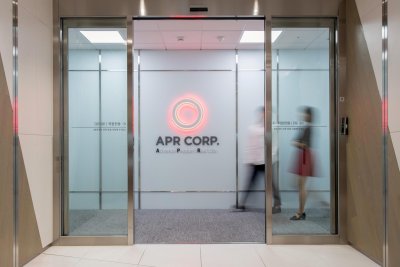
The head office of APR in Seoul. The South Korean beauty company has emerged as a new powerhouse in the country’s cosmetics industry. Photo by APR
May 28 (UPI) — South Korea overtook the United States in 2025 to become the world’s second-largest exporter of cosmetics, according to the Ministry of Food and Drug Safety (MFDS) earlier this month.
The ministry noted that the East Asian country’s cosmetics exports amounted to $11.4 billion in 2025, up 11.8% from a year before, trailing only runaway leader France with $24.3 billion.
The United States ranked third with $10.8 billion, followed by Germany with $9.9 billion, Spain with $9.2 billion, Italy with $9 billion, China with $7.3 billion, and Japan with $3.9 billion.
Meanwhile, South Korea’s 2025 cosmetics imports declined 2.3% year-on-year to $1.29 billion, resulting in a trade surplus of $10.1 billion. It marked the first time Asia’s fourth-largest economy topped $10 billion in the annual cosmetics trade surplus.
By destination, the United States has emerged as the largest overseas market for Korean cosmetics last year as exports jumped 15% year-over-year to $2.2 billion. In contrast, shipments to China plunged 19% to $2 billion.
Demand for Korean cosmetics, widely known as K-beauty products, also increased sharply in Europe and the Middle East. Exports to Poland, in particular, more than doubled from a year earlier to $282 million.
To further beef up the competitiveness of the K-beauty industry, the MFDS pledged to pursue a range of policy initiatives, including expanded regulatory support programs.
“As countries such as the United States and China have recently introduced cosmetic safety assessment systems, we are preparing to implement our own safety evaluation framework in phases,” the MFDS said in a statement.
“To help domestic companies comply smoothly with the new system, the government plans to establish guidelines, provide consulting services, and train professional evaluators,” it added.
New players fueling K-beauty boom
In the past, South Korea’s cosmetics giants relied heavily on China as their primary offshore market. Traditional behemoths, including AmorePacific and LG Household and Health Care, resorted to such a business model for years.
However, a new wave of entrepreneurs has come to the fore with a different approach, reducing dependence on China while tapping aggressively into the United States, Europe, and Southeast Asia.
Leading the shift is APR, which was founded in 2014 and built its growth around online sales channels and beauty devices aimed at international customers.
Last year, APR almost tripled its operating profit to $240 million, which is almost equivalent to that of AmorePacific and well above $113 million of LG Household & Health Care.
APR continued its strong momentum this year as its first-quarter operating profit stood at $101 million, up 173.7% from a year ago, based on robust performance in such major markets as the United States and Japan.
According to U.S. business tracker Navigo Marketing, APR came in third place in Amazon’s beauty category last year with a 7.1% market share. The firm doubled it to 14.1% in the first quarter to claim the top position.
APR has also strengthened its offline presence by entering more than 1,500 Target stores across the United States last month. It plans to expand further into about 3,000 Walmart stores in June.
Meanwhile, first-quarter operating incomes of AmorePacific and LG Household and Health Care fell short of APR with $84 million and $72 million, respectively.
The strong earnings have prompted investors to pile into APR shares on the Seoul bourse.
As a result, APR’s market capitalization jumped 73.59% this year to reach $10 billion as of Thursday. Those of AmorePacific and LG Household & Health Care were $4.49 billion and $2.52 billion, respectively.
“Considering the expansion of offline channels in the United States and accelerating sales growth in Europe, APR’s stock is likely to maintain a medium- to long-term upward trajectory,” Yuanta Securities Korea analyst Lee Seung-eun said in a report.
HMC Investment Securities analyst Ha Hee-ji shared a similar view.
“APR’s growing brand recognition in the United States appears to be spreading across global markets, thus creating a virtuous cycle,” Ha said. “Business-to-business sales in Europe, Latin America, and the Middle East are also showing steep growth trends.”
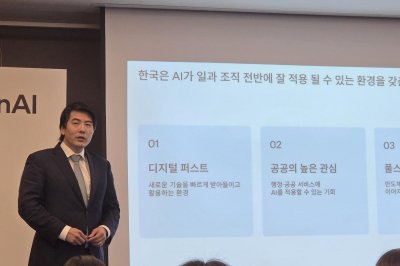
OpenAI Chief Strategy Officer Jason Kwon speaks during a press conference on the Korea Cyber Action Plan in Seoul on Wednesday. Photo by Asia Today
May 27 (Asia Today) — OpenAI said Wednesday it will expand artificial intelligence-based cyber defense cooperation with the South Korean government, public agencies and companies in key industries.
The company announced its Korea Cyber Action Plan during a press conference at the JW Marriott Hotel in Seoul’s Seocho District. The plan is designed to give government agencies, public institutions and companies broader access to OpenAI’s advanced AI cyber models.
Jason Kwon, OpenAI’s chief strategy officer, said AI has entered a third stage as an “intelligence utility,” becoming core infrastructure for the economy and society after earlier phases focused on capability breakthroughs and broader access.
Kwon said South Korea is well positioned to adopt AI because it is a digital-first society that quickly embraces new technologies and has a “full-stack economy” with global semiconductor companies including Samsung Electronics and SK hynix.
“Advanced cyber AI capabilities should not remain in the hands of only a few,” Kwon said. “Korea’s key defenders should be able to use them to strengthen collective security and public safety.”
“Korea is a very important country for OpenAI,” he said. “We hope to become an important partner in Korea’s AI transformation and in strengthening national resilience.”
The Korea Cyber Action Plan is part of Daybreak, OpenAI’s global cybersecurity initiative that aims to build security into systems from the earliest stages of development. OpenAI says Daybreak is designed to help cyber defenders identify threats, generate patches and verify fixes across code and systems.
A key part of the plan is expanding Trusted Access for Cyber, a program that gives verified defensive users access to specialized cyber AI models. OpenAI said in April it was scaling the program to thousands of verified individual defenders and hundreds of teams responsible for protecting critical software.
Kwon said access for the South Korean government to the government version of the program is in its final stage. He said OpenAI is also discussing adoption of the private-sector program with several Korean companies.
Asked about potential misuse of cyber models and data leakage risks, Kwon said OpenAI is controlling risk by granting access only to “trusted defenders” who go through strict verification.
He also said OpenAI supports data residency in South Korea, allowing data to be processed on domestic servers. Public agencies and companies may also choose an option in which data is not stored at all, he said.
Kwon said OpenAI has begun talks with the Korea AI Safety Institute under the Ministry of Science and ICT. He said the company will draw on its experience working with AI safety institutes in the United States and Britain to help South Korea build its own model evaluation capabilities.
Before Wednesday’s announcement, OpenAI had been deepening cooperation with South Korea’s public sector. On May 18, Sasha Baker, OpenAI’s head of national security policy, visited South Korea and demonstrated the company’s latest cyber-focused models to major agencies including the science ministry, the Foreign Ministry, the Interior Ministry, the Financial Services Commission and the National AI Strategy Committee.
On Tuesday, Kwon met with Ryu Je-myung, second vice minister of science and ICT, to discuss AI security cooperation. OpenAI also signed memorandums of understanding with Korea Water Resources Corp. and Korea Technology Finance Corp.
Kwon emphasized the company’s expectations for the Korean market.
“Korea is a country with very favorable conditions to turn AI into national competitiveness,” he said. “Based on ChatGPT, Korea is already one of the top 10 markets globally, and the speed of AI adoption is very fast.”
OpenAI said use of Codex in South Korea is also growing quickly. Weekly active users of ChatGPT Codex in the country have increased tenfold since the beginning of the year, placing South Korea among the top five countries by usage.
More than half of the requests come from non-development work such as document writing, analysis, research and operations, showing the potential for wider enterprise use, the company said.
Kwon said changes in OpenAI’s partnership with Microsoft have made it possible to provide OpenAI API services through a wider range of cloud providers, including Amazon Web Services, and that enterprise growth is expected to accelerate.
On pricing for enterprise services, Kwon said consumer subscriptions and corporate services are different, and that business customers already use contract-based pricing. Over the long term, he said OpenAI aims to provide stronger AI performance at the same cost or lower unit prices so more users can benefit.
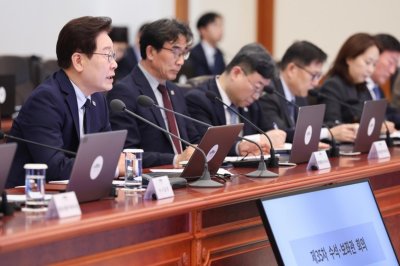
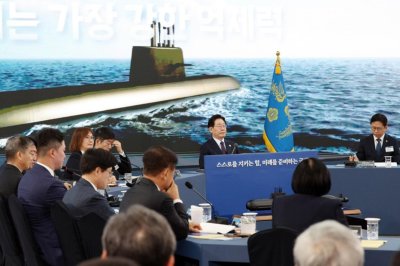
South Korean President Lee Jae Myung (2-R) presides over a defense strategy committee meeting in Changwon, South Gyeongsang Province, South Korea, 26 May 2026. Photo by YONHAP / EPA
May 26 (Asia Today) — The South Korean government said Tuesday it aims to launch its first nuclear-powered submarine by the mid-2030s and deploy the vessel to the Navy in the late 2030s.
The plan was presented during the first meeting of the Future Defense Strategy Committee in Jinhae, South Gyeongsang Province, attended by President Lee Jae-myung.
According to the government, South Korea plans to domestically develop and build the submarines to strengthen the independence and stability of its military procurement, maintenance and operational systems.
The submarines are expected to use low-enriched uranium fuel enriched below 20%, allowing for long operational cycles without frequent refueling.
Defense Minister Ahn Gyu-back briefed Lee on the government’s basic plan for developing nuclear-powered submarines.
The announcement came seven months after Lee said he received support from President Donald Trump during a bilateral summit in October for South Korea’s submarine program.
“Based on the strong South Korea-U.S. alliance, the nuclear-powered submarines we will build symbolize our determination to take responsibility for peace and security on the Korean Peninsula ourselves,” Lee said.
He added that the project would also contribute significantly to strengthening South Korea’s defense industry capabilities.
Lee also emphasized the importance of regaining wartime operational control, known as OPCON, from the United States.
“The recovery of wartime operational control is a core element of self-reliant national defense,” Lee said. “It will serve as an opportunity for South Korea to more clearly establish itself as the main actor in defending the Korean Peninsula.”
He said Seoul and Washington would continue close consultations to finalize a roadmap for the transfer, including the timing of the transition.
Lee also called for integrating advanced science and technology into national defense to build what he described as a “smart military” capable of dominating future warfare.
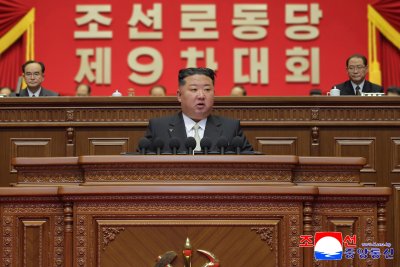
North Korea will convene a plenary meeting of the ruling Workers’ Party of Korea next month, state media reported Monday. In this February photo, leader Kim Jong Un speaks during the opening of the ninth party congress. File Photo by KCNA/EPA
North Korea will convene a plenary meeting of the ruling Workers’ Party of Korea (WPK) next month for an interim review of state and party policies for this year, state media reported Monday.
The WPK’s political bureau has decided to hold the second plenary meeting of the ninth central committee in late June, according to the Korean Central News Agency (KCNA).
The meeting will be convened “in order to have an interim review of the implementation of the party and state policies for 2026 and discuss the work in the second half of the year and a series of important issues,” the KCNA said, without providing further details.
The North has recently been holding plenary meetings regularly at the end of June and December, while also convening them when important issues need to be discussed.
It remains to be seen whether North Korea will make major decisions regarding its policy stance against South Korea or the United States at the upcoming meeting, amid speculations Chinese President Xi Jinping may visit the North soon.
The planned June meeting comes as North Korea seeks to implement follow-up measures for decisions made at the ninth party congress held in late February.
The following month, the North revised its constitution to add a new territorial clause, defining its territory as the land bordering China and Russia to the north and South Korea to the south, while removing all references to unification with South Korea.
Copyright (c) Yonhap News Agency prohibits its content from being redistributed or reprinted without consent, and forbids the content from being learned and used by artificial intelligence systems.
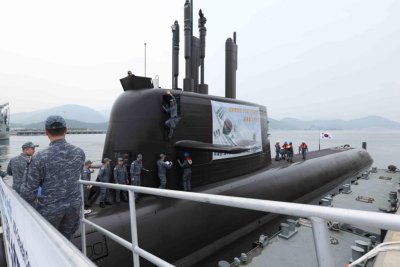
Sailors board the ROKS Dosan Ahn Chang-ho, a 3,000-ton South Korean naval submarine, at a naval port in Changwon, South Gyeongsang Province, South Korea, 25 March 2026. The submarine is departing across the Pacific for the first time to take part in joint drills with Canada in June aimed at bolstering maritime security and defense industry cooperation. Photo by YONHAP / EPA
May 24 (Asia Today) — South Korea is preparing to publicly unveil a development roadmap for a nuclear-powered attack submarine program after the successful Pacific deployment of the domestically built Dosan Ahn Chang-ho submarine, according to military and defense officials.
The move signals Seoul’s effort to strengthen what officials describe as the strongest conventional strategic deterrence available to a non-nuclear weapons state in response to North Korea’s advancing nuclear and missile capabilities and growing maritime competition in the region.
Senior military officials said the Ministry of National Defense and the Defense Acquisition Program Administration have completed technical reviews for a South Korean nuclear-powered submarine program and are now coordinating with related ministries, including the Foreign Ministry, on a diplomatic and regulatory strategy.
The report follows the recent Pacific deployment of the 3,000-ton Dosan Ahn Chang-ho submarine, which sailed about 14,000 kilometers, or 8,700 miles, from Jinhae through Guam and Hawaii using only domestically developed lead-acid batteries, diesel engines and an air-independent propulsion system.
South Korean officials said the deployment significantly reduced the need for snorkeling operations, in which submarines surface or raise air intake masts to recharge batteries, and demonstrated the vessel’s long-duration underwater operational capability and hull durability.
Officials also said the submarine successfully demonstrated stable operation of its submarine-launched ballistic missile vertical launch system in rough Pacific conditions. The Dosan Ahn Chang-ho class is the world’s first diesel-electric submarine class equipped with vertical launch tubes for submarine-launched ballistic missiles.
Defense experts said the mission simultaneously highlighted the operational limitations of conventional diesel submarines and the strategic advantages of nuclear propulsion.
While diesel-electric submarines must operate at relatively slow underwater speeds to maintain endurance, nuclear-powered submarines can remain submerged for much longer periods and travel underwater at speeds exceeding 40 kilometers per hour, allowing broader operational flexibility, officials said.
The foreign affairs and security publication The Diplomat reported Thursday that South Korea’s pursuit of a nuclear-powered submarine would become “a major test case of non-nuclear deterrence” for a country that does not possess nuclear weapons.
Chung Sung-chang, head of the Korea Nuclear Strategy Forum and a senior researcher at the Sejong Institute, said the submarine under discussion would be a non-nuclear attack submarine that would not carry nuclear weapons.
Chung said South Korea plans to retain the hull design and submarine-launched ballistic missile strike capability proven through the Dosan Ahn Chang-ho program while replacing the diesel propulsion system with a small nuclear reactor.
He said South Korea should first publicly present its nuclear submarine development roadmap before negotiating a bilateral nuclear submarine cooperation agreement with the United States and securing approval from the U.S. Congress.
Chung also said Seoul would need a separate agreement with Washington to secure low-enriched uranium fuel for naval reactors derived from downgraded highly enriched uranium.
Officials are reportedly studying the AUKUS security partnership among the United States, Britain and Australia, under which Australia received access to nuclear-powered submarine technology while remaining within the international nonproliferation framework.
South Korean officials said the success of the Dosan Ahn Chang-ho deployment demonstrated that the country’s technical preparations for a future nuclear-powered submarine program had reached a mature stage, shifting the focus toward diplomatic negotiations and international coordination.