kit

Red Cross shares 14 must-have items in 3-day emergency kit as snow forecast

The Met Office has issued a yellow warning for snow affecting 18 areas across the UK

People are being urged to “be prepared” for unexpected problems as the first snow and frost of the autumn and winter begins to arrive. The Met Office has issued a yellow warning for snow across 18 parts of the UK, advising those living in the affected areas they could face traffic disruption.

While on this occasion the snow is forecast over higher ground and is not likely to have a major impact on power or most services, it is a reminder to check homes have a suitable kit to cover them if there are outages or other issues. The government has launched a three-year Be Prepared plan to help households feel better prepared for events such as severe weather, which can occasionally affect services including power, water, phones and the internet.

The Red Cross is also advising people to make sure they are safe and has shared what is needed in a kit that will need to last up to 72 hours – or three days – of disruption. It says: “Emergencies in the UK can happen unexpectedly and may disrupt power, water, transport, communications or access to shops and services.

“Having an emergency kit ready can help you stay safe and comfortable during a power cut, flood, storm or other emergency. It can also help reduce stress and make it easier to look after yourself, your family and your pets.

“You don’t need specialist equipment or expensive supplies, and there’s no such thing as the perfect emergency kit. Most households already have many useful items at home, such as torches, phone chargers, blankets, long-life food, medication and basic first aid supplies. Use our emergency preparedness checklist to assess what you already have before buying anything new, and you don’t need to buy everything at once.”

What to include in the 3-day emergency kit

The Red Cross advises: “Your emergency kit should work for you. What you include will depend on your household, where you live and any health, accessibility or caring responsibilities you have. A 3-day or 72 hour emergency kit doesn’t need to be complicated. Focus on the essential emergency supplies first, then add items that suit your household and circumstances.”

Essential emergency supplies

These are the core emergency items every household should consider keeping in an emergency kit:

  • Paper copy of important contact numbers, to communicate with others even without mobile devices.
  • Mobile phone charger and portable power bank, so you can keep in communication.
  • Cash for essentials such as food or fuel, in case of a cyber attack or power cut stopping card payments.
  • Torch and spare batteries, in case of a power cut.
  • Battery-powered or wind-up radio, so you can access information during a power cut.
  • Essential medication and copies of prescriptions if needed.
  • Basic first aid kit.
  • Hand sanitiser and wet wipes, to maintain basic hygiene.
  • Three days’ supply of drinking water, in case a power cut, drought or flood disrupts the water supply.
  • Three days’ supply of long-life or ready-to-eat food.
  • Tin opener.
  • Copies of important documents stored in a waterproof bag, in case of electrical devices not being available or originals destroyed in a flood or fire.
  • Pen and paper, in case anything needs to be recorded.
  • Spare home and car keys, in case these are lost in the emergency.

Useful additional emergency supplies

These items are not essential, but they may help make managing during an emergency easier:

  • blankets or sleeping bags
  • warm spare clothing
  • toiletries and hygiene products
  • waterproof bags
  • whistle
  • spare glasses or contact lenses
  • duct tape

What does your own household need?

The charity says people need to assess their own individual needs as a household – if there are children, pets or specific health requirements. It also says you should ensure your car is prepared for all eventualities.

Emergency supplies for children and babies

If you have young children, consider including:

  • nappies and wipes
  • formula milk or baby food
  • bottles and feeding equipment
  • children’s medication
  • comfort items such as a favourite toy or blanket
  • activities to help keep children occupied

Emergency supplies for pets

It says: “Don’t forget to prepare for pets too. ” Ensure you have:

  • pet food
  • drinking water
  • leads, harnesses or carriers
  • medication
  • bedding or blankets
  • waste bags or litter supplies

Emergency supplies for health and accessibility needs

Other items might be needed depending on your circumstances. It says you may wish to include:

  • prescription medication
  • medical information or care plans
  • spare chargers or batteries for essential equipment
  • mobility aids
  • spare hearing aid batteries
  • accessibility aids used regularly
  • instructions for any medical equipment you rely on

Emergency supplies for your car

Keep essential supplies in your car in case you get stranded:

  • ice scraper and de‑icer
  • snow shovel
  • paper map (for diversions or poor signal)
  • blanket and warm clothing
  • first aid kit
  • torch and radio (battery or wind-up)
  • jump leads
  • bottled water and non-perishable snacks
  • high-visibility clothing

Met Office warning

On Monday the Met Office issued an updated yellow warning for snow affecting 18 areas across the UK saying it could mean longer journeys by road and on rail or bus services. It also warned it could affect power supply and mobile phones saying: “There is a small chance of power outages or degradation of mobile phone service.“

Ensure our latest lifestyle news always appears at the top of your Google Search by making us a Preferred Source. Click here to activate or add us as Preferred Source in your Google search settings

It said it was likely to affect some areas of high ground between midnight tonight and 11am on Tuesday. It explained: “A band of rain is expected to head northwards across the UK during Monday night and Tuesday morning. As it encounters colder air across the highlighted region, it is likely to turn to snow for a time, mainly affecting locations at 100-200 m altitude or higher.

“Any snow falling below this level will likely be temporary and quickly melt. Where snow does accumulate, depths of 1-5 cm are likely; some locations above 300-400 m could see 5-15 cm. This may cause travel disruption on higher level routes, particularly in combination with a strong easterly wind which could also cause localised drifting.

“Some accretion of ice onto infrastructure such as power lines is also a possibility. Snow will gradually turn back to rain both from the south and through the morning on Tuesday, perhaps resulting in some minor disruption from surface water.

It listed the potentially affected areas as being:

  • Derbyshire
  • Durham
  • Northumberland
  • Blackburn with Darwen
  • Cheshire East
  • Cumbria
  • Greater Manchester
  • Lancashire
  • Staffordshire
  • North Yorkshire
  • South Yorkshire
  • West Yorkshire
  • East Ayrshire
  • South Ayrshire
  • South Lanarkshire
  • Dumfries and Galloway
  • Midlothian Council
  • Scottish Borders

Source link

This Is The Army’s New MALET Kit That Turns Mortars Into Drone-Dropped Weapons

The Army on Wednesday unveiled its new system allowing front-line troops to rapidly convert 60mm and 81mm mortar rounds into drone-droppable munitions. Dubbed the Munitions Air-dropped Lethal Effects Tool (MALET), it is part of the service’s Picatinny Common Lethality Integration Kit (CLIK), which enables lethal payloads to be placed on unmanned systems, including small drones.

The development of these systems is taking place as the Army races to catch up to a mode of delivering munitions on enemy targets that began to show up a decade ago, when ISIS fighters started using this capability during the Battle of Mosul in Iraq in 2016 and 2017.

Work on the MALET system began in 2024, the Army explained in its announcement Wednesday morning. Experts at the Armaments Center’s Fuze and Mortar Divisions “recognized a critical opportunity,” according to the service. “Rather than introducing new munitions to the battlefield, soldiers could benefit from a capability to safely drop existing munitions without having to perform field modifications or manually remove safety mechanisms.”

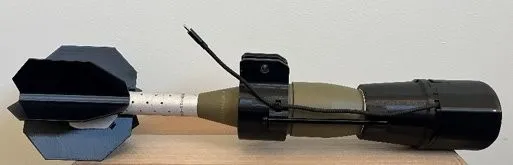
What they came up with was a clip-on kit that adds a fuze function to the round that allows it to be detonated after being dropped and includes fins to ensure “the aerodynamic stability required for a drone drop of the cartridge,” the Army stated.

Prototype of the Munitions Air-dropped Lethal Effects Tool (MALET), a clip-on conversion kit which converts munitions into dropped munitions for aerial deployment.
Prototype of the Munitions Air-dropped Lethal Effects Tool (MALET), a clip-on conversion kit which converts munitions into dropped munitions for aerial deployment. (U.S. Army) Eric Kowal

Once the rounds are converted, the goal is to drastically extend the range of mortars. Fired from a tube, they have a range of about between two to 3.5 miles. While the Army did not specify which drones were used in recent MALET tests, a solicitation earlier this year said the service is seeking to place these systems on drones with a desired operational range of between 20 and 40 km (about 12.5 to 25 miles).

The MALET system doesn’t damage the mortar, nor does removing it. That way, if the mortar is not expended, or mission requirements shift, soldiers can return the munition back to its original state, allowing it to be fired as a conventional mortar if needed.

Another advantage of the MALET system, according to the Army, is that it has a large supply of mortars.

“Instead of having to procure purpose-built munitions on drones, soldiers will be able to use rounds which they have in abundance already, such as 60mm and 81mm mortar rounds,” the Army noted.

U.S. Army Soldiers from Multi-Purpose Company, 2nd Battalion, 35th Infantry Regiment, 3rd Mobile Brigade, 25th Infantry Division, fire a 60mm High Explosive Dual Purpose (HEDP) round during a Mortar Training and Evaluation Program (MORTEP) at Area X-ray Range Complex, Schofield Barracks, Hawaii, Oct. 20th, 2026, to evaluate their proficiency in employing the 60mm mortar system and reinforce their ability to provide accurate and timely indirect fire. (Photo by U.S. Army Sgt. Jozeph Alvarez)
U.S. Army Soldiers from Multi-Purpose Company, 2nd Battalion, 35th Infantry Regiment, 3rd Mobile Brigade, 25th Infantry Division, fire a 60mm High Explosive Dual Purpose (HEDP) round during a Mortar Training and Evaluation Program (MORTEP) at Area X-ray Range Complex, Schofield Barracks, Hawaii, Oct. 20, 2026. (Photo by U.S. Army Sgt. Jozeph Alvarez) Sgt. Jozeph Alvarez

Recent test drops at multiple facilities “have already shown the MALET’s effectiveness, successfully maturing both the system’s fuze function and its critical safety elements,” the Army claimed. “The team just recently had a successful test where they demonstrated the performance of MALET with live 60mm mortars. The items were dropped from a UAS on the move; they oriented correctly and detonated within the desired target area.”

The Army only provided still images showing the round after it was released and then hitting a target, so we can’t independently confirm how well the system worked or how easy it is for soldiers to use it.

MALET undergoes live field testing.
MALET undergoes live field testing. (U.S. Army) Eric Kowal

As it conducts these tests, the Army says the MALET architecture can be applied to munitions other than these two mortar types. Mortars were the first to be demonstrated due to their maturity and alignment with large UAS requirements.

“The MALET Integrated Product Team (IPT) is exploring even more concepts” which are “mostly close-hold for now,” said the Army. Senior Scientific Technical Manager for Indirect Fire Munitions Ryan Gorman would say only that these new concepts are “unique.” 

“The MALET program is a great example of how the DEVCOM Armaments Center can leverage core competencies like fuze design, safety, and ammunition development and apply them to a dynamic, emerging space like lethal UAS to provide a unique and viable option for the warfighter,” Gorman added.

For the Army, the next step is to distribute the kit to major military exercises this fall “to allow for soldier touchpoints and receive feedback,” the service stated. “Conversations with industry partners, the User and Acquisition communities have already proven fruitful.”

As we noted at the top of this story, MALET is part of the Picatinny CLIK modular system. It includes the Armament UAS Delivered Immediate Battlefield Effects (AUDIBLE) Weapons Release System and the Gunslinger fire control software.

The Army’s Picatinny Common Lethality Integration Kit (CLIK). (U.S. Army)

AUDIBLE enables “quick change adapters to safely drop existing munitions, like the M67 grenade, providing a proven concept that is scalable to service a larger array of munition options,” the Army said in a 2025 release.

Gunslinger was originally designed by the Armaments Center for the Future Vertical Lift – Future Attack Reconnaissance Aircraft XM915 20mm Cannon, the Army explained in a separate release. 

Fire control software helps users point the weapon where it will most likely result in a strike while taking into account variables like target or weapons platform motion.

While the Army is touting the MALET system, it should be noted that last year, the service came under fire for lauding its ability to drop a grenade from a drone. This practice had been in widespread use by even the lowliest of actors for years by then.

“Have you ever seen a drone drop a GRENADE?” a now-deleted post from the official U.S. Army account on X read. “Watch Soldiers from @7thATC [7th Army Training Command], the Joint Multinational Training Group-Ukraine [JMTG-U] and @173rdAbnBde [the 173rd Airborne Brigade] execute the Army’s first live-grenade drop from an unmanned aircraft system in Grafenwoehr Training Area, Germany.”

The accompanying video, also since deleted, showed Army personnel loading standard M67 fragmentation hand grenades, as well as inert M69 practice types, onto small quadcopter-type drones fitted with purpose-built mechanisms for dropping them. The system was designed to pull out the safety pin on the unmodified grenade as it is released.

The following image is a screen capture of the now deleted video.

A screen capture from the Army video showing a soldier loading an M69 practice grenade onto a small quadcopter-type drone at the Grafenwoehr Training Area in Germany. (US Army capture)

As we pointed out last year, the answer to the “have you ever seen a drone drop a GRENADE?” is a resounding ‘yes’ for anyone who has watched this area of development over the past decade. We had predicted exactly this kind of application for commercially available drones even years before ISIS began using them in Iraq in 2016.

I have gotten a lot of crap for continuously nailing the Pentagon on being absurdly behind on low-end drone warfare threats and opportunities. This official post is all you need to know. It’s 2025. Mosul was nearly 9 years ago. https://t.co/1z2hwuTWuC

— Tyler Rogoway (@Aviation_Intel) July 21, 2025

There was a deep disconnect between the tone of the social media post, what is seen in the video and the comments therein, as well as the global reality when it comes to small armed drones.

The Army suggested this was a technological advancement. However, as we noted earlier in this piece, this mode of attack has been used for quite some time.

After the initial use by ISIS in Iraq a decade ago, ISIS and other militant organizations also used drones to drop small munitions, including on American forces in Syria. The threat of weaponized commercial drones, including types carrying improvised explosive payloads designed to just smash into their target and detonate, migrated to Afghanistan, as well. They have been a big part of the Ukraine war, used widely by both sides.

You can see a video of Ukrainian forces dropping munitions from drones early in the war below.

In addition, various nation-state armed forces and non-state actors around the world, including drug cartels in Mexico, now regularly employ small armed drones.

Difunden video de bombardeo desde drones en Tepalcatepec thumbnail

Difunden video de bombardeo desde drones en Tepalcatepec

The concept of adapting surplus munitions to be dropped from drones is not new by any means either, though it has been largely done in more of an improvised manner than the MALET system.

Ukrainians in particular became masters of this, including breaking down some of the U.S.-made cluster munition artillery shells they received to repurpose the submunition bomblets inside as improvised weapons to be air-dropped from small drones. Now there are munitions built just for this, as well.

The following video shows one example of how that worked.

Given that the Army is still testing the MALET system, it will be some time before it is actually fielded. While the service remains behind the curve, if MALET works as advertised, it will be a welcome addition for soldiers who want to extend the reach of a plentiful munition.

Contact the author: howard@twz.com

Source link