Mexico announces killing of drug cartel kingpin ‘El Mencho’ | Drugs News
Mexican security forces have killed Nemesio Ruben Oseguera Cervantes, the notorious drug lord widely known as “El Mencho”, in a major military operation, the country’s Secretariat of National Defence confirmed.
The Mexican government said that seven members of Oseguera’s Jalisco New Generation Cartel (CJNG) were killed in the raid in Tapalpa on Sunday.
Recommended Stories
list of 3 itemsend of list
Reports of road blocking and violence by drug cartels emerged in Jalisco and other states after news of the operation became public.
“At this time, elements of the Mexican National Guard and Mexican Army troops from the centre of the country and states neighbouring Jalisco are mobilising to reinforce the security of this state,” the Defence Secretariat said in a statement.
“With these actions, the Secretariat of National Defence reaffirms its commitment to contributing to the strengthening of Mexico’s security.”
Oseguera, the leader of the powerful CJNG, one of Mexico’s most violent and dominant criminal organisations, spent decades evading justice.
Washington, which had a $15m reward for information leading to Oseguera’s arrest, was quick to laud the raid.
“I’ve just been informed that Mexican security forces have killed ‘El Mencho,’ one of the bloodiest and most ruthless drug kingpins,” US Deputy Secretary of State Christopher Landau said in a post on X, calling the operation “a great development for Mexico, the US, Latin America, and the world”.
Of the seven cartel members killed on Sunday, four had been injured but later succumbed to their wounds. Three others were arrested, according to the Secretariat of National Defence.
Three military personnel were wounded during the operation and hospitalised, according to the statement.
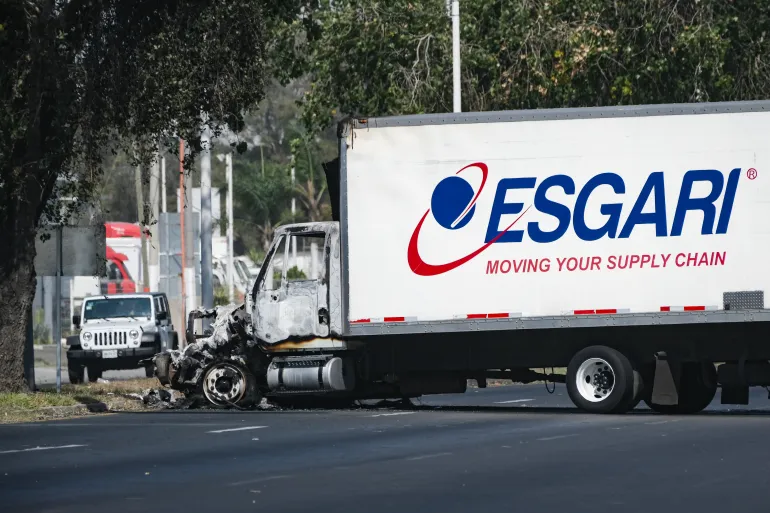
As news of the killing spread, cartel-linked violence erupted in response, with reports of roadblocks, burning vehicles, and other acts of intimidation in Jalisco and surrounding areas – tactics the CJNG has used in the past to disrupt security operations.
President Claudia Sheinbaum said her government was responding to the unrest, stressing that in the “vast majority of the national territory, activities are proceeding with complete normality”.
“There is absolute coordination with the governments of all states; we must remain informed and calm,” Sheinbaum wrote on X.
According to The New York Times, the violence erupted in at least five Mexican states, and
the Spanish newspaper El Pais also reported “blockades” in central Mexico.
An Al Jazeera witness shared photos of a burned-out bus on a major highway in Guadalajara, the capital of Jalisco, which will host several matches in the upcoming FIFA World Cup.
The US Embassy in Mexico warned American citizens in Jalisco and other central states to stay at home until further notice due “to ongoing security operations, associated roadblocks and related criminal activity”.
Landau, the US diplomat, also expressed concern about the events. “It’s not surprising that the bad guys are responding with terror. But we must never lose our nerve,” he said.
While airports across Mexico remain operational, the US embassy later noted that “some domestic and international flights cancelled” in Guadalajara and Puerto Vallarta, a coastal city in Jalisco.
The Reuters news agency reported that several major airlines, including Air Canada and United, have temporarily halted flights to Puerto Vallarta.
Oseguera’s fall was a priority target for the US, and is the biggest blow to drug trafficking in recent years.
Oseguera had built an aura of mystery around himself, drawing on the overwhelming power of the CJNG and his limited media presence: All photos of him were decades old, according to Al Pais.

Oseguera crossed over the border in the US several times in the late 80s, and lived illegally in San Francisco.
At the age of 19, he was arrested for the first time by local police for stolen property and carrying a loaded gun.
In 1989, he was arrested again and deported to Mexico. But he re-entered the US and was again arrested on drug charges in 1992 . He was prosecuted and sentenced to five years in prison after pleading guilty.
After spending three years in a federal US prison, El Mencho was released on parole and deported to Mexico, where he joined the local police.
A former police officer and avocado farmer, he rose through the ranks of the Milenio Cartel before founding the CJNG.
The FBI has described him as one of the most wanted fugitives in Mexico, and the CJNG as one of the most violent cartels in the country.
“It has been assessed to have the highest cocaine, heroin, and methamphetamine trafficking capacity in Mexico, and over the past few years, includes the trafficking of fentanyl into the United States,” the FBI said in a 2024 statement.
“Under Oseguera Cervantes’ leadership, CJNG has been responsible for many homicides against rival trafficking groups and Mexican law enforcement officers.”