King Carl XVI Gustaf of Sweden

Passenger ‘kicked out’ of his booked flight seat and couldn’t believe who took it

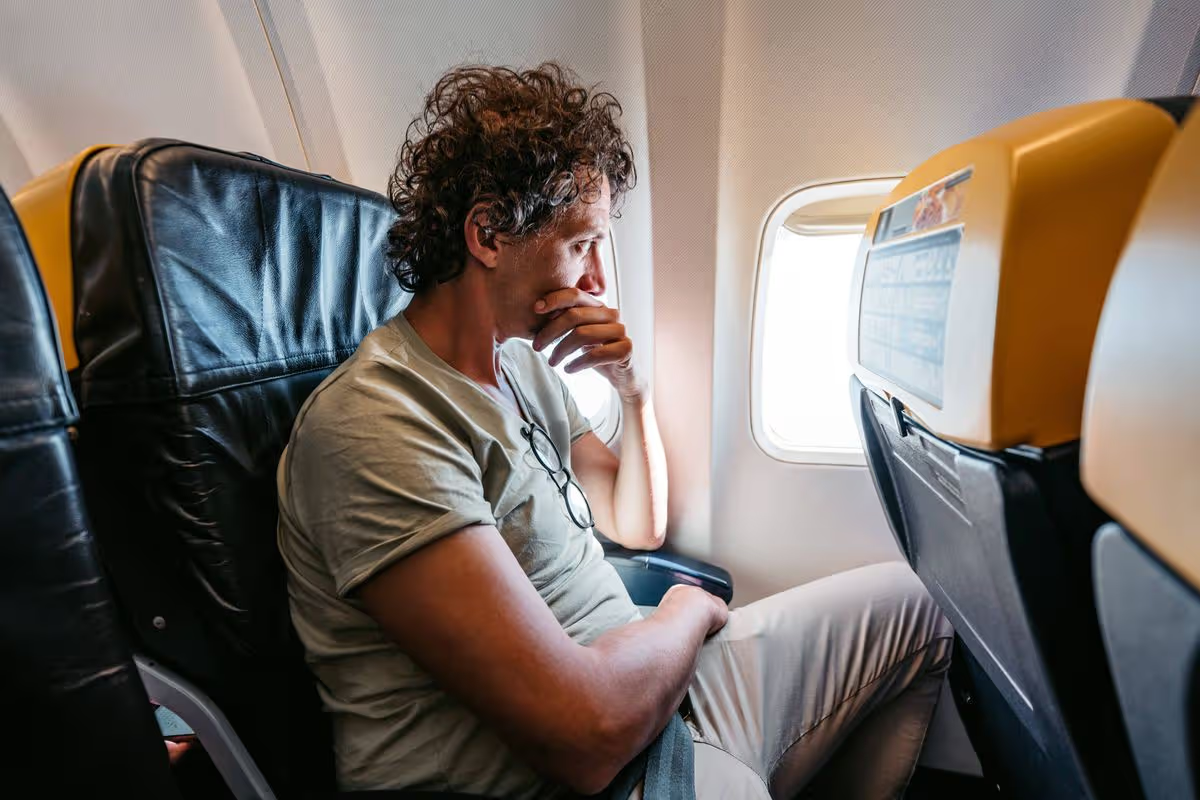
Christian Magnuson paid extra for his preferred seat on a Scandinavian Airlines flight, only to find it had been reassigned – moments later, he spotted who was sitting in it

Whether you’re a seasoned globetrotter or preparing to board a plane for the first time in ages, most of us have our tried-and-tested routines for making the journey as pleasant as possible. This might include wearing a particular outfit, grabbing some food or a drink at the terminal, or pre-selecting your favourite seat on the flight. But when these arrangements fall through or take an unexpected turn, it can throw your entire day off.

This was precisely what happened to one passenger named Christian Magnuson, who, despite being a regular flyer who frequently posts snapshots of his journeys on social media, was left utterly bewildered when his seat was abruptly switched without any warning.

Chris went on to show evidence that he’d reserved seat 17C on his Scandinavian Airlines flight, explaining he had paid extra to secure a seat towards the rear of the aircraft on the route from Stockholm Arlanda airport to Kalmar, a city in southern Sweden.

However, when boarding time arrived, Christian discovered his seat had been unexpectedly switched to 5D. The confusion deepened as he stepped onto the aircraft, only to spot his original seat remaining vacant.

Nevertheless, he proceeded to make his way through the plane to his reassigned seat. It was at that moment something wholly unexpected happened.

Content cannot be displayed without consent

“Then a convoy of cars pulled up and the King of Sweden boarded the airplane and sat in my seat,” he revealed in the caption of the post.

The footage captured King Carl XVI Gustav standing on the tarmac as Christian made his way down the aircraft steps after landing. A silver vehicle could be spotted in the distance, presumably waiting to collect the monarch from his journey.

Later that day, the royal family’s official Instagram account, ‘Kungahuset’, posted a photograph of the King alongside his eldest daughter, Crown Princess Victoria, and Swedish Prime Minister Ulf Kristersson, clarifying the reason behind the King’s travels.

“Was it fair of them to kick me out of my seat with no compensation? I will say it was cool that he flew on a regular airplane but he took my seat!” Christian added in the caption of the post.

Viewers quickly flocked to the comments section to voice their opinions, with many praising the Swedish King for choosing to fly commercially. “Happened to me too and I’m just proud to have a monarchy not wasting our resources with a private jet,” one person said.

A second user wrote: “I think it’s awesome that the King flies commercial. Also, you have a cool story.”

Others also questioned why Christian should have received compensation, given he still secured a seat on the flight. “Well, the king is… the king,” one person argued. Someone else added: “Airline employee here, yes its fair since they need security personnel onboard. ARN – KLR is also a really short route.

“I would be happy and proud to give him my seat! It’s for his safety. He did not decide himself,” another user chipped in.

Scandinavian Airlines has been approached for comment.

Source link

A beautiful town is being moved three miles away and locals aren’t happy

Moving a town down the road requires a huge amount of money and incredible engineering expertise, but not losing the community in the process might be even more complex

One sunny day last August, a 713-tonne, 113-year-old church was lifted off the ground and placed onto a specialised 224-wheel transporter to begin its journey five kilometres down the road.

The Gothic revival Kiruna Church is a beloved building, once named the most beautiful in Sweden. It would’ve stood where it did to the west of the Arctic town for many decades more, had the ground not threatened to swallow it up.

A great cheer went up as the church arrived at its new home, traffic lights, lamp posts and even a bridge having been demolished to make way for the timber structure. Among the spectators was Sweden’s King Carl XVI Gustaf and children who clambered onto roofs for a better look. The widely publicised event made headlines across the world and the typically capable Swedish engineering team earned many metaphorical slaps on the back.

And then, a week later, everything changed.

READ MORE: I stayed in the new ice hotel – it’s not the cold that some guests can’t handle

Author avatarMilo Boyd

“They smashed us in the head,” says Kjell Törmä, a local journalist and lifelong resident. The 67-year-old has chronicled the town’s move since 2004, when mining company Luossavaara Kiirunavaara Aktiebolag, (LKAB) first told the population what its digging had done.

A century of going down into the 2km iron ore deposit had caused fissures to spread from the mine to the town centre, roughly 2km away.

It was decided that the town must be moved, or else its foundations would collapse. At first, 4,700 residents would be moved to the safer east of the town – their homes bought and then demolished by LKAB, which is legally required to fund the estimated £737m relocation effort. Twenty buildings, including the church and iconic town hall, would be driven to safety.

“Almost everyone in Kiruna accepts this change, but many of us don’t like it. It is tragic in many ways. We have to accept it or accept that we will lose our jobs,” Kjell told the Mirror.

“In my family, my mother and father worked for LKAB for 75 years together, one of my brothers worked there for 20 years. I have done a lot of jobs for the mine as a freelancer. Almost every family depends on LKAB.”

As reluctantly accepting of the town’s move as locals may have been before, what came after the church relocation has caused far more disquiet. Eight days later, once the world’s press had left the town, 6,000 more locals were told their homes would be demolished.

“The mining company is the enemy. A lot of people are taking the money and leaving,” former Kiruna resident Hannes told me on the night train to the town.

The young dad was returning north, having swapped his hometown for Malmo in the far south several years ago. “I find it depressing to go back now,” he said, in between marshalling his sociable toddler as she made her way down the carriage.

Hannes’ parents have also left and soon, so will his cousin Kjell. “When they told us we had to move, I was in shock and sad for a week. Then my wife and I decided we would turn a page in our lives,” Kjell explained.

As technically remarkable as the great shift east is, and as deep as LKAB’s pockets seem to be when it comes to paying over the odds to homeowners, moving a town is complex.

Kjell is losing a home he’s spent 35 years building. Each day, he can hear machines working away in the distance.

“Many people who have moved from Kiruna and come back say it’s not my town anymore. I have always answered, ‘no it’s not the town for us elders, but for the kids. They grew up with this, it will be their town.’ But, a lot of memories are disappearing all the time.”

Exploring the old and new sides of town, their distinct personalities are immediately obvious. When city planner Per Olof Hallman drew up the blueprint a century ago, he selected the best location in terms of climate, placing the traditional Swedish timber home on a south-facing slope, close to the mines and with a favourable aspect and microclimate. Streets followed the terrain to avoid wind tunnelling and to maintain beautiful views for the residents.

In the new town, tall modern blocks of flats have been built in a dip, which blocks the view south and, according to a University of Gothenburg study, can be 10C colder than the old town.

The slightly ramshackle feeling of a community that has grown organically over the years is replaced with something a little more familiar.

“It looks like anywhere else in Sweden now,” Hannes says.

This is not to say that the move has not been attempted with great care, attention or love by those in charge. Indeed, Kjell says LKAB have managed it “very well” on the whole.

But it is undeniably difficult to transport a place that isn’t just physical buildings, but memories.

Göran Cars, the current urban planner for the Kiruna municipality, acknowledges the challenge. “I was stupid coming up here, because I assumed that the way to maintain identity and preserve history was to move physical buildings,” he told Dezeen.

“We are moving the church. When I speak to people they say: ‘Yes I know that, but what about a grave? How about the birches?’ I didn’t understand that. They are small trees! But they are 100 years old – as old as the church. I get the question time and time again: ‘What about the birches?’ So now we are moving the birches.”

The complexity of the challenge is sobering. This is, after all, Sweden, where the structures of local democracy are strong, the engineering sector is world-leading, and the concerns of nomadic reindeer herding Sami are increasingly heard. It’s also a project backed by one of the world’s biggest iron ore mines.

These are advantages other places won’t enjoy. And there will be many more such places.

The United Nations’ Intergovernmental Panel on Climate Change report warns that the predicted 1.5 centigrade increase in global temperatures will lead to an average sea-level rise of between 26 and 77 centimetres by the end of the century. With 2C of warming – which looks increasingly likely – the Greenland ice shelf could melt, triggering a rise of up to seven metres.

The world’s largest cities Miami and Mumbai are under threat and the Maldives will likely be uninhabitable by 2100. Not just 10,500 as in Kiruna’s case, but millions of people will have to move.

LKAB and Kiruna Council were approached for comment.

Source link