Trejo has played for several first and second division soccer clubs in the South American country since 2023 and signed on with the northern Venezuela-based Club Sport Marítimo de La Guaira earlier this year.
On Sunday, Trejo’s club announced the deaths of his family in an Instagram post.
“Club Sport Marítimo de La Guaira profoundly laments the irreparable loss of the wife and sons of our player Lucas Trejo,” the team wrote. “[The deaths] occurred on June 24th during the earthquake that shook the entire country.”
When the earthquakes struck, Trejo was at a training session in the capital city of Caracas while his wife Yanina and children— Aarón and Ainhoa— were at the family home in the severely affected beachfront city of La Guaira.
Trejo’s brother-in-law Ricardo Ardiles told CNN Español that the Club Sport Marítimo de La Guaira defender rushed home after the temblors and was “emotionally overwhelmed” as he dug through rubble for days in search of his family.
“What he found was a horrific scene,” Ardiles said last week. “He found absolutely nothing of what the building itself had been.”
Trejo was far from the only athlete gravely affected by the seismic activity in Venezuela.
Former Club Sport Marítimo de La Guaira player Héctor Bello also lost his wife Andrea during the earthquakes. She died while protecting their infant daughter, who was later found alive by rescue teams.
“I’m going to make sure our baby remembers how wonderful you were, how much you loved her,” Bello wrote in an Instagram post honoring his wife. “I’ll tell her the story of how you saved her, how you gave your own life for our daughter, how you were a brave woman who, even with your last breaths, never abandoned her.”
“Venezuelan football bids a heart-wrenching farewell to a young man who represented our country’s colors with pride, commitment and love,” a social media statement from the federation read. “His passing has plunged the entire Vinotinto family into mourning and leaves an indelible mark on all those who shared moments with him both on and off the pitch.”
Eighteen-year-old Razan Sijaa, who played for Caracas Fútbol Club, 14-year-old Víctor Palacios of Club Sport San Augustín’s academy and 17-year-old prospect Ricardo Veloz were also killed by the quakes.
Locally, the family of Dodgers shortstop Miguel Rojas narrowly escaped tragedy and were doing OK after the earthquakes.
“Literally two blocks away from where my family was, two buildings collapsed — the whole building,” Rojas told reporters last week. “I’m lucky, to be honest with you guys. I’m really lucky to have my family still alive and with me. I’m not taking this for granted.”
According to Rojas, his wife and kids were in Caracas, which is approximately six miles south of where the quakes struck. His wife was there to renew her passport, and the kids were going to try to get Venezuelan citizenship. He added that his sister was in Los Teques, Rojas’ hometown about 17 miles south of the coastal destruction.
“It’s really tough to see teammates of mine and players that I played with at some point in my career lose family members, to lose kids,” said Rojas, who spent years playing baseball in La Guaira. “It’s really devastating. It’s been really hard for me to go to sleep at night.”
Less than two hours before the Dodgers took the field in Minneapolis on Wednesday, a pair of powerful earthquakes rattled Venezuela, where the wife and two kids of Dodgers shortstop Miguel Rojas were visiting and where his sister lives.
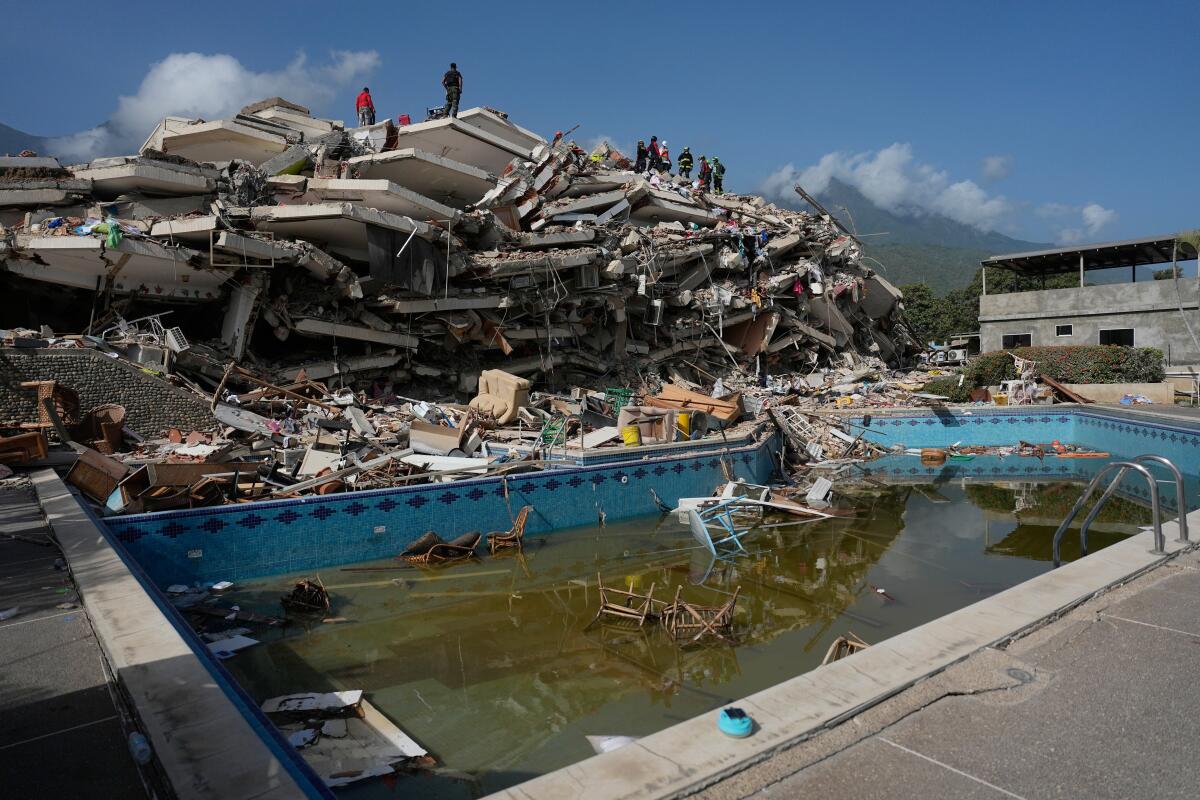
The successive magnitude 7.2 and 7.5 earthquakes left the country’s northern coastal state of La Guaira in ruins, collapsing more than 770 buildings and killing at least 1,450 people, local authorities said Sunday.
All of Rojas’ family members were OK, the Venezuelan native told reporters ahead of Friday’s game against the Padres in San Diego.
“Literally two blocks away from where my family was, two buildings collapsed — the whole building,” he said. “I’m lucky, to be honest with you guys. I’m really lucky to have my family still alive and with me. I’m not taking this for granted.”
Rojas’ wife and kids were in Venezuela’s capital, Caracas, which is only about six miles south of the destruction along the coast. His wife was there to renew her passport, and the kids were going to try to get Venezuelan citizenship. His sister was in Los Teques, Rojas’ hometown about 17 miles south of the coastal destruction.
Rescue workers search through rubble on Saturday in Catia La Mar following the devastating double earthquakes.
(Fernando Vergara / Associated Press)
“It’s really tough to see teammates of mine and players that I played with at some point in my career to lose family members, to lose kids,” said Rojas, who had spent years playing baseball in La Guaira. “It’s really devastating. It’s been really hard for me to go to sleep at night.”
Rojas, on Friday, said he was talking daily with his family members, who were still in Venezuela. He hoped to bring them back to the United States as soon as possible. Aftershocks continued to rattle the country into Sunday morning.
As the Dodgers and Padres started their series in Petco Park on Friday, both teams wore caps with the letters “VZ” embroidered on the side to honor the people of Venezuela as the road to recovery begins.
“That means a lot because both teams will be doing it — it means a lot, because it brings awareness,” Rojas said.
“We are on one of the biggest stages in sports, and I really appreciate what the Dodgers do to support us,” he added. “It’s not just what happens now, it’s what’s going to happen in the future. It’s going to take a long time for people to recover.”
Times staff writer Maddie Lee contributed to this report.
SEATTLE — Cristian Roldan and Haji Wright grew up less than three years and 30 miles apart, Roldan in Pico Rivera and Wright in Culver City. The odds that they would go on to become teammates on not one, but two, U.S. World Cup teams seem astronomical.
Yet despite starting at the same time and place and arriving together at the same destination, the two players followed completely different paths to get there.
Wright joined the Galaxy’s academy at 14 and signed with Schalke of the top tier German Bundesliga days after his 18th birthday. Roldan was still playing for El Rancho, when he was 17, making him the only member of the U.S. World Cup team to play four years at a public high school.
“I might be the last one,” Roldan said. “I hope not.”
Crescenta Valley’s Salar Hajimirsadeghi and El Rancho’s Cristian Roldan meet in unison for a header.
(Tim Berger / Glendale News Press)
High school soccer was once the foundation of the sport in the U.S. Eighteen players on the 2002 World Cup team, the only American team to reach the tournament quarterfinals, played for their high school teams. By 2022, the only man on the roster who played four years for a public school was Roldan.
“I don’t wish my story, or how I ended up here, was any different,” Roldan said. “What I will say was it made it more difficult to be here, play[ing] four years in high school. But it makes my story special.”
His story becomes even more special with this World Cup, which opened for the U.S. in Inglewood, a 45-minute drive from his boyhood home, and will continue when the Americans face Australia on Friday in Seattle, where Roldan played two years at the University of Washington and 12 seasons as an all-star midfielder with the Sounders, winning two MLS titles.
“When we talk about people’s paths, Cristian’s is not the standard right now,” said older brother Cesar, an athletic trainer with the Galaxy. “Cristian did it mostly to be around his friends. He wanted to play with his buddies.
“That is not a standard way to make it into MLS. And forget about making [it] all the way to the national team.”
“Yeah, it’s different,” Cristian said with a smile. “Being able to play in your backyard, have friends and family there. It’s a celebration.”
And it may never be repeated.
Roldan, 31, is the third-oldest player on the U.S. team, so the MLS academy system was just getting started when he enrolled at El Rancho in 2010. But as the academy system and the Elite Club National League became larger and more powerful, they began to throw their weight around.
Academy and elite club teams essentially robbed prep soccer of its best players by forcing them to choose between their high school teams and elite club programs, demanding a year-round commitment and banning participation in other sports. When top players began opting for the academies, others had no choice but to follow if they wanted to be seen and scouted.
That also robbed U.S. soccer of one of the few advantages it has over European and South American countries, most of whom have nothing to rival the high school and college sports infrastructure where kids can play and develop for free.
Cristian Roldan sprints during a training session Tuesday in Irvine ahead of the United States’ World Cup match against Australia on Friday.
(Andre Penner / Associated Press)
“That’s not available in Germany or England, or whatever,” said Brian Schmetzer, Roldan’s coach with the Sounders. “I like the fact that the United States is a big enough country where we can give kids opportunities to continue playing.”
Especially since the academy and elite club pathways aren’t open to everybody. Moving from a free neighborhood high school team to an academy can be expensive, erecting a “pay-to-play” barrier that often restricts those programs to wealthier families. Travel to games and practices can also be an issue. Since many high school-age players can’t drive, a parent has to accept the responsibility of toting them back and forth to team activities.
That leaves little time for work, which can pose an additional financial burden.
“My parents would have done whatever for us. So they would have made things happen,” Cesar Roldan said of Cristian. “But he really didn’t have any of those options. There was just not the opportunity.”
Paul Caliguiri, who played in two World Cups before retiring as the second-most-capped player in U.S. Soccer history, said the slow strangulation of high school soccer will ensure some talented players will be overlooked.
“There are a lot more qualified players that choose the path of high school soccer rather than the full-time academies,” he said. “The issue is that many of those players that don’t go to full-time academies when the opportunity presents is likely due to transportation.
“We need to have more full-time training offered to players without increasing the ‘pay to play’ cost.”
Dominic Picon, who coached all three Roldan brothers at El Rancho, agrees.
“We’re losing a ton of kids who never get seen,” he said. “There’s a lot of kids that just get lost in the shuffle simply because we have a very limited scope of how we find players. If you look at our three main sports — baseball, basketball and football — virtually all of them play high school sports. They all come through that pipeline.”
Roldan, the son of a Guatemalan immigrant father and a Salvadoran-born mother, said he never really considered any of those issues when he decided to play with the neighborhood kids in high school, just as his older brother Cesar had done.
“I looked up to my brother and I wanted to share a similar path as he did,” he said. “And I wanted to win a trophy for the city of Pico Rivera, which only has one high school.”
U.S. midfielder Cristian Roldan defends the ball from Senegal forward Habib Diarra during an international friendly match on May 31.
(Scott Kinser / Associated Press)
He made good on that last pledge in his senior season. Playing with younger brother Alex, who was a junior, Roldan scored 54 goals and had 31 assists — what Picon calls “video-game numbers” — to lead El Rancho to 29 wins and a CIF Southern Section title. Individually, he was named the Gatorade national player of the year.
Alex would go on to play alongside Cristian with the Sounders and captain the Salvadoran national team. Picon said he knew the brothers were good. But he didn’t know how good.
“When you’re coaching them, they’re in high school,” he said. “You never look at them and say, ‘You know, these guys are going to be in the World Cup someday.’”
In fact, there was some doubt both would even play in college. Alex was headed to a junior college in Arizona before receiving a last-minute offer from Seattle University. And Cristian, despite his award-winning senior season, had very few firm offers from top schools, in part because he insisted on playing high school soccer and in part because he was small at 5-foot-7.
“What hurt him is playing at a public school,” Picon said. “His rise was improbable because of where he came from, but also when he did play in front of [college] coaches, I think his size was something that dissuaded coaches.”
Contrast that with Wright, whose exposure at the academy level helped him get stamped as one of the country’s top youth players, opening up professional opportunities before he was old enough to vote.
In the end, it wasn’t Roldan’s talent that got him a scholarship as much as it was the boldness of his mother Ana. When Washington coach Jamie Clark inadvertently sat down next to her at the Surf Cup showcase in San Diego, she urged him to have a look at her son.
He did, then called Picon the next week.
“He’s a legit player,” Picon remembers telling Clark. “He’s better than 99% of the academy players out there. It’s just because of where he plays, the city that he’s from.”
Cristian Roldan speaks to reporters during a team training session in Seattle on Thursday.
(Soobum Im / Getty Images)
Picon was right. In his first season at Washington, Roldan was the Pac-12 freshman of the year and after his sophomore season he turned pro. MLS stardom and two World Cup selections were on the horizon. And there was luck in that, the coach says.
But that good fortune started at home with parents who put their faith in public schools, then saw that faith rewarded.
“It’s the quintessential American story, right?” Picon offered. “You have immigrant parents. They come here and they put a lot of trust in the public school system. At the elementary level, the teachers were tasked with making sure they have a grasp of English. They did that.
“At middle school, they were tasked with getting them prepared for high school and they did that. All three were accepted into a four-year [college], their kids.
“Where Cristian and his brothers lucked out is having the parents that they did. They were the type of parents that any coach, high school or club, would want to have.”
Getting to the World Cup, then, isn’t always determined by the path you take. Sometimes the most important factors are how and where you started.
Beneath azure skies and fluffy white clouds, three giggling toddlers and their mothers arrive at a candy-colored water park in the town of CoComelon.
It’s the opening of “Fast Little Fishy Splash Water Park Adventure,” a three-minute episode of “CoComelon,” the popular children’s cartoon series that is perhaps as controversial as it is appealing to young children.
Moonbug Entertainment, the studio behind “CoComelon,” says the episode, which debuted on YouTube in May, is the result of a years-long collaboration with a UCLA think tank.
In an unconventional move for a privately held entertainment company, the studio released its child development guidelines on its website Tuesday. Moonbug’s head of communications Bao Nguyen said the company began to incorporate findings from the research into its creative process in late 2025.
“It’s a great example of what we’ve been trying to do,” said Rich Hickey, Moonbug’s chief creative officer, referring to the episode. “Inclusive storytelling and learning through play — they’re all evident within that episode.”
Nina and Cody, ecstatic about visiting their neighborhood splash pad, run through fountains and hop in kiddie pools, but protagonist JJ is a bit more skeptical.
With support from his friends and his mother, who offers him goggles and a pair of orange arm floaties, JJ decides to face his fears. He joins his friends under a tipping bucket, and — spoiler alert — realizes that he actually enjoys playing in water. (“I just love to swim, swim, swim,” he sings.)
The guidelines, called the “Moonbug Learning Principles Framework,” are informed by academic research and advise that Moonbug shows should help young viewers navigate “real life moments” and “model positive relationships among children and their friends and caregivers.”
Other priorities include creating shows that encourage kids to learn through play, as this helps them develop their imagination and creativity, and featuring characters from diverse backgrounds (“CoComelon’s” Nina is Mexican American, Cece is Korean American and Cody is Black) — and giving said characters depth — across all Moonbug shows.
“We’re a digital-first company and we realized that there may be some … hesitation to sharing online content with children,” Hickey said. “This is really to keep building on the trust we think we’ve built.”
“CoComelon” is Moonbug’s flagship preschool show, and the series’ origins date back to 2006 when commercial director Jay Jeon shared a YouTube video of an alphabet cartoon set to music. The videos began to revolve around toddler JJ in 2017.
By 2020, “CoComelon” was the most-watched YouTube channel in the world, averaging 3.5 billion monthly views. That year, the show made its streaming debut on Netflix — where it broke ratings records — and was bought by London-based entertainment company Moonbug.
Moonbug was then acquired by Candle Media, a firm led by ex-Disney execs Kevin Mayer and Tom Staggs, for a reported $3 billion. Disney+ has since obtained the exclusive streaming rights to “CoCoMelon.”
“CoComelon‘s” image woes aren’t new. The series has developed a reputation for keeping children glued to the screen, as seen in videos that have gone viral on social media of babies bolting to the television upon hearing the marimba theme song.
In 2020, a Guardian columnist wrote that “CoComelon” was “like crack” for a preschool child. A New York Times report in 2022 gave the public more insight into Moonbug’s audience development process, which included testing “CoComelon” videos on young children to make its shows as attention-grabbing as possible.
The program has been a hot topic on parentingforums. The exchange typically goes something like this: Someone asks if “CoComelon” is “bad” and a gaggle of parents weigh in. “Very overstimulating,” said a user in one Reddit thread. “It moves too fast for kids’ brains to process, which can cause a speech delay,” wrote another.
Asked to respond to the criticism, Hickey said he believes Moonbug makes “age-appropriate content” and produces a range of videos to cater to different moments throughout a child’s day, from slow bedtime videos to faster-paced ones meant to encourage movement, Hickey said.
In 2023, Moonbug recruited the Center for Scholars and Storytellers, a think tank at UCLA that bridges entertainment media and psychology research, to “create the best possible product” for its audience, Hickey said.
The center was tasked with analyzing Moonbug’s content and crafting the learning principles to guide the studio’s future preschool programming, which also includes the “Blippi” and “Little Angel” franchises.
A scene from Moonbug Entertainment’s “Blippi’s Job Show.”
(Jessica Perez / Moonbug)
Moonbug also asked the center to determine if there was research showing that audiovisual content could be addicting for preschoolers, said Yalda T. Uhls, an assistant adjunct professor of psychology at UCLA and executive director of the Center for Scholars and Storytellers. Uhls said the center’s review of existing peer-reviewed research found that there was no such evidence.
And despite oft-repeated claims that long-form content is better for kids than short-form content, “there isn’t really actually any evidence for that,” Uhls said. “It’s very inconclusive.”
The center found that preschool children struggle to learn as much from content with frequent cuts, though consuming it doesn’t impact their attention span negatively, Uhls said.
As such, the principles the center crafted recommend Moonbug “minimize distractions and tangential songs or storylines” when characters are navigating real-life situations to make sure it does not interfere with preschool children’s ability to learn lessons.
The center interviewed members of Moonbug’s creative teams and formed an advisory council of academic experts in child development to evaluate a selection of Moonbug’s episodes, assess the quality of socio-emotional learning and find areas for improvement, Uhls said.
“The content certainly had a lot of places where it could improve, but it wasn’t horrible,” Uhls said. “There was some learning within the episodes. … It wasn’t all good, it wasn’t all bad.”
Uhls said she recalled several instances of episodes modeling unsafe behavior, but declined to share specifics.
The center plans to continue to work with Moonbug to integrate child development research much earlier in the studio’s creative process and aid with the integration of the learning principles into its content slate, Uhls said.
WASHINGTON — The Trump administration has identified more than 15,000 cases of adults gaining custody of multiple immigrant children who enter the U.S. without a parent, officials said Thursday, signaling a potential push to prosecute prolific child sponsors.
The Justice Department highlighted cases against three Guatemalan nationals that they say underscore the dangers of improper vetting of sponsors in a program that seeks to unite kids with relatives or family friends after they enter the U.S. Officials said they are investigating numerous other so-called super-sponsors — those who gained custody of more than three unrelated children — to determine whether the sponsors took the kids in fraudulently.
“We will not accept half measures when it comes to securing the border, protecting American lives and saving children from exploitation,” Acting Atty. Gen. Todd Blanche told reporters.
Taking custody of multiple unrelated migrant children is not a crime. The sponsors may be caring and well-intentioned, but senior administration officials calling them out suggests that authorities harbor suspicion about them and may subject them to deeper scrutiny.
Under former President Biden, officials tried to release children to eligible adult sponsors within 30 days, reuniting many families quickly. But the approach also yielded errors, with some children being released to adults who forced them to work illegally or to people who provided clearly false identification and addresses.
Under Trump, the administration tightened rules aimed at preventing traffickers from illegally bringing children into the country, and that has also led to a dramatic increase in federal custody times for kids. As of May, children are held in federal custody for an average of 206 days before they’re released, compared with an average of 37 days when Trump took office. At the same time, the number of total children in custody has steadily dropped.
Striking a balance between releasing children to vetted sponsors and shielding them from danger has proved a contentious partisan disagreement.
Democrats “want to claim that Republicans, because we’re enforcing the laws, it’s inhumane, somehow,” Blanche said after criticizing the vetting procedures under the Biden administration. “What’s inhumane about taking care of our kids?”
The cases announced Thursday include charges against a woman who, authorities say, was living in the U.S. illegally, schemed with others to smuggle kids across the border, then used fake identities to gain custody of them in exchange for money. In another case, a woman is accused of falsely claiming that she was siblings with a teen who had entered the U.S. illegally in her application to become the teen’s sponsor.
The Associated Press has sought comment from attorneys representing the accused in those cases.
Critics of the Trump administration have raised concerns over wellness checks carried out by immigration officers at elementary schools, immigration officers showing up and detaining sponsors at reunification meetings with children, and newly required documentation that’s created a “paperwork barrier” and led to a recent lawsuit.
Even sponsors willing to undergo the new vetting procedures have been forced to wait through unnecessary delays.
A Chicago father who is a U.S. citizen and had a valid birth certificate for his child was kept waiting for five months before the government could schedule a fingerprinting appointment. During the wait, his toddler daughter was sexually abused in federal custody, a lawsuit claimed.
Richer and Gonzalez write for the Associated Press. Gonzalez reported from McAllen, Texas.