U.S. and Canadian refs to have a record-sized presence at World Cup
Brooke Mayo was just 4 when she started playing soccer. She was about 4½ when she started fantasizing about participating in the World Cup.
“I just fell in love with the game,” she said. “Like any soccer player, you dream about the World Cup, you know?”
That dream came true three years ago, though not quite in the way Mayo had imagined. Although she took part in four matches at the 2023 Women’s World Cup, she did so as an assistant referee, not a player, running up and down the field with a flag in her hand, not a ball at her feet.
Yet Mayo made history just the same, joining Tori Penso and Kathryn Nesbitt as the first American officials to work a World Cup final as a trio. More importantly, they performed so well they have been invited to officiate in the men’s World Cup this summer, where they will make more history as just the second all-female crew to work a game in the men’s tournament.
And while Mayo appreciates the barrier breaking, for the three women it’s just another day at the office.
“For us, it’s just business as usual,” she said. “I think there’s still a lot of places in the world that need to see this and that’s why it’s still important. But our colleagues are used to seeing women around.”
Mark Geiger, a two-time World Cup referee who is now general manager of the Professional Referee Organization (PRO), which manages officials for MLS, agrees. After decades of seeing U.S. and Canadian referees given little respect by FIFA — nor by international soccer in general — Geiger says the biggest takeaway from this summer’s tournament isn’t the gender of the domestic officials selected, but rather the number, 11, making it the largest contingent to work a World Cup.
In addition to Mayo, Penso and Nesbitt, the list includes Ismail Elfath, Armando Villarreal, Kyle Atkins, Corey Parker and Drew Fischer, who took part in the 2022 men’s tournament. Nesbitt, Elfath, Parker and Atkins all worked the final of that World Cup four years ago, Elfath as the fourth official, Nesbitt as the reserve assistant referee and Parker and Atkins as video assistant referees.
With Mayo’s team working the 2023 women’s final — alongside Villarreal, who was in the video booth — seven MLS officials have worked the last two World Cup finals and at least one PRO official has been assigned to 19 of the 32 knockout games in the most recent men’s and women’s tournaments.
No other league or country in the world is even close to that.
“Over the past few years I think we’ve shown that the quality of football and the quality of the officiating in the United States and Canada is at a really high level,” said Geiger, who made history of his own in 2014 when he became the first American center referee to work a Round-of-16 match in the men’s World Cup.
“We are in the normal conversation of knockout-stage games, we’re in the normal conversation for Tori to do the final. It’s not out of the realm of possibility.”
Another thing that makes this World Cup special for the PRO officials is that with the U.S., Mexico and Canada sharing host duties, the tournament will be played at home. The only other time the men’s World Cup was played in the U.S., in 1994, Arturo Angeles, a Mexican-born naturalized citizen, was the only American referee selected and he supervised just one group-play game.
“Any World Cup game anywhere is going to be special on some level,” said Fischer, a 45-year-old Canadian who has been a FIFA referee for 11 years. “It’s definitely a special feeling when you get to play host. It’s a little bit of welcoming the world into your backyard.
“There’s a certain hometown pride. So I’m definitely looking forward to that aspect of it.”
Joe Dickerson, U.S. Soccer’s reigning male referee of the year, received the FIFA international badge he needed to work major competitions just three years ago. Yet he will be a replay official in this World Cup, the first one he was eligible to work.
“This kind of happened so fast in the last couple of years,” said Dickerson, who became a professional referee in 2013, then began targeting the World Cup when it was awarded to the U.S., Mexico and Canada in 2018. “To work the biggest sporting event in the world in front of friends and family is really cool. And being a part of the celebration of culture happening in your own country and, as much as we can, celebrate our own culture, is really cool.”
It also makes things much easier on family and friends. When Mayo officiated her first group-stage game in the 2023 tournament in New Zealand, her wife, Falon Catalano, flew in for the match.

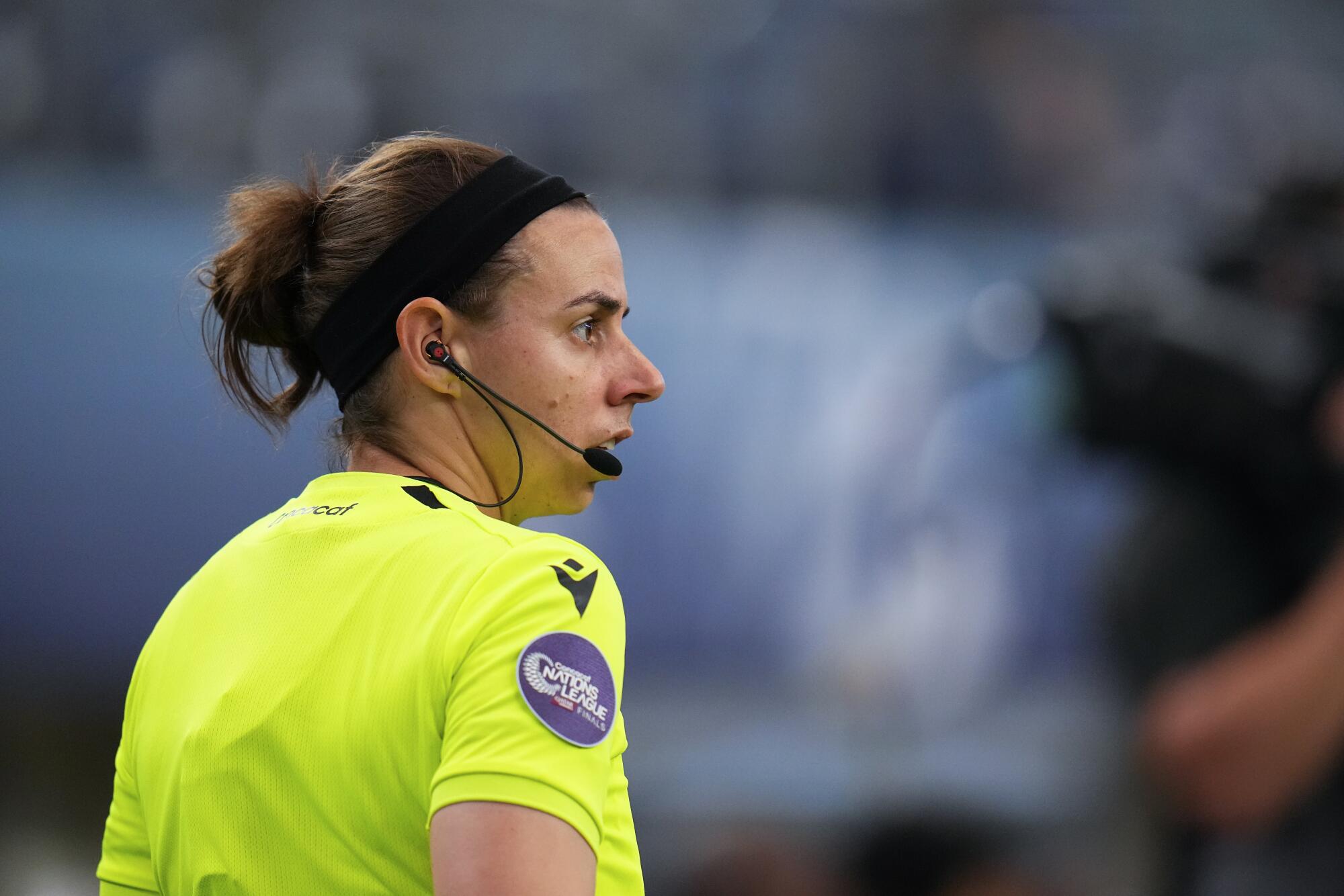
Referee Brooke Mayo looks on during a CONCACAF Nations League third place match between Jamaica and Panama in March 2024.
(Julio Cortez / Associated Press)
“I told her like hey, it’s our first World Cup. So she came to that and then went home,” said Mayo, 37, who wasn’t sure she’d get another game.
When she was assigned the England-Australia semifinal in Sydney, she called Catalano back.
“I said ‘this might be the biggest appointment in my entire career, in Australia in front of 75,000 fans. You’ve got to come to this,’” she pleaded.
So Catalano came then went before Mayo found out she would be doing the final. That led to another call. “I said, ‘well, you’ve gotta come back.’”
An exhausted and broke Catalano said no to the expense and fatigue of another 38-hour round trip, but after a group of MLS officials passed the hat to buy the ticket, Catalano surprised Mayo by making the match after all.
Making it to the semifinals — much less the final — was far from guaranteed since the World Cup is a meritocracy for officials as well as for the players. In fact, it’s harder to make the final as an official: There will be 170 officials from 50 countries taking part in this summer’s tournament as opposed to 1,248 players — or one referee for every 13 players.
“A lot of people underestimate how difficult it is for us to get there,” said Dickerson.
Referees are graded after every game and those who don’t measure up in their first match don’t work another one. Those who excel, however, continue to advance — as Mayo did in 2023.
“Just like teams try to kind of hit their stride in a tournament setting, that was similar with us. We just went in there focused on only one game in front of us,” she Mayo, who got her FIFA badge in 2018. “Our goal was to earn another game after that, do everything we can to clean up our communication. We’re like micro-managing ‘how could we have done this better?’
“You are just operating in sync. You’re spending every minute together. You’re together at breakfast. You’re together at training. You’re together at lunch. You’re traveling together. By the end, if they even sigh on the field, I know what that means.”
Mayo, like most officials, came to the game as a player — one good enough to play four years at Tennessee Tech. As a teenager she was moonlighting as a referee, raising enough money to fund a trip to South Africa to watch the 2010 World Cup as a fan.
“But I didn’t take reffing seriously,” she said. “Once I finished playing, I missed that competitive edge. When I realized I could do it in reffing, I was like, ‘Oh, this scratches that itch that I miss.”
Taking part in a World Cup remained a dream, however, and she got to scratch that itch three years ago. Now she’s working the tournament at home, where her family, who live in Colorado, will be just a few hours away should there be any frantic last-minute flights to catch.
Having already worked one World Cup final, anything short of the final this summer could feel like a failure.
“It’s a lot of skill, but it’s also a lot of luck. You have to be in the right place at the right time,” Mayo said. “There’s not that much that separates people at the top.
“We’re up against amazing referees. We’re going to fight for every game, one game at a time, knock it out of the park and hope for the best.”