‘Devil Wears Prada 2’ review: Curtains for Runway? Streep in media nightmare
“The Devil Wears Prada 2” opens like a knockoff of itself, with sight gags calling back to the mean quips in the 2006 hit: near-identical teal belts, a gala hailing the less-than-innovative theme “Spring Florals” and a red carpet that’s actually cerulean. Those belts, if you’ll remember, were the trigger for Meryl Streep’s Oscar-nominated speech about how her imperious fashion magazine editor in chief Miranda Priestly creates trends that trickle down to the rest of us rabble.
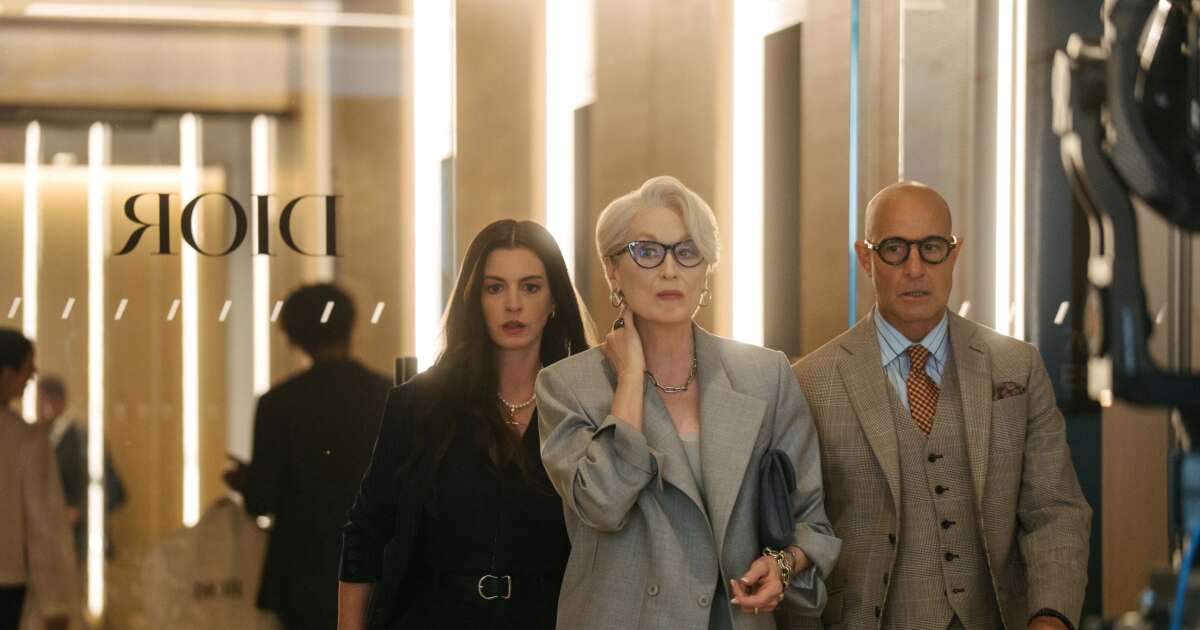
That first film (I’ll go ahead and anoint it a classic) followed a dowdy college graduate, Andy (Anne Hathaway), pursuing a low-level position at Runway magazine — Vogue in everything but name — as a bridge to a serious reporting career. Woe, said bridge is guarded by three trolls: fellow assistant Emily (Emily Blunt), tastemaker Nigel (Stanley Tucci) and the devil herself, Streep’s silver-haired Miranda, whose saintly last name is an ironic joke. Miranda is a riff on Vogue’s former editor in chief Anna Wintour, who used to be irritated by her caricature but eventually came around. After all, she’s getting played by Meryl Freaking Streep.
The setting was glam, the struggle relatable. Andy’s transition from sensible boots to stilettos served as a metaphor for the effort — even discomfort — it takes to chase your dreams, however they might evolve. “The Devil Wears Prada” gets celebrated for her makeover, with even Andy’s clueless boyfriend, played by Adrian Grenier, accusing her of caring about her Runway job solely for the shoes. No, it was never about the shoes. It was about respecting the workaholic she saw in the mirror.
The sequel, from returning director David Frankel and screenwriter Aline Brosh McKenna, doesn’t find its own footing until it acknowledges that a Cinderella story about making it in journalism no longer fits. Gone are the days when Miranda and Nigel could casually tell their deep-pocketed publisher Irv (Tibor Feldman) that they’re junking a $300,000 photo shoot because it failed to reach their lofty standards. Likewise, Andy’s story starts when a magnate shutters her current job at a newspaper called the New York Vanguard, firing her and her colleagues for a $500-million tax write-off. (Cue the workers of at least one major Hollywood studio nodding in recognition.)
Hathaway’s Andy, smart and likable as ever, returns to a budget-slashed Runway as the features editor in charge of investigative pieces that online metrics reveal nobody reads — that is, until she breaks a celebrity engagement. Meanwhile, the internet has reduced Miranda to a meme. Her most recent viral scandal has gotten her animated into that Homer-Simpson-in-a-hedge GIF.
McKenna writes Miranda a self-aware scene where she acknowledges that her harsh reputation boosts her clout. Yet I wonder what Wintour will make of this diminished avatar pursuing the same promotion that she herself just claimed at Condé Nast as global head of content. After elevating custom couture to an art form, just the word “content” sounds like a demotion. Content is to prestige journalism what Shein is to Chanel.
Twenty years later, all of the money and power in publishing has been siphoned to the very, very rich. There seem to be as many billionaires in the script for “The Devil Wears Prada 2” as magazine assistants. Mighty Miranda must kowtow to the luxury brands and their ambassadors, whose sponsorship keeps Runway strutting, including the once-harried and humiliated Emily, who is now an executive at Dior. The tension is thicker than mink. The film franchise chooses to ignore original author Lauren Weisberger’s own 2013 follow-up novel “Revenge Wears Prada,” although I’d love to see a threequel that follows her lead and gives Blunt’s hilariously frosty Emily the center stage as she does in her third book, “When Life Gives You Lululemons.”
The storytelling is wonky, given the film’s competing needs to be Miranda-blunt about the modern magazine business while pairing marvelously with a glass of rosé. Instead of Paris, we’re now whisked to cameo-studded shindigs in the Hamptons and Milan, including a dinner party underneath Da Vinci’s mural of “The Last Supper.” (Not only is the painting’s topic apropos, Da Vinci himself butted heads with his wealthy patrons.) Much of the first half feels like we’re cooling our heels with the gang, waiting for a plot to start. There are a lot of idea threads that fray off and don’t go anywhere. Are we supposed to interpret anything from the fact that Miranda has succumbed to throwing a spring florals event — a theme she famously loathes — or are we just supposed to chuckle at the banner and move on? Also, no one in attendance is even wearing anything with flowers. Is the old gal slipping, or is the costume design?
Finally, things get going with a funeral — I won’t say whose, only that the death makes a fitting twist for an industry already getting the axe. Like Andy, I started writing for newspapers a few years after Craigslist decimated the classified page. My personal version of “The Devil Wears Prada” would be closer to a grindhouse flick. At least the Runway employees look killer at their own wake.
Twerpy MBAs force Miranda to fly coach. Of course you snicker — her character hasn’t gone past the first-class curtain since everyone onboard got served a hot meal and plenty of legroom. But there’s no schadenfreude watching her squeeze into a middle seat, no glee in her comeuppance. If Miranda Priestly can get thrown in steerage, we’re all screwed.
The movie is simultaneously more depressing than the original and more saccharine, with a repellent amount of affection between characters who should know better. Tucci’s endearingly steadfast Nigel is finally applauded for his years of service to Runway, and I was dismayed to find myself rolling my eyes at how corny the moment felt. Frankel and McKenna were geniuses to keep things callous on the first go-round, but they now add a romantic subplot between Andy and an Australian apartment contractor (Patrick Brammall) that detracts from the platonic workplace relationships — it’s fan service that I’m not sure fans actually want. Miranda, too, has found love again, and her new husband’s part is so small that I kept trying to convince myself that the actor couldn’t really be the great Kenneth Branagh..
Justin Theroux has a showier, funnier part as the billionaire Benji Barnes who, every time you see him, is holding court about another inane idea or giggling about how a civilization-destroying Pompeii disaster is on the horizon. Terrifyingly, he refers to “humans” in the third person, as if he no longer considers himself one of our species. Given the film’s interest in the figures gutting journalism and how his character’s ex-wife (Lucy Liu) refers to their marriage as being like “a rocket ship to a hall of mirrors,” he’s Jeff Bezos with a sprinkle of Elon Musk. It’s pointed timing, given that Bezos is sponsoring May’s Met Gala, wrapping the Wintour-chaired event in his brand like a giant cardboard box.
But enough about what “The Devil Wears Prada 2” has to say about the economy. How are the clothes? Aesthetically, I dug Andy and Miranda’s sleek menswear looks, lots of vests and blazers with panache. Narratively, their characters — a heroine and her nemesis — shouldn’t dress as though they could swap wardrobes. Then again, they’re here aligned as champions of art, beauty and the press, standing shoulder to shoulder in the all-but-hopeless fight to protect Runway from the philistines. The real devils wear Fitbits.
‘The Devil Wears Prada 2’
Rated: PG-13, for strong language and some suggestive references
Running time: 1 hour, 59 minutes
Playing: Opening Friday, May 1 in wide release