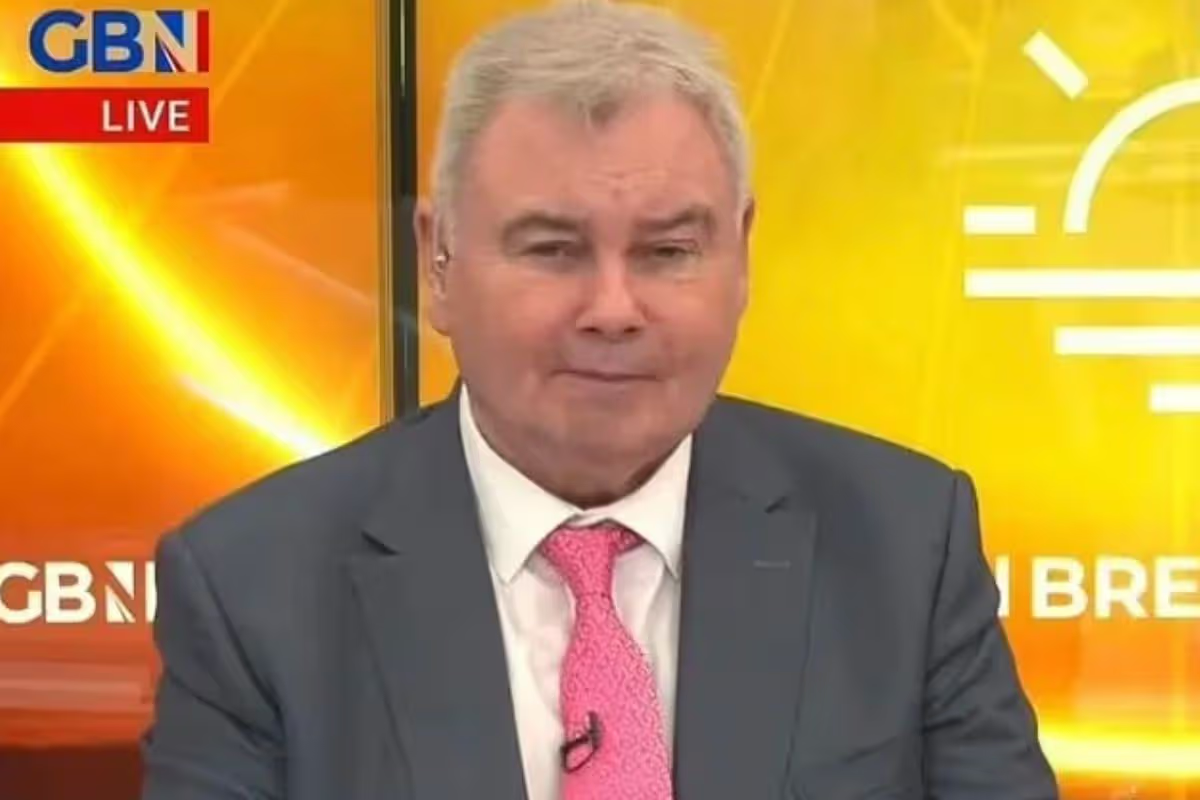
The GB News presenter continued working in a pub even after landing his first TV role at 21
Carly Duffy and Karen Price Assistant Editor of Screen Time
18:34, 06 Apr 2026
Eamonn Holmes is now a presenter on GB News(Image: GBNews)
GB News host Eamonn Holmes has enjoyed a career in broadcasting for decades but the Irish TV host admits that he almost never gave up his first-ever job.
The TV veteran had such a fondness for his evening job that he continued it well into the early stages of his blossoming career, until his boss eventually urged him to concentrate solely on his television aspirations.
His first television appearance came in 1979 as a reporter and presenter for Ulster Television (UTV) in Northern Ireland, and his career has gone from strength to strength ever since.
Yet Eamonn was so anxious that his TV career might suddenly dry up that he was determined to keep pulling pints while he still could, and he was in absolutely no rush to abandon his bar job before he finally did relinquish the evening role to dedicate himself fully to his television career.
Speaking to the Express. at the Young Chef, Young Waiter, Young Mixologist awards where he was a judge, Eamonn looked back on his career and said: “Nobody in the UK had been given tea time programmes at 21, so when I did, it went in my favour.
“But I was working in a pub, and the head barman said to me, ‘what is this? You serve them up the news until seven o’clock and then you’re in here at 7.30pm’.”
He revealed that his response to his manager at the time was: “But does this TV business ever last?”
The barman boldly assured Eamonn it would, invited him for a drink, and encouraged him to chase his dreams, with Eamonn saying: “That was my last night in the bar.”
Eamonn credits his bar work with helping him break into television, claiming it drew out his personality and showed him how to connect with people.
He said: “It taught me to be more relaxed with a TV audience and how to talk to people in television, so that was amazing. It was a bitb strange, I didn’t know anybody who was in television or presenting, but that’s what happened.”
His breakthrough in Ireland was merely the beginning of his broadcasting journey, transitioning to the BBC in 1986 and subsequently GMTV in 1993, where he remained until 2005, taking on a host of other television roles along the way, including stints at Sky News, BBC show Jet Set, and periodic appearances on GMB.
Eamonn’s latest venture has seen him comfortably settled at GB News, where he fronts the breakfast show.
Remember when our president attacked a female journalist for asking uncomfortable questions with a casual, sincere, “Quiet, piggy”?
That was five months ago, a lifetime in the chaos of the Trump administration, but it was a telling moment about how not just our president but those crafting his policy view women and their place in society. Hint: It’s not at the top.
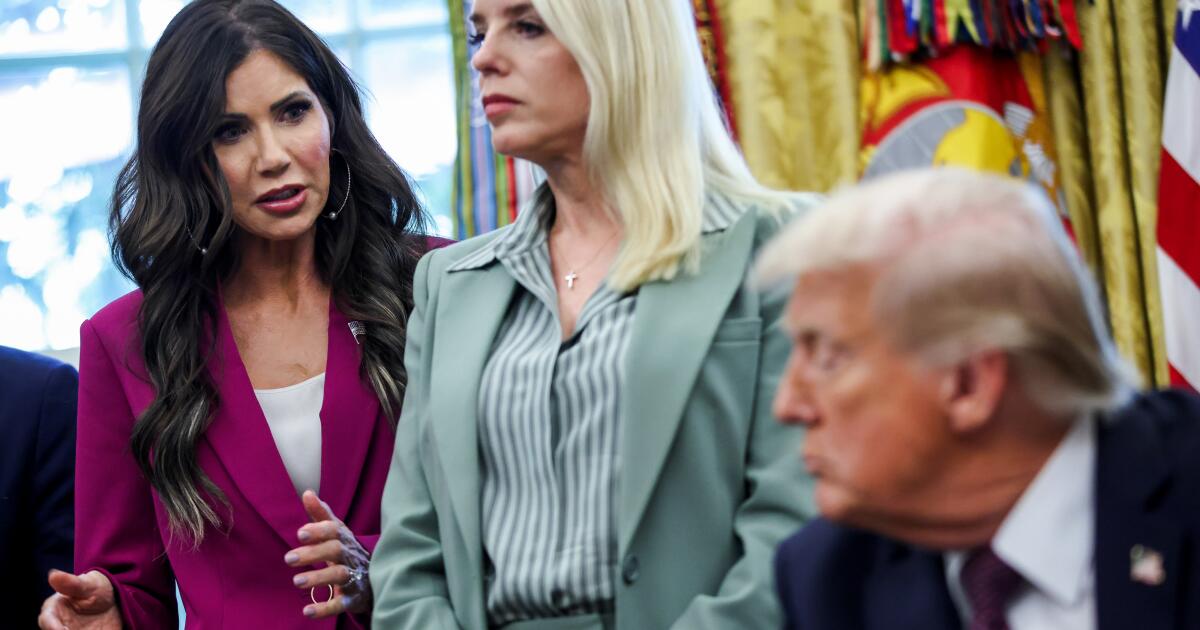
While I have not a bit of pity or dismay that Pam Bondi and Kristi Noem — the former U.S. attorney general and the former secretary of Homeland Security, respectively — were given the ax by President Trump in recent days, it shouldn’t be lost that this is another “quiet, piggy” week in an administration that is increasingly openly hostile to women in power.
When democracies decay, and especially when movements like Christian nationalism rise, an erosion of women’s equality almost always comes first. Bondi and Noem are part of a U.S. erosion that should alarm us all, whatever your gender identity.
First, the obvious. Good riddance. Noem seemed to relish cruelty, and treated her job like a costume party, constantly mugging for cameras with guns and faux toughness as if the dismantling of lives and imprisoning even children was a game. Never mind the grift.
Bondi, meanwhile, always seemed like the football team’s third-favorite cheerleader, desperately vying for the attention of the jock-gods around her, even if it meant groveling for approval, even if it meant selling out all women with her ultimate censoring of the Epstein files.
But while Bondi and Noem were obviously incompetent, incompetence has never been a fire-able offense for Trump. Just ask Pete Hegseth, whose Thor fantasies are currently playing out in an all-to-real war. Or Robert F. Kennedy Jr., who has dismantled American science while glorifying beef tallow and workouts in jeans. Don’t even get me started on Kash Patel.
It’s no accident that women at the top of Trump’s administration are being purged. They were useful in the first days of the regime, while power was still being consolidated and shimmers of diversity were helpful. But as the sexist and racist nature of the MAGA machine has gained mainstream acquiescence if not acceptance, the need to keep up the appearance of diversity is less and less.
Take, for example, the far-right attacks on Supreme Court Justice Amy Coney Barrett after her pointed and skeptical questions recently on Trump’s attempt to end birthright citizenship.
This is the same Texas gentleman who went viral recently for proclaiming, “Women, shut up! Of course. It is literally an offense to God” for women to have influence in the governing of society.
He’s also part of a group of far-right religious leaders — including a pastor associated with Hegseth — who support ending women’s right to vote and replacing it with a single “household” vote cast by, you guessed it, men.
Bondi and Noem may be the most high-profile examples of how this misogyny is playing out in MAGA reality, but they aren’t the only women forced out of power by Trump and his cronies this year. It’s a push that is far more systematic and insidious than we are giving them credit for. Hegseth has all but wiped women out of the top ranks of the military — just recently personally knocking two women off a promotions list.
RFK Jr. and others, meanwhile, are busy pushing women out of science. The Washington Post pointed out that last year at this time, the feds purged women and people of color from the boards that review the science and research happening at the National Institutes of Health— 38 out of 43 experts that were fired were women and minorities.
A report out last month also found that all those attacks on universities last year, with the cutting of grants even in areas such as cancer research — disproportionately affected female scientists. Many of these female scientists, especially younger ones, will never recover from those quashed research projects and lost jobs in a field that demands results and published work, meaning we are looking at a generational loss of female scientific talent.
And let’s not forget Renee Nicole Good, shot by an ICE officer in Minneapolis who, with as much casualness as Trump’s “quiet, piggy,” said “f—ing b—” after shooting her and walking away.
Bondi and Noem aren’t just unqualified villains shown the door. They are villainesses.
The Trump administration knows the difference, and so should we.
WASHINGTON — Three fired FBI agents sued on Tuesday to try to get their jobs back, saying in a class-action lawsuit that they were illegally punished for their participation in an investigation into President Trump’s efforts to overturn his 2020 election defeat.
The federal lawsuit adds to the mounting list of court challenges to a personnel purge by FBI Director Kash Patel that over the last year has resulted in the ousters of dozens of agents, either because of their involvement in investigations related to Trump or because they were perceived as insufficiently loyal to the Republican president’s agenda.
The lawsuit in federal court in Washington was technically filed on behalf of just three agents but may have much broader implications given that its request for class-action status could open the door for agents fired since the start of the Trump administration to get their jobs back.
The three agents — Michelle Ball, Jamie Garman and Blaire Toleman — were fired last October and November in what they say was a “retribution campaign” targeting them for their work on the investigation into Trump. The agents had between eight and 14 years of “exemplary and unblemished” service in the FBI and expected to spend the remainder of their careers at the bureau but were abruptly fired without cause and without being given a chance to respond, the lawsuit says.
“Serving the American people as FBI agents was the highest honor of our lives,” they said in a statement. “We took an oath to uphold the Constitution, followed the facts wherever they led and never compromised our integrity. Our removal from federal service — without due process and based on a false perception of political bias — is a profound injustice that raises serious concerns about political interference in federal law enforcement.”
Trump’s indictment
The investigation the agents worked on culminated in a 2023 indictment from special counsel Jack Smith that accused Trump of illegally scheming to undo the results of the presidential election he lost to Democrat Joe Biden in 2020. Smith ultimately abandoned that case, along with a separate one accusing Trump of illegally retaining classified records at his Mar-a-Lago estate in Palm Beach, Fla., after Trump won back the White House in 2024, citing Justice Department legal opinions that prohibit the federal indictments of sitting presidents.
The lawsuit notes that the firings followed the release by Sen. Chuck Grassley, the Republican chair of the Senate Judiciary Committee, of documents about the election investigation — known as Arctic Frost — that he said had come from within the FBI. Those records included files showing that Smith’s team had subpoenaed several days of phone records of some Republican lawmakers, an investigative step that angered Trump allies inside Congress.
The complaint names as defendants Patel and Atty. Gen. Pam Bondi, accusing them of having orchestrated the firings despite being “personally embroiled” either as witnesses or attorneys in some of the legal troubles Trump has faced.
Patel, for instance, was subpoenaed to appear before a federal grand jury investigating Trump’s retention of classified documents at Mar-a-Lago and had his phone records subpoenaed, while Bondi was part of the legal team that represented Trump at his first impeachment trial, which resulted in his acquittal.
“And now, by virtue of presidential appointment to the pinnacle of federal law enforcement, Defendants are abusing their positions to claim victories that eluded them on the merits,” the lawsuit states.
Spokespeople for the FBI and the Justice Department declined to comment on the ongoing litigation. Patel and Bondi have said the fired agents and prosecutors who worked on Smith’s team were responsible for weaponizing federal law enforcement, a claim that was also asserted in their termination letters but that the plaintiffs call defamatory and baseless.
Fired agents call for ‘fundamental constitutional protections’
Dan Eisenberg, a lawyer for the agents, said in a statement that his clients were fired without any investigation, notice of charges or chance to be heard.
“This lawsuit seeks to reaffirm fundamental constitutional protections for FBI employees, ensuring they can perform their duties without fear or favor. We all benefit when law enforcement officers’ only loyalty is to facts and the truth,” said Eisenberg, who is with the firm of Emery Celli Brinckerhoff Abady Ward & Maazel.
The lawsuit asks for the agents to be reinstated to their positions and for a court declaration affirming that their rights had been violated. It also seeks to represent a class of at least 50 agents who have been terminated since Jan. 20, 2025, or will be. Those agents also stand to recover their jobs in the event the case is successful and the requested class-action status is granted.
Others have been fired too
Other fired employees who have sued include agents who were photographed kneeling during a racial justice protest in 2020; an agent trainee who displayed an LGBTQ+ flag at his workspace; and a group of senior officials, including the former acting director of the FBI, who were terminated last summer.
The firings have continued, with Patel last month pushing out a group of agents in the Washington field office who had been involved in investigating Trump’s hoarding of classified documents. Trump has insisted he was entitled to keep the documents when he left the White House and has claimed without evidence that he had declassified them.
SACRAMENTO — Former Assemblyman Tom McClintock, a Ventura County conservative Republican and anti-tax crusader, today will announce plans to run for state controller.
A staunch critic of waste in government spending, McClintock is trying to recapture public office after losing a congressional bid last year to Democratic Rep. Anthony C. Beilenson in a district that encompasses most of Thousand Oaks.
McClintock, 37, a Republican who represented Ventura County in the Legislature for a decade ending in 1992, said Wednesday that he considers the controller’s post the perfect outlet for his vision of government reform.
“The more I looked at the controller’s office, the more it became clear that everything I want to accomplish in public office falls in its purview,” McClintock said. “And that is to identify, expose and eliminate waste throughout the state bureaucracy.”
Up to this point, the outspoken director of the Center for the California Taxpayer had been mentioned in conservative circles as a possible challenger to Gov. Pete Wilson in next June’s Republican primary.
McClintock admitted he was tempted to seek the governor’s seat, but decided the state controller’s office was more winnable.
“I came to the conclusion that Wilson can probably be beaten in the Republican primary and (Democrat Kathleen) Brown can probably be beaten in the general election, but they can’t both be beaten.”
Just as he often assailed fellow state lawmakers during budget debates, McClintock has not been shy about criticizing the governor. In a scalding opinion article published earlier this year, McClintock said Wilson was so tainted by tax increases, deficit spending and state budget shell games that former Democratic Gov. Edmund G. (Jerry) Brown Jr. actually made a better Republican than Wilson.
Sometimes described as strident and unyielding in his views, McClintock is also known for putting forth specific proposals to cut through what he contends is a thicket of government overspending and excessive taxation.
“I have issued very precise warnings of the deterioration of the fiscal condition of the state and proposed literally hundreds of spending reforms totaling billions of dollars of savings,” he said Wednesday. “The controller’s office is the ideal office from which to wage a crusade to eliminate government waste.”
But other lawmakers have at times accused McClintock of using inaccurate data to drive home his points. Two years ago, for example, state Sen. Gary K. Hart (D-Santa Barbara) asked Legislative Analyst Elizabeth Hill to check McClintock’s figures, and she was unable to verify them.
While pursuing the office of California’s chief fiscal watchdog, McClintock said he plans to take a leave of absence next spring from the taxpayer advocacy group he heads in Sacramento. He said he will continue to maintain his Thousand Oaks residence, although he lived and worked in the Sacramento area for the past year.
He is the first prominent Republican to enter the race for state controller, the $90,000-a-year post that accounts for and disburses state money. Democratic State Controller Gray Davis is leaving the job to run for lieutenant governor.
Also running for state controller are Democrats Rusty Areias, an assemblyman from San Jose, and Brad Sherman of Granada Hills, who is chairman of the State Board of Equalization.
Luba Muhstuk has been seen heading to her new job after her brutal axe from Strictly Come Dancing and looked full of confidence as she was spotted in London over the weekend
Luba blew a kiss to the camera (Image: JAMES CURLEY AND MAGICMOMENTSUK)
Luba Muhstuk has been seen heading to her new job after her brutal axe from Strictly Come Dancing. The TV star, 36, has served as a professional on the BBC Saturday night favourite since 2018 but along with Karen Hauer, Michelle Tsiakkas and Nadiya Bychkova, it was recently announced that she will not be part of the competition series going forward.
Just hours after the news broke,. Luba herself broke her silence on the matter. Taking to Instagram, insisting the time had come for her “step away” from the show, she wrote: “With a heart full of gratitude, the time has come for me to step away from Strictly Come Dancing. I am deeply grateful for the past 10 years on this beautiful show! Thank for you for the amazing opportunities and unforgettable memories. It truly has meant the world to me.”
Sharing that she was now looking forward to the future, Luba continued : “Now it’s time for me to follow my dreams beyond the show, and I’m excited for what the future holds. I can’t wait to see you all on the Pro Tour and I’m really looking forward to it one last time.”
Ensure our latest headlines always appear at the top of your Google Search by making us a Preferred Source. Click here to activate or add us as your Preferred Source in your Google search settings.
Over the weekend,, photos emerged of Luba heading to role taking dance classes in central London. Despite the sudden nature of her departure from the series, Luba looked to be in great spirits as she walked to work. This was the first time she had been spotted out in public since news of her axing emerged.
The TV star was suitably dressed for her role at the dance class, opting for comfortable rehearsal wear and let her dark locks flow down her back. She clutched her phone in her hand and threw a series of excitable poses.
Praising Luba – while announcing her exit – the BBC said: “We are incredibly grateful for her dedication to the programme and for always going above and beyond—whether through the care and commitment she showed her celebrity partners or her warmth and kindness behind the scenes. Luba has been, and always will be, a much-loved member of the Strictly family, and we wish her every success in the future.”
Fellow dancers were quick to share supportive messages in the comments section. Among them was Amy Dowden, who simply wrote: “Love you xxx.” Johannes Radebe echoed the sentiment, typing: “Love you darling,” alongside a red love heart emoji. And Nadiya, who met the same fate as Luba in recent days, shared three white love heart emojis.
While she will no longer be part of the dancing on screen team, Nadiya has reportedly been offered a chance to stay on the show in a different role. Speaking to The Sun, a source said: “Nadiya is so recognisable with viewers and bosses felt it would be a real loss to lose her from the Strictly family altogether. After a few conversations, they reportedly offered her a choreography role which she is very open to.
“Obviously, she is sad to no longer be dancing but recognises she will have great scope for more lucrative commercial opportunities now, and can explore exciting new projects.”
The Strictly team has already said goodbye to a number of long-time members of the show in recent weeks. Gorka and Michelle Tsiakkas are also said to have been axed in a bid for bosses to get “fresh faces” in the professional line-up.
And the decision of who will present the show following the exit of Tess Daly and Claudia Winkleman is yet to be made public, too. Recently, Louie Spence told the Mirror: “With Strictly, people say I should go on there and be a judge just because I’m known as a dancer – but it’s a very different dance genre. Ballroom and Latin is very particular. It’s like the difference between hip-hop and classical ballet…”
Suggesting Rylan and Zoe Ball would make good hosts, he concluded: “Rylan would be great fun [as host]. I love Rylan, he’s got a great personality. He’s young enough to keep going if it’s going to keep going for years.
“Zoe Ball, she’s great. Who knows how many more years a show like that will last? Things are moving so quickly now, with the way things are changing. Whoever gets it, I’m sure they’d be fabulous.”
A woman in Indiana who put off dental surgery because she doesn’t know if she can afford the copay. A Florida couple with young children who are depleting their savings. A grandmother in Idaho who plans to sell her car to pay the rent.
They are among about 50,000 Transportation Security Administration officers expecting to receive another $0 paycheck this week. A dispute in Congress over funding the Department of Homeland Security has held up their salaries since mid-February. With monthly bills coming due, many of these federal employees, who screen passengers and luggage at airports across the U.S., are making difficult choices about how to make ends meet.
High absentee rates at some major airports have produced long lines and frustrated passengers at understaffed security checkpoints. Union leaders and federal officials say empty gas tanks, child care expenses and the threat of eviction keep more screeners from showing up the longer the shutdown continues. At last count, more than 455 had quit instead of weathering the ongoing uncertainty, according to DHS.
“Stop asking me about the long lines. Ask me if somebody’s gonna eat today,” Hydrick Thomas, president of the national American Federation of Government Employees union council that represents TSA employees, told reporters Tuesday.
Indiana TSA agent turns to food pantry for groceries
Before starting her shift at Indianapolis International Airport on Monday, Taylor Desert stopped at a food bank for meat, eggs, vegetables and dairy products.
“I never thought I would be in a position where, working for the federal government, I would need to go to a food bank to supplement my groceries,” she said as she loaded bags into her car.
Desert, who has been a TSA officer for seven years, said her last full paycheck came on Feb. 14, the day the shutdown started.
She had some savings to draw on despite a record 43-day shutdown last fall but put some personal plans on pause.
For example, Desert needs to get her wisdom teeth removed but says the TSA isn’t approving time off during the shutdown. She also worries about costs from the surgery not covered by insurance.
Wednesday was the 39th day of the DHS funding lapse. If it goes another 21 days, Desert said she would seek another job.
“I don’t want to have to spend my entire savings just to afford to keep living,” she said.
Florida TSA couple worry about their young children
Oksana Kelly, 38, and her husband, Deron, 37, both work as TSA agents at Orlando International Airport. They have two young children and don’t know how they will keep supporting their family without any income coming in.
Kelly said they’re dipping into savings for now, but it’s running dry. If the shutdown persists, they will ask relatives for help or take out a loan, which she worries would put them deeper in debt.
Her husband has worked as a DoorDash delivery driver in his spare time since the shutdown in October and November. He’s considered resigning from the TSA to put the couple on more stable financial footing.
“It’s very mentally exhausting,” said Kelly, who is an organizer for the labor union representing TSA workers across central and northern Florida. “How do we even decide between being able to feed our kids or come to work?”
Kelly said strangers might criticize the couple for “putting all eggs in one basket” since both choose to work for the TSA for the past decade.
“All we want is to pay our bills and get the pay we deserve,” she said.
A veteran officer in Idaho fears homelessness
Rebecca Wolf cries every day. She tries to hide it from her grandchildren, ages 11 and 6.
“They don’t understand why grandma’s crying,” Wolf said. “I try not to cry in front of them, but sometimes it’s just too much.”
The 53-year-old TSA officer and union leader in Boise, Idaho, joined the agency soon after its creation in the wake of the Sept. 11 attacks. She was homeless at the time but turned her situation around with steady work and the benefits of federal employment.
Now, Wolf can’t help but dwell on where she was 24 years ago. “I don’t want to be in that position again,” she said.
Her Feb. 28 paycheck amounted to $13.53, sending her “into a spiral right away.”
With no savings to fall back on, she is preparing to sell her car to cover her rent due in a week. She calls nonprofits daily seeking rental assistance, but hasn’t had any luck.
Supporting six family members — four children and two grandchildren — has always been challenging, but the repeated shutdowns have made it nearly unsustainable.
Wolf, who serves as president of AFGE TSA Local 1127, is hesitant to walk away from both the job that turned her life around and her role advocating for fellow officers.
“I worked hard to get to where I am now, and the thought I might lose it all scares me,” she said, her voice breaking as she tried to stifle the sound of weeping.
Massachusetts agent digs into savings to get by
Mike Gayzagian, a TSA officer at Boston’s Logan International Airport, says long stretches without pay have become enough of a “new normal” that he’s prepared for them.
The 56-year-old says he has a financial cushion of about six months to tap but that his situation is “an exception to the rule.”
“The majority live paycheck to paycheck and don’t have those kinds of reserves available,” said Gayzagian, who is president of his local TSA union chapter.
It shouldn’t be this way for federal workers, he said.
“The financial situation adds an additional burden to what is already a stressful job,” Gayzagian said. “I didn’t go into public service to make a lot of money. I went into public service because it has a certain stability and reliability and predictability that other jobs don’t have.”
A father in Utah leaves TSA
Robert Echeverria quit his job as a TSA agent at Utah’s Salt Lake City International Airport about two weeks into the current shutdown.
The 45-year-old, who has a wife and three children, counted five government shutdowns in the nine years he worked for the agency. The toughest was last year’s record shutdown that ended in mid-November around the start of the holiday season.
Echeverria said his family skipped Christmas and took months to recover financially. He began looking for a new job in February when it became clear Congress was headed for another budget battle.
“Emotionally I was already distraught,” Echeverria said last week. “We were barely recovering from the last shutdown.”
He now works for the department that manages the airports in Utah’s capital. Leaving federal service “was a hard decision for me,” Echeverria said.
“I really believed in the mission of the TSA,” he said. “We took an oath, and it was a way for me to give back to the country that gave me so much.”
He’s still based at Salt Lake City International, where his 20-year-old daughter works as a TSA agent, and says that seeing his former colleagues struggling is difficult.
“They all feel betrayed by their government because they’re showing up to work,” Echeverria said. “They’re there, but they feel that the government doesn’t care for them,” he said.
Marcelo, Lamy and Yamat write for the Associated Press. Marcelo reported from New York, Lamy reported from Indianapolis and Yamat reported from Las Vegas.
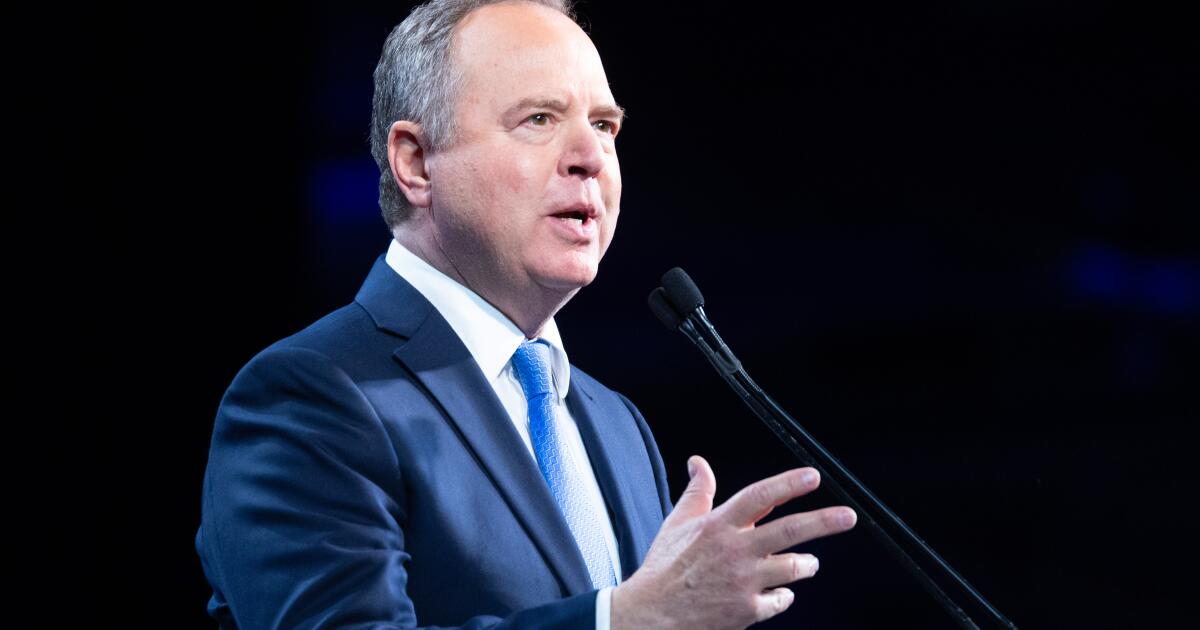
“State programs cannot simply substitute for the kind of global, federal and competitive tax incentives that are needed to bring production back to American soil and stop its offshoring,” U.S. Sen. Adam Schiff (D-Calif.) said during a news conference Friday morning.
“We must act, and the urgency could not be greater,” he said. He revealed he is working on a bipartisan federal film incentive proposal that would be competitive with what other countries are offering for film productions.
He said the program isn’t about Hollywood’s stars; it’s about the jobs that productions create, including roles for set designers, carpenters and lighting crews.
“These are the people who make that magic happen. We want to keep those jobs here, and many of us are deeply concerned about what this potential merger will do to those jobs,” Schiff said.
Earlier this week, the California Film Commission revealed that 16 shows had recently received tax credits for filming in the state. The projects represent $871 million in qualified in-state spending and are expected to generate $1.3 billion in economic activity in California. Schiff said the state tax credit has generated more than $29.1 billion in motion picture production wages and supported more than 220,000 jobs.
Even as shows start to see gains in Southern California, Los Angeles film activity was still down 13.2% from July through September when compared with the same period in 2024. The downward trend extends the loss of 42,000 jobs in L.A. between 2022 and 2024, the continued suffering of local sound stages and the offshoring of productions internationally.
“Federal policymakers must act to level the playing field and make the U.S. film and television industry more competitive on the global stage,” said Matthew Loeb, the president of the International Alliance of Theatrical Stage Employees. “A globally competitive labor-based and tax incentive is. For us, production that supplements state incentives is essential to return and maintain film and television jobs in America.”
HBO Max’s medical drama “The Pitt” is filmed at one of Warner Bros. soundstages in Burbank and it’s one of the shows benefiting from California’s tax incentive.
Noah Wyle, the star and executive producer of the show, said during the news conference that “it’s really hard to shoot a TV show in Los Angeles, and it’s really expensive, prohibitively” — so adopting an economic model that allows productions to take full advantage of the California tax incentive was essential to “The Pitt” filming in L.A.
“As an Angeleno with generational roots to this city and as a seasoned member of its creative community, advocacy for Los Angeles-based production is something that is very close to my heart,” Wyle said.
“‘The Pitt’ has blessedly become proof of that speculative concept. I’m happy to report we’ll commence shooting season three this summer, and that a rising tide has indeed lifted all boats in season one under the 3.0 tax program,” he added.
The show received a 20% tax rebate on many above-the-line costs. The budget for one episode was approximately $6.6 million, so the show received a rebate of about $760,000 per episode. By the end of season one, the production was able to save over $11 million. Wyle estimated that the first season of “The Pitt” contributed around $125 million toward California’s gross domestic product.
Rep. Laura Friedman (D-Glendale), who is working with Schiff on production tax incentives, said that because California is already seeing benefits from the current program, there’s no reason it wouldn’t work nationally. Friedman added that tax incentives are a common practice among many industries in the U.S.
“Hollywood is not asking for special treatment. Whether it is computer chips, the energy sector or pharmaceuticals, this is something that is standard in the United States,” said Friedman. “In terms of our nation, Hollywood and its ability to tell the story of America, it is something worth saving.”
As the U.S. wades even deeper into the conflict with Iran, some Democratic and progressive political figures are trying to figure out how to connect the public’s wariness about war with concerns about affordability and the widespread reaction against President Trump’s xenophobic immigration policies.
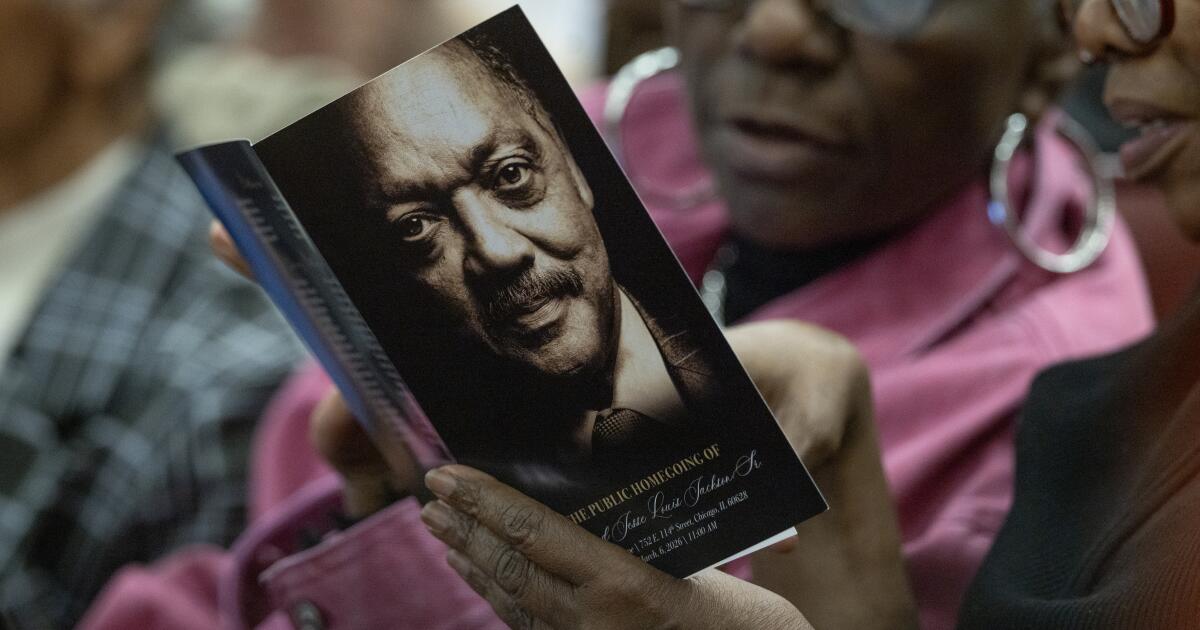
If you’re looking for a template to do it well, one can be found in the words and actions of a political figure who recently passed away: the Rev. Jesse Jackson.
For while attention after his death has rightfully focused on Jackson’s long involvement with the civil rights movement, the more telling lesson for this moment is how his presidential campaigns connected a concern for addressing domestic disenfranchisement with a resolute stance against U.S. military adventures — a message that built on and echoed the Rev. Martin Luther King Jr.’s landmark 1967 speech against the Vietnam War, economic exploitation and racial injustice.
Jackson’s candidacies in 1984 and 1988 emerged at a moment when the social compacts forged by the labor, civil rights and women’s movements of the 20th century were being systematically undone. Deindustrialization was hollowing out working-class communities. Reaganism was consolidating power around tax cuts for the wealthy, deregulation and attacks on unions. A new corporate consensus was hardening — one that increasingly shaped both major parties — prioritizing financial elites while disciplining labor and shrinking the public sphere.
Sound familiar?
Jackson refused to accept that such a right-wing and corporate realignment was inevitable. His Rainbow Coalition was far more ambitious than a candidate-centered campaign. It was an attempt to build an organized, multiracial, cross-class political front capable of contesting the direction of the country itself.
The Rainbow brought together constituencies that conventional political wisdom said could not unite — Black voters in the South, industrial workers in the Midwest, family farmers in crisis, Latino and Native organizers, Arab American activists, peace advocates, labor insurgents and progressive whites.
Jackson’s platform did not treat these groups as symbolic additions to a coalition; it linked their material interests. Farmers facing foreclosure were not an afterthought — the farm crisis was up front. Deindustrialized workers were not rhetorical props — trade, jobs and industrial policy were central. Civil rights were braided together with economic justice.
And crucially, Jackson insisted, as King had, that economic populism could not be separated from anti-militarism.
At the height of the Cold War, amid Reagan’s military buildup and interventionist doctrine, Jackson argued that bloated Pentagon budgets were not abstract line items. They were resources diverted from schools, healthcare, housing and jobs. He connected the violence of abandonment at home to the violence of intervention abroad — and his campaign called for redirecting military spending toward human needs and for diplomacy over escalation.
When Jackson thundered that we should “choose the human race over the nuclear race,” this was not a simple turn of phrase. It was integral to the Rainbow’s moral and economic logic. A government that prioritizes war over welfare, weapons over workers, cannot sustain democratic life.
That clarity feels especially salient today, as the United States continues to pursue military interventions and proxy conflicts whose legality and human cost are deeply contested. Once again, defense budgets swell while public goods strain. Once again, dissent against war is treated as disloyalty. Jackson rejected that false choice decades ago. He understood that militarism abroad reinforces inequality and immorality at home.
Jackson’s 1988 campaign captured millions of votes, won primaries and caucuses across the country and forced issues into the Democratic Party that party elites preferred to sideline. He demonstrated that a progressive program grounded in the lived experiences of ordinary people — rural collapse, urban disinvestment, plant closures, racial injustice and war — could assemble a national constituency.
Unfortunately, after Jackson’s last campaign, the Rainbow’s experiment in independent organizational life was folded too tightly into the mainstream Democratic Party. While that seemed a strategy to achieve a broader front, it meant that the progressive anchor was unmoored — and the effort dissolved before it could truly mature.
But the lessons of that era may be more relevant than ever.
Today, we again confront an ever-ascendant rightward turn buttressed by concentrated corporate power and normalized militarism. As in Jackson’s day, some leaders seek to deflect our attention, blaming economic challenges on the proximate “other” — in his era, Black women taking welfare, in our era, immigrants taking jobs — rather than those with power.
Jackson understood that defeating reactionary politics required isolating it — not only morally, but structurally — by assembling a coalition larger than the right’s base and rooted in shared material demands. He understood that hope had to be organized and that peace had to be part of prosperity. His campaigns showed that racial justice, labor rights, rural survival, gender equality and anti-war politics were not competing claims but interlocking ones.
Protest has surged in the United States, particularly after the excesses in Minnesota. But protest alone does not prevent consolidation. Nor do narrow electoral bargains that leave the underlying corporate and military consensus intact.
At a time when both parties remain deeply entangled with corporate and defense interests, remembering the promise of the Rainbow is not nostalgia. It is instruction.
Rishi Awatramani is a postdoctoral scholar in sociology at USC, where Manuel Pastor is a professor of sociology and the director of the Equity Research Institute.
A woman has shared how she managed to travel the world without spending a single penny – and she is sharing her favourite things about the life-changing experience
She has shared how she achieved the lifestyle (stock image)(Image: Getty Images)
Sarah, known on social media as @sarahmonaco99, explained how she achieved this lifestyle – revealing that her “entire salary is 100 per cent disposable income. No rent. No food. No bills.” She shared that she lives and works on a yacht, where “everything onboard is covered”.
She said: “Accommodation, three meals a day, toiletries, travel to and from the boat – I have not paid a single living expense in two years. My first full season, I saved enough to put a deposit on an apartment. I was 24. My friends doing 9-5s are still saving. I’m not saying this to brag – I genuinely couldn’t believe it was real.”
Explaining how she got into the industry, she added: “Most people find their first season through Yotspot, Bluewater, or Saltwater Agency. No experience needed for entry-level roles. Just show up willing to work hard.”
Commenting on her post, one user said: “If I didn’t have a cat, I would so do this.”
Others were curious about the reality of the job, asking questions about working hours and expectations onboard, with one user writing: “Are you obligated to party with guests?”
In another post, Sarah shared some of the wild experiences she’s had while working on yachts, including gifts and behaviour from ultra-wealthy guests.
She said: “Rating the most unbelievable things billionaire guests did on our yacht…”
Giving the first example an 11/10, she said: “Moved the boat at midnight because the stars weren’t ‘visible enough’. Woke the captain at 12am. We sailed for two hours. The stars were the same.”
She rated another moment 10/10, adding: “Ordered £4,000 worth of groceries for a five-day charter – Wagyu beef, fresh truffles, three types of caviar. Ate none of it. Left it all on the boat when they disembarked. We ate like royalty for a week.”
She also revealed that the crew were tipped £11,000 by one millionaire because they “seemed like they needed it”.
Finally, she recalled one guest complaining that the Mediterranean Sea was “too blue” and asking if they could find somewhere with a “more interesting” water colour.
In the comments, users shared their amazement at the lifestyles of the ultra-rich, with many wishing they could experience that level of luxury.
One user said: “Those drinks look good.” Another added: “How do I get this job?”
SACRAMENTO — Gov. Gavin Newsom’s former chief of staff, Dana Williamson, left state service with two things: a federal corruption investigation and more than $50,000 in pay for vacation time she accrued but never took.
State payroll records reviewed by The Times show Williamson used approximately $30,000 in unused vacation time to remain on California’s payroll through Jan. 31 — seven weeks after Newsom’s office indicated she had departed — before collecting an additional $22,000 lump-sum payout for the hours she had left.
Large cash-outs for departing state workers with hundreds of hours of time off on the books have been a recurring issue in California. The state’s unfunded liability for vacation and other leave owed to employees has ballooned in recent years to $5.6 billion, fueled by generous time-off provisions and a long-standing failure to enforce policies that cap most employees’ vacation balances at 640 hours.
Many state workers accumulate large balances of unused vacation after decades of being on the government payroll. The typical public employee retires with more than two decades in public service, according the California Public Employees’ Retirement System. Their unused time off is paid when they leave state employment at their final rate of pay.
Williamson, however, amassed 462 hours of unused leave in less than two years on the job. She earned $19,612 a month as the governor’s chief of staff.
John Moorlach, director at the conservative think tank the Center for Public Accountability at the California Policy Center, said that a job like Williamson had probably involved incredibly long workdays but that the pace in which employees accumulate days off is a major financial burden.
“A normal blue-collar worker would say, ‘Really? Really?“” said Moorlach, a former Republican state senator from Orange County. “You don’t find this perk in the private sector.”
Williamson notified Newsom in November 2024 that she was under federal investigation and was put on paid administrative leave through Dec. 16, the governor’s office said.
Federal charges against Williamson, which were filed in November 2025, allege she siphoned $225,000 out of a dormant state campaign account belonging to gubernatorial hopeful Xavier Becerra and illegally claimed $1 million in luxury handbags and travel as business expenses on her tax returns. She pleaded not guilty to the charges.
A status conference in Williamson’s case was moved to April 16 after she recently underwent a successful liver transplant and due to the large volume of discovery — more than 280,000 pages so far — according to court records filed last month.
Williamson’s attorney, McGregor Scott, did not respond to a request for comment.
State payroll records show Williamson earned $40,000 in regular pay in 2025, which the state controller’s office said included her December 2024 and January 2025 paychecks. The governor’s office said Williamson’s December 2024 paycheck included 11 days of paid administrative leave, and the remainder of both paychecks was covered by her unused leave.
With her final cash-out of $22,000 in remaining time off, she made a total of $62,000 last year — all tied to administrative leave and unused vacation time rather than time worked.
“That’s shocking, honestly,” said Assemblyman Josh Hoover (R-Folsom), adding that stockpiled vacation time overall is something the state Legislature should look into.
The state paid $453 million in unused leave benefits to state workers in 2025. That was an average of more than $20,000 to the 21,000 employees who received a lump-sum check. The amount paid to departing or retiring state workers has steadily increased each year. In 2024, the state paid $413 million for unused time off.
“Obviously, employees are an important part of our state and they accrue vacation time,” Hoover said. “But, if this is something being used to pad people’s salaries … we need to look into that and possibly reform that.”
Last year, 80 state employees took home at least $250,000 in unused time off, and 1,081 employees were paid more than $100,000. Those numbers have been increasing each year. For example, the state paid 16 state workers more than $250,000 for unused time off in 2010, and 309 employees were paid more than $100,000.
In 2024, the state paid out a record $1.2 million to a prison supervising dentist for unused time off. Last year, the top amount paid for unused leave was about $650,000 to an assistant fire chief with the California Department of Forestry and Fire Protection.
The state owed nearly $5.6 billion to state workers for unused vacation and other leave benefits in 2024, according to the most recent financial accounting report issued by the state controller’s office. Although that unfunded liability held steady when compared with 2023, it has risen sharply from pre-pandemic amounts.
In 2019, the state owed $3.9 billion for employees’ unused time off before COVID-19 curtailed travel and work-from-home policies resulted in fewer workers taking time off. State employees have argued that under-staffing at state agencies can make it difficult to take vacations.
Nick Schroeder, a policy analyst at the nonpartisan California Legislative Analyst’s Office, said the state has plans to reduce unfunded liabilities for pensions and retiree healthcare, but that isn’t the case with unused time off.
“There isn’t a plan to address it,” Schroeder said.
When an employee retires with a large leave balance, the department where that person worked last is on the hook for the amount.
“It can be a big effect on that individual department’s budget,” Schroeder said.
During budget deficits — including in the current fiscal year — the state has cut employee pay or deferred annual raises in exchange for additional days off, a strategy that helps balance budgets but also adds to workers’ growing vacation balances.
In Newsom’s January budget proposal, which estimated a $3-billion deficit, the governor recommended providing $91 million in ongoing funding to the California Department of Corrections and Rehabilitation to help the prison system pay departing employees for their unused time off. The department said that from 2020 to 2025, it paid about $130 million annually on average to employees leaving state service, according to a Legislative Analyst’s Office report.
When employees cash out banked leave, the state pays them not only for the hours they have accumulated, but also for the additional vacation and holidays they would have earned had they taken that time off.
That means a person with 640 hours of vacation would also be paid for all of the vacation and holidays they would have earned had they taken those 80 days off. Each hour of leave is paid based on an employee’s final salary — not what they were earning when the time was accrued.
Most private-sector employers cap vacation accrual between 40 and 400 hours and stop employees from earning additional time once they reach those limits. Some companies have moved in the opposite direction, adopting “unlimited paid time off” policies. Under those systems, employees do not accumulate vacation days that can be banked or cashed out, but critics say the policies can lead to workers taking less time off because there is no guaranteed number of days and employees may feel pressure not to appear absent.
Jon Coupal, president of the Howard Jarvis Taxpayers Assn., said there appears to be little appetite in the state Capitol to address California’s burgeoning vacation liability.
“This problem is systemic within California government and no one seems willing to take it on,” Coupal said. “At the same time, they are clamoring that there is a budget crisis. I suspect they will continue to kick the can down the road.”
SHE is an Oscar-winner married to a former James Bond, but Rachel Weisz says Hollywood made her feel so ugly she considered having plastic surgery.
When the British beauty first went there in the Nineties, she contemplated a nose job, boob job or liposuction to get noticed and boost her career.
Sign up for the Showbiz newsletter
Thank you!
Oscar-winner Rachel Weisz says Hollywood made her feel so ugly she considered having plastic surgeryCredit: Shutterstock EditorialRachel with Leo Woodall in new Netflix thriller VladimirCredit: PARachel in 2015’s YouthCredit: GIANNI FIORITO
Rachel, now 56 and one of the world’s most sought-after stars, said: “I went into quite a major depression.
“I was watching so many daytime TV shows. And then I would get in my car and drive to these auditions while listening to the radio.
“I feel sick now when I listen to the radio, all these commercials for different car dealers.
“I just felt like the world was so desperate and lonely and sad and people were trying to sell cars and no one wanted to buy them.
“People are very focused on their own thing. In LA unless you’ve just won an Oscar or you’re ‘Mr Studio Head’, no one talks to you. Even at parties. I was at this big Hollywood party, and no one looked.
“Everyone is blinkered and they just kind of scan the room for anyone important. LA makes you feel ugly. Because if you’re an actress, no one pays you any attention.
“And you immediately start thinking, ‘God, I must have a nose job. Or, I must get that boob job, or I must get that lipo’, whatever it is.”
For Rachel, who started her career with bit-parts on Inspector Morse and whose new thriller Vladimir was released on Netflix on March 5, real success and happiness came when she turned her back on the glitz and glamour of Los Angeles.
She decided to split her time between London, where she grew up, and New York with her then-partner, director Darren Aronofsky, and their son Henry, now 19.
Rachel, who has been married to 007 actor Daniel Craig since 2011, told Index mag: “There’s not much room for eccentricity in Hollywood, and eccentricity is what’s sexy in people.
“I think London’s sexy because it’s so full of eccentrics.”
The actress’s breakthrough came in 1999 when she landed the role of feisty librarian Evelyn Carnahan in blockbuster The Mummy.
By 2006 her A-list status was cemented when she won the Best Supporting Actress Oscar for The Constant Gardener.
She went on to star in 2009’s The Lovely Bones and 2015’s Youth, as well as 2021 Marvel film Black Widow.
Now Vladimir sees her as married college professor M, whose life spirals into a steamy, all-consuming obsession with her younger colleague, played by One Day and White Lotus star Leo Woodall.
The series is based on the book of the same name by Julia May Jonas, which Rachel describes as a brilliant piece of writing.
She added of the character she plays: “I deeply empathise with her and understand her. But I left her when I got home.
“She’s like a projection of what a viewer might want to live out.”
Rachel and Daniel, who officially ended his 15-year stint as James Bond with No Time To Die in 2021, were friends for years before falling for each other in 2010 while filming thriller Dream House.
Within months they secretly wed in New York and went on to have daughter Grace, now seven. They split their time between Brooklyn in New York and Primrose Hill in North London.
But the couple deliberately choose not to do films together.
Rachel said: “I think we really love our private life as a life, as a family, and then we go to work separately.
“It means we can alternate, so I can stay home with the family while he works. We can swap out. If we’re both doing something at the same time, it’s probably less ideal.”
Rachel grew up in Hampstead, North London, with dad George, a Hungarian-Jewish mechanical engineer, and mum Edith, who originated from Austria and was a teacher-turned-psychotherapist.
The star started modelling at 14 and studied English at Cambridge University, with her parents hoping she would choose a more traditional career.
Rachel told the Sunday Sitdown With Willie Geist podcast: “They were just the kind of parents who were like, ‘You’ve got to get a degree, like you have to go to college’, which in the end I did.
“They wanted me to have a fall-back, so I could be a teacher . . . that would be a really good job.
“My parents would be really happy if I was a teacher. My dad was very sceptical about my career choice. I think he wasn’t very impressed by what I was doing.
“He was my harshest critic for a very long time. I think he only, after a good 15 years, was like, ‘OK, yeah’.
“He was tough — yeah, he was tough, in a good way. He was always honest, he didn’t make it nice. He’d take things apart and say, ‘I didn’t understand what you were doing,’ or, ‘That was a bit wooden’.”
But winning her Oscar changed everything.
Actress Rachel holds her Oscar for her performance in The Constant GardnerCredit: EPA
Rachel said: “That definitely changed my life. Maybe my dad was like, ‘OK, all right, you were OK’.
“He would never be more over the top than that.”
And that Oscar meant she had the freedom to choose the roles she truly wanted, just like the one in Vladimir.
She said: “In the beginning of my career, I just did whatever job I got so I could pay the rent. I wasn’t picky.
“Now I’m in this luxurious position where I can choose things. It’s really about the character and writing, if it appeals to me or if it seems it would be interesting to pretend that story.
“I was never the kind of kid that got on the table and did a tap dance and a song. I wasn’t the star of the school plays or anything. I was actually really shy.
“I think a lot of actors, when I meet them as grown-ups, they go, ‘I was really shy too’.
“I think I’m just a daydreamer. I think storytelling is, in a way, daydreaming, but putting your daydreams into writing and getting people to embody them.
“I think my daydreaming skills have just come into it, I get paid for it.”
Despite now being praised for her stylish looks, ranging from velvet trouser suits to Valentino haute couture, walking the red carpet still makes Rachel nervous even today.
She said: “I don’t think any actress would say doing the red carpet is not terrifying. The way to get through it is to pretend.
“It’s a fantasy, like walking into a fantasy world. These people, they transform you, and that is fun.
“What you see on the red carpet is not a character that has anything to say.
“I used to be very shy, and in a way that was what was so great about the idea of acting. You can hide the real you behind that character.”
But after years of struggling with fame, Rachel says she has finally learned to be content with exactly where she is in life.
She said: “Someone once said to me when I was younger, ‘Never think the best party is somewhere else’. You know that feeling of being somewhere and thinking you should go somewhere better?
“You can’t do that. Wherever you are is the right place to be.”
JUNIOR Andre has made his acting debut alongside his father Peter and an EastEnders star, just days after revealing his secret job.
The young lad, 20, played the role of Johnny in a new coming-of-age drama called Finding My Voice.
Sign up for the Showbiz newsletter
Thank you!
Junior has announced he’ll be starring in a filmCredit: Instagram/findingmyvoicemovieThe news comes only a matter of days after he revealed he secretly works at the London underground to make money to support his own musicCredit: Instagram/findingmyvoicemovie
Finding My Voice is about a girl called Mel who feels like she has nowhere to go after facing a series of tragedies.
Her family breaks up due to alcoholism following the death of her baby brother, plunging her into deep struggles.
Johnny is a friend who is always there for her when she needs someone to believe in her, which is truly heartwarming.
At the end of the month Finding My Voice will host its first screening as a part of Manchester‘s Film Festival.
Another Instagram post announced who Junior would be playing, which received a roaring reception from his friends and family.
The post shows a carousel of snaps of Junior featuring in the film, the first of which includes the name “Johnny” over his head in block lettering.
The caption says: “Junior Andre. Johnny is Mel’s school friend and one of the few people who’s always there when she needs someone to believe in her.
“Finding My Voice movie is out on 28th March at Manchester Film Festival. See you there!”
Junior’s character is very supportive in the filmCredit: Instagram/findingmyvoicemovieHis girlfriend Jasmine gushed with pride online about his film debutCredit: Splash
Right at the top of the post’s comments section is Peter, gushing: “Yea my son,” followed by three flame emojis.
Junior’s girlfriend Jasmine Orr added: “Can’t wait for this,” along with three hand emojis forming hearts.
Fans felt the same level of enthusiasm, saying “Wow” and that they “can’t wait to watch” the film.
Peter plays the role of Costas, who more details are yet to be released about.
The Island Bakery in Tobermory on the Isle of Mull is hiring two production staff members, with the job offering a two-bed flat and a salary of £22,000-£24,000
Isobel Pankhurst Audience Writer
07:50, 09 Mar 2026
This remote Scottish island is looking for a new baker(Image: Getty)
Anyone seeking a remote relocation with some baking know-how might find their dream opportunity on a stunning Scottish island. The Island Bakery in Tobermory, situated on the wild Isle of Mull, is recruiting two production staff members – and the position includes a two-bedroom property.
The bakery has built quite a reputation, stocking its renowned biscuits through several upmarket stores, including Selfridges and Harvey Nichols. According to the job advert, the salary ranges from £22,000-£24,000, with minimal experience necessary, making it ideal for anyone wanting to swap hectic urban living for a more peaceful existence – so it could be time to refresh that CV.
Two shift patterns are available: 2pm to midnight, Monday to Thursday, or 6am to 2pm, Monday to Friday.
The posting has gained traction online because it includes a two-person flat, as job vacancies offering accommodation on the Isle of Mull are relatively uncommon.
The bakery has made clear it will favour candidates prepared to share the flat, given the accommodation is suited for two occupants. Those with a partner or mate also keen to move may stand a stronger chance of securing the role.
With a population of merely 900 residents, Tobermory is genuinely isolated, with the journey from Glasgow typically requiring a two-and-a-half-hour drive to Oban, followed by a 45-minute ferry crossing to Craignure and then an additional 35-minute drive to reach the village.
Lonely Planet highlighted its “cinematic scenery” and “distinct wildlife,” acknowledging that whilst it may lack Mediterranean sunshine, the village still boasts stunning landscapes and exceptional seafood.
The island’s remarkable wildlife includes golden and white-tailed eagles, minke whales, and basking sharks, all of which you might spot frequently if you choose to relocate to this beautiful village.
To apply for this job, visit the listing at hijobs.net.
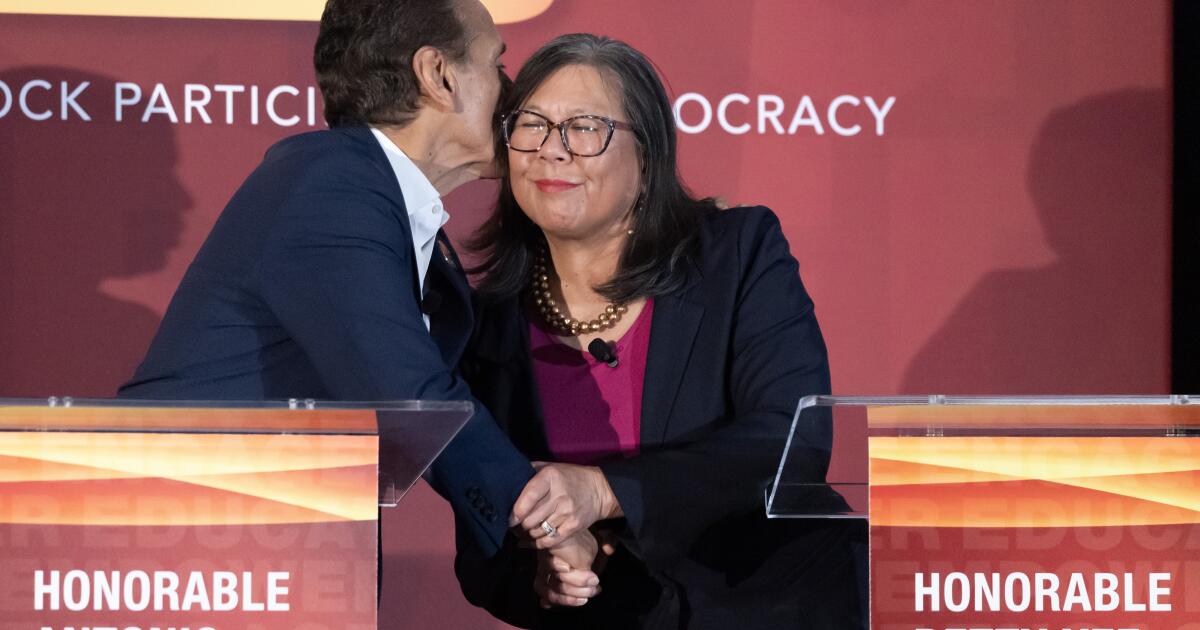
The former state controller has been running for California governor longer than just about anybody in the cheek-by-jowl field. And yet the Democrat is bumping along near the bottom, a blip in polls and a laggard in the money chase.
Beyond that, she said, it’s not as if anyone’s running away with the contest; most polls have shown the leading candidate — which depends on the survey — standing atop the pile with around 20% support.
“The public is still shopping,” Yee said. “In the next month or so, we’re going to try to get [a TV ad] on the air, basically make our case and hope that can spread as voters are getting more focused on the race.”
Which is not to say Yee is delusional.
“As a candidate, I make that assessment every day about whether we’re going to be viable or not,” she said last week, just before stopping by the Alameda County voter registrar‘s office to file paperwork for the June 2 primary.
“Right now, it’s less than a 50-50 chance,” Yee said, suggesting it’s her job to boost those odds by getting voters to appreciate what she offers, which amounts to unvarnished talk about the challenges facing the next governor and the ways Sacramento — which has been run for years by fellow Democrats — isn’t working.
“ ‘Accountability’ has kind of become a dirty word … where it’s about who we’re going to throw under the bus, rather than stepping back and saying, ‘What have we gotten for the dollars that we spend and, if we’re not getting those outcomes, how do we do better?’ ”
Yee served two terms as controller, in effect the state’s chief financial officer, and 10 years before that on the Board of Equalization, which oversees property tax assessments. She’s isn’t trying to buy the governorship, like billionaire Tom Steyer, or leverage her political celebrity, like cable-TV fixtures Katie Porter and Eric Swalwell. Instead, Yee is running a grassroots campaign, visiting nearly all 58 California counties and holding as many face-to-face meetings as humanly possible.
“I’m in the trenches,” she said. “I knock on doors every election cycle because to me, that’s the reality check of where people really are in terms of their lives.”
Which is certainly an admirable approach, albeit a rather idealistic strategy in a state of nearly 23 million voters, spread over roughly 800 miles from north to south. It would take more than two years of round-the-clock campaigning just to give each and every one a quick handshake.
The most notable feature of Yee’s candidacy is her message. She’s not selling barn-burning populism or viral take-downs of President Trump — “I don’t have any gimmicks, I don’t swear, I don’t have a reality-TV show personality” — but rather practical know-how and a deep understanding of state government.
It’s almost quaint in today’s theatrical political environment.
Seated at a sidewalk table outside a coffee stand in downtown Oakland, Yee focused on California’s stretched-thin budget, which happens to be her area of expertise.
“People ask what would you do in your first days as governor, if you have the privilege of serving,” Yee said, as her butterscotch latte sat cooling. “I’d come clean with the voters about where we are fiscally.”
After years of surpluses, she said, the state is spending more than it can afford. Facing a structural deficit, the next governor will have to cut programs and raise taxes, not just one or the other, with corporations and California’s richest residents being forced to cough up more. (She’s dubious, however, of a proposed November ballot measure imposing a one-time 5% tax on billionaires, questioning whether it would stand up in court.)
Sacramento’s credibility, Yee suggested, is on the line.
Before any expansive new programs can be implemented — and she has some notions for how to make life more affordable, increase access to healthcare and create jobs — Californians have to be convinced their tax dollars are being well spent and delivering proven results. “I would really insist on and invite stricter accountability of what we do with our money,” Yee said.
She’s not beyond criticizing the current administration.
“I mean, I’ve been termed out as controller since January 2023. I still get calls from companies in the [European Union], Canada, even Mexico about how we want to do business with California. Who do we talk to?” Yee said. “So I’ll send them over to the governor’s Office of Business Development and they tell me, ‘Well, we try to call people, but nobody’s answering our call.’ ”
(In response, a spokesman for the Office of Business and Economic Development touted California as “a premier hub for international business” and described foreign trade and investment as major drivers of the state economy.)
As for Gov. Gavin Newsom, while she supports his teenaged trolling of Trump, she said it shouldn’t be done through official channels, , or on the taxpayers’ dime.
“We have to focus on making the state work,” Yee said, “and that’s where I’m more focused on because people … want service delivery. They want government to be responsive to their needs. Somebody just pick up the damn phone on the other line to help them.”
Tough medicine, as she described it, and “stabilization” — which is “kind of my theme” — won’t make a great many hearts go pit-a-pat. But Yee hopes that straight talk and her distinct lack of ornamentation will count for something with California voters.
“The climate now is that people are very drawn by the performative approaches,” she said. “However, I think that will change. I want to give [voters] credit, because I do think they are very discerning when they’re ready to mark their ballot.”
The coming weeks will test that premise. And Yee is staying put.