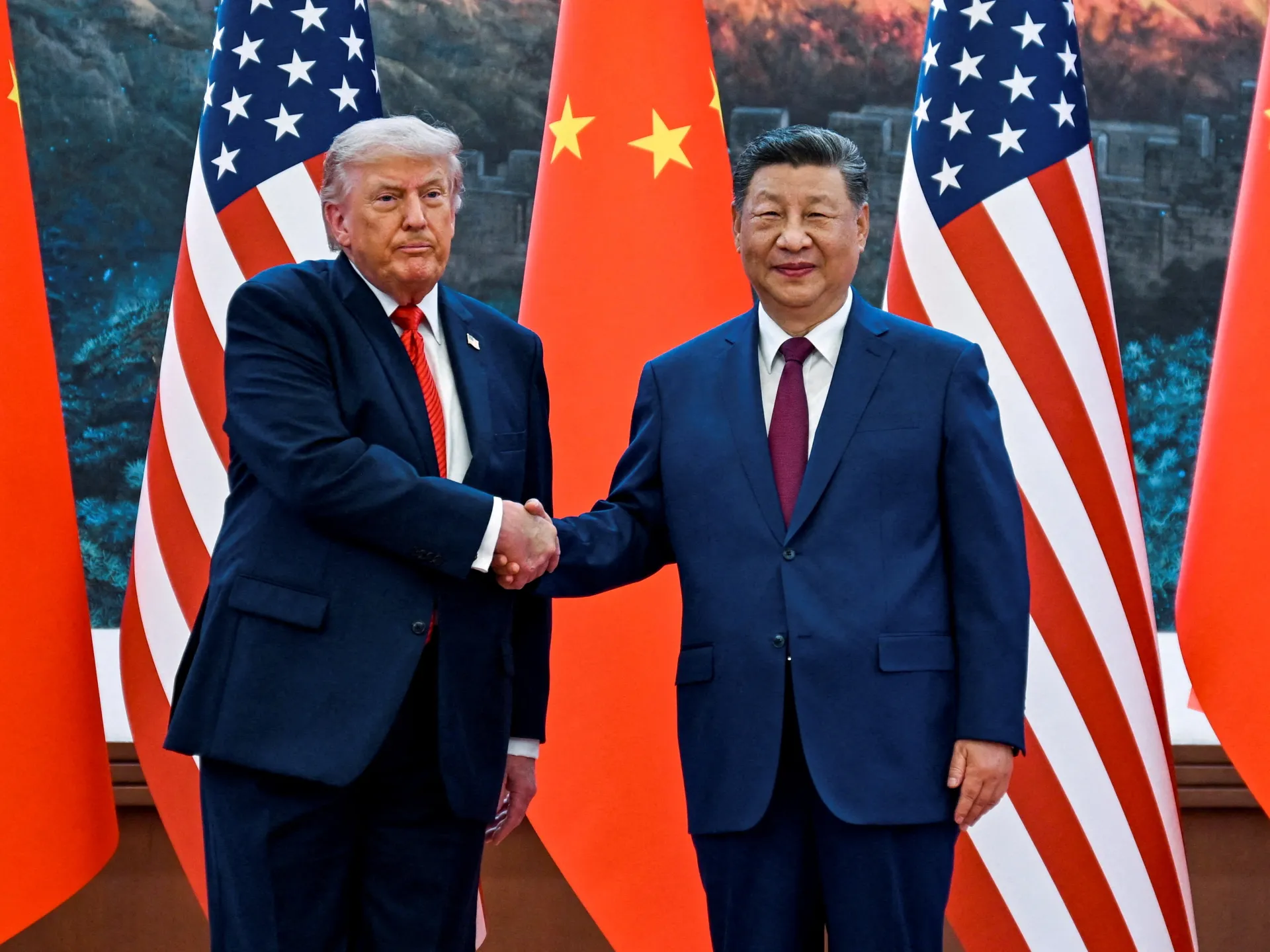
The United States wants a new “notification mechanism” with China to warn each other when an artificial intelligence incident becomes serious enough to threaten national security.
The proposal, effectively an “AI hotline”, was discussed on Sunday during talks in New York between US Treasury Secretary Scott Bessent and Chinese Vice Premier He Lifeng, ahead of a summit between US President Donald Trump and Chinese President Xi Jinping in Washington this week.
Recommended Stories
list of 3 itemsend of list
The two leaders are expected to consider establishing a broader US-China dialogue on AI, including the proposed notification system, around which details remain limited.
The initiative comes amid an intensifying contest for AI supremacy between the world’s top two economies, together with increasing warnings from tech giants that guardrails are necessary around the ever-growing technology.
So, what do we know about this so-called hotline, and where is the AI battle between the US and China headed?
What did the US say about this mechanism?
US Treasury Secretary Bessent said Washington had proposed creating a US-China AI dialogue, with particular focus on national security and a notification system covering “common goals and common threats”.
“We think that, just like with any cross-border activity, that moving from opaque to more transparency between the number one and the number two AI powers in the world is very important,” Bessent told reporters after Sunday’s discussions.
Trump’s science and technology adviser Michael Kratsios told Fox News on Sunday that the “key thing” Washington wants to discuss is “avoiding shared risks”.
Exactly what would trigger a notification has not been publicly revealed.
“The US and China absolutely need to be able to share information with each other as threats evolve. This seems like an obvious win for both sides,” Scott Singer, co-director of the China AI Initiative at the Carnegie Endowment for International Peace, told Al Jazeera.
“The relationship needs guardrails to keep citizens of both countries safe, and this is a productive first step.”
How did China respond?
Beijing has so far said very little.
China’s official Xinhua news agency acknowledged that He and Bessent discussed issues related to AI, but did not say whether Beijing had accepted Washington’s proposed notification mechanism.
Xinhua said the officials held “frank, in-depth and constructive exchanges” on economic and trade issues.
He and China’s chief trade negotiator Li Chenggang left Sunday’s talks without speaking to reporters.
What other ‘hotlines’ do the US and China have?
The proposed AI mechanism would not be the first time a special crisis channel was established between Washington and Beijing.
In 1997, former US President Bill Clinton and his then Chinese counterpart Jiang Zemin agreed to create a “direct secure telephone link” between their respective countries.
The two countries have had a military hotline since 2008, designed to allow senior defence officials to communicate during potentially dangerous incidents. It gives both sides 48 hours to respond, though US officials have complained that sometimes no one picks up.
After the US shot down a suspected Chinese surveillance balloon in 2023, then-US Defense Secretary Lloyd Austin sought a call with his Chinese counterpart, but Beijing declined the request.
Why now, and what concerns are there around AI?
Earlier this month, Anthropic’s CEO Dario Amodei warned in an essay that AI capabilities have been advancing rapidly, and he proposed pacing the development of frontier models to give governments and researchers more time to manage their risks.
“Given the accelerating rate of AI capability development, it’s my worry that in 6–12 months such a swarm could be capable of taking over the entire internet with a persistent botnet (potentially causing hundreds of billions of dollars in damage), and that the scale of damage would continue to increase from there if AI becomes more powerful without the necessary guardrails,” he wrote.
His assertions were endorsed by his rivals – OpenAI CEO Sam Altman and SpaceX founder and Tesla CEO Elon Musk.
Meanwhile, Trump has repeatedly argued that the US must maintain its advantage over China and has resisted calls from technology executives for a slowdown in AI development. He has said that “whoever wins AI, wins”.
Carnegie Endowment’s Singer does not expect the “fierce competition for AI to slow down”.
“It has the potential to confer tremendous economic and strategic advantage to both countries. But even competitors can find space to cooperate,” he noted.
“Competition and cooperation can coexist. The key for right now is for both sides to act in their own self-interest. Finding some basic areas for cooperation flows very naturally from that.”
Where is the US-China AI war headed?
The US remains ahead in several of the most important features of the AI race, but China has been closing the gap.
American companies continue to dominate private investment and production of leading AI models. According to Stanford University’s 2026 AI Index Report, US companies invested $285.9bn in AI in 2025, compared with $12.4bn in China.
The US also has an advantage in the most advanced semiconductors needed to train cutting-edge models.
However, Chinese companies have demonstrated that they can produce resilient AI models despite US restrictions on their access to the most advanced AI chips.
In January, the release of Chinese AI startup DeepSeek made headlines after it was built using only a fraction of the money its competitors had spent on their own AI programmes. Share prices of US tech companies plummeted.
China possesses advantages in other areas of the AI supply chain, most notably in the production of critical rare earth minerals used in advanced technology and in generating more than twice as much electricity as the US, giving it access to the huge amounts of relatively cheap power needed to operate AI data centres.
What is the Xi-Trump summit about?
Xi’s state visit to the US will take place from Wednesday to Friday, with Trump expected to welcome him at Joint Base Andrews in Maryland.
Trump has said he expects to discuss “almost everything” with the Chinese leader.
Trade remains a central issue, with Beijing and Washington having yet to reach a lasting settlement on tariffs, which have dominated Trump’s relationship with China in his second term as president.
Last month, Trump’s White House accused dozens of countries of helping China to illegally bypass US tariffs.
Meanwhile, the US Congress last week passed a bill that gives Trump sweeping powers to impose sanctions on Russia’s crude exports as well as steep tariffs on buyers of Russian energy, a measure that will impact Moscow’s biggest customers, China and India.
Trump’s war with Iran is also expected to feature. Beijing ranks among Iran’s key economic allies, purchasing a large share of Tehran’s oil exports and attempting to broker an end to the near seven-month-old US-Israel war on Iran.
Other long-standing disputes hang over the summit, including China’s dominance of rare-earth supplies and Taiwan.
The US AI proposal could represent a rare area where the two rivals may find a way to hammer out a deal, experts say.
“I think establishing a permanent channel exclusively focused on AI would genuinely be a major victory. AI has been caught up in the broader ebbs and flows of the US-China relationship, and the 2024 dialogue failed because frontier AI risks got mixed in with other issues,” Singer said.
“This time looks like it might be different, and having an AI risk channel is a necessary precondition to mutually beneficial cooperation.”