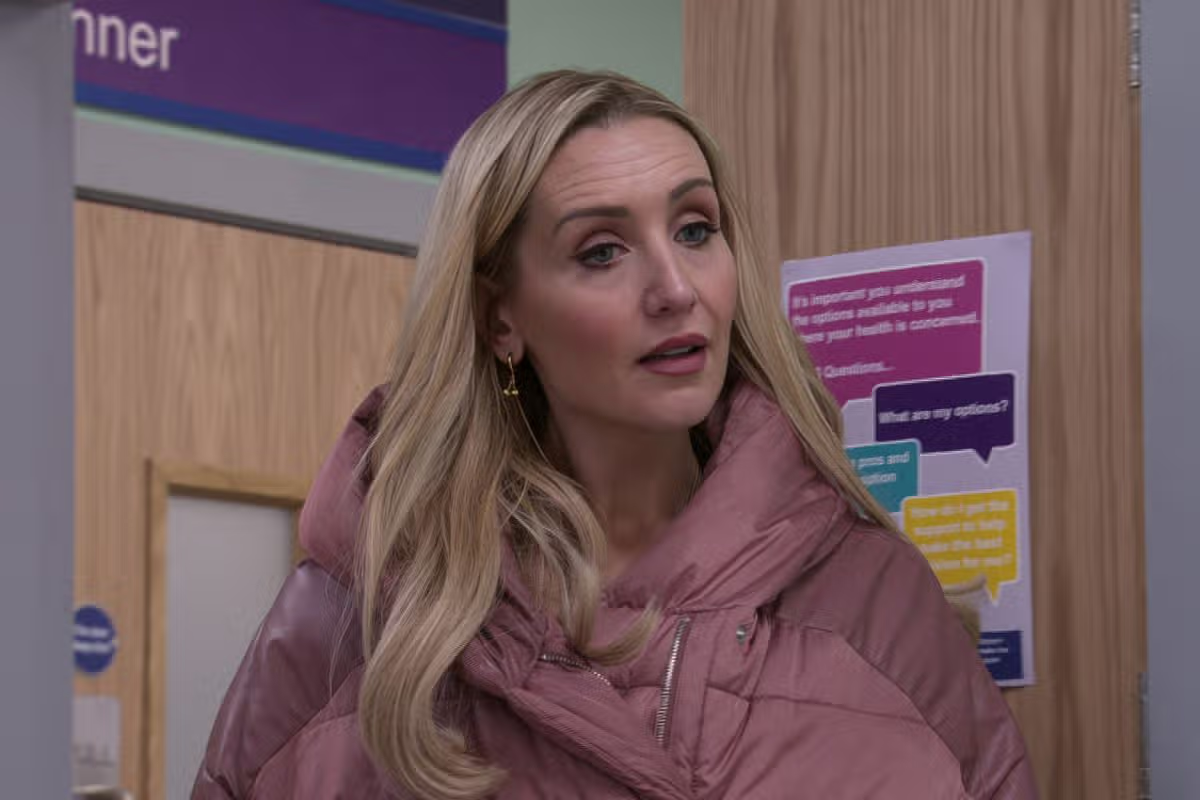
Coronation Street’s Eva Price actress Catherine Tyldesley has confirmed if Eva Price survives her attack by Sam Blakeman, while teasing some mystery new plots on the way

Coronation Street’s Eva Price actress Catherine Tyldesley has confirmed if Eva Price survives (Image: ITV)
Eva Price’s fate has been confirmed by one Coronation Street star.
With the character feared to be leaving after Sam Blakeman left her to die, actress Catherine Tyldesley, who plays her, appeared to confirm if she dies or not. Speaking to the Mirror and other press, the star told us about things coming up, and the fallout of Sam’s attack.
She teased events for the families involved, and even hinted at some worrying future storylines. This seems to confirm that Eva does not die, and will survive the attack.
Teasing the fallout and whether Eva can support Sam, given his mental health struggles, Catherine said: “What happened really scared her, and once she’s out of hospital, she’s genuinely in a lot of pain. She she’s kind of 50/50 initially, but very much appreciates the fact as well that it takes a while for certain medications to kick in with certain patients that are in the same position as Sam, and she fully understands that.
“In her eyes, she wants to take a step back briefly while she recovers, and hopefully Sam adjusts to his medication, and then her first thing will then be to get the family back together because that that is always at the forefront of her mind.
“She can’t stand any arguing. That’s always her first objective, to keep the family tight.” Catherine wasn’t expecting the attacker to be Sam. She said: “I was really surprised initially.
“But because of where Sam is at and because of his storyline, once I’d read the script, I was like, ‘Ah, okay, this makes a lot more sense’. Eva takes mental health very seriously, after what happened with Aidan.
“That that was the first time she’d come across a situation like that, and the first time that suicide had affected her. And since then, I think it’s really opened her eyes up to how important mental health is.
“It’s a difficult juggle for her because she’s got a family to protect. She doesn’t want to feel scared, but at the same time she feels deeply sorry for Sam, and she just wants him to get better. So it’s finding that balance that trust again, I suppose.”
It seems there could be some big scenes ahead for the Driscoll family too, or perhaps the wider family including Eva’s sister Leanne and Toyah. Catherine didn’t specify who would be involved, but it came after questions about Sam, and Eva’s relationship with Leanne and Toyah.
She teased: “I think we’ve got a few mountains to climb. There’s a couple of storylines coming up with the family at the forefront, and if Eva thinks her family is in any kind of jeopardy, which they certainly are, she turns into mafia wife style.
“She will do anything to defend her family, and that’s what I love about her. It’s my belief that if she had to kill for her kids, if she was pushed that far, she would. I think it’s an interesting part of her personality. She’s a very, very strong character.”
Coronation Street airs weeknights at 8:30pm on ITV1 and ITV X. * Follow Mirror Celebs and TV on TikTok , Snapchat , Instagram , Twitter , Facebook , YouTube and Threads .