jayden maiava

Lincoln Riley wants to see USC’s Jayden Maiava run the ball more

Over his years molding the minds of star passers, Lincoln Riley has coached college quarterbacks through innumerable questions that come up while playing the position. And in his experience, few are as tough as telling a quarterback when — or when not — to take off.

“It’s a split-second decision,” the USC coach says. “There’s oftentimes opportunities where you could do both.”

For his current quarterback, Jayden Maiava, that decision has been a source of consternation this season to those watching and wondering how a previously mobile passer suddenly turned so statuesque. As the Trojans take on Maryland on Saturday and Maiava suits up for what’s likely his last game at the Coliseum, it feels like one final hurdle for the senior quarterback.

“It’s something we’re continuing to push him to be able to do,” said Riley, when asked about Maiava running more. “Because when defenses have to defend that, it does change the way that the game is played and it can certainly take some stress off of the offense.”

That element of Riley’s offense has clearly been missing. Maiava has minus-71 yards rushing through 10 games. He has carried the ball just 13 times, not counting sacks (of which he’s also taken 13). That’s 26 fewer designed carries and scrambles than last season, when he rushed for 157 yards and six touchdowns. It’s even seven fewer than Maiava had as a sophomore at USC, when he only started the final four games.

By comparison, his predecessor, Caleb Williams, ran the ball 113 times during the 2022 season and 97 times in 2023. At Oklahoma, Riley’s quarterbacks often ran even more than that. Kyler Murray had 140 rushes in his Heisman-winning season. Jalen Hurts, meanwhile, had 233 carries in 2019. Both finished with more than 1,000 rushing yards.

The only time a Riley-coached quarterback has had fewer scrambles than this version of Maiava was with Miller Moss in 2024.

Why Maiava has run so much less isn’t entirely clear, considering his past profile. Riley blamed himself for that, for not putting his quarterback in as many designed opportunities to run.

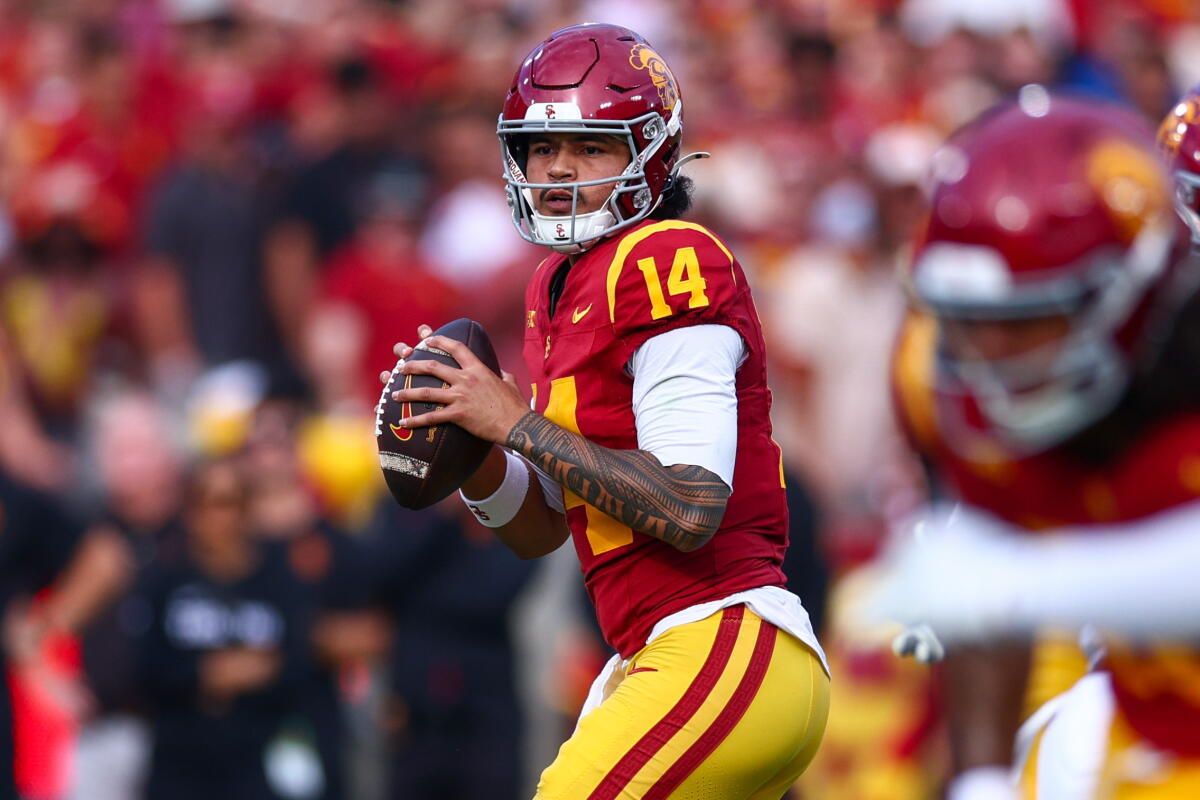
USC quarterback Jayden Maiava looks to pass against Oregon at the Coliseum on Sept. 26.

USC quarterback Jayden Maiava looks to pass against Oregon at the Coliseum on Sept. 26.

(Ronaldo Bolanos / Los Angeles Times)

The coach also suggested that his quarterback was perhaps so comfortable in USC’s offense that “he knows exactly where the ball needs to go” and was thus less likely to take off.

Riley said in September that he believed, during their time together, that Maiava had improved more than any other quarterback he’d ever worked with. But over the back half of his senior season, Maiava hasn’t exactly looked comfortable at the helm of the Trojans’ offense. He’s thrown five interceptions to three touchdowns over his past three games and has struggled with his presence in the pocket.

That’s not what USC hoped it would be getting from Maiava, who has been under Riley’s tutelage longer than any of his other starting quarterbacks. Maiava has thrown far less downfield — 43 passes of 20-plus yards this season, compared to 76 last year — and been far less effective when he does. He’s also struggled more against the blitz, completing just 35.6% of his passes under pressure in 2026, compared to 42% a season ago.

After his most recent performance — a 311-yard, three-interception showing in a loss to Indiana — Maiava said he “let my team down.”

The Trojans’ quarterback hasn’t held back with his own self-criticism. He called it “second nature.”

“I just love to compete,” Maiava said. “It happens, regardless of whether I think about it or not.”

USC will need its quarterback to keep his confidence if it hopes to finish strong — and perhaps save Riley’s job. Maryland is just 4-6, but has won two in a row since firing its coach, including a win over Wisconsin, which beat USC last month. After that awaits one of the more consequential crosstown rivalries in recent memory, as USC heads to the Rose Bowl to face No. 4 UCLA.

“It’s just about being able to flush it and move onto the next,” Maiava said.

The question, with only scant hopes of USC still making the College Football Playoff, is whether the Trojans are actually capable of putting last week’s loss behind them.

That starts with the quarterback.

“Definitely finishing strong here is front and center in his mind,” Riley said of Maiava. “He’s one of the reasons we all want to end this thing the right way.
Source link

USC offensive line transforms into one of Trojans’ biggest assets

It was a potential nightmare scenario. Starting left tackle, Elijah Paige, had been scratched in pregame warm-ups at Penn State. And in his place stepped a true freshman in his first start at USC, forced to find his way in a White Out, surrounded by a hostile crowd of 114,000 strong.

But when Vlad Dyakonov learned he was stepping in, a couple of hours ahead of kickoff, his coaches were surprised by how little it seemed to faze him.

“Some of us [coaches] were like, ‘Does he realize what he’s getting himself into?’” coach Lincoln Riley said, with a grin. “He didn’t flinch, man.”

You could say the same, generally, about USC’s entire front through the first half of this season. After years of shallow depth, unfortunate injuries, and transfer misfires at the position, USC’s offensive line has been the stabilizing force propelling its high-powered attack to a 6-1 record.

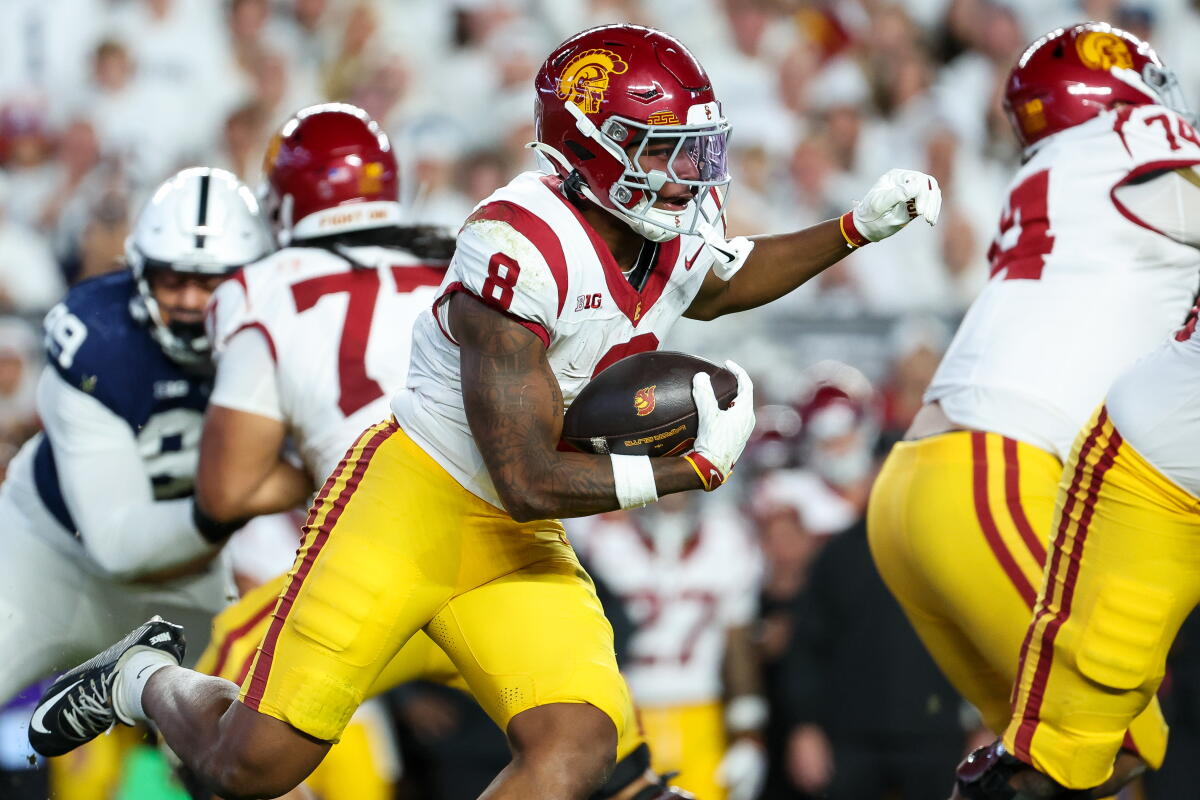
USC running back King Miller carries the ball as the offensive line blocks during a win at Penn State on Oct. 10.

USC running back King Miller carries the ball as the offensive line blocks during a win at Penn State on Oct. 10.

(Isaiah Vazquez / Getty Images)

That’s a testament primarily to offensive line coach Zach Hanson, who, in his fifth season, has now fully rebuilt the room in his image.

“He’s a very steady guy,” Riley said of Hanson. “He’s not a guy who fluctuates a lot day to day, so our players kind of feed off of that. There’s a steadiness to our group.”

USC is also entering the brutal back half of its schedule with that group as healthy as it has been all season. As the Trojans take to the road Saturday looking to build momentum off the big win over Penn State and subsequent bye week, they’ll have all five starters available along the offensive line against Wisconsin. Paige is set to return, as is left guard Hayden Treter, who missed the last two games.

It comes at an ideal time, considering the pass rusher they’ll have to contend with Saturday. The Badgers have just eight sacks as a defense this season, but boast one of the best pass rushers in the Big Ten, senior Sebastian Cheeks. Cheeks leads the conference with 28 quarterback pressures.

Few teams, though, have been better than USC through seven games at protecting the quarterback. The Trojans’ starting offensive line has only given up one more combined pressure (29) than Cheeks has accumulated himself this season, while only allowing seven sacks in seven games.

“We’re a unit,” center Tobias Raymond said. “So everyone is feeding off each other.”

USC offensive lineman Elijah Paige blocks during a game against Oregon at the Coliseum on Sept. 26.

USC offensive lineman Elijah Paige blocks during a game against Oregon at the Coliseum on Sept. 26.

(Ben Liebenberg / Getty Images)

With Cheeks and a handful of other fearsome pass rushers approaching on USC’s upcoming Big Ten slate, right tackle Justin Tauanuu said the Trojans used the bye week to get back to the basics up front.

“Going against great players like that, you have to go back to fundamentals,” Tauanuu said. “Fundamentals will triumph over everything else.”

USC hasn’t looked like a line in need of much instruction this season. Jayden Maiava has faced pressure on just over 20% over his dropbacks, which ranks 10th among all quarterbacks nationally. It’s also a considerably lower rate of pressure than any USC quarterback has faced in recent years. The previous low, under Riley, was 30.5% with Miller Moss at quarterback in 2024.

Part of that success is Maiava’s penchant for getting rid of the ball quickly. But his protection has certainly been a critical aspect of his success this season. Because when pressure has managed to reach him, the USC senior has been much less effective as a passer. According to Pro Football Focus, Maiava has a completion rate of just 39% under pressure versus 79% when he has a clean pocket.

Blitzes also haven’t bothered USC’s passing attack much, either. Another product of the line’s impressive performance to date. Maiava has essentially had the same amount of time to throw when blitzed (2.7 seconds) versus when not blitzed (2.78 seconds).

Creating room in the run game has been a different story. USC has been considerably less effective on the ground this season than in recent years — a fact that Riley said was front of mind during the bye. The Trojans rank ninth in the Big Ten in rush yards per attempt (4.33) and 10th in rush plays of 20-plus yards (5).

“We definitely can run the ball better,” Riley said. “We’re gonna need to run the ball better. Good is not good enough for us.”

As a whole, though, it’s hard to imagine USC being in a better place up front this season. Especially considering where the position stood at the start of Riley’s tenure. The coach tried, at first, to build the room through the transfer portal and saw mixed results. After that, injuries ravaged an otherwise thin room.

But now the depth Hanson has built over the past few years is paying off. USC has already weathered injuries, including a season-ending injury to last year’s starting center, Kilian O’Connor. Meanwhile, several highly touted linemen are still currently buried on the depth chart, among them five-star freshman Keenyi Pepe, whose progression Riley said has been impressive.

“If you just kind of look at the makeup of it, we don’t have transfers,” Riley said. “We have a lot of guys who were kind of homegrown in this program. We have a good healthy young group. Zach has obviously had a big role in putting that whole group together.”

Source link